Agoracom Blog Home

Posts Tagged ‘#silver’

Dollar Weakness Could Be the Catalyst Commodities Are Looking For SPONSOR: Affinity Metals $AAF.ca $SII.ca $TUD.ca $GTT.ca $AMK.ca $OSK.ca

Posted by AGORACOM at 3:57 PM on Tuesday, January 14th, 2020

Sponsor: Affinity Metals (TSX-V: AFF) a Canadian mineral exploration company building a strong portfolio of mineral projects in North America. The Corporation’s flagship property is the Drill ready Regal Property near Revelstoke, BC. Recent sampling encountered bonanza grade silver, zinc, and lead with many samples reaching assay over-limits. Further assaying of over-limits has been initiated, results will be reported once received. Click Here for More Info

By: Frank E. Holmes, Chairman/CEO/CIO of U.S. Global Investors, Inc.,

 — Published: Tuesday, 14 January 2020 | 
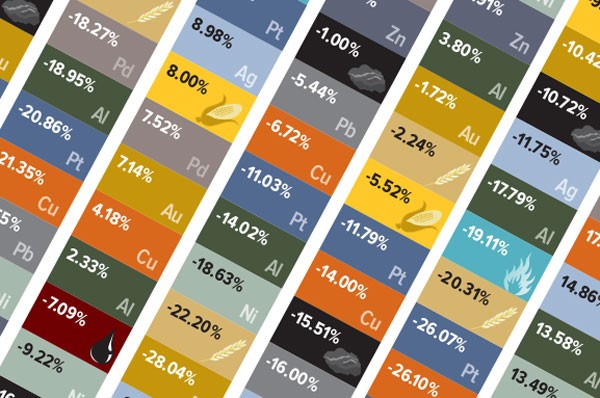
Near the start of every year, I share our ever-popular Periodic Table of Commodity Returns, now updated to reflect the final results of 2019. To view the interactive table and download a copy of your own, click here.  

  • Having broken above $2,000 an ounce last week, palladium in now forecast by Citi analysts to hit $2,500 by the middle of this year.

Commodities as a whole had a mostly positive 2019, returning 16.53 percent as measured by the S&P GSCI. This far surpasses commodities’ five-year average return of about negative 11.52 percent, between 2014 and 2018.

Precious metals were responsible for much of the growth. For the third straight year, and for the fourth time in six years, palladium was the top-performing commodity. The metal, used widely in the production of catalytic converters, increased an incredible 54.21 percent to end 2019 at $1,912 an ounce, a slightly higher price than gold’s all-time high set in September 2011.

As was the case in past years, palladium benefited from mounting global demand to curb emissions from gasoline-burning engines. It’s also among the world’s scarcest precious metals, mined primarily in Russia and South Africa, which means supply will potentially remain in deficit for years to come.

Having broken above $2,000 an ounce last week, palladium in now forecast by Citi analysts to hit $2,500 by the middle of this year.

Gold Price Up in Four out of Every Five Years

Gold, meanwhile, had its best year since 2010, climbing as much as 18.31 percent. The yellow metal’s role as an exceptional store of value shined brightly in the second half of the year when the pool of negative-yielding debt around the world began to skyrocket, eventually topping out at around $17 trillion in August. On the news last week that Iran launched a counterstrike against U.S.-occupied military bases in Iraq, the safe haven briefly broke above $1,600 an ounce for the first time since April 2013.    

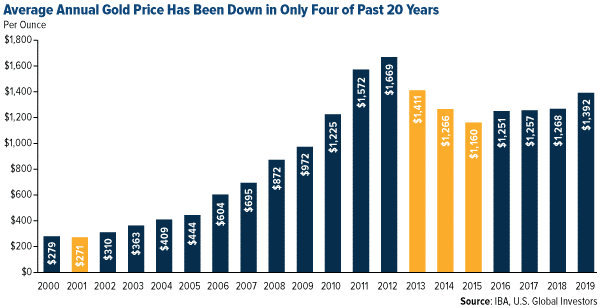
In the past two decades, gold has helped investors limit market volatility and portfolio losses. Between 2000 and 2019, the precious metal’s average annual price was down in only four years. Put another way, gold was up on average in four out of every five years—a remarkable track record.
Safe haven-seeking investors around the world piled into gold-backed ETFs in 2019, making it the best year on record for gold holdings. Assets under management (AUM) in gold bullion ETFs expanded 37 percent from the previous year, adding $19.2 billion, or 400 tonnes, according to the World Gold Council (WGC). During the fourth quarter, total holdings hit a jaw-dropping 2,900 tonnes, the equivalent of 102 million ounces, which is the most on record.
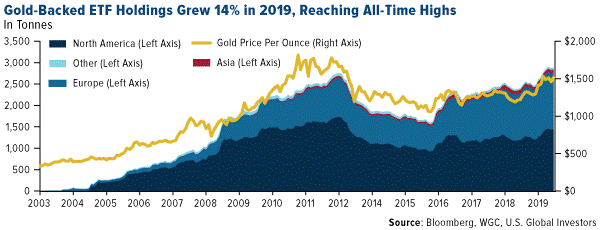
As of the end of last week, gold looked slightly overbought on a relative strength basis, meaning a correction wouldn’t be such a bad thing and in fact expected.

Has the Greenback Peaked?

Short of escalating tensions in the Middle East or a pullback in stocks, the catalyst for higher gold prices—and, indeed, commodity prices in general—may very well be a substantial weakening of the U.S. dollar. On Tuesday, the U.S. Dollar Index experienced a “death cross,” a bearish signal that takes places when an asset’s 50-day moving average crosses below its 200-day moving average. We haven’t seen this from the greenback since May 2017.
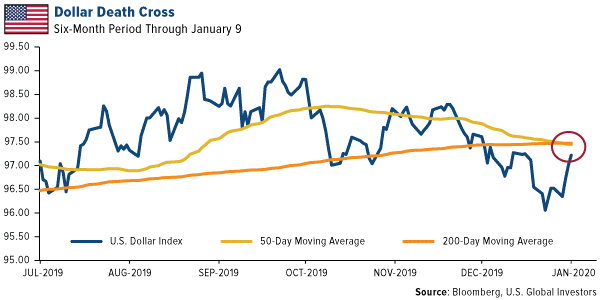
Other firms and analysts have recently made the case that the dollar is ready to decline in 2020, which would give gold and other hard assets the room to gain momentum. Below are just three such forecasts from the past couple of weeks:

“Our view is that the dollar is ready to decline in 2020 and will be encouraged to do so as negative interest rates abroad turn less negative while the Fed holds pat (or cuts)… In the event of an unlikely recession in 2020, U.S. fiscal and monetary policy will turn sharply expansionary, the dollar will decline further, and gold will do well.”

                ~Murenbeeld & Co., January 3

“We expect that U.S. dollar weakness will likely characterize global financial markets throughout 2020… A weaker dollar is always good news for commodity prices. We are particularly bullish gold at this point. Gold is a direct play on a weaker dollar and could also benefit from any major flare-up in geopolitical tensions.”

                ~Alpine Macro, January 6

“Starting 2020, the key setup from a macro perspective is the confirmed top in the U.S. Dollar Index as well as the U.S. Trade-Weighted Broad Dollar Index… The U.S. Dollar Index (DXY) has broken below the 97 support to trigger the bearish implication of the June-December topping pattern (head-and-shoulders top) and the U.S. Trade-Weighted Broad Dollar Index has broken below the early-November 2019 low as well as the 200-day moving average to confirm a similar topping pattern to the DXY.”

                ~CLSA, January 7

Bitcoin as a Safe Haven Asset

Gold isn’t the only asset that responded positively to geopolitical uncertainty involving Iran. The price of bitcoin, the world’s largest cryptocurrency by market cap, surged on the news that President Donald Trump had ordered a strike on Iranian general Qasem Soleimani, before commenting that the U.S. was targeting as many as 52 sites in Iran.
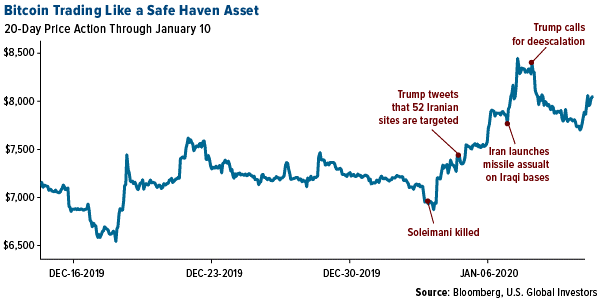
From January 2, the day before the strike, to January 8, when Trump announced that Iran appeared to be “standing down,” bitcoin traded up as much as 21 percent to its highest level in six weeks. In addition, there were reports that local bitcoin sellers in Iran were charging three times the market rate in response to the threat of war with the U.S.

Google searches for “bitcoin” were also up. Cointelegraph reports that the search term “bitcoin Iran” exploded more than 4,450 percent in the seven days through January 8.

All of this tells me that bitcoin continues to mature as an asset, and that investors and savers increasingly trust it as a store of value in times of uncertainty.

Looking for the inside scoop on mining companies? Click here to read U.S. Global Investors portfolio manager Ralph Aldis’ interview with MoneyShow and get his favorite mining picks for 2020!
Source: http://news.goldseek.com/USFunds/1579015085.php

SPONSOR: Affinity Metals $AAF.ca – 12-Year Breakout in Mining Stocks Relative to Gold $SII.ca $TUD.ca $GTT.ca $AMK.ca $OSK.ca

Posted by AGORACOM at 2:39 PM on Wednesday, January 8th, 2020

Sponsor: Affinity Metals (TSX-V: AFF) a Canadian mineral exploration company building a strong portfolio of mineral projects in North America. The Corporation’s flagship property is the Drill ready Regal Property near Revelstoke, BC. Recent sampling encountered bonanza grade silver, zinc, and lead with many samples reaching assay over-limits. Further assaying of over-limits has been initiated, results will be reported once received. Click Here for More Info

Excerpts from Crescat Capitals November Newsletter:

Precious Metals

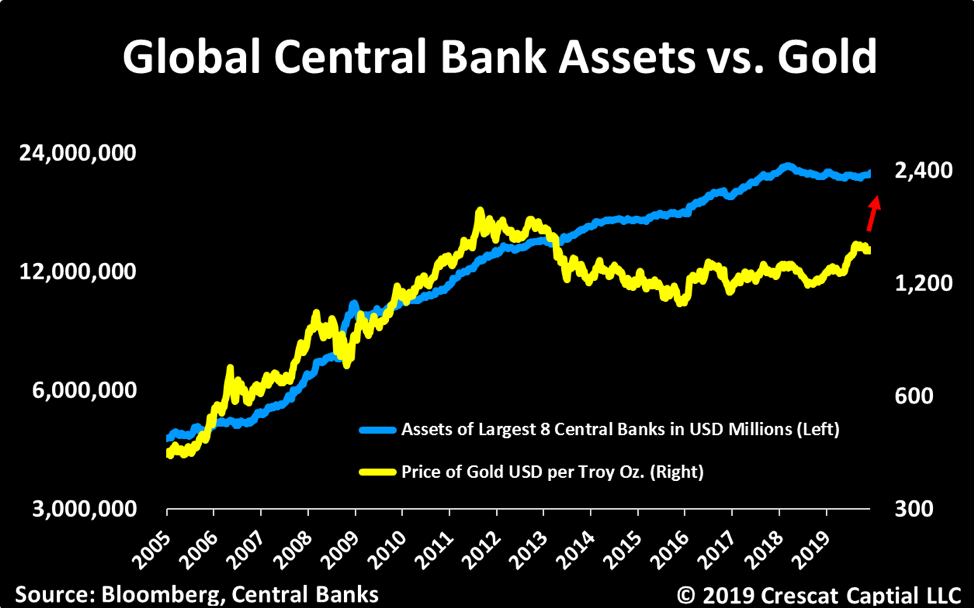
Precious metals are poised to benefit from what we consider to be the best macro set up we’ve seen in our careers. The stars are all aligning. We believe strongly that this time monetary policy will come at a cost. Look in the chart below at how the new wave of global money printing just initiated by the Fed in response to the Treasury market funding crisis is highly likely to pull depressed gold prices up with it.

The gold and silver mining industry endured a severe bear market from 2011 to 2015 and have formed a strong base over the last four years.

The imbalance between historically depressed commodity prices relative to record overvalued US stocks remains at the core of our macro views. On the long side, we believe strongly commodities offer tremendous upside potential on many fronts. Precious metals remain our favorite. We view gold as the ultimate haven asset to likely outperform in an environment of either a downturn in the business cycle, rising global currency wars, implosion of fiat currencies backed by record indebted government, or even a full-blown inflationary set up. These scenarios are all possible. Our base case is that governments and central banks will keep their pedals to the metal to attempt to fend off credit implosion or to mop up after one has already occurred until inflation becomes a persistent problem.

The gold and silver mining industry is precisely where we see one of the greatest ways to express this investment thesis. These stocks have been in a severe bear market from 2011 to 2015 and have been formed a strong base over the last four years. They are offer and incredibly attractive deep-value opportunity and appear to be just starting to break out this year. We have done a deep dive in this sector and met with over 40 different management teams this year. Combining that work with our proprietary equity models, we are finding some of the greatest free-cash-flow growth and value opportunities in the market today unrivaled by any other industry. We have also found undervalued high-quality exploration assets that will make excellent buyout candidates.

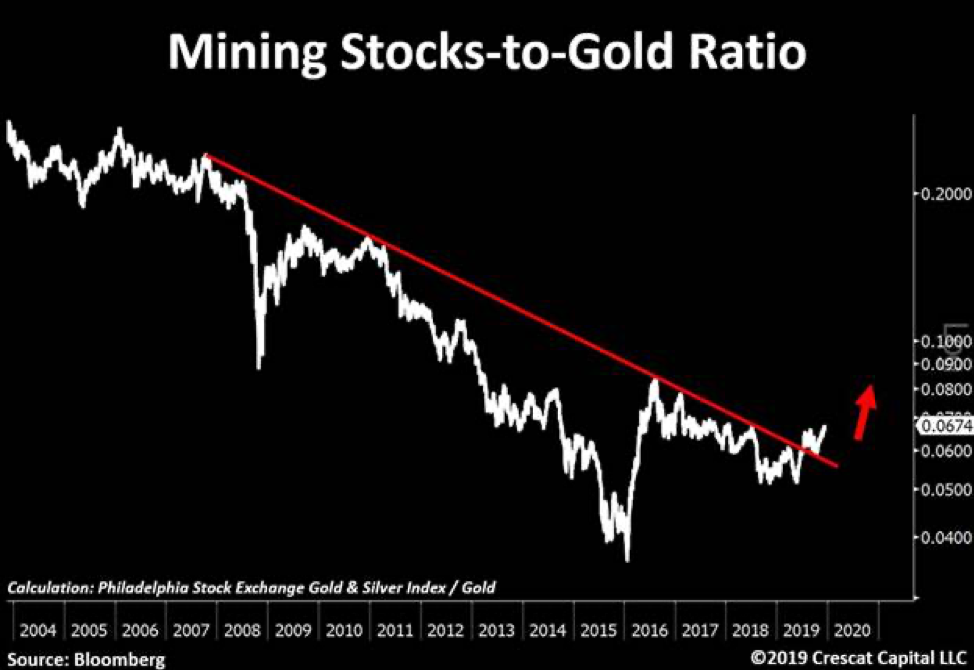
We recently point out this 12-year breakout in mining stocks relative to gold now looks as solid as a rock. In our view, this is just the beginning of a major bull market for this entire industry. We encourage investors to consider our new Crescat Precious Metals SMA strategy which is performing extremely well this year.

“This is just the beginning of a major bull market for this entire industry”

Zero Discounting for Inflation Risk Today

With historic Federal debt relative to GDP and large deficits into the future as far as the eye can see, if the global financial markets cannot absorb the increase in Treasury debt, the Fed will be forced to monetize it even more. The problem is that the Fed’s panic money printing at this point in the economic cycle may hasten the unwinding of the imbalances it is so desperate to maintain because it has perversely fed the last-gasp melt up of speculation in already record over-valued and extended equity and corporate credit markets. It is reminiscent of when the Fed injected emergency cash into the repo market at the peak of the tech bubble at the end of 1999 to fend off a potential Y2K computer glitch that led to that market and business cycle top.
After 40 years of declining inflation expectations in the US, there is a major disconnect today between portfolio positioning, valuation, and economic reality. Too much of the investment world is long the “risk parity” trade to one degree or another, long stocks paired with leveraged long bonds, a strategy that has back-tested great over the last 40 years, but one that would be a disaster in a secular rising inflation environment.

With historic Federal debt relative to GDP and large deficits into the future as far as the eye can see, rising long-term inflation, and the hidden tax thereon, is the default, bi-partisan plan for the US government’s future funding regardless of who is in the White House and Congress after the 2020 elections. The market could start discounting this sooner rather than later.
The Fed’s excessive money printing may only reinforce the unraveling of financial asset imbalances today as it leads to rising inflation expectations and thereby a sell-off in today’s highly over-valued long duration assets including Treasury bonds and US equities, particularly insanely overvalued growth stocks. We believe we are in the vicinity of a major US stock market and business cycle peak.

Source:”Running Hot”

Courtesy of Crescat Capital: https://www.crescat.net/running-hot/

Thanks to

Kevin C. Smith, CFA
Chief Investment Officer

Tavi Costa
Portfolio Manager

SPONSOR: Affinity Metals $AFF.ca – An Explosive Rally In Gold and the Key Levels to Watch $SII.ca $TUD.ca $GTT.ca $AMK.ca $OSK.ca $AOT.ca

Posted by AGORACOM at 1:21 PM on Friday, January 3rd, 2020

Sponsor: Affinity Metals (TSX-V: AFF) a Canadian mineral exploration company building a strong portfolio of mineral projects in North America. The Corporation’s flagship property is the Drill ready Regal Property near Revelstoke, BC. Recent sampling encountered bonanza grade silver, zinc, and lead with many samples reaching assay over-limits. Further assaying of over-limits has been initiated, results will be reported once received. Click Here for More Info

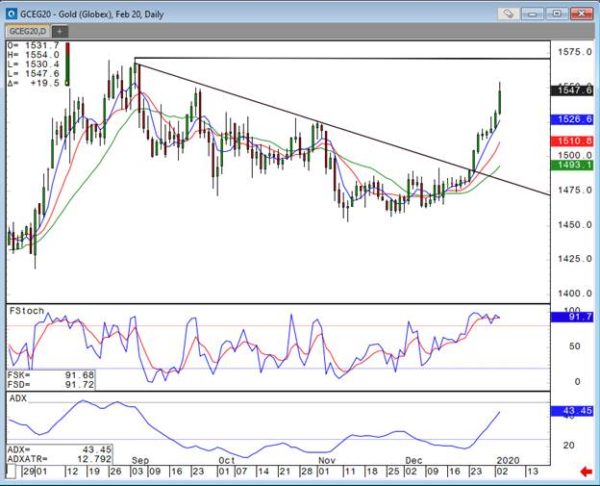
With an impressive start to the year this new heightened geopolitical development could be the catalyst to break out gold to multi year highs. The U.S. strike that killed a key Iranian general could have a ripple effect on the signing of the trade agreement on the 15th as China and Iran have recently worked together on joint military operations along with Russia. Any set back in the trade agreement would severely impact the direction of U.S. equities and the expectations for interest rate decisions globally. Price Analysis and Outlook The daily gold chart shows that momentum indicator slow stochastics are rising steadily and reaching overbought territory giving longer term indication that we have pushed into a Bull Market. While ADX, which measures strength of the trend, has turned up over 40 showing that the driving force behind the recent upward move is very strong. The 2 key levels of support to watch are the November 1st high of $1525.2 and the December 30th high of $1519.1. This should act as a consolidation level while a likely upside target completing this trend would be an objective of $1572

Source: https://www.kitco.com/commentaries/2020-01-03/An-Explosive-Rally-in-Gold-and-the-Key-Levels-to-Watch.html

American Creek $AMK.ca Announces the Discovery of a Copper-Silver Horizon Significantly Enriching the Grades at Treaty Creek Located in the Golden Triangle $TUD.ca $SII.ca $GTT.ca $AFF.ca $SEA.ca $SA $PVG.ca $AOT.ca

Posted by AGORACOM at 9:56 AM on Thursday, December 19th, 2019

American Creek Resources (TSXV: AMK) (OTC Pink: ACKRF) (the “Corporation” or “American Creek”) is pleased to announce its partner Tudor Gold has concluded the interpretation of a copper-silver mineralized zone, the ‘CS 600 Horizon’, within the Goldstorm Zone. Composite grades for drill holes GS19-42, 47, 48, 49, 52 and CB18-39 were re-calculated utilizing the copper and silver grades obtained from the 2019 drill-hole program. These holes are located in the northeastern-most area of the project. The copper and silver mineralization contributed greatly to increasing the gold equivalent content of all drill holes that cut the new copper-rich ‘CS 600 Horizon’.

  • The largest increase in gold equivalent content to the ‘300 Horizon’ was from GS19-42. The gold-only grade previously reported for the 370.5 m interval was 1.097 gpt Au. After adding the copper-silver mineralization, the gold metal equivalent content has increased to 1.275 gpt Au Eq over the same 370.5 metre interval. This was due mainly to the elevated silver grades.
  • Copper grades were very consistent within the ‘CS 600 Horizon’. Grades ranged from approximately 0.16% Cu to 0.34% Cu over intervals of 69m to 151.5m in holes GS19-42, 47, 48, 49 and 52. These intercepts led to the largest gold equivalent increases within the Goldstorm System.
  • Silver grades averaged as high as 10 gpt within both the ‘300 Horizon’ and the ‘CS 600 Horizon’ and the metal appears to occur throughout the entire Goldstorm System.

Vice President of Project Development, Ken Konkin P.Geo. comments: “The newly discovered copper-rich ‘CS 600 Horizon’ is a very important feature of the Goldstorm System. The presence of copper and silver mineralization gives this discovery a true polymetallic nature yet it remains a gold-dominant project. Copper grades appear to be increasing with depth within the ‘CS 600 Horizon’. In the following weeks our technical team will continue to examine the rest of the drill holes to re-compute the gold-equivalent grades to include copper and silver throughout the entire system.”

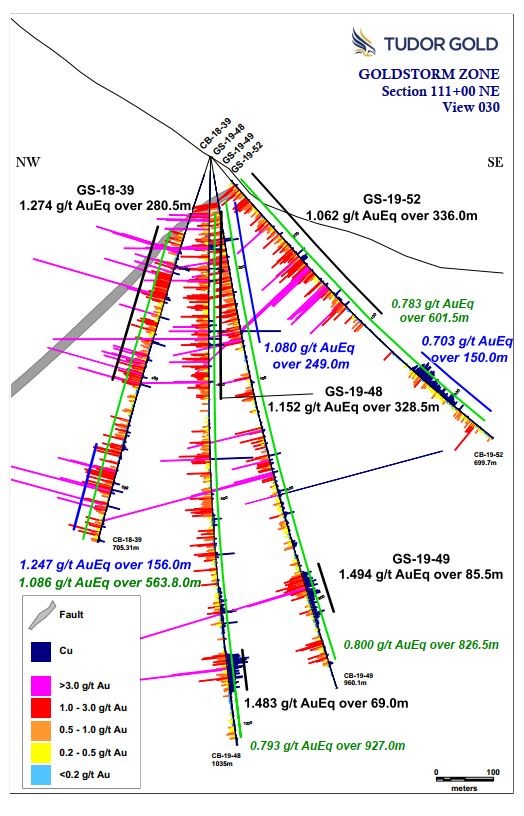
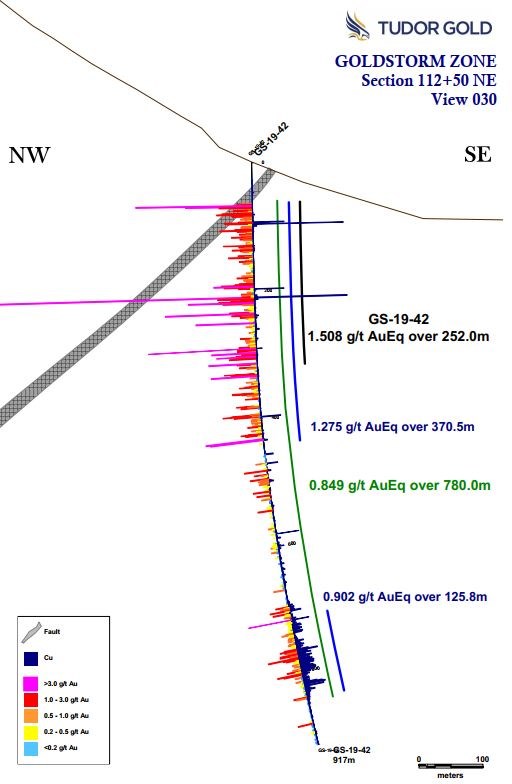
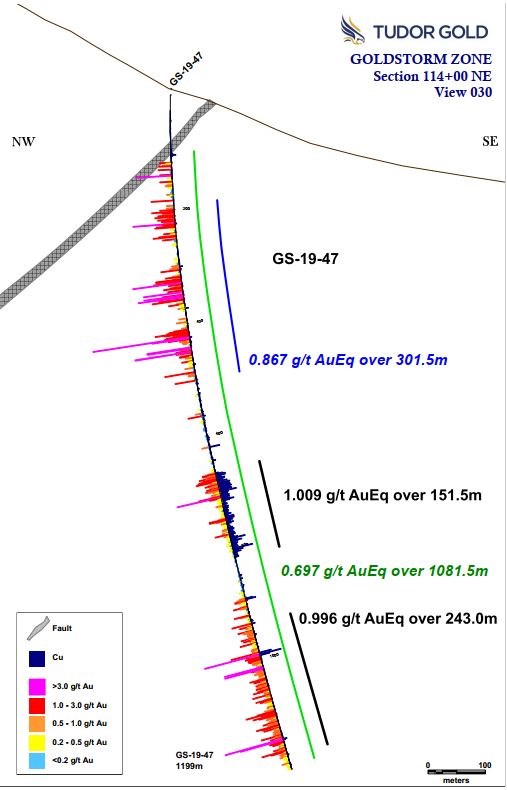
Table l provides gold equivalent composites from five drill holes completed on three sections that cut the ‘300 Horizon’ and the ‘CS 600 Horizon’ within the Goldstorm System. Although the sixth hole in this table (CB18-39) did not intersect the ‘CS 600 Horizon’, the Au Eq composite increased the grade of the intercept by over 11% within the ‘300 Horizon’. Sections attached demonstrate that the copper pulse is un-like the main gold mineralization within the ‘300 Horizon’ as the ‘CS 600 Horizon’ appears to be dipping sub-parallel to the main Treaty Thrust Fault (TTF1) shown in section 111+00 NE. The Company’s Press Release dated October 24th provides the drill collar data including drill hole location, elevation, inclination, azimuth and drill hole length.

Table l: Gold Equivalent Composites GS19-42, 47, 48, 49,52 and CB18-39

To view an enhanced version of Table I, please visit:
https://orders.newsfilecorp.com/files/682/50940_table1.jpg

* All assay grades are uncut and intervals reflect drilled intercept lengths. True widths of the mineralization have not been determined. HQ and NQ2 diameter core samples were sawn in half and typically sampled at standard 1.5m intervals.

**Prices used to calculate the AuEq metal content are: Gold $1322/oz, Ag: $15.91/oz, Cu: $2.86/lb. All metals are reported in USD and calculations do not consider metal recoveries.

The goal is to design a diamond drill hole program that will fast-track the exploration program for 2020 with the objective to begin the Mineral Resource Estimate work at the end of the 2020 field season. Tudor hopes to accomplish as much drilling needed to bring a Measured and Indicated Mineral Resource Estimate forward as quickly as possible.

Walter Storm, President and CEO, stated: “These new gold equivalents are extremely encouraging as our technical team continues to take positive steps advancing Tudor Gold’s flagship Treaty Creek Au-Ag-Cu project. During the following months our geologist and engineers will continue to work with the geological model and begin to prepare the diamond drill hole proposal for 2020 .”

Darren Blaney, President and CEO of American Creek, stated: “The Goldstorm deposit on Treaty Creek continues to amaze us. Its scale has grown exponentially over the last two years to close to a billion tonnes and these recent calculations are giving us a more accurate indication of the grades within the system. The focus has been on the 300 zone as it’s a gold enriched area just below the surface giving it great potential to be open pitted, and now we’re starting to see the tremendous potential at depth in the CS 600 zone. The Goldstorm is open at depth and to the north and east which is where these pulses of copper and silver are becoming more concentrated. With power and the highway only 20km down the valley, and the deposit increasing in size exponentially, the Goldstorm truly has the potential to be a world class deposit.”

The Treaty Creek Project is a Joint Venture with Tudor Gold owning 3/5th and acting as operator. American Creek and Teuton Resources each have a 1/5th interest in the project. American Creek and Teuton are both fully carried until such time as a Production Notice is issued, at which time they are required to contribute their respective 20% share of development costs. Until such time, Tudor is required to fund all exploration and development costs while both American Creek and Teuton have “free rides”.

The Treaty Creek Project lies in the same hydrothermal system as Pretium’s Brucejack mine and Seabridge’s KSM deposits with far better logistics.


Map 1

To view an enhanced version of Map 1, please visit:
https://orders.newsfilecorp.com/files/682/50940_90c505c404ac3984_002full.jpg

QA/QC

Drill core samples were prepared at MSA Labs’ Preparation Laboratory in Terrace, BC and assayed at MSA Labs’ Geochemical Laboratory in Langley, BC. Analytical accuracy and precision are monitored by the submission of blanks, certified standards and duplicate samples inserted at regular intervals into the sample stream by Tudor Gold personnel. MSA Laboratories quality system complies with the requirements for the International Standards ISO 17025 and ISO 9001. MSA Labs is independent of the Company.

Qualified Person

The Qualified Person for this news release for the purposes of National Instrument 43-101 is the Company’s Vice President of Project Development, Ken Konkin, P.Geo. He has read and approved the scientific and technical information that forms the basis for the disclosure contained in this news release.


Figure 1: Goldstorm Zone Section 111+00 NE

To view an enhanced version of Figure 1, please visit:
https://orders.newsfilecorp.com/files/682/50940_90c505c404ac3984_003full.jpg

Figure 2: Goldstorm Zone Section 112+50 NE

To view an enhanced version of Figure 2, please visit:
https://orders.newsfilecorp.com/files/682/50940_90c505c404ac3984_004full.jpg

Figure 3: Goldstorm Zone Section 114+00 NE

To view an enhanced version of Figure 3, please visit:
https://orders.newsfilecorp.com/files/682/50940_90c505c404ac3984_005full.jpg

About American Creek

American Creek is a Canadian junior mineral exploration company with a strong portfolio of gold and silver properties in British Columbia. Three of those properties are located in the prolific “Golden Triangle”; the Treaty Creek and Electrum joint venture projects with Tudor Gold/Walter Storm as well as the 100% owned past producing Dunwell Mine.

More information about the Treaty Creek Project can be found here: https://americancreek.com/index.php/projects/treaty-creek/home

An exploration program is ongoing on American Creek’s 100% owned Dunwell Mine property located near Stewart B.C.. More information can be found here: https://americancreek.com/index.php/projects/dunwell-mine

The Corporation also holds the Gold Hill, Austruck-Bonanza, Ample Goldmax, Silver Side, and Glitter King properties located in other prospective areas of the province.

For further information please contact Kelvin Burton at: Phone: 403 752-4040 or Email: [email protected]. Information relating to the Corporation is available on its website at www.americancreek.com

SPONSOR: Affinity Metals $AAF.ca – Central Banks’ Appetite For Gold Expected To Continue $SII.ca $TUD.ca $GTT.ca $AMK.ca $OSK.ca

Posted by AGORACOM at 11:45 AM on Wednesday, December 18th, 2019

Sponsor: Affinity Metals (TSX-V: AFF) a Canadian mineral exploration company building a strong portfolio of mineral projects in North America. The Corporation’s flagship property is the Drill ready Regal Property near Revelstoke, BC. Recent sampling encountered bonanza grade silver, zinc, and lead with many samples reaching assay over-limits. Further assaying of over-limits has been initiated, results will be reported once received. Click Here for More Info

Central bankers have been voracious buyers of gold during the last two years, and analysts look for that trend to continue in 2020.

Through the end of October, net official-sector purchases this year totaled 562 metric tons, reported Alistair Hewitt, director of market intelligence with the World Gold Council. That 56.2-tons-a-month average puts sales on pace to roughly match the 656 tons bought in 2018, which were the most central-bank purchases since 1967, according to WGC data.

“This year has been exceptionally strong. We think that next year, net buying will continue at a high level, even if it’s not as high as this year,” said Philip Newman, director of the London-based consultancy Metals Focus.

Goldman Sachs looks for global central banks to collectively acquire around 650 tons in 2020, while Standard Chartered is projecting central-bank purchases will total 525 tons.

“It’s still elevated,” said Suki Cooper, precious-metals analyst with Standard Chartered. “That is still firmly on the buy side.”

‘Safe, liquid and generates returns’

Hewitt commented that central banks are looking at three main criteria when deciding to expand the amount of gold they hold within their foreign-exchange reserves.

“For a central bank, gold is a fantastic asset because it’s safe, liquid and generates returns over the long term,” Hewitt said.

He also listed two more factors why the central-bank buying has suddenly jumped in recent years.

“One issue is we are seeing heightened geopolitical tensions,” Hewitt said, with these involving major gold-buying countries and economies. “Central banks are looking toward gold to balance some of that risk.

“We’ve also got negative rates and yields for a large number of sovereign bonds.”

Newman added that many central banks are “trying to get away” from the U.S. dollar. This is especially the case with Russia due to U.S. sanctions, he added.

As recently as 2017, most of the official-sector buying came from a handful of central banks, including Russia, Turkey and Kazakhstan. But in 2018 and 2019, there have been a slew, including some that had not been in the market for years.

“You’ve got a whole range of buyers,” Newman said.

The largest buyers during the first 10 months of the year were Turkey with 144.8 tons; Russia, 139; Poland, 100; and China, 95.8.

Others include Kazakhstan, 26.9 tons; India, 17.7; Qatar, 11; Ecuador, 10.6; Serbia and the U.K., 9.9; Argentina, 7; Colombia, 6.1; Kyrgyz Republic, 3.2; Mongolia, 2.3; Belarus, 1.9; Guinea, 0.9; Egypt and Mauritania, 0.7; Albania and Malta, 0.6; and Ukraine and Greece, 0.3.

Goldman Sachs projected that central-bank purchases could amount to as much as 22% of global supplies during 2019.

Central banks ‘buy for an extended period’

Hewitt looks for official-sector buying momentum to continue.

Central banks tend to put a lot of thought into decisions to buy – with a long, rigorous policy-making process — and purchase the metal for strategic reasons, rather than simply reacting to day-to-day moves in the price, Hewitt said.

“Once these people start buying, they continue to buy for an extended period of time,” Hewitt said. For instance, he pointed out that Kazakhstan has been a regular gold buyer since 2010.

“Both trade tensions and negative yields are still here,” Hewitt said. “They may rear their ugly heads again and become more pronounced, or they may fade away and become less pronounced. But those underlying forces will remain ever present in the market. Certainly in the next year or so, those two factors should continue to support and underpin central-bank demand for gold.”

Observers pointed out that not only have central-bank gold purchases been strong, but sales have been light. Back in 1999, when European central banks were selling the metal, they began following central-bank sales agreements to try to limit how much was sold in any one year and thereby keep this from being a destabilizing force in the gold market.

These agreements have been discontinued, Hewitt noted. Commerzbank analysts pointed out they were no longer necessary since hardly any European central banks are selling anyway. Germany’s central bank sells a modest amount each year only for its coin-minting program, Hewitt said.

“The market was not bothered by the central-bank gold agreement coming to an end, partly because the gold market is very different from what it was in 1999,” Hewitt said, adding that there “dramatic selling” back then.

“The gold market today is just more diverse, more resilient and more liquid. That’s why the market just shrugged its shoulder when the central-bank gold agreement came to an end.”

Further, analysts at Commerzbank, in their 2020 outlook, commented that one or more Western European central banks might even enter the market as a gold buyer.

“One possible candidate is the Dutch central bank (DNB), which in October published a remarkable statement about the role of gold on its website,” Commerzbank said. “In it, it described gold as an anchor of trust for the financial system. According to the DNB, gold reserves could serve as the basis for a new beginning in the event of a system collapse.

“If one or more Western central banks indeed started to actively buy gold, this would attract considerable attention and spark market reactions.”

SOURCE: https://www.kitco.com/news/2019-12-18/Central-banks-appetite-for-gold-expected-to-continue.html

Advance Gold $AAX.ca – 50-Year High In Central Bank Gold Purchases $FA.ca $ANG.jo $ABX.ca $NGT.ca $MGG.ca $TECK.ca

Posted by AGORACOM at 3:16 PM on Tuesday, December 10th, 2019

SPONSOR: Advance Gold AAX.v – Advance Gold controls 100% interest in the Tabasquena Silver Mine in Zacatecas, Mexico. A cluster of 30 Epithermal veins have been discovered, with recent emphasis on exploring a large anomaly to drill. Advance also owns 13.5% of the Kakamega JV attached to Barrick Takeover Offer for Acacia Mining. Click Here For More Info

Opportunities

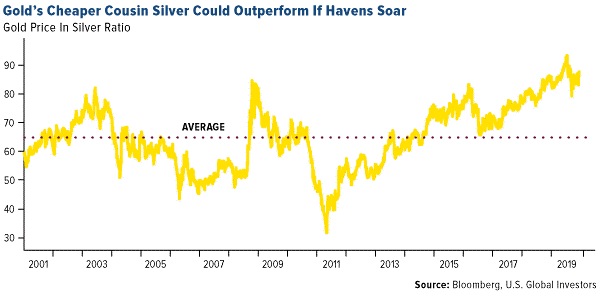
  • 2019 is on track to be a 50-year high in central banks’ net gold purchases. Bloomberg Intelligence reports that central banks have been absorbing about 20 percent of global gold mine supply. Based on the gold-to-silver ratio, it looks like silver might have more upside if demand for safe haven assets rises. Bloomberg’s Eddie van der Walt writes that the gold-silver ratio has dropped to 86 from 93 in July and that means silver has outperformed on the back of gold’s gains. UBS analyst Giovanni Staunovo is bullish on palladium and platinum. Staunovo wrote in a December 5 report that palladium will likely enter its ninth straight year of market deficit in 2020 and could climb above $2,000 an ounce. Even as platinum is set to enter a surplus, its price could be driven by gold. “As platinum is highly correlated to gold, our bullish view for gold should mean higher platinum prices, which we expect to trade at around $1,000 an ounce next year.”
  • Zijin Mining Group Co. has agreed to buy Continental Gold in a rare all-cash deal worth C$1.37 billion – the second big takeover in a few weeks of a junior Canadian gold miner. Bloomberg reports the offer reflects a 29 percent premium to the Continental Gold share price from the past 20 days and that major shareholder Newmont Goldcorp was supportive of the deal. In hostile M&A news, Centamin Plc rejected Endeavour Mining Corp.’s $1.9 billion takeover offer saying that it undervalues its assets, reports Bloomberg News. Centamin has been a takeover candidate since the size of its Egyptian mine was discovered at the start of the decade, though the company has faced many operational setbacks.
  • Kinross Gold has been busy raising cash. Kinross announced this week that it has agreed to sell its remaining shares of Lundin Gold for C$150 million to Newcrest Mining and the Lundin Family Trust. Kinross earlier announced that it has sold its royalty portfolio to Maverix Metals for $74 million.

Threats

  • ABN Amro strategist Georgette Boele says they see gold weakening in the coming weeks and months with a price average of $1,400 an ounce. However, they do expect prices to increase to $1,600 by December of 2020. Before this happens, extreme net-long positioning would clear u p because “these positions currently hang over the market and prevent prices from moving substantially higher.”
  • Another sign of a weakening economy was released last week. The ISM manufacturing PMI unexpectedly declined to 48.1 in November, below the median forecast of 49.2. The reading remains below the 50 level that indicates activity is shrinking.

Bloomberg’s Enda Curran writes that cheap borrowing costs have sent global debt to another record – $250 trillion of government, corporate and household debt. This level is almost three times global economic output and policymakers are now grappling with how to keep economies afloat – with more debt? According to Cornerstone Macro’s head of technical analysis Carter Worth, his S&P 500 chart signals a 5 to 8 percent decline in the coming months. Bloomberg reports that the S&P 500 fell 1.4 percent on Tuesday, pushing it below an upward trend line established in October.

SOURCE: https://www.gold-eagle.com/article/50-year-high-central-bank-gold-purchases

Affinity Metals $AAF.ca: Goldman Says Case for Diversifying into Gold ‘as Strong as Ever’ $SII.ca $TUD.ca $GTT.ca $AMK.ca $OSK.ca

Posted by AGORACOM at 6:41 PM on Monday, December 9th, 2019

Sponsor: Affinity Metals (TSX-V: AFF) a Canadian mineral exploration company building a strong portfolio of mineral projects in North America. The Corporation’s flagship property is the Drill ready Regal Property near Revelstoke, BC. Recent sampling encountered bonanza grade silver, zinc, and lead with many samples reaching assay over-limits. Further assaying of over-limits has been initiated, results will be reported once received. Click Here for More Info

https://news.goldcore.com/ie/wp-content/uploads/sites/19/2017/09/goldman-gold.jpg

Affinity Metals $AAF.ca – Gold Is New Obsession for East Europe’s Nationalist Leaders $SII.ca $TUD.ca $GTT.ca $AMK.ca $OSK.ca

Posted by AGORACOM at 3:30 PM on Monday, December 2nd, 2019

Sponsor: Affinity Metals (TSX-V: AFF) a Canadian mineral exploration company building a strong portfolio of mineral projects in North America. The Corporation’s flagship property is the Drill ready Regal Property near Revelstoke, BC. Recent sampling encountered bonanza grade silver, zinc, and lead with many samples reaching assay over-limits.  Further assaying of over-limits has been initiated, results will be reported once received. Click Here for More Info

  • Slovakia joins a host of countries seeking to repatriate
  • Serbia, Poland and Hungary have boosted their bullion reserves

Gold is all that nationalist leaders in Europe’s east can talk about these days.

Just this week, Poland’s government touted its economic might after completing the repatriation of 100 tons of the metal. Over in Hungary, anti-immigrant Prime Minister Viktor Orban has been ramping up holdings of the safe-haven asset to boost the security of his reserves.

Hungary's Prime Minister Victor Orban Attends The Opening Session Of Parliament
Viktor Orban Photographer: Akos Stiller/Bloomberg

The gold rush mirrors steps by Russia and China to diversify reserves exceeding $3 trillion away from the dollar amid flaring geopolitical tensions with the U.S. Motivations in Europe’s ex-communist wing, however, can vary.

Take the latest example. Former Slovak Premier Robert Fico, who has a shot at returning to power, urges parliament to compel the central bank into bringing home gold stocks stored in the U.K.

The reason? Sometimes your international partners can betray you, Fico said, citing a 1938 pact by France, Britain, Italy and Germany allowing Adolf Hitler to annex a chunk what was then Czechoslovakia, and — more recently — the Bank of England’s refusal to return Venezuela’s gold stock over political differences.

“You can hardly trust even the closest allies after the Munich Agreement,” Fico told reporters. “I guarantee that if something happens, we won’t see a single gram of this gold. Let’s do it as quickly as possible.”

His comments came despite the U.K. being one of Slovakia’s closest allies after the Soviet empire crumbled, helping ease the path to European Union and NATO. Fico said Brexit and the risk of a global economic crisis put Slovak gold stored in Britain in a dangerous situation.

The gold Poland brought back also came from the U.K., though there was no questioning of Britain’s reliability by central bank Governor Adam Glapinski.

Poland's Central Bank Governor Adam Glapinski News Conference As Rates Held And Hawks Sidelined
Adam GlapinskiPhotographer: Piotr Malecki/Bloomberg

Instead, he said he wanted to demonstrate the strength of his nation’s $586 billion economy — the largest in the EU’s east. Poland has doubled its gold holdings in the past two years and now has the region’s biggest stockpile.

Hungary, though, has been an active buyer too. Gold reserves surged 10-fold last year, setting the clamor for the metal in the countries around it in motion.

Serbia’s strongman leader Aleksandar Vucic took note, ordering the central bank to boost reserves and prompting the purchase of nine tons in October. Vucic said last week that more should be bought because “we see in which direction the crisis in the world is moving.”

The biggest nation to emerge from the breakup of Yugoslavia still keeps some of its gold abroad, the central bank said by email. The region is buying more of the metal because of global uncertainty over trade and politics, Brexit and low interest rates, it said.

Romania had also sought to relocate some of its gold reserves from the U.K., but those plans were put on hold when the government behind them was ousted in October.

For the no-nonsense leaders that have come to dominate eastern Europe, the main benefit may be the message to voters that hefty holdings of the precious metal conveys.

“Gold is a symbol,” said Vuk Vukovic, a political economist in Zagreb. “When states purchase it, people everywhere see it as a sign of economic sovereignty.”

By Andrea Dudik and Radoslav Tomek

https://www.bloomberg.com/news/articles/2019-11-29/gold-is-the-new-obsession-for-east-europe-s-nationalist-leaders

Advance Gold $AAX.ca – Gold Discovery Rates Continue To Slide $SIL.ca $FA.ca $ANG.jo $ABX.ca $NGT.ca $MGG.ca $TECK.ca

Posted by AGORACOM at 11:25 AM on Monday, December 2nd, 2019

SPONSOR: Advance Gold AAX.v – Advance Gold controls 100% interest in the Tabasquena Silver Mine in Zacatecas, Mexico. A cluster of 30 Epithermal veins have been discovered, with recent emphasis on exploring a large anomaly to drill. Advance also owns 13.5% of the Kakamega JV attached to Barrick Takeover Offer for Acacia Mining. Click Here For More Info

  • Just 215.5 million ounces has been discovered in 41 discoveries over the past decade, compared with 1.72 billion ounces in 222 discoveries in the preceding 18-year period.

S&P Global Market Intelligence’s annual Gold Discoveries report found that gold exploration budgets peaked in 2012, but remain at historically high levels.

Explorers have allocated US$54.3 billion to gold exploration over the past decade, 60% higher than the $32.2 billion spent over the preceding 18 years.

Despite the effort, just 215.5 million ounces has been discovered in 41 discoveries over the past decade, compared with 1.72 billion ounces in 222 discoveries in the preceding 18-year period.

Over half of that amount is contained in just 10 discoveries, with Zhaojin Mining Industry Co’s 16.4Moz Haiyu deposit in China the largest.

Other deposits in the top 10 including Barrick Gold’s Goldrush, White Rivers Exploration/Harmony Gold’s JV, SolGold’s Cascabel and Cardinal Gold’s Namdini.

S&P says that even after adjusting for more recently identified deposits that might eventually surpass its threshold for a major discovery, and for major discoveries with potential to expand, it forecasts that the gold in major discoveries might only increase to about 363Moz over the next decade.

S&P Metals & Mining senior research analyst Kevin Murphy said previous research into gold lead times showed that it took about 20 years for an asset to advance from early exploration to production.

“This timeline implies that the reduced discovery rates of the last decade will limit the pool of projects that could come online in 15 to 20 years,” he said.

“Unless discovery rates begin an upswing in the near future, there could be a lack of quality assets available for development in the longer term.

“The declining discovery rate shows the importance of continuing exploration and funding companies responsible for exploration to maintain a healthy future pipeline of assets available for development.”

Majors Barrick and Newcrest Mining reported declines in reserves this year.

Barrick’s reserves dropped to 64.4Moz from 86Moz, mainly due to divestments and reclassification, while Newcrest’s dropped by 3Moz to 62Moz.

Newmont Mining’s remained unchanged at 68.5Moz, though the average grade fell by 5%.

Newmont has increased its 2018 exploration budget to US$350-400 million from $200 million last year, Barrick is boosting its spend to $185-225 million from $149 million, and Newcrest is spending $70-90 million in FY18, up from $58 million.

SOURCE: https://www.mining-journal.com/research/news/1337480/gold-discovery-rates-continue-to-slide

Advance Gold $AAX.ca – Starts Drilling Large 1000 x 500 Metres Continuous Chargeability Anomaly $SIL.ca $FA.ca $ANG.jo $ABX.ca $NGT.ca $MGG.ca $TECK.ca

Posted by AGORACOM at 2:33 PM on Wednesday, November 27th, 2019

Kamloops, British Columbia–(Newsfile Corp. – November 27, 2019) – Advance Gold Corp. (TSXV: AAX) (“Advance Gold” or “the Company”) is pleased to announce drilling has started to test the large chargeability anomaly identified in recent 3D Induced Polarization (IP) geophysical surveys on its Tabasquena project in Zacatecas, Mexico. Two phases of IP surveys identified a 1000 metres by 500 metres continuous chargeability anomaly. The anomaly remains open to the north and to the south and at depth.

Allan Barry Laboucan, President and CEO of Advance Gold Corp. commented: “We are very excited to drill this large chargeability anomaly as these kinds of targets are not easily found, especially in regions well known for big mines. What makes it particularly stand out is that the high chargeability is consistent from east to west on each survey line, and from line to line over the entire grid. One always has to be aware of possible false positives, such as the possibility of disseminated magnetite causing the chargeability anomaly. However, in this case there has been no magnetite found in the area and an historical magnetic geophysical survey by the Geological Survey of Mexico showed no magnetic anomaly. There are a few potential explanations for the anomaly of this size from mines in Zacatecas. At the Real de Angeles mine and the mine at Fresnillo there were large stockwork vein systems. Previous drilling at Tabasquena has found a near surface network of epithermal veins with widespread gold and silver mineralization, although the IP survey did not pick up that network of drilled veins. Another possibility is a porphyry intrusion that are known to be below epithermal vein systems. Finally, volcanogenic massive sulphide deposits (VMS) are known to occur in clusters, so far, there is only one found in the area, Teck’s San Nicolas VMS deposit. The San Nicolas discovery was found with the first drill hole into a large IP chargeability anomaly. For a small company like Advance Gold to have such a significant anomaly, in a prolific region for mines is exceptional, now we are drilling to better understand what we have at the Tabasquena project.”

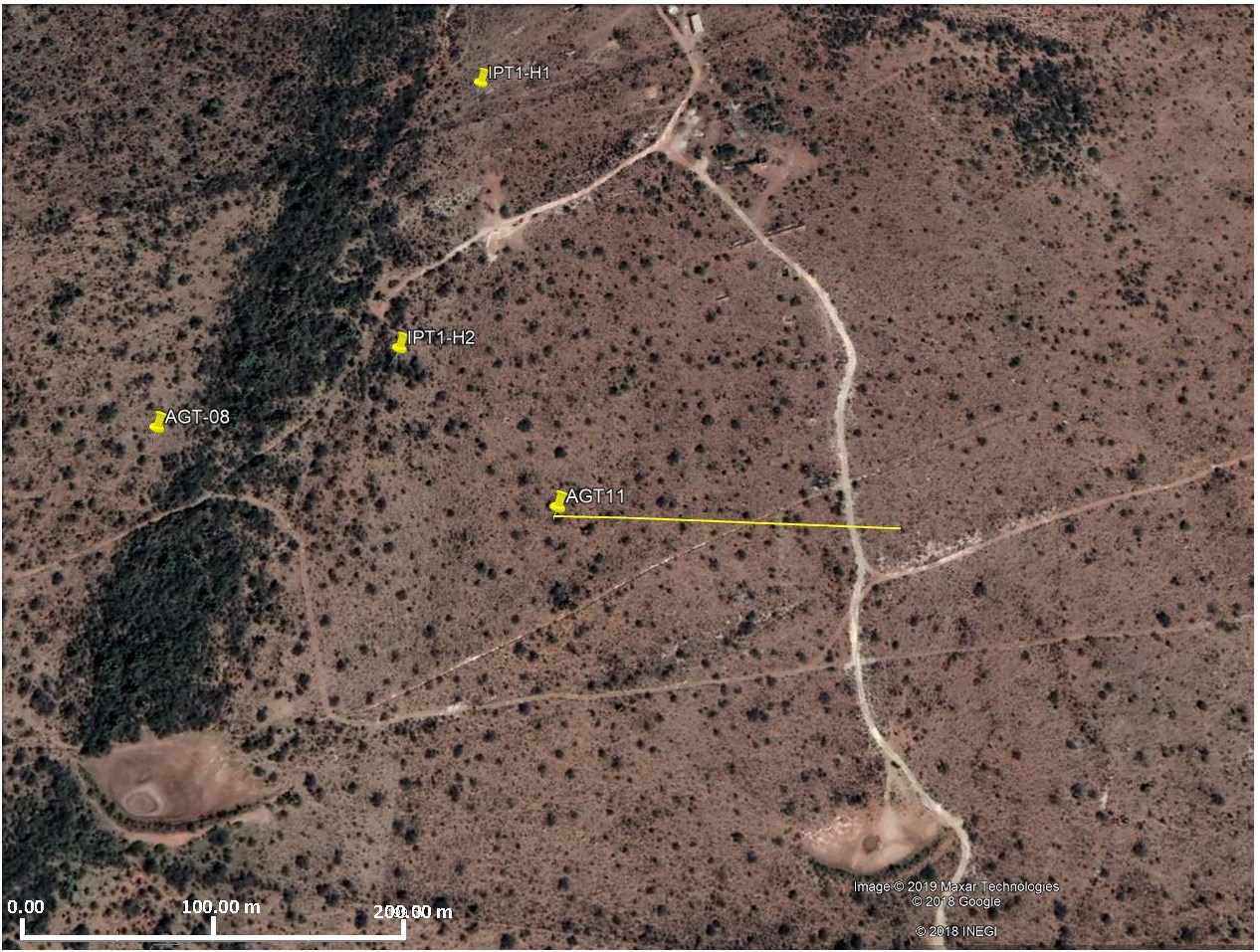
The first drill hole to test the chargeability anomaly will be approximately in the middle of the anomaly. It will be drilled at a 65 degree angle, from west to east. The first image below shows the collar location and direction of the hole. In the north part of the image, you can see the Tabasquena shaft area, where historical mining was done in the oxide zone of the Tabasquena vein, and just off the image to the south is the Tesorito shaft also used historically to mine the Tabasquena vein in the oxides.


Drill Hole 1

To view an enhanced version of Drill Hole 1, please visit:
https://orders.newsfilecorp.com/files/5492/50185_7f3793d874883847_001full.jpg

The image below is a plan view, with past drill holes outside the purple area which is the projected chargeability anomaly to surface. Those drill holes intersected a series of veins, with widespread gold and silver mineralization. None of the holes reached the chargeability anomaly.


Plan view showing previous drill holes

To view an enhanced version of the plan view, please visit:
https://orders.newsfilecorp.com/files/5492/50185_7f3793d874883847_002full.jpg

The final image below, is a cross section of the new drill hole, which has been designed to cover approximately 100 metres from west to east, plus go down to 500 metres and hit the middle of the chargeability anomaly. The anomaly remains open at depth beyond the planned 500 metres and a decision will be made during drilling to extend it.

Cross section of new drill hole

To view an enhanced version of the cross section, please visit:
https://orders.newsfilecorp.com/files/5492/50185_7f3793d874883847_003full.jpg

Julio Pinto Linares is a QP, Doctor in Geological Sciences with specialty in Economic Geology and Qualified Professional No. 01365 by MMSA., and QP for Advance Gold and is the qualified person as defined by National Instrument 43-101 and he has read and approved the accuracy of technical information contained in this news release.

About Advance Gold Corp. (TSXV: AAX)

Advance Gold is a TSX-V listed junior exploration company focused on acquiring and exploring mineral properties containing precious metals. The Company acquired a 100% interest in the Tabasquena Silver Mine in Zacatecas, Mexico in 2017, and the Venaditas project, also in Zacatecas state, in April, 2018.

The Tabasquena project is located near the Milagros silver mine near the city of Ojocaliente, Mexico. Benefits at Tabasquena include road access to the claims, power to the claims, a 100-metre underground shaft and underground workings, plus it is a fully permitted mine.

Venaditas is well located adjacent to Teck’s San Nicolas mine, a VMS deposit, and it is approximately 11km to the east of the Tabasquena project, along a paved road.

In addition, Advance Gold holds a 13.23% interest on strategic claims in the Liranda Corridor in Kenya, East Africa. The remaining 86.77% of the Kakamega project is held by Barrick Gold Corporation.

For further information, please contact:

Allan Barry Laboucan,
President and CEO
Phone: (604) 505-4753
Email: [email protected]Reply