Agoracom Blog Home

Posts Tagged ‘#smallcapstocks’

Inside the Explosive Growth of Pro Gaming on a Smartphone $KUU.ca $GMBL

Posted by AGORACOM-JC at 11:20 AM on Friday, March 9th, 2018

  • Tencent, one of the largest internet and tech companies in the world, Arena of Valor is based on one of the most downloaded apps in the world
  • Last month they announced that they’ll be hosting the Arena of Valor World Cup in Los Angeles, putting up a bold $500,000 prize-pool

Michael “FlashX” Valore discovered his love for Vainglory in rehab. After a lengthy flirtation with professional DOTA in college, he was abandoning that dream for a career in the Marine Corps – which meant that he had to deal with a nagging leg injury he sustained playing soccer. Every day, he’d set up on a stationary bike at the gym with his iPad mounted carefully in front of him. “I’d go for three to four hours a day,” says Valore. “If you spend that much time playing something, you’re gonna get really good at it.”

Tencent is one of the largest internet and tech companies in the world, Arena of Valor is based on one of the most downloaded apps in the world

This was back in 2015, when Vainglory was crawling out of its lengthy development cycle to debut on iPhone and Android. Valore was an early adopter, and easily capable of transmuting all of his PC ability to the touchscreen. It’s a classic esports origin story: he and two friends broke ground on an upstart team called Ardent Alliance, and entered one of the very first Vainglory competitive events. They expected to wash out immediately, but instead they blazed through the qualifiers and secured a trip to the finals in South Korea. Suddenly, the exclusivity of the upper echelon of pro gaming didn’t seem so opaque, and Valore found himself with a legitimate career in a game he adored. Within months, Ardent Alliance was picked up by Team SoloMid – one the largest esports organizations in America – and they were off to the races. “I quit my job. I was working in sales at the time,” says Valore. “I’ve been playing full-time ever since.”

For years, Vainglory was the only major esport in mobile games. It’s independently published and developed by the (mordantly named) Super Evil Megacorp, who themselves are made up of industry veterans with longstanding backgrounds developing on PC. The idea, says CEO Kristian Segerstrale, was to bring an “uncompromising” competitive experience to the cellphone – nurturing the belief that this platform was made for more than just polychromatic matching puzzles and catapulting birds.

They did this by creating a stripped down MOBA; two teams of three duke it out on a single lane, with abilities and movement all controlled on the touchscreen. I have been to several Vainglory tournaments, and the way they both mirror and diverge from what you’re used to at traditional PC LAN events is surreal. The gameplay itself remains strong, tactile, and technical, but the players are extremely young, even for esports standards. Middle schoolers, high schoolers, from 14 to 16, negotiating their phones with profound native grace. There’s no starker representation of the generation gap in gaming – you and I might prefer a mouse and keyboard, but our cribs weren’t stocked with tablets.

Last month, Super Evil MegaCorp unveiled the long-gestating 5v5 mode for Vainglory, which widens the game’s scope into a more recognizable MOBA, with three lanes and heavier emphasis on team play. Segerstrale talks about the change as an obvious evolution. “We’ve been working on it since we started the company,” he tells me. “We went with 3v3 initially for two reasons. The gamer culture at the time was just Candy Crush. Going from that to a MOBA felt like a very large leap. … The second thing was the tech. We’ve been optimizing the engine to use every piece of processing power that these devices have to bring out a 5v5 experience. For us it was a really natural extension.”

He’s right. Vainglory always felt like a product that was going to evolve over time – free-to-play phone games are nothing if not extremely opportunistic. But there’s a crucial element that Segerstrale leaves out. In a shockingly short amount of time, mobile esports has become one of the most cutthroat sectors in the games industry, and for the first time ever, Vainglory’s place at the top of the mountain is under siege. Nothing captures this moment better than a GIF that rocketed to the top of the Vainglory subreddit shortly after the release of the 5v5 module. The Super Evil MegaCorp logo is embossed over the head of Mirai Nagasu, the first American figure skater to land a triple axel in competition. As she twists in the air, the edge of her pearly skate destroys the superimposed insignias of Mobile Legends, Arena of Valor, and Heroes Evolved – three other mobile MOBAs currently tearing up the app store. It’s a silly meme, of course, but it cuts to the anxiety paramount in those within the community. In 2018, cellphone software is just as divisive as the console wars. Why did Vainglory go 5v5? Because it made for a more holistic experience, because it opened more design space, because phone hardware is more powerful. That’s all true. It’s also true that the games getting dunked on in that GIF were already offering a 5v5 mode, and Super Evil Megacorp is trying to stay ahead of the pack.

“There are a lot of diehard Vainglory fans. Even when DOTA and League first came out, everyone in the DOTA community – myself included – hated League of Legends, because it was a copycat,” explains Valore. “Vainglory has been the only game in this space, but within the last six months to a year, you’ve seen other games released. We take a lot of pride in Vainglory … That’s where those memes come from, and I’m definitely guilty of making one or two myself.”

Arena of Valor

The biggest threat, (and the biggest player at the table,) is Arena of Valor. In China, Arena of Valor debuted under the name Kings of Glory on the marketplace as a faithful, rock-solid League of Legends-style MOBA back in 2015, and since then it’s emerged as the most profitable free-to-play app in the world, hosting 80 million daily players, and 200 million monthly active players according to the South China Morning Post. The game is so insanely popular that it’s actually summoned the ire of the Chinese Communist Party, which has enforced municipal play restrictions for juvenile gamers – one hour for kids under 12, two hours for kids from 12 to 18.

A lot of Arena of Valor’s success can be chalked up to its publisher. Tencent is a massive, multinational conglomerate with fingerprints all over the Chinese internet. Their biggest asset is WeChat, the instant messaging service with over 980 million users, which fills in the gap that Facebook and Google left behind after the Communist Party censored those services. Last November, Tencent was valued at over $500 billion, officially surpassing Facebook. The company’s massive reach helped make Arena of Valor so ubiquitous, and over the past two years, they’ve enacted a long campaign to bring the game to foreign markets. First to Vietnam, then Indonesia, then Europe, and just before Christmas last year, to iOS and Android in the United States.

Tencent aren’t messing around about this expansion. Last month they announced that they’ll be hosting the Arena of Valor World Cup in Los Angeles, putting up a bold $500,000 prize-pool. As the Esports Observer points out, that money laps the highest purse Super Evil Megacorp has gathered for Vainglory, which was $150,000 at the World Championship last year. Already, Arena of Valor has seduced major esports companies like Team Liquid and SK Gaming to sign rosters. That might seem premature, but Tencent’s reputation precedes them. This company is directly responsible for publishing and distributing League of Legends in China, and according to an insider who works there, their ultimate goal is for Arena of Valor to mirror that same success.

“We don’t feel that [PC esports and mobile esports] different platforms are rivals, but rather that the two complement each other. The biggest value in mobile is convenience – you can play Arena of Valor anywhere, anytime in short bursts on your phone,” he says. “With that in mind, there is great potential for mobile games as an esports platform, and the accessibility and convenience of being able to get good or ‘train’ for competition makes it easy for the general playing field to offer up new challengers as more people become confident in their skills. We feel this element of what makes Arena of Valor special will lead to a lot more people being involved at a local or regional, or even international level, who would never have otherwise considered entering a tournament.”

When I asked him how he thinks Arena of Valor stacks up against games like Vainglory, his response was short and to the point: “We strongly feel that Arena of Valor stands alone in the space of mobile MOBA gameplay and is the most polished, most fun and best-in-class offering available for a competitive game on the mobile device.”

I wouldn’t say that po-player Michael Valore feels threatened by Arena of Valor, but he does get a little prickly when that game is compared to Vainglory. The easiest parallel to understand the dynamic might be the cold war between DOTA 2 and League of Legends fans. There’s a longstanding snobby belief among Valve lifers that high-level DOTA 2 play is elementally more complex and more beautiful than high-level League. How true that is depends on your own mileage, but that’s the stance the Vainglory community has taken as other games have moved into the space. “Now that Vainglory is 5v5, I truly don’t think, objectively, people can say that those other games are better than what Vainglory brings,” says Valore.

Segerstrale, predictably, is very diplomatic when I ask him about the newly crowded field in mobile esports. “Gamers are naturally tribal. Gaming is an outlet for our hunter-gatherer homosapien brains. So we take all of this stuff as an encouraging sign that the overall expectations of mobile games is growing,” he says. “From our perspective, we go out of our way to respect every other game, and every other game community out there, because making multiplayer games is hard. We need to build this industry together. … because we have the most powerful engine in the market, and because people are passionate about our deep strategies, we hope that people gravitate to our game, but that doesn’t mean that we are the only experience around.”

Vainglory certainly does have the benefit of an ingrained, grassroots base of players, but still, you have to feel for an independent company like Super Evil Megacorp, who’s suddenly been injected into a rivalry with a real-life Super Evil Megacorp like Tencent. To say that this isn’t a fair fight would be a huge understatement. Segerstrale speaks like someone who truly isn’t concerned, but Valore is willing to be a bit more candid with some of his hangups. “They gotta get [Vainglory’s] name out there, so that people know they have choices between all the other MOBAs,” he says, when I ask him what he thinks Super Evil needs to do over the next few years. “Tencent is a huge billion dollar company, it’s very easy for them to throw money at tournaments, and throw money at advertisements. But if Super Evil spends a lot of time on their marketing and advertising so that any player interested in mobile MOBAs know they have a choice, that will do wonders.”

Skillz

I haven’t detailed Mobile Legends and Heroes Evolved, the other two titles named in that triple-axel meme, mostly because they’re minor players. In fact, Mobile Legends first and only claim to fame is getting sued by Riot for copyright infringement, (and as DOT Esports writer Aaron Mickunas points out, it’s not hard to see why.) Both of those games are working the same MOBA gimmick, but they have neither the loyal bedrock of Vainglory, or the bottomless resources of Arena of Valor. I would like to pretend that the esports economy is kind, and will happily concede room for a meritocracy of enterprises, but there’s a graveyard of failed MOBAs who tried to take a bite of the League apple over the past five years. It’s hard to imagine that the same fate won’t await those buying into the mobile space.

However, there is one company that’s trying something different. Skillz is the passion project of Andrew Paradise, a man who had already made a fortune in the online commerce industry. Like Super Evil Megacorp and Tencent, the company is in the business of mobile esports, but the scope of the project is far different. Skillz isn’t trying to build another grim MOBA. Instead, they’re hosting cash tournaments for a bevy of flotsam on the app store; Candy Crush doppelgangers, index-finger billiards, public-access mahjong variants. Everything your mom loves, now with stakes.

You can consider Skillz as more of a blanket service, rather than a specific game. They partner with mobile giants like Zynga and Ilyon and port tournament software directly into their infrastructure. Now, when you go play something like Strike! Real Money Bowling on your phone, you can buy into brackets for as little as a dollar. Paradise says they’ve actually nurtured a community of professionals; imagine that, mastering the physics of touchscreen ten-pin as a full-time job – like stay-at-home dads who struck it big playing fantasy football.

“In 2015, the top electronic bowler on their phone was the fifth highest earning bowler in the world – both online and offline,” says Paradise. “They’re doing stuff we didn’t anticipate, like dripping candle wax onto their phone and scraping it off with a razor blade to better their grip.”

The ethos of Skillz is similar to Vainglory and Arena of Valor, but Paradise is going a step further. He’s betting that someday everyone, literally everyone, will participate in esports – not just stubbly 18-year olds in snapbacks and springy black gaming chairs. I have no reason to doubt him. Phones are changing the ways we think about the games industry at an unprecedented clip, who’s to say that won’t touch esports? Who’s to say the culture isn’t changing right below our feet?

“We are competitive by nature. It’s so fundamental to being human. Whether you’re the world’s best Candy Crush player or the world’s best Vainglory player, the ability to show that skillset and compete with your peers across the world [is valuable,]” says Paradise. “The question is who’s gonna crack the code for games like Candy Crush? Who’s going to create a player competitive experience and a spectator experience? Whether it’s one kind of content or another kind of content, that just changes the kind of audience that’s engaging in it.”

Frankly, the most radical thinking in esports is happening in the mobile industry. For they’re the only ones imagining a future where everyone with a phone and a few minutes on the train can be training for the big leagues. Imagine that, competitive gaming as easy as breathing, free at last from the feeding frenzy, whether you’re matching three or chasing down a pentakill.

Source: https://www.rollingstone.com/glixel/features/vainglory-arena-of-valor-esports-w517459

Star Navigation $SNA.ca Remembers MH370

Posted by AGORACOM-JC at 10:00 AM on Thursday, March 8th, 2018

Sna

  • March 8th will mark four years since the disappearance of MH370
  • Aircraft, a Boeing 777-200ER with 239 souls onboard, operated by Malaysia Airlines, was one of the most modern aircraft flying at the time and was en-route from Kuala Lumpur to Beijing

TORONTO, March 08, 2018 – Star Navigation Systems Group Ltd. (CSE:SNA) (OTCQB:SNAVF) (CSE:SNA.CN) (“Star” or the “Company”).

March 8th will mark four years since the disappearance of MH370. The aircraft, a Boeing 777-200ER with 239 souls onboard, operated by Malaysia Airlines, was one of the most modern aircraft flying at the time and was en-route from Kuala Lumpur to Beijing.

The aircraft disappeared after apparently veering away from its flight path and no one has yet been able to explain what happened or where the Boeing ended its flight. There have been theories and speculation on what happened, but none have been substantiated to date.

The official search, conducted by Malaysia, Australia and China over a period of almost 3 years, was finally called off. Scattered pieces of aircraft debris have been found scattered far away from the initial search zone of 120,000 Sq. Km. A new extended search zone of more than 25,000 sq km, will soon be searched by a private company.

Following the loss of MH370, as well as, Air France flight AF447 in 2009, Star worked with several regulatory Authorities, including the French BEA and the ad-hoc aviation working-groups from the ITU and ICAO, on developing connectivity, advanced tracking and data safe retrieval.

INDUSTRY FAILURE TO IMPLEMENT TRACKING PROVISIONS

Star successfully demonstrated its ability to track and monitor aircraft, even in remote and trans-oceanic areas.  In March, 2016, the International Civil Aviation Organization (ICAO) adopted new aircraft tracking provisions designed to gradually take effect by 2021. These provisions include a requirement that aircraft carry a device that can autonomously transmit its location every minute during emergency circumstances, as well as enhancing the ability to recover and make available aircraft recorded data in a timely manner.

Unfortunately, as of this solemn anniversary, the commercial aerospace industry has yet to implement  aircraft tracking technology  that would provide operators, authorities and the public the means necessary to both track the route followed by distressed  aircraft and the health of its critical systems and to effect a prompt rescue or recovery.

STAR NAVIGATION STANDS READY TO DELIVER

Star Navigation stands ready to deliver its patented technology solution now. Star has proven its ability to provide immediate location information of any aircraft in the world  and critical data  with respect to events aboard the aircraft prior to an incident.

The Star solution is independent from the crew and tamper proof. Information transfer is via satellite, encrypted and secure.

The Star solution is not only affordable, it provides significant ROI through savings generated by features ranging from stricter fuel management to more effective preventive maintenance.

The families of the MH370 passengers and crew and future families who are destined to suffer the same fate and anguish until solutions are implemented, deserve more. It is our hope and mission that the human cost of tragedies such as MH370 will be mitigated through the use of currently available technology.

About Star Navigation:

Star Navigation Systems Group Ltd. owns the exclusive worldwide license to its proprietary, patented In-flight Safety Monitoring System, STAR-ISMS®, the heart of the STAR-A.D.S. ® System. Its real-time capability of tracking performance trends and predicting incident-occurrence enhances aviation safety and improves fleet management while reducing costs for the operator.

Stars’ M.M.I. Division designs and manufactures high performance, mission critical, flight deck flat panel displays for defence and commercial aviation industries worldwide. These displays are found on aircraft and simulators, from P-3 Orion and C-130 aircraft, to Sikorsky and AgustaWestland helicopters, as examples.

Certain statements contained in this News Release constitute forward-looking statements. When used in this document, the words “may”, “would”, “could”, “will”, “expected” and similar expressions, as they relate to Star or its management are intended to identify forward-looking statements. Such statements reflect Star’s current views with respect to future events and are subject to certain risks, uncertainties and assumptions. Many factors could cause Star’s actual performance or achievements to vary from those described herein. Should one or more of these factors or uncertainties materialize, or should assumptions underlying forward-looking statements prove incorrect, actual results may vary materially from those described herein as intended, planned, anticipated, believed, estimated or expected. Star does not assume any obligation to update these forward-looking statements, except as required by law.

Neither the Canadian Securities Exchange nor its Market Regulator (as that term is defined in the policies of the Canadian Securities Exchange) accepts responsibility for the adequacy or accuracy of the content of this release.

Please visit www.star-navigation.com or

Viraf S. Kapadia, (416) 252-2889 Ext. 230

[email protected]

Primary Logo

PyroGenesis $PYR.ca Provides Update on its #PUREVAP™ Project with $HPQ.ca Silicon Resources Inc.

Posted by AGORACOM-JC at 8:54 AM on Thursday, March 8th, 2018

Pyr header 1

MONTREAL, March 08, 2018 – PyroGenesis Canada Inc. (http://pyrogenesis.com) (TSX-V:PYR), (the “Company”, the “Corporation” or “PyroGenesis”) a Company that designs, develops and manufactures plasma waste-to-energy systems and plasma torch systems, is pleased to provide herein a general update on its PUREVAP™ Project with HPQ Silicon Resources Inc (“HPQ”).

Comparison of PUREVAP™ vs. Conventional and Timminco Process.

Mr. P. Peter Pascali, President and CEO of PyroGenesis, provides this update on PUREVAP™ in the following Q&A format. The questions, for the most part, are derived from inquiries received from investors, and analysts:

Q. For those that are new to the story, could you please describe to us what the PUREVAP™ technology is and some of its many advantages?

A.  Most certainly.  HPQ is the owner of quartz properties.  Quartz can be processed, through multiple steps, into a high purity silicon metal which is an important element in solar panels.  It helps convert solar energy into useful electricity. Many in the solar panel industry consider the cost of converting Quartz into solar grade silicon metal to be a limiting factor in the growth of the solar panel industry.

PyroGenesis was first engaged by HPQ to demonstrate, on a laboratory scale, that its one-step proprietary PUREVAPTM process could produce high purity silicon metal from quartz in just one step.

PyroGenesis was taken by the prospect of using a plasma-based process to convert Quartz into solar grade silicon metal as there seemed to be a strong market need for such.  A number of years ago, a company by the name of Timminco saw its stock soar from 20 cents to over $30 and its market cap increased to over 3 billion of dollars when it was perceived that they had found a way to reduce the number of steps, not eliminate all steps, just reduce the number of steps, in the processing of quartz into solar grade silicon metal1.  That is not to say that this is what we expect here, but it did give us confidence that there was a significant need for a cheaper way to make solar grade silicon metal and, on paper, at the time, it looked like plasma might be able to address issues where other processes failed (Figure 1).

A photo accompanying this announcement is available at http://www.globenewswire.com/NewsRoom/AttachmentNg/616c51e5-4644-46e2-b77d-2de4e8d362e7

To date, we are very pleased with the results and, in fact, believe we have already demonstrated better results than the Timminco process had in its day.

Q. That is quite impressive and quick. Tell me…the project has been described in several phases; Gen 1, Gen 2, and now the Pilot Plant.  Could you please explain what the targets were in each generation, what was accomplished, and what the targets are now? 

A.   Sure.

It goes without saying that, from a 30,000 ft level, it all has to do with purity and production rates.  GEN-1’s goal was simply to prove the concept on a bench test scale and, if possible, identify parameters that could affect purity and production rates. GEN-2’s goal was to test the observations in GEN-1 at scale more representative of the pilot unit and was also geared towards optimizing the final pilot scale design.

GEN-1 was limited in that it was a batch system.  This means that the feedstock, quartz, was fed into the system in batches…i.e. there was not a continuous feed of material.  This limited the running time to batch runs of only a few hours. GEN-1’s primary goal of proving out that the PUREVAP™ technology could convert quartz into pure silicon metal in only one step was successful. From tests with GEN-1, we were also able to estimate the impurity removal efficiency of the PUREVAP™ process which turned out to be higher than expected from bench tests.

Some of the most interesting developments with GEN-1 were the observations relating to production yield.  GEN-1’s thermal efficiency was very low due to certain characteristics inherent with GEN-1 (excessive cooling rate and long ramp ups for example). To make a long story short, PyroGenesis was able to conclude, by the end of GEN-1, that operating under a batch process with low thermal efficiency, lowered production yield (i.e. % conversion of silicon in quartz to elemental silicon) and in turn production rate. In other words, we concluded that by increasing production yield, we would not only generate larger amounts of output (higher production rate), but that output, by all accounts, should be at higher yields of wanted end-product.  This was later proven out in GEN-2 and remains an important parameter in the final purity of silicon metal.

Another significant observation with GEN-1 spoke to the efficiency of the PUREVAPTM process.  During testing with the GEN-1, we used lower quality quartz to see how the system would handle impurities.  Low and behold, we managed to produce high purity silicon metal.  Not the high purity metal demanded by solar panels, but high enough to be suitable for other commercial applications. We found this to be extremely significant as it opened up other markets for the PUREVAPTM process which were not identified at the outset.  Remember, the original goal was to convert high purity quartz to high purity silicon metal for solar panels…now we can add to that equation the conversion of low purity quartz to high purity silicon for other applications (such as casting and chemical industries).

In short, GEN-1 accomplished the following:

  • Proof of concept: converting quartz to high purity silicon using PUREVAPTM,
  • Production rates and yields move in step,
  • Use of lower quality quartz for the production of high purity silicon: PUREVAP™ has a very high impurity removal efficiency which enables the use of lower quality quartz for silicon production.

GEN-2 was designed and fabricated to operate semi-continuously in order to test the observations made in GEN-1.  We also wanted to operate at higher temperatures and confirm the impact of thermal efficiency on production yield and ergo, purity (i.e. the more heat that goes towards the process rather than being lost to various system components should allow for a higher rate of silicon production and as such higher product purity).

GEN-2 was also made at a scale more representative of the operating mode of the pilot unit and as such was also geared towards optimizing the final pilot scale design.

GEN-2 demonstrated the following:

  • PUREVAP™ can operate semi-continuously,
  • A higher thermal efficiency was obtained resulting in a higher operating temperature,
  • A higher production yield was achieved.

The challenges going forward relate to typical scale up issues, as well continually improving the process and focusing on removing individual impurities towards achieving solar grade silicon metal.  Given the accomplishments to date and that, in many aspects, the GEN-2 is similar to the pilot plant, we are confident that at the end of the day we will have a commercial success. However, we don’t know what we don’t know, right?  That is what development is all about.  I am confident that any challenges will be met head on, as they have in the past, by arguably the best team around to do that.  Together with Apollon Solar, which have signed an agreement with HPQ to provide valuable input into the process, we are well positioned to successfully complete the design and testing of the next phase.

Q. Interesting.  In your press release dated January 15th, 2018, you announced that your GEN-2 process is now operating “semi-continuously under vacuum”. What does that mean exactly, “under vacuum”? And what difference does it make?

A.  This is a huge development.  Essentially it means that rather than operate at normal pressure, the PUREVAP™ process can operate at very low pressure when converting quartz into high grade silicon metal.  Lowering the operating pressure favors something called volatilization of impurities.  Without getting too technical, this volatilization of impurities essentially improves the purity of the end product by forcing the impurities out of the reacting system thus leaving behind a purer silicon metal.  It effectively enhances the removal efficiency of impurities. Bottom line:  the main advantage of being under vacuum is the fact that impurities don’t accumulate in the silicon phase.  This is a huge development on our road to success. To our knowledge, there is no other process that produces silicon metal directly from quartz under vacuum. Don’t get me wrong, vacuum refining does exist in the market to remove certain impurities from silicon that has already been produced (i.e., silicon is produced, re-melted, then it goes under vacuum), but it is a total different animal altogether.  It requires a post-treatment process which is limited and thereby adds additional costs. As far as we know, we are the only players to operate under vacuum in the production of silicon metal.  As I said, this is huge, and the impact of which has not really been fully understood by the market.

Q. How transferable are the results obtained from GEN-2 to the pilot plant?

A.  We believe they are very transferable. In fact, we expect the results to be even better at larger scale. By increasing the scale, we are increasing the production rate.  Theoretically, this will give us a better conversion yield according to our results so far.

As you can imagine, we are already extremely excited about the results we have had with GEN-2, and we can only imagine what the results will be with the pilot plant. As mentioned, at a larger scale, the production rate is automatically higher which, we have proven with GEN-2, should lead to a higher conversion yield and better purity.

Q. Tapping tapping tapping… Everyone is asking for tapping.  Why hasn’t it occurred and when will it occur?

A.  It is an interesting question because it reflects a belief that there is a connection between tapping and success to date.  The accomplishments noted above with GEN-1 and GEN-2, in my opinion, are more reflective of success than tapping.

Tapping will come naturally. When liquid accumulates enough, tapping can occur.  The purity of silicon in liquid form is expected to be very high. Tapping was not part of the GEN-2 objectives and, as such, we never operated with the goal of creating the conditions to tap.   At this point, we spent our time and money on testing that had a direct impact on production, purity, and design.  Tapping, as nice as it would be to see, and possibly a nice press release, has more value to our knowledge and progress in the pilot phase. As such, rest assured, that at the pilot plant phase tapping will be demonstrated as production and conversion yields should be higher.

Q. An often-asked question is, how comfortable are you with the patent application?

A. The short answer is: very comfortable. PyroGenesis has never failed in obtaining a patent when we have applied for one, and we have extensive experience over many years doing so.   

It is understandable that a person unfamiliar with our history, patents in general and the patent process specifically, may get hung up or side tracked by this question.

I answered this type of question once before, in another forum, by describing the players and the process.  It basically works something like this: when one applies for a patent it behooves one to try and describe in as much detail what the patent can uniquely do and, at the same time, get the best coverage surrounding the patent claims.  That is the role of one who applies for a patent.   The examiners role, on the other hand, is to challenge the patent and/or limit the claims.  That is their role. Of note is that the examiner cannot be expected to be an expert in every field so oftentimes, the challenges are more of a “please explain why…” type of a challenge.  We have faced on numerous occasions extremely negative comments from the examiner at the PCT level.  This is quite common, and it has never prevented us from obtaining patents at the end of the day.

As I said, we feel very comfortable with the patent application and, without getting into specifics, we have a very well thought out and articulated patent and IP strategy regarding the PUREVAP™ technology.  Just remember, this is a costly and time-consuming process and we don’t have either to waste. Rest assured, if we did not think we would succeed we wouldn’t waste our time or money.  It’s not more complicated than that.

Q. Some investors/shareholders are skeptical about the whole process.  Do you have any comments?

A. …and so they should be.  Seriously, we are talking about a process that potentially could be game changing beyond description. Who wouldn’t be skeptical?  You would have to be a fool not to be.  Adding to this is the fact that the results to date are beyond our expectations which, in a weird way, fuels the skepticism, no?  It’s almost too good to be true…makes one think that a little bit of bad news might put people at ease.  Just joking, but you get my drift.

On the other hand, how many chances do you get to invest into such potential, at 10 cents a share and market cap of under CAD$20 million?  I am talking about HPQ here.  Anyways, just food for thought.

Q. PyroGenesis is a shareholder of HPQ, isn’t it?

A.  Yes, we are.  We currently hold over 5 million common shares and over 3 million warrants which are reflected on our balance sheet.

Q. Would you invest more into HPQ?

A. Yes, we would consider it if it made sense, but let me be very very clear on this point. PyroGenesis is investing each and every day into HPQ. I have said this before and I will say it again, PyroGenesis does not have time or money to waste on projects that do not have future potential.  Each and every day PyroGenesis has to decide where to allocate its resources, the most important of which is its time.  Plasma expertise, such as ours, does not grow on trees and we must be very discerning as to where we dedicate this valuable resource.  Do we dedicate it to Additive Manufacturing (powders for 3D printers), DrosriteTM, other development projects…or HPQ? The profit from the HPQ contract does not in and of itself justify dedicating such scarce resources to the project, the royalty from the success of the project, does.

Q. And that is a good segue into our last question.  Some investors of HPQ have accused them of paying PyroGenesis for a project that has no risk to PyroGenesis.  How would you respond to them?

A.  Besides my answer above, where I describe the opportunity cost of the HPQ contract and the risk associated with that, I would have to add that PyroGenesis is not a charity and we are in the business of making money.  Our expertise is unique and arguably, it is that exact expertise that has given this project, and HPQ, a life and a future.  In short, you get what you pay for and we would not have done it for less…in fact, we wanted more and were negotiated to the current arrangement.

My final comment to any detractor of HPQ and HPQ management is: wake up.  Wake up to the unique management you have, a management that was not only able to identify this opportunity, but also the players required to carry out the project.  In fact, it took a lot of convincing by HPQ management to get PyroGenesis’ interest as HPQ did not fit our client/risk profile at all.  All this to say that, take it from experience, encouraging management and getting behind it goes a long way to getting management up in the morning…to do it again and again …which, can do nothing but help the stock…. then bashing them with perverted 20/20 hindsight.  Just a thought.

Q. Conclusion?

A.  We believe the PUREVAP™ process to be game changing and has the potential to revolutionize the solar panel industry.  We don’t know of any other process or technology that is able to do what we have done to date.

Not only have we progressed along the path to processing high purity quartz to solar grade silicon metal, but we have demonstrated the ability to convert low purity quartz to quality silicon metal suitable for other industries which was not contemplated when the project was initiated.

In short, PyroGenesis is happy with the progress to date and stand firmly behind the project.  We are more convinced than ever before that we will be successful in having a commercially viable process at the end of the day.

About PyroGenesis Canada Inc.

PyroGenesis Canada Inc. is the world leader in the design, development, manufacture and commercialization of advanced plasma processes. We provide engineering and manufacturing expertise, cutting-edge contract research, as well as turnkey process equipment packages to the defense, metallurgical, mining, advanced materials (including 3D printing), oil & gas, and environmental industries. With a team of experienced engineers, scientists and technicians working out of our Montreal office and our 3,800 m2 manufacturing facility, PyroGenesis maintains its competitive advantage by remaining at the forefront of technology development and commercialization. Our core competencies allow PyroGenesis to lead the way in providing innovative plasma torches, plasma waste processes, high-temperature metallurgical processes, and engineering services to the global marketplace. Our operations are ISO 9001:2008 certified, and have been since 1997. PyroGenesis is a publicly-traded Canadian Corporation on the TSX Venture Exchange (Ticker Symbol: PYR) and on the OTCQB Marketplace. For more information, please visit www.pyrogenesis.com

This press release contains certain forward-looking statements, including, without limitation, statements containing the words “may”, “plan”, “will”, “estimate”, “continue”, “anticipate”, “intend”, “expect”, “in the process” and other similar expressions which constitute “forward- looking information” within the meaning of applicable securities laws. Forward-looking statements reflect the Corporation’s current expectation and assumptions, and are subject to a number of risks and uncertainties that could cause actual results to differ materially from those anticipated. These forward-looking statements involve risks and uncertainties including, but not limited to, our expectations regarding the acceptance of our products by the market, our strategy to develop new products and enhance the capabilities of existing products, our strategy with respect to research and development, the impact of competitive products and pricing, new product development, and uncertainties related to the regulatory approval process. Such statements reflect the current views of the Corporation with respect to future events and are subject to certain risks and uncertainties and other risks detailed from time-to-time in the Corporation’s ongoing filings with the securities regulatory authorities, which filings can be found at www.sedar.com, or at www.otcmarkets.com. Actual results, events, and performance may differ materially. Readers are cautioned not to place undue reliance on these forward-looking statements. The Corporation undertakes no obligation to publicly update or revise any forward- looking statements either as a result of new information, future events or otherwise, except as required by applicable securities laws.

Neither the TSX Venture Exchange, its Regulation Services Provider (as that term is defined in the policies of the TSX Venture Exchange) nor the OTCQB accepts responsibility for the adequacy or accuracy of this press release.

SOURCE PyroGenesis Canada Inc.

For further information please contact: Rodayna Kafal, VP, Investor Relations and Strategic Business Development, Phone: (514) 937-0002, E-mail: [email protected] 

Namaste $N.ca $NXTTF Announces LOI With Ample Organics to Integrate and Sell Vaporizer Hardware Through Their E-Commerce Platform $ACB.ca $HIP.ca $WEED.ca $CMED.ca

Posted by AGORACOM-JC at 8:37 AM on Thursday, March 8th, 2018

Nlogo

  • Ample Organics will offer Namaste’s product catalogue of over 5000 vaporizers and similar products to their clients via API integration
  • Namaste will provide product and warranty claim support for Ample Organics’ clients
  • Namaste will provide sales and support training to Ample Organics’ customer service team

VANCOUVER, British Columbia, March 08, 2018 — Namaste Technologies Inc. (“Namaste” or the “Company”) (CSE:N) (FRA:M5BQ) (OTCMKTS:NXTTF) is pleased to announce the signing of a Hardware Supply Letter of Intent (“LOI”) with Ample Organics Inc. (“Ample Organics”), whereby Namaste and Ample Organics will integrate Namaste’s vaporizer and accessory hardware with Ample Organics’ e-commerce platform. The intention of the LOI is to allow all of Ample Organics’ customers, including their extensive client list of ACMPR Licensed Producers to access Namaste’s full range of high-quality products. This engagement represents a unique opportunity for both Ample Organics and Namaste to leverage their technology platforms to provide added value and a new revenue stream for many of Canada’s largest ACMPR Licensed Producers.

Ample Organics is Canada’s leading seed-to-sale software platform. Under the terms of the LOI, Ample Organics and Namaste will collaborate and aim to provide ACMPR Licensed Producers and their patients seamless access to the widest range of high-quality vaporizer and accessory hardware in the cannabis industry.

Key Terms of the LOI

  • Ample Organics will offer Namaste’s product catalogue of over 5000 vaporizers and similar products to their clients via API integration.
  • Namaste will provide product and warranty claim support for Ample Organics’ clients.
  • Namaste will provide sales and support training to Ample Organics’ customer service team.

Management Commentary

John X. Prentice, President and CEO of Ample Organics, comments, “Namaste has established a world leading portfolio of innovative and novel products. This partnership represents an incredible opportunity to provide additional value to our Licensed Producer clients and their patients by integrating Namaste’s products directly into the e-commerce platform used by over 200,000 patients across Canada.

Sean Dollinger, President and CEO of Namaste comments, “We are very pleased to be partnering with Ample Organics, who we believe is Canada’s largest and most innovative and trusted seed-to-sale software platform. With access to 80% of Canada’s medical cannabis patients and the country’s largest dataset, Ample Organics provides Namaste with an incredible opportunity to offer our high-quality vaporizers and accessories to Licensed Producers across the country, and for Ample Organics to provide even more value for their clients. In addition to partnering with Ample Organics on this exciting project, we are also working closely with Ample Organics’ team as it relates to our late-stage ACMPR medical cannabis “sales-only” license under our wholly owned subsidiary, Cannmart Inc., and have also identified additional opportunities for future collaborations that could be mutually beneficial for both parties. We are very excited to be working the Ample Organics and look forward to following through on this LOI with a definitive agreement.”

About Ample Organics
Ample Organics is Canada’s leading cannabis business solution, adopted by 75% of the nation’s Licensed Producers. To date, the Ample Organics platform has processed more than 680,000 orders and 12,000,000 grams of cannabis. Ample Organics makes compliance easy by tracking individual plants, from seed to consumer, and reporting every detail of the growth, production, and sales processes. With Ample Organics, data is collected at the most granular levels, offering insights that can drive business decisions and help to protect public safety. Beyond seed to sale, Ample Organics’ extended suite of products creates a complete ecosystem for cannabis businesses. From easy patient registration to cannabis-exclusive payment solutions, Ample Organics continues to evolve and release new products to provide reliable and compliant solutions for the cannabis industry.

About Namaste Technologies Inc.
Namaste is the largest online retailer for medical cannabis delivery systems globally. Namaste distributes vaporizers and smoking accessories through 24 e-commerce sites in 20 countries and with distribution hubs located around the world. Namaste has majority market share in Europe and Australia, with operations in the UK, Canada and Germany and has opened new supply channels into emerging markets including Brazil, Mexico and Chile. Namaste, through its acquisition of Cannmart Inc., a Canadian based late-stage applicant for a medical cannabis distribution license (under the ACMPR Program) is pursuing a new revenue vertical in online retail of medical cannabis in the Canadian market. Namaste intends to leverage its existing database of Canadian medical cannabis consumers, along with its expertise in e-commerce to create an online marketplace for medical cannabis patients, offering a larger variety of product and a better user experience.

On behalf of the Board of Directors,

Sean Dollinger
Chief Executive Officer
Direct: +1 (786) 389 9771
Email: [email protected]

Further information on Namaste and its products can be accessed through the links below:

namastetechnologies.com
namastevapes.ca
everyonedoesit.ca
namastevaporizers.co.uk
everyonedoesit.co.uk
australianvaporizers.com.au

For more information about Ample Organics, please visit ampleorganics.com or contact:
Peter Slater
VP, Corporate Development
Direct: +1 (416) 262-4175
Email: [email protected]

Forward Looking Information
This press release contains forward-looking information based on current expectations. These statements should not be read as guarantees of future performance or results. Such statements involve known and unknown risks, uncertainties and other factors that may cause actual results, performance or achievements to be materially different from those implied by such statements. Although such statements are based on management’s reasonable assumptions, Namaste assumes no responsibility to update or revise forward-looking information to reflect new events or circumstances unless required by law. Although the Company believes that the expectations and assumptions on which the forward-looking statements are based are reasonable, undue reliance should not be placed on the forward-looking statements because the Company can give no assurance that they will prove to be correct. Since forward-looking statements address future events and conditions, by their very nature they involve inherent risks and uncertainties. These statements speak only as of the date of this press release. Actual results could differ materially from those currently anticipated due to a number of factors and risks including various risk factors discussed in the Company’s disclosure documents, which can be found under the Company’s profile on www.sedar.com. This press release contains “forward-looking statements” within the meaning of Section 27A of the Securities Act of 1933, as amended, and Section 21E the Securities Exchange Act of 1934, as amended and such forward looking statements are made pursuant to the safe harbour provisions of the Private Securities Litigation Reform Act of 1995. The Canadian Securities Exchange has neither reviewed nor approved the contents of this press release

Tetra Bio-Pharma $TBP.ca Signs Co-development and Distribution Partnership Term Sheet $ACB.ca $HIP.ca $WEED.ca $CMED.ca

Posted by AGORACOM-JC at 8:25 AM on Thursday, March 8th, 2018

Logo tetrabiopharma rgb web

  • Signed co-development and distribution partnership term sheet with a major specialty healthcare distributor
  • Company has a pan-Canadian distribution network that reaches up to 7000 specialized healthcare professionals

OTTAWA, ONTARIO–(March 8, 2018) – Tetra Bio-Pharma Inc. (“Tetra” or the “Company”) (TSX VENTURE:TBP)(OTCQB:TBPMF), a global leader in cannabinoid-based drug development and discovery, is pleased to announce it has signed a co-development and distribution partnership term sheet with a major specialty healthcare distributor.

The finalization of the term sheet follows Tetra’s September 20th, 2017 Letter of Intent for a co-development and distribution partnership with the same privately held company in the specialty healthcare market. The company has a pan-Canadian distribution network that reaches up to 7000 specialized healthcare professionals. Through their distribution channel, they have access to more than 3000 specialized healthcare businesses in Canada and already work with a worldwide network of partners.

Partnership highlights

  • In order to maximize both marketing and revenue impact, Tetra and its partner have agreed to launch all products at the same time, once the regulatory framework has been established by Health Canada following the legalization of cannabis. This includes cannabinoid-based as well as non-cannabinoid-based products. Both companies are confident that this strategy will solidify the brand awareness of Tetra’s partner in this new product line. The timing of the original LOI was for the commencement of revenue in Q1 2018. Tetra and its partner are now revising that date to Q4 2018.
  • Both Tetra and its partner will agree to a clinical trial plan, with Tetra owning and maintaining the right to use the data gathered from the trial(s) for its own regulatory and commercial efforts in its own, non-competitive Fields of Use.
  • Tetra will develop a line of private label products for its partner, the products will be distributed under the partner’s brand.

Management Statement

“We are very pleased to sign this term sheet as it solidifies the elements of the LOI outlined in September. We are continually striving and working hard every day to both solidify and grow Tetra as a major player in cannabinoid pharma and this is yet again a step in that direction. I am excited to continue to build on the momentum that we have going for us now and throughout 2018,” says Bernard Fortier, CEO of Tetra.

About Tetra Bio-Pharma:

Tetra Bio-Pharma (TSX VENTURE:TBP)(OTCQB:TBPMF) is a biopharmaceutical leader in cannabinoid-based drug discovery and clinical development. Tetra is focusing on three core business pillars: clinical research, pharmaceutical promotion and retail commercialization of cannabinoid-based products.

More information at: www.tetrabiopharma.com

Source: Tetra Bio-Pharma

Neither the TSX Venture Exchange nor its Regulation Services Provider (as that term is defined in the policies of the TSX Venture Exchange) accepts responsibility for the adequacy or accuracy of this release.

Forward-looking statements

Some statements in this release may contain forward-looking information. All statements, other than of historical fact, that address activities, events or developments that the Company believes, expects or anticipates will or may occur in the future (including, without limitation, statements regarding potential acquisitions and financings) are forward-looking statements. Forward-looking statements are generally identifiable by use of the words “may”, “will”, “should”, “continue”, “expect”, “anticipate”, “estimate”, “believe”, “intend”, “plan” or “project” or the negative of these words or other variations on these words or comparable terminology. Forward-looking statements are subject to a number of risks and uncertainties, many of which are beyond the Company’s ability to control or predict, that may cause the actual results of the Company to differ materially from those discussed in the forward-looking statements. Factors that could cause actual results or events to differ materially from current expectations include, among other things, without limitation, the inability of the Company, through its wholly-owned subsidiary, GrowPros MMP Inc., to obtain a license for the production of medical marijuana; failure to obtain sufficient financing to execute the Company’s business plan; competition; regulation and anticipated and unanticipated costs and delays, the success of the Company’s research strategies, the applicability of the discoveries made therein, the successful and timely completion and uncertainties related to the regulatory process, the timing of clinical trials, the timing and outcomes of regulatory or intellectual property decisions and other risks disclosed in the Company’s public disclosure record on file with the relevant securities regulatory authorities. Although the Company has attempted to identify important factors that could cause actual results or events to differ materially from those described in forward-looking statements, there may be other factors that cause results or events not to be as anticipated, estimated or intended. Readers should not place undue reliance on forward-looking statements. While no definitive documentation has yet been signed by the parties and there is no certainty that such documentation will be signed The forward-looking statements included in this news release are made as of the date of this news release and the Company does not undertake an obligation to publicly update such forward-looking statements to reflect new information, subsequent events or otherwise unless required by applicable securities legislation.

Tetra Bio-Pharma Inc.
Dr. Anne-Sophie Courtois, DVM
Vice President, Marketing & Communications
(438) 899-7575

For investors information, please contact:
[email protected]
(438) 504-5784

New Age Metals $NAM.ca Currently Advancing North America’s Largest Undeveloped Resource of #PGM #Platinum #Palladium $WG.ca $XTM.ca $WM.ca

Posted by AGORACOM-JC at 12:03 PM on Wednesday, March 7th, 2018
New age large
  • Palladium and platinum are irreplaceable as auto catalysts
  • Palladium is essential in catalytic converters for gasoline-powered engines
  • Platinum is necessary for production of catalytic converters for diesel engines
Jeff Nielson, Stockhouse

Platinum group metals (PGM’s) fly under the radar of investors in the world of mining. The evidence is all around us.

Like gold and silver, these are precious metals: 28% of platinum demand is specifically for jewelry and investment purposes, and 17% of palladium demand is for jewelry/investment. Yet when investors think “precious metals”, typically all they consider are gold and silver.

Palladium and platinum are also vital for industry. Indeed, these are arguably the first two green metals. When investors think “green”, they immediately look to the electric vehicle market, and the lithium-ion batteries that power these vehicles. However, before the EV came to market, it was palladium and platinum that have played crucial roles in mitigating harm to the environment.

Palladium and platinum are irreplaceable as auto catalysts, used in the manufacturing of the catalytic converters that have dramatically reduced toxic emissions from internal combustion engines. Palladium is essential in catalytic converters for gasoline-powered engines (more popular in North America). Platinum is necessary for the production of catalytic converters for diesel engines (more popular in Europe).

image: http://www.stockhouse.com/getattachment/84b58a2c-8be5-4db3-b9cd-822628d5c9ae/NewAgeMetals_Pd_Pt_demand.jpg

image: http://www.stockhouse.com/getattachment/aec2ed11-af8e-44d8-9d0b-b698b28ccbc7/NewAge_catatytic-(2).gif?width=450&height=338


(click to enlarge)

A leading company looking to bring new supply of these metals to market is New Age Metals Inc. (TSX. V.NAM, OTCQB: PAWEF, Forum). NAM is currently advancing North America’s largest undeveloped resource of PGM’s. In a conference call with Stockhouse Editorial, management pointed to the lack of familiarity with these metals.

In terms of price, what has been the best-performing metal over the past ten years? Very few mining investors could answer this question. It’s palladium.

image: http://www.stockhouse.com/getattachment/8df15a5c-5157-45a5-a858-5060b98ce023/NewAgeMetals_pd_10yr.gif

Typically, when demand heats up for a particular metal, prices spike – stimulating additional supply as new mines come online. The increased supply turns into a glut and a bull market becomes a bear market. This hasn’t happened with palladium because the price has never risen high enough to spur such an increase in supply.

This is reinforced when we look closer at the sources for palladium. Russia and South Africa dominate the supply of these metals, with Canada a distant third. However, South Africa’s mining industry has become notorious for declining mine reserves and labour strife. Almost certainly, palladium production there is already at peak levels.

Meanwhile, Russia has been supporting the palladium market for years, selling roughly 15 tonnes per year from state stockpiles. Without these sales, the palladium market could not have remained fully supplied. In 2015, however, Russia’s government announced that it “may significantly reduce exports” of several strategic metals – including palladium.

With the sector in a continuing supply deficit and demand in the auto industry continuing to climb, the price has hit a 17-year high, and has actually exceeded the price of platinum for the first time since 2001. Rising emissions standards require better catalytic converters, implying further increases in demand. An article from December 2017 explains why metals analysts expect continued strength in this market.

The 2015 Volkswagen (ETR:VOW3) emissions-rigging scandal involving diesel-powered vehicles has also led drivers in Europe to gravitate towards gasoline-powered vehicles.

Johann Wiebe, lead analyst at Thomson Reuters’ GFMS Supply Chain & Commodities Research division, said, “diesel vehicles will still be around for awhile, but their share in Europe, the largest market, is estimated to decline from around 45 percent at present to as little as 35 percent in 2025.”

Meanwhile, George Gero, managing director of RBC Wealth Management, recently told Reuters that palladium, “cannot be reclaimed as easily or as often from junked automobiles as platinum.”

Clearly, the world needs additional sources of palladium. Even the current price of $1,000+ per ounce has been insufficient to bring this market into equilibrium. This puts the importance of New Age Metal’s multi-million ounce deposit into context. But while palladium prices have been merely insufficient, platinum prices have been truly depressed.

image: http://www.stockhouse.com/getattachment/58a5519d-ba40-45bd-8a27-830881daf1b2/NewAgeMetals_8yrPt.gif

Historically, platinum has always been priced at a significant premium to gold. Yet today, the price of platinum is lower than gold. Putting this fact into proper context, the price of gold is also depressed – so depressed that mine supply of the yellow metal is now falling. Today’s platinum price represents an historic trough for this metal.

The price of platinum must rise dramatically to restore sustainability to this market. The same is true with palladium. Russia’s 2015 announcement means that its stockpiles are no longer an assured source of supply. Given that these stockpiles are a “state secret”, they could even be near exhaustion.

New Age Metals is ideally positioned to take advantage of these supply/demand dynamics with its 100%-owned River Valley PGM Project, situated in the Sudbury’s famed mining district. Management has been patiently advancing this project for more than a decade. However, with current market conditions so favorable, the Company is now looking to step on the accelerator pedal.

The River Valley PGM Project

The first question that investors new to this Company will want answered is: how large is the River Valley deposit already?

image: http://www.stockhouse.com/getattachment/29d1798c-307b-4c91-97ea-88a58b5afdfd/NewAgeMetals_PGMresource.jpg?width=450&height=240


(click to enlarge)

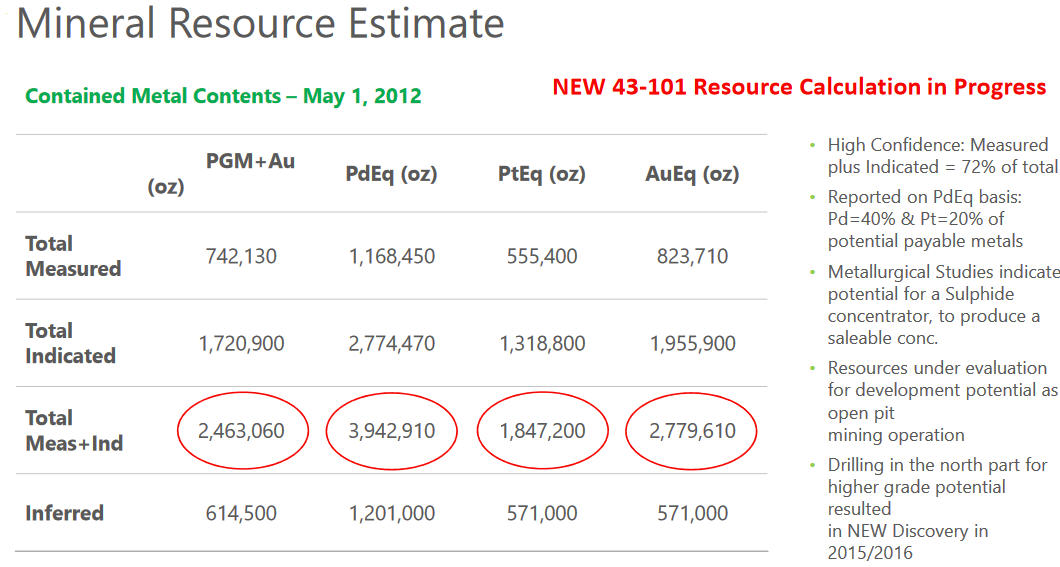
Total precious metals approach 2.5 million ounces. Expressed as a palladium resource, this equates to nearly 4 million ounces Pd equivalent (including base metals credits). Expressed as a gold resource, it equates to roughly 2.8 million ounces Au equivalent.

This robust resource is about to get bigger. A new resource estimate is due for release imminently.

Part of the reason why NAM has previously been patient in its development of River Valley was a matter of necessity. An important puzzle-piece was missing from this land package. On August 4, 2016; the Company announced the acquisition of what it has dubbed the “River Valley Extension”: six mining claims previously held by Mustang Minerals Corp.

Harry Barr, the Chairman and CEO of New Age Metals explains why he has coveted these mining claims, and for how long NAM has been seeking to acquire them.

For more than 10 years, management has had its eye on the acquisition of the River Valley Extension. This new acquisition allows our shareholders to control 100% or 16 kilometers of a new PGM mining district.

Solidifying the land package still further, the Company did extensive staking around the boundaries of these claims until management was satisfied they had assembled the whole “puzzle”. Since that time, there have been three focal points in development of River Valley:

  1.  Developing NAM’s new Pine Zone and T3 discoveries (to the east of the original deposit).
  1. Continuing the development of the footwall discovery from T3 to T9.
  1. Demonstrating that the River Valley Extension can significantly enhance the overall resource

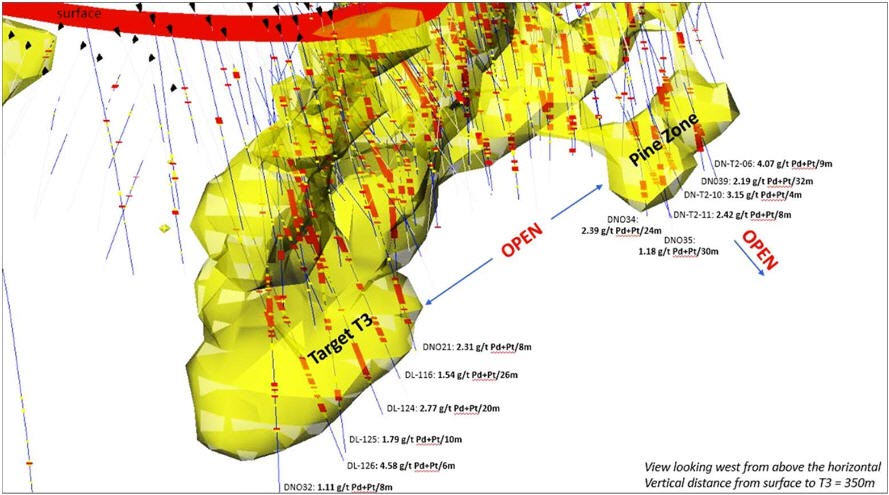
In 2015; New Age Metals reported a “new discovery”: the Pine Zone. This mineralization was located in the footwall areas, east of the main deposit. Not only does this represent additional mineralization at River Valley, the Company has been encountering some higher grade intercepts, as well as significant levels of copper mineralization.

A total of seven drillholes were completed during 2015 and 2016. Highlights include:

  • 16 meters @ 2.054 g/t Pd+Pt, 0.091 g/t Au, and 0.179% Cu
  • 9 meters @ 4.065 g/t Pd+Pt, 0.176 g/t Au, and 0.280% Cu

image: http://www.stockhouse.com/getattachment/48d89daf-c116-4586-90e2-cfa01cc34a94/NewAgeMetals_newdiscovery.jpg?width=450&height=250


(click to enlarge)

Investors looking to project ahead to the potential of River Valley don’t even need to leave Ontario. Approximately 90 km north of Thunder Bay is the Lac des Iles Mine of North American Palladium, a company that bills itself as (at present) “the only pure play palladium producer in the world”.

Lac des Iles has been in operation for more than 20 years. It is a 6,000+ tonnes per day underground mining operation, with a 15,000 tpd mill. Similar grades to River Valley, very similar geology.

What is different between the two companies? Location. North American Palladium ships its concentrate roughly 1,000 kilometers to Sudbury, the nearest refining facility. New Age Metals is only 100 kilometers from Sudbury, representing 1/10th of the transportation costs.

NAM’s updated resource estimate for River Valley will be a stepping-stone in mine development, providing the first estimate of a resource for both the (new) Pine Zone and the recently added River Valley Extension. Slightly further along the horizon, management is planning to produce the first Preliminary Economic Assessment (PEA) for River Valley.

To further expedite development of the Project, in March 2017 the Company elevated Trevor Richardson from his role as VP Business Development to President and Chief Operating Officer (COO). Talk to Richardson about the exploration potential at River Valley, and you will quickly hear about “footwall mineralization”.

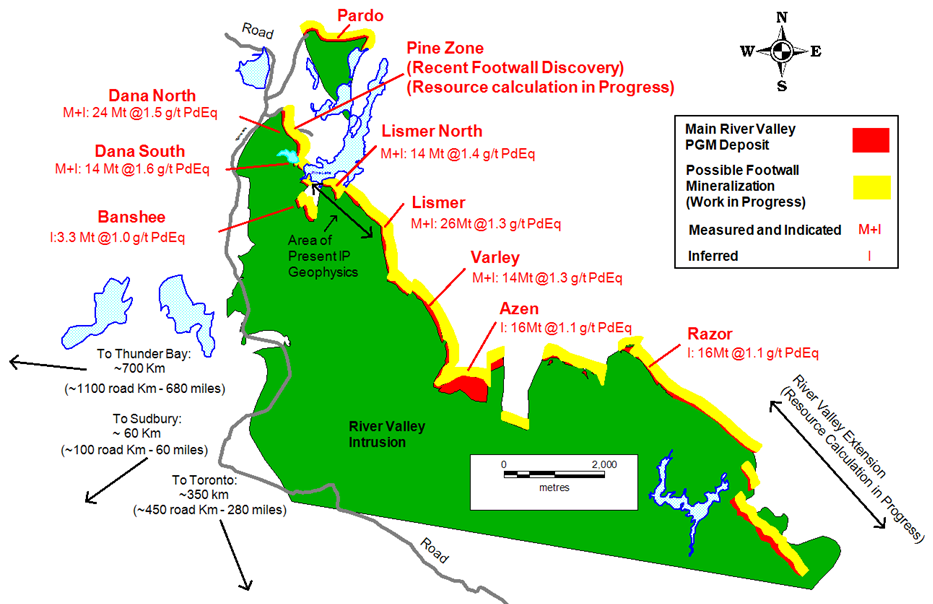
To date, approximately 40 million dollars has been expended on our combined River Valley and River Valley Extension project. The current substantial resource which has been defined, but is a long way from being drilled out, is in the contact mineralization. The contact extends throughout our 16 kilometers. We are most excited about the newly defined footwall mineralization, which we have only completed 3,000 meters of geophysics on, and have already identified the Pine and T3 Zones discoveries.

The plan is to take this geophysics and drilling program from North to South over our entire project. Our ultimate goal is to mine a series of open pits throughout our 16 kilometers, concentrate on site, and ship the concentrates to the long-established Sudbury Metallurgical Complex.

image: http://www.stockhouse.com/getattachment/0333f53b-241d-482c-851e-5df18d5bbb7d/NewAge_newFootwall.png?width=450&height=291


(click to enlarge)

For many investors, the River Valley Project alone would be reason enough to look to add NAM to their portfolio. However, this Company became “New Age Metals” in 2016, when management changed the corporate name to reflect the addition of a new lithium division.

While palladium and (especially) platinum have yet to hit their stride in terms of pricing, the lithium sector is already hot. NAM has acquired five prospective lithium properties, situated in the Winnipeg River Pegmatite Field in southeast Manitoba.

image: http://www.stockhouse.com/getattachment/164a4bdc-44a4-40ba-9aea-a009e8d48e7e/NewAgeMetals_lithiumproperties-(1).jpg?width=450&height=210


(click to enlarge)

This is hard-rock lithium geology, meaning that any future mining would be via conventional mining operations, not the “lithium brine” mining with which most investors are now more familiar. Lithium brine extraction is environmentally and logistically challenging.

Commonly, Lithium brine operations require hyper-arid climates in order to be able to efficiently conduct the large-scale evaporation required to concentrate lithium. The problem is that this form of lithium concentration also requires vast quantities of water. This can result in environmental issues and friction with other water-users in these arid climates.

NAM recently completed a joint venture with Azincourt Energy, a comprehensive agreement covering all five properties. The exploration plan is to spend $500,000 in 2018 to advance three of the five projects.

Many mining and tech analysts would argue that the 21st century represents “a new age” for metals markets: producing large quantities of many metals, for industrial applications that didn’t even exist prior to this century. Many mining investors will see New Age Metals as a strong investment vehicle to help meet this new demand.

Appendix: 

Fundamental Research Corp analyst report January 2018

Read more at http://www.stockhouse.com/news/newswire/2018/03/07/leading-development-project-first-green-metals#f600SPpWSrAtqZE7.99

Namaste $N.ca Announces February 2018 Sales of C$1.37M Representing a 146% Year-Over-Year Increase and Provides Update on #NamasteMD $ACB.ca $HIP.ca $WEED.ca $CMED.ca

Posted by AGORACOM-JC at 8:55 AM on Wednesday, March 7th, 2018

Nlogo

  • February 2018 total unaudited net revenue C$1,370,442
  • 146% revenue increase in February 2018 vs. February 2017

VANCOUVER, British Columbia, March 07, 2018 – Namaste Technologies Inc. (“Namaste” or the “Company”) (CSE:N) (FRA:M5BQ) (OTCMKTS:NXTTF) is pleased to announce February 2018 total unaudited net revenue as reported by the Company (including shipping revenues and after discounts and refunds) were C$1,370,442, representing a 146% revenue increase in February 2018 compared with February 2017. February is a historically low month for sales and as such, the Company is pleased with these results. Management anticipates these year-on-year growth trends to continue as the Canadian market moves towards cannabis legalization and the Company executes its strategy to expand sales in emerging markets.

The table below outlines gross sales of Namaste’s major sites and includes site traffic, conversion rates, total number of orders per site and average online basket price.

In addition to announcing its February sales, the Company is pleased to provide an update on its progress with Namaste’s medical cannabis telemedicine application, NamasteMD. During the month of February, management initiated a soft-launch of NamasteMD, which is now available on Apple and Google Android devices. The Company is pleased with initial results, having over 3,000 downloads with a 5-star rating on the Apple Store and a 4.9-star rating on Google Android. The Company, through its soft-launch of NamasteMD has also acquired 375 medical cannabis patients. The Company is now focusing on streamlining the patient acquisition process and further developing the platform. Management anticipates substantial growth in patient acquisition rates for March following a full launch of NamasteMD across the Company’s Canadian platform.

Management Commentary

Sean Dollinger, President and CEO of Namaste comments; “We are very pleased to be seeing the positive trend of monthly sales increases year-over-year. With the Cannmart license pending approval, we are very encouraged to see our hardware business growing, which should have a direct impact on our ability to expand our e-commerce platform to include the sale of cannabis products and shift our focus on aggressive acquisition of patients via NamasteMD. While the soft-launch of NamasteMD has been a success, we feel that obtaining our sales license should substantially increase our ability to convert downloaded users into patients. Our ability to provide patients with an all-inclusive e-commerce marketplace of cannabis products and services in the near term should serve to significantly increase our market share moving forward.”

About Namaste Technologies Inc.

Namaste is the largest online retailer for medical cannabis delivery systems globally. Namaste distributes vaporizers and smoking accessories through 24 e-commerce sites in 20 countries and with distribution hubs located around the world. Namaste has majority market share in Europe and Australia, with operations in the UK, Canada and Germany and has opened new supply channels into emerging markets including Brazil, Mexico and Chile. Namaste, through its acquisition of Cannmart Inc., a Canadian based late-stage applicant for a medical cannabis sales (under the ACMPR Program) is pursuing a new revenue vertical in online retail of medical cannabis in the Canadian market. Namaste intends to leverage its existing database of Canadian medical cannabis consumers, along with its expertise in e-commerce to create an online marketplace for medical cannabis patients, offering a larger variety of product and a better user experience.

On behalf of the Board of Directors
“Sean Dollinger”
Chief Executive Officer
Direct: +1 (786) 389 9771
Email: [email protected]

Further information on Namaste and its products can be accessed through the links below:
namastetechnologies.com
namastevapes.ca
everyonedoesit.ca
namastevaporizers.co.uk
everyonedoesit.co.uk
australianvaporizers.com.au

Forward Looking Information

This press release contains forward-looking information based on current expectations. These statements should not be read as guarantees of future performance or results. Such statements involve known and unknown risks, uncertainties and other factors that may cause actual results, performance or achievements to be materially different from those implied by such statements. Although such statements are based on management’s reasonable assumptions, Namaste assumes no responsibility to update or revise forward-looking information to reflect new events or circumstances unless required by law. Although the Company believes that the expectations and assumptions on which the forward-looking statements are based are reasonable, undue reliance should not be placed on the forward-looking statements because the Company can give no assurance that they will prove to be correct. Since forward-looking statements address future events and conditions, by their very nature they involve inherent risks and uncertainties. These statements speak only as of the date of this press release. Actual results could differ materially from those currently anticipated due to a number of factors and risks including various risk factors discussed in the Company’s disclosure documents, which can be found under the Company’s profile on www.sedar.com. This press release contains “forward-looking statements” within the meaning of Section 27A of the Securities Act of 1933, as amended, and Section 21E the Securities Exchange Act of 1934, as amended and such forward looking statements are made pursuant to the safe harbour provisions of the Private Securities Litigation Reform Act of 1995. The Canadian Securities Exchange has neither reviewed nor approved the contents of this press release.


INTERVIEW: PyroGenesis $PYR.ca Discusses ISO Certification for the Production of Metal Powders + DROSRITE™ Update

Posted by AGORACOM-JC at 3:12 PM on Tuesday, March 6th, 2018

February #Esports Investment Recap: Over $200M Raised $GMBL $ATVI $TTWO $GAME $EPY.ca

Posted by AGORACOM-JC at 11:57 AM on Tuesday, March 6th, 2018

  • February was an exceptional month for esports investments and acquisitions.
  • Esports Observer recorded over $200M in transactions from major players in the industry such as Tencent, ESL, TPG Growth, and CAA’s Evolution Media.

Tencent Continues to Expand its Esports Footprint

In February, the Chinese tech giant expanded its gaming portfolio by acquiring stakes in the Shanghai-based Shanda Games and the South Korea-based Kakao Games. While the first deal did not disclose a sum, the investment round in Kakao totaled 140 billion won (roughly $130 million), 50 billion of which came directly from Tencent. In esports, Kakao’s largest impact has been managing the Korean servers for Bluehole’s PLAYERUNKNOWN’S BATTLEGROUNDS. Notably, the two companies have had an existing partnership that stretches back to 2013.

Indian Esports Are on the Rise

Early in February, ESL acquired a minority stake in Indian mobile game publisher Nazara Technologies and wasted no time in further expanding their footprint in the burgeoning market. Nazara recently acquired NODWIN Gaming, who through this deal now has the license to operate ESL’s events in the country through 2023.

Additionally, Akshat Rathee, Managing Director at NODWIN Gaming, lead a funding round for an undisclosed investment in AFK Gaming, an Indian esports media startup.

While India is currently a relatively small market for esports, there is a high potential for the space to grow. Mobile esports in particular could be an opportunity in India as there are more than 1 billion mobile customers in the country. With games like Clash Royale, Vainglory, and Tencent’s Arena of Valor making a push into the space, this is likely an opportunity for ESL and the associated companies to get in on the ground.

More Professional Sports Teams Have Taken their First Steps in Esports

While major professional sports teams have backed esports organizations for the last several years, this last month saw a major league baseball team, the owner of a French Ligue 1 soccer club, and several former and current professional athletes investing into esports teams.

Team Vitality, best known as an EU LCS mainstay, received €2.5 million (roughly $3.1 million) in funding early in February. This investment is particularly notable as H 26, an investment group owned by Olivier Delcourt, contributed to the round. Delcourt has been the president of French Ligue 1 team Dijon FCO since 2012.

Additionally, Vision Esports raised $38 million in funding later in the month. Vision Esports has made a large impact in the industry as the parent company for both Echo Fox and Twin Galaxies. The funding round was lead by Evolution Media, an investment firm backed by Creative Artists Agency and private equity firm TPG Growth. However, backers also included notable sports figures Kevin Durant and Odell Beckham Jr. in addition to the MLB’s St. Louis Cardinals.

Vision has a robust history with investment from professional sports figures. Likely this is due to the influence of Rick Fox, owner of Echo Fox and one of the founders of Vision Esports, who played in the NBA from 1991 to 2004. Additionally, the Cardinals are the second MLB team to invest in Vision Esports. In October 2017, the New York Yankees invested an undisclosed amount into the company.

This could lead to a conflict of interest should the MLB choose to pursue their own league like the NBA and the MLS.

The Esports Observer keeps track of relevant investments in the esports industry. We do not claim to cover every investment of any size that has happened in the industry during the respective period. If you want to stay up to date with more investments and other business-related developments in esports, download TEO’s quarterly reports.

Source: https://esportsobserver.com/february-esports-investments-200-million/

FEATURE: Tartisan Resources $TTC.ca Kenbridge Property Hosts M&I Resource of 7.14 Million Tonnes at 0.62% #Nickel, 0.33% #Copper $ROX.ca $ITG.ca $MTU.ca

Posted by AGORACOM-JC at 11:04 AM on Tuesday, March 6th, 2018

Investment Highlights

  • Acquisition of Canadian Arrow Mines Limited includes two Ontario-based nickel-copper-(cobalt) properties
  • Canadian Arrow’s Kenbridge property has a measured and indicated resource of 7.14 million tonnes at 0.62% nickel, 0.33% copper
  • 20 percent equity stake in Eloro Resources and 2 percent NSR in their La Victoria property with drill program in progress
  • Strong management team with proven experience in advancing projects to production readiness and increasing shareholder value
  • Tightly held share structure with 50 percent owned by approximately 10 investors

Kenbridge Ni Project (ON, Canada)

  • Advanced  stage  deposit  remains open  in  three  directions,  is  equipped with a 623m  deep  shaft  and  has  never  been  mined.
  • Preliminary  Economic Assessment completed in   2008   and later updated returned robust project
    economics and operating costs including  a  NPV  of  C$253M  and  cash costs of US$3.47/lb of nickel net of
    copper credits.
  • Plans for Kenbridge include updating the 2008 PEA, advancing the project through to feasibility and exploring
    the open mineralization at depth