Agoracom Blog Home

Posts Tagged ‘#smallcapstocks’

Tetra Bio-Pharma $TBP.ca accelerates submission of New Drug Application to FDA & Expects to Commercialize Dronabinol XL Tablet Ahead of Schedule in the US $AERO $CBDS $CGRW $APH.ca $GBLX

Posted by AGORACOM-JC at 5:29 PM on Tuesday, November 28th, 2017

Logo tetrabiopharma rgb web

  • Announced that it is partnering with a major manufacturer of controlled active pharmaceutical ingredients (APIs) in the USA for the manufacturing of Dronabinol XL AdVersa® 
  • Company accelerates its plans to submit a 505(b)(2) New Drug Application for the treatment of chemotherapy-induced nausea and vomiting (CINV) and anorexia associated with weight loss in patients with AIDS

OTTAWA, ONTARIO–(Nov. 28, 2017) – Tetra Bio-Pharma Inc. (“Tetra” or the “Company“) (TSX VENTURE:TBP) (OTCQB:TBPMF), a global leader in cannabinoid-based drug development, today announced that it is partnering with a major manufacturer of controlled active pharmaceutical ingredients (APIs) in the USA for the manufacturing of Dronabinol XL AdVersa® as the Company accelerates its plans to submit a 505(b)(2) New Drug Application (NDA) for the treatment of chemotherapy-induced nausea and vomiting (CINV) and anorexia associated with weight loss in patients with AIDS.

According to market research by the International Agency for Research on Cancer 2, the global chemotherapy-induced nausea and vomiting (CINV) market will reach a valuation of US$1.88 bn by 2020, rising from its 2013 valuation of US$1.28 bn. Based on the expected improved safety profile of a delayed release Dronabinol, Tetra expects that the Adversa® tablet can gain an important share of this market within three (3) years of its launch in the USA, with sales of Adversa® that could potentially reach $30,000,000 USD at the end of the third year of sales.

In March 2017, Tetra licensed the Dronabinol XL AdVersa® technology from IntelGenx and entered into a co-development agreement to bring this controlled release formulation of Dronabinol (tetrahydrocannabinol; THC) to the market. Tetra is looking to accelerate its commercialization plans in the USA by seeking marketing approval by the Food and Drug Administration (FDA) for the following therapeutic indications, which are identical to those of Marinol® (dronabinol capsules): “Use in treating anorexia associated with weight loss in patients with AIDS, and nausea and vomiting associated with cancer chemotherapy in patients who have failed to respond adequately to conventional antiemetic treatments.” It’s buccal administration in cases of nausea makes it an attractive therapeutic option for cancer patients.

Tetra’s partnership with a major manufacturer in the USA that has been manufacturing dronabinol for years to develop the commercial manufacturing of this innovative patent-protected new drug is key in its submission to the FDA. The submission of an NDA under 505(b)(2) to the U.S. Food and Drug Administration (FDA) requires demonstration that the new controlled release formulation provides similar systemic exposure to the listed/approved drug dronabinol. The data generated by IntelGenx demonstrated that the new formulation increases bioavailability of the THC and the new route of administration results in a lower level of the metabolite 11-hydroxy THC. The implications are that a lower dose of THC will be required. The Dronabinol XL AdVersa® formulation is absorbed by the buccal mucosa thereby limiting exposure to the gastrointestinal tract. These differentiating points, along with other characteristics of the new drug Dronabinol XL AdVersa®, are expected to result in a diminution of the side effects traditionally described with dronabinol capsules thus in a more optimal product for patients.

In 2018, Tetra will perform a comparative pharmacokinetic study of Dronabinol XL AdVersa® versus the listed drug. This study, along with the manufacturing file, will be part of the basis for the Tetra’s planned 505(b)(2) new drug application. The Company expects to complete the analysis of the trial data and announce results in the fourth quarter of 2018, followed by a potential NDA submission in 2019 and will request classification under Schedule III of the Schedules of Controlled Substances.

Dr. Guy Chamberland commented that “in parallel to the preparation of the NDA file, Tetra and IntelGenx will continue the development of PPP002 (Dronabinol XL AdVersa®) as an adjunct therapy for opioid sparing in chronic cancer pain. The commercialization of Dronabinol XL AdVersa® will allow the co-development team to focus its attention on the clinical development activities in opioid sparing. Once completed these Phase III clinical trials will allow Tetra to submit supplements to the NDA and expand the indications of drug approval.”

1: Completion of NDA file expected late 2018/early 2019 followed by a 505(b)(2) NDA submission 1 year ahead of original plans.

2: https://www.transparencymarketresearch.com/cinv-market.html

Market Info CHEMOTHERAPY-INDUCED NAUSEA AND VOMITING (CINV)2:

According to market research by the International Agency for Research on Cancer (IARC), in 2012, there were 14 million new cases of cancer diagnosed and approximately 4 million people per year receiving chemotherapy globally. CINV affects nearly 70-80% of patients undergoing chemotherapy.

505(b)(2) New Drug Application:

The 505(b)(2) application is one of three established types of new drug application (NDA). It is defined in The Federal Food Drug and Cosmetics Act (FDC Act) as an NDA containing investigations of safety and effectiveness that are being relied upon for approval and were not conducted by or for the applicant, and for which the applicant has not obtained a right of reference. These applications rely in part on the FDA’s findings of safety and/or effectiveness for a previously approved drug (Marinol®(Dronabinol capsules)).

The 505(b)(2) NDA also differs from an abbreviated NDA (ANDA) for generic drugs (Section 505(j) of the FDC Act). An ANDA is an application containing information to demonstrate that the new product is identical to a previously approved product.

About IntelGenx:

IntelGenx is a leading oral drug delivery company primarily focused on the development and manufacturing of innovative pharmaceutical oral films based on its proprietary VersaFilm™ technology platform. Established in 2003, the Montreal-based company is listed on the TSX-V and OTC-QX. IntelGenx highly skilled team provides comprehensive pharmaceuticals services to pharmaceutical partners, including R&D, analytical method development, clinical monitoring, IP and regulatory services. IntelGenx state-of-the art manufacturing facility, established for the VersaFilm™ technology platform, supports lab-scale to pilot and commercial-scale production, offering full service capabilities to our clients. More information is available about the company at: www.intelgenx.com.

About PPP002 /Dronabinol XL AdVersa®:

PPP002 /Dronabinol XL AdVersa® is a sustained release formula of THC in the form of a buccally absorbed tablet.

About Tetra Bio-Pharma:

Tetra Bio-Pharma (TSX VENTURE:TBP)(OTCQB:TBPMF) is a biopharmaceutical leader in cannabinoid-based drug discovery and clinical development. Tetra is focusing on three core business pillars: clinical research, pharmaceutical promotion and retail commercialization of cannabinoid-based products.
More information at: www.tetrabiopharma.com
Source: Tetra Bio-Pharma

Correction to Tetra Bio-Pharma’s previous press release announcing Stock Options Grants

Company also wishes to announce a correction to the information disclosed in its press release dated October 4th, 2017 regarding the grant of an aggregate of 1,400,000 incentive stock options to certain members of its board of directors (“Board of Directors“) and executive officers on October 3rd, 2017. Contrary to what was disclosed in such press release, such grant was not finalized due to a corporate deficiency related to the Board of Directors’ approval.

On November 27, 2017, such deficiency was corrected and, in accordance with the Company’s stock option plan and subject to the approval of the Canadian Securities Exchange, the Board of Directors granted an aggregate of 1,400,000 incentive stock options (“options“) to certain directors, officers and consultants. Each option, vesting immediately upon grant or vesting once certain pre-determined milestones are met, as applicable, entitles the holder thereof to purchase one common share in the capital of the Company at a price of $0.71 per share until November 28, 2018 or November 28, 2021, as applicable.

Neither the TSX Venture Exchange nor its Regulation Services Provider (as that term is defined in the policies of the TSX Venture Exchange) accepts responsibility for the adequacy or accuracy of this release.

Forward-looking statements

Some statements in this release may contain forward-looking information. All statements, other than of historical fact, that address activities, events or developments that the Company believes, expects or anticipates will or may occur in the future (including, without limitation, statements regarding potential acquisitions and financings) are forward-looking statements. Forward-looking statements are generally identifiable by use of the words “may”, “will”, “should”, “continue”, “expect”, “anticipate”, “estimate”, “believe”, “intend”, “plan” or “project” or the negative of these words or other variations on these words or comparable terminology. Forward-looking statements are subject to a number of risks and uncertainties, many of which are beyond the Company’s ability to control or predict, that may cause the actual results of the Company to differ materially from those discussed in the forward-looking statements. Factors that could cause actual results or events to differ materially from current expectations include, among other things, without limitation, the inability of the Company, through its wholly-owned subsidiary, GrowPros MMP Inc., to obtain a licence for the production of medical marijuana; failure to obtain sufficient financing to execute the Company’s business plan; the success of the Dronabinol XL AdVersa® product offering; guidance on expected sales volumes associated with the Dronabinol XL AdVersa® product offering; approval by the FDA of the Dronabinol XL AdVersa® clinical trial, competition; regulation and anticipated and unanticipated costs and delays, and other risks disclosed in the Company’s public disclosure record on file with the relevant securities regulatory authorities. Although the Company has attempted to identify important factors that could cause actual results or events to differ materially from those described in forward-looking statements, there may be other factors that cause results or events not to be as anticipated, estimated or intended. Readers should not place undue reliance on forward-looking statements. The forward-looking statements included in this news release are made as of the date of this news release and the Company does not undertake an obligation to publicly update such forward-looking statements to reflect new information, subsequent events or otherwise unless required by applicable securities legislation.

PyroGenesis $PYR.ca Announces Q3-2017 Results: Cash Flow Positive on EBITDA (Modified) Basis; Revenues Increase by 7%; Positive Gross Margin of 57%; Current Backlog $7.41MM $HPQ.ca $DDD $SSYS $PRLB

Posted by AGORACOM-JC at 5:22 PM on Tuesday, November 28th, 2017

Pyr header 1

  • Nine month revenues increased 58% to $5.90MM over same period in 2016;
  • Revenues for Q3 2017 increased 7% to $2.03MM over same period in 2016.
  • Gross Margin Before Amortization of Intangible Assets increased to 52.2% in the first 9 months of 2017 from 42.5% posted over the same period in 2016.

MONTREAL, Nov. 28, 2017 — PyroGenesis Canada Inc. (http://pyrogenesis.com) (TSX-V:PYR) (OTCQB:PYRNF), a high-tech company (the “Company” or “PyroGenesis”) that designs, develops, manufactures and commercializes plasma waste-to-energy systems and plasma torch products, is pleased to announce today its financial and operational results for the third quarter ended September 30, 2017.

Results for the first nine (9) months, and Q3, of 2017 reflected the following:

  • Nine (9) month revenues increased 58% to $5.90MM over that of $3.74MM posted in the same period in 2016;
  • Revenues for Q3 2017 increased 7% to $2.03MM over that of $1.9MM posted in the same period in 2016.
  • Gross Margin Before Amortization of Intangible Assets increased to 52.2% in the first 9 months of 2017 from 42.5% posted over the same period in 2016.
  • Gross Margin After Amortization of Intangible Assets increased to 52.2% from 14.5% over the same period in 2016.
  • Gross Margin Before Amortization of Intangible Assets decreased to 57.1% in the third Quarter of 2017, from 64.2% posted in the same period in 2016.
  • Gross Margin After Amortization of Intangible Assets increased to 57.1% from 45.8% over the same period in 2016.
  • Most importantly, for the first nine months of 2017 EBITDA (mod.) improved to a loss of $73.8K as compared to an EBITA (Mod.) loss of $1.1 Million posted in the same period of 2016.
  • For Q3 2017 we posted an EBITA (Mod.) of $92K versus that of $239K for the same period in 2016.
  • Backlog of signed contracts as of the date of this writing is $7.41MM.

At year end 2016, we described the preceding twelve months as being a pivotal year for PyroGenesis as the Company shifted its focus away from being a fabricator of plasma-based systems that produced unique titanium powders, in favour of becoming a producer of metal powders for the Additive Manufacturing Industry (the “Industry”).

Given their unique properties (pure, small, spherical, and uniform) which make them flow like water these powders are greatly sought after in the Industry, particularly for 3D printing. Given this strategic shift, together with the backlog of signed contracts from our non-additive manufacturing business (“Core/Traditional Lines of Business”), we projected that 2017 was shaping up to be a break out year for PyroGenesis, and the first nine months of 2017 have not been disappointing as (i) our powder production system comes on-line (ii) an order for a second DROSRITE™ system from an existing client (iii) US  Navy poised to order a 3rd waste destruction system, and (iv) our chemical warfare weapon destruction system is in the testing phase.

What is important to note is that these results reflect revenues from what we call our Core/Traditional Lines of Business (with little to no revenues from powder sales).  During this period we completed our first powder production system which following certain improvements came on stream in Q1-2017 and ramped up to full production mode during Q3-2017 and is now complete.

We are more convinced than ever before that 2017 is becoming the break out year for which we have positioned the Company for a number of reasons:

  • The healthy gross margins established in 2016 (before consideration of the 2016 write-offs) have improved, and are expected to continue to improve once powder production is in full swing.
  • Established backlog of signed contracts,
  • Our Core/Traditional Lines of Business are poised to contribute significantly to the bottom line and be both profitable and significant in their own right.

The following is a non-exhaustive review of PyroGenesis’ main commercial activities:

A)    Powder Production: The Company has met every major milestone previously announced on the road to making metal powders for the Industry; particularly, the completion of the assembly of its first powder production system; the first powder run; and the completion of ramp-up.

Also, as previously announced in recent press releases, interest has far exceeded management’s expectations as several initial contracts were received for sample powders during the ramp-up phase. Furthermore, the Company announced having signed several agreements with significant players in the Industry, whereby the Company is in discussions regarding the possibility of concluding business relationships or transactions geared to the production of its powders.

These discussions are continuing as the Company actively expands the number, and type, of agreements it is entering into with potential clients.  The Company cannot comment on the specific details of these discussions, or communicate the comments that it has received with regards to the samples provided, other than to say that nothing negative has been reported.

Of note, during the first nine months of 2017, not only was the Company’s first powder production system completed but the Company successfully delivered sample orders for Titanium powder, as well as for Inconel powders. Furthermore, during this period, the Company announced one of the most significant developments to date, possibly even more significant than the Company’s original invention of Plasma Atomization, which is that it has developed a new plasma-based process that provides significant control over its particle size distributions with little to no waste and which, in turn, has enabled the production of MIM cut powders in quantity.

The current system is the first of many PyroGenesis expects to make in order to address an increasing need for metal powders in the Industry1.

B)     DROSRITETM:   As the Company positioned itself, during the first 9 months of 2017, to become a significant powder producer to the Additive Manufacturing Industry, it also positioned its DROSRITETM Furnace System to become a fully commercial product line in and of its own right.

The DROSRITETM Furnace System was proven at a North American customer’s Mexican facility during the first half of 2016.  Soon thereafter, a successful demonstration of the DROSRITE™ System took place in the Middle East, following which an unsolicited request to exclusively market the process in the region was received, and is, as of this writing, in the closing months of being concluded. The Company has also received a request to demonstrate DROSRITE’s™ capabilities in India in early 2018. This flurry of activity and interest for the DROSRITE™ System resulted in the Company dedicating a full time business development manager to market the DROSRITE™ System.

With the recent announced reorder for a DROSRITE™ system by an existing client, management believes it has succeeded in positioning DROSRITE™ as a fully commercial product line.

The market potential for PyroGenesis’ DROSRITE™ System from aluminium dross alone exceeds $400MM.

C)  HPQ: On August 2, 2016, PyroGenesis announced that it had signed contracts totalling CAN$8,260,000 with HPQ Silicon Resources Inc., formally Uragold Bay Resources Inc. (“HPQ”) for the sale of IP and to provide a 200 metric tonne (MT) per year PUREVAPTM pilot system to produce silicon metal directly from quartz. Of particular note, if successful, PyroGenesis benefits from a 10% royalty on all revenues derived from the use of this system by HPQ, subject to annual minimums.

D)  Chemical Warfare Destruction System: The Company recently announced that PyroGenesis has, in coordination with the US-based Southwest Research Institute (SwRI), successfully completed long-duration performance tests using the Company’s tactical Plasma Arc Chemical Warfare Agents Destruction System (“PACWADS”) against surrogate chemical warfare agent material. These tests supported the Defense Advanced Research Projects Agency (DARPA) Agnostic Compact Demilitarization of Chemical Agents (ACDC) program and far exceeded minimum requirements with over 99.9999% destruction efficiency.  The PACWADS has been delivered to the testing site and is currently going through final testing using real chemical warfare agents.  The completion of these tests has been delayed due to unrelated program testing schedules. The testing timeline is out of the Company’s control but now looks like it will be concluded in early 2018.

E)   Other Contracts:  The Company is in discussions relative to other contracts such as a third order for a PAWDS for a New US Aircraft Carrier which is expected to be ordered sometime in the first half of 2018 with an estimated value of approximately $6MM and the sale of the Company’s SPARC system.

Management remains focused on reducing PyroGenesis’ dependency on long-cycle projects by developing a strategic portfolio of volume driven, high margin/low risk products that resolve specific problems within niche markets, and doing so by introducing these plasma-based technologies to industries that have yet to consider such solutions.

Management is also actively targeting recurring revenue opportunities that will generate a growing, and profitable, regular cash flow to the Company.

PyroGenesis has one of the largest concentrations of plasma expertise in the world, with over 250 years of accumulated technical experience and 54 patents (issued/pending), combined with unique relationships with major universities performing cutting edge plasma research and development, which positions the Company well to execute upon its various strategies.

Financial Summary

Revenues

The Company posted revenues of $2,026,557 in the third quarter of 2017 (“Q3, 2017”), representing an increase of 7% compared with $1,902,748 recorded in the third quarter of 2016 (“Q3, 2016”). Revenue recorded in Q3 2017 was generated primarily from (i) the development of a vacuum arc reducing process to convert Silica into high purity Silicon metal, (ii) manufacture and further field testing of Tactical PACWADS, the first mobile plasma system for destruction of chemical warfare agents under contract with an international military consortium, (iii) the demonstration of the viability of PyroGenesis’ existing plasma chemical warfare agent destruction platform with locally available materials, for the complete eradication of chemical warfare agents without creating hazardous by-products, and (iv) support services related to PAWDS-Marine systems supplied to the US Navy.

Cost of Sales and Services and Gross Margins

Cost of sales and services before amortization of intangible assets was $870,352 in Q3, 2017, representing an increase of 28% compared with $682,105 in Q3, 2016. Total costs of sales and services, was $870,352 representing a decrease of 16% compared with $1,031,373 in Q3, 2016.

Various factors, including, but not limited to, the mix of long and short-term manufacturing projects, project complexity and scale, and project R&D content, may significantly impact both the composition and overall level of cost of sales and services reported in a given period, as the mix of labor, materials and subcontracts may be significantly different.

The costs incurred in Q3, 2017 are primarily attributable to the work completed under PyroGenesis’ project to develop a vacuum arc reducing process to convert Silica into high purity Silicon metal, work completed on the tactical mobile plasma system for destruction of chemical warfare agents under contract with an international military consortium, and support services related to PAWDS Marine systems supplied to the US Navy.

Investment tax credits recorded against cost of sales are primarily related to client funded projects that qualify for tax credits from the provincial government of Quebec. Qualifying tax credits increased to $88,338 in Q3, 2017, compared with $16,354 in Q3, 2016. This represents an increase of 440% quarter-over-quarter. The Company continues to make investments in research and development projects incorporating the involvement of strategic partners and government bodies.

In Q3, 2017, the gross margin before amortization of intangible assets was $1,156,205, which represents 57% of revenue. This compares with a gross margin before amortization of intangible assets of $1,220,643 (64% of revenue) for Q3, 2016.

The amortization of intangible assets of Nil in Q3, 2017 ($349,268 in Q3, 2016) relates to the licenses and know-how purchased in 2011 from a company under common control. This expense is a non-cash item and the underlying asset was fully amortized by December 31, 2016.

Selling, General and Administrative Expenses

Selling, general and administrative expenses (“SG&A”) for Q3, 2017 were $1,160,752, representing a decrease of 17% compared with $1,397,638 reported for Q3, 2016. Excluding the costs associated with share-based compensation (a non-cash item in which options vest over a four-year period), SG&A expenses increased by 4% in Q3, 2017 compared with Q3, 2016.

The increase in SG&A expenses is attributable to the net effect of (i) an increase of 13% in employee compensation, (ii) a decrease of 31% for professional fees, primarily due to a decrease in accounting fees and deferred patent expenses, (iii) an increase of 16% in office and general expenses, due to an increase in computers and internet expenses, (iv) travel costs increased by 157%, due to an increase in travel abroad, (v) depreciation on property and equipment decreased by 12%, asset under development in Q3 2017 will begin to be depreciated when the asset is available or ready for use, (vi) government grants increased by 100% due to a higher level of activities supported by such grants, (vii) other expenses increased by 31%, primarily due to the higher cost of freight and shipping, and (viii) a decrease in share base payments of 65%  primarily due to the vesting structure of the stock option plan and the stock options exercised to date.

Total Comprehensive Loss

The comprehensive loss for Q3, 2017 was $360,083 compared to a loss of $717,041 in Q3, 2016, representing a decrease of 50% quarter-over-quarter.

The decrease of $356,958 in the comprehensive loss in Q3, 2017 is primarily attributable to: (i) an increase in product and service related revenue of $123,809, (ii) an increase in cost of sales and services totaling $188,249 as explained above (iii) a decrease in amortization of intangible assets of $349,268, (iv) a decrease in SG&A expenses of $236,886 as explained above, (v) an increase in R&D expenses of $37,668 primarily due to the fact that many of the Company’s engineering and R&D resources were concentrated on activities within projects under construction for clients, with such costs being recorded within cost of sales, (vi) an increase in net finance costs of $127,090 due to a decrease in the fair value of investments of $115,513 compared to the same period in 2016.

EBITDA

The EBITDA loss in Q3, 2017 was $161,094 compared with an EBITDA loss of $176,553 for Q3, 2016, representing a decrease of 9%.

EBITDA (Mod.) gain in Q3, 2017 was $91,713 compared with an EBITDA (Mod.) gain of $238,860 for Q3, 2016. The decrease of $147,147 in the EBITDA (Mod.) in Q3, 2017 is mainly attributable to the decreased comprehensive loss of $356,958, a decrease in depreciation on property and equipment of $3,808, a decrease of $349,268 in amortization of intangible assets, an increase in finance charges of $11,577, a decrease in share-based payments of $278,119, and a decrease in the fair value of investments of $115,113.

Liquidity

As at September 30, 2017, the Company had cash on hand of $317,931 and negative working capital of $5,590,101 compared with a cash balance of $385,257 and negative working capital of $2,079,353 as at December 31, 2016.

About PyroGenesis Canada Inc.
PyroGenesis Canada Inc. is the world leader in the design, development, manufacture and commercialization of advanced plasma processes. PyroGenesis provides engineering and manufacturing expertise, cutting-edge contract research, as well as turnkey process equipment packages to the defense, metallurgical, mining, additive manufacturing (3D printing), oil and gas, and environmental industries.  PyroGenesis maintains its competitive advantage by remaining at the forefront of technology development and commercialization with a team of experienced engineers, scientists and technicians working out of our Montreal office and our 3,800 m2 manufacturing facility. Its core competencies allow PyroGenesis to lead the way in providing innovative plasma torches, plasma waste processes, high-temperature metallurgical processes, and engineering services to the global marketplace. Its operations are ISO 9001:2008 certified, and have been ISO certified since 1997. PyroGenesis is a publicly-traded Canadian company on the TSX Venture Exchange (Ticker Symbol: PYR) and on the OTCQB Marketplace (Ticker Symbol: PYRNF). For more information, please visit www.pyrogenesis.com

This press release contains certain forward-looking statements, including, without limitation, statements containing the words “may”, “plan”, “will”, “estimate”, “continue”, “anticipate”, “intend”, “expect”, “in the process” and other similar expressions which constitute “forward-looking information” within the meaning of applicable securities laws. Forward-looking statements reflect the Company’s current expectation and assumptions, and are subject to a number of risks and uncertainties that could cause actual results to differ materially from those anticipated. These forward-looking statements involve risks and uncertainties including, but not limited to, our expectations regarding the acceptance of our products by the market, our strategy to develop new products and enhance the capabilities of existing products, our strategy with respect to research and development, the impact of competitive products and pricing, new product development, and uncertainties related to the regulatory approval process. Such statements reflect the current views of the Company with respect to future events and are subject to certain risks and uncertainties and other risks detailed from time-to-time in the Company’s ongoing filings with the securities regulatory authorities, which filings can be found at www.sedar.com, or at www.otcmarkets.com. Actual results, events, and performance may differ materially. Readers are cautioned not to place undue reliance on these forward-looking statements. The Company undertakes no obligation to publicly update or revise any forward-looking statements either as a result of new information, future events or otherwise, except as required by applicable securities laws.

Neither the TSX Venture Exchange, its Regulation Services Provider (as that term is defined in the policies of the TSX Venture Exchange) nor the OTC Markets Group Inc. accepts responsibility for the adequacy or accuracy of this press release.

For further information: Rodayna Kafal, VP, Investor Relations and Communications, Phone: (514) 937-0002, E-mail: [email protected] or [email protected]

FEATURE: Explor Resources $EXS.ca Flagship Hosts NI 43-101 Resource – 609K Oz Indicated , 470K Oz Inferred $EXN.ca $HBE.ca $OSK.ca

Posted by AGORACOM-JC at 4:03 PM on Tuesday, November 28th, 2017

Why Explor Resources?

  • Flagship Property Offers The Following:
  • NI 43-101 Resource – 609,000 oz Indicated / 470,000 Inferred
  • Property Is 13 KM From Downtown Timmins
  • 2nd Project 43-101 Open Pit Resource
  • 1.4 MILLION T Indicated @ 1.38% Copper
  • 2.09 MILLION T Inferred @ 1.26% Copper

5 reasons why you should learn more about #Blockchain #Blockstation $IDK.ca $HIVE.ca $BLOC.ca $CODE.ca

Posted by AGORACOM-JC at 12:35 PM on Tuesday, November 28th, 2017
  • Universal infrastructure once and for all
  • Futuristic Know-How
  • Complete Disruption in Chain
  • Blockchanization of Industries

Amirsan Roberto

28 November 2017

If you are one of those who, like myself, are working their way into the #blockchain industry for the first time, or are uncertain about whether to believe in the phenomenon or not, trust me: you aren`t alone. However, the reasons to be motivated about it are all about us. If we think back to the birth of Bitcoin in 2009, we might even compare it to the inception of the World Wide Web, developed with the help of Tim Berners-Lee around 1990.

Presently we are only in about year eight of adoption of blockchain technology, which is roughly equivalent to the web in 1998. We recall those hectic times in the DotCom era, during which rapid growth led to a bubble and wiped out a swathe of companies while making way for the success of companies like Amazon, Yahoo and Google, all of which have changed our global (digital) economy and society in previously unimaginable ways.

Can we think of blockchain and the multiplying variety of cryptocurrencies in the same way? Do cryptocurrency tokens have any potential? I would argue yes, knowing the fact that we have before us.

The more I learn, the more fascination I havefor this idea of blockchain computing. Based on my recent findings I would like to share some of thoughts. First of these reflections should be an expression of gratitude for those who are doing the stuff that is disrupting such powerful industries and pushing the human race forward.

Blockchain was developed as the nerve system of Bitcoin in the wake of the financial cataclysm of 2008. At its heart is a rebellious disdain for central authoritative control, offering instead a decentralized network of self-compliance and regulation. But the servant has become the master, offering business benefits not envisaged during its conception. In fact, it’s nothing short of a game changer for those who can master it.

But wait: What the hell is blockchain?

There are two major blockchains that we can say without hesitation are of global importance: the Bitcoin Blockchain and the Etherium Blockchain.

  1. A) Bitcoin is digital money. The Bitcoin blockchain stores and processes all past transactions since the start of its network. This ensures easy accounting and transfer of value (i.e. money).
  2. B) The Ethereum blockchain, apart from handling accounts and transactions, also stores programming logic.

Ethereum is different from Bitcoin because with Ethereum you can not only transfer money (i.e. Ether), you can execute smart contracts.

There are a lot of real-world scenarios where we trust third parties or escrow agents to enforce a transaction. In this way, they all earn their cut. With Ethereum, such parties will become useless as the technology matures and permits more activity to be processed in its revolutionary way.

So what are the five best reasons that indicate one should invest time in learning about the blockchain with a view to becoming a user, investor or developer? Here are my picks:

  1. Universal infrastructure once and for all

More than a single solution/ technology/infrastructure, blockchain and DLT (Distributed Ledger Technology) technologies essentially connect together to form a new type of market infrastructure that sits on top of – and integrates into – existing systems and processes. And in doing so, they are quickly and quietly changing the way firms, regulators, investors, and managers communicate and share data.

  1. Futuristic Know-How

Blockchain investments may not be paying massive returns yet, but they are allowing some firms to create the right platform for future growth. The adoption of Blockchain and DLT is unlocking unprecedented business flexibility, improved efficiency and new capabilities that could be leveraged to rapidly respond to changing market dynamics and competition in the future. For example: Venture capital firm Mangrove Capital Partners has recently stated that if you had blindly invested into all ICOs, including all those that failed, you’d have a 1320% return.

  1. Complete Disruption in Chain

Blockchain will add significant value – improving confidence between parties, reducing friction in the value chain and speeding up complicated inter-party processes. But it will also mean the disintermediation (or, more likely a refocusing) of certain players in the value chain. Players should be sizing up their future position and managers should be reassessing their value chains.

  1. Blockchanization of Industries

Clearly, it will take many years – maybe decades – for Blockchain and DLT to become the dominant technology in the asset management space. But we expect to see many players (particularly in the mid- to large-sized funds) start to shift processes and transactions towards Blockchain and DLT platforms over the coming year, thereby creating the scale to drive ubiquity.

  1. November 29-30th Blockshow Asia, Singapore

Two hundred million dollars were raised by startups from BlockShow Europe 2017. Guess how much can be raised in Singapore given the weight advantage of Asia over the EU?

The show will feature over 1000+ attendees, 50+ handpicked speakers (making it a heaven for networking and learning), 40+ exhibitors and media will all be there for you to make the best use of your time and immerse yourself in the blockchain.

BlockShow Asia 2017, powered by CoinTelegraph, is a unique opportunity to meet those who are altering the financial and technological fabric of our world. In this most appropriate of contexts Genaro will be proud to present its revolutionary plans for #Decentralized Storage.

For those that are interested in understanding how blockchain is disrupting over 30+ industries, here are great pieces for you to look at: part-1, Part-2, Part-3

There is one more thing-I was really excited to learn that there’s a documentary movie coming that ought to help all us newbies dive deeper into the blockchain space and discover the ideas behind the paradigm shift.

Crypto Rush is a documentary by author and director Liliana Pertenava which will tell the story of the rise of cryptocurrencies such as #Bitcoin and #Etherium while also looking into some of the more intricate parts of the blockchain and the community around it.

The documentary has the potential to be a hit on two fronts when it comes to audience appeal – those who have an interest in the world of cryptocurrency but have a hard time understanding it, and those who have an interest in meeting some of the big players that are getting rich by investing in the new tech. Filming will take place all over the world including countries like Switzerland, USA, Germany and will end in Singapore, which has become one of the leading blockchain hubs.

Those in blockchain welcome to reach out to director, indeed, exciting project…

(Disclaimer: The views and opinions expressed in this article are those of the author and do not necessarily reflect the views of YourStory.)

Source: https://yourstory.com/2017/11/5-reasons-learn-blockchain/

How a 23-Year-Old Gamer Got Billionaires to Back His #Esports Team $GMBL $ATVI $TTWO $GAME $EPY.ca

Posted by AGORACOM-JC at 11:56 AM on Tuesday, November 28th, 2017
  • 23-year-old college dropout has raised tens of millions of dollars
  • From investors such as former junk bond king Mike Milken and billionaire Phil Anschutz’s AEG, to be among the first team owners in a new international video-game league

By

Christopher Palmeri
November 28, 2017, 5:00 AM EST

Noah Whinston is a young man on the go. The 23-year-old college dropout has raised tens of millions of dollars, from investors such as former junk bond king Mike Milken and billionaire Phil Anschutz’s AEG, to be among the first team owners in a new international video-game league.

The Los Angeles Valiant will start competing next month in the inaugural year of Activision Blizzard Inc.’s Overwatch League. Whinston and his backers paid the video-game giant $20 million for their franchise rights, aiming to get in on the ground floor of what could be the next big professional sport.

Video-game competitions have been around since the 1970s. What’s different now is that young people are spending less time watching traditional sports like football and basketball and more time glued to game consoles and tablets. Companies like Activision see live events and broadcasts of their games as a natural extension of their business and are tapping big names in media, finance and sports to participate.

Noah Whinston at the training facility for the Los Angeles Valiant.
Photographer: Troy Harvey

Activision, based in Santa Monica, California, has raised $240 million selling franchises for the Overwatch League, in which players compete in a cartoon-like shooting game that’s a little more than a year old. Last week, Riot Games, part of Chinese internet giant Tencent Holdings Ltd., announced 10 franchises for its newly revamped North American League of Legends Championship Series. Prices started at $10 million.

“Everybody is looking at an audience base that is 300 million people and saying there has to be a way to harness the commercial part of this,” said Bruce Stein, a former Mattel Inc. executive whose company acquired the rights to a League of Legends team. “We see this as a sea change in the way people interact with content,” said Stein, whose company attracted investments from basketball great Magic Johnson and Walt Disney Co.

The change is dizzying for the older hands. Last month, Jason Lake sold a majority stake in his 14-year-old CompLexity Gaming to Dallas Cowboys owner Jerry Jones and investor John Goff for an undisclosed sum. Lake said he always operated on a break-even basis, but competing in a world of $20 million franchise fees and dedicated training facilities required outside capital. Players who used be paid $2,500 a month are being lured to other teams for 10 times that salary, according to Lake. “We were becoming a farm team,” he said.

Whinston grew up in the Chicago suburb of Evanston, where his father was an economics professor and his mother taught political science. Whinston played online poker for money in high school and built a business selling Magic: The Gathering trading cards. He later discovered a site called Vulcun where fans could build esports teams and win money much like in fantasy sports. Soon Whinston’s name was popping up at the top of leader boards.

Amid questions about the legality of such betting, Vulcun shut down, but not before Whinston was introduced to Clinton Foy, a Los Angeles-based venture capitalist. The pair bought an existing esports business, Team 8, and renamed it the Immortals, bringing in investors including Peter Levin, an executive at Lions Gate Entertainment Corp., and a venture capital fund affiliated with the rock band Linkin Park. Foy said he had to sign leases on property for the Immortals because no landlords would rent to the boyish CEO.

Noah’s father Michael Whinston, who now teaches at the Massachusetts Institute of Technology, said he and his wife tried to talk their son out of leaving school. The senior Whinston now feels his son was right. “I’m an economist,” Michael Whinston said. “He passed the market test.”

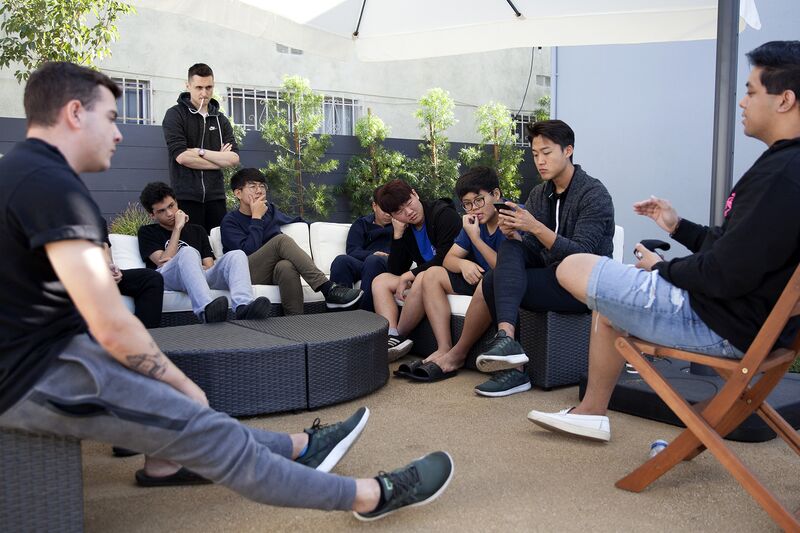
A team meeting at the new Immortals and Los Angeles Valiant training facility located in Los Angeles.
Photographer: Troy Harvey

The Immortals now fields teams playing four games, including Valve Corp.’s Dota 2 and Nintendo Co.’s Super Smash Bros. The company failed to win a League of Legends franchise, despite having a team in a prior version of the league and seeming like a shoo-in to everyone in the industry. “I won’t lie, I’m disappointed, even a little heartbroken, in not being able to participate,” Whinston said in a video statement to fans.

In an online chat with fans, Riot Games esports executive Chris Hopper declined to discuss why some teams didn’t make the cut, calling the decision “really difficult.”

Esports competitions generate money from ticket sales, corporate sponsorships and team merchandise. The Immortals’ sponsors come from the video game world: HP Inc., chairmaker LF Gaming and Bloody Gaming, which sells mouses and other accessories. Stein’s Team Liquid has 12 sponsors including Monster Beverage Corp. listed on its website.

Whinston’s company houses its two dozen pros in an apartment building in Marina Del Rey. Players practice from 10 a.m. to 6 p.m. at the Immortals’ Culver City campus. They scrimmage and in some cases play other teams, working from inside a handful of garage-like “pods.” Lunch and dinner are provided. Physical therapists and sports psychologists are on call.

The 20,000-square-foot property is among the first standalone training facilities for esports. Previously players lived and practiced in houses rented by the company. Whinston lived in one with nine other people. “I lasted 18 months,” he said. When the new Overwatch League season starts, teams will compete in a theater Activision leases in Burbank, California.

Whinston said his approach to picking teams involves a mix of data and human dynamics. Eight of his 11 Overwatch players are under 20 years old, green even by esports standards. Seb Barton, a U.K. native who goes by the name Numlocked, is an elder statesman at 24. He’s an important part of the team, Whinston said, because his effusive personality rallies others when they’re not performing well.

“We’re not looking to go out there, sign the biggest name free agents, and just try to throw them in a room and hope it all works out,” Whinston said. “We’re not the New York Yankees of esports. We’re not trying to be.”

—With assistance from Eben Novy-Williams

Source: https://www.bloomberg.com/news/articles/2017-11-28/how-a-23-year-old-gamer-got-billionaires-to-back-his-esports-team

Marijuana Company of America $MCAO Provides Update on 30,000 Sq. Ft. Cultivation Facilty in Washington State $AERO $CBDS $CGRW $APH.ca $GBLX

Posted by AGORACOM-JC at 8:47 AM on Tuesday, November 28th, 2017

15233 mcoa

  • Announced that it’s joint venture partner, Bougainville Ventures, Inc., initiated construction on a 30,000 square foot cultivation facility in Washington state
  • Delivery of the first pre-designed greenhouses, with full tracking and reporting protocols, is expected to be completed this week for the I-502 facility

Escondido, California–(November 28, 2017) – MARIJUANA COMPANY OF AMERICA INC. (OTC: MCOA) (“MCOA” or the “Company“), an innovative hemp and cannabis corporation, is pleased to announce that it’s joint venture partner, Bougainville Ventures, Inc., initiated construction on a 30,000 square foot cultivation facility in Washington state. The delivery of the first pre-designed greenhouses, with full tracking and reporting protocols, is expected to be completed this week for the I-502 facility. The site will eventually consist of 6 greenhouses providing a total of 30,000 sq. ft., of cultivation area. The construction is expected to be completed in February of 2018.

This one acre footprint of greenhouse is anticipated to be a technologically advanced and predominantly automated cannabis production facility. The Company also has an option to purchase additional contiguous acreage and so may choose to expand its leasehold in the area. Bougainville Ventures, Inc. anticipates the facility to be capable of producing in excess of 12,000 lbs. of high quality cannabis annually once the cultivation area is fully built out. The location of the new facility provides access to transportation, industrial infrastructure, power, water, gas, and courier services.

Donald Steinberg, CEO of the Company, observed: “We have raised eight hundred thousand dollars and have issued fifteen million shares of the Company’s common stock, per the revised agreement with Bougainville Ventures, Inc. The tenant is in the process of obtaining approval of plans and issuance of permits from Okanogan County and Washington State Liquor Control Board (WSLCB) to authorize construction on the first phase of the project. This transaction enables the joint venture to install 4 of the 6 design automated greenhouse systems.” Mr. Steinberg also added “The attainable goal for the joint venture is to deliver the finished project early in Q1 2018 so that our tenant can begin producing revenues shortly thereafter.”

Additional details on this specific project will be announced in the coming weeks. MCOA continues to be a company pursuing aggrotech, cannabis, and advanced organic greenhouse farming assets. Meanwhile, for more information on this project including images of the jobsite, please visit: http://marijuanacompanyofamerica.com/

About Bougainville Ventures, Inc.
Bougainville Venture Inc. is in the core business of converting irrigated farmland that was traditionally used to grow marginally profitable feed crops, to greenhouse-equipped farmland used to grow luxury crops with a primary focus on marijuana. Bougainville is an agricultural services company that focuses on providing growers with state-of-the-art computer controlled greenhouses and processing facilities. Bougainville offers fully built out turnkey solutions to licensed I-502 tenant-growers and luxury crop growers who will lease the facilities for production and processing. MCOA does not “touch the plant” and only provides growing infrastructure as a landlord for licensed marijuana growers in the state of Washington. Bougainville has a strong management team with relevant experience and education in place with a focus on build-out and occupancy of its planned greenhouses in Oroville, WA. Strategic plans to expand its land bank, greenhouse campus and I-502 tenant-grower clients are scheduled for expanding operations.

About Marijuana Company of America, Inc.
MCOA is a corporation which participates in: (1) product research and development of legal hemp-based consumer products under the brand name “hempSMART™”, that targets general health and well-being; (2) an affiliate marketing program to promote and sell its legal hemp-based consumer products containing CBD; (3) leasing of real property to separate business entities engaged in the growth and sale of cannabis in those states and jurisdictions where cannabis has been legalized and properly regulated for medicinal and recreations use; and, (4) the expansion of its business into ancillary areas of the legalized cannabis and hemp industry, as the legalized markets and opportunities in this segment mature and develop.

Forward Looking Statements
This news release contains “forward-looking statements” which are not purely historical and may include any statements regarding beliefs, plans, expectations or intentions regarding the future. Such forward-looking statements include, among other things, the development, costs and results of new business opportunities and words such as “anticipate”, “seek”, intend”, “believe”, “estimate”, “expect”, “project”, “plan”, or similar phrases may be deemed “forward-looking statements” within the meaning of the Private Securities Litigation Reform Act of 1995. Actual results could differ from those projected in any forward-looking statements due to numerous factors. Such factors include, among others, the inherent uncertainties associated with new projects, the future U.S. and global economies, the impact of competition, and the Company’s reliance on existing regulations regarding the use and development of cannabis-based products. These forward-looking statements are made as of the date of this news release, and we assume no obligation to update the forward-looking statements, or to update the reasons why actual results could differ from those projected in the forward-looking statements. Although we believe that any beliefs, plans, expectations and intentions contained in this press release are reasonable, there can be no assurance that any such beliefs, plans, expectations or intentions will prove to be accurate. Investors should consult all of the information set forth herein and should also refer to the risk factors disclosure outlined in our annual report on Form 10-12G, our quarterly reports on Form 10-Q and other periodic reports filed from time-to-time with the Securities and Exchange Commission. For more information, please visit www.sec.gov.

For more information, please visit the Company’s websites at:

MarijuanaCompanyofAmerica.com
hempSMART.com
agoracom.com/ir/MarijuanaCompanyofAmerica

Marijuana Company of America, Inc.
Investor Relations
1+(888)-777-4362
Communications Contact:
NetworkNewsWire (NNW)
New York, New York
212.418.1217 Office

FEATURE: American Creek $AMK.ca JV Drill Program is Well on Its Way to Defining a #Gold Resource $SEA $SA $SKE.ca $TUD.ca $PVG

Posted by AGORACOM-JC at 2:51 PM on Monday, November 27th, 2017

AMK: TSX-V, OTCBB: ACKRF

RECENT HIGHLIGHTS

  • Encountered numerous high grade gold/silver intercepts in preliminary drilling at the new HC zone at the Treaty Creek Project Read More
  • Additional gold discovery of 5.1m of 9.57 g/t gold from 249.35m to 254.45m Read More
  • Discovered a New Gold Zone at Treaty Creek: 110 M of 0.909 g/t Gold, Upper 316 M of Hole Yet to Be Assayed
  • Specimens from the Electrum property average 27,092 gm/tonne silver and 248 gm/tonne gold. Read More
  • Completed the previously announced Magnetotelluric survey and has commenced drilling Read More
  • Hole CB-16-03 returned 0.526 g/t gold over 629.7 meters
  • Included within this wide 629.7 meter interval is 338 meters of 0.70 g/t gold
  • Also included 54 meters (from 88 to 142 meters) of 1.117 g/t gold and 122 meters of 0.965 g/t gold
  • Reports that drill program is well on its way to defining a Gold Resource

View Presentation

$AAO.ca Augusta Industries Through Its Sub FOX-TEK Receives a Contract for an Application in the Nuclear Space

Posted by AGORACOM at 12:36 PM on Monday, November 27th, 2017


  • FOX-TEK Canada Inc. received a contract for phase one ( proof-of-concept application) in the Nuclear Space
  • Will demonstrate technological ability to measure minute changes in pressure in a test pipe.
  • “Contract represents a first big step toward serving a new market and an exciting space for the Corporation.”

Toronto, Ontario–(November 27, 2017) – Augusta Industries Inc. (TSXV: AAO) (the “Corporation”), a developer and marketer of patented non-intrusive sensing systems, is pleased to announce that its wholly-owned subsidiary, FOX-TEK Canada Inc. (“Fox-Tek”), received a contract for phase one (a proof-of-concept application) in the Nuclear Space. For this application FOX-TEK will look at the use of its high precision Fiber Bragg Grating (FBG) acquisition equipment to measure very small changes in strain in injector ports.

If successful, the technology will be incorporated within the end users injection control system to verify (in real time) that the injection ports are not clogged. This will be part of a safety program due to the material being transported to the injectors. A failure of the injectors could lead to a hazardous situation.

The proof-of-concept will demonstrate that the technology will be able to measure minute changes in pressure in a test pipe. A number of FBG sensors will be mounted on the test spool for validation of the technology.

“This is an example of the Corporation’s strategy to expand our bandwidth and offering New technologies and concepts. We pursuing markets untapped in the past with new concepts and applications in the Industrial Nuclear arena,” commented Allen Lone, President and CEO of the Corporation. “This contract represent a first big step toward serving a new market and an exciting space for the Corporation.”

About the Corporation

Through its wholly owned subsidiaries, Marcon International Inc. (“Marcon”) and Fox-Tek Canada Inc. (“Fox-Tek”), the Company provides a variety of services and products to a number of clients.

Marcon is an industrial supply contractor servicing the energy sector and a number of US Government entities. Marcon’s principal business is the sale and distribution of industrial parts and equipment.

Fox-Tek provides world leading solutions to various sectors including the oil and gas industry. With non-intrusive technologies including fiber-optic sensors and electric field mapping systems, Fox-Tek is able to accurately measure changes that could negatively impact our client’s operations.

Corporation Contact:

Allen Lone, President, CEO, Augusta Industries Inc.
Tel: (905) 275 8111 Ext 226, email: [email protected]

Life in an #Esports gaming house with #Schlinks $GMBL $ATVI $TTWO $GAME $EPY.ca

Posted by AGORACOM-JC at 11:34 AM on Monday, November 27th, 2017

It’s essentially every gamer’s wildest fantasy – living in a house full of other esports enthusiasts.

  • Essentially every gamer’s wildest fantasy: Living in a house full of other esports enthusiasts, where everyone understands that online games can’t be paused
  • But for esports pros, gaming house life is even more valuable than not being nagged to empty the dishwasher all the time – it allows teams to bond and gel on all-new levels.
27 November 2017 – 17:01 By Good Luck Have Fun

Image: Scott Peter Smith

It’s essentially every gamer’s wildest fantasy: Living in a house full of other esports enthusiasts, where everyone understands that online games can’t be paused. But for esports pros, gaming house life is even more valuable than not being nagged to empty the dishwasher all the time – it allows teams to bond and gel on all-new levels.

The concept of gaming houses is new to the South African esports scene, so naturally there’s a lot to be learned from the first MGO to do it, White Rabbit Gaming. We managed to get over our jealousy long enough to catch up with Nicholas ‘Schlinks’ Dammert about what it’s like to literally be living the dream.

“Since WRG were the first in the local scene to venture into the whole idea of gaming houses, I was really excited for this new adventure. Initially I thought it would be quite hard to adjust to the new living circumstances and the change of scenery (Capetonian for life). I expected most of my days to be quite repetitive and restricted, but nevertheless would enjoy the tough grind. “It turned out to be extremely liberating. Outside of team obligations (practices, tournaments) you’re in control of whatever you want to do. On off days you could go read a book, watch series or spend your time visiting new places and experiencing new things. Although it took some time to get used to, the gaming house started to feel like a second home and the change of scenery was hardly noticeable.”

SA gets its first house of gaming – yes, an actual house

In what many consider to be a significant step in local esport development, South Africa now has its own dedicated gaming house
Sport
2 months ago

A man after our own hearts – #capetown4lyf. We had to try hard to not make the rest of the interview about how great Cape Town is. Fortunately for you, our self control is excellent.

When gaming is such a massive part of your life, it must be, as Schlinks says, “extremely liberating” to be able to just focus on what you do best. It allows the players to dive right into the competitive side.

“The grind was really fun. When we’re motivated and every one of us are all playing tons of Dota, matching into each other (in solo queue) or against one another, there’s really high spirits in the team (special shoutout to Castaway’s mid Techies vs my offlane Dazzle in ranked). “Most importantly, every time we managed to achieve a good result against a notable team or placed high in online international tournaments we could all celebrate our achievements together.”

Instead of whooping and hollering over Discord or TeamSpeak, these guys get to walk right up to each other after an online win, high five, tap a few bums, hug it out in a manly fashion and crack a beer in appreciation – adopting the best elements of traditional team sports.

But when you’re living in a gaming house, are you allowed to do anything other than game, eat, sleep, repeat? Are you even allowed to eat and sleep?

“It all depends on whether Dota 2 is getting any local action. While us Dota players are fortunately able to practice on international servers with only minor drawbacks, it’s fairly difficult to maintain a hyper-competitive mindset all the time – it all depends on the competitive climate. “Basically, if there aren’t many international qualifiers or local tournaments being held, us WRG players take a more mellow approach and prefer to play solo queue or relax. But don’t be fooled – we practice a damn load and intensely when we are in that competitive mindset. “On a good day I would play for about 8 hours (practice/solo queue) – taking breaks to walk to the local convenience store and spending some time with the boys while we cook/eat dinner. On lazy days I would watch series all day and order take-out. “As surprising as it may seem, we do tend to go out a fair bit. I believe it’s important to get that little break from the surreal life of full-time gaming and enjoy the time we spend out of the house. We tend to usually walk to the shop around lunch time every day and some of the WRG guys go gymming every few days. Depending on the mood, we also spontaneously visit the casino and have some good nights out around Joburg. Good times.”

It all sounds too good to be true, but Schlinks assures us it was all very real. And yes, we’re nerdgasming over here too.

While there were obvious benefits, there were a few bugs that needed patching too, which is to be expected when you put five highly-competitive individuals in such close quarters for too long. But even those issues were resolved by the magic of the gaming house.

“The positives were very clear. Our performance in-game and communication improved significantly over the competitive Dota season (locally and internationally). The only negative I could point out is the clashes amongst players, but as of late these issues have been rectified via open communication between players and the support we offer one another. “You learn a lot about your teammates once you spend upwards of 75% of your time with them for months at a time. Thankfully we all get along really well and I have come to respect each of them. As time passes it’s typical that some personal issues or clashes ensue, but they’re generally very small-scale and we resolve them swiftly and maturely (while others in the team prefer to box it out – no kidding. Kicking too).”

Competition is tough for the South African Dota 2 circuit but international play is what will really improve your game, say gamers.
Image: Scott Peter Smith

For those of you who don’t stalk local esports players like we do, Schlinks moved back home to Cape Town a few weeks ago. Given the success of the whole experience, this left a couple of onlookers speculating about his future at WRG. But fear not, he ain’t goin’ nowhere. Except for, like, back to Joburg. Poor guy.

“As many people know, the Dota 2 competitive scene in South Africa has largely been on hold for the latter part of the year. Internationally however, the Dota 2 competitive scene has completely restructured and now works in qualifier ‘blocks’ (periods of which many qualifiers are held).

“Once these blocks were finished, I felt the majority of my days were lazy days. I figured I needed a break from the mild pressure of practicing and flew back home to Cape Town – where I am seriously contemplating my Dota 2 career for the upcoming year. However, the move back is only temporary and as soon as things spice up in the local Dota 2 scene I’ll be on the next flight back to the gaming house.”

The benefits of gaming houses are clear, with one of the top Dota players in the country vouching for their efficacy. But are they vital for team growth and progression?

“While they’re a great benefit to any team that would utilise them correctly, I don’t think they’re necessary for that next level.

“The current situation is that esports in SA has – for the most part – been circulating around itself with regards to playstyles, strategies and general competitiveness. The level of competitiveness in SA has been maximised and we need to look overseas in order to expand.

“Thus, for us to reach the next level of competitiveness we would need to have achieved reputable results in international events (‘putting SA on the map’) and in order to get good results teams need to be exposed to these international teams’ level of competitiveness.”

The gaming house life has certainly helped WRG improve as a team. They have the freedom to train as much as they like, their communication skills are getting almost as good as their Dota skills, and they’ve got the international results to show for it. So, while not vital to the scene, gaming houses do seem to play a part in getting us some international exposure.

We’ll leave you today with Schlinks’ answer to our ultimatum: Gaming house and no salary, or salary and no gaming house?

“I’d definitely choose both options – a luxurious gaming house as well as a hefty salary.”

Nope, that’s not how ultimatums work, bro.

“If I had to choose, my answer would be the salary. The reason being: While a gaming house helps in most aspects of gaming, I think the main objective of a gaming house can primarily be achieved by a bootcamp before a tournament. On the other hand, a salary changes the game entirely.

“If salaries were mainstream it would stabilise the competitive scene in many ways. More players would find themselves in an adequate financial state from gaming revenue. This will result in growth amongst the entire competitive scene as we see less players leaving the scene, more players entering the competitive sphere, fewer players jumping ship and switching to other teams and overall less emphasis on trying to place first at every event.

“The point of less pressure on placing first alone encourages practice amongst teams on a local scale and I think we will see the scene expand at a rapid rate – both in mentality about practicing (thus competitiveness) and the pure number growth.”

There you have it MGO owners. If you’re thinking about renting a house for your teams, rather consider putting that money towards stable salaries for the players. But if you’re feeling generous, get them a nice little house too. Preferably in Cape Town.

Source: https://www.timeslive.co.za/sport/2017-11-27-life-in-an-esport-gaming-house-with-schlinks/

Deal-Making in the #Cannabis Industry Hits an All-Time High: What It Means for #Marijuana Stocks $TBP.ca $N.ca $MCOA $ATT.ca $ABCN.ca $ACG.ca $ACB

Posted by AGORACOM-JC at 10:12 AM on Monday, November 27th, 2017

Could more deals mean more dollars for marijuana stock investors?

  • If it seems like there’s been a spurt of deals and potential deals going on in the cannabis industry lately, it’s because that’s exactly what’s happening.
Keith Speights
Nov 27, 2017 at 9:16AM

Canopy Growth Corporation (NASDAQOTH:TWMJF) scored what was probably the most highly publicized deal with large beverage company Constellation Brands (NYSE:STZ) buying a 9.9% stake in the Canadian marijuana grower for $245 million. But Canopy has also forged other agreements with smaller companies both before and after the Constellation partnership.

More recently, Aurora Cannabis (NASDAQOTH:ACBFF) launched a takeover bid for CanniMed Therapeutics. Aurora had wanted CanniMed’s board of directors to agree to an acquisition proposal made last week. When the board failed to respond, Aurora moved forward with its unsolicited takeover attempt.

Major deal-making in the cannabis industry is hitting an all-time high. Here are three ways it impacts not just the parties involved but marijuana stocks in general.

Image source: Getty Images.

1. Acceptance of the cannabis industry

While it’s true that more people have accepted legalization of both medical and recreational marijuana than ever before, the cannabis industry hasn’t entirely been viewed as part of the mainstream economy in the past. I think Constellation Brands’ partnership with and investment in Canopy Growth changes that significantly.

Constellation Brands isn’t a small fish in the pond. The company is a member of the S&P 500 and has a market cap of $43 billion. Its decision to partner with Canopy Growth amounted to an endorsement of the cannabis industry — at least in Canada. However, Constellation’s move could also lead to greater acceptance of the cannabis industry in the U.S.

The company’s CEO, Rob Sands, said in an interview with The Wall Street Journal, that Constellation thinks that legalization of recreational marijuana in the U.S. is “highly likely, given what’s happened at the state level.” Although Constellation Brands is echoing the stance taken by Canopy Growth of only selling marijuana in markets where it’s legal at a federal level, the prospects of future legalization throughout the U.S. can only be helped by a major company like Constellation making a big investment in a marijuana grower.

2. Acceleration of more deal-making

There have been plenty of deals that haven’t received quite as much attention as Constellation’s investment in Canopy Growth and Aurora Cannabis’ takeover attempt of CanniMed. For example, Canopy Growth recently acquired small Canadian medical marijuana grower TerrAscend. Earlier this month, Aurora increased its stake in Hempco Food and Fiber to more than 50%.

Image source: Getty Images.

There’s something of a “me, too” factor when mergers and acquisitions activity picks up. Companies that haven’t been making big deals can be spurred to action in fear of missing out.

Canopy Growth is currently the biggest marijuana grower in Canada. I have no doubt that its size made a difference in Constellation Brands choosing Canopy Growth as a partner. But Aurora Cannabis could become the largest marijuana grower (at least in terms of market cap) if its attempt to buy CanniMed is successful.

Just imagine what’s going through the minds of the executives running other major marijuana growers in Canada. If you’re the CEO of MedReleaf (NASDAQOTH:MEDFF) or Aphria (NASDAQOTH:APHQF), you have to at least be thinking about making some deals of your own.

In fact, MedReleaf recently announced a stock offering that will generate $100.5 million. What will this money be used for? The company intends “to finance the acquisition and/or construction of additional cannabis production and manufacturing facilities in Canada as well as in other jurisdictions with federal legal cannabis markets.” In other words, expect an acceleration of deal-making in the cannabis industry.

3. Attraction of more investors

My view is that deal-making in any industry attracts more investors to stocks in that industry. I see it happen frequently in the bopharmaceutical world, where the possibility of mergers and buyouts tends to bring some individual investors off the sidelines. I suspect that’s what is happening already and will only pick up in the months ahead.

There are several factors that could contribute to this. Size matters for many investors who are leery of putting their money into companies that are small. Deals also make headlines, and therefore bring the involved stocks to the attention of more investors.

Another key reason why I suspect the recent deals for marijuana stocks could attract more investors is the bandwagon effect. That’s especially applicable with Constellation Brands’ investment in Canopy Growth. Some individual investors are likely to think, “If a big company like Constellation thinks it’s a good investment, it probably is a good investment.” I’m not saying that line of thinking is necessarily correct, but I’d bet plenty of people have similar thoughts.

Adding it all up

So what does all of this mean for marijuana stocks in general? It should be good news.

Smaller companies could find themselves takeover targets of somewhat larger companies, just like the situation with CanniMed and Aurora Cannabis. Relatively larger companies like Aurora, Aphria, and MedReleaf could attract the attention of other alcoholic beverage makers not wanting to be left behind by Constellation Brands in a potential cannabis-infused beer market.

I think these and other Canadian marijuana stocks should go higher in the coming months. This won’t be driven entirely by mergers and acquisitions, though. Legalization of recreational marijuana in Canada in 2018 will be the biggest catalyst.

At the same time, investors shouldn’t throw out all the traditional rules of investing in stocks. Look at the underlying businesses, growth prospects, and valuations before investing in any stock. After all, the most important deal is the one that requires you to put your own hard-earned money at stake.

Tom Gardner: Forget Aurora Cannabis Inc.! This buying opportunity is bigger than I ever imagined…

A few months ago, Motley Fool CEO Tom Gardner recently discovered what he considers the greatest buying opportunity he’s seen in more than a decade… within a group of stocks no one is talking about. On Monday, November 27, at 9:30 A.M. ET, Tom is making an important announcement where he will discuss this buying opportunity and how it potentially impacts any investor in the market today. To learn how to access Tom’s timely update, click the button below.

Source: https://www.fool.com/investing/2017/11/27/deal-making-in-the-cannabis-industry-hits-an-all-t.aspx