Agoracom Blog Home

Author Archive

Gold Stocks Take Flight SPONSOR: Labrador Gold $LAB.ca $RIO.ca $WHM.ca $SIC.ca $NXS.ca

Posted by AGORACOM at 10:02 AM on Friday, May 8th, 2020

SPONSOR: Labrador Gold – Two successful gold explorers lead the way in the Labrador gold rush targeting the under-explored gold potential of the province. Exploration has already outlined district scale gold on two projects, including a 40km strike length of the Florence Lake greenstone belt, one of two greenstone belts covered by the Hopedale Project. Recently acquired 14km of the potential extension of the new discovery by New Found Gold’s Queensway project to the south. Click Here for More Info

  • Gold Bullion Surges above March Lows
  • Gold Mining Equities Track Gold Higher
  • Gold Mining Equities vs. S&P 500 Show Convincing Breakout

Markets Recalibrate

Capital markets and society continue to recalibrate from the enormity of the fallout of the COVID-19 pandemic. As difficult as the current situation is, gold fundamentals continue to improve. Gold, as an investment, offers a hedge against the current financial turmoil and has significant capital appreciation potential in the years ahead.

The magnitude of central banks and government actions over the past several weeks will resonate for the rest of this decade. In our March commentary (March Roars in Like a Lion), we mentioned that we are now in the “end game” where debt explodes in the face of a financial calamity (although no one predicted that it would be a pandemic). We will discuss what near-term options the U.S. Federal Reserve (“Fed”) will likely implement, and how gold is likely to respond. We will also look at the recent move higher for gold mining equities.

Gold Bullion: Increased Demand for Physical Gold

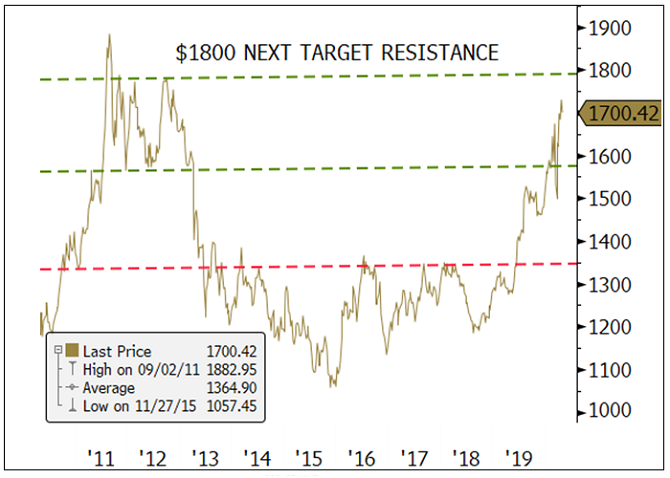
Gold bullion ended April at $1,687, adding $109/oz, or +6.9% for the month. Gold began its surge in early April as physical delivery shortages resulted in gold futures (COMEX, New York) trading wildly higher than spot gold (London). COVID-19 has caused refining capacity for gold to decline and greatly restricted the transport of physical gold from London to New York. Typically, gold futures trade fairly tight with spot gold due to arbitrage, but in early April, the spreads spiked as high as $70/oz. The unprecedented fiscal and monetary policy response to the worst economic shock since the Great Depression has put gold squarely into investors’ minds.

Gold is almost always in contango (longer-dated contracts are more expensive than the near month). In April, parts of the gold futures curve traded in a rare backwardation (the near month contract is more expensive), usually indicative of a supply shortage. With the usual gold channels disrupted, futures are pulling spot prices higher as short positions are closed by going long futures. Compounding the disruption was the growing demand for gold in physical form, fueled by soaring investor buying interest. The unprecedented fiscal and monetary policy response to the worst economic shock since the Great Depression has put gold squarely into investors’ minds.

Figure 1. Gold Bullion Surges above March Lows
Our short-term target is $1,800, and we expect to reach new all-time highs.

Source: Bloomberg. Data as of 4/30/2020.

Gold Mining Equities: Convincing Breakout in April

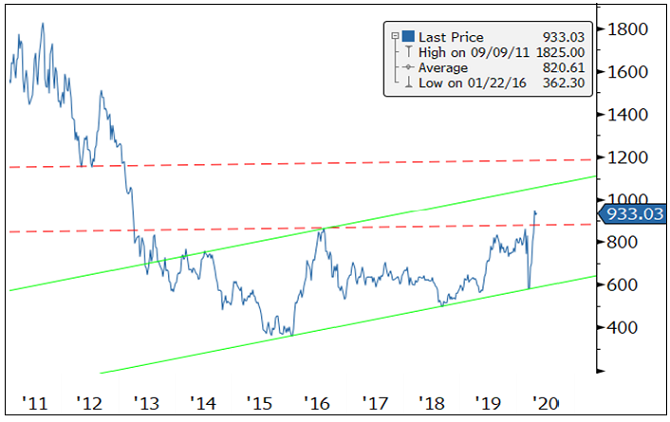
Gold equities broke out of a multi-year resistance level on massive buying flows. Using the NYSE Arca Gold Miners Index (GDM)5 as a reference, the 860 index resistance level was taken out convincingly. As shown in Figure 2, there is very little meaningful resistance until 1,200 (+25%). In March, gold equities, like bullion, experienced a forced liquidation event. Selling in GDX forced the ETF to trade at a significant discount to its underlying net asset value (NAV). Like many other ETFs, the selling volumes in GDX outpaced the liquidity in the underlying securities. Off the lows, the price action as measured by volume, breadth and money flow far exceeds the bullish thrust of the 2019 summer rally. This breakout, without question, is impressive on the technical measures.

Figure 2. Gold Mining Equities Track Gold Higher
The NYSE Arca Gold Miners Index (GDM) has broken out of a broad base pattern; our short-term target is 1,200.

Source: Bloomberg. Data as of 4/30/2020.

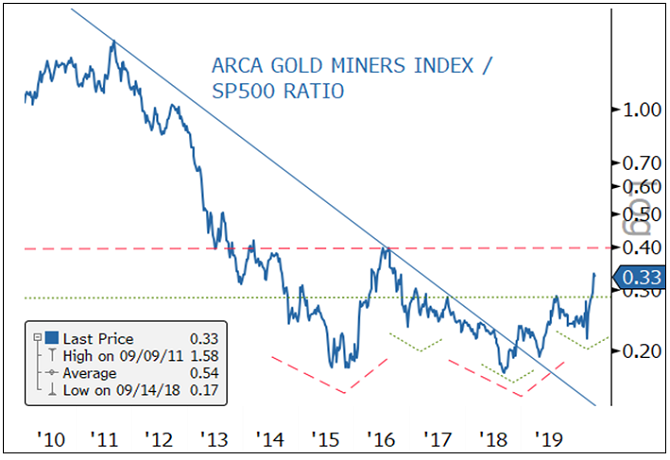
The absolute price action is impressive, but when measured relative to the S&P 500 Index6 (Figure 3), the chart pattern looks even more impressive. Typically, new market leadership is more evident when measured against the broad market index. As shown in Figure 3, the NYSE Arca Gold Miners Index (GDM) relative to the S&P 500 Index has put in a very bullish bottom base pattern. There is a double bottom pattern set up with the right bottom shaping a head and shoulder breakout pattern. This bullish pattern within a bullish pattern is a very positive sign.

Figure 3. Gold Mining Equities vs. S&P 500 Show Convincing Breakout
GDM is putting a remarkable long-term basing chart pattern and breaking out in the medium term.

Source: Bloomberg. Data as of 4/30/2020.

Increasing Revenue with Deflationary Input Costs

The gold mining industry, like many other industries, is experiencing disruptions due to pandemic shutdowns. But unlike other industries, gold producers are experiencing a steep increase in the selling price of its product. Gold bullion is up +11% year to date and up over +31% year-over-year (through April 30, 2020). From a cost perspective, energy and labor are typically the two highest cost components for miners. The dramatic fall in crude oil is a rare function of both a supply shock (the Organization of the Petroleum Exporting Countries [OPEC] price war) and a demand shock (pandemic shutdowns) co-occurring. The enormity of both events will have lasting price consequences well beyond a few quarters. Labor, the other component, has been devastated by the pandemic. A tremendous labor crisis is occurring globally. In the U.S. alone, jobless claims have now exceeded 30 million, a crushing toll. Both of these conditions are deflationary shockwaves that will ripple out to all corners of the economy. There is virtually no major cost component (reagents, consumables, equipment) that will not see lower costs. Though near-term gold company earnings may be volatile due to COVID-19 disruptions, the potential increase in long-term profit margins may be unlike anything seen in recent history, and most comparable to the 1930s when gold company revenues soared and costs plummeted.

As QE (quantitative easing) Infinity continues to expand and ZIRP (zero interest rate policy) takes hold in a likely recession (or depression), growth equities will become highly sought after. Gold mining equities will have one of, if not the highest growth in earnings of any industry. Because of the nature of its revenue product (gold bullion), and its input costs (deflation), gold equities will likely develop into a convexity trade. Relative to the broad market, gold mining equities have a more direct path to higher prices. In the absence of earnings and post liquidity lift, general market equities require QE to increase stock prices by suppressing the risk-free rate and credit spreads, thereby reducing the discount rate used to calculate the present value of cash flows. Currently, cash flows are near impossible to forecast. The broad market equity risk is if earnings do not recover for more than a year due to COVID-19 and/or if a risk event pushes up credit spreads (i.e., credit defaults). Both risks are quite high compared to the risk for gold mining equities.

The Likely Market Impact of the Fed Stimulus and Fiscal Policy Response

At the end of April, the Fed Balance Sheet had expanded to $6.66 trillion (previous high was $4.5 trillion) and will climb higher. The final number is unknown due to moving variables and the lack of visibility, but $10 trillion by summer is in the ballpark. The deficit for 2020 is estimated to be $3.7 trillion (18% to 20% of gross domestic product [GDP]), an all-time high with risk to the upside. The debt-to-GDP current expected range of 110% to 120% will probably prove to be too low despite being the highest ever. More billions of dollars, week by week, are being added to a dizzying array of Federal programs, credit facilities and swap lines to mitigate the damage of the pandemic.

The amount of debt is genuinely numbing in its size and scale and will keep growing. Long term, there is very little hope that the economy can grow out of this debt load. To manage this debt, we believe the Fed will need to implement three broad conditions: 1) negative real yields, longer and lower than previously expected; 2) yield curve control to maintain a flat and low rate structure, and 3) a weaker or capped U.S. dollar.

1) Negative Real Interest Rates

We have discussed numerous times the importance of negative real interest rates in reducing (debasing) the debt. The huge increase in debt levels and the likely lingering effects of COVID-19 on the global economy will assure that negative real interest rates will be here for years. There will be a persistent and growing erosion of wealth via negative real yields.

Figure 4. U.S. Real Yields Near Zero
The Fed Funds target rate is 0.00-0.25%, and real yields are approximately -0.43%. Gold tends to thrive in low-interest rate environments. 
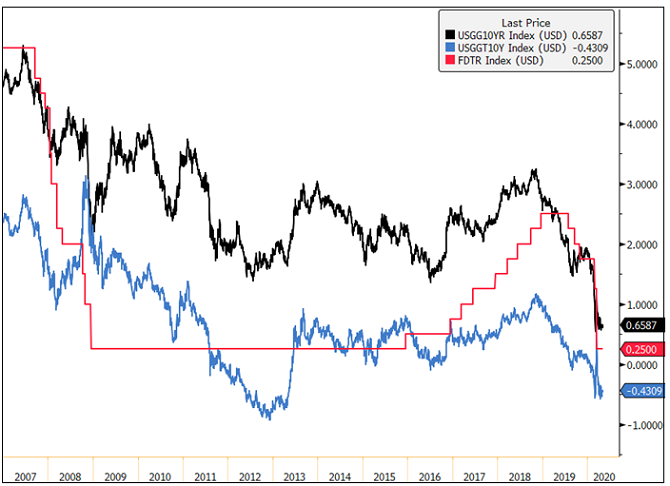
Source: Bloomberg. Data as of 5/5/2020. Nominal yields are measured by the USGG10YR Index, representing U.S. generic 10-year bond yields. Real yields are measured by USGGT10Y Index, representing U.S. 10-year TIPs (Treasury Inflation Protected) yields. The FDTR Index represents the Federal Funds Target Rate, which is set by the central bank in its efforts to influence short-term interest rates as part of its monetary policy strategy.

2) Yield Curve Control

Yield curve control was last used during World War II to finance the war. As the term implies, the U.S. government exerted control on both ends of the curve. Yields were capped with the short end lower than the long end. The long end was capped at around 2% irrespective of the economic condition. Controlled low yields provided a stable and manageable interest expense. By issuing more Treasuries in the short end, the government encouraged investors to borrow at the short end and to lend in the long end. Also, by issuing more at the short end of the curve, it ensured there was constant ample liquidity searching for yield. Today’s world is vastly different, but we expect to see a similar effort to control the yield curve. The Fed will continue to use QE Infinity to monetize the majority of bond issuances with an effort to keep rates as low as possible and the curve as flat as possible. For example, the $2.2 trillion of fiscal stimulus announced in March has already been monetized; 10-year Treasury yields are around 0.60% and the Fed Fund Rate is at zero.

3) Lower or Capped U.S. Dollar

We have also discussed the importance of a weaker U.S. dollar in previous commentaries. The impact of the global pandemic and the total collapse of crude oil pricing has elevated the importance of the U.S. dollar significantly. The sudden deceleration in global economic activity has dramatically reduced the flow of U.S. dollars. The U.S. dollar is the world’s reserve currency; about 60% to 70% of the world’s economic activity is transacted in U.S. dollars. Crude oil is one of the most critical sources of U.S. dollar liquidity. At year-end, an oil market of 100 Mb/d (million barrels a day) at $50 per barrel equated to $1.8 trillion of yearly U.S. dollar flows. Today, at 75 MB/d at $20 per barrel, crude oil-based U.S. dollar flows are now at $0.55 trillion. Now apply that to every industry that transacts globally, and the magnitude of U.S. dollar funding shortage becomes apparent.

There is an estimated $12 to $13 trillion of U.S. dollar-denominated debt held by foreign holders. The U.S. dollar is now the biggest financial short and there is a massive ongoing short squeeze as the global shutdown makes funding and servicing of this debt difficult. That the U.S. has launched trillions in fiscal and monetary stimulus, and the U.S. dollar has barely budged is an alarming sight. A runaway U.S. dollar in a financial and economic crisis coupled with a deflationary shockwave would be nothing short of a disaster scenario. In March, we had a small taste of what a U.S. dollar funding shortage and dollar hoarding had on global liquidity.

If the Fed has any chance of making this version of MMT (modern monetary theory) work, it will do everything in its power to keep the U.S. dollar in check and control a flat yield curve. Fighting the Fed’s efforts is this significant mismatch between U.S. dollar assets and liabilities. Historically, this has been the justification to devalue the dollar (or the prevailing reserve currency at the time) to bail out the world. Price regime changes typically occur with currency debasements. If we reach the point where the U.S. dollar stages a significant uncontrolled breakout higher, gold will spike as the market begins to price in the possibility of a reset of asset prices. At that point, gold would become the ultimate convexity trade for U.S. dollar debasement. Dollar debasement is a key tail risk in the end game.

Figure 5. The U.S. Dollar (DXY): Highs of March 2020 will be a Crucial Level
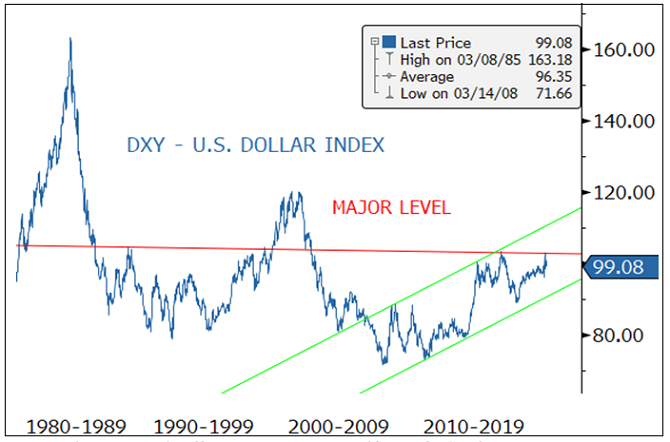

Source: Bloomberg. Data as of 4/30/2020.

A Realignment of Asset Classes

In just a few months, a global pandemic has caused a shutdown of the economy to an estimated tune of -25% annualized GDP for Q2, over 30 million U.S. workers filing jobless claims and trillions of dollars (and growing) added to the debt. Whether the news of the virus gets better or worse in the next few quarters, we will be in a ZIRP environment for years due to the debt level. With the Fed capping rates, yields will remain low and the curve flat whether the economic recovery is V-shaped, U, L, or any other alphabet shape (yield curve control). The economy will no longer determine the level of interest rates and the yield curve. The Fed will keep real interest rates negative; the only question is how negative? Investing in Treasuries has moved from a “return on capital” to a “return OF capital” proposition. Investing in Treasuries today is an erosion of wealth in real dollar terms.

The broader U.S. stock market has now recovered a significant part of its decline entirely due to the sheer amount of stimulus thrown by the Fed. To value the equity market today would require a look past a deep valley of uncertain duration, to the other side that may be changed entirely. As companies pull guidance due to the lack of visibility, equities can only rise mainly by never-ending liquidity. Equity valuations are already back to their all-time highs. Equity markets, like the bond market, will continue to decouple from the economy further.

Gold Makes Sense as Equity Volatility Increases 

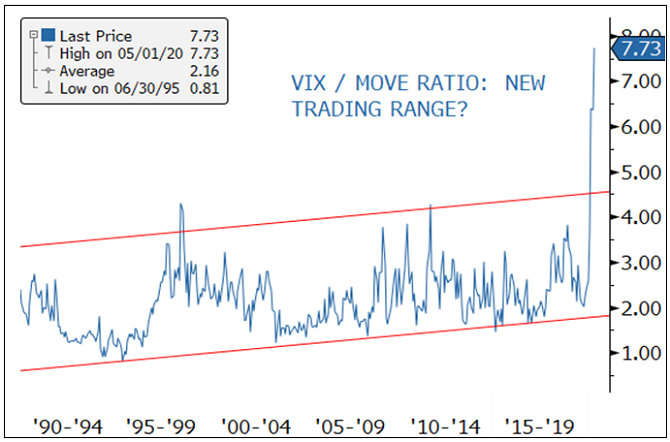
Moreover, if we are correct that the Fed’s main risk focus is containing the U.S. dollar and controlling the yield curve, equity risk (volatility) will trade higher vis-a-vis the U.S. dollar and bond prices than historical parameters (Figure 5). If this becomes the new reality, this repricing of volatility will have a dramatic effect on all asset classes. It will mean more effective equity hedges will be needed, such as gold. The one risk that the Fed cannot remove entirely is a tail risk event in which this current environment is a breeding ground.

Figure 6. Equity Risk Volatility is Trading Higher than Bond Volatility
The VIX7 (CBOE Volatility Index for equities) has likely entered into a new trading range relative to the MOVE Index8 (Implied volatility of Treasuries across the yield curve) with far-reaching consequences.

Source: Bloomberg. Data as of 4/30/2020.

SOURCE: https://sprott.com/insights/gold-stocks-take-flight/

https://sprott.com/insights/gold-stocks-take-flight/

Gratomic $GRAT.ca Granted a Comprehensive Mining Licence for Base and Rare Metals, Industrial Minerals and Precious Metals $SRG.ca $NGC.ca $LLG.ca $GPH.ca $NOU.ca #TODAQ $NMI.ca

Posted by AGORACOM at 9:54 AM on Wednesday, May 6th, 2020
http://blog.agoracom.com/wp-content/uploads/2019/09/GRAT-square2.png
  • Securing the mining licence is a critical step towards moving the Aukam Mine into commercial production
  • Gratomic can now produce a concentrate of up to 98% Cg
  • A PEA on the Aukam Processing plant to be undertaken
  • Diamond drilling will resume at Aukam Graphite mine

TORONTO, ON / ACCESSWIRE / May 6, 2020 / Gratomic Inc. (“GRAT” or the “Company”) (TSXV:GRAT)(FRANKFURT:CB81)(WKN:A143MR) is pleased to announce, further to its Press Release dated March 26, 2020, that it has received confirmation from the Ministry of Mines and Energy of Namibia that the Minister has issued Mining Licence 215 (ML215) for the Company’s Aukam Graphite Property in Namibia. The Licence covers Base and Rare Metals, Industrial Minerals and Precious Metals. The Licence area falls within the proximity of the Aukam Processing Plant and the Graphite bearing shear zone for a total of 5002 hectares (5002 ha). Securing the mining licence is a critical step towards moving the Aukam Mine into commercial production.

The Company has completed 8 months of pilot testing on historically mined product and conducted an internal study on the efficiency of the pilot processing facility on this material. Through rigorous testing and adjustments to the plant, Gratomic can now produce a concentrate of up to 98% Cg. Management has subsequently decided to build a 20 000 tonne per annum processing plant. To date, 90% of construction is complete. Upon completion of the remaining 10%, the Company will initially start processing material from historical workings left at the surface when the mine last operated in 1974.

The Company has recently appointed Dr. Ian Flint to complete a preliminary economic assessment on the Aukam Processing plant. The study, its recommendations, and their subsequent implementation, will ensure the scale up of the existing pilot plant to a commercial scale processing facility that will provide the desired concentrate grades and production rates.

With respect to site exploration, in the coming months diamond drilling will resume at Aukam Graphite. The drilling will be conducted utilizing Company owned drilling equipment, focusing on areas proximal to graphite mineralization, depicted by previous diamond drilling, underground excavation and surface outcrop sampling. The drill targeting will be systematic with the expectation of producing an NI 43-101 resource estimate.

Arno Brand, President and CEO of the Company stated that “we are thrilled to receive the official mining licence for the Aukam Graphite Mine in Namibia. This is a monumental milestone for Gratomic, which took an extensive amount of effort to accomplish. Once the funding is secured, Gratomic will be able to move into the commercialization phase of development.”

Risk Factors

No mineral resources, let alone mineral reserves demonstrating economic viability and technical feasibility, have been delineated on the Aukam Property. The Company is not in a position to demonstrate or disclose any capital and/or operating costs that may be associated with the processing plant.

The Company advises that it has not based its production decision on even the existence of mineral resources let alone on a feasibility study of mineral reserves, demonstrating economic and technical viability, and, as a result, there may be an increased uncertainty of achieving any particular level of recovery of minerals or the cost of such recovery, including increased risks associated with developing a commercially mineable deposit.

Historically, such projects have a much higher risk of economic and technical failure. There is no guarantee that production will begin as anticipated or at all or that anticipated production costs will be achieved.

Failure to commence production would have a material adverse impact on the Company’s ability to generate revenue and cash flow to fund operations. Failure to achieve the anticipated production costs would have a material adverse impact on the Company’s cash flow and future profitability.

Steve Gray, P. Geo. has reviewed and approved the scientific and technical information in this press release and is the Company’s “Qualified Person” as defined by National Instrument 43-101 – Standards of Disclosure for Mineral Projects.

About Gratomic Inc.

Gratomic is an advanced materials company focused on mine to market commercialization of graphite products most notably high value graphene-based components for a range of mass market products. We have a Joint Venture collaboration with Perpetuus Carbon Technology, a leading European manufacturer of graphenes, to use Aukam graphite to manufacture graphene products for commercialization on an industrial scale. The Company is listed on the TSX Venture Exchange under the symbol GRAT.

For more information: visit the website at www.gratomic.ca or contact:

Arno Brand at [email protected] or 416 561-4095

Mota Ventures $MOTA.ca Acquires A Record 17,996 New Customers in April $APH.ca $GBLX $PFE $ACG.ca $ACB.ca $WEED.ca $HIP.ca $WMD.ca $CGRW

Posted by AGORACOM at 11:05 AM on Tuesday, May 5th, 2020
https://s3.amazonaws.com/s3.agoracom.com/public/companies/logos/564664/hub/MOTA_Large.png

VANCOUVER, BC / ACCESSWIRE / May 5, 2020 / Mota Ventures Corp. (CSE:MOTA)(FSE:1WZ1)(OTC PINK:PEMTF) (the “Company“) is excited to announce for the month of April, it acquired 17,996 new customers. This represents an increase of 48% compared to April 2019. In April, the Company also experienced strong demand from customers enrolling in a subscription, totaling of 14,091 new subscribers during the month. This represents a new subscriber increase of 78% compared to April 2019.

The Company’s Natures Exclusive brand offers a CBD hemp-oil formulation intended to provide users with the therapeutic benefits that hemp may offer. The hemp oil used in the products is derived from hemp grown and cultivated in the United States. The extraction process is designed to maintain all the beneficial qualities that hemp may offer. Natures Exclusive offers a range of products, which include CBD oil drops, CBD gummies, CBD pain relief cream, CDB skin serum and CBD coffee.

“We continue to see strong consumer demand for our entire range due to our concentrated customer acquisition efforts and by providing compelling products our customers are asking for. Our April new customer acquisition and subscription numbers are continued evidence of the strength of the business. Additionally, I am excited about our recent launch of a CBD hand sanitizer product and anticipate we will see very strong sales through this current quarter,” stated Ryan Hoggan, CEO of the Company.

The Company also announces that it has granted 7,995,000 incentive stock options to certain directors, officers and consultants of the Company. The options vest immediately, and are exercisable at a price of $0.30 for a period of 60 months. The options are governed by the terms of the Company’s incentive stock option plan, and the policies of the Canadian Securities Exchange.

About Mota Ventures Corp.

Mota Ventures is an established eCommerce, direct to consumer provider of a wide range of CBD products in the United States and Europe. In the United States, the Company sells a CBD hemp-oil formulation derived from hemp grown and formulated in the US through its Nature’s Exclusive brand. Within Europe, its Sativida brand of award winning 100% organic CBD oils and cosmetics are sold throughout Spain, Portugal, Austria, Germany, France, and the United Kingdom. Mota Ventures is also seeking to acquire additional revenue producing CBD brands and operations in both Europe and North America, with the goal of establishing an international distribution network for CBD products. Low cost production, coupled with international, direct to customer, sales channels will provide the foundation for the success of Mota Ventures.

ON BEHALF OF THE BOARD OF DIRECTORS

MOTA VENTURES CORP.

Ryan Hoggan

Chief Executive Officer

For further information, readers are encouraged to contact Joel Shacker, President at +604.423.4733 or by email at [email protected] or www.motaventuresco.com

New Study Examines Impacts of Different Sources of Critical Metals for EV Batteries SPONSOR: Lomiko Metals $LMR.ca $CJC.ca $SRG.ca $NGC.ca $LLG.ca $GPH.ca $NOU.ca

Posted by AGORACOM at 9:07 AM on Tuesday, May 5th, 2020

SPONSOR: Lomiko Metals is focused on the exploration and development of minerals for the new green economy such as lithium and graphite. Lomiko owns 80% of the high-grade La Loutre graphite Property, Lac Des Iles Graphite Property and the 100% owned Quatre Milles Graphite Property. Lomiko is uniquely poised to supply the growing EV battery market. Click Here For More Information

  • The study commissioned by DeepGreen examines how we can source the massive amount of mineral resources required for a wholesale move away from fossil fuels with the least amount of damage to the planet.

As calls for a transition to renewable energy and electric transport grow louder in the face of increasing global climate chaos, demand for certain EV battery metals is projected to increase by 11 times the current level by 2050, according to the World Bank, with shortages in nickel, cobalt and copper predicted to emerge as soon as 2025.

The first-of-its-kind LCSA study provides an in-depth comparison of the cradle-to-gate impacts of producing metals from land ores and polymetallic nodules, both sources of the nickel, cobalt, copper and manganese required to build one billion EV batteries. The researchers examine the relative impacts of the extraction, processing and refining of these key base metals on several impact categories, including: greenhouse gas emissions and carbon sequestration, ecosystem services, non-living resources and habitats, biodiversity, human health and economics.

“The purpose of this in-depth research effort is to provide a substantive look into the impacts of different sources of the critical battery metals that make up the bedrock of the clean energy economy” said DeepGreen Chairman and CEO Gerard Barron. “The scale of the green transition is monumental, and the timeline is daunting. For Earth Day’s 50th anniversary let’s go deeper than mere calls for renewable energy and electric transport and have an honest conversation about the resources required to get us there. We believe that polymetallic nodules are an important part of the solution. They contain high concentrations of nickel, cobalt and manganese – they’re effectively an EV battery in a rock.”

Gerard Barron, DeepGreen Chairman and CEO, added that ocean nodules are a unique resource to consider at a time when society urgently needs a good solution for supplying new virgin metals for the green transition and that extraction of virgin metals – from any source – is by definition not sustainable and generates environmental damage. This means there is a responsibility to understand the benefits – as well as the damages associated with sourcing base metals from nodules.

Polymetallic nodules are made of almost 100 percent usable minerals and contain no toxic levels of deleterious elements, compared to ores mined from the land which have increasingly low yields (often below 1 percent) and often do contain toxic levels of deleterious elements. This means that producing metals from nodules has the potential to generate almost zero solid waste and no toxic tailings, as opposed to terrestrial mining processes which produce billions of tonnes of waste and can leak deadly toxins into soil and water resources.

Based on a relative impact assessment of land ores and ocean nodules, the researchers find that nodule collection and processing can deliver a 70 percent reduction in carbon dioxide equivalent (C02e) emissions, 94 percent reduction in stored carbon at risk, 90 percent reduction in SOx and NOx emissions, 100 percent less solid waste, 94 percent less land use, 92 percent less forest use and zero child labour, among other benefits.

“Over the last 5 years there has been heightened awareness of the environmental, social and economic impacts of producing metals from land ores” said one of the whitepaper’s lead researchers, marine biologist and ecologist Dr. Steven Katona. “We essentially built on existing lifecycle assessment indicators work for land-based mining and created an apples-to-apples comparison for battery material production from ocean nodules. This unique comparative LCSA enables auto manufacturers, technology companies and policy makers to understand how these different sources of key base metals measure up against each other with regards to their impacts.”

While the deep seabed is a food-poor environment with limited biomass, uncertainties remain over the nature as well as temporal and spatial scales of impacts from nodule collection on deep-sea wildlife. The study provides the broader context for a deeper, multi-year environmental and social impact assessment (ESIA) being conducted by DeepGreen, in what the company says will be the largest integrated seabed-to-surface deep-ocean science programme ever conducted, with over 100 separate studies being undertaken. DeepGreen has partnered with three pacific island states for deep-sea environmental studies, mineral exploration and project development. Through these relationships with the Republic of Nauru, the Republic of Kiribati and the Kingdom of Tonga, DeepGreen has exclusive rights under the International Seabed Authority to explore for polymetallic nodules in regions of the Clarion Clipperton Zone of the Pacific Ocean.

In recent months DeepGreen has continued its push to disrupt the minerals industry and re-shape how critical battery metals are sourced, processed and ultimately recycled, through several key milestones. In October DeepGreen derived its first metal from polymetallic nodules in a processing lab, and in March, the company’s partner Allseas acquired a former drill ship to convert to a polymetallic nodule collecting vessel.

Earlier this month the company announced the acquisition of Tonga Offshore Mining Limited (TOML), giving DeepGreen access to a third seabed contract area in which to explore for battery metals with significantly lower environmental and social impact. As part of its commitment to develop these resources, which are defined as the ‘Common Heritage’ of Humankind, DeepGreen is committed to full transparency, has pledged to share all knowledge generated and is currently involved in a global stakeholder engagement process.

Source: https://www.renewableenergymagazine.com/electric_hybrid_vehicles/new-study-examines-impacts-of-different-sources-20200422

Elon Musk: One of The Most Exciting Days in Tesla History is Coming – Hints At ‘Terafactory’ – SPONSOR: Lomiko Metals $LMR.ca $CJC.ca $SRG.ca $NGC.ca $LLG.ca $GPH.ca $NOU.ca

Posted by AGORACOM at 11:48 AM on Friday, May 1st, 2020

SPONSOR: Lomiko Metals is focused on the exploration and development of minerals for the new green economy such as lithium and graphite. Lomiko owns 80% of the high-grade La Loutre graphite Property, Lac Des Iles Graphite Property and the 100% owned Quatre Milles Graphite Property. Lomiko is uniquely poised to supply the growing EV battery market. Click Here For More Information

Elon Musk is hyping Tesla’s upcoming Battery Day – saying that it will be “one of the most exciting days in Tesla history” and hinting at a ‘Terafactory’ announcement.

Last year, Musk said that Cybertruck is Tesla’s last product unveil for “a while,” but he teased some upcoming tech announcements.

Those announcements were expected to happen at what Tesla has been referring to as “Powertrain and Battery Investor Day.”

Much like the “Autonomy Day” that happened last year, Tesla said that it is planning to give presentations to investors, which are livestreamed, about the automaker’s latest development in powertrains and battery technology.

Later, Musk referred to the event as â€œTesla April company talk” and said that it will be held at Gigafactory New York, where Tesla plans to offer media and investors tours of the facility.

Earlier this month, Musk updated Tesla’s upcoming event to add that it will focus just on batteries and not powertrain.

During a conference call following Tesla’s Q1 2020 results yesterday, Musk was asked about the Battery Day.

The CEO said:

“Yes. Actually, we don’t want to preempt Battery Day. We want to leave the exciting news for that day, but there will be a lot of exciting news to tell. And I think it would be one of the most exciting days in Tesla’s history and we’re just trying to figure out the right timing for that.”

Musk gave a hint later in the call when he talked about Tesla’s next factories becoming “Terafactories”.

When announcing the first Gigafactory, Tesla decided to call it that because it was going to produce ‘gigawatt-hours’ (GWh) in battery capacity.

A ‘Terafactory’ could be producing over a terawatt-hour of battery capacity, which is 1,000 GWh or about 20 times the current capacity of Panasonic’s production at Gigafactory Nevada and several times the world’s production for EV batteries.

As we previously reported, Electrek revealed that Tesla will present the result of its internal secret Roadrunner project at the battery event.

The goal is for Tesla to produce its own battery cells using technologies developed by Tesla’s internal teams, including work from its research lab in Canada led by Jeff Dahn, and new technologies recently acquired through the acquisition of Maxwell, on a massive scale and at a cost below $100 per kWh.

Musk said that Tesla is aiming for the event to be held the third week of May:

“We think probably the right timing will be probably the third week of May. Not giving a firm date, but we think that probably that’s the right timing. And depending upon what we’re allowed to do, it will either be in California or Texas.”

It will put the event between May 17-23.

Electrek’s Take

On top of the actual new cells and production system developed under Roadrunner, I think Tesla is going to announce a location to produce over 1 terawatt-hour of battery cells.

The fact that Elon mentioned California or Texas might lead people to think that the factory is going to be at one of those locations, but I wouldn’t be so quick to jump to that conclusion.

The event was first supposed to happen in Gigafactory New York, but I think he doesn’t believe any event is going to be able to be held in NY next month.

California is where Tesla is based and where the automaker is running its pilot production line for the Roadrunner battery cells and Texas is where Elon is based right now for SpaceX work and also where restrictions are being relaxed.

I am not saying that it’s not possible Tesla might announce a deal for a factory in Texas at the event, but I am just saying that it’s not a done deal just because he mentioned the state.

Source: https://electrek.co/2020/04/30/elon-musk-tesla-battery-day-terafactory/

Discovering the Benefits of CBD Oil SPONSOR: Mota Ventures $MOTA.ca $APH.ca $GBLX $PFE $ACG.ca $ACB.ca $WEED.ca $HIP.ca $WMD.ca $CGRW

Posted by AGORACOM at 2:25 PM on Wednesday, April 29th, 2020

SPONSOR: Mota is seeking to become a vertically integrated global CBD brand. Mota is creating sales channels and a distribution network internationally through the acquisition of the Sativida and First Class CBD brands. Low cost production, coupled with international, direct to customer sales channels will provide the foundation for the success of Mota. Combined total sales of almost $29,000,000 with a EBITDA of approximately 12.5% (2019) . Click Here for More Info

Mota large

CBD oil is increasingly acclaimed for its benefits. Use as an e-liquid for vaping, but also as a dietary supplement to fight against stress or depression, CBD is everywhere.

Find out what its benefits are, how to consume it, and where to find it.

With some of the best online suppliers in Europe, British users can now easily find and order CBD flowers in UK. It has simplified the way to purchase high-quality CBD online, and we can now enjoy the best CBD oils.

What is CBD oil?

CBD, or cannabidiol, is part of the family of cannabinoids, a group of molecules found in the hemp plant, such as THC or CBD. We all have so-called cannabinoid receptors in our brains, which explains why these compounds have a more or less significant impact on the human nervous system.

CBD oil is extracted from the cannabis plant. It contains mostly cannabidiol, the concentration of which varies depending on the product. Today it is mainly used as an e-liquid for electronic cigarettes, as CBD oil to add in food and drinks, and CBD capsules.

While the hemp plant has been cultivated for over 6.000 years in China, it is only today that CBD oil is becoming more and more popular, as scientists discover many benefits for our organism. Indeed, unlike THC, another cannabinoid, CBD does not have psychotropic properties. For this reason, cannabidiol is also called “therapeutic cannabis”!

What are the effects of CBD oil?

Unlike THC, the effects of CBD oil are not harmful to our nervous system. CBD does not cause a feeling of intoxication or euphoria, unlike THC, and therefore no loss of control.

Conversely, it offers a feeling of serenity and a sense of relaxation. CBD is also found in recognized drugs like Cannador, Sativex, or Epidiolex.

To start with, CBD oil can help you fall asleep. If it does not have the effect of a sleeping pill, it will, however, cause your body to relax to promote falling asleep indirectly.

Likewise, CBD oil can help you not only to combat stress but also to regulate your mood. Indeed, CBD acts in particular on receptors linked to anxiety. For this reason, it is reputed to be a powerful anxiolytic and is effective in treating depression.

Note that paradoxically, CBD oil can help you fight against drug addiction since it will promote emotional balance while helping you overcome anxiety and stress, often overwhelming during withdrawal.

Finally, CBD oil can be used as an anti-inflammatory, especially in the case of Crohn’s disease, a chronic inflammatory disease of the digestive system.

How should you use CBD oil?

CBD oil is consumed orally, by placing 1 to 2 drops on your tongue or by adding them to your food or drink. The bottles sold are therefore often equipped with a pipette. After swallowing the CBD oil drops, leave it on for 30 seconds before continuing to eat or keep busy.

Please note, it is essential not to exceed 3 doses per day. If you take too much CBD oil, you risk increasing the relaxing effects and wanting to sleep! The ideal is to start with a low dosage and increase it gradually if you support it.

Also, CBD oil is not recommended for pregnant women.

Is CBD oil legal in the UK?

Cannabis derivatives do not have an outstanding reputation, in particular, because of THC, the compound which has psychotropic effects. European legislation is therefore relatively strict with cannabidiol. For example, any product containing THC is prohibited if the THC level exceeds 0.2 %.

However, products from Cannabis sativa seeds and stems are not prohibited in the UK, which explains why most of the CBD oils currently on sale come from them. Despite everything, CBD oil remains banned for minors. No law has been enacted regarding CBD oil, but case law prevails until European law issues an opinion on the subject, not always in a pleasant manner!

Where to buy CBD oil?

CBD-based products are very numerous: crystals (the purest form) for culinary preparations or other uses of this type, oil, e-liquid for electronic cigarettes, CBD flowers, CBD resins, etc. You will, therefore, have no harm to find CBD for your consumption.

On the Internet, you will mainly find CBD oil, as on the online store. You will find a whole lot of websites that are claiming to sell the best CBD products. However, you should only buy the best quality of CBD flowers and CBD oils.

Check websites such as Justbob.shop to find the right CBD products. As a leading company in Europe, this supplier from Italy is offering natural CBD flowers and great CBD oils. Also, they are following a set of many quality controls, and they are recognized by the Italian authorities, which means that they are well-known and that they are complying with local and European laws.

Source: London Loves Business

https://londonlovesbusiness.com/discovering-the-benefits-of-cbd-oil/

Scotiabank’s Metals Business Closure Could Impact Daily Gold Price Discovery SPONSOR: Labrador Gold $LAB.ca $RIO.ca $WHM.ca $SIC.ca $NXS.ca

Posted by AGORACOM at 11:03 AM on Wednesday, April 29th, 2020

SPONSOR: Labrador Gold – Two successful gold explorers lead the way in the Labrador gold rush targeting the under-explored gold potential of the province. Exploration has already outlined district scale gold on two projects, including a 40km strike length of the Florence Lake greenstone belt, one of two greenstone belts covered by the Hopedale Project. Recently acquired 14km of the potential extension of the new discovery by New Found Gold’s Queensway project to the south. Click Here for More Info

  • We were already having a tough time getting the amount of physical that we require. I think it’s going to be that much harder – Sprott Inc CEO Peter Grosskopf

(Kitco News) Turbulent times of first trying to sell, then downsizing its bullion desk, Canadian Bank of Nova Scotia (Scotiabank) (TSX: BNS.TO) now appears to be closing its metals business, according to Reuters. 

Reports came to light on Tuesday with Reuters citing two sources familiar with the matter. “Scotia had a global call with all its metals staff and said it was shutting down its metals business,” one source said. “The plan is to unwind the metals business,” said another one.

The goal is to reportedly wind down all existing metals business by the beginning of 2021, the sources added.

The move could mean more challenges for the gold market that has already seen a supply crunch and wide price spreads between spot and futures prices, analysts told Kitco News. 

“The Scotiabank shuttering of its metals business is a sign of these historic times of markets upheaval. However, such is not a shock to the metals marketplace that has in recent weeks already seen many companies and mines so severely impacted by the Covid-19 pandemic,” said Kitco’s senior technical analyst Jim Wyckoff. 

“From my perspective the Comex futures market has at least temporarily overshadowed the spot, or cash, gold market in terms of accurate daily price discovery, given the significant slowing of spot business and spot market-making. Thus, the gold market from a price perspective will take this news in stride,” Wyckoff noted.

One fear is that spot prices could become less reliable, which could be a a big hit for the gold market that has already been struggling with a wide spread between spot and futures prices due to all the logistical issues connected with all the COVID-19 shutdowns. 

“It definitely will have an effect on price discovery. The less big banks that are participating in the metals markets, the less reliable those prices coming out of London will be, which we’ve already seen has been a problem in the past couple of weeks,” Gainesville Coins precious metals expert Everett Millman told Kitco News on Tuesday. 

The problem could be made worse if more banks like this close their bullion businesses, Millman added. “A lot of people are worried that Scotiabank is just going to be the first of many banks right now to kind of exit the metals business. We have to see if there’s a domino effect that exacerbates the problem,” he said.  

Another area of concern is some disruption on the client inter-phase side, said Kitco Metals global trading director Peter Hug.

“I would imagine Scotia has financing projects/lease agreements, metals accounts for their clients, as well as inventory financing deals with dealers. Scotia, I assume will attempt to sell these deals or handle them to maturity … Clients that may need new credit facilities, with other bullion banks or mines that have financing in place may be a bit nervous and are likely already looking for new options,” Hug said. 

The news of Scotiabank winding down its bullion desk might also add pressure to the supply side, said Sprott Inc CEO Peter Grosskopf. 

“We were already having a tough time getting the amount of physical that we require. I think it’s going to be that much harder,” said Grosskopf. “It’s almost the opposite of what’s happening in the oil market right now.” 

Other analysts said they believe that the nature of the physical market is not going to change.

RBC Wealth Management managing director George Gero said that the spot price was never really reliable because “it is not liquid and it is full cash, there is no margin.”

“Lately I’ve seen a number of banks move their trading departments or close their trading departments. A lot of it has to do with other things like Brexit. The problem of the traders all having to work remote from home,” Gero added. 

The character of investments has also been changing, he noted. “The problem with the trading of the gold is that it’s just changed a lot. But it will not affect anything because you have more central bank business and traditionally the central bank business is in the spot market.”

Back in 2017, Scotiabank tried to sell ScotiaMocatta, the world’s oldest gold trader owned by Scotiabank.

Unable to finalize the sale, however, Scotiabank ended up keeping its precious metals trading business but downsizing it at the beginning of 2018.

Only around 15 people currently work in Scotia’s metals business, Reuters said. Seventy-five percent of the employees are on the precious metals side and the rest are on the industrial metals side. Just five years ago, the unit had about 140 employees with offices across the world.

ScotiaMocatta’s history goes all the way back to 1600s when Moses Mocatta partnered with the East India Co. to ship gold to India. The operations were set up in London in 1684. In 1997, Scotiabank acquired Mocatta Bullion by purchasing it from Standard Chartered.

Source:https://www.kitco.com/news/2020-04-28/Scotiabank-s-metals-business-closure-could-impact-daily-gold-price-discovery-analysts.html

By Anna Golubova

The DRC Should Become the Largest Mining Economy in Africa SPONSOR: Loncor Resources $LN.ca $ABX.ca $TECK.ca $RSG $NGT.to $GOLD $NEM

Posted by AGORACOM at 10:07 AM on Wednesday, April 29th, 2020

Sponsor: Loncor, a Canadian gold explorer controlling over 3.6 million high grade ounces outside of a Barrick JV. The Ngayu JV property is 200km southwest of the Kibali gold mine, operated by Barrick, which produced 814,000 ounces of gold in 2019. Barrick manages and funds exploration at the Ngayu project until the completion of a pre-feasibility study on any gold discovery meeting their Tier One investment criteria. Newmont $NGT $NEM owns 7.8%, Resolute $RSG owns 27% Management owns 29% Click Here for More Info

This image has an empty alt attribute; its file name is Loncor-Small-Square.png
https://d3gvybjp3zjp3i.cloudfront.net/wp-content/uploads/2020/04/drc-money-new-640x480.jpg

“Investment appetite in the resources sector is low and investment hurdles have been raised which means that only the best investment jurisdictions, like the Democratic Republic of Congo, will receive much needed investment for growth.”

This is according to Dr Tony Harwood, president and CEO of Montero Mining and Exploration.

“The slow-down in the global economy has depressed metal prices and the advent of the Coronavirus (COVID-19) has also exacerbated this, bringing many countries into a negative growth and some in recession,” Dr Harwood, who is also an ambassador for DRC Mining Week, continues.

In addition, the implementation of the new DRC mining legislation has caused concerns with existing investors and potentially new foreign investors to the DRC.

Despite these challenges progress made on some very exciting mining and exploration projects, notably developments of the world class Kamoa-Kakula copper project and Kipushi zinc project, notes Harwood.

“Other highlights for the DRC include the development of the high grade Bisie Tin project as well as seeing gold production being achieved at Kibali gold mine,” Harwood points out.

Positive approach needed

In addressing the challenges surrounding the country’s divisive mining legislation Harwood encourages current investors to discuss changes in a positive manner with government for an equally equitable solution for both parties.

Harwood believes the development of the Kamoa-Kakula copper project will open the Katanga province and encourage further exploration and development not only in this area but the country as well.

“Its success will aid greatly in the development of the DRC mining sector not only from a production perspective but also by increasing employment, skills transfers, taxes paid, infrastructure development both in the DRC and in neighbouring countries,” states Harwood.

Looking to the future Harwood is adamant good mining legislation with investor incentives will boost local capital and entice foreign investors will ensure growth and if the DRC gets this right it will become the largest mining economy in Africa.

Harwood founded and listed the company on the TSX Venture exchange. He is also a non-executive director of private and public companies largely operating in Africa. In all he has listed three companies over the last 10 years all of which operate in Africa from a base in Africa.

Between 2006 and 2009 he was the President and CEO of Africo Resources, a company attempting to develop a high-grade coper project in Katanga.

During the exploration and development period the company entered various cooperative community development programmes with local villages surrounding the project.

These programmes largely revolved around agriculture and the company assisted in setting up community co-operatives for growing vegetables to be sold to the company and the surrounding communities. “In addition, we also set up health screening initiatives with the DRC health administration in and around our project area,” explains Harwood.

“In 2007 to 2008 we also distributed 328 wheelchairs for children. These had been designed for use in the country and had thick rubber tyres – this brought children a new mobility and enabled them to get to school and participate in their communities,” he concludes.

Source: https://www.miningreview.com/base-metals/the-drc-should-become-the-largest-mining-economy-in-africa/

Rolls-Royce To Work with Graphene Experts to Pioneer the Next Generation of Aero Engines SPONSOR: Gratomic $GRAT.ca $SRG.ca $NGC.ca $LLG.ca $GPH.ca $NOU.ca #TODAQ $NMI.ca

Posted by AGORACOM at 9:53 AM on Wednesday, April 29th, 2020
http://blog.agoracom.com/wp-content/uploads/2019/09/GRAT-square2.png

SPONSOR: Gratomic Inc. (TSX-V: GRAT) Advanced materials company focused on mine to market commercialization of graphite products, most notably high value graphene based components for a range of mass market products. Collaborating with Perpetuus, Gratomic will use Aukam graphite to manufacture graphene products for commercialization on an industrial scale. For More Info Click Here

Rolls-Royce has selected The University of Manchester’s Graphene Engineering Innovation Centre (GEIC) and award-winning Versarien subsidiary 2-DTech Ltd to help develop the use of graphene and other 2D materials within next-generation aero engines.

The initial programme will use the state-of-the-art chemical vapour deposition (CVD) equipment located within the GEIC.

The collaboration will look to explore, understand and create technological advances surrounding the use of graphene and other 2D materials used in wiring for next-generation aerospace engine systems.

The work will seek to use the unique properties of these 2D materials to reduce the weight of electrical components, improve electrical performance and also increase resistance to corrosion of components in future engine systems.

The programme aims to present potential economic benefits, through the possibility of significant cost reductions, and global environmental benefits, through the reduction of energy use and lower emissions from electrification.

Neill Ricketts, Chief Executive of Versarien, said: “The pursuit of sustainability has become an important goal for many companies in recent years. Rolls-Royce is one of the world’s leading industrial technology companies and today, the size and impact of the markets its serves makes this task more urgent than ever.

“Taking advantage of advanced materials such as graphene, has the potential to revolutionise these markets and add real benefit.

“The partnership with Rolls-Royce is a significant endorsement to 2-DTech’s work over the years and we are delighted it has been chosen by such a renowned business and look forward to working together.” “It’s great to see a company like Rolls-Royce partner with us and our other Tier 1 member, 2-DTech, to capitalise on our world-leading expertise and experience, along with specialist equipment, which will accelerate the product and process development and market entry. James Baker, CEO Graphene@Manchester”     Dr Al Lambourne, Materials Specialist at Rolls-Royce, said: “Partnering with the GEIC and its members makes perfect sense to Rolls-Royce as we explore the opportunities and properties of a new class of 2D materials.

“Using the unique capabilities of 2-DTech and the GEIC we hope to address some of the challenges facing materials in the global aerospace industry, as we pioneer the electrification of future aircraft.”

James Baker, CEO of Graphene@Manchester, said: “The GEIC is intended to act as an accelerator for graphene commercialisation, market penetration and in the creation of the material supply chain of graphene and 2D materials.

“It’s great to see a company like Rolls-Royce partner with us and our other Tier 1 member, 2-DTech, to capitalise on our world-leading expertise and experience, along with specialist equipment, which will accelerate the product and process development and market entry.”

Advanced materials is one of The University of Manchester’s research beacons – examples of pioneering discoveries, interdisciplinary collaboration and cross-sector partnerships that are tackling some of the biggest questions facing the planet. #ResearchBeacons

Source: https://www.manchester.ac.uk/discover/news/rolls-royce-to-work-with-graphene-experts-to-pioneer-the-next-generation-of-aero-engines/

The Fed Can’t Print Silver SPONSOR: Affinity Metals $AAF.ca $SII.ca $TUD.ca $GTT.ca $AMK.ca $OSK.ca $RKR.ca

Posted by AGORACOM at 11:21 AM on Tuesday, April 28th, 2020
This image has an empty alt attribute; its file name is Affinity_Metals_Corp_Logo.png

Sponsor: Affinity Metals Corp. (TSX-V: AFF) is a Canadian mineral exploration company building a strong portfolio of mineral projects in North America. The Corporation’s flagship property is the drill ready Regal Property near Revelstoke, BC where Affinity Metals is making preparations for a spring drill program to test two large Z-TEM anomalies. Click Here for More Info

As a general rule, the most successful man in life is the man who has the best information Richard (Rick) Mills, Ahead of the Herd

April 27, 2020 (Investorideas.com Newswire) Silver prices will test $19 an ounce later this year on the back of heavy investment demand, as the coronavirus continues to depress markets and push investors in the direction of safe havens like precious metals.

That is the conclusion of The Silver Institute’s annual World Silver Survey, compiled by research firm Metals Focus and released in April.

Silver prices are driven by mine supply/ recycling and demand from both retail/ institutional investors and industry.

Over half of silver demand comes from industrial uses like solar panels, electronics and automotive parts. (Around 20 grams of silver are required to build a solar panel)

While most of the world’s mined gold is still around, either cast as jewelry, or smelted into bullion and stored for investment purposes, the same cannot be said for silver. It’s estimated around 60% of silver is utilized in industrial applications, leaving only 40% for investing. Of the 60% used for industrial applications almost 80% ends up in landfills.

The drop in demand for most goods and services owing to covid-19 doesn’t exempt silver – industrial fabrication is seen falling by 7%, along with jewelry and silverware offtake – but the report projects these declines will be offset by a 16% increase in silver bar and coin demand. There is also expected to be strong inflows into silver-backed ETFs as well as net buying by institutional investors on both the futures and OTC markets.

And while the white metal, sometimes called “poor man’s gold”, is expected to be in surplus again this year, the Silver Institute says the glut will be limited (to 14.7 million ounces, 53% smaller than in 2019), by a number of government shutdowns in top producers Mexico and Peru. As of April 3rd silver mine closures had restricted 40% of global production.

The Silver Institute therefore expects silver prices, currently trading around $15 an ounce, to hit $19/oz before year-end, possibly even outperforming gold on the back of its historically low relative value. If that happens, it would be a repeat of silver’s pattern last year.

Catching gold’s wave

In analyzing silver we also need to look at gold. The precious metals often follow each other’s price movements and they are frequently found together in mineral deposits.

Silver and gold both spiked last summer after the US Federal Reserve began cutting interest rates to deal with slowing global growth and signs of a worsening US economy. In July the Fed lowered rates three times before freezing the federal funds rate at a range of 1.5 – 1.75%. (they have subsequently been cut to near 0%)

Rate cuts, along with similarly dovish policies among other central banks, a record $17-trillion of negative-yielding sovereign debt, and safe-haven demand due to tensions with Iran, to name a key issue, powered the precious metals to new heights.

Silver prices rose 15% in 2019, helped by a 12% increase in silver investment demand – the highest annual growth since 2015. 

The onset of the coronavirus, first appearing as an epidemic in China, then spreading to Iran and South Korea, before becoming a full-blown pandemic in mid-March, has meant high volatility for gold and silver.

We’ve seen gold spike on safe-haven demand, as investors piled into gold ETFs, US Treasuries and the US dollar, only to fall sharply mid-March, as traders sold their gold holdings to cover losses in other assets

Since the beginning of April gold has surged, reclaiming $1,700/oz on the back of a record $2.2 trillion spending package announced by the US government, to combat the economic fallout from covid-19.

Other central banks have launched huge stimulus measures to head off, or more likely dampen, the effects of a global recession or even depression.

On April 14 Comex gold futures for June delivery vaulted to $1,785 an ounce, the highest since October 2012. Although gold prices have slipped back a bit, currently trading around $1,720/oz, some analysts see the potential for another leg up. Bloomberg quoted Hans Goetti, founder and chief executive officer of HG Research, saying:

“What’s happening here is that the Fed is expanding its balance sheet and every other central bank in the world is doing the same,” he told Bloomberg TV. “What you’re looking at is massive currency debasement in the long term. That’s the major reason why gold is higher, and I would think that over the next few weeks or months, we’re probably going to retest the high that we saw in 2011” (when gold passed an all-time high of $1,900/oz).

Another factor in gold’s favor is negative real interest rates.

Many countries including the United States have seen bond yields approach or even go below 0%. When real rates (yield minus rate of inflation) turn negative, investors tend to rotate from bonds into gold.

And while securities analysts quoted by Bloomberg expect the Federal Reserve’s renewed quantitative easing, combined with large fiscal stimulus (spending), could see long-end rate rise during the recovery phase of coronavirus, they don’t see that happening without inflation, “which should keep real rates suppressed.”

This week, Bank of America released a forecast predicting gold will rocket as high as $3,000 an ounce within 18 months.

According to Marketwatch, BofA Global Research raised its 18-month price target from an earlier $2,000, citing the prospects of endless monetary expansion from central banks, including the Federal Reserve, to limit the economic damage from the COVID-19 pandemic.

“The rather lofty upside gold price forecast from Bank of America continues to echo in the marketplace with the widely publicized quote ‘the Fed can’t print gold’ a very strong point for the bull camp,” analysts at Zaner Metals wrote in a daily update.

As we showed in a previous article, there is a close relationship between gold and debt-to-GDP ratios.

Undervalued silver

Gold and silver prices are often compared, to get a sense of which direction each are headed. The gold-silver ratio is the amount of silver one can buy with an ounce of gold. Simply divide the current gold price by the price of silver, to find the ratio.

When gold is over-valued compared to silver, investors take advantage of the arbitrage opportunity, by selling some of their gold holdings to buy silver. The opposite occurs when silver is over-valued compared to gold. In that situation, precious metals investors sell silver to buy gold.

The higher the number, the more undervalued is silver.

The current gold-silver ratio, 113:1, is double the historical ratio of 50-60 ounces of silver to one ounce of gold, meaning that silver is highly undervalued compared to gold. It means an investor with an ounce of gold could sell his gold for 113 ounces of silver.

All the bullish factors for gold are in place: a “black swan” event that has created huge fear and uncertainty, imploding global stocks and sending traders/ investors flocking to the safety of havens like the US dollar, US Treasuries and precious metals. The demand for Treasuries has pushed up their prices, causing their yields to fall to new lows. Negative real yields (yields minus inflation) are bullish for gold, and we expect real yields to remain negative for some time.

Remember, gold rises proportionally to debt. As long as governments are wrangling the coronavirus, we fully expect national debt piles to keep growing. Indeed the political pressure on governments to help the most vulnerable in society, for fear not only of losing power, but in some countries, extreme social unrest, is bound to keep the stimulus taps gushing.

While demand for silver, like for most industrial metals, will fall during this period of virus-related uncertainty, after the pandemic is beaten, we expect it to come roaring back, and the extremely out-of-whack gold-silver ratio to correct, in silver’s favor.

Silver mines, ranked

Silver supply is sensitive to mine production cuts – as we have seen recently with coronavirus-related stoppages. However, silver is also vulnerable to supply slippage, more so than gold, because there are relatively few pure-play silver mines.

Only around 30% of annual supply comes from primary silver mines while more than a third is produced at lead/zinc operations and a further 20% is from copper mines. Over two-thirds of the world’s silver resources are sourced from polymetallic ore deposits.

That makes silver quite a bit different from gold, in that primary gold deposits, with relatively few other minerals, are common. Large deposits of gold are also found in copper-gold porphyries.

Not so for silver, which most often has to be coaxed out of lead and zinc ores, followed by mines specializing in copper and gold, in that order.  Only twenty eight percent of global silver production is sourced from primary silver mines. Last year’s World Silver Survey delineated the world’s largest primary silver mines. Topping the list was Fresnillo’s Saucito mine in Mexico, which in 2018 produced 19.9 million ounces. Second spot went to Polymetal’s Dukat mine in Russia (16.5Moz), followed by Buenaventura Mines’ Uchucchacua mine in Peru, producing 15.4Moz. According to the US Geological Survey, Mexico is by far the largest producer, outputting 6,300 tonnes in 2019, followed by Peru and China, at a respective 3,600t and 3,800t. Next on the list are Russia, Poland and Australia. Global silver production in 2019 totaled 27,000 tonnes, or 868 million ounces. 

Where are the world’s largest silver mines, including mines that produce silver as a by-product of other metals?

The 2020 Silver Survey has KGHM Polska Miedz’s three copper-silver mines in Poland – Lubin, Rudna and Polkowice-Sieroszowice – leading by a long shot, at 40.2Moz in 2019.

That is almost twice the production of number 2 Penasquito (22.7Moz) and over double Dukat’s 19.3Moz. Saucito, ranked highest last year in primary silver mine production in 2020, is the fourth-largest mine in the world containing silver and other metals.


Poland’s Kupferschiefer silver

State-run Polska Miedź (KGHM) is the second largest silver producer in the world, behind only Fresnillo, and the sixth biggest copper miner. 

Why is so much silver produced from one company, KGHM Polska Miedz, versus Mexico and Peru, which are more closely associated with silver mining?

To know the answer, we must first understand Poland’s giant “Kupfershiefer” copper-silver deposits, of which the Lubin, Rudna and Polkowice-Sieroszowice mines, containing 1.4 billion ounces of silver reserves, are a significant part.

Sedimentary-hosted stratiform copper deposits are among the two most important copper sources in the world, the other being copper porphyries. They typically range from 1.6 million to 170 million tonnes copper ore, grading between 0.7% and 4.2%, with a median of 14 million tonnes at an average grade of 1.6% Cu, according to a 2019 academic paper, ‘The Kupferschiefer Deposits and Prospects in SW Poland: Past, Present and Future’.

Sedimentary copper deposits are formed in ocean basins, where copper and other minerals travel up through porous lithologies such as sandstone and become trapped in the upper sequence of sandstone and overlaying it black shale and limestone.

Red-bed deposits, so named due to oxidation resulting from exposure to the atmosphere, are divided into volcanic and sedimentary.

Kupferschiefer deposits are similar to red-beds but larger, even regionally extensive. They typically form in a marine setting, after land is gradually submerged into a shallow sea, then overlain by sedimentary rocks – which formed from the gradual deposition of the carcasses of dead sea creatures, onto the ocean floor.

A classic “Kupferschiefer” consists of three main layers – sandstone, bituminous shale and limestone overlain by evaporates often containing oil and gas. Copper-containing fluids migrate up through the sandstone and get trapped by the carbon-rich copper shale. This is where most of the mineralization is concentrated, although it can also be found in the sandstone, limestone, or a combination of all three layers.

The Kupferschiefer copper belt that underlies Germany and Poland is among only three giant sediment-hosted copper deposits in the world. It is also within an elite 1% of deposits that contain over 60 million tonnes of copper.

Orebodies can range in thickness from 0.3 m, contained largely within the black shale of the Kupferschiefer sensu stricto, up to more than 50 m, where sublevel stoping, backfilling, and pillar mining reflect the pervasive mineralization, states a research paper.

According to the Polish Geological Institute, Poland holds the largest economic copper resources in Europe, about 36 million tonnes, and the most anticipated economic silver resources on the continent, about 3.4 billion troy ounces.

Other metals recovered from copper ores at Poland’s Kupferschiefer deposits include gold, platinum, palladium and rhenium.

Despite being a small country, about the size of New Mexico, Poland produced 54.6 million ounces of silver in 2019, up 18% from 2018, mainly as a product of copper mining.

The richest silver deposits are located in the Lower and Upper Silesia regions, where the first shallow mines pre-date the Roman Empire, going back as far as 1136 AD.

According to the US Geological Survey, the massive volume of metal in Poland’s Kupferschiefer deposits is due to continuous mineralization that extends down dip and laterally for kilometers.

Identified resources within the giant Lubin-Sieroszowice deposit, are 1.6 billion tonnes of ore containing 30.3 million tonnes of copper and 2.7 billion ounces of silver, at average grades of 1.63% Cu and 57 g/t Ag. Reserves are 23.7 million tonnes copper and 1.4 billion ounces silver.

The strongest copper sulfide mineralization occurs in the black clay shales, including chalcocite, bornite, covelline and chalcopyrite, accompanied by minerals associated with silver, native silver, lead, zinc, cobalt and nickel.

A comparison at this point is interesting. #1 primary silver mine Saucito contains 130.3Moz in reserves, at an average silver grade of 272 g/t Ag. #2 is Dukat, with 93.4 Moz in reserves averaging 4.1 g/t Ag. The third largest primary silver mine, Uchucchacua, has 98.5Moz at 294.2 g/t.

Lubin-Sieroszowice dwarfs all three, at 10 times the reserves of Saucito, 15 times those of Dukat, and 14 times Uchucchacua’s. (Saucito and Uchucchacua are admittedly much higher-grade)

Minerals from three underground mines – Lubin, Polkowice-Sieroszowice and Rudna – are extracted using the room and pillar method at depths of between 600 and 1,250 meters. Expected minelife is 50 to 60 years, producing at a rate of 30 million tonnes a year. Consider that three of the four original mines have been producing since the late 1960s. They’ve already been going for 50+ years, yet they have another 50-60 more years to go and mineralization is open down dip.

The earliest exploration dates back to 1914, when German geologists conducted studies of the Zlotoryja region, and later, Grodziec. The first mine, Lena, started in 1936 but production was halted due to the onset of World War Two.

In 1959, 24 drill holes outlined the Lubin-Sieroszowice deposit, found at depths of between 400 and 1,000 meters. A resource estimate tallied indicated resources of 1.364 billion tonnes of ore grading 1.42%, containing 19.34 million tonnes of copper and about 1.157 billion ounces of silver.

Copper mining began in 1968 with the commissioning of two mines, Lubin and Polkowice.

According to KGHM’s 2019 results, the Lubin, Polkowice-Sieroszowice and Rudna mines produced 1,400 tonnes of silver last year, or 45 million ounces, at an average 48.7 g/t Ag.

In 2014, a project called “Deep Glogow” began mining from below the 1,200m level, using infrastructure from Rudna and Polkowice-Sieroszowice. The project contains 265.5 million tonnes grading 1.6% copper and 54 g/t silver, and has a minelife of 40 years.

There are also three undeveloped deposits to the north with identified resources (2018) of 139,535 million tonnes of ore including 2.2 million tonnes of copper and 356.3 million ounces of silver. And this year, 2020, Zielona Góra Copper (a Canadian company) documented a new Cu-Ag deposit “Nowa Sól” located northwest from the Lubin area. This new deposit has an estimated resource of 848 MT of copper and 0.036 MT of silver.

CESAR copper+silver project

The reason we have spent so much time writing about Poland’s Kupferschiefer is because of Max Resources (TSX.V:MXR).

Since November, Max’s geological teams have been identifying copper and silver targets within a 120 km x 20 km area, at their CESAR copper+silver project in northeastern Colombia.

Max field crew has been mapping copper-silver bearing stratabound horizons, rock chip channel sampling across mineralized beds and wall rock and following continuity of identified horizons along strike, to determine potential size prior to drilling.

The Vancouver-based company sees similarity of mineralization at the CESAR project to Kupferschiefer as a new giant sediment-hosted coppersilver mineralized system.

In a Feb. 27 news release, Max notes that its recent AM North and AM South discoveries are hosted in well-bedded sandstone-siltstone similar to KGHM’s monster “Kupferschiefer” mines in Poland.

In an earlier interview with AOTH, Max’s head geologist, Piotr Lutynski, said Colombia’s stratigraphy is similar to his homeland, Poland, and its cluster of Kupferschiefer sediment-hosted copper-silver deposits.

The last news release from CESAR concerns the AM South discovery – which features a stratabound copper-silver horizon, with mineralized structures totaling over 5 km of strike length. Earlier this year, sampling from 0.1 to 25-meter intervals returned highlight values of 5.4% copper and 63 g/t silver.

Having recently discovered a 10-meter by 2-meter panel which returned copper and silver grades of 3.5% Cu + 26 g/t Ag, the 1.4-km stratabound copper-silver horizon has been extended 1,000m, to 2,400m. (2.4 km).

Max also reported a new discovery, AM-2, located 500 meters south of AM-1. The new zone extends for 1,000 meters, and is open along strike and dip. The fact that it is parallel to AM-2 strongly suggests stacked horizons.

Assays at AM-2 are pending.

The CESAR project and its potential to be a Kupfershiefer analogue has grabbed the attention of one of the most important research centers in the world for the study of these sedimentary-hosted stratiform copper deposits which are also large repositories of silver.

In the press release below, Max says it has sent surface rock samples extracted from CESAR’s stratabound copper-silver mineralization horizons to the University of Science and Technology’s Department of Economic Geology, located in Krakow, Poland. Researchers at the university, which has worked extensively with KGHM in Poland, will conduct mineralogical and geochemical studies on the samples; also, a Masters-level student is planning on writing a thesis paper on the results.

Vancouver B.C., April 21, 2020 – MAX RESOURCE CORP. (“Max” or the “Company”) (TSX.V: MXR; OTC: MXROF; Frankfurt: M1D2) is pleased to report the involvement of the University of Science and Technology (“AGH-UST”), Faculty of Geology, Geophysics and Environmental Protection, Department of Economic Geology (“AGH”), Krakow, Poland in a study of the sediment-hosted copper-silver mineralization of the CESAR project, located 420-km north of Bogota, in NE Colombia.

Max has dispatched surface rock samples extracted from the CESAR stratabound copper-silver mineralized horizons to AGH. From these samples, AGH will conduct various mineralogical and geochemical studies.

AGH Professors and teaching staff have a long history of cooperation with KGHM Polska Miedz (“KGHM”), the largest copper producer in Europe and the worlds largest silver producer. AGH will leverage their extensive knowledge of KGHM’s world renowned Kupferschiefer sediment-hosted copper-silver deposits in Poland, on the academic study of CESAR.

Max and AGH agreed that results from the study on CESAR may be used for public presentations and scientific papers. In addition, discussion have commenced with respect to an AGH M.Sc. student focusing their thesis on selected material sent from the CESAR project.

AGH-UST in Krakow, Poland has a distinguished history and a deep understanding of sediment-hosted copper-silver deposits, due to their extensive work with Kupferschiefer, established in Poland as a world-class producer of copper and silver since 1968, also producing, gold, palladium, platinum and rhenium as by-products.

“We anticipate the scientific team from the Department of Economic Geology will play a significant role in identifying the similarities with Kupferschiefer and unlocking the ultimate potential of CESAR,” Max CEO, Brett Matich, commented.

“Max’s CESAR project in Colombia provides for significant exposure to both copper and silver, and notably silver has increased from a low of $11.74 per ounce in March to a high of $16.06 in April,” Mr. Matich concluded.

Max cautions investors that mineralization at Kupferschiefer is not necessarily indicative of similar mineralization at CESAR.

Conclusion

Investment demand for silver looks solid, with no end in sight to the low-interest-rate/ loose monetary policy direction of central banks, combined with record-breaking stimulus packages being passed by governments, as the coronavirus crisis rages on.

Adding higher demand due to shrinking silver supply, lower grades, and less by-product credits from falling lead and zinc mine production, we see a floor forming under silver prices.

The 113:1 gold-silver ratio is very high by historical standards. This is a warning to investors that at any time, the ratio could correct, either meaning a move up in silver prices or a move down in gold prices. Trust me, gold is not going down anytime soon, meaning silver prices must eventually correct.

The coronavirus has lit a fire under gold prices, which have burned past $1,720 an ounce. Historically, silver rides the wave started by gold.

As long as governments are wrangling the coronavirus, we fully expect national debt piles to keep growing. Gold prices rise proportionally to debt.

Consider what a $10 trillion Fed balance sheet will do to the debt-to-GDP ratio. Consider what it will do for gold and silver!

Despite broad-based market volatility, now is an unbelievably good time to be investing in precious metals. Buying physical gold and silver won’t hurt you, but high prices do not make an attractive entry point and we don’t see a significant pullback happening anytime soon.

Historically, and especially so today, the greatest leverage to rising precious metals prices has been owning the shares of junior resource companies focused on acquiring, discovering and developing precious metals deposits.

Identifying who owns the most attractive silver, in the ground, that can be bought at historically low valuations would seem to me a very prudent investing strategy at the moment.

For the last several months I’ve been following Max Resource Corp. as it develops CESAR. Max’s goal is to bring in a major as a partner, that can help finance a drill program at CESAR and bring it to a resource, then, fingers crossed, complete the rest of the steps (PEA, prefeasibility study, feasibility study, permits, etc.) required to build a mine.

We are also encouraged to see interest expressed by AGH-UST university in Poland, where some of the people most familiar with Kupfershiefer-type deposits, other than KGHM, will study samples from Max’s CESAR to see if there is a correlation. That’s exciting.

Could Max be sitting on another Kupfershiefer? Time will, as always, tell. But by the time we get a definitive answer I would expect the share price to have already runaway.

Richard (Rick) Mills

subscribe to my free newsletter

aheadoftheherd.com

Source:https://aheadoftheherd.com/Newsletter/2020/The-Fed-cant-print-silver.htm