Posted by AGORACOM
at 10:43 AM on Monday, September 9th, 2019
SPONSOR: Lomiko Metals LMR:TSX-V – A Canadian exploration-stage company discovered high-grade graphite at its La Loutre Property in Quebec and is working toward a Pre-Economic Assessment (PEA) that will increase its current indicated resource of 4.1 Mt of 6.5% Cg to over 10 Mt of 10%+ Cg through a 21 hole program at the Refractory Zone. Click Here For More Information
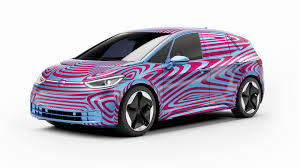
Porsche will be investing over US$6 billion in battery power over the next few years
Markedly superior to the Tesla Model S it competes with.
It just debuted two days ago, but Porsche has already taken some 30,000 deposits for its new Taycan. Not exactly Tesla numbers, but impressive nonetheless. Closer to home, more than 1,000 Canadians have plunked down $2,500 hoping to secure one of the first electrified Porsche four-doors to hit the street. Again, neither number rivals the multitudes that offered up deposits on Tesla’s Model 3, but Taycan does play in an entirely different snack bracket.
A
more appropriate context, then, might be to note that said deposits are
roughly equal to the number of 911s that Porsche Canada sells in its
best of years. In other words, September 4’s worldwide launch of the
Taycan was a very good day at the office for Porsche Canada’s president
and CEO, Marc Ouayoun.
Now, never mind
that a few of those chomping at the bit may well be put off by the
Taycan’s price — the base Turbo starts at $173,900 and the Turbo S is a
wallet-stretching $213,900. If that means Porsche has finally brought
profitability to the electric vehicle segment, so much the better.
More
important is that the company is depending on the Taycan to be
successful, Detlev von Platen, Porsche’s executive board member for
sales and marketing, telling the launch event attendees the company will
be investing over US$6 billion in battery power over the next few years
and expects more than 50 per cent of the company’s cars to be
electrified within the next decade. In other words, Porsche needs the Taycan to be successful.
And
more important than that is that the automotive industry needs the
Taycan to be successful. So far, the electric vehicle segment has been
all Tesla, the Silicon Valley upstart the only truly successful purveyor
of battery power. Yes, I know Nissan’s Leaf remains the best-selling EV
of all time, but, while semi-plentiful, it’s actually selling well
below – barely 10 percent of initial projections – what was predicted
when it was introduced ten years ago.
Tesla, meanwhile, has become the poster
child for planet-friendly motoring, Elon Musk’s decision – whether it
was brilliant insight or bulls%^t luck really doesn’t matter – to focus
on the luxury segment proving to be providential. Whither goes Tesla, it
now seems, goes the entire electric vehicle industry.
Whether
you’re a fan of long-range plug-ins or prefer fuel cells, it is not so
much that Tesla is winning, but that Mr. Musk so dominates the
conversation surrounding EVs that it stifles discussion into what a
truly multi-platform zero-emissions future might look like.
Now,
to be certain, the company and man – for they are one and the same –
deserve all the accolades they have received for a) creating the luxury
EV segment where none existed and b) legitimizing the concept of the
battery-powered car in the eyes of a formerly skeptical audience. For
that, Mr. Musk will undoubtedly be lauded in history books as the
founder of a movement.
The problem is that said worship has gone
too far, creating disciples for whom any dissent, any mention of
competitive brands is seen as traitorous. In my 35 years in this biz, I
have see nothing – not the Ford-versus-Chevy wars, not Jeep Wrangler
aficionados, not even “one-per-centers†devoted to their Hogs – to
match the cult-like allegiance Tesla enjoys amongst its minions.
Unfortunately,
that deference is stifling competition. Despite the deception that
traditional automakers are dragging their heels on electrification,
nothing could be further from the truth. The problem they all face is
that, any time they introduce a (costly-to-develop) EV, they are met
with the mildest of “mehs.â€
Initially,
they were decried as too ugly (Chevy’s Bolt), too slow (the Kia Soul) or
lacking in panache (pretty much everyone). But, then Jaguar came out
with the I-Pace, offering both pedigree and panache. Yet they too were
greeted with another giant yawn. Too slow, said the disciples, ignoring
the fact there’s more to a sporty automobile than Ludicrous
acceleration. So I-Pace sales have crashed.
Audi’s e-tron? Better, but hardly all-conquering, especially
considering that the Model X with which it competes is the weakest model
in Tesla’s lineup.
And
that’s why the Taycan is so important. It meets every single objection
even the most devoted of Teslarati could dream up. Brand image? None is
stronger than Porsche’s. Build quality? Ditto. Beauty? The Taycan is the
four-door 911 that Porsche always promised the Panamera would be.
Ludicrously fast? My Lord, yes. Toss in handling that is all but a match for the best of supercars and you have a car that is markedly superior to the Tesla Model S it ostensibly competes with.
Oh,
the haters will no doubt point to its price as an objection, but the
fact remains that, if the Taycan fails to become a genuine Tesla rival –
if not in sales then at least in influence – then we really may have to
come to grips with the possibility that what we have been projecting as
an electrified future is really just cult worship writ especially
large.
Niagara Falls in Ontario, Canada, was chosen as the locale for the North American reveal of the Porsche Taycan
fully electric sedan for good reason: the ginormous hydro-electric
power plant that resides there. It didn’t hurt that the Taycan looked
imposing in the foreground of the press snaps either. It’ll likely
garner attention wherever it goes, especially from whomever it quietly
zooms past thanks to the eye-catching, futuristic design and some
serious power-train engineering.
In terms of size, the Taycan is smaller than the Panamera,
about the same size as a BMW 5 Series or a Mercedes-Benz E-Class, or
even the car that it’ll henceforth be benchmarked against: the Tesla
Model S. I got a test-ride in a Taycan around a Formula E track.
Despite being thrashed around by a professional racing driver, I felt
that the backseat was plush and spacious enough for my 6-foot-2 frame.
The car was also fast as hell.
The 750 hp Taycan Turbo S surges from zero to 60 mph in 2.8 seconds using launch control. Photo: Courtesy of Porsche AG.
Underneath the floor is a skateboard containing a 93 kWh lithium-ion
battery pack, which pushes energy to a pair of synchronous electric
motors, one for each axle. The front axle receives a single-speed motor
while the rear contains a two-speed transmission. For the quizzical, the
first gear is for acceleration, and the shift point is around 62 miles
an hour. While it’s pretty unusual for an EV to include a transmission,
the point here is pure power and time will tell whether this will
practically benefit drivers.
Onto the name. The base Taycan will be called the Turbo and some
engineering tinkering will eke out more power for the Turbo S. As there
is no combustion engine to which a turbo can physically be affixed, it’s
silly to keep the conventional names, but Porsche
is doing so because it believes customers can better equate the
products to competitor vehicles. (Later next year, there will be a wagon
variant, too.)
Both the Turbo and the Turbo S generate 616 hp, but an “overboostâ€
function affords the Turbo bursts up to 670 hp while the Turbo S pushes
750 ponies to the wheels. The torque is 626 and 774 ft lbs,
respectively, which is good enough to propel the 5,121-pound beast from a
standstill to 60 mph in 3.0 seconds for the Turbo and in 2.6 seconds
for the Turbo S. While those numbers are more blunted than a Tesla Model
S, Porsche would prefer you focus on the fact that the engineers were
more concerned with making an all-around dynamic car with repeatable
performance rather than a drag strip winner.
The Taycan Turbo runs with 670 horses and 626 ft lbs of torque. Photo: Courtesy of Porsche AG.
Porsche hopes for a range of 280 miles, though no official EPA
numbers have arrived. It’ll likely clock in around 240 miles, and that’s
a little bit of a bummer because the Model S can go about 50 percent
further (370 miles) on a battery that’s only about 8 percent bigger.
Perhaps to offset this, Porsche’s imbued the Taycan with 800-volt
charging systems, a giant nose-thumb to the norm of 400-volt systems in
most other EVs. Still, the battery can only take about 270 kWh at its
peak, though Porsche believes to achieve 400-500 kWh as advancements in
technology develop. For now, with optimal temperature and conditions,
the Taycan can go from five percent charge to 80 percent in roughly 20
minutes.
The Taycan’s high-tech interior. Photo: Courtesy of Porsche AG.
The Turbo starts at $153,510 (though the launch edition includes a
glass roof and better charger) and the Turbo S will begin at $187,610.
After launch, they’ll drop down to $150,900 and $185,000, respectively.
Are they worth the money? Check back with us later this month after our
first-drive review.
Posted by AGORACOM
at 9:50 AM on Monday, September 9th, 2019
SPONSOR: Advance Gold AAX.v – Advance Gold controls 100% interest in the Tabasquena Silver Mine in Zacatecas, Mexico. A cluster of 30 Epithermal veins have been discovered, with recent emphasis on exploring a large anomaly to drill. Advance also owns 15% of the Kakamega JV attached to Barrick Takeover Offer for Acacia Mining. Click Here For More Info
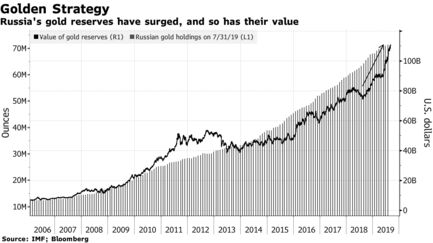
China has added almost 100 tons of gold to its reserves since it resumed buying in December
People’s Bank of China raised bullion holdings to 62.45 million ounces in August from 62.26 million a month earlier
Terms of Trade is a daily newsletter that untangles a world embroiled in trade wars. Sign up here.Â
China
has added almost 100 tons of gold to its reserves since it resumed
buying in December, with the consistent run of accumulation coming amid a
rally in prices and the drag of the trade war with Washington.
The
People’s Bank of China raised bullion holdings to 62.45 million ounces
in August from 62.26 million a month earlier, according to data on its
website at the weekend. In tonnage terms, August’s inflow was 5.91 tons,
following the addition of about 94 tons in the previous eight months.
Bullion
is near a six-year high as central banks including the Federal Reserve
cut interest rates as signs of a slowdown mount amid the U.S.-China
trade war. Central-bank purchases have been another key support for
prices as authorities from China to Russia accumulate significant
quantities of bullion to help diversify their reserves. That buying
spree likely to persist in the coming years, according to Australia
& New Zealand Banking Group Ltd.
Trade
war restrictions, in the case of China, or sanctions, as with Russia,
give “an incentive for these central banks to diversify,†John Sharma,
an economist at National Australia Bank Ltd., said in an email. “Also,
with increasing political and economic uncertainty prevailing, gold
provides an ideal hedge, and will therefore be sought after by central
banks globally.â€
China
has previously gone long periods without revealing increases in gold
holdings. When the central bank announced a 57% jump in reserves to 53.3
million ounces in mid-2015, it was the first update in six years.
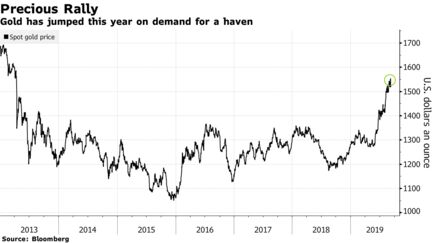
Spot
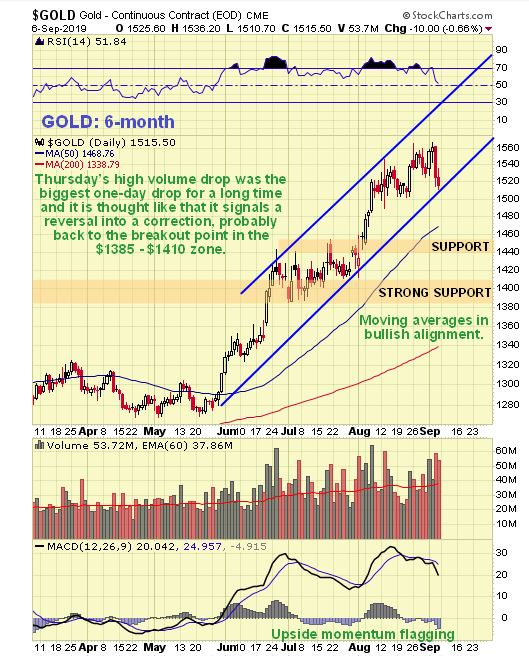
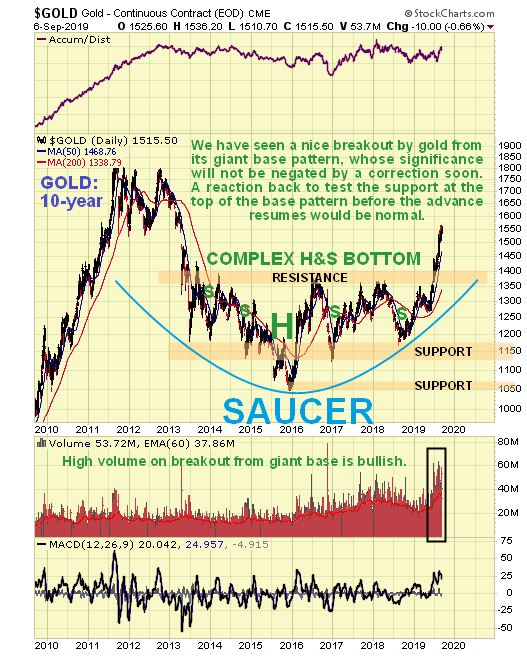
gold rose 0.2% to $1,510.27 an ounce on Monday. Prices, which capped a
fourth straight monthly gains in August, have risen 18% this year.
Goldman Sachs Group Inc. and BNP Paribas SA are among banks that expect
the metal to challenge $1,600 an ounce within the coming months.
Posted by AGORACOM
at 7:44 PM on Friday, September 6th, 2019
SPONSOR: Applied Biosciences Corp. is a vertically integrated company focused on the development of science-driven cannabinoid therapeutics and biopharmaceuticals, as well as state-of-the-art testing and analytics. As a leading company in the CBD, Pet and Health and Wellness space, the company is currently shipping to the majority of US states as well as to 5 International countries. Click Here for More Info
The firm is estimating that by 2024, the continent’s cannabis market will be worth $47.3 Billion.
Big-name brands entering the game and celebrity endorsements are cited
as important steps toward positioning cannabis as a mainstream
product.
In the 134-page paper, the firm analyzes the current state of the
cannabis industry in Canada and the United States to draw key insights
into the industry’s future in the region.
The firm is estimating that by 2024, the continent’s cannabis market will be worth $47.3 Billion.
Daragh Anglim, the firm’s managing director, said the report
offers good reason to believe that both medical and recreational
cannabis will be completely legal in the entire region by that same year
and “integrated across a number of industry verticals from pharma to
food.â€
Key Insights
Although the report places Canada as a global leader and an example
for countries looking to follow suit with cannabis legalization, it also
said the U.S. could soon challenge its northern neighbor’s leadership.
Federal legalization could turn the scale around for the two countries.
Big-name brands entering the game and celebrity endorsements are
cited as important steps toward positioning cannabis as a mainstream
product.
A long-term decline in smoking and a stagnation in alcohol
consumption are helping the cannabis sector accelerate through Big
Tobacco and Big Alcohol investments and alliances, which are expected to
continue to flourish, according to Prohibition Partners.
The cannabis industry is expanding within the beauty market, with many premium retailers offering cannabis products.
The edible revolution is expected to hit big, with great expectations
around Canada’s legalization of cannabis edibles next month.
Publicly Listed Cannabis Companies
The number of cannabis companies listed on stock exchanges has increased substantially.
The CSE is by far the largest lister for cannabis companies, with 156.
Curaleaf (OTC: CURLF), Green Thumb Industries (OTC: GTBIF), Cresco Labs (OTC: CRLBF), Acreage Holdings (OTC: ACRGF) and Harvest Health & Recreation (OTC: HRVSF) top the CSE’s list in terms of market cap.
The TSX follows with 22 listed companies; NASDAQ with 15; and NYSE with nine, where the leaders in terms of market cap are Canopy Growth (NYSE: CGC), Aurora Cannabis (NYSE: ABC), The Scotts Miracle-Gro Company (NYSE: SMG), Aphria (NYSE: APHA) and Hexo Corp. (NYSE: HEXO).
Current, Projected Cannabis Market Values
The estimated value for medicinal cannabis in both Canada and the
U.S. today is of $10.6 billion, and that figure is expected to climb to
$25.2 billion by 2024, the North American Cannabis Report said.
The recreational market is estimated at $6.5 billion, with a climb to
$22.1 billion projected in five years. Both markets are projected to
climb to a cumulative $47.3 billion in 2024, which would represent 177%
growth.
Cannabis Consumers: Key Insights
In both countries, 22% of the population reported having consumed cannabis within the past 12 months.
In the U.S., 19% of users said they use cannabis products to relieve
pain. In Canada, the average age of first-time consumption is almost 19
years old.
Posted by AGORACOM-JC
at 4:24 PM on Friday, September 6th, 2019
Investment Highlights
Kenbridge property has a measured and indicated resource of 7.14 million tonnes at 0.62% nickel, 0.33% copper
17.5 (21.8 fully diluted) percent equity
stake in Eloro Resources and 2 percent NSR in their La Victoria property
with drill program in progress
Kenbridge Ni Project Highlights
Advanced stage deposit remains open in three directions, is
equipped with a 623m deep shaft and has never been mined
Preliminary Economic Assessment completed and updated returned robust project economics and operating costs including a NPV of C$253M and cash costs of US$3.47/lb of nickel net of copper credits
Plans for Kenbridge include updating PEA,
advancing the project through to feasibility and exploring the open
mineralization at depth
Indonesia has declared that they will ban nickel ore exports as of January 1st, 2020 (previously scheduled for 2022).
On Monday, September 2, 2019, Indonesia’s Energy and Mineral Resources Ministry confirmed plans to move the ban up and place it ahead of schedule. Indonesia currently accounts for about 27-28% of global nickel ore supply.
Nickel prices surged higher on the news.
Nickel’s price surge – up over 50% in the past 3 months, up 10% in the last week
Indonesia’s Coal and Minerals Director General Bambang Gatot Ariyono stated:
“The government decided, after weighing all the pros and cons, that we
want to expedite smelter building. So we took the initiative to stop
exports of nickel ores of all quality.â€
Indonesia will soon have 36 smelters, and if exports were to continue
there would have been only enough reserves for seven to eight years.
These smelters can process low-grade nickel ores and they can be used
for batteries to help Indonesia meet its electric-vehicle goals. Bambang
continued: “We already exported 38 million
tons up until July this year. At this rate, we would need to think
about our reserves especially if we keep issuing exports permits.â€
Put simply, Indonesia has long wanted to encourage investments within
Indonesia that can value-add to their nickel ore. The end game would be
for Indonesia to be able to produce their own finished nickel,
stainless steel, and lithium-ion batteries (NMC batteries require plenty
of nickel).
Nickel supply by country
Other sources of nickel supply
The Philippines has maintained its position as a
top nickel ore producer and exporter for approximately a decade. Even
though Indonesian ore was generally of a higher grade than ore from the
Philippines, nickel miners in the Philippines will try to boost ore
production next year when the Indonesia export ban kicks in. The
Philippines has 29 nickel mines and two nickel processing plants.
However strict environmental law changes in the Philippines in recent
years have reduced their nickel supply. Also, it is said that many
Chinese buyers prefer higher-grade ores from Indonesia. Current
Philippine nickel ore production has dropped to about 340,000 tonnes in
2018, due to the closure of 23 mines as the government seeks to curb
environmental damage from mines in the Philippines.
Perhaps the boost will come from New Caledonia, Russia, Australia,
Canada, and some contributions from the new Indonesian smelters. But
will this be enough?
Nickel demand looks set to increase boosted by electric vehicles
All experts agree that the demand for nickel sulphate is set to go
through the roof as electric vehicles (EVs) take off. Demand for nickel
in the EV space is expected to reach 350,000-500,000 tonnes by 2025.
Final thoughts
No doubt new sources of nickel will start to fill the supply gap that
Indonesia will leave, but this takes time. Indonesia will also step up
it’s processing of ores, but this will take several years to raise
capital and then build out the processing plants. Many companies that
halted nickel sales due to the recent bear market years for base metals
will start to come back online, as will new nickel projects assuming the
nickel price stays strong. Will we see nickel over USD 10/lb in 2020?
Yes, I would say this is very possible, as with most severe supply
disruptions the industry usually takes a couple of years to catch up.
The top global nickel producers are Vale, Norilsk Nickel, Jinchuan
International Group Resources, Glencore, and BHP Group. Some nickel
developers to consider include RNC Minerals and Ardea Resources. And
some nickel explorers include Canada Cobalt Works Inc. (TSXV: CCW | OTCQB: CCWOF), New Age Metals Inc. (TSXV: NAM | OTCQB: NMTLF), Noble Mineral Exploration Inc. (TSXV: NOB) and Searchlight Resources Inc. (TSXV: SCLT).
For investors, it has been a great past week for the nickel miners, but the best may be yet to come.
Posted by AGORACOM
at 2:33 PM on Friday, September 6th, 2019
SPONSOR: Labrador Gold – Two successful gold explorers lead the way in the Labrador gold rush targeting the under-explored gold potential of the province. Exploration has already outlined district scale gold on two projects, including over a 40km strike length of the Florence Lake greenstone belt, one of two greenstone belts covered by the Hopedale Project. Click Here for More Info
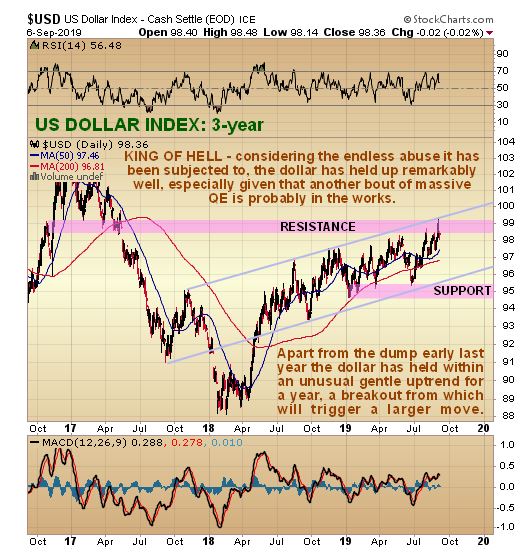
Gold is priced internationally in US dollars. So generally, when the
USD rises, gold drops, and vice versa. But over the last year, gold and
the USD seem to be rising together. That’s a strong indication of
safe-haven demand driving money around the world into both gold and the
USD. You can see both the overall inverse relationship and the recent
exception clearly in a long-term USD vs. gold chart.
That much is obvious. What’s less obvious is just how rare this is.
There seem to be a few times when gold and the USD spiked together since
the early 1970s, when the price of gold was freed when Nixon closed the
gold window. But if you look carefully, the most notable spikes are not
at the same exact time. The inverse relationship holds.
Hold on—haven’t we all seen times when safe-haven demand clearly
drives both the USD and gold higher? Yes, but most of those tend to be
very short lived. We’re talking daily price movements. Sometimes weekly.
The fact that such short-term moves aren’t even visible on the chart
shows that they don’t really matter that much.
And even more striking is that gold is rising much faster than the
USD. The gold line is accelerating upward while the USD line is
decelerating. If those curves continue, the USD will be falling hard and
gold will be hitting new nominal highs within two years.
That’s a big “IF,†of course. I’m not making that call. All the more
so since the USD may follow gold’s lead upward—whether it deserves to or
not—if the global economy tanks and central bankers around the world
panic in that timeframe.
Regardless, it’s important to think about what these curves are telling us.
Increasing numbers of people around the world are worried, and they’re shifting their money into safe-haven assets.
The fact that the USD is not rising as fast as gold could be
dismissed as an artifact of gold being the smaller asset class, but the
opposite inflection of the curves suggests that more people are starting
to worry about the soundness of the USD.
That’s bullish for gold.
But what if the trends change?
Almost 50 years of data say that gold and the dollar rising together
won’t last long. This anomaly could be corrected by either the USD
rebounding and gold falling, or the opposite. But which is more likely?
Well, is the volatility and fear driving people into safe-haven assets likely to end soon?
I don’t think so.
Has the US central bank pivoted to a weaker dollar stance?
No question.
With rate hikes fading in the rearview mirror in the US, we may well
see a period of substantial USD weakening, as we did in the years after
the crash of 2008.
That’s very bullish for gold.
So why has the USD been strengthening despite the Fed throwing it
under the bus in favor of prolonging the US’s economic party? Because
things have been getting even worse in much of the rest of the world.
The USD isn’t stronger. It’s just that other major currencies are
weakening faster.
That’s extremely bullish for gold—whichever currency is winning the race to the bottom at the time.
All of this begs the big question: “When will people around the world
lose faith in the US dollar and see it as just another piece of paper
of no special value?â€
Well, folks should have realized this long ago. Unfortunately, the
petrodollar system has propped up the USD ever since Nixon killed what
was left of the gold standard in the US. That system is starting to
fray, with China and Russia pulling on the threads to unravel it as fast
as they can, but it still stands.
While the petrodollar system endures, I think that even great
weakness in the US economy and policies obviously destructive of the
USD’s value will hurt, but not dethrone, the dollar.
Remember that in the global economy, a major downturn in the US
economy would have serious consequences for just about every other
economy in the world. If other countries are hurting and trashing their
own currencies at the same time, the USD could still look like the least
leaky among a fleet of sinking ships.
But someday—and it may not be very far off—the USD will lose its last special characteristic.
That’s when I think people worldwide will see that the emperor has no clothes…
… and gold and silver will reemerge as money.
When?
Go ask someone with a working crystal ball.
I’m just happy to own gold now and to see it doing its job as a safe haven.
The tides of history are shifting. I’m confident I’m on the right side.
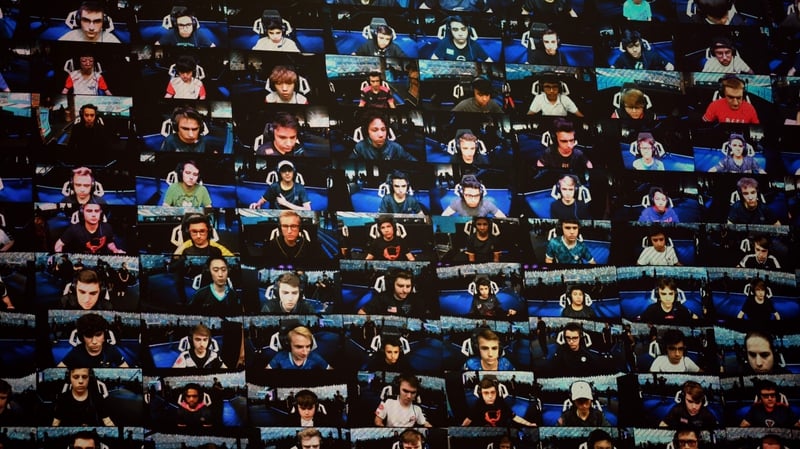
Anheuser-Busch is Pouring Beer and Money Into Esports
Anheuser-Busch is one of the brands
that isn’t shy about embracing esports. It is a non-endemic brand,
meaning it isn’t born and bred with gamers the way that, say, esports
headsets are. It’s a mainstream brand looking to break into the
previously insular world of esports a with authentic experiential
marketing.
Some brands have been wary of the unpredictability of esports. The
games come and go. The athletes can blow big deals with their big
mouths. And fans don’t always behave in a becoming way at esports
events. But it’s the job of Joe Barnes,
director of experiential marketing at Anheuser-Busch InBev, to make
sure that his company is represented in the right way in front of the
right consumers of esports as the “official beer of esports.â€
MillenThere’s a lot of money at stake, but Barnes believes that big
brands have to be nimble when it comes to getting behind a big trend
among young adults. He isn’t waiting for competitors to arrive. He is
pushing ahead of them with the mission of making Bud Light and other
Anheuser-Busch products the beer of choice for a new generation of
esports fans. I’ll be moderating a session with Barnes at the Esports BAR Miami event in October.
Here’s an edited transcript of our interview.
Above: Joe Barnes, director of experiential marketing at Anheuser-Busch InBevImage Credit: Anheuser-Busch
GamesBeat: What does your job entail? The experiential part is intriguing there.
Joe Barnes: I lead the Anheuser Busch portfolio in
the U.S. I lead our sports sponsorship strategy. Additionally I do the
experiential marketing for esports, soccer, and our emerging properties,
which also covers fighting and women’s sports and a few other things.
Our experiential marketing team is part of our consumer connections
team. We’re focusing on how we can impact and influence consumer
decisions at the point of their passion points.
With Bud Light, one of those is esports. We’re trying to–how can we
get fans to start experiencing our product in a different way? Right
now, within esports, our biggest challenge is that there’s not the
traditional norms within the sports industry where it’s very in-person
and communal. “We’re going to bars to watch the games. We’re gonna watch
the NFL game at the sports bar and get pitchers of Bud Light.â€
It’s much different within esports. That’s where experiential for us
is a big lever that we try to pull. At events, the consumers are with
community, not just their virtual community. That gives us a true point
to interact with them and introduce them to Bud Light. As crazy as it
sounds, a lot of these consumers that are becoming the 21-27 year old
are growing up without drinking Bud Light, or beer at all. Their main
drink is Red Bull, energy drinks. We’re trying to bring in these beer
occasions to esports, just like we’ve established 100 years ago within
traditional sports.
GamesBeat: I don’t know how much gamers drink beer. Are you guys endemic or non-endemic to games and esports?
Barnes: We definitely consider ourselves
non-endemic. The key challenge, when people ask us–what’s our value
proposition in esports? We’re not going to make your internet faster.
We’re not going to make your screen bigger. We’re not going to give you
better posture in a nice chair. For us, we can offer the fan something
different.
This week we announced another Twitch program, and in another month
we’ll be announcing another one. The Bud Light Twitch channel is our key
asset within esports. First and foremost, in this community, we’re able
to age gate our channel, so only 21 and up is able to interact with Bud
Light. That obviously a huge concern with the traditionally younger
audience. But within our Bud Light Twitch channel, we can offer gamers
something in addition to the game.
We’re not endemic, like I say. We’re not part of the game. But what
we can do–I’ll give you an example. We just launched, this past Tuesday,
the Bud Light Beer League, which is an amateur Tekken tournament.
Amateurs can win a chance to become a pro esports athlete and compete at
the Tekken grand finals in Bangkok for a huge payout. Our value
proposition here is that we’ll host a tournament, and we’re going to do
it for gamers, not just esports athletes. We’re going to give them the
opportunity to win prizes. And what can Bud Light do that someone else
can’t do? We’ll give you a chance to become a pro.
Above: Anheuser-Busch doesn’t want esports fans to become wine drinkers.Image Credit: Anheuser-Busch
That’s much different from our strategy with Overwatch League.
We’re the official beer sponsor of Overwatch League. Our Twitch channel
content with that one, it’s Bud Light Happy Hour. Every week we have
two hosts talking for 20 minutes, essentially a Sportscenter of
Overwatch League, where they look at the past and they talk about key
storylines coming up. It’s set at a bar environment with beers, with
neons and things, just to establish that–as you’re hanging out and
talking about esports, it’s happy hour. Get excited about tonight and
have some Bud Light. That’s the behavior that we’re trying to get people
introduced to.
Then, within Overwatch League, since this is the first year they’ve
ever done live in-person events, we also sponsor all of the homestand
weekends. We had consumer experiences and giveaways. We put them in what
we call the Bud Light Watchtower, playing on the Overwatch IP. It’s the
most premium seat within all the venues, where we’ll invite guests to
hang out with influencers, streamers and professional gamers. Free Bud
Light, the best seats, and the best experience you could possibly have.
When you drink Bud Light, when you’re playing games and Bud Light’s your
beer of choice, the opportunities are endless for cool experiences. We
consider ourselves the leader in terms of offering premium experiences
for consumers.
GamesBeat: There’s been a lot of attention on esports hype. There was a long Kotaku story that talked about the mismeasurement of the audiences. I’ve interviewed someone from Nielsen
— that story just ran — on how they’re doing measurement of the esports
audience as well. These things are brand new. The information and the
data still needs work.
Barnes: 100 percent. We do our own independent data
collection. We do partner with Nielsen, and we value them and their
partnership across all of our sports properties. That’s one of the
reasons we use them. We also use a few other research companies, and
then we always have–if we’re doing streams we have Twitch analytics. If
we’re doing events we have exit surveys. We have a whole lot that–right
now the key for us is data collection. Whether the true audience size of
Overwatch League fans is 10 million or if it’s 100 million, for us
right now, using whatever the data is, how can we use that data to
inform how we interact with the fans?
It’s not necessarily about the numbers. We know the numbers are big.
We may not know exactly how big. But for us what’s most interesting is,
what are the consumer habits? What are the consumer passion points? How
do we offer value back to the fans?
GamesBeat: In some sense I guess you would like better
measurement, but there’s enough precision out there for you to take
action and do what you need to do.
Barnes: That’s exactly it. For us it’s more about,
are we asking the right questions with the research? Rather than, do we
have the exact right sample data, and do we know the exact figures? For
us it’s about fine-tuning the right questions and finding the right
passion points for consumers.
Above: Bud Light wants to be the official beer of esports.Image Credit: Anheuser-Busch
GamesBeat: As far as the comparisons people make to
traditional sports, what are your own observations about that? How soon
do you think this catches up, or in what ways will they always be
different?
Barnes: There is some crossover, and that’s
what–when we’re trying to segment the real size of the prize, we look at
the different consumer groups. There are the passionate, die-hard
esports fans and athletes, and then there’s more casual gamers. What we
see with the crossover with traditional sports — and this is very rich
territory, because we have a league sponsorship with three of the top
four core leagues — we want to see what is the crossover and how we can
act on that.
What’s really starting the big crossover is that pro athletes in
other sports are playing video games, whether it’s on Twitch or in their
free time. They’re all big gamers. Juju Smith-Schuster, right? He’s a
big gamer and he plays in the NFL. He reaches both. For Bud Light that’s
super compelling. He’s a partner with us with the NFL, and we can look
at partnering with him for esports. How can we tap into both consumer
bases? Most people out there play Fortnite, and most people watch the
NFL. What are the efficiencies Bud Light could have with that?
The other thing we look at, we have some data that shows that amongst
gaming fans, Game of Thrones was as popular as the NFL. That may not be
their number two or three passion point behind video games, it’s still
top 10. There’s a lot of ways we can use our NFL partnerships and others
to reach those fans. Right now, most brands and most esports teams are
focusing on the esports strategy. We think there’s a lot of rich
territory for crossover between true sports and esports.
GamesBeat: As far as which esports to bet on, what are your
views there? Do you feel like you have to make bets and back certain
games or certain events? Or can you stay above that and reach the whole
audience in some way?
Barnes: I don’t think there’s one league that could
be a silver bullet for an esports strategy. When we look at it, it’s
going to require multiple partnerships in order to reach a big portion
of the fans. We want Bud Light to be for everyone. How do we get to the
biggest level there? It’s a mix. As we’ve already announced, in 2019 we
have partnerships with the Overwatch League, with Tekken 7, and with
NBA2K. We prefer to be looking with those at how we can reach consumers,
how we can keep new and interesting partnerships like the Beer League —
which can rotate in different titles — so we can reach more and more
fans. We also want to use influencers within key games and titles to
influence and reach those consumers as well.
There has to be a mix. There’s not a one-size-fits-all approach with
one title. For us it’s a mix of assets. It’s about reach and what’s the
best thing we can do to reach all those consumers, or at least a
significant portion of them.
Above: Anheuser-Busch is experimenting with esports marketing.Image Credit: Anheuser-Busch
GamesBeat: So far, can you reiterate which games you’ve
backed in some way, or that you’ve worked closely with and are happy
with?
Barnes: We have our partnership with the Overwatch
League, which is a global partnerships. Then, in the U.S., we have an
NBA2K partnership, which we just announced at the end of our season.
We’re planning 2020 right now. Then we have a Tekken 7 partnership,
which will be for the Bud Light Beer League. It’ll be a mix of–it’s
primarily Twitch streaming and the online tournament, and then there
will be a few live event components as well. Overwatch League, for us
that’s been a live event and a Twitch stream component as well. We’re
looking for not only a mix of partners, but a mix of assets within each
partnership.
GamesBeat: What about following some of these celebrity
gamers, or top athletes within different esports? Would you do deals
with individuals like that in addition to the league partnerships?
Barnes: Definitely. Arguably the most marketable and
popular name would be Ninja. A few years ago, during our Bud Light All
Stars program, which was before my time, we had a Ninja partnership.
This year we’re partnered with a few influencers. We’ve used them more
tactically, rather than just signing the biggest name. It’s about how we
can use them to propel our Twitch content and help us to activate.
We’ve been using influencer streams to promote our live events for
Overwatch League. Before each homestand weekend we do influencer streams
where they take over and give away consumer tickets to our Bud Light
Watchtower experience.
Then, for 2020, we’re looking for partners that are, let’s say,
endemic to beer. They already like to engage with the product. They have
a large reach and are playing various titles. That’s great for us,
because while it’s sometimes difficult for us to be involved with
certain games, we can partner with the top streamers — as long as
they’re over 21 — to create cool content and give that back to
consumers.
GamesBeat: Some people have always talked about how esports
and games are unpredictable. Sometimes you get bad behavior among the
athletes, or strange things happening at events. This is supposed to be
scary to brands. What are your thoughts on that, whether that’s
manageable?
Barnes: I can answer that question in a few parts.
One, in the current environment, whether it’s traditional sports or
esports, as a brand you have to be nimble. You have to act fast. You
have to be able to react to trends and react to what’s going on.
We understand that esports is in its infancy, and there are
challenges that come along with that. But for us it’s worth it, knowing
that we can be the brand, the beer brand, that is the beer of esports.
We’re the official beer of esports, the official beer of games, the
official beer of gamers. We did that for a reason. When we look at what
consumers are talking about on social media, we have 70 percent share of
voice amongst beer brands. Our competitors aren’t even really in the
same sphere as us right now, and we want to keep leaning into that. As
this grows, we know that we’ll continue to grow with it, and we can
continue to dominate the share of esports.
As far as the question around titles, yes, we’re constantly watching
what’s hot, what’s up and coming. You look at what happened this summer.
Was Fortnite going to get dethroned by a little-known title from EA?
And then a few weeks later, it fell off the radar. We need to continue
to monitor, continue to watch, and that’s great for us, because it’s an
opportunity to work with the top streamers. They can switch playing
games. When something’s hot they can play that. When it falls off they
can play something else and still reach their fanbase.
We have to be nimble. We have to be a part of it. We can’t just be a
big, slow brand. We have to be able to act within the space at the pace
it’s going.
Above: Social media multiplies the impact of esports marketing.Image Credit: Anheuser-Busch
GamesBeat: How do you find the right people in this business
in order to do all those things fast? As you say, it’s fairly new still.
Barnes: The key thing for us is research. We like to
make fact-based decisions. Of course we have to play in the margin of
error, because it’s always changing so fast. We have to use good
judgment. But we have a great team of agencies that support us on all
our initiatives, help provide that research, help provide the insight on
everything that’s going on.
GamesBeat: Is the team pretty large there, that focuses on esports?
Barnes: I lead it for Bud Light in the U.S. I’m
supported by the brand team. They’re doing everything else. It’s a bit
of a team effort internally. But then I also have my agencies that are
more solely focused on esports. I have teams that are dedicated, that
are experts in the space. They’re former gamers, former publishers. They
offer the expertise and insight that can really help us to refine our
strategy and act quickly.
GamesBeat: Do you happen to know Mark Friedler? He’s a
long-time gaming person that just joined Anheuser Busch on the biz dev
side for esports.
Barnes: I’ve had one call with Mark. He’s consulting
with our ZX Ventures arm. Our ZX Ventures mission is to disrupt
ourselves. What are these trends that could disrupt beer, and how do we
essentially become a part of it before it can eat us alive? He’s
consulting on the gaming aspect of that, because like I mentioned
earlier, there’s not a ritual within esports like going to the bar on
Sunday to watch the NFL. We’re looking at how we can bring these
experiences, these rituals, into the U.S. gamer’s world.
GamesBeat: TopGolf is converting a lot of their bars into esports bars recently for local gatherings.
Barnes: Yeah, TopGolf is a great partner. Usually
when they roll into town they become one of the top beer sellers in
their market, because people really love the value proposition. If they
continue to expand into esports or more VR types of activities, I
consider that a win. They put their beverage venue at the top of the
list for their priorities. It always helps us when we can help the
category expand in this space.
GamesBeat: You have to think about a lot of different opportunities as far as how to get a win for a product.
Barnes: Definitely. What we’re seeing, this is such a
digitally native, such an on-demand type of consumer. It’s different
from who we try to reach with, say, Major League Baseball. There, you
have an older fan. They skew to an age around 45. Gamers skew around 23.
How beer comes to life for them is much different.
What we did two weeks ago for the Overwatch League homestand weekend
in Los Angeles, we did a Drizly promotion targeting L.A. with one of the
top players on the L.A. Valiant. Drizly is an online alcohol delivery
service. We said, “Hey, L.A., you guys like tech. You don’t like doing
things in person. But if you order Bud Light from Drizly, you’ll get the
chance to not only get your beer, but your beer could be delivered by
Custa from the L.A. Valiant, and he’ll give you VIP passes to the Bud
Light Watchtower.â€
Custa went out and delivered that beer to an unexpecting consumer.
He’s from Australia, so he ended up what they call shooting the boot,
shotgunning it out of a shoe. He did it with the consumer. Everyone had a
great time. For us, that’s how we break through. We’re not going to be
talking to the Valiant consumer in the way that they want to be reached.
We want to be content creators, not content interrupters. We want to
have them tune in to watch something because they think it’s cool — it’s
their favorite player and their favorite team — rather than just
serving them an ad on Twitch.
When you’re non-endemic you have to think much differently about the
space. You have to find ways to offer value to the consumer while the
endemic brands are doing it in a much different way.
Above: Influencers are part of the esports marketing plan.Image Credit: Anheuser-Busch
GamesBeat: What do you plan to talk about at Esports BAR in Miami?
Barnes: Stuart Saw and I are co-keynoting. Endeavor
is our esports agency in the U.S. We have a lot of programs that we’ve
developed together between Anheuser Busch and Endeavor. For a lot of it,
it’s going to be talking about what we’re doing to reach consumers as a
non-endemic brand. It’s exactly what we’ve talked about, but in more
detail, with more videos and concrete examples that people can see, as
well as some of the data.
By October we’ll have a lot of data for how this is working so far.
We just ran our first social listening test, where we figured out that
we’re now 70 percent of social share voice, which is huge for us.
Consumers aren’t talking about beer brands because they want to. It’s
because we’re offering something crazy and unique to them, something
that gets them excited. They’re talking about this in their free time.
It’s not just industry. We hope to have a lot more of those examples by
then.
In addition, we’re hoping to have a very cool–it’s not fully
finalized, but a very cool Overwatch League grand finals activation.
We’re hoping to propel that message beyond what just core gamers and
Overwatch League fans care about, but also transcend the message for the
whole city of Philadelphia. Bud Light has a very rich history with
Philadelphia, with things like the Philadelphia Eagles Super Bowl win,
where we gave free beer to the city of Philadelphia. For this to come
back to Philly, there’s a lot of excitement and a lot of cool things
we’re planning. The Overwatch League finals are the week before Esports
BAR, so we’re hoping to share a lot of cool things, and a full Overwatch
League recap as well.
GamesBeat: Is your whole industry as active as you guys are, or do you feel like you’re ahead?
Barnes: We’re significantly ahead of our
competitors. That’s where we want to be. We have much different
approaches to esports. Our competitor, earlier in the year, their big
esports moment of the year was announcing that they were turning a beer
can into a controller. They had an event at E3 where the controller
couldn’t connect to Bluetooth and no one could play.
We really try to stay clear, like I said, of being an endemic brand
that will make your gameplay better. We want to be the beer for fans,
the beer for casual gamers, and the beer for esports athletes when
they’re not on the screen, so to speak. We want to play to our
strengths. It’s just a much different approach.
Posted by AGORACOM
at 11:17 AM on Friday, September 6th, 2019
SPONSOR: ZEN Graphene Solutions: An emerging advanced materials and graphene development company with a focus on new solutions using pure graphene and other two-dimensional materials. Our competitive advantage relies on the unique qualities of our multi-decade supply of precursor materials in the Albany Graphite Deposit. Independent labs in Japan, UK, Israel, USA and Canada confirm this. Click here for more information
Metal-air batteries provide a sustainable and efficient solution to large scale adoption of electric vehicles
Graphene consists of a single layer of carbon atoms and yet is
stronger than steel, possess exceptional electrical and thermal
conductivity and is versatile, customizable, and has extraordinary uses
that it can be put to. Since graphene came into limelight a decade ago
it has faced major roadblocks in its large scale commercialization.
How Graphene Works in Metal Aid Batteries?
The electric revolution that we see today is largely due to
significant advancements in lithium ion battery technology however large
scale adoption has multiple bottlenecks such as limited energy density,
concentration of lithium ores in certain locations and hazardous waste
created during disposal of batteries. Metal air batteries provide a
sustainable and efficient solution to large scale adoption of electric
vehicles. The metal air batteries use a metal as anode, air (oxygen) as
cathode and water as an electrolyte. A graphene rod is used in the air
cathode of the batteries. Since Oxygen has to be used as the cathode,
the cathode material has to be porous to let the air pass, a property in
which graphene excels. The graphene used in the electrode is able to
increase the battery efficiency by five times at one-third the cost.
What is the Use of Graphene in Oil Sorbent Pads?
Oil sorbent pad LSP20 uses graphene as an absorbing material; the
porous structure of graphene is responsible for the high absorbance
capacity of the pad. The pad is extremely light weight and has very high
absorbance thus making it a cost effective and sustainable solution for
oil spill industry.
According to the Composite Water Management Index
(CWMI) report released by the Niti Aayog in 2018, 21 major cities are
racing to reach zero groundwater levels by 2020, affecting access for
100 million people. However this acute water crisis is for fresh water
reserves whereas water as a resource is abundantly available in the form
of sea water, current desalination methods are extremely inefficient
and consume large amounts of fossil fuels.
Among graphene’s host of remarkable properties, its hydrophobia is
probably one of the traits most useful for water treatment. Graphene
naturally repels water, but when narrow pores are made in it, rapid
water permeation is allowed. This sparked ideas regarding the use of
graphene for water filtration and desalination, especially once the
technology for making these micro-pores has been achieved. Graphene
sheets (perforated with miniature holes) are studied as a method of
water filtration, because they are able to let water molecules pass but
block the passage of contaminants and substances. Graphene’s small
weight and size can contribute to making a lightweight, energy-efficient
and environmentally friendly generation of water filters and
desalinators.
The future of Graphene
However, 12 percent of India’s population is already living the ‘Day
Zero’ scenario, thanks to excessive groundwater pumping, an inefficient
and wasteful water management system and years of deficient rains.
The CWMI report also states that by 2030, the country’s water demand is
projected to be twice the available supply, implying severe water
scarcity for hundreds of millions of people and an eventual six per cent
loss in the country’s GDP.
Air filtration is another major sector where properties of graphene
can result in developing efficient and effective products. The current
technologies in air purification use adsorption and filtration, however
when the adsorbent material reaches saturation limit it must be
replaced. Graphene nano composites offer excellent adsorption and
filtration properties thus making an effective air filter.
SPONSOR: ZEN Graphene Solutions: An emerging advanced materials and graphene development company with a focus on new solutions using pure graphene and other two-dimensional materials. Our competitive advantage relies on the unique qualities of our multi-decade supply of precursor materials in the Albany Graphite Deposit. Independent labs in Japan, UK, Israel, USA and Canada confirm this. Click here for more information
Posted by AGORACOM-JC
at 3:15 PM on Thursday, September 5th, 2019
SPONSOR: Tartisan Nickel (TN:CSE)
Kenbridge Property has a measured and indicated resource of 7.14
million tonnes at 0.62% nickel, 0.33% copper. Tartisan also has
interests in Peru, including a 20 percent equity stake in Eloro
Resources and 2 percent NSR in their La Victoria property. Click her for more information
The price of nickel on international markets continued its dizzying climb Wednesday, breaking past US$8 a pound before settling in at US$8.17 late in the day.
It’s a surge Terry Ortslan, a nickel analyst at TSO and Associates in
Montreal, saw coming in late 2018, when the metal was struggling to hit
$5.
“We all know batteries for electric vehicles are going to be very
important new demand source of nickel, as much as stainless steel was 50
or 60 years ago,” he said at the time. “So it’s going to be slow times
for the next couple of months, but it’s a short-term issue.
“But for the battery-grade nickel that both Vale and Glencore
produce, there’s no problem. I think there’s going to be a great market
for it. I’d be really surprised if, once we go through this uncertainty
over the next three or four months, nickel prices aren’t back in the
saddle again.”
On Wednesday, Ortslan said fears of supply shortages – especially
after Indonesia banned nickel exports – are driving prices right now.
“The supply side is dominating the market trend,†he said in an
email. “The demand side is strong but the impact of electric vehicles
are still some time away.â€
But there hasn’t been much investment in new supply, he said, and that’s causing fears in the marketplace.
“The underinvestment into the nickel industry will be catching up
with higher prices,†Ortslan said. “The industry needs a steady $8-$10 a
pound of nickel for brownfield and greenfield investment
considerations.â€
In Sudbury, Glencore declined comment on rising prices, but Angie
Robson, Vale’s director of corporate affairs and sustainability, North
Atlantic operations and Asian refineries, said higher nickel prices is
always good news.
“While we don’t comment on the market, I can tell you that we
continue to work very hard to be a sustainable producer that is
competitive in all price cycles – both high and low, especially given
the cyclical nature of our business,†Robson said in an email. “With
respect to our local operations, we continue to invest in increased
exploration, in mine expansions such as Copper Cliff Mine, and in new
projects such as our joint feasibility study with Glencore on our Victor
deposit.â€
The company is always looking for ways to be profitable regardless of
price fluctuations, she said, with an eye on long-term goals.
“We are also continuing on our journey to digitize our mines to become a
safer and more reliable operation,†Robson said. “While we certainly
welcome the higher prices, we intend to continue mining in Sudbury for
many years to come and won’t rely on favourable prices alone for our
long-term success.â€
Favourable prices are expected to continue – late Wednesday, Goldman Sachs revised its price forecast, predicting nickel would rise to US$11 a pound before the end of the year.
Posted by AGORACOM-JC
at 2:50 PM on Thursday, September 5th, 2019
SPONSOR: CardioComm Solutions (EKG: TSX-V) – The heartbeat of cardiovascular medicine and telemedicine. Patented systems enable medical professionals, patients, and other healthcare professionals, clinics, hospitals and call centres to access and manage patient information in a secure and reliable environment.
EKG: TSX-V ———————-
How mHealth is Maturing and Changing Healthcare Delivery
As the market for mobile health tools continues to flourish, patients and providers experience a growing list of benefits.
Mobile devices and applications — tablets, smartphones, wearables, streaming services and gaming consoles — are at the heart of both work and play.
This is true in the healthcare world as well.
Zion Market Research predicts the global market for mHealth apps will grow to more than $11 billion by 2025.
Gus Vlahos is the Director of Healthcare Sales for CDW in the Central Region.
Mobile devices and applications — tablets, smartphones, wearables,
streaming services and gaming consoles — are at the heart of both work
and play. This is true in the healthcare world as well. Zion Market Research predicts the global market for mHealth apps will grow to more than $11 billion by 2025.
Patients Benefit from Expanded Access to Health Data and Devices
On the consumer side, apps that track vital signs are a boon
for population health and preventive care. Wellness apps are being
utilized to help people understand and engage in their health.
Mobile apps and devices are also the foundation of many hospital programs designed to boost patient satisfaction and quality of care. For instance, Phoenix Children’s Hospital equips its rooms with iPad devices
and other mobile tools so patients and their families can access
educational materials, discharge instructions, medical records and
treatment plans. Patients can also check their social media accounts and
stream movies from the same bedside devices.
Mobility Drives Better Patient Care and Physician Workflows
Beyond the world of wellness apps and patient-focused devices, other
technologies designed for medical professionals — such as medical record
portals and e-prescription tools — are reshaping healthcare services,
from the emergency room to post-acute care.
The FDA also gave the green light to Triton OR,
which uses artificial intelligence to monitor blood loss collected by
surgical sponges and suction canisters in the operating room. Triton OR
also assists surgical staff in making transfusion decisions and
predicting postoperative hemoglobin levels.
These are just a few of the modern medical devices and apps
available. The future is constrained only by the imagination and talent
of healthcare IT professionals. We have much more to look forward to.