Agoracom Blog Home

Archive for the ‘All Recent Posts’ Category

FEATURE: Monarques Gold $MQR.ca Estimates Pit-Constrained Resource on its Swanson #Gold Project $GDX.ca $ECR.ca $MZZ.ca $QMX.ca $IMG.ca $IAG $MUX

Posted by AGORACOM-JC at 11:21 AM on Wednesday, July 4th, 2018

MQR: TSX-V

  • Pit-constrained Indicated resource of 90,319 ounces and Inferred resource of 941 ounces, and an underground Indicated resource of 7,732 ounces and Inferred resource of 5,975 ounces
  • Advantageous location of the Swanson deposit, some 100 metres from a railway track, provides easy access to the Beacon mill
  • Company holds a mining lease on the Swanson property, enabling it to put the deposit into production more rapidly
  • Continues to increase its combined Measured and Indicated resources to more than 3.1 million ounces of gold
Indicated Resource Inferred Resource
Zone Tonnage Grade
(g/t Au)
Ounces Tonnage Grade
(g/t Au)
Ounces
Pit-constrained 1,568,000 1.79 90,319 12,000 2.44 941
Underground 75,000 3.21 7,732 60,000 3.10 5,975
Total 1,643,000 1.86 98,051 72,000 2.99 6,917

FULL DISCLOSURE: Monarques Gold Corp. is an advertising client of AGORA Internet Relations Corp.

#Lithium Demand Continues To Soar $NAM.ca $LIC.ca $LIX.ca $TSLA

Posted by AGORACOM-JC at 10:38 AM on Wednesday, July 4th, 2018
  • A steady roll-out of wireless products, such as power tools, vacuums, phones and computers over the past decade has driven increased demand for the metals that go into lithium batteries
  • Franklin Equity Group’s Steve Land explains why the growing adoption of electric vehicles (EVs) is one particular development that is arousing investor interest in those resources

A Bit of Background

For decades, lithium and its compounds have been used in a variety of ways, including in pharmaceuticals and chemical manufacturing. However, lithium’s popularity in recent years can be tied to the demand for lithium-ion batteries that power EVs, as well as smartphones, laptops and other products.

Although they are called lithium-ion batteries, they also contain significant amounts of cobalt, copper, nickel and sometimes manganese or aluminum. Battery technology continues to evolve, as companies look to reduce their reliance on harder to source materials. However, a need to produce a safe battery capable of delivering the high-performance characteristic needed for an EV makes this a slow process. Given the potentially rapid growth in EVs, battery suppliers are worried about shortages of critical elements in the years ahead.

The World Embraces Electric Vehicles

According to the International Energy Agency (IEA), by the end of 2017, there were more than three million EVs globally.1 As the chart below shows, China has the largest stock of these vehicles, with more than 1.2 million EVs.
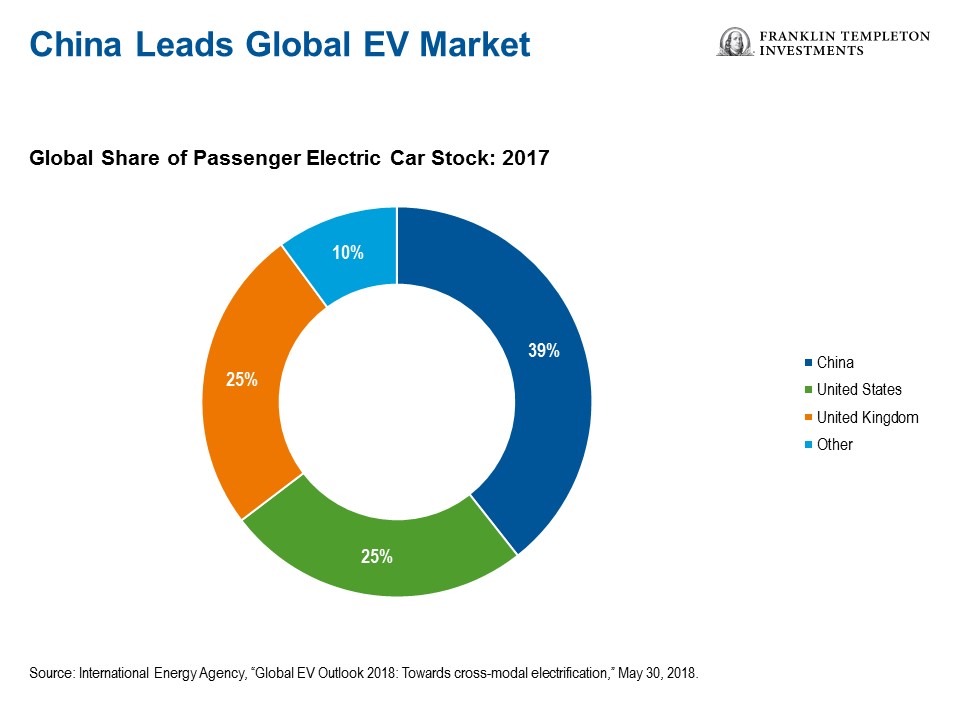
China has the longest-running national program to build up its EV volumes, including financial incentives to manufacture and buy the vehicles, as well as build out the country’s EV-charging station infrastructure. However, major world economies, including France, India, the United Kingdom and Norway, have set strict target dates by which they want to have specific percentages of EVs on the road.

Based on these new policies, the IEA projects there could be as many as 125 million EVs on the world’s roads by 2030.2 Under its high-adoption scenario, where EVs comprise 30% of the global auto market by 2030, the agency projects up to 220 million electric cars could be on the road by then.3

Demand for EV Batteries Rises

In our view, the demand for lithium-ion batteries from technology firms and vehicle manufacturers is likely to grow exponentially, with automakers already scrambling to secure supplies as more customers switch their gas-guzzling vehicles for an electric alternative with significantly lower maintenance and operating costs. As the chart below shows, Bloomberg projects demand for both lithium and cobalt from the EV industry to increase at a compound annual growth rate of about 20% through 2040.4

The growing adoption of EVs has already led lithium and cobalt prices to rise dramatically over the past two years. In 2017 alone, the prices for lithium and cobalt rose 29% and 129% respectively, and many producers’ share prices also increased sharply.5
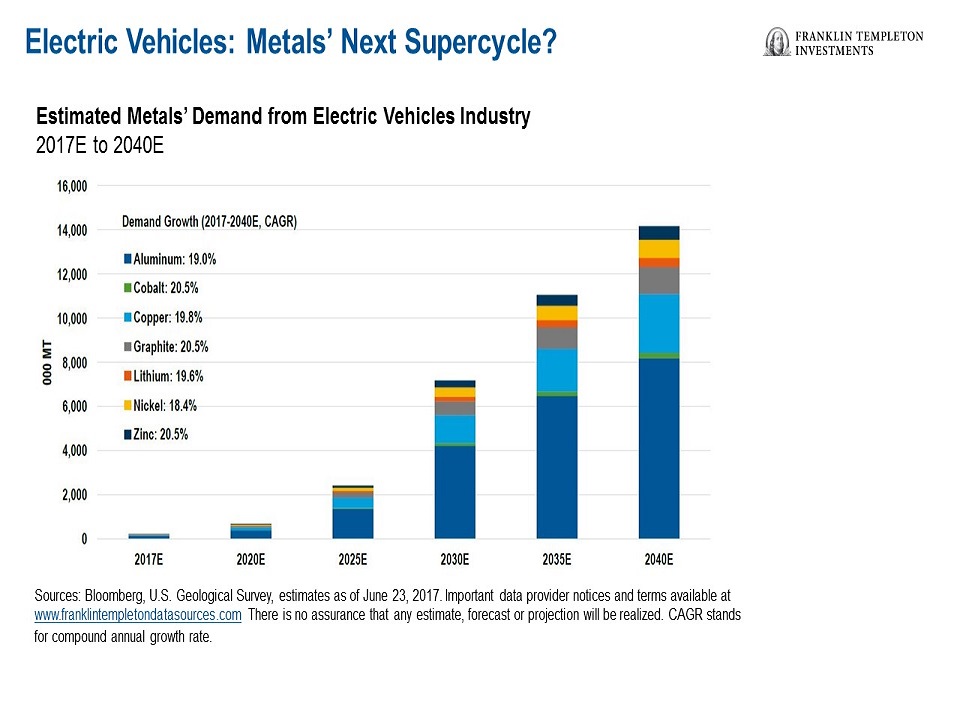
The Road Ahead for Lithium Battery Production

Lithium is a relatively common element, so many market observers believe there should be enough lithium in the ground to meet the needs of an electric-car future. However, we’ve already seen periods of market disruption amid concerns that heightened demand for lithium-ion batteries for EVs, laptops, drones and smartphones could prompt shortages.

Although common, developing naturally occurring lithium into a form and purity level suitable for modern battery usage can be a challenging process. Producers are building new, more efficient processing centers in response to the expected demand spike but it can still take several years for a new plant to reach the required specifications for EV battery-grade lithium.

With cobalt, virtually all (99%) of the world’s supply comes as by-products, where a small amount of cobalt is recovered from certain large copper and nickel mines around the world, making it difficult to grow supply. Although the nickel and copper markets are already much larger with diverse areas of demand, EV growth can still be a significant demand driver, especially when combined with the limited current investment in new mines.

Investment Implications

Despite the IEA’s rosy outlook for EV adoption, its trajectory is likely to remain a hotly debated topic for the next decade. On the one hand, it seems clear that with tightening government emission standards and a growing consumer desire for low-pollution vehicles, EVs are going to be a critical part of the transportation mix going forward.

On the other hand, we do see some possible production issues for the metals that comprise EV batteries in the near term. The mining industry is still recovering from explosive Chinese-led demand growth in the early 2000s, a boom that resulted in the development of many of the world’s known ore bodies. What is left either requires higher-than-average costs or exists in more challenging mining jurisdictions such as central Africa.

Also, it typically takes about 15 years from first discovery to production for new mines. Mining companies need this lead time for exploration, engineering studies and proper environmental work before they can even consider beginning construction on new mines.

At this time, there are relatively few new copper and nickel projects in the development pipeline. Instead, major mining companies are focused on repairing balance sheets and returning cash to shareholders, coming off of a period of rapid expansion and cost blowouts.

The Democratic Republic of Congo (DRC) accounts for about 63% of the world’s cobalt production,6 and many of the world’s undeveloped, low-cost copper and cobalt deposits are located in the DRC. That presents many unique operating and regulatory challenges as well as a concentration of supply risk to the EV industry.

Battery manufacturers are looking for ways to reduce the amount of cobalt in lithium batteries. However, it remains a critical safety and performance component for several of the leading battery chemistries.

The market for lithium outside of the battery industry is limited, so EV adoption will require the market to grow multiple times its current size. There are a number of lithium projects moving forward, but there are relatively few examples in recent history where raw materials companies have tried to deliver such a large increase in production in such a relatively short timeframe. Based on our experience, the only thing for certain is that all of the projects won’t be on time and under budget.

On paper, the amount of mined lithium seems to be tracking ahead of current demand scenarios, leading to a number of bearish forecasts from several analysts. The real challenge with lithium is less with the mining and more with the industry’s ability to process and upgrade the material to a high-quality, battery-grade product. As a result, we believe the companies that are best positioned to benefit from EV demand growth are those with existing lithium capacity capable of delivering reliable, high-quality, battery-grade supply.

Mass adoption of EVs also has significant implications beyond the battery. Major infrastructure improvements will be required to create charging networks capable of high-speed charging. New power sources will have to be developed to provide the energy, and significant power distribution upgrades will have to take place to accommodate high voltage at-home charging in many parts of the world. These improvements are favorable for the copper and aluminum demand outlook.

Overall, we see a positive backdrop developing over the next decade for metals tied to the global roll-out of EVs, and thus we see opportunity in natural resource companies with exposure to the key building blocks of an electrified future.

The comments, opinions and analyses expressed herein are for informational purposes only and should not be considered individual investment advice or recommendations to invest in any security or to adopt any investment strategy. Because market and economic conditions are subject to rapid change, comments, opinions and analyses are rendered as of the date of the posting and may change without notice. The material is not intended as a complete analysis of every material fact regarding any industry, security or investment.

This information is intended for US residents only.

CFA® and Chartered Financial Analyst® are trademarks owned by CFA Institute.

To get insights from Franklin Templeton Investments delivered to your inbox, subscribe to the Beyond Bulls & Bears blog.

For timely investing tidbits, follow us on Twitter @FTI_US and on LinkedIn.

What are the Risks?

Franklin Natural Resources Fund

All investments involve risks, including possible loss of principal. Stock prices fluctuate, sometimes rapidly and dramatically, due to factors affecting individual companies, particular industries or sectors or general market conditions. Investing in a fund concentrating in the natural resources sector involves special risks, including increased susceptibility to adverse economic and regulatory developments affecting the sector. Growth stock prices may fall dramatically if the company fails to meet projections of earnings or revenue; their prices may be more volatile than other securities, particularly over the short term. Smaller companies can be particularly sensitive to changes in economic conditions and have less certain growth prospects than larger, more established companies and can be volatile, especially over the short term. The fund may also invest in foreign companies, which involve special risks, including currency fluctuations and political uncertainty. These and other risks are described more fully in the fund’s prospectus.

Investors should carefully consider a fund’s investment goals, risks, sales charges and expenses before investing. Download a prospectus, which contains this and other information. Please carefully read a prospectus before you invest or send money.

__________________________________

1. Source: International Energy Agency, “Global EV Outlook 2018: Towards cross-modal electrification,” May 30, 2018. The report refers to an electric car as either a battery electric vehicle (BEV) or a plug-in hybrid electric vehicle (PHEV) in the passenger light-duty vehicle (PLDV) segment. It does not include hybrid electric vehicles (HEVs) without a plug.

2. Source: International Energy Agency, “Global EV Outlook 2018: Towards cross-modal electrification,” May 30, 2018.

3. Ibid.

4. Sources: Bloomberg, U.S. Geological Survey, estimates as of June 23, 2017. Important data provider notices and terms available at www.franklintempletondatasources.com.

5. Source: Bloomberg New Energy Finance, “The Force Is With Clean Energy: 10 Predictions for 2018,” January 16, 2018. Important data provider notices and terms available at www.franklintempletondatasources.com.

6. Source: Bloomberg, “We’ll All Be Relying on Congo to Power Our Electric Cars,” October 27, 2017. Important data provider notices and terms available at www.franklintempletondatasources.com.

The Global X Lithium ETF (LIT) closed at $32.43 on Tuesday, up $0.07 (+0.22%). Year-to-date, LIT has declined -16.33%, versus a 1.92% rise in the benchmark S&P 500 index during the same period.

Source: https://etfdailynews.com/2018/07/04/lithium-demand-continues-to-soar-lit/

Advertising on quality websites more cost effective, suggests study $GOOD.ca #advertising #DigitalMarketing $TTD $RUBI $AT.ca $TRMR $FUEL

Posted by AGORACOM-JC at 3:41 PM on Tuesday, July 3rd, 2018


  • According to the study, advertising in quality digital environments is 98% more likely to be placed fully above the fold than adverts on non-premium sites
  • Such placements also resulted in average uplifts for brand awareness ( 11%), ad recall ( 19%), brand perception ( 10%) and recommendation intent ( 10%)

UK – Online adverts appearing within quality branded environments are 42% more cost effective for advertisers, according to a GroupM and Newsworks study.

According to the study, advertising in quality digital environments is 98% more likely to be placed fully above the fold than adverts on non-premium sites. Such placements also resulted in average uplifts for brand awareness ( 11%), ad recall ( 19%), brand perception ( 10%) and recommendation intent ( 10%).

Quality digital environments were defined as websites where consumers have a stronger affinity with the brand, such as newsbrand publishers or sports websites.

Ads appearing on quality websites are over 58% more likely to be 100% in view for at least five seconds, according to the study, which also found that 48% of ads on the open exchange were never seen. Ads must be 50% in view for at least one second to be deemed viewable according to online industry standards.

The two companies will now use the findings from the research to build an industry-wide quality exposure factor for programmatic buying.

Vanessa Clifford, chief executive at Newsworks, said: “For years now, digital advertising has been used as a catch-all term in our industry, encompassing a myriad range of contexts. Now we have the insight to differentiate the value of a high-quality placements – such as on a newsbrand website – from general free browsing. This marks a huge step in our ongoing effectiveness programme and, working with GroupM, our aim is to make this work an actionable part of the online buying process for advertisers.”

The research, covering 394 million impressions in 84 campaigns and over 28,000 survey responses, ran between September 2017 and June 2018. Meetrics collected viewability and user engagement data for the campaign impressions and Cint distributed brand tracking surveys to panellists exposed to the campaigns.

Source: https://www.research-live.com/article/news/advertising-on-quality-websites-more-cost-effective-suggests-study/id/5040483

FEATURE: Tartisan Nickel $TN.ca Kenbridge Property Hosts M&I Resource of 7.14 Million Tonnes at 0.62% Nickel, 0.33% Copper $NI.ca $GP.ca

Posted by AGORACOM-JC at 2:11 PM on Tuesday, July 3rd, 2018

TN:CSE

Investment Highlights

  • Acquisition of Canadian Arrow Mines Limited includes two Ontario-based nickel-copper-(cobalt) properties
  • Canadian Arrow’s Kenbridge property has a measured and indicated resource of 7.14 million tonnes at 0.62% nickel, 0.33% copper
  • 20 percent equity stake in Eloro Resources and 2 percent NSR in their La Victoria property with drill program in progress
  • Strong management team with proven experience in advancing projects to production readiness and increasing shareholder value
  • Tightly held share structure with 50 percent owned by approximately 10 investors

Kenbridge Ni Project (ON, Canada)

  • Advanced  stage  deposit  remains open  in  three  directions,  is  equipped with a 623m  deep  shaft  and  has  never  been  mined.
  • Preliminary  Economic Assessment completed in   2008   and later updated returned robust project
    economics and operating costs including  a  NPV  of  C$253M  and  cash costs of US$3.47/lb of nickel net of
    copper credits.
  • Plans for Kenbridge include updating the 2008 PEA, advancing the project through to feasibility and exploring
    the open mineralization at depth

FULL DISCLOSURE: Tartisan Nickel Corp. is an advertising client of AGORA Internet Relations Corp.

Six Games, $5.5M, 65,000 Players, One Olympic-Style #Esports Tournament $GMBL $ATVI $TTWO $GAME $EPY.ca $TCEHF

Posted by AGORACOM-JC at 11:24 AM on Tuesday, July 3rd, 2018
  • Hype for the World Electronic Sports Games 2018-2019, which starts U.S. qualifiers in September, has already begun
  • More than 65,000 gamers are expected to compete for the right to represent their countries this year in DOTA2, StarCraft II, Counter-Strike: Global Offensive (male and female divisions), Hearthstone (male and female), Vainglory (a mobile MOBA) and Pro Evolution Soccer.
Heather Newman , Contributor I write about PC games, VR games and Blizzard esports. Opinions expressed by Forbes Contributors are their own.

The World Electronic Sports Games announcement this week in Kuala Lumpur.

Hype for the World Electronic Sports Games 2018-2019, which starts U.S. qualifiers in September, has already begun.

The competition is unusual in the esports arena because it requires teams to be all of one nationality and includes significant female competition, albeit in separate matches. Last year’s competition drew gamers from 126 regions and countries.

More than 65,000 gamers are expected to compete for the right to represent their countries this year in DOTA2, StarCraft II, Counter-Strike: Global Offensive (male and female divisions), Hearthstone (male and female), Vainglory (a mobile MOBA) and Pro Evolution Soccer.

WESG is run by Alisports, a division of Chinese media giant Alibaba, but the global winners are far from the Far East domination you would expect. The 2017-2018 competitions just wrapped up in March, and winners included China and South Korea; but also teams from Sweden, Russia and Turkey. This is the third year of the competition.

This year’s competition has 206 eligible countries and will include 25 regional competitions.

For the first time, WESG preliminaries in the United States and Canada will be hosted by WorldGaming Network in September through November. The U.S. finals will be held at the Santa Anita Park racetrack in Los Angeles in mid-November by WorldGaming and The Stronach Group, while the Canadian finals will take place Oct. 26-28 at the Enthusiast Gaming Live Expo (EGLX) at the Metro Toronto Convention Centre.

Registration for U.S. and Canadian play has not yet begun; so far only the Southeast Asia region has begun taking signups. The WESG finals will be held in China next March.


I’ve covered gaming for more than two decades, and I cover PC games, VR games and Blizzard eSports for Forbes. Sign up for email alerts when my stories run. Follow me @gbitses.

Source: https://www.forbes.com/sites/hnewman/2018/06/30/six-games-5-5m-65000-players-one-olympic-style-esports-tournament/#3bdf7e2b6a60

Online-based learning is transforming the #Indian #education system #edtech $BTRU.ca

Posted by AGORACOM-JC at 10:54 AM on Tuesday, July 3rd, 2018

  • Multiple issues ranging from obsolete syllabus, lack of practical learning, shortage of quality educators, and other issues formed the crux of the problem.
  • e-learning has been able to permeate many layer of the Indian society, and the platform is fast-becoming an essential tool in transforming the educational system for good

by Bhola Meena

There was a time when the state of the Indian education system was significantly dismal and bleak. Multiple issues ranging from obsolete syllabus, lack of practical learning, shortage of quality educators, and other issues formed the crux of the problem. However, in the past couple of years, one could undoubtedly observe educational efficacy evolve with the support of digital means.

E-learning has played the role of a catalyst for bringing about an equitable approach to high-quality education. It has done so by providing unlimited teaching and learning opportunities, while also improving student’s learning outcomes, participation and pedagogical innovation tremendously.

The proliferation of digital tools like apps, tablets, and laptops has introduced a sense of unbridled, real-time interaction into the learning process. A simple chalk & talk lesson has matured into engagement, collaboration and feedback. This reflects in the number of eager learners who sign up for online courses. In 2016 alone, 5.8 million students enrolled in online courses. This is a 263% increase over the last twelve years, making India the third-largest online learning market behind only the US and China.

E-learning has reached deep and wide

Breaking barriers is one thing, and the ability to consolidate education and training across geographical constraints is another. E-learning has penetrated into the Indian hinterland owing to increasing affordability of high-speed Internet as well as access to smart-phones. Students are being empowered to get quality resource and education, anytime, anywhere. Improved connectivity and digital payment access have further bolstered the concept of education for all.

It is proving to be value for money, and flexible with time

There was a 175% increase in the cost of education from 2008 to 2014. This made the online space the most cost-effective place for learners to hone new skills, supplement for school learning, prepare for competitive exams or even take up non-academic subjects. Courses online are 53% cheaper than offline alternatives. Along with that ardent learners are also able to save on time otherwise lost while travelling from one place to another. They can simply log on to their devices and leverage the benefits of e-learning on the go.

Quality has not been lost despite its reach

Online learning is a great platform to present a world-class learning experience to the ever-expanding student community and workforce. There is no denying that each year a limited number of seats are available at leading universities. Many lose out on them, and along with it, on the chance of getting a quality education. However, online education has changed this. Many online websites have opened up access to live and interactive learning in collaboration with premier schools and universities from around the globe. The faculty is best in class and the students have the opportunity to learn directly from industry stalwarts. Simple-to-use interface, virtual field trips, email, virtual labs, electronic textbooks, and free online resources are students them excellent global educational experiences.

It is customizable to personal needs and goals

Personalized e-learning enables learners to customize a variety of the elements involved in their education process. From modified schedules, personalized lesson plans and activities, customized goal-setting, everything is as per the individual’s needs.  This unique learning approach has helped provide individualized and differentiated instruction to each learner. This makes the learning experience richer and with improved learning results.

The online-to-offline strategy is removing the barricade of owning gadgets

Many e-learning centers have adopted an O2O strategy; that is an Online-to-Offline strategy. In this approach, they rope in local coaching institutes, independent tutors, and publishers, to offer students a simulated learning experience. This is a big leap in terms of providing digital access to a wider learning audience. It ensures that quality study materials and preparation guides are available to those who live beyond metro cities.

Evidently, e-learning is creating a better learning environment for learners and teachers alike. It is now expanding into areas like test preparation for government and bank jobs, re-skilling initiatives and professional certification for entrepreneurs and professionals looking to upgrade their skillset, higher education through distance-learning, and casual learning.

Product offerings are set to increase with the advent of artificial intelligence and Big Data analytics. While the former will make discovery of learning more accessible and intuitive; the latter will contextualize learning options and drive purchase behaviour based on past choices of learning modules.

To summarize, e-learning has been able to permeate many layer of the Indian society, and the platform is fast-becoming an essential tool in transforming the educational system for good.

Source: https://qrius.com/online-based-learning-is-transforming-the-indian-education-system/

3 Ways #Blockchain Is Already Delivering Real-world Results $IDK.ca $SX $SX.ca $SXOOF $AAO.ca $HPQ.ca $HIVE.ca $BLOC.ca $CODE.ca

Posted by AGORACOM-JC at 10:39 AM on Tuesday, July 3rd, 2018
  • Most people are familiar with blockchain technology in relation to bitcoin and other cryptocurrencies
  • The two are inextricably linked in the minds of everyday people. It’s fair to say that the bitcoin market has flourished in recent years, with the price of bitcoin peaking at nearly US$20,000 in December 2017.

By Ben Beard

However, cryptocurrency is a volatile commodity as the recent US$17 billion market collapse illustrates all too well. The cryptocurrency market had seemed more stable in recent months, but it was the calm before the storm, and the hack of South Korea’s biggest cryptocurrency exchange triggered a huge market decline as investors sought to offload their crypto assets.

Bitcoin and other cryptocurrencies notwithstanding, blockchain is, nevertheless, an exciting technology. It has the power to change the world as we know it, in many exciting areas.

Distributed ledger technology is poised to change the world. Blockchain, as it’s better known, is being rolled out over numerous industries. Blockchain technology is scalable. It can be used to create a worldwide ledger, with data stored on thousands of servers. This information is accessible to everyone, in real-time. The blockchain is virtually incorruptible. Every single transaction is given a timestamp that can’t be altered. It’s already having an impact on industries where efficiency matters the most.

The following three sectors are where blockchain is already having a major ripple effect.

Logistics

Blockchain technology is changing the face of modern logistics. Fifty years ago, very few businesses traded on a global scale. Today, international trade is not just for Fortune 500 businesses. It’s now easier than ever to unlock your business’s global potential thanks to cloud technology, innovative fintech, and e-commerce solutions. Amazon (NASDAQ:AMZN) now has 340 million online buyers in Europe alone. It’s clear that trading online is more profitable than ever, but no matter what niche you are in, you have to take care of your bottom line.

This is where blockchain comes in. Blockchain makes the logistics of transporting goods from A to B more efficient. Existing technology can already track shipments, but this data is vulnerable to misinterpretation and tampering. Blockchain applications solve the problem of authenticity, adding a layer of accountability and trust to global logistics. Companies save money and customers enjoy a better service. It’s a win-win for everyone.

Healthcare

Healthcare is already benefitting from blockchain technology, especially in pharma and biotech, but it has the potential to do so much more. Healthcare generates a huge amount of data. There are approximately 325 million US citizens with medical records. Then we have medical research, assorted information, and a host of other data. It’s hard to keep track of all this data, so the system has become incredibly cluttered over the years.

Blockchain is changing the face of modern healthcare, by offering a safe and secure third-party mechanism for storing data. 86.9% of physicians now use electronic medical records, but the system is still fragmented, and mistakes cost lives. Blockchain has the potential to unify the EMR system, making data more accessible and easier to track across different platforms. The blockchain is also a solution to the problem of reconciliation and fraud within a bloated healthcare system. It’s impossible to alter data in the blockchain, which in the long-term, should save money and improve patient care.

Finance

Finance is probably the best-known application for blockchain technology since most people associate it with cryptocurrencies such as Bitcoin and Ethereum. However, bitcoin and blockchain are not the same thing. Bitcoin transactions are stored on the distributed ledger, but bitcoin blockchain is different to that used in other applications. However, whilst Bitcoin is still viewed with suspicion by governments and financial institutions, the underlying blockchain technology is being adapted to revolutionize the banking sector.

In 2016, Goldman Sachs estimated that blockchain technology could potentially save them $6 billion a year by 2020, by eliminating additional costs. They also predicted that blockchain would reduce the number of errors and fraudulent transactions, thus saving even more money.

Banks traditionally use secure databases for transactions. Banks need to establish a secure connection to send and receive money, which is time-consuming and expensive. Blockchain technology allows transactions to happen instantly, regardless of the location. Global payments are cleared within seconds, instead of days. IBM (NYSE:IBM) is already working in blockchain global payment solutions, so it’s only a matter of time before global currency transactions move on to the blockchain.

Blockchain technology is still in its infancy, so we have yet to see what distributed ledger tech is truly capable of.

Don’t forget to follow us @INN_Technology for real-time news updates!

Securities Disclosure: I, Ben Beard, hold no direct investment interest in any company mentioned in this article.
Editorial Disclosure: The Investing News Network does not guarantee the accuracy or thoroughness of the information reported in contributed article. The opinions expressed in these interviews do not reflect the opinions of the Investing News Network and do not constitute investment advice. All readers are encouraged to perform their own due diligence.

Source: https://investingnews.com/daily/tech-investing/blockchain-investing/blockchain-already-delivering-real-world-results/

Namaste $N.ca $NXTTF Signs Services Agreement with Indigenous Canadian Medical Dispensaries (IcMD) to Provide Patient Consultations to Over 1.5 Million Indigenous Community Members Exclusively through NamasteMD $ACB.ca $HIP.ca $WEED.ca $CMED.ca

Posted by AGORACOM-JC at 8:45 AM on Tuesday, July 3rd, 2018

  • Company has signed an exclusive Software Services Agreement (the “Agreement”) with Indigenous Canadian Medical Dispensaries Inc
  • Partnering with IcMD to provide all Indigenous communities across Canada (representing a population of over 1.5 million people) with free access to the Company’s revolutionary telemedicine application and online patient portal, NamasteMD

VANCOUVER, July 3, 2018 – Namaste Technologies Inc. (“Namaste” or the “Company”) (TSXV: N)(FRA: M5BQ)(OTCMKTS: NXTTF) is pleased to announce the Company has signed an exclusive Software Services Agreement (the “Agreement”) with Indigenous Canadian Medical Dispensaries Inc. (“IcMD” or “IcMD.ca”), whereby Namaste is partnering with IcMD to provide all Indigenous communities across Canada (representing a population of over 1.5 million people) with free access to the Company’s revolutionary telemedicine application and online patient portal, NamasteMD. The Company anticipates that this Agreement will drive further patient growth in Namaste achieving its target of acquiring over 50,000 medical cannabis patients by the end of 2018 and 200,000 by the end of 2019.

Under the terms of the Agreement, NamasteMD will provide IcMD with exclusive access to its online platform for Indigenous people across Canada, via both desktop and mobile phone platforms, on both Apple iOS and Android devices. In turn, IcMD has agreed to offer NamasteMD exclusivity for all its online patient consultations across Canada. As part of the Agreement, Namaste will use a unique code for IcMD to track patient acquisition from IcMD’s channels, and will offer medical cannabis, pharmaceutical products, as well as medical devices.

This Agreement represents a significant milestone, as Namaste and IcMD collaborate in providing Indigenous communities across Canada with the right to access medical cannabis. This will be accomplished by offering all community members with free consultations, whereby patients have instant access to doctors or nurse practitioners. Namaste and IcMD believe they can help bridge the gap for Indigenous communities across Canada who are suffering from an overwhelming lack of access to quality healthcare services. Through a platform powered by NamasteMD’s technology, IcMD plans to potentially provide healthcare access to over 1.5 million Indigenous peoples, many of whom currently reside in remote or rural areas, and have little to no access to comprehensive clinic services.

This Agreement embodies Namaste and IcMD’s belief that all Indigenous people across Canada, whether in urban environments or rural communities, should have proper access to healthcare practitioners and medical cannabis.  IcMD’s management team is committed to supporting Indigenous communities and believes NamasteMD will serve as a powerful tool to enhance the lives of many members. Both Namaste and IcMD view this partnership as an incredible opportunity to become leaders in the Indigenous medical cannabis and direct healthcare space by providing people with safe and reliable access to healthcare in their hands.

Namaste views this opportunity as potentially one of the most significant initiatives it has embarked on to date. Once deployed, Namaste believes its platform has the ability to have a significant social impact on Indigenous communities across Canada. Namaste and IcMD are also confident this technology has the ability to catch the attention of Indigenous leaders on a global scale once its effects are observed within the Canadian market. This represents a unique opportunity for both parties to come together and work with Indigenous leaders across the country in helping drive social reform.

At a time when political leaders at all levels of government have acknowledged an impending opioid epidemic, it would appear that there is no better time to implement better access to healthcare. By making it easier and more affordable to access doctors and nurse practitioners, it is believed that this will allow Indigenous members, whose communities have been some of the hardest hit, the ability to make more informed choices under the guidance of a trained professional.

The fact that the Indigenous market and its people have consistently been left out of equal access to healthcare is something Namaste and IcMD are extremely excited to change. Starting with nationwide access to medical cannabis and moving forward to health consultations and treatment plans Namaste & IcMD will truly be putting healthcare in the hands of the people.

Namaste’s wholly owned subsidiary, Cannmart Inc. (“Cannmart”) is a late-stage applicant for a medical cannabis “sales-only” license that will serve to provide a diverse selection of cannabis from preferred cultivation partners and will be integrated with IcMD’s platform through NamasteMD upon receipt of its sales license.

IcMD and Namaste are excited to attend and launch IcMD at the Assembly of First Nation’s 39th General Assembly in Vancouver, BC July 23 to 26, 2018. Namaste and IcMD will be highlighted in a booth at the AFN Circle of Trade. The AFN Circle of Trade provides the opportunity to meet, network and showcase products to over 4,500 key decision makers and influencers from a growing market within the First Nations communities across Canada.

The Assembly of First Nations (AFN) is a national advocacy organization representing First Nation citizens in Canada, which includes more than 900,000 people living in 634 First Nation communities and in cities and towns across the country. http://www.afn.ca/about-afn/

Namaste is pleased to be hosting a special edition Namaste420 Youtube live-stream at 9:00 AM EST on July 3rd, 2018 to discuss the Agreement with IcMD and answer questions. To join the stream please visit the link below;

https://www.youtube.com/watch?v=SOJb-uO-OXg

Management Commentary

Christopher Henry, CEO of IcMD comments: “As a proud member of the MMF I have been consistently involved in Indigenous employment and advancement to towards complete self-sufficiency. For the past 25 years, I have worked closely with and in Indigenous communities across Canada. During that time, I have personally seen the lack of access to almost every service most Canadians take for granted every day. By partnering with Namaste Technologies and NamasteMD we are able to gain access to technology that would allow us to realize our dream of putting healthcare in the hands of the people. This has the potential to change how we provide healthcare to Indigenous communities across Canada and bring them one more step to equality with all Canadians.”

Christopher Henry is a member of the Manitoba Metis Federation and co-owner of WorkingWarriors.ca a national Indigenous Engagement and Employment Company.

Michael Birch, President, and COO of IcMD comments: “I grew up in Garden Hill First Nation. A fly in remote community in Northern Manitoba with over 3000 residents. We didn’t have access to a doctor or nurse or even a healthcare facility at times. To be able to put access to reliable secure healthcare in the hands of our people is a dream I didn’t think would ever happen in my lifetime. By partnering with Namaste and NamasteMD we will finally be able to give all Indigenous people, regardless of location, access to a more equal standard of care.”

Michael Birch is an entrepreneur originally from Garden Hill First Nation. He is owner & President of MBE a Facility Management and Logistics Company for Indigenous communities.

Sean Dollinger, President and CEO of Namaste comments: “We are beyond honored to have partnered with IcMD and their management team who exemplify the nature of Namaste and our core values. We truly believe that our technology will improve the health and well-being of hundreds of thousands of people in Indigenous communities across Canada. The level of accessibility to high-quality healthcare that we will be able to offer has the ability to create a significant social impact to all Indigenous communities. We are proud to be partnered with IcMD’s management team who are deeply committed to this cause.

This Agreement is just the start of what we feel will evolve into a long-term relationship and success in bringing value to the lives of many Indigenous people. While the legalization of recreational cannabis may not be accessible to community members across Canada, Namaste will serve to provide convenient access to medical cannabis in remote areas not yet served by the recreational market.

For IcMD to select Namaste among hundreds of ACMPR Licensed Producers in Canada, speaks volumes as to the value in our technology and we feel privileged to embark on this new and exciting initiative for the betterment of all Indigenous communities and its members. We’d like to thank IcMD’s team, Christopher Henry and Michael Birch for their support and hard work in putting together this exciting partnership.

We’re also pleased to announce the submission of the TSX Venture Form 5G at the close of the market on Friday, June 29th, 2018, and we anticipate commencing our Normal Course Issuer Bid (“NCIB”), whereby the Company will purchase up to 25,308,136 of its common shares, or 8.9% of the “Public Float” (as such term is defined in the TSX-V Corporation Finance Manual).”

About Indigenous Cannabis Medical Dispensaries Inc.

IcMD’s goal is to put reliable and accessible healthcare in the hands of Indigenous people. By working with our relationships created over a lifetime of work in the Indigenous community IcMD will bring medical cannabis to every region of Canada. We believe that the over prescription of pharmaceuticals to our people has had a negative effect on our communities. By offering a natural solution to many common conditions we believe will we be more able to return to our traditional roots. Moving towards health consultations and treatment plans will eventually see IcMD as the nationwide leader in direct Indigenous healthcare equality.

About Namaste Technologies Inc.

Namaste Technologies is a global leader in the sale of medical cannabis consumption devices. Namaste has nine offices with multiple distribution centers around the globe and operates over 30 websites under various brands. Namaste has developed innovative technology platforms including NamasteMD.com, Canada’s first ACMPR compliant telemedicine application. The company is focused on patient acquisition through NamasteMD and intends on building Canada’s largest database of medical cannabis patients. The company’s subsidiary, CannMart Inc. is an ACMPR Licensed Producer pending receipt of   a “sales-only” license, whereby the company will offer a large variety of medical cannabis sourced from domestic and international producers. Namaste will continue to develop and acquire innovative technologies which will provide value to the Company and to its shareholders as well as to the broader cannabis market.

On behalf of the Board of Directors

“Sean Dollinger”

Chief Executive Officer

Direct: +1 (786) 389 9771

Email: [email protected]

Further information on the Company and its products can be accessed through the links below:

NamasteTechnologies.com

NamasteMD.com

NamasteVapes.ca

Everyonedoesit.ca

FORWARD-LOOKING INFORMATION This press release contains forward-looking information based on current expectations. These statements should not be read as guarantees of future performance or results. Such statements involve known and unknown risks, uncertainties and other factors that may cause actual results, performance or achievements to be materially different from those implied by such statements. Although such statements are based on management’s reasonable assumptions, Namaste assumes no responsibility to update or revise forward-looking information to reflect new events or circumstances unless required by law. Although the Company believes that the expectations and assumptions on which the forward-looking statements are based are reasonable, undue reliance should not be placed on the forward-looking statements because the Company can give no assurance that they will prove to be correct. Since forward-looking statements address future events and conditions, by their very nature they involve inherent risks and uncertainties. These statements speak only as of the date of this press release. Actual results could differ materially from those currently anticipated due to a number of factors and risks including various risk factors discussed in the Company’s disclosure documents which can be found under the Company’s profile on www.sedar.com. This press release contains “forward-looking statements” within the meaning of Section 27A of the Securities Act of 1933, as amended, and Section 21E the Securities Exchange Act of 1934, as amended and such forward-looking statements are made pursuant to the safe harbor provisions of the Private Securities Litigation Reform Act of 1995. Neither the TSX Venture Exchange nor its market regulator has reviewed or approved the contents of this press release.

SOURCE Namaste Technologies Inc.

View original content with multimedia: http://www.newswire.ca/en/releases/archive/July2018/03/c4242.html

Microsoft $MSFT and EY Are Rolling Out #Blockchain Technology for #Xbox $SX $SX.ca $IDK.ca $AAO.ca $HPQ.ca

Posted by AGORACOM-JC at 3:47 PM on Friday, June 29th, 2018

It will expand to other products including Bing, MSN

4 hours ago

  • Microsoft and EY are partnering on a blockchain platform for publishing royalties.
  • If Microsoft and EY’s blockchain product is successful, it should shape the way video game developers, creators and publishers of all types earn money online

Last week, the companies debuted a content rights and royalties platform built on the blockchain, which will allow Microsoft and its partners to process millions of transactions in a faster and more reliable way.

Working with Microsoft and EY’s platform, publishers in music, gaming, television and other entertainment industries will someday be able to connect to the blockchain, where they can create and agree on business terms. When users buy content, those royalties are coded onto the blockchain based on the previously agreed upon conditions before the money is reviewed and distributed to the proper publishers. And it would all happen at a rapid pace. While it currently takes some businesses 45 days to translate clicks to money owed through a manual process, the blockchain program could process millions in a more automated fashion.

“Microsoft has an amazing experience if you buy a game on the Xbox,” Paul Brody, EY’s global innovation leader for Blockchain, said in an interview. “It’s pretty much a straightforward kind of click-and-buy activity for the end user.”

Behind the technology, however, is a lot of complexity, as there are thousands of different software vendors and publishing houses that have thousands of titles. These products are sold all around the world in different jurisdictions with all kinds of tax rules and different rules in the purchasing of contracts and payment agreements.

According to Brody, the system reduces the transaction cost for publishers by 99 percent and cuts Microsoft’s own operating costs in half.

“If you care about how your business is doing and you want to manage by how you’re actually driving the car and not looking 90 days back in the rear-view mirror, the value proposition is just incredibly compelling for the publishers,” he said.

The system is built on top of the Quorum blockchain, a blockchain protocol that has additional layers of privacy controls for enterprise businesses. The network is also built using Microsoft’s Azure Cloud.

For starters, the companies have partnered with Ubisoft and several other video game publishers to roll out the blockchain for Microsoft’s Xbox gaming console. However, if all goes well, that could later be rolled out to other Microsoft properties including hardware, Bing search and the Azure marketplace. It could also even work for movie royalties.

“All these contracts—content contracts, search contracts, the hardware, intellectual property contracts—all of these are already managed by my team,” said Rohit Amberker, director of royalties and content operations at Microsoft. “So we’ve started with the gaming portfolio, but we will be expanding this to Bing, MSN, Surface and many others … So any time you have this intellectual property licensing contracts, this will eventually support all of those businesses.”

The transaction process currently used by Microsoft and its partners is very “painful,” said Amberker. That’s partially because of how complex and slow it is—each transaction without the blockchain takes a minute to complete. And when you have millions of transactions, that time quickly ads up.

The plan is to first take the software to larger publishers, which can in turn do the same with game developers, who will then be able to work with audio and video artists whose intellectual property goes into the games.

This isn’t Microsoft’s first foray into the blockchain. In February, the company debuted a blockchain-powered identity management software to help consumers maintain control of their own personal data rather than entrusting it to third parties.

Microsoft and EY also aren’t the only companies seeking to make transactions more trustworthy and efficient using the blockchain. Last week, IBM and Mediaocean debuted a blockchain-enabled ad network for tracking advertising transactions.

Source: https://www.adweek.com/brand-marketing/microsoft-and-ey-are-rolling-out-blockchain-technology-for-xbox/

#Esports Is The Next Biggest Frontier In Influencer Marketing $GMBL $ATVI $TTWO $GAME $EPY.ca $TCEHF

Posted by AGORACOM-JC at 10:30 AM on Friday, June 29th, 2018

Nicolas Miachon is CMO of Upfluence, an influencer marketing software that helps brands to tell their stories.

 Nicolas Miachon , Forbes Councils

  • Whether you’re ready or not, competitive gaming is disrupting entertainment as we know it. Very soon you might find yourself betting on matches in Vegas, rooting for your country’s esports team during the Olympics or sending your kid to college with an esports scholarship.
  • The reality is, esports is everywhere. As a marketer, it would be crazy not to embrace it

Giant social networks, multimillion-dollar prizes, international audiences: Welcome to the world of esports.

Whether you’re ready or not, competitive gaming is disrupting entertainment as we know it. Very soon you might find yourself betting on matches in Vegas, rooting for your country’s esports team during the Olympics or sending your kid to college with an esports scholarship. The reality is, esports is everywhere. As a marketer, it would be crazy not to embrace it.

Not convinced yet? Let’s talk numbers.

In 2017, the esports industry raked in nearly 500 million dollars. As it continues to grow more than 40% year over year, the industry is destined to become a $1.7 billion market by 2021.

With an audience of over 300 million people, viewership of streaming sites like Amazon’s Twitch have surpassed popular news sources such as CNN, and according to one study, more unique viewers watched “Gaming video content” than HBO, Netflix, ESPN and Hulu combined in 2017.

The Intel Extreme Masters of 2017 (in Katowice, Poland) was viewed by 46 million people. To put that into perspective, the audience turnout was twice as large as the most recent NBA finals.

Who is watching esports, though? Demographically, the esports audience is mostly male aged from 13-40, making them one of the hardest marketing segments to address. They are also quite international, with Asia, North America and Europe constituting the biggest shares of the market.

How does the esports economy actually work?

The esports ecosystem consists of six major actors: game publishers, teams, players, fans, sponsors and investors. Players become professional when they join teams and play in tournaments organized by game publishers or third parties. These events, both offline and online, attract brand sponsors. Investors range from major sports teams to celebrities and corporate moguls like Russia’s richest man, Alisher Usmanov.

While professional players can earn team salaries and tournament cash prizes, streaming is where most of the action happens for advertisers and consumers. Platforms such as Twitch and YouTube Gaming allow players (professional and amateur alike) to broadcast their game play online 24 hours a day, seven days a week. Fans flock to these livestreaming sites where they can watch their favorite streamer, learn strategy and be entertained. In a way, streaming is the social media of esports.

Streaming is a new influence market.

With new platforms come new influencers. As explored in a previous article, influencers play a crucial role in social media ecosystems, acting as fuel for the platforms by connecting brands and consumers. In this case, the phenomenon of streaming influencers is exploding in esports – so the arrival of sponsors cannot be far behind.

Who are these new influencers and how are they different from professional players? While streaming influencers aren’t necessarily as highly ranked as pros, they do have much larger followings on their streams. The poster child for Twitch fame would have to be Tyler “Ninja” Blevins. In March, he broke records, drawing in over 600,000-plus concurrent viewers during a live stream with Drake.

Unlike traditional social media influencers, who are not paid by the platforms they post on, popular esports players can actually make money on these sites via integrated ads, direct donations from audience members and paid subscription offers. In short, followers are paying to follow and it’s no small matter. In an interview from this year, Tyler Blevins reported earning $560,000 per month from his Twitch streaming. This is purely based on known revenue from paid subscribers — the actual amount could be twice that when donations sponsorships and Twitch Bits are taken into account.

The esports environment is clearly brimming with potential, but advertisers will need to adapt their sponsorship strategies for this unique market. Unlike other niches, streaming influencers are much more likely to be self-sufficient and thus picky about who they work with. What’s more, professional players come as a team package, which is a barrier to smaller brands. So, how does one secure a partnership in esports?

Source: https://www.forbes.com/sites/forbescommunicationscouncil/2018/06/28/esports-is-the-next-biggest-frontier-in-influencer-marketing/#529b473a6d7b