Agoracom Blog

Tudor Gold Talks up Goldstorm Project SPONSOR: American Creek Resources $AMK.ca $TUD.ca $SII.ca $GTT.ca $AFF.ca $SEA.ca $SA $PVG.ca $AOT.ca

Posted by AGORACOM at 10:55 AM on Thursday, March 12th, 2020

SPONSOR: American Creek owns a 20% Carried Interest to Production at the Treaty Creek Project in the Golden Triangle. 2019’s first hole averaged of 0.683 g/t Au over 780m in a vertical intercept. The Treaty Creek property is located in the same hydrothermal system as the Pretivm and Seabridge’s KSM deposits. Click Here For More Info

  • Tudor Gold said it had discovered a significant new copper-silver horizon within the Goldstorm system.
  • The newly discovered copper-rich CS 600 Horizon is a very important feature of the Goldstorm System.
  • Presence of copper and silver mineralization gives this discovery a true polymetallic nature yet it remains a gold-dominant project.

Tudor Gold Corp. [TUD-TSXV, TUC-Frankfurt] has released the results of gold-equivalent calculations for all drilling completed at the company’s Treaty Creek project, which is located in British Columbia’s Golden Triangle region.

These calculations are posted on the company’s website and include credit for previously analyzed values for copper and silver. Geological analysis and reinterpretation of all the drill holes to date exposed a new copper horizon (CS 600 horizon) as well as significant silver and copper mineralization through the Goldstorm system, the company said in a press release, which was issued just after the close of trading on March 3, 2020.

On Wednesday, Tudor shares eased 4.0% or $0.02 to 48 cents on volume of 309,585. The shares are currently trading in a 52-week range of 26 cents and $1.08.

Tudor Gold holds a 60% stake in the Treaty Creek joint venture and is the project operator. The other partners are American Creek Resources Ltd. [AMK-TSXV] and Teuton Resources Corp. [TUO-TSXV, TUC-Frankfurt], each of which hold a 20% stake in the project. American Creek and Teuton are both fully carried to a production notice. At that point, each of the two is required to contribute their respective 20% share of development costs.

Until that happens, Tudor is required to fund all exploration and development costs. The property is also subject to 3% net smelter return royalties.

The 17,913-hectare Treaty Creek Project borders Seabridge Gold Inc.’s [SEA-TSX, SA-NYSE] KSM property to the southwest and borders Pretium Resources Inc.’s [PVG-TSX] Brucejack property to the southeast. The past-producing Eskay Creek mine lies 12 kilometres to the west.

Exploration of the Treaty Creek area over the past 30 years by various junior companies has resulted in the discovery of a number of surface mineral showings, some with very high gold and silver values.

There have been over 150 diamond drill holes completed on the property from 1987 to date, in eight different mineral zones. However, it is only recently that drilling revealed the potential for a large-scale porphyry-style gold deposit at the Copper Belle and Goldstorm zones, which are located on trend and just five kilometres northeast of the KSM deposits.

In a press release on December 16, 2019, Tudor Gold said it had discovered a significant new copper-silver horizon within the Goldstorm system.

The newly discovered copper-rich CS 600 Horizon is a very important feature of the Goldstorm System, the company has said. It said presence of copper and silver mineralization gives this discovery a true polymetallic nature yet it remains a gold-dominant project.

“We are very encouraged to see that the silver copper mineralization has made an important impact to the gold equivalent results from our recent drilling as well as the historical drilling,’’ said Ken Konkin, vice-president of project development at Tudor Gold.

“The next step is to plan the drill hole program for the 2020 exploration season,” he said. The company’s goal is to design a diamond drill program that will fast-track the exploration program for 2020 with the objective to begin mineral resource estimate work as soon as possible.

Bay Street billionaire Eric Sprott recently increased his stake the company to 14.1% by investing in a non-brokered private placement of 4.2 million shares that raised $2.93 million. The shares are priced at 70 cents each.

About American Creek

American Creek holds a strong portfolio of gold and silver properties in British Columbia. The portfolio includes three gold/silver properties in the heart of the Golden Triangle; the Treaty Creek and Electrum joint ventures with Walter Storm/Tudor, as well as the recently acquired 100% owned past producing Dunwell Mine. Other properties held throughout BC include the Gold Hill, Austruck-Bonanza, Ample Goldmax, Silver Side, and Glitter King.

For further information please contact Kelvin Burton at: Phone: 403 752-4040 or Email: [email protected]. Information relating to the Company is available on its website at www.americancreek.com

SOURCE:  Resource World

GM Announces Battery Technology, EV Production Plans SPONSOR: Lomiko Metals $LMR.ca $CJC.ca $SRG.ca $NGC.ca $LLG.ca $GPH.ca $NOU.ca

Posted by AGORACOM at 10:42 AM on Thursday, March 12th, 2020

SPONSOR: Lomiko Metals is focused on the exploration and development of minerals for the new green economy such as lithium and graphite. Lomiko owns 80% of the high-grade La Loutre graphite Property, Lac Des Iles Graphite Property and the 100% owned Quatre Milles Graphite Property. Lomiko is uniquely poised to supply the growing EV battery market. Click Here For More Information

  • Automaker plans to launch several electric vehicles with lower-cost batteries within the next three years.
  • “Accepted the challenge to transform product development at GM and position our company for an all-electric future”

Detroit, Michigan – General Motors (GM) is promising a wide array of less-expensive electric vehicles (EVs) thanks to battery technologies it is developing, improved product design processes, and plans to scale EV production to the size of its truck business.

“Our team accepted the challenge to transform product development at GM and position our company for an all-electric future,” said GM Chairman and CEO Mary Barra. “What we have done is build a multi-brand, multi-segment EV strategy with economies of scale that rival our full-size truck business with much less complexity and even more flexibility.”

The heart of GM’s strategy is a modular propulsion system and a highly flexible, third-generation global EV platform powered by proprietary Ultium batteries.

“Thousands of GM scientists, engineers, and designers are working to execute an historic reinvention of the company,” GM President Mark Reuss said. “They are on the cusp of delivering a profitable EV business that can satisfy millions of customers.”

Ultium batteries use large-format, pouch-style cells that can be stacked vertically or horizontally inside the battery pack. By avoiding rigid, cylindrical cells, GM engineers can optimize pack shapes and layouts for each vehicle.

Energy options range from 50kWh to 200kWh – enough for 400 miles of range on the larger battery side. Motors designed in-house will support front-wheel drive, rear-wheel drive, all-wheel drive, and performance all-wheel drive applications.

Ultium-powered EVs are designed for Level 2 and DC fast charging. Most will have 400V battery packs and up to 200kW fast-charging capability. Trucks will get 800V battery packs and 350kW fast-charging capability.

Developed with LG Chem, GM’s joint venture partner on a battery cell plant in Ohio, upcoming cells reduce use of expensive cobalt, a development the companies believe will drive cell cost to less than $100/kWh. At $100/kWh, GM’s 200kWh batteries would cost $20,000, before considering the cost of the rest of the vehicle, so lowering cell costs is critical to affordable EVs.

Reuss said engineers are designing future vehicles and propulsion systems together to minimize complexity and part counts compared to adapting gasoline-powered vehicles for electric drive. GM plans 19 different battery and drive unit configurations initially, compared with 550 internal combustion powertrain combinations.

GM’s technology can be scaled to meet customer demand much higher than the more than 1 million global sales the company expects mid-decade.

Chevrolet, Cadillac, GMC, and Buick will all be launching new EVs starting this year.

  • 2021 Bolt EV, launching in late 2020, updating GM’s first mass-market all-electric
  • 2022 Bolt EUV, launching summer 2021, larger crossover version of the Volt will be the first non-Cadillac GM to get Super Cruise semi-autonomous driving
  • Cruise Origin, self-driving, electric shared vehicle, debuted at shows but no production plans announced
  • Cadillac Lyriq SUV unveiling set for April 2020
  • GMC HUMMER EV debuted in Super Bowl ads, more details coming May 20, production to begin fall 2021

SOURCE: https://www.todaysmotorvehicles.com/article/gm-battery-tech-ev-plans/

Democracy Labs uses Datametrex AI $DM.ca #Nexalogy Tech to Study #Coronavirus Misinformation

Posted by AGORACOM-JC at 7:35 AM on Thursday, March 12th, 2020
  • Announce that Democracy Labs successfully used Nexalogy’s technology to monitor #covid19 and #coronavirus to identify misinformation campaigns and Fake News
  • Democracy Labs is a US based organization providing a hub for ongoing technology and creative innovation that serves progressive campaigns and organizations at the national, state, and local levels.

TORONTO, March 12, 2020 — Datametrex AI Limited (the “Company” or Datametrex”) (TSXV: DM) (FSE: D4G) is pleased to announce that Democracy Labs successfully used Nexalogy’s technology to monitor #covid19 and #coronavirus to identify misinformation campaigns and Fake News. Democracy Labs is a US based organization providing a hub for ongoing technology and creative innovation that serves progressive campaigns and organizations at the national, state, and local levels. In addition to misinformation about Covid-19 DemLabs has also used Nexalogy tech to examine Islamophobia against U.S. Representative Rashida Tlaib.

Key takeaways:

  • 450,000 tweets analyzed from March 1st through 4th using hashtag #covid19
  • Russia Today suggested that the U.S.A. primaries be cancelled and was promoted by BOTS

Results of these campaigns can be found by clicking the attached links:

https://insights.nexalogy.com/democracy-labs-uses-nexalogy-tech-to-study-coronavirus-misinformation-b88ea13c4bed
https://nexalogy.com/insights/keep-an-eye-on-trolls-activity-and-report-harassment-to-twitter/

About Datametrex

Datametrex AI Limited is a technology focused company with exposure to Artificial Intelligence and Machine Learning through its wholly owned subsidiary, Nexalogy (www.nexalogy.com).

For further information, please contact:

Jeff Stevens
Email: [email protected]Phone: 647-777-7974

Forward-Looking Statements

This news release contains “forward-looking information” within the meaning of applicable securities laws.  All statements contained herein that are not clearly historical in nature may constitute forward-looking information. In some cases, forward-looking information can be identified by words or phrases such as “may”, “will”, “expect”, “likely”, “should”, “would”, “plan”, “anticipate”, “intend”, “potential”, “proposed”, “estimate”, “believe” or the negative of these terms, or other similar words, expressions and grammatical variations thereof, or statements that certain events or conditions “may” or “will” happen, or by discussions of strategy.

Readers are cautioned to consider these and other factors, uncertainties and potential events carefully and not to put undue reliance on forward-looking information. The forward-looking information contained herein is made as of the date of this press release and is based on the beliefs, estimates, expectations and opinions of management on the date such forward-looking information is made. The Company undertakes no obligation to update or revise any forward-looking information, whether as a result of new information, estimates or opinions, future events or results or otherwise or to explain any material difference between subsequent actual events and such forward-looking information, except as required by applicable law.

Neither the TSX Venture Exchange nor its Regulation Services Provider (as that term is defined in the policies of the TSX Venture Exchange) accepts responsibility for the adequacy or accuracy of this release.

INTERVIEW: Datametrex $DM.ca – The Small Cap #A.I. Company Governments Use To Fight Fake News & Election Meddling

Posted by AGORACOM-JC at 5:01 PM on Wednesday, March 11th, 2020

Until now, investor participation in Artificial Intelligence has been the domain of mega companies and those funded by Silicon Valley.  Small cap investors can finally consider participating in the great future of A.I. through Datametrex AI (DM: TSXV) (Soon To Be Nexaology) who has achieved the following over the past few months:

  • Q3 Revenues Of $1.6 million,  an increase of 186%
  • 9 Month Revenues Of $2.56M an increase of 37%
  • Repeat Contracts Of $1M and $600,000 With Korean Giant LOTTE   
  • $954,000 Contract With Canadian Department of Defence To Fight Social Media Election Meddling
  • Participation In NATO Research Task Group On Social Media Threat Detection 

When a small cap Artificial Intelligence company is successfully deploying its technology with military and conglomerates, smart investors have to take a closer look.   That look can begin with our latest interview of Datametrex CEO, Marshall Gunter, who talks to us about the use of the Company’s Artificial Intelligence to discover and eliminate US Presidential election meddling.  The fake news isn’t just targeting candidates specifically, it also targets wedge issues such as abortion cases now before the US Supreme Court and even the Coronavirus.   Watch this interview on one of your favourite screens or hit play and listen to the audio as you drive. 

The most expensive #metals and where they are mined #Palladium SPONSOR: New Age Metals $NAM.ca $WG.ca $XTM.ca $WM.ca $PDL.ca $GLEN

Posted by AGORACOM-JC at 5:00 PM on Wednesday, March 11th, 2020

SPONSOR: New Age Metals Inc. The company owns one of North America’s largest primary platinum group metals deposit in Sudbury, Canada. Updated NI 43-101 Mineral Resource Estimate 2,867,000 PdEq Measured and Indicated Ounces, with an additional 1,059,000 PdEq Ounces Inferred. Learn More.

The most expensive metals and where they are mined

  • Palladium is the most expensive of the four major precious metals – gold, silver and platinum being the others.
  • It is rarer than platinum, and is used in larger quantities for catalytic converters.
  • In the near-term, the demand for metals used in catalytic converters is expected to be steady, buoyed by growing automotive sales in Asia.

By Matthew Hall

Palladium

Rhodium’s little brother palladium also did well out of the Dieselgate scandal. After sales of diesel vehicles slumped and petrol alternatives came back into fashion, platinum – used primarily in catalytic converters for diesel vehicles – took a tumble, while petrol-friendly palladium rose.

Palladium is the most expensive of the four major precious metals – gold, silver and platinum being the others. It is rarer than platinum, and is used in larger quantities for catalytic converters. In the near-term, the demand for metals used in catalytic converters is expected to be steady, buoyed by growing automotive sales in Asia. However, the increased uptake of battery-electric vehicles – which do not use catalytic converters – could see palladium demand take a hit.

Russia00n mining company Nornickel is the top global palladium producer, pulling up 86 metric tons of the metal in 2019.

Rhodium

Relatively unknown to the layperson, rhodium is quietly one of the hottest trades right now, after a price surge of more than 30% this year. Rhodium previously peaked – and quickly crashed – in 2008 at more than $10,000 per troy ounce (ozt), but the metal is now trading above that 2008 high on the back of a swell in demand from the automotive industry.

Rhodium is used in catalytic converters, a part of vehicle exhaust systems that reduce toxic gas emissions and pollutants. According to S&P Global Platts, almost 80% of demand for rhodium and palladium comes from the global automotive industry. Fortunately for South Africa at least, around 80% of all rhodium is mined within its borders.

Part of the reason for the metal’s price leap is its rarity. Annual rhodium production sits at around 30 tonnes – to place that in context, gold miners annually dig up between 2,500 and 3,000 tonnes of the precious metal. Rhodium also benefitted from the Volkswagen emissions scandal, or Dieselgate, the 2015 emissions scandal that rocked the automotive industry. With major economies including China and India tightening emissions rules, platinum group metals (PGM) miners are anticipating good times ahead for rhodium.

Gold

Part durability, part tradition, gold is among the most versatile commodities. Primarily used in jewellery, but also having significant applications across electronics and aerospace due to its durability and conductivity, gold is, to put it plainly, everywhere.

Source: https://www.mining-technology.com/features/five-most-expensive-metals-and-where-they-are-mined/

Digital Learning #Edtech: Can it Solve the Access to Education Problem for Indian Students? – SPONSOR: BetterU Education Corp. $BTRU.ca $ARCL $CPLA $BPI $FC.ca

Posted by AGORACOM-JC at 4:20 PM on Wednesday, March 11th, 2020
SPONSOR:  BetterU Education Corp. aims to provide access to quality education from around the world. The company plans to bridge the prevailing gap in the education and job industry and enhance the lives of its prospective learners by developing an integrated ecosystem. Click here for more information.

Digital Learning: Can it Solve the Access to Education Problem for Indian Students?

  • India is home to the largest youth population in the world.
  • As per recent government statistics, we have an estimated 430 million people under the age of 18.

Author: DQINDIA Online

Digital learning can help tackle existing problems in the education sector such as shortage of skilled teachers, lack of adequate teaching materials and so on.

India is home to the largest youth population in the world. As per recent government statistics, we have an estimated 430 million people under the age of 18. These young minds hold immense potential to build a strong future for themselves and the country. A potential that is often held to ransom by an education system marred by outmoded methods of teaching, disproportionate student to teacher ratio, a shortage of skilled teachers and lack of adequate teaching materials.

At a time when technology is transforming every other aspect of our existence, it is only natural that we turn to tech tools to disrupt the way we learn. A lack of access and resources emerges as a constant stumbling block in our youth’s pursuit of education – a problem that can be tackled by modernising the education system through digital learning. Here’s how:

Education beyond Boundaries

Digital content and e-learning can bring entire teaching modules to your doorstep through smart devices, making it possible for students to continue working toward completing their education even if they jump off the path of traditional learning. With a boom in cheaper data and devices, this mode of learning proves especially effective in pursuit of higher education or career-oriented skills. Access to online learning opportunities through remote classes, webinars and online academies can accord equal learning opportunities to students in Tier II and III cities as well as rural areas where skilled educators in one’s desired field of study may not be available.

Personalised Learning

The advent of deep data analytics, Artificial Intelligence and Machine Learning, personalised learning has become a tangible reality. These tech tools allow enable an identification of student goals – whether it is securing merit, landing jobs or simply amassing knowledge – and create educational content to suit these goals. This promotes a truly personalised approach toward learning. With the inclusion of edtech networks and multimedia in education, learning and teaching methods have evolved greatly in their methodology, style and content.

Learning on the Go

Gadgets are an integral part of the youth’s lifestyle today. From shopping to entertainment and social interactions, they seek everything on their finger tips and on the go. Their approach toward education and learning is no exception to this tendency. Digital learning allows them to consume educational content in a format they’re more comfortable in and at a place and setting of their choosing.

Affordability

The cost of higher education in India is steep. By comparison, specialised online course are far more affordable. If you factor in the costs of moving to and living in a big city for students from Tier II and III cities, small towns and rural areas, professional online courses don’t cost a fraction of brick-and-mortar set ups. It is for this reason that India is fast emerging as the second biggest market for MOOCs or open online courses, after the US. This new educational revolution presents great opportunity to help the youth access high-quality education and training, at affordable price points, from the comfort of their homes.

Job Readiness

The higher education in India essentially revolves around securing a stable – ideally, well-paying – job. With easy access to e-learning platforms and digital content, students can access the right kind of content in a format fit for their preferred mode of consumption and be better equipped to meet this goal. For instance, the same curriculum can be easily tweaked to suit academic and competitive purposes in a cost-effective manner in the e-book format.

Future-Ready Education

The world around us is changing at a lightning fast pace, thanks to the constant eruptions of the technology front. Sadly, most of the traditional forums of learning – be it schools, colleges or universities – find themselves lagging behind when it comes to tailoring the course content as per the changing demands of the times we live in. Besides, overhauling entire course curriculums can often a slow, time-consuming process. In such a scenario, professionally tailored online courses can be a bankable alternative in amassing skills training that contributes to employability and is in line with the learners’ interests.

It is undisputable that the future of education will be defined by digital content and learning. Students in India can ride this wave to tide over the inherent flaws in our education system and set themselves up for success in their chosen profession.

Source: https://www.dqindia.com/digital-learning-can-solve-access-education-problem-indian-students/

Elon Musk Says Tesla Has Now Produced 1 Million Electric Vehicles SPONSOR: Lomiko Metals $LMR.ca $CJC.ca $SRG.ca $NGC.ca $LLG.ca $GPH.ca $NOU.ca

Posted by AGORACOM at 3:36 PM on Wednesday, March 11th, 2020

SPONSOR: Lomiko Metals is focused on the exploration and development of minerals for the new green economy such as lithium and graphite. Lomiko owns 80% of the high-grade La Loutre graphite Property, Lac Des Iles Graphite Property and the 100% owned Quatre Milles Graphite Property. Lomiko is uniquely poised to supply the growing EV battery market. Click Here For More Information

  • Tesla shares dropped by over 13% yesterday, amid continuing concerns about the coronavirus outbreak and a steep drop in oil prices.
  • Musk’s announcement comes at a time when several large automakers are making moves into the electric vehicle sector.

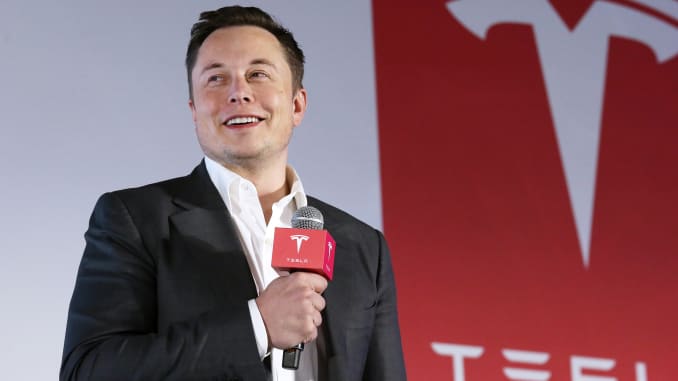
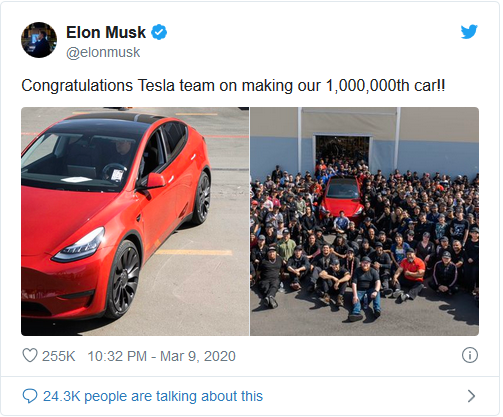
Tesla has produced 1 million electric vehicles, according to the firm’s CEO Elon Musk, who congratulated the “Tesla team” on the milestone via a tweet. News of the landmark figure came after Tesla shares dropped by over 13% yesterday, amid continuing concerns about the coronavirus outbreak and a steep drop in oil prices. The Nasdaq Composite index, on which Tesla is listed, fell 7.3 percent on the day. In extended hours trading Tuesday, Tesla shares were over 10% higher

Currently, Tesla offers four models of electric vehicle: the Model 3 and Model S, which are sedans, and the Model Y and Model X, which are types of SUV. Deliveries of the Model Y are due to start by the end of this quarter.

Musk’s announcement comes at a time when several large automakers are making moves into the electric vehicle sector.

Last week, the BMW Group released details of an electric concept car, the BMW Concept i4. Production of that vehicle is expected to start in 2021.

Towards the end of last year, the German company announced that 500,000 of its electrified cars had been sold. At the time, CEO Oliver Zipse said that the business “was stepping up the pace significantly” and aiming to have one million electric vehicles on the road “within two years.”

And in November 2019, the Volkswagen Group officially started series production of its ID.3 electric car, with the German carmaker planning to launch “almost 70 new electric models” on its platform by 2028.

China’s electric car market is the biggest on the planet: a little over one million electric cars were sold there in 2018, according to the IEA, with Europe and the U.S. following behind.

SOURCE:https://www.cnbc.com/2020/03/10/elon-musk-says-tesla-has-now-produced-1-million-electric-vehicles.html

Bob Moriarty Discusses Loncor Resources: The Fed, the Coronavirus and Investing SPONSOR Loncor Resources $LN.ca t $ABX.ca $TECK.ca $RSG $NGT.to $GOLD $NEM

Posted by AGORACOM at 3:02 PM on Wednesday, March 11th, 2020

Sponsor: Loncor, a Canadian gold explorer controlling over 2,400,000 high grade ounces outside of a Barrick JV. The Ngayu JV property is 200km southwest of the Kibali gold mine, operated by Barrick, which produced 800,000 ounces of gold in 2018. Barrick manages and funds exploration at the Ngayu project until the completion of a pre-feasibility study on any gold discovery meeting their Tier One investment criteria. Newmont $NGT $NEM owns 7.8%, Resolute $RSG owns 27% Click Here for More Info

This image has an empty alt attribute; its file name is Loncor-Small-Square.png

Maurice Jackson of Proven and Probable speaks to Bob Moriarty of 321gold about his thoughts on the current financial markets and investment opportunity

  Excerpt: Maurice Jackson:……Staying in the Southern Hemisphere, let’s visit the Congo, where you just introduced Loncor Resources (TSX:LN). Sir, who is Loncor Resources, and what is the opportunity they present to the market?

Bob Moriarty: Here’s what’s absolutely amazing, I’m glad you brought that up. Loncor Resources approached me, I had never even heard a whisper of the name, I had no clue as to who they were. I went looking into it, they have an incredibly massive land position, in the Democratic Republic of Congo, the DRC.

Barrick Gold has several gold mines there, in the Greenstone Belt, and across the border in Tanzania. Barrick Gold has some of their other really giant mines. Loncor has, in their wholly owned properties, resources of about 2.4 million ounces. They’ve got joint venture with Barrack, on a big piece of their property, like 3000 square kilometers, which is a really big project. Barrick is funding it to feasibility, they’re paying everything. Barrick runs the project, and Barrick spends the money. There are no particular limits on what Barrick can spend, they can spend anything they want to. They’ve got a drill program that’s literally starting right now.

If you look at any stock, you want to figure out what the basement is, what is the lowest price the stock can go to? If you ignored the JV with Barrick, which would be a foolish thing to do, but if you ignored it, you’re buying ounces of gold, in the ground, for $19 an ounce, U.S. So, I don’t think there’s any downside to it. Approximately 70% of shares are in the top three or four shareholders. I think Loncor Resources is a great stock, because if you like gold, and I think after all of the things that I’ve said over the last 15 years, anybody who doesn’t like gold right now is economically illiterate.

Maurice Jackson: You know, you said that lightly, $19 an ounce.

Bob Moriarty: Yeah, yeah. How can you go wrong? At the stage they’re operating, they should be getting $50 or $60 bucks an ounce.

Now, one of the things that we haven’t gotten into, and we need to get into is, one, the T-bond, and, two, what I see happening to gold and gold shares. The T-bond Daily Sentiment Index (DSI), on Friday, hit 98. That is the highest rating I’ve seen, on the Daily Sentiment Indicator for any commodity, ever. Therefore, the T-bond’s going to crash, it’s probably going to take gold with it. Gold had a DSI of 96 a couple of weeks ago.

Everybody hates it. They act like, “Oh my God, you say that gold’s going down. My God, I hate you!” The corrections are perfectly normal, and we’re going to have a correction in gold, and we’re going to have a correction in palladium, and we’re going to have a correction in rhodium. We’re going to go into the biggest financial crash in world history, and most asset classes are going to get sold off. That’s not a bad thing, that creates opportunity, but you’ve got to be flexible, and hopefully liquid.

Now, I am not saying, “Go out and sell everything you’ve got.” Every time I say we’re going to have a correction, “Oh my God, you told me to sell everything.” Well, that’s not what I said, not at all. I said we’re going to have a correction. At the end of the correction, gold and silver and platinum are going to be a lot more valuable. We’re going to do exactly what we did in 2008. A lot of stocks were down 70% or 80%. Most of the big ones, the ones that I like, Lion One Metals, Novo Resources, Irving Resources, Barksdale Capital, these stocks are down 30 or 40% since the first of the year, when I said, “Beware of the stock market.”

I’m not saying something’s going to change on Monday with gold shares, gold shares have been going down for two months.

Maurice Jackson: You referenced Jake Bernstein’s work on the Daily Sentiment Index. What are the parameters that you referenced regarding buy and sell indicators?

Bob Moriarty: The DSI measures sentiment. Most investor look at fundamentals, technicals, worry about the interest rates, worry about the Fed. That’s all bull. People buy stocks because of emotions, and they sell stocks because of emotions. If you can measure those emotions accurately, you’d make a lot of money.

When 98 out of 100 people say something is going to go up, and it doesn’t make any difference what it is, or what the fundamentals are, or what the Fed does, or what the economy does, or what interest rates do, when 98 out of 100 people say something is going to go up, the next move is down. That is the highest number I’ve ever seen. Anything above 90 says the top is near, and anything below 10 says the bottom is near. 98 is such an extreme measure, that I’m perfectly comfortable saying that, you and I are talking on Saturday, and on Monday, T-bonds are going to go down.

Maurice Jackson: Mark the words, there. Which metals have your attention, and why?

Bob Moriarty: Silver and platinum, strange enough, you sent me some information (click here). There was a fire, an explosion at a platinum processing place in South Africa, and the real story is the price of platinum is so far below the cost of production, they’ve got to shut production.

Nobody wants to admit this, everybody’s got their own pet theory, but the fact is supply and demand does work. You cannot have the price of any commodity below the cost of production for very long, or things are going to happen. People are going to shut down production whether it’s wheat, whether it’s gold, or anything else. The silver gold ratio got above 100 to 1, that’s the highest it’s ever been. I think it got up to 102, intraday, a week ago. Silver was very cheap, relative to gold, but that doesn’t mean silver couldn’t correct. I own a lot of silver, and I own a lot of platinum, and a little bit of gold.

SOURCE: https://www.streetwisereports.com/article/2020/03/10/the-fed-the-coronavirus-and-investing.html

Gold To Silver Ratio Hits 100! SPONSOR: Affinity Metals $AAF.ca $SII.ca $TUD.ca $GTT.ca $AMK.ca $OSK.ca $RKR.ca

Posted by AGORACOM at 2:09 PM on Wednesday, March 11th, 2020
This image has an empty alt attribute; its file name is Affinity_Metals_Corp_Logo.png

Sponsor: Affinity Metals Corp. (TSX-V: AFF) is a Canadian mineral exploration company building a strong portfolio of mineral projects in North America. The Corporation’s flagship property is the drill ready Regal Property near Revelstoke, BC where Affinity Metals making preparations for a spring drill program to test two large Z-TEM anomalies at its Regal Property. Click Here for More Info

Gold is testing its previous 2020 highs, but silver plunged anyway, which created a very special situation. Namely, the gold to silver ratio just jumped to the 100 level.

This may not seem like a big deal, because ultimately people buy metals, not their ratio, but it actually is a huge deal. This ratio is observed by investors and traders alike, as it tends to peak at the market extremes. Moving to the 100 level might indicate that we are at a price extreme. But what kind of extreme would that be if silver is declining while gold moved up?

Let’s take a closer look at the gold to silver ratio chart for details.

In early July 2019, the gold to silver ratio topped after breaking above the previous highs and now it’s after the verification of this breakout. Despite the sharp pullback, the ratio moved back below the 2008 high only very briefly. It stabilized above the 2008 high shortly thereafter and now it’s moving up once again.

It previously moved up relatively slowly, but it jumped to new highs last week and today.

Anything after a breakout is vulnerable to a quick correction to the previously broken levels. On the other hand, anything after a breakout that was already confirmed, is ready to move higher and the risk of another corrective decline is much lower.

The most important thing about the gold and silver ratio chart to keep in mind is that it’s after a breakout above the 2008 high and this breakout was already verified. This means that the ratio is likely to rally further. It’s not likely to decline based on being “high” relative to its historical average. That’s not how breakouts work.

The breakout above the previous highs was verified by a pullback to them and now the ratio moved even higher, just as we’ve been expecting it to.

The true, long-term resistance in the gold to silver ratio is at about 100 level. This level was not yet reached, which means that as long as the trend remains intact (and it does remain intact), the 100 level will continue to be the likely target.

We’ve been writing the above for weeks (hence we formatted it with italics), despite numerous calls for a lower gold to silver ratio from many of our colleagues. And our target of 100 was just hit today. It was only hit on an intraday basis, not in terms of the daily closing prices, but it’s still notable.

We had been expecting the gold to silver ratio to hit this extreme close or at the very bottom and the end of the medium-term decline in the precious metals sector – similarly to what happened in 2008. Obviously, that’s not what happened.

Instead, the ratio moved to 100 in the situation where gold rallied, likely based on its safe-haven status, and silver plunged based on its industrial uses.

Despite numerous similarities to 2008, the ratio didn’t rally as much as it did back then. If the decline in the PMs is just starting – and that does appear to be the case – then the very strong long-term resistance of 100 might not be able to trigger a rebound.

It might also be the case that for some time gold declines faster than silver, which would make the ratio move back down from the 100 level. The 100 level could then be re-tested at the final bottom.

Or… which seems more realistic, silver and mining stocks could slide to the level that we originally expected them to while gold ultimately bottoms higher than at $890. Perhaps even higher than $1,000. With gold at $1,100 or so, and silver at about $9, the gold to silver ratio would be a bit over 120.

If the rally in the gold to silver ratio is similar to the one that we saw in 2008, the 118 level or so could really be in the cards. This means that the combination of the above-mentioned price levels would not be out of the question.

At this time, it’s too early to say what combination of price levels will be seen at the final bottom, but we can say that the way gold reacted recently and how it relates to everything else in the world, makes gold likely to decline in the following months. Silver is likely to fall as well and its unlikely that a local top in the gold to silver ratio will prevent further declines.

Source: https://www.kitco.com/commentaries/2020-03-10/Gold-to-silver-ratio-hits-100.html

TU Delft Team Develops Model to Guide Large-Scale Production of Graphene SPONSOR – ZEN Graphene Solutions $ZEN.ca $LLG.ca $FMS.ca $NGC.ca $CVE.ca $DNI.ca

Posted by AGORACOM at 1:44 PM on Wednesday, March 11th, 2020

SPONSOR: ZEN Graphene Solutions: An emerging advanced materials and graphene development company with a focus on new solutions using pure graphene and other two-dimensional materials. Our competitive advantage relies on the unique qualities of our multi-decade supply of precursor materials in the Albany Graphite Deposit. Independent labs in Japan, UK, Israel, USA and Canada confirm this. Click here for more information

  • A research team at Delft University of Technology has developed a mathematical model that can be used to guide the large-scale production of graphene.

“Our model is the first to give a detailed view of what happens at the micro and nanoscale when graphene is produced from plain graphite using energetic fluid mixing,” says Dr. Lorenzo Botto, researcher at the department of Process & Energy at TU Delft. “The model will help the design of large-scale production processes, paving the way for graphene to be incorporated in commercial applications from energy storage devices to biomedicine”.

One of the most promising techniques to produce graphene from graphite is liquid-phase exfoliation. In this technique, graphite is sheared in a liquid environment until layers of graphene detach from the bulk material. The liquid causes the graphene layers to detach gently, which is important to obtain high-quality graphene.

The process has already been successful in the production of graphene on laboratory scale, and, on a trial-and-error basis, on larger scales. It has the potential to be used on industrial scales, to produce tons of material. However, in order to increase the scale of graphene production, we need to know the process parameters that make the exfoliation work efficiently without damaging the graphene sheets.

A research team at TU Delft led by Dr. Lorenzo Botto has developed a mathematical model to determine those parameters. This model can be embedded in large-scale industrial process optimisation software or used by practitioners to choose processing parameters.

“The exfoliation process is difficult to model,” explains Botto. “The adhesion between graphene layers is not easy to quantify and the fluid dynamical forces exerted by the liquid on the graphite depend sensitively on surface properties and geometry.” Team members Catherine Kamal and Simon Gravelle developed and tested the model against molecular dynamics simulations, and proved that that the model can be very accurate. Key to the success of the model is the inclusion of hydronamic slip of the liquid pushing against the graphite surface, and of the fluid forces on the graphene edges

 Botto: “The model forms the basis for better control of the technique at any scale. We hope it will pave the way to the large-scale production of graphene for all kinds of useful applications.””

SOURCE: https://www.graphene-info.com/tu-delft-team-develops-model-guide-large-scale-production-graphene