Agoracom Blog

American Creek Announces Acquisition of Glacier Creek Claims $AMK.ca $SII.ca $TUD.ca $GTT.ca $AMK.ca $OSK.ca $RKR.ca

Posted by AGORACOM at 8:23 AM on Monday, January 20th, 2020

Cardston, Alberta–(Newsfile Corp. – January 20, 2020) – American Creek Resources Ltd. (TSXV: AMK) (the “Company” or “American Creek”) is pleased to announce that it has entered into a property purchase agreement pursuant to which it will acquire the precious and base mineral undersurface rights relating to 45 Crown Grant claims commonly referred to as the “Glacier Creek Claims” located in the Stewart area, British Columbia, from a subsidiary of Strikepoint Gold Inc. (TSXV:SKP)(“Strikepoint“). In consideration for the Glacier Creek Claims, the Company will pay Strikepoint $50,000, issue 3,000,000 common shares to Strikepoint, and grant Strikepoint a 0.5% NSR royalty over the Glacier Creek Claims which NSR royalty may be purchased by the Company at any time for $500,000 cash.

The Glacier Creek Crown Grant claim package consists of claims that overlap a portion of the
Company’s present Dunwell property as well as extending beyond the current Dunwell property boundaries. The net effect being a significant expansion of the Dunwell project and associated mineral rights.

Darren Blaney, President & CEO of the Company stated: “We are very pleased to be able to acquire this package of Crown Grants as it makes sense to amalgamate the claims into one property. This acquisition expands our Dunwell property considerably and provides for increased exploration potential as work is done in the immediate area hosting the historic Dunwell Mine as well as in the surrounding region. We believe that the Dunwell Mine and the multiple bonanza grade gold and silver showings within several kilometers of the mine are all related geologically and are part of a large underlying system”.

Completion of this acquisition is conditional upon, among other things, receipt of all necessary regulatory approvals, including approval of the TSX Venture Exchange.

Any shares issued pursuant to this transaction will be subject to a 4 month hold period pursuant to applicable securities laws.

About American Creek

American Creek is a Canadian junior mineral exploration company with a strong portfolio of gold and silver properties in British Columbia.

Three of those properties are located in the prolific “Golden Triangle”; the Treaty Creek and Electrum joint venture projects with Tudor Gold/Walter Storm as well as the 100% owned past producing Dunwell Mine.

A major drill program was conducted in 2019 at Treaty Creek by JV partner and operator Tudor Gold. The focus of the program was on the Goldstorm zone where drilling has produced very wide intercepts of gold including a 780 meter intercept of 0.683 g/t gold including a higher grade upper portion of 1.095 g/t over 370.5 meters.

The Treaty Creek Project is a Joint Venture with Tudor Gold owning 60% and acting as operator. American Creek and Teuton Resources each have 20% interests in the project. American Creek and Teuton are both fully carried until such time as a Production Notice is issued, at which time they are required to contribute their respective 20% share of development costs. Until such time, Tudor is required to fund all exploration and development costs while both American Creek and Teuton have “free rides”.

A drill program was also recently concluded on the 100% owned Dunwell Mine property located near Stewart. Assay results are pending.

The Corporation also holds the Gold Hill, Austruck-Bonanza, Ample Goldmax, Silver Side, and Glitter King properties located in other prospective areas of the province.

For further information please contact Kelvin Burton at: Phone: 403 752-4040 or Email: [email protected]. Information relating to the Company is available on its website at www.americancreek.com

Datametrex $DM.ca Announces $600,000 Renewal Contract with #LOTTE

Posted by AGORACOM-JC at 7:12 AM on Monday, January 20th, 2020
  • Secured an additional contract with a division of LOTTE for approximately $600,000
  • Contract is renewal from last year, and it is for 12 months monthly subscription.

TORONTO, Jan. 20, 2020 — Datametrex AI Limited (the “Company” or Datametrex”) (TSXV: DM) (FSE: D4G) is pleased to announce it has secured an additional contract with a division of LOTTE for approximately $600,000. The contract is renewal from last year, and it is for 12 months monthly subscription.

“I am thrilled to start the new year with a large contract from LOTTE. Our team is doing an excellent job servicing LOTTE as they continue to execute on our “land and expand” strategy. Generating more SaaS business is one of our key objectives as it will help to smooth out our lumpier government contracts,” says Marshall Gunter, CEO of the Company.

The Company also wishes to provide an update on the previously announced license sale to GreenInsightz. Given the challenging environment in the sector, GreenInsightz and Datametrex have agreed to rework the purchase terms as follows:

  • $250,000 CAD cash payment
  • 30% of GreenInsightz equity position

About Datametrex

Datametrex AI Limited is a technology focused company with exposure to Artificial Intelligence and Machine Learning through its wholly owned subsidiary, Nexalogy (www.nexalogy.com).

For further information, please contact:

Jeff Stevens
Email: [email protected]Phone: 647-777-7974

Forward-Looking Statements

This news release contains “forward-looking information” within the meaning of applicable securities laws. All statements contained herein that are not clearly historical in nature may constitute forward-looking information. In some cases, forward-looking information can be identified by words or phrases such as “may”, “will”, “expect”, “likely”, “should”, “would”, “plan”, “anticipate”, “intend”, “potential”, “proposed”, “estimate”, “believe” or the negative of these terms, or other similar words, expressions and grammatical variations thereof, or statements that certain events or conditions “may” or “will” happen, or by discussions of strategy.

Readers are cautioned to consider these and other factors, uncertainties and potential events carefully and not to put undue reliance on forward-looking information. The forward-looking information contained herein is made as of the date of this press release and is based on the beliefs, estimates, expectations and opinions of management on the date such forward-looking information is made. The Company undertakes no obligation to update or revise any forward-looking information, whether as a result of new information, estimates or opinions, future events or results or otherwise or to explain any material difference between subsequent actual events and such forward-looking information, except as required by applicable law.

Neither the TSX Venture Exchange nor its Regulation Services Provider (as that term is defined in the policies of the TSX Venture Exchange) accepts responsibility for the adequacy or accuracy of this release.

Why #Facebook #Twitter and governments are concerned about #deepfakes – SPONSOR: Datametrex AI Limited $DM.ca

Posted by AGORACOM-JC at 9:45 PM on Sunday, January 19th, 2020

SPONSOR: Datametrex AI Limited (TSX-V: DM) A revenue generating small cap A.I. company that NATO and Canadian Defence are using to fight fake news & social media threats. The company announced three $1M contacts in Q3-2019. Click here for more info.

Why Facebook, Twitter and governments are concerned about deepfakes

  • Facebook recently announced it has banned deepfakes from its social media platforms ahead of the upcoming 2020 US presidential elections.
  • The move came days before a US House Energy and Commerce hearing on manipulated media content, titled “Americans at Risk: Manipulation and Deception in the Digital Age.”

By: Giorgia Guantario

In a blog post, Monika Bickert, Facebook’s Vice President of Global Policy Management, explained that the ban will concern all content that “has been edited or synthesised – beyond adjustments for clarity or quality – in ways that aren’t apparent to an average person and would likely mislead someone into thinking that a subject of the video said words that they did not actually say,” as well as content that is “the product of artificial intelligence or machine learning that merges, replaces or superimposes content onto a video, making it appear to be authentic.”

The move came days before a US House Energy and Commerce hearing on manipulated media content, titled â€œAmericans at Risk: Manipulation and Deception in the Digital Age.”

Twitter has also been in the process of coming up with its own deepfake policies, asking its community for help in drafting them,  although nothing has come out as of yet.

But what are deepfakes? And why are social media platforms and governments so concerned about them?

Artificial Intelligence has been the hot topic of 2019 – this vast and game changing technology has opened new doors for what organisations can achieve thanks to technology. However, with all the good, such as facial recognition or automation, also came some bad.

In the decade of fake news and misinformation, there has always been a general understanding that although social media posts, clickbait websites, and text content in general, were not to be fully trusted, videos and audios were safe from the rise of deception – that is until deepfakes entered the scene.

According to Merriam-Webster, the term deepfake is “typically used to refer to a video that has been edited using an algorithm to replace the person in the original video with someone else (especially a public figure) in a way that makes the video look authentic.”

The fake in the word is pretty self-explanatory – these videos are not real. The deep comes from deep learning, a subset of artificial intelligence that utilises different layers of artificial neural networks. Specifically, deepfakes employ two sets of algorithms, one to create the video, and the second to determine if it is fake. The first learns from the second to create a perfectly unidentifiable fake video.

Although the technology behind these videos is very fascinating, the improper use of deepfakes has raised questions and concerns, and its newfound mainstream status is not to be underestimated.

The beginning of the new decade saw TikTok’s parent company ByteDance under accusations of developing a feature, referred to as “Face Swap“, using deepfakes technology. ByteDance has denied the accusations, but the possibility of such feature to become available to everyone raises concerns as to the use the general public would make of it.

The most famous example is Chinese deepfakes app Zao, which superimposes a photo of the user’s face onto a person in a video or GIF. While Zao’s mainly faced privacy issues –the first version of the user agreement stated that people who uploaded their photos surrendered intellectual property right to their face– the real concern stems from the use people will actually do of such a controversial technology if it were to become available to a wider audience. At the time, Chinese online payment system Alipay responded to fears over fraudulent use of Zao saying that the current facial swapping technology “cannot deceive

[their]

payment apps” – but this doesn’t mean that the technology is not evolving and couldn’t pose a threat in the future.

Another social network to make headlines in the first week of 2020 with relation to deepfakes is Snapchat – the company also decided to invest in its own deepfake technology. The social network bought deepfake maker AI Factory for US $166M and the acquisition resulted in a new Snapchat feature called “Cameos” that works in the same way deepfakes videos do – users can use their selfies to become part of a selection of videos and essentially create content that looks real, but that has never happened.

Deepfakes have been around for a while now – the most prevalent use of this technology is in pornography, which has seen a growing number of women, especially celebrities, becoming the protagonists of pornographic content without their consent. The trend started on Reddit, where pornographic deepfakes featuring the faces of actress Gal Gadot, singers Taylor Swift and Ariana Grande, amongst others, grew in popularity. Last year, deepfake pornography accounted for 96 percent of the 14678 deepfake videos online, according to a report by Amsterdam-based company Deeptrace.

The remaining four percent, although small, could be just as dangerous, and even change the global political and social landscape.

In response to Facebook’s decision to not take down the “shallowfake” (videos manipulated with basic editing tools or intentionally placed out of context) video of US House Speaker Nancy Pelosi appearing to be slurring her words, a team which included UK artist Bill Posters posted a deepfake video of Mark Zuckerberg giving an appalling speech that boasted
his “total control of billions of people’s stolen data, all their secrets, their lives, their futures.” The artists aim, they said, was to interrogate the power of new forms of computational propaganda.

Other examples of very credible deepfake videos see Barack Obama deliver a speech on the dangers of false information (the irony!), or in a much more worrying use of the technology, cybercriminals mimicking a CEO’s voice to demand a cash-transfer.

There is clearly a necessity to address deepfakes on a number of fronts to avoid them becoming a powerful tool of misinformation.

For starters, although the commodification of this technology can be frightening, it also raises people’s level of awareness, and puts them in a position to question the credibility of the videos and audio they’re watching or listening to. It is up to the watcher to check if videos are real or not, just as it is when it comes to fake news.

Moreover, the same technology that created the issue could be the answer to solving it. Last month, Facebook, in cooperation with Amazon, Microsoft and Partnership on AI, launched a competition called the “Deepfake Detection Challenge” to create automated tools, using AI technology, that can spot deepfakes. At the same time, the AI Foundation also announced they are building a deepfake detection tool for the general public.

Regulators have also started moving in the right direction to avoid the misuse of this technology. US Congress held its first hearing on deepfakes in June 2019, due to growing concerns over the impact deepfake could have on the upcoming US presidential elections; while, as in the case of Facebook and Twitter, social media platforms are under more and more pressure to take action against misinformation, which now includes deepfake videos and audios.

Source: https://www.tahawultech.com/industry/technology/deepfakes-concerns-facebook-ban-manipulated-media/

Scripps Researchers Use #Mhealth Wearables to Track Flu Outbreaks – SPONSOR: CardioComm Solutions $EKG.ca – $ATE.ca $TLT.ca $OGI.ca $ACST.ca $IPA.ca

Posted by AGORACOM-JC at 9:30 PM on Sunday, January 19th, 2020

SPONSOR: CardioComm Solutions (EKG: TSX-V) – The heartbeat of cardiovascular medicine and telemedicine. Patented systems enable medical professionals, patients, and other healthcare professionals, clinics, hospitals and call centres to access and manage patient information in a secure and reliable environment.

Scripps Researchers Use mHealth Wearables to Track Flu Outbreaks

The study used data from Fitbit users over two years to determine who was experiencing a flu-like illness. It shows that mHealth wearables could be used to identify and possibly even anticipate viral outbreaks.

  • Led by digital health expert Eric Topol, MD, researchers at the Scripps Research Translational Institute used data from roughly 50,000 people wearing Fitbits between 2016 and 2018 and were able to plot outbreaks of seasonal respiratory infections like the flu.
  • Researchers found they could identify and possibly even anticipate an outbreak by the activities of Fitbit users who became sick.

By Eric Wicklund

January 17, 2020 – Researchers have found a way to use mHealth wearables to tackle population health concerns.

Led by digital health expert Eric Topol, MD, researchers at the Scripps Research Translational Institute used data from roughly 50,000 people wearing Fitbits between 2016 and 2018 and were able to plot outbreaks of seasonal respiratory infections like the flu.

The first-of-its-kind study tracked sleep patterns, resting heart rate (RHR) and activity among users in Texas, California, New York, Illinois and Pennsylvania, and compared that data to influenza-like illnesses (ILIs) recorded by the US Centers for Disease Control in those states.

Researchers found they could identify and possibly even anticipate an outbreak by the activities of Fitbit users who became sick. People who develop the flu, they noted, tend to have an elevated RHR, sleep more and move around less.

“Activity and physiological trackers are increasingly used in the USA and globally to monitor individual health,” Topol and his colleagues said in a study published this week in The Lancet. “By accessing these data, it could be possible to improve real-time and geographically refined influenza surveillance. This information could be vital to enact timely outbreak response measures to prevent further transmission of influenza cases during outbreaks.”

Joining Topol in the research were Jennifer M. Radin, PhD; Nathan E. Wineinger, PhD, and Steve R. Steinhubl, MD, all of the San Diego-based organization, which has conducted dozens of mHealth and telehealth studies over the past decade.

This study, funded in part by the National Institutes of Health, aims to improve population health management for a virus that annually affects 20 percent of children and 7 percent of adults in the US, and which causes as many as 650,000 deaths worldwide. Traditional surveillance methods usually lag one to three weeks behind the outbreak, putting healthcare providers at a disadvantage in curbing the spread of the virus.

Topol and his colleagues are looking at mHealth to reduce that disadvantage and give providers and public health officials an opportunity to stop and outbreak earlier.

There are some challenges. While roughly 10 percent of the US population, according to a 2016 study, now uses wearables, that percentage has to be higher to make the results more meaningful. In addition, any connected health platform used to gather data shoud be able to draw information from a wide variety of wearables, including smart watches and smart clothing.

And finally, such a platform would need to be careful to distinguish behaviors caused by the onset of the flu with normal behaviors, and sensitive enough to detect those changes in behavior at the earliest possible moment.

“In the future, wearables could include additional sensors to prospectively track blood pressure, temperature, electrocardiogram, and cough analysis, which could be used to further characterize an individual’s baseline and identify abnormalities,” the study concluded. “Capturing physiological and behavioral data from a growing number of wearable device users globally could greatly improve timeliness and precision of public health responses and even inform individual clinical care. It could also fill major gaps in regions where influenza surveillance data are not available.”

Source: https://mhealthintelligence.com/news/scripps-researchers-use-mhealth-wearables-to-track-flu-outbreaks

How #Edtech became personalised in the 2010s SPONSOR: BetterU Education Corp. $BTRU.ca $ARCL $CPLA $BPI $FC.ca

Posted by AGORACOM-JC at 9:15 PM on Sunday, January 19th, 2020
SPONSOR:  BetterU Education Corp. aims to provide access to quality education from around the world. The company plans to bridge the prevailing gap in the education and job industry and enhance the lives of its prospective learners by developing an integrated ecosystem. Click here for more information.

How Edtech became personalised in the 2010s

  • The internet is being used to reach this diverse population in the remotest corners, and advanced tech is being used to create new learning experiences
  • If we look at the new technology accessible to teachers and students today, then we would agree that the accepted way to teach and learn has changed

By Zishaan Hayath

The integration of technology started with improving classroom experiences and reached adaptive learning platforms that students can personalise, says Toppr’s Zishaan Hayath

We are in an era where unprecedented ideas are unfolding in education, driven by technology. Digitising learning content has been imperative, keeping in mind affordability, accessibility and inclusiveness of the large trainable youth population. The internet is being used to reach this diverse population in the remotest corners, and advanced tech is being used to create new learning experiences. If we look at the new technology accessible to teachers and students today, then we would agree that the accepted way to teach and learn has changed. It is undeniable that education has evolved so much, and technology has opened up the world a lot for both students and teachers. In this article, we explore the journey of edtech through this decade that saw it evolve from smart classes to personalised learning apps on smartphones.

EDTECH SOLUTIONS WERE DESIGNED AROUND IMPROVING THE CLASSROOM EXPERIENCE AND HELPING TEACHERS

Integration of technology in the learning and education system is evidently the greatest change in education in the past decade. The earliest technology innovations for schools were created around providing software and hardware to make the classroom experience better. More emphasis was put on the use of rich multimedia content as a teaching tool inside classrooms. We saw more and more teachers making use of overhead projectors and videos during their lessons. This was then considered to be a revolutionary in-classroom technology, leveraging a large repository of digital content across virtually all subjects from kindergarten to Class 12. This new technology helped schools with better educational resource planning and helped teachers with better lecture delivery. Performance management and tracking systems enabled teachers to measure the progress of students systematically. Such classrooms were called “smart classes”. Progress in technology, however, has led to much more.

INTERNET SHIFTED FOCUS FROM CLASSROOMS TO VIRTUAL CLASSROOMS WITH DIGITISED CONTENT.

Smart class solutions faced challenges like high set-up cost, hardware maintenance and non-payments by institutions. As a result, edtech companies started moving to asset-light models. Digitisation of learning material and availability on platforms, including YouTube, followed the wave of smart classes. Internet penetration made everything easier and faster, enabling students to access digital study material that was informational and interactive and could be accessed anytime, anywhere. The gap in the ability to access high quality learning material was shrinking. This boom in digitisation of content helped scale the concept of pre-recorded online classes in India. The availability of fast internet connections and easy access allowed students to be more informed and open to new avenues. ‘In jobs, expertise from experience is no longer critical’ Students were able to take on-demand classes without having to attend any physical classes. For students, this improved affordability, while reduced travel time allowed them to study at their own pace and time.

EDTECH STARTED GROWING EXPONENTIALLY WITH LEARNING APPS

As students started accessing learning material over the internet, it gave rise to a new opportunity. Newly introduced learning apps started providing content at one place, which was otherwise scattered. The content was now organised and designed around a teacher’s pedagogy. Online courses developed by proficient tutors gave students the experience of real-time learning while sitting in the comfort of their homes. Edtech saw growth in many disciplines, including primary and supplementary education, test preparation, reskilling and online certifications, and language learning. Global institutions started running online certification courses powered by edtech that helped in course delivery, examinations and assessments. Indian entrepreneurs made an impressive effort in following and customising the global trend of digitisation of the education system. Increasing awareness and higher disposable income boosted the edtech market and it attracted significant investments from Indian and global investors.

PERSONALISED LEARNING MARKED THE NEW AGE OF EDTECH

The second half of the last decade saw the use of advanced technology. Cutting edge tech, including artificial intelligence (AI) and machine learning (ML), gave rise to education platforms that addressed the basic problem of the education system of India—the one-size-fits-all-approach. With a typical classroom having a teacher-to-student ratio of 1:50, the quality is often compromised and that’s where technology is useful. Adaptive learning platforms using AI and ML create personalised learning paths helping students study in the way they best understand, thus enabling them to learn as per their needs. Gamification in learning has helped engage students in a meaningful way, making them genuinely interested in their subject matter. Why companies will have to fill digital skill gaps soon: Wipro’s Saurabh Govil Cloud-based learning is fast emerging as the medium to make personalised and high quality learning available to all students. Live classes with teachers can be conducted on such platforms, along with pre-recorded video classes, where the students can access the material on their own time. Students can now reach out for academic help 24×7. This is quickly changing the possibilities of delivery mediums when it comes to affordable access to high-quality learning.

CUSTOMER ACQUISITION AND RETENTION WOULD BE KEY CHALLENGES TO FURTHER GROWTH

Availability and access to the internet are important for all of these technologies to become relevant to end-users, i.e. students and teachers. The number of people accessing the internet has grown manifold over the last decade. However, for a society like India where the culture of coaching classes is deep-rooted, it is challenging to drive the adoption of edtech platforms as an alternative. Students, parents and teachers need to be better informed of the benefits of edtech. Startups are trying various business models, including free, freemium and premium subscriptions to drive usage and trial. However, there is a lot of ground to be covered. As this decade ends, we recognise that the Indian education system has evolved fast, along with global trends. Technology has also enabled streamlining of the learning experience, improved accessibility and offered new resources to students. And there is only more to come. With one of the largest populations in the world, stronger implementation of AI and ML will help bring truly adaptive and personalised platforms addressing the real learning needs of students and professionals. Edtech is all set to give more accessible, high-quality and personalised learning and prepare the leaders of tomorrow.

Source: http://www.forbesindia.com/article/vision-2020/how-edtech-became-personalised-in-the-2010s/57109/1

Bitcoin Price Tests $9,000 As Altcoins Flourish: Friday #Crypto Market Watch SPONSOR: ThreeD Capital $IDK.ca $HIVE.ca $BLOC.ca $CODE.ca

Posted by AGORACOM-JC at 9:00 PM on Sunday, January 19th, 2020

SPONSOR: ThreeD Capital Inc. (IDK:CSE) Led by legendary financier, Sheldon Inwentash, ThreeD is a Canadian-based venture capital firm that only invests in best of breed small-cap companies which are both defensible and mass scalable. More than just lip service, Inwentash has financed many of Canada’s biggest small-cap exits. Click Here For More Information.

Bitcoin Price Tests $9,000 As Altcoins Flourish: Friday Crypto Market Watch

  • 2020 has so far been particularly positive for Bitcoin and the rest of the cryptocurrency market. Starting the year at around $7,100, BTC currently trades at almost $9,000, charting notable increases throughout the entire week. 

Author: George Georgiev

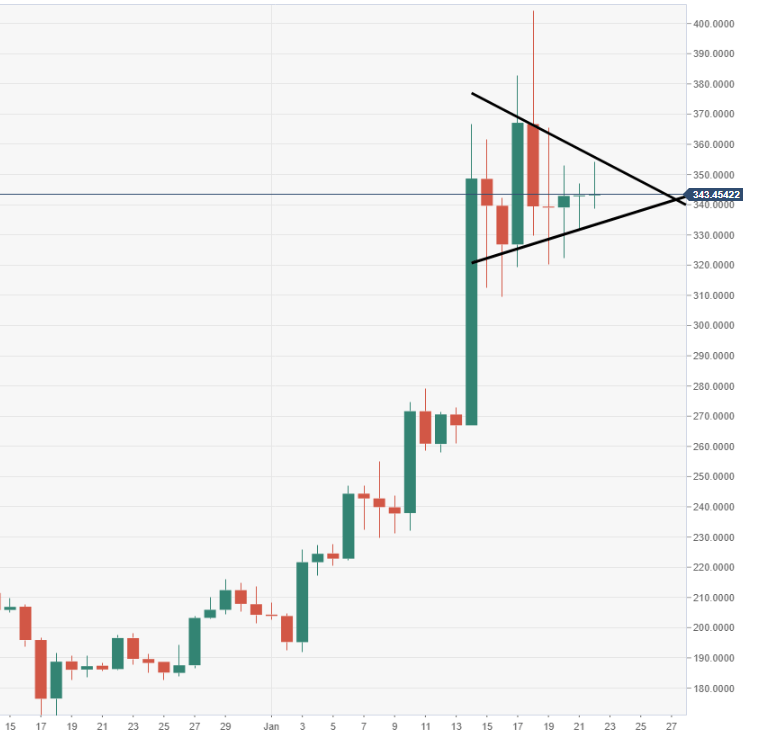
2020 has so far been particularly positive for Bitcoin and the rest of the cryptocurrency market. Starting the year at around $7,100, BTC currently trades at almost $9,000, charting notable increases throughout the entire week. 

In the past 24 hours alone, Bitcoin gained another 3% to its value, increasing from around $8,650 to about $9,000 from where it retraced a bit and it currently trades at $8,900. 

BTC/USD. Source: TradingView

Bitcoin’s total market capitalization has increased to $162 billion. However, its dominance has sized down to 66.1%, meaning that altcoins have managed to recover and to claim new grounds. 

Indeed, looking at how other cryptocurrencies besides Bitcoin performed, it’s rather clear that they are flourishing. All of the projects from the top 20 are in the green, charting serious gains throughout the entire week. The past 24 hours are no exception. 

Bitcoin SV is once again one of the best-performing altcoins, increasing by 10% throughout the past 24 hours. Others who marked serious gains include Binance Coin (9.14%), EOS, (8.84%), Bitcoin Cash (7.8%), and so forth. 

Total Market Capitalization: $245B | Bitcoin Market Capitalization: 162B | BTC Dominance: 66.1%

Major Crypto Headlines

$3.2 Million ETH Stolen From UPbit Is Already Laundered: Report Claims. Following the hack of UPbit which took place in November 2019, it now becomes clear that $3.2 million from the stolen cryptocurrency has already been laundered. The report also claims that this happened by using small transactions in a lot of different exchanges. 

YouTube Crypto Purge Is Back: Popular YouTuber Davinci Reports He’d Been Blocked From Streaming. Despite issuing a formal apology and saying that the cryptocurrency purge has been a mistake, it appears that YouTube is taking a charge at content creators once again. Popular cryptocurrency YouTuber Davinci has said that his channel has been flagged and that he has been blocked from streaming. 

Craig Wright’s Defamation Case Against Hodlnaut Reportedly Dismissed By UK’s High Court. Self-proclaimed Satoshi Nakamoto, Craig Wright, has reportedly seen his defamation case against popular Twitter user Hodlnaut dismissed. The merit for the order is the is lack of jurisdiction but the case will supposedly continue in Norway.  

Significant Daily Gainers and Losers

Ethereum Classic (31.45%)

Ethereum Classic (ETC) is undoubtedly the most significant daily gainer throughout the past 24 hours, at the time of this writing. Up 31.45% so far, ETC stands at a price of $10 and a total market capitalization of about $1.1 billion. More interestingly, ETC saw a surge in its 24-hour trading volume which is now more than $3.2 billion. 

MonaCoin (24.72%)

MonaCoin is another altcoin that managed to impress in today’s trading session. It’s up about 24 percent in the past day alone, bringing its price to $1.22 at the time of this writing. MonaCoin now sits on a market cap of about $80 million and is the 61st largest cryptocurrency. In terms of 24-hour trading volume, MonaCoin stands at about $21 million. 

Swipe (-11.83%)

Unfortunately, not all altcoins managed to increase with the rest of the market. Swipe is down about 11.8% and its price reduced to $1.30. The cryptocurrency stands on a total market cap of about $79 million and saw a trading volume of $14 million in the past 24 hours.

Source: https://cryptopotato.com/bitcoin-price-tests-9000-as-altcoins-flourish-friday-crypto-market-watch/

Gold’s Big Picture SPONSOR: Affinity Metals $AAF.ca $SII.ca $TUD.ca $GTT.ca $AMK.ca $OSK.ca $RKR.ca

Posted by AGORACOM at 12:49 PM on Sunday, January 19th, 2020

Sponsor: Affinity Metals (TSX-V: AFF) a Canadian mineral exploration company building a strong portfolio of mineral projects in North America. The Corporation’s flagship property is the Drill ready Regal Property near Revelstoke, BC. Recent sampling encountered bonanza grade silver, zinc, and lead with many samples reaching assay over-limits. Further assaying of over-limits has been initiated, results will be reported once received. Click Here for More Info

From the HRA Journal: Issue 314

The fun doesn’t stop. Waves of liquidity continue to wash traders cares away. Even assassinations and war mongering generate little more than half day dips on Wall St. It seems nothing can get in the way of the bull rally that’s carrying all risk assets higher.

It feels like it could go on for a while, though I think the liquidity will have to keep coming to sustain it. By most readings, bullishness on Wall St is at levels that are rarely sustained for more than a few weeks. Some sort of correction on Wall St seems highly likely, and soon. Whether its substantial or just another blip on the way higher remains to be seen.

The resource sector, especially gold and silver stocks, have had their own rally. Our Santa Claus market was as good or better than Wall St’s for a change. And I don’t think its over yet. I think we’re in for the best Q1 we’ve seen for a few years. And we could be in for something better than that even. I increasingly see signs of a major rally developing in the gold space. It’s already been pretty good but I think a multi-quarter, or longer, move may be starting to take shape.

I usually spend time on all the metals in the first issue of the year. But, because the makings of this gold rally are complex and long in coming I decided to detail my reasoning. That ended up taking several pages so I’ll save talk on base metals and other markets for the next issue.

Eric Coffin
January 7, 2020

Gold’s Big Picture

“Après moi, le déluge“

No, I’m not writing about Louis IV, though there might be some appropriateness to the analogy, now that I think about it. The quote is famous, even though there’s no agreement on what it was supposed to mean. Most figure Louis was referring to the biblical flood, that all would be chaos once his reign ended.

The deluge I’m referring to isn’t water. It’s the flood of money the US Fed, and other central banks, continue to unleash to keep markets stable. Markets, especially stock markets, love liquidity. You can see the impact of the latest deluge, particularly the US Fed’s in the chart below that traces both the SPX index value and the level of a “Global Liquidity Proxy” (“GLP”) measuring fiscal/monetary tightness and weakness.

You can see the GLP moved lower in late 2018 as the Fed tightened and the impact that had on Wall St. Conversely, you can see the SPX running higher in the past couple of months as the US backed off rate increases, increased fiscal deficit expansion, and grew the Fed balance sheet through, mainly, repo market operations.

Wall St, and most other bourses, are loving these money flows. The Santa Claus rally discussed in the last issue continued to strengthen all the way to and through year end. As it turned out, the Fed either provided enough backstop in advance or the yearend repo issues were overstated. The repo market itself was calm going through year end and a lot of the short-term money offered by the Fed during that week wasn’t taken down.

Everything may have changed in the past couple of days with the dramatic increase in US-Iran tensions. I don’t know how big an issue that will be, since no one knows what form Iran’s retaliation will be or how much things will escalate. I DO think it’s potentially a big deal with very negative connotations, but it may take time to unfold. Someone at the Fed thought so too, as the past couple of days saw a return to large scale Fed lending in the repo market.

I’ve no doubt Iran will try and take revenge for the assassination of its most famous military commander by the US. But I don’t know what form it will take and if this means the US has drawn itself into the Mideast quagmire even more. I fear it has though. The US is already talking about adding 3,000 troops to its Mideast presence and they’re just warming up. Even larger scale attacks, if they happen, may not derail Wall St, but they’re certainly not a positive development at any level.

We know how stretched both market valuations and sentiment were before the Suleimani drone strike. The chart below shows a three-year trace of the “fear/greed index”. You can see that its hardly a stable reading. It flip flops often and extreme readings rarely hold for long. At last check, the reading was 94% bullish.

Sentiment almost never gets that bullish and, when it does, nothing good comes of it for bulls. A reading that close to 100% tells you we’re just about out of buyers. Whatever happens in and around Iran, I think a near term correction is inevitable. The only question is whether it’s a large one or not.

A rapid escalation in US-Iran tensions could certainly make a near term correction larger. If the flood of liquidity continues though, a correction could just be another waystation on the road to higher highs. There are a couple of other dangers Wall St still faces that I’ll touch on briefly at the end of this article. First however, lets move on to the main event for us-the gold market.

It wasn’t just the SPX enjoying a Santa rally this year. Gold experienced the rally we were hoping for that gold miner stocks seemed to be foretelling early last month. Gold’s been doing well since it bottomed at $1275 in June, but it didn’t feel that way during the long hiatus between the early September high and the current move. The gold price currently sits above September’s multi-year high, after breaching that high in the wake of the Baghdad drone strike. And the first retaliatory strike by Iran. Volatility will be very high for a while going forward.

I think we’ll see more multi-year highs going forward. I hate that the latest move higher is driven by geopolitics. Scary geopolitics and military confrontations mean people are dying. We don’t want to profit from misery. And we won’t anyway, if things get ugly enough in the Mideast to scare traders out of the market.

Geopolitical price moves almost always unwind quickly. I’d much prefer to see gold moving higher for macro reasons, not as a political safety trade. I expect more political/military inspired moves. As the Iran conflict unfolds. Make no mistake, Iran is NOT Iraq. Its army is far larger, better trained and better equipped than Iraq. This could get ugly.

The balance of this piece will deal with my macro argument for higher gold prices over an extended period. The geopolitical stuff will be layered on top of that for the next while and could strengthen both gold prices and the $US in risk-off trading. It should be viewed as a separate event from the argument laid out below.

What else is driving gold higher? In part, it was gold’s inverse relationship with the US Dollar. As you already know, I’m not a believer that “its all about the USD, all the time” when it comes to the gold market. That’s an over-simplification of a more complex relationship. It also discounts the idea of gold as its own asset class that trades for its own reasons.

If you look at the gold chart above, and the USD chart below it, its immediately apparent that there isn’t a constant negative correlation at play. Gold rallied during the summer at the same time the USD did and for the same reason; the world-wide explosion of negative real yields. Gold weakened a bit when yields reversed to the upside and the USD got a bit of traction, but things changed again at the start of December.

The USD turned lower and lost two percent during December. US bond yields were generally rising during the month and the market (right or wrong) was assuming economic growth was accelerating. So, neither of those items explains the USD weakness.

If gold was a “risk off” trade, you sure couldn’t see it in the way any other market was trading. So, is there another explanation for recent strength in the gold price, and what does it tell us about 2020 and, perhaps, beyond?

Well, I’ve got a theory. If I’m right, it could mean a bull run for gold has a long way to go.

Some of this theory will be no surprise to you because it does partially hinge on further USD weakness. There are long term structural reasons why the US currency should weaken. But there are also fluctuating sources of demand for USDs, particularly from offshore buyers and borrowers that transact in US currency. That can create enough demand to strengthen the US over long periods. We just went though one such period, but it looks like that may have come to an end, with more bearish forces to the USD reasserting themselves.

How did we get here? Let’s start with the big picture, displayed on the top chart on the next page. It gives a long-term view of US Federal deficits and the unemployment rate. Normally, these travel in tandem. Higher unemployment means more social spending and higher deficits. Government spending expands during recessions and contracts-or should- (as a percentage of GDP) during expansions. Classic Keynesian stuff.

You rarely see these two measures diverge. The two times they did significantly before, on the left side of the chart, was due to “wartime deficits” which acted (along with conscription) to stimulate the economy and drive down unemployment.

You can see the Korean and Vietnam war periods pointed out on the chart.

The current period stands out for the extreme size of the divergence. US unemployment rates are at multi decade lows and yet the fiscal deficit as a percentage of GDP keeps rising. There has never been a divergence this large and its due to get larger.

We know why this is. Big tax cuts combined with a budget that is mostly non-discretionary. And the US is 10 years into an economic expansion, however weak. Just think what this graph will look like the next time the US goes into recession.

We can assume US government deficits aren’t going to shrink any time soon (and I think we can, pun intended, take that to the bank). That leaves trade in goods to act as a counterbalance to the funding demand created by fiscal deficits.

The chart above makes it clear the US won’t get much help from international trade. The US trade balance has been getting increasingly negative for decades. It’s better recently, but unlikely to turn positive soon, and maybe not ever.

To be clear, this is not a bad thing in itself, notwithstanding the view from the White House. The relative strength of the US economy and the US Dollar and cheaper offshore production costs have driven the trade balance. It’s grown because Americans found they got more value buying abroad and the world was happy to help finance it. It’s not a bad thing, but not a US Dollar support either.

The more complete picture of currency/investment flows is given by changes in the Current Account. In simplified terms, the Current Account measures the difference between what a country produces and what it consumes. For example, if a country’s trade deficit increases, so does its current account deficit. If there are funds flowing in from overseas investments on the other hand, this decrease the Current Account deficit or increase the surplus.

The graph below summarizes quarterly changes in the US current account. You can see how the balance got increasingly negative in the mid 2000’s as both imports and foreign investment by US companies increased.

Not coincidentally, this same period leading up to the Financial Crisis included a sustained downtrend in the US Dollar Index. The USD index chart on the bottom of the next page shows the scale of that decline, from an index value of 120 at the start of 2002 all the way down to 73 in early 2008.

The current account deficit (and value of the USD) improved markedly up to the end of the Financial Crisis as money poured into the US as a safe haven and consumers cut back on imports. The current account deficit bas been relatively stable since then, running at about $100bn/quarter until it dipped a bit again last year.

Trade, funds flows and changes in money supply have the largest long-term impacts on currency values. When the US Fed ended QE and started tightening monetary conditions in 2014, the USD enjoyed a strong rally. The USD Index was back to 100 by early 2015 and stayed there until loosening monetary conditions-and lots of jawboning from Washington-led to pullback. Things reversed again and the USD maintained a mild uptrend from early 2018 until now.

There are still plenty of US Dollar bulls around, and their arguments have short-term merit. Yes, the US has higher real interest rates and somewhat higher growth. Both are important to relative currency valuations as I’ve said in the past. Longer term however, the “twin deficits” -fiscal and current account-should underpin the fundamental value of the currency.

Movements don’t happen overnight, especially when you’re talking about the worlds reserve currency that has the deepest and largest market supporting it. Changing the overall trend for the USD is like turning a supertanker. I think it’s happening though, and it has big potential implications for commodities, especially gold.

Dollar bulls will tell you the USD is the “cleanest shirt in the laundry hamper”, referring to the relative strength of the growth rate and interest rates compared to other major currencies. That’s true if we just look at those measures but definitely not true when we look at the longer term-fiscal and current account deficits.

In fact, the US has about the worst combined fiscal/current account deficit in the G7. The chart at the bottom of this page, from lynalden.com shows the 2018 values for Current Account and Trade balances for a number of major economies, as a percentage of their GDP. It’s not a handsome group.

Both the trade and current account deficits are negative for most of them. In terms of G7 economies, the US has the worst combined Current/Trade deficit at 6% of GDP annually. You may be surprised to note that the Current/Trade balance for the Euro zone is much better than the US, thanks to a large Trade surplus. Much of that is generated by Germany. Indeed, this chart explains Germanys defense of the Euro. It’s combined Trade/Current Account surplus is so large it’s currency would be skyrocketing if it still used the Deutschmark.

Because the current account deficit is cumulative, the overall international investment position of the US has continued to worsen. The US has gone from being an international creditor to an international debtor, and the scale if its debt keeps increasing. That means it’s getting harder every year to reverse the current account position as the US borrows ever more abroad to cover its trade and fiscal deficits. Interest outflows keep growing and investment inflows shrinking. Something has to give.

The US has to borrow overseas, as private domestic demand for Treasury bonds isn’t high enough to fund the twin deficits. In the past, whenever the US Dollar got too high, offshore demand for US government debt diminished. It’s not clear why. Maybe the higher dollar made raising enough foreign funds difficult, or perhaps buyers started worrying about the USD dropping after they bought when it got too expensive. Whatever the reason, foreign holdings of US Treasuries have been declining, forcing the US to find new, domestic, buyers.

Last year, the US Fed stopped its quantitative tightening program, due to concerns about Dollar liquidity. Then came the repo market. Since September, the Fed’s balance sheet has expanded by over $400 billion, mainly due to repo market transactions.

The Fed maintains this “isn’t QE” because these are very short duration transactions but, cumulatively, the total Fed balance sheet keeps expanding. The “QE/no QE” debate is just semantics.

What do these transactions look like? Mostly, its Primary Dealers, banks that also take part in Treasury auctions, in the repo market. The Fed buys bonds, usually Treasuries, from these banks and pays for them in newly printed Dollars. That injects money into the system, helps hold down interest rates in the repo market and, not coincidentally, effectively helps fund the US fiscal deficit. To put the series of transactions in their simplest form, the US is effectively monetizing its deficit with a lot of these transactions.

The chart below illustrates the problem for the Primary Dealer US banks. They’ve got to buy Treasuries when they’re auctioned-that is their commitment as Primary Dealers. They also need to hold minimum cash balances as a percentage of assets under Basel II bank regulations. Cash balances fell to the minimum mandated level by late 2019- the horizontal black line on the chart. That’s when the trouble started.

These banks are so stuffed with Treasuries that they didn’t have excess cash reserves to lend into the repo market. Hence the blow up back in September and the need for the Fed to inject cash by buying Treasuries. The point, however, is that this isn’t really a “repo market issue”, that’s just where it reared its head. It’s a “too many Treasuries and not enough buyers” problem.

It will be tough for the Treasury to attract more offshore buyers unless the USD weakens, or interest rates rise enough to make them irresistible. Or a big drop in the federal deficit reduces the supply of Treasuries itself.

I doubt we’ll see interest rates move up significantly. I don’t think the economy could handle it and it would be self-defeating anyway, as the government deficit would explode because of interest expenses. And that’s not even taking into account the fact that President Trump would be freaking out daily.

Based on recent history and political expediency, I’d say the odds of significant budget deficit reductions are slim and none. That’s especially true going into an election year. There’s just no way we’re going to see spending restraint or tax increases in the next couple of years. Indeed, the supply of Treasuries will keep growing even if the US economy grows too. If there is any sort of significant slowdown or recession the Federal deficit will explode and so will the new supply of Treasures. Not an easy fix.

Barring new haven demand for US Treasuries, odds are the Fed will have to keep sopping up excess supply. That means expanding its balance sheet and, in so doing, effectively increasing the US money supply.

That brings us (finally!) to the “money shot” chart that appears above. It compares changes in the size of the Fed balance sheet and the US Dollar Index. To make it readable and allow me to match the scales, I generated a chart that tracks annual percentage changes.

The chart shows a strong inverse correlation between changes in the size of the Fed balance sheet and the value of the USD. This is unsurprising as most transactions that expand the Fed balance sheet also expand the money supply.

It’s impossible to tell how long the repo market transactions will continue but, after three months, they aren’t feeling very “temporary”. To me, it increasingly looks like these market operations are “debt monetization in drag”.

I don’t know if that’s the Fed’s real intent or just a side effect. It doesn’t really matter if the funding and money printing continues at scale. Even if the repo market calms completely, the odds are good we see some sort of “new QE” start up. Whatever official reason is given for it; I think it will happen mainly to soak up the excess supply of Treasuries fiscal deficits are creating.

I don’t blame the FOMC if they’re being disingenuous about it. That’s their job after all. If you’re a central banker, the LAST thing you’re going to say is “our government is having trouble finding buyers for its debt”, especially if its true.

With no prospect of lower deficits and apparent continued reduction in offshore Treasury holdings, this could develop into long-term sustained trend. I don’t expect it to move in a straight line, markets never do. A severe escalation in Mideast tensions or the start of a serious recession could both generate safe-haven Treasury buying. Money flows from that would take the pressure off the Fed and would be US Dollar supportive too.

That said, it seems the US has reached the point where a substantial increase in its central bank’s balance sheet is inevitable. Both Japan and the Eurozone have gotten there before the Fed, but it looks like it won’t be immune.

The Eurozone at least has a “Twin surplus” to help cushion things. And Japan, considered a basket case economically, had an extremely deep pool of domestic savings (far deeper than the US) to draw on. Until very recently, Japan also ran massive Current Account surpluses thanks to decades of heavy investments overseas by Japanese entities. Those advantages allowed the ECB and especially the BoJ to massively expand their balance sheets without generating a huge run up in interest rates or currency collapse.

I don’t know how far the US Fed can expand its balance sheet before bond yields start getting away from it. I think pretty far though. Having the world’s reserve currency is a massive advantage. There is huge built in demand for US Dollars and US denominated debt. That gives the Fed some runway if it must keep buying US Treasuries.

Assuming a run on yields doesn’t spoil the party, continued balance sheet and money supply expansion should put increasing downward pressure on the US Dollar. I don’t know if we’ll see a move as large as the mid-2000s but a move down to the low 80s for the USD Index over the course of two or three years wouldn’t be surprising.

It won’t be a straight-line move. A recession could derail things, though the bear market on Wall St that would generate would support bullion. Currency markets tend to be self-correcting over extended periods. If the USD Index falls enough and there is a bump in US real interest rates offshore demand for Treasuries should increase again.

The bottom line is that this is, and will continue to be, a very dynamic system. Even so, I think we’ve reached a major inflection point for the US currency. The 2000s were pretty good for the gold market and gold stocks. We started from a much lower base of $300/oz on the gold price. Starting at a $1200-1300 base this time, I think a price above $2000/oz is a real possibility over the next year or two.

It’s not hard to extrapolate prices higher than that, but I’m not looking or hoping for those. I prefer to see a longer, steadier move that brings traders along rather than freaking them out.

This prediction isn’t a sure thing. Predictions never are. But I think the probabilities now favor an extended bull run in the gold price. Assuming stock markets don’t blow up (though I still expect that correction), gold stocks should put in a leveraged performance much more impressive than the bullion price itself.

There will be consolidations and corrections along the way, but I think there will be many gold explorers and developers that rack up share price gains in the hundreds of percent. That doesn’t mean buying blindly and never trading. We still need to adjust when a stock gets overweight and manage risk around major exploration campaigns. The last few weeks has been a lot more fun in the resource space. I don’t think the fun’s over yet. Enjoy the ride.

Like any good contrarian, a 10-year bull market makes me alert of signs of potential trouble. As noted at the start of this editorial, I’m expecting continues floods of liquidity. That may simply overwhelm everything else for a while and allow Wall St to keep rallying, come what may.

That said, a couple of data points recently got my attention. One is more of a sentiment indicator, seen in the chart below. More than one wag has joked that the Fed need only worry about Wall St, since the stock market is the economy now. Turns out there is more than a bit of truth to that.

The chart shows the US Leading Indicator reading with the level of the stock market (which is a component of the official Leading Indicator) removed. As you can see, without Wall St, the indicator implies zero growth going forward. I’m mainly showing it as evidence of just how surreal things have become.

The chart above is something to keep an eye on going forward. It shows weekly State unemployment claims for several major sectors of the economy. What’s interesting about this chart is that claims have been climbing rapidly over the past few weeks. Doubly interesting is that the increase in claims is broad, both within and across several sectors of the economy.

I take the monthly Non-Farm Payroll number less seriously than most, because it’s a backward-looking indicator. This move in unemployment claims looks increasingly like a trend though. It’s now at its highest level since the Financial Crisis.

It’s not in the danger zone-yet. But its climbing fast. We may need to start paying more attention to those payroll numbers. If the chart below isn’t a statistical fluke, we may start seeing negative surprises in the NFP soon. That won’t hurt the gold price either.

Source and Thanks: https://www.hraadvisory.com/golds-big-picture

Gold’s Big Picture SPONSOR: American Creek Resources $AMK.ca $TUD.ca $SII.ca $GTT.ca $AFF.ca $SEA.ca $SA $PVG.ca $AOT.ca

Posted by AGORACOM at 2:44 PM on Saturday, January 18th, 2020

SPONSOR: American Creek owns a 20% Carried Interest to Production at the Treaty Creek Project in the Golden Triangle. 2019’s first hole averaged of 0.683 g/t Au over 780m in a vertical intercept. The Treaty Creek property is located in the same hydrothermal system as the Pretivm and Seabridge’s KSM deposits. Click Here for More Info

From the HRA Journal: Issue 314

The fun doesn’t stop. Waves of liquidity continue to wash traders cares away. Even assassinations and war mongering generate little more than half day dips on Wall St. It seems nothing can get in the way of the bull rally that’s carrying all risk assets higher.

It feels like it could go on for a while, though I think the liquidity will have to keep coming to sustain it. By most readings, bullishness on Wall St is at levels that are rarely sustained for more than a few weeks. Some sort of correction on Wall St seems highly likely, and soon. Whether its substantial or just another blip on the way higher remains to be seen.

The resource sector, especially gold and silver stocks, have had their own rally. Our Santa Claus market was as good or better than Wall St’s for a change. And I don’t think its over yet. I think we’re in for the best Q1 we’ve seen for a few years. And we could be in for something better than that even. I increasingly see signs of a major rally developing in the gold space. It’s already been pretty good but I think a multi-quarter, or longer, move may be starting to take shape.

I usually spend time on all the metals in the first issue of the year. But, because the makings of this gold rally are complex and long in coming I decided to detail my reasoning. That ended up taking several pages so I’ll save talk on base metals and other markets for the next issue.

Eric Coffin
January 7, 2020

Gold’s Big Picture

“Après moi, le déluge“

No, I’m not writing about Louis IV, though there might be some appropriateness to the analogy, now that I think about it. The quote is famous, even though there’s no agreement on what it was supposed to mean. Most figure Louis was referring to the biblical flood, that all would be chaos once his reign ended.

The deluge I’m referring to isn’t water. It’s the flood of money the US Fed, and other central banks, continue to unleash to keep markets stable. Markets, especially stock markets, love liquidity. You can see the impact of the latest deluge, particularly the US Fed’s in the chart below that traces both the SPX index value and the level of a “Global Liquidity Proxy” (“GLP”) measuring fiscal/monetary tightness and weakness.

You can see the GLP moved lower in late 2018 as the Fed tightened and the impact that had on Wall St. Conversely, you can see the SPX running higher in the past couple of months as the US backed off rate increases, increased fiscal deficit expansion, and grew the Fed balance sheet through, mainly, repo market operations.

Wall St, and most other bourses, are loving these money flows. The Santa Claus rally discussed in the last issue continued to strengthen all the way to and through year end. As it turned out, the Fed either provided enough backstop in advance or the yearend repo issues were overstated. The repo market itself was calm going through year end and a lot of the short-term money offered by the Fed during that week wasn’t taken down.

Everything may have changed in the past couple of days with the dramatic increase in US-Iran tensions. I don’t know how big an issue that will be, since no one knows what form Iran’s retaliation will be or how much things will escalate. I DO think it’s potentially a big deal with very negative connotations, but it may take time to unfold. Someone at the Fed thought so too, as the past couple of days saw a return to large scale Fed lending in the repo market.

I’ve no doubt Iran will try and take revenge for the assassination of its most famous military commander by the US. But I don’t know what form it will take and if this means the US has drawn itself into the Mideast quagmire even more. I fear it has though. The US is already talking about adding 3,000 troops to its Mideast presence and they’re just warming up. Even larger scale attacks, if they happen, may not derail Wall St, but they’re certainly not a positive development at any level.

We know how stretched both market valuations and sentiment were before the Suleimani drone strike. The chart below shows a three-year trace of the “fear/greed index”. You can see that its hardly a stable reading. It flip flops often and extreme readings rarely hold for long. At last check, the reading was 94% bullish.

Sentiment almost never gets that bullish and, when it does, nothing good comes of it for bulls. A reading that close to 100% tells you we’re just about out of buyers. Whatever happens in and around Iran, I think a near term correction is inevitable. The only question is whether it’s a large one or not.

A rapid escalation in US-Iran tensions could certainly make a near term correction larger. If the flood of liquidity continues though, a correction could just be another waystation on the road to higher highs. There are a couple of other dangers Wall St still faces that I’ll touch on briefly at the end of this article. First however, lets move on to the main event for us-the gold market.

It wasn’t just the SPX enjoying a Santa rally this year. Gold experienced the rally we were hoping for that gold miner stocks seemed to be foretelling early last month. Gold’s been doing well since it bottomed at $1275 in June, but it didn’t feel that way during the long hiatus between the early September high and the current move. The gold price currently sits above September’s multi-year high, after breaching that high in the wake of the Baghdad drone strike. And the first retaliatory strike by Iran. Volatility will be very high for a while going forward.

I think we’ll see more multi-year highs going forward. I hate that the latest move higher is driven by geopolitics. Scary geopolitics and military confrontations mean people are dying. We don’t want to profit from misery. And we won’t anyway, if things get ugly enough in the Mideast to scare traders out of the market.

Geopolitical price moves almost always unwind quickly. I’d much prefer to see gold moving higher for macro reasons, not as a political safety trade. I expect more political/military inspired moves. As the Iran conflict unfolds. Make no mistake, Iran is NOT Iraq. Its army is far larger, better trained and better equipped than Iraq. This could get ugly.

The balance of this piece will deal with my macro argument for higher gold prices over an extended period. The geopolitical stuff will be layered on top of that for the next while and could strengthen both gold prices and the $US in risk-off trading. It should be viewed as a separate event from the argument laid out below.

What else is driving gold higher? In part, it was gold’s inverse relationship with the US Dollar. As you already know, I’m not a believer that “its all about the USD, all the time” when it comes to the gold market. That’s an over-simplification of a more complex relationship. It also discounts the idea of gold as its own asset class that trades for its own reasons.

If you look at the gold chart above, and the USD chart below it, its immediately apparent that there isn’t a constant negative correlation at play. Gold rallied during the summer at the same time the USD did and for the same reason; the world-wide explosion of negative real yields. Gold weakened a bit when yields reversed to the upside and the USD got a bit of traction, but things changed again at the start of December.

The USD turned lower and lost two percent during December. US bond yields were generally rising during the month and the market (right or wrong) was assuming economic growth was accelerating. So, neither of those items explains the USD weakness.

If gold was a “risk off” trade, you sure couldn’t see it in the way any other market was trading. So, is there another explanation for recent strength in the gold price, and what does it tell us about 2020 and, perhaps, beyond?

Well, I’ve got a theory. If I’m right, it could mean a bull run for gold has a long way to go.

Some of this theory will be no surprise to you because it does partially hinge on further USD weakness. There are long term structural reasons why the US currency should weaken. But there are also fluctuating sources of demand for USDs, particularly from offshore buyers and borrowers that transact in US currency. That can create enough demand to strengthen the US over long periods. We just went though one such period, but it looks like that may have come to an end, with more bearish forces to the USD reasserting themselves.

How did we get here? Let’s start with the big picture, displayed on the top chart on the next page. It gives a long-term view of US Federal deficits and the unemployment rate. Normally, these travel in tandem. Higher unemployment means more social spending and higher deficits. Government spending expands during recessions and contracts-or should- (as a percentage of GDP) during expansions. Classic Keynesian stuff.

You rarely see these two measures diverge. The two times they did significantly before, on the left side of the chart, was due to “wartime deficits” which acted (along with conscription) to stimulate the economy and drive down unemployment.

You can see the Korean and Vietnam war periods pointed out on the chart.

The current period stands out for the extreme size of the divergence. US unemployment rates are at multi decade lows and yet the fiscal deficit as a percentage of GDP keeps rising. There has never been a divergence this large and its due to get larger.

We know why this is. Big tax cuts combined with a budget that is mostly non-discretionary. And the US is 10 years into an economic expansion, however weak. Just think what this graph will look like the next time the US goes into recession.

We can assume US government deficits aren’t going to shrink any time soon (and I think we can, pun intended, take that to the bank). That leaves trade in goods to act as a counterbalance to the funding demand created by fiscal deficits.

The chart above makes it clear the US won’t get much help from international trade. The US trade balance has been getting increasingly negative for decades. It’s better recently, but unlikely to turn positive soon, and maybe not ever.

To be clear, this is not a bad thing in itself, notwithstanding the view from the White House. The relative strength of the US economy and the US Dollar and cheaper offshore production costs have driven the trade balance. It’s grown because Americans found they got more value buying abroad and the world was happy to help finance it. It’s not a bad thing, but not a US Dollar support either.

The more complete picture of currency/investment flows is given by changes in the Current Account. In simplified terms, the Current Account measures the difference between what a country produces and what it consumes. For example, if a country’s trade deficit increases, so does its current account deficit. If there are funds flowing in from overseas investments on the other hand, this decrease the Current Account deficit or increase the surplus.

The graph below summarizes quarterly changes in the US current account. You can see how the balance got increasingly negative in the mid 2000’s as both imports and foreign investment by US companies increased.

Not coincidentally, this same period leading up to the Financial Crisis included a sustained downtrend in the US Dollar Index. The USD index chart on the bottom of the next page shows the scale of that decline, from an index value of 120 at the start of 2002 all the way down to 73 in early 2008.

The current account deficit (and value of the USD) improved markedly up to the end of the Financial Crisis as money poured into the US as a safe haven and consumers cut back on imports. The current account deficit bas been relatively stable since then, running at about $100bn/quarter until it dipped a bit again last year.

Trade, funds flows and changes in money supply have the largest long-term impacts on currency values. When the US Fed ended QE and started tightening monetary conditions in 2014, the USD enjoyed a strong rally. The USD Index was back to 100 by early 2015 and stayed there until loosening monetary conditions-and lots of jawboning from Washington-led to pullback. Things reversed again and the USD maintained a mild uptrend from early 2018 until now.

There are still plenty of US Dollar bulls around, and their arguments have short-term merit. Yes, the US has higher real interest rates and somewhat higher growth. Both are important to relative currency valuations as I’ve said in the past. Longer term however, the “twin deficits” -fiscal and current account-should underpin the fundamental value of the currency.

Movements don’t happen overnight, especially when you’re talking about the worlds reserve currency that has the deepest and largest market supporting it. Changing the overall trend for the USD is like turning a supertanker. I think it’s happening though, and it has big potential implications for commodities, especially gold.

Dollar bulls will tell you the USD is the “cleanest shirt in the laundry hamper”, referring to the relative strength of the growth rate and interest rates compared to other major currencies. That’s true if we just look at those measures but definitely not true when we look at the longer term-fiscal and current account deficits.

In fact, the US has about the worst combined fiscal/current account deficit in the G7. The chart at the bottom of this page, from lynalden.com shows the 2018 values for Current Account and Trade balances for a number of major economies, as a percentage of their GDP. It’s not a handsome group.

Both the trade and current account deficits are negative for most of them. In terms of G7 economies, the US has the worst combined Current/Trade deficit at 6% of GDP annually. You may be surprised to note that the Current/Trade balance for the Euro zone is much better than the US, thanks to a large Trade surplus. Much of that is generated by Germany. Indeed, this chart explains Germanys defense of the Euro. It’s combined Trade/Current Account surplus is so large it’s currency would be skyrocketing if it still used the Deutschmark.

Because the current account deficit is cumulative, the overall international investment position of the US has continued to worsen. The US has gone from being an international creditor to an international debtor, and the scale if its debt keeps increasing. That means it’s getting harder every year to reverse the current account position as the US borrows ever more abroad to cover its trade and fiscal deficits. Interest outflows keep growing and investment inflows shrinking. Something has to give.

The US has to borrow overseas, as private domestic demand for Treasury bonds isn’t high enough to fund the twin deficits. In the past, whenever the US Dollar got too high, offshore demand for US government debt diminished. It’s not clear why. Maybe the higher dollar made raising enough foreign funds difficult, or perhaps buyers started worrying about the USD dropping after they bought when it got too expensive. Whatever the reason, foreign holdings of US Treasuries have been declining, forcing the US to find new, domestic, buyers.

Last year, the US Fed stopped its quantitative tightening program, due to concerns about Dollar liquidity. Then came the repo market. Since September, the Fed’s balance sheet has expanded by over $400 billion, mainly due to repo market transactions.

The Fed maintains this “isn’t QE” because these are very short duration transactions but, cumulatively, the total Fed balance sheet keeps expanding. The “QE/no QE” debate is just semantics.

What do these transactions look like? Mostly, its Primary Dealers, banks that also take part in Treasury auctions, in the repo market. The Fed buys bonds, usually Treasuries, from these banks and pays for them in newly printed Dollars. That injects money into the system, helps hold down interest rates in the repo market and, not coincidentally, effectively helps fund the US fiscal deficit. To put the series of transactions in their simplest form, the US is effectively monetizing its deficit with a lot of these transactions.

The chart below illustrates the problem for the Primary Dealer US banks. They’ve got to buy Treasuries when they’re auctioned-that is their commitment as Primary Dealers. They also need to hold minimum cash balances as a percentage of assets under Basel II bank regulations. Cash balances fell to the minimum mandated level by late 2019- the horizontal black line on the chart. That’s when the trouble started.

These banks are so stuffed with Treasuries that they didn’t have excess cash reserves to lend into the repo market. Hence the blow up back in September and the need for the Fed to inject cash by buying Treasuries. The point, however, is that this isn’t really a “repo market issue”, that’s just where it reared its head. It’s a “too many Treasuries and not enough buyers” problem.

It will be tough for the Treasury to attract more offshore buyers unless the USD weakens, or interest rates rise enough to make them irresistible. Or a big drop in the federal deficit reduces the supply of Treasuries itself.

I doubt we’ll see interest rates move up significantly. I don’t think the economy could handle it and it would be self-defeating anyway, as the government deficit would explode because of interest expenses. And that’s not even taking into account the fact that President Trump would be freaking out daily.

Based on recent history and political expediency, I’d say the odds of significant budget deficit reductions are slim and none. That’s especially true going into an election year. There’s just no way we’re going to see spending restraint or tax increases in the next couple of years. Indeed, the supply of Treasuries will keep growing even if the US economy grows too. If there is any sort of significant slowdown or recession the Federal deficit will explode and so will the new supply of Treasures. Not an easy fix.

Barring new haven demand for US Treasuries, odds are the Fed will have to keep sopping up excess supply. That means expanding its balance sheet and, in so doing, effectively increasing the US money supply.

That brings us (finally!) to the “money shot” chart that appears above. It compares changes in the size of the Fed balance sheet and the US Dollar Index. To make it readable and allow me to match the scales, I generated a chart that tracks annual percentage changes.

The chart shows a strong inverse correlation between changes in the size of the Fed balance sheet and the value of the USD. This is unsurprising as most transactions that expand the Fed balance sheet also expand the money supply.

It’s impossible to tell how long the repo market transactions will continue but, after three months, they aren’t feeling very “temporary”. To me, it increasingly looks like these market operations are “debt monetization in drag”.

I don’t know if that’s the Fed’s real intent or just a side effect. It doesn’t really matter if the funding and money printing continues at scale. Even if the repo market calms completely, the odds are good we see some sort of “new QE” start up. Whatever official reason is given for it; I think it will happen mainly to soak up the excess supply of Treasuries fiscal deficits are creating.

I don’t blame the FOMC if they’re being disingenuous about it. That’s their job after all. If you’re a central banker, the LAST thing you’re going to say is “our government is having trouble finding buyers for its debt”, especially if its true.

With no prospect of lower deficits and apparent continued reduction in offshore Treasury holdings, this could develop into long-term sustained trend. I don’t expect it to move in a straight line, markets never do. A severe escalation in Mideast tensions or the start of a serious recession could both generate safe-haven Treasury buying. Money flows from that would take the pressure off the Fed and would be US Dollar supportive too.

That said, it seems the US has reached the point where a substantial increase in its central bank’s balance sheet is inevitable. Both Japan and the Eurozone have gotten there before the Fed, but it looks like it won’t be immune.

The Eurozone at least has a “Twin surplus” to help cushion things. And Japan, considered a basket case economically, had an extremely deep pool of domestic savings (far deeper than the US) to draw on. Until very recently, Japan also ran massive Current Account surpluses thanks to decades of heavy investments overseas by Japanese entities. Those advantages allowed the ECB and especially the BoJ to massively expand their balance sheets without generating a huge run up in interest rates or currency collapse.

I don’t know how far the US Fed can expand its balance sheet before bond yields start getting away from it. I think pretty far though. Having the world’s reserve currency is a massive advantage. There is huge built in demand for US Dollars and US denominated debt. That gives the Fed some runway if it must keep buying US Treasuries.

Assuming a run on yields doesn’t spoil the party, continued balance sheet and money supply expansion should put increasing downward pressure on the US Dollar. I don’t know if we’ll see a move as large as the mid-2000s but a move down to the low 80s for the USD Index over the course of two or three years wouldn’t be surprising.

It won’t be a straight-line move. A recession could derail things, though the bear market on Wall St that would generate would support bullion. Currency markets tend to be self-correcting over extended periods. If the USD Index falls enough and there is a bump in US real interest rates offshore demand for Treasuries should increase again.

The bottom line is that this is, and will continue to be, a very dynamic system. Even so, I think we’ve reached a major inflection point for the US currency. The 2000s were pretty good for the gold market and gold stocks. We started from a much lower base of $300/oz on the gold price. Starting at a $1200-1300 base this time, I think a price above $2000/oz is a real possibility over the next year or two.

It’s not hard to extrapolate prices higher than that, but I’m not looking or hoping for those. I prefer to see a longer, steadier move that brings traders along rather than freaking them out.

This prediction isn’t a sure thing. Predictions never are. But I think the probabilities now favor an extended bull run in the gold price. Assuming stock markets don’t blow up (though I still expect that correction), gold stocks should put in a leveraged performance much more impressive than the bullion price itself.

There will be consolidations and corrections along the way, but I think there will be many gold explorers and developers that rack up share price gains in the hundreds of percent. That doesn’t mean buying blindly and never trading. We still need to adjust when a stock gets overweight and manage risk around major exploration campaigns. The last few weeks has been a lot more fun in the resource space. I don’t think the fun’s over yet. Enjoy the ride.

Like any good contrarian, a 10-year bull market makes me alert of signs of potential trouble. As noted at the start of this editorial, I’m expecting continues floods of liquidity. That may simply overwhelm everything else for a while and allow Wall St to keep rallying, come what may.

That said, a couple of data points recently got my attention. One is more of a sentiment indicator, seen in the chart below. More than one wag has joked that the Fed need only worry about Wall St, since the stock market is the economy now. Turns out there is more than a bit of truth to that.

The chart shows the US Leading Indicator reading with the level of the stock market (which is a component of the official Leading Indicator) removed. As you can see, without Wall St, the indicator implies zero growth going forward. I’m mainly showing it as evidence of just how surreal things have become.

The chart above is something to keep an eye on going forward. It shows weekly State unemployment claims for several major sectors of the economy. What’s interesting about this chart is that claims have been climbing rapidly over the past few weeks. Doubly interesting is that the increase in claims is broad, both within and across several sectors of the economy.

I take the monthly Non-Farm Payroll number less seriously than most, because it’s a backward-looking indicator. This move in unemployment claims looks increasingly like a trend though. It’s now at its highest level since the Financial Crisis.

It’s not in the danger zone-yet. But its climbing fast. We may need to start paying more attention to those payroll numbers. If the chart below isn’t a statistical fluke, we may start seeing negative surprises in the NFP soon. That won’t hurt the gold price either.

Source and Thanks: https://www.hraadvisory.com/golds-big-picture

Gold’s Big Picture SPONSOR: Labrador Gold $LAB.ca $RIO.ca $WHM.ca $SIC.ca $NXS.ca

Posted by AGORACOM at 4:36 PM on Friday, January 17th, 2020
This image has an empty alt attribute; its file name is LAB-square-logo-2.png

SPONSOR: Labrador Gold – Two successful gold explorers lead the way in the Labrador gold rush targeting the under-explored gold potential of the province. Exploration has already outlined district scale gold on two projects, including a 40km strike length of the Florence Lake greenstone belt, one of two greenstone belts covered by the Hopedale Project. Click Here for More Info

From the HRA Journal: Issue 314

The fun doesn’t stop. Waves of liquidity continue to wash traders cares away. Even assassinations and war mongering generate little more than half day dips on Wall St. It seems nothing can get in the way of the bull rally that’s carrying all risk assets higher.

It feels like it could go on for a while, though I think the liquidity will have to keep coming to sustain it. By most readings, bullishness on Wall St is at levels that are rarely sustained for more than a few weeks. Some sort of correction on Wall St seems highly likely, and soon. Whether its substantial or just another blip on the way higher remains to be seen.

The resource sector, especially gold and silver stocks, have had their own rally. Our Santa Claus market was as good or better than Wall St’s for a change. And I don’t think its over yet. I think we’re in for the best Q1 we’ve seen for a few years. And we could be in for something better than that even. I increasingly see signs of a major rally developing in the gold space. It’s already been pretty good but I think a multi-quarter, or longer, move may be starting to take shape.

I usually spend time on all the metals in the first issue of the year. But, because the makings of this gold rally are complex and long in coming I decided to detail my reasoning. That ended up taking several pages so I’ll save talk on base metals and other markets for the next issue.

Eric Coffin
January 7, 2020

Gold’s Big Picture

“Après moi, le déluge“

No, I’m not writing about Louis IV, though there might be some appropriateness to the analogy, now that I think about it. The quote is famous, even though there’s no agreement on what it was supposed to mean. Most figure Louis was referring to the biblical flood, that all would be chaos once his reign ended.

The deluge I’m referring to isn’t water. It’s the flood of money the US Fed, and other central banks, continue to unleash to keep markets stable. Markets, especially stock markets, love liquidity. You can see the impact of the latest deluge, particularly the US Fed’s in the chart below that traces both the SPX index value and the level of a “Global Liquidity Proxy” (“GLP”) measuring fiscal/monetary tightness and weakness.

You can see the GLP moved lower in late 2018 as the Fed tightened and the impact that had on Wall St. Conversely, you can see the SPX running higher in the past couple of months as the US backed off rate increases, increased fiscal deficit expansion, and grew the Fed balance sheet through, mainly, repo market operations.

Wall St, and most other bourses, are loving these money flows. The Santa Claus rally discussed in the last issue continued to strengthen all the way to and through year end. As it turned out, the Fed either provided enough backstop in advance or the yearend repo issues were overstated. The repo market itself was calm going through year end and a lot of the short-term money offered by the Fed during that week wasn’t taken down.

Everything may have changed in the past couple of days with the dramatic increase in US-Iran tensions. I don’t know how big an issue that will be, since no one knows what form Iran’s retaliation will be or how much things will escalate. I DO think it’s potentially a big deal with very negative connotations, but it may take time to unfold. Someone at the Fed thought so too, as the past couple of days saw a return to large scale Fed lending in the repo market.

I’ve no doubt Iran will try and take revenge for the assassination of its most famous military commander by the US. But I don’t know what form it will take and if this means the US has drawn itself into the Mideast quagmire even more. I fear it has though. The US is already talking about adding 3,000 troops to its Mideast presence and they’re just warming up. Even larger scale attacks, if they happen, may not derail Wall St, but they’re certainly not a positive development at any level.

We know how stretched both market valuations and sentiment were before the Suleimani drone strike. The chart below shows a three-year trace of the “fear/greed index”. You can see that its hardly a stable reading. It flip flops often and extreme readings rarely hold for long. At last check, the reading was 94% bullish.

Sentiment almost never gets that bullish and, when it does, nothing good comes of it for bulls. A reading that close to 100% tells you we’re just about out of buyers. Whatever happens in and around Iran, I think a near term correction is inevitable. The only question is whether it’s a large one or not.

A rapid escalation in US-Iran tensions could certainly make a near term correction larger. If the flood of liquidity continues though, a correction could just be another waystation on the road to higher highs. There are a couple of other dangers Wall St still faces that I’ll touch on briefly at the end of this article. First however, lets move on to the main event for us-the gold market.

It wasn’t just the SPX enjoying a Santa rally this year. Gold experienced the rally we were hoping for that gold miner stocks seemed to be foretelling early last month. Gold’s been doing well since it bottomed at $1275 in June, but it didn’t feel that way during the long hiatus between the early September high and the current move. The gold price currently sits above September’s multi-year high, after breaching that high in the wake of the Baghdad drone strike. And the first retaliatory strike by Iran. Volatility will be very high for a while going forward.

I think we’ll see more multi-year highs going forward. I hate that the latest move higher is driven by geopolitics. Scary geopolitics and military confrontations mean people are dying. We don’t want to profit from misery. And we won’t anyway, if things get ugly enough in the Mideast to scare traders out of the market.

Geopolitical price moves almost always unwind quickly. I’d much prefer to see gold moving higher for macro reasons, not as a political safety trade. I expect more political/military inspired moves. As the Iran conflict unfolds. Make no mistake, Iran is NOT Iraq. Its army is far larger, better trained and better equipped than Iraq. This could get ugly.

The balance of this piece will deal with my macro argument for higher gold prices over an extended period. The geopolitical stuff will be layered on top of that for the next while and could strengthen both gold prices and the $US in risk-off trading. It should be viewed as a separate event from the argument laid out below.

What else is driving gold higher? In part, it was gold’s inverse relationship with the US Dollar. As you already know, I’m not a believer that “its all about the USD, all the time” when it comes to the gold market. That’s an over-simplification of a more complex relationship. It also discounts the idea of gold as its own asset class that trades for its own reasons.

If you look at the gold chart above, and the USD chart below it, its immediately apparent that there isn’t a constant negative correlation at play. Gold rallied during the summer at the same time the USD did and for the same reason; the world-wide explosion of negative real yields. Gold weakened a bit when yields reversed to the upside and the USD got a bit of traction, but things changed again at the start of December.

The USD turned lower and lost two percent during December. US bond yields were generally rising during the month and the market (right or wrong) was assuming economic growth was accelerating. So, neither of those items explains the USD weakness.

If gold was a “risk off” trade, you sure couldn’t see it in the way any other market was trading. So, is there another explanation for recent strength in the gold price, and what does it tell us about 2020 and, perhaps, beyond?

Well, I’ve got a theory. If I’m right, it could mean a bull run for gold has a long way to go.

Some of this theory will be no surprise to you because it does partially hinge on further USD weakness. There are long term structural reasons why the US currency should weaken. But there are also fluctuating sources of demand for USDs, particularly from offshore buyers and borrowers that transact in US currency. That can create enough demand to strengthen the US over long periods. We just went though one such period, but it looks like that may have come to an end, with more bearish forces to the USD reasserting themselves.

How did we get here? Let’s start with the big picture, displayed on the top chart on the next page. It gives a long-term view of US Federal deficits and the unemployment rate. Normally, these travel in tandem. Higher unemployment means more social spending and higher deficits. Government spending expands during recessions and contracts-or should- (as a percentage of GDP) during expansions. Classic Keynesian stuff.

You rarely see these two measures diverge. The two times they did significantly before, on the left side of the chart, was due to “wartime deficits” which acted (along with conscription) to stimulate the economy and drive down unemployment.

You can see the Korean and Vietnam war periods pointed out on the chart.

The current period stands out for the extreme size of the divergence. US unemployment rates are at multi decade lows and yet the fiscal deficit as a percentage of GDP keeps rising. There has never been a divergence this large and its due to get larger.

We know why this is. Big tax cuts combined with a budget that is mostly non-discretionary. And the US is 10 years into an economic expansion, however weak. Just think what this graph will look like the next time the US goes into recession.

We can assume US government deficits aren’t going to shrink any time soon (and I think we can, pun intended, take that to the bank). That leaves trade in goods to act as a counterbalance to the funding demand created by fiscal deficits.

The chart above makes it clear the US won’t get much help from international trade. The US trade balance has been getting increasingly negative for decades. It’s better recently, but unlikely to turn positive soon, and maybe not ever.

To be clear, this is not a bad thing in itself, notwithstanding the view from the White House. The relative strength of the US economy and the US Dollar and cheaper offshore production costs have driven the trade balance. It’s grown because Americans found they got more value buying abroad and the world was happy to help finance it. It’s not a bad thing, but not a US Dollar support either.

The more complete picture of currency/investment flows is given by changes in the Current Account. In simplified terms, the Current Account measures the difference between what a country produces and what it consumes. For example, if a country’s trade deficit increases, so does its current account deficit. If there are funds flowing in from overseas investments on the other hand, this decrease the Current Account deficit or increase the surplus.

The graph below summarizes quarterly changes in the US current account. You can see how the balance got increasingly negative in the mid 2000’s as both imports and foreign investment by US companies increased.

Not coincidentally, this same period leading up to the Financial Crisis included a sustained downtrend in the US Dollar Index. The USD index chart on the bottom of the next page shows the scale of that decline, from an index value of 120 at the start of 2002 all the way down to 73 in early 2008.

The current account deficit (and value of the USD) improved markedly up to the end of the Financial Crisis as money poured into the US as a safe haven and consumers cut back on imports. The current account deficit bas been relatively stable since then, running at about $100bn/quarter until it dipped a bit again last year.

Trade, funds flows and changes in money supply have the largest long-term impacts on currency values. When the US Fed ended QE and started tightening monetary conditions in 2014, the USD enjoyed a strong rally. The USD Index was back to 100 by early 2015 and stayed there until loosening monetary conditions-and lots of jawboning from Washington-led to pullback. Things reversed again and the USD maintained a mild uptrend from early 2018 until now.

There are still plenty of US Dollar bulls around, and their arguments have short-term merit. Yes, the US has higher real interest rates and somewhat higher growth. Both are important to relative currency valuations as I’ve said in the past. Longer term however, the “twin deficits” -fiscal and current account-should underpin the fundamental value of the currency.

Movements don’t happen overnight, especially when you’re talking about the worlds reserve currency that has the deepest and largest market supporting it. Changing the overall trend for the USD is like turning a supertanker. I think it’s happening though, and it has big potential implications for commodities, especially gold.

Dollar bulls will tell you the USD is the “cleanest shirt in the laundry hamper”, referring to the relative strength of the growth rate and interest rates compared to other major currencies. That’s true if we just look at those measures but definitely not true when we look at the longer term-fiscal and current account deficits.

In fact, the US has about the worst combined fiscal/current account deficit in the G7. The chart at the bottom of this page, from lynalden.com shows the 2018 values for Current Account and Trade balances for a number of major economies, as a percentage of their GDP. It’s not a handsome group.

Both the trade and current account deficits are negative for most of them. In terms of G7 economies, the US has the worst combined Current/Trade deficit at 6% of GDP annually. You may be surprised to note that the Current/Trade balance for the Euro zone is much better than the US, thanks to a large Trade surplus. Much of that is generated by Germany. Indeed, this chart explains Germanys defense of the Euro. It’s combined Trade/Current Account surplus is so large it’s currency would be skyrocketing if it still used the Deutschmark.

Because the current account deficit is cumulative, the overall international investment position of the US has continued to worsen. The US has gone from being an international creditor to an international debtor, and the scale if its debt keeps increasing. That means it’s getting harder every year to reverse the current account position as the US borrows ever more abroad to cover its trade and fiscal deficits. Interest outflows keep growing and investment inflows shrinking. Something has to give.

The US has to borrow overseas, as private domestic demand for Treasury bonds isn’t high enough to fund the twin deficits. In the past, whenever the US Dollar got too high, offshore demand for US government debt diminished. It’s not clear why. Maybe the higher dollar made raising enough foreign funds difficult, or perhaps buyers started worrying about the USD dropping after they bought when it got too expensive. Whatever the reason, foreign holdings of US Treasuries have been declining, forcing the US to find new, domestic, buyers.

Last year, the US Fed stopped its quantitative tightening program, due to concerns about Dollar liquidity. Then came the repo market. Since September, the Fed’s balance sheet has expanded by over $400 billion, mainly due to repo market transactions.

The Fed maintains this “isn’t QE” because these are very short duration transactions but, cumulatively, the total Fed balance sheet keeps expanding. The “QE/no QE” debate is just semantics.

What do these transactions look like? Mostly, its Primary Dealers, banks that also take part in Treasury auctions, in the repo market. The Fed buys bonds, usually Treasuries, from these banks and pays for them in newly printed Dollars. That injects money into the system, helps hold down interest rates in the repo market and, not coincidentally, effectively helps fund the US fiscal deficit. To put the series of transactions in their simplest form, the US is effectively monetizing its deficit with a lot of these transactions.

The chart below illustrates the problem for the Primary Dealer US banks. They’ve got to buy Treasuries when they’re auctioned-that is their commitment as Primary Dealers. They also need to hold minimum cash balances as a percentage of assets under Basel II bank regulations. Cash balances fell to the minimum mandated level by late 2019- the horizontal black line on the chart. That’s when the trouble started.

These banks are so stuffed with Treasuries that they didn’t have excess cash reserves to lend into the repo market. Hence the blow up back in September and the need for the Fed to inject cash by buying Treasuries. The point, however, is that this isn’t really a “repo market issue”, that’s just where it reared its head. It’s a “too many Treasuries and not enough buyers” problem.

It will be tough for the Treasury to attract more offshore buyers unless the USD weakens, or interest rates rise enough to make them irresistible. Or a big drop in the federal deficit reduces the supply of Treasuries itself.

I doubt we’ll see interest rates move up significantly. I don’t think the economy could handle it and it would be self-defeating anyway, as the government deficit would explode because of interest expenses. And that’s not even taking into account the fact that President Trump would be freaking out daily.

Based on recent history and political expediency, I’d say the odds of significant budget deficit reductions are slim and none. That’s especially true going into an election year. There’s just no way we’re going to see spending restraint or tax increases in the next couple of years. Indeed, the supply of Treasuries will keep growing even if the US economy grows too. If there is any sort of significant slowdown or recession the Federal deficit will explode and so will the new supply of Treasures. Not an easy fix.

Barring new haven demand for US Treasuries, odds are the Fed will have to keep sopping up excess supply. That means expanding its balance sheet and, in so doing, effectively increasing the US money supply.

That brings us (finally!) to the “money shot” chart that appears above. It compares changes in the size of the Fed balance sheet and the US Dollar Index. To make it readable and allow me to match the scales, I generated a chart that tracks annual percentage changes.

The chart shows a strong inverse correlation between changes in the size of the Fed balance sheet and the value of the USD. This is unsurprising as most transactions that expand the Fed balance sheet also expand the money supply.

It’s impossible to tell how long the repo market transactions will continue but, after three months, they aren’t feeling very “temporary”. To me, it increasingly looks like these market operations are “debt monetization in drag”.

I don’t know if that’s the Fed’s real intent or just a side effect. It doesn’t really matter if the funding and money printing continues at scale. Even if the repo market calms completely, the odds are good we see some sort of “new QE” start up. Whatever official reason is given for it; I think it will happen mainly to soak up the excess supply of Treasuries fiscal deficits are creating.

I don’t blame the FOMC if they’re being disingenuous about it. That’s their job after all. If you’re a central banker, the LAST thing you’re going to say is “our government is having trouble finding buyers for its debt”, especially if its true.

With no prospect of lower deficits and apparent continued reduction in offshore Treasury holdings, this could develop into long-term sustained trend. I don’t expect it to move in a straight line, markets never do. A severe escalation in Mideast tensions or the start of a serious recession could both generate safe-haven Treasury buying. Money flows from that would take the pressure off the Fed and would be US Dollar supportive too.

That said, it seems the US has reached the point where a substantial increase in its central bank’s balance sheet is inevitable. Both Japan and the Eurozone have gotten there before the Fed, but it looks like it won’t be immune.

The Eurozone at least has a “Twin surplus” to help cushion things. And Japan, considered a basket case economically, had an extremely deep pool of domestic savings (far deeper than the US) to draw on. Until very recently, Japan also ran massive Current Account surpluses thanks to decades of heavy investments overseas by Japanese entities. Those advantages allowed the ECB and especially the BoJ to massively expand their balance sheets without generating a huge run up in interest rates or currency collapse.

I don’t know how far the US Fed can expand its balance sheet before bond yields start getting away from it. I think pretty far though. Having the world’s reserve currency is a massive advantage. There is huge built in demand for US Dollars and US denominated debt. That gives the Fed some runway if it must keep buying US Treasuries.

Assuming a run on yields doesn’t spoil the party, continued balance sheet and money supply expansion should put increasing downward pressure on the US Dollar. I don’t know if we’ll see a move as large as the mid-2000s but a move down to the low 80s for the USD Index over the course of two or three years wouldn’t be surprising.

It won’t be a straight-line move. A recession could derail things, though the bear market on Wall St that would generate would support bullion. Currency markets tend to be self-correcting over extended periods. If the USD Index falls enough and there is a bump in US real interest rates offshore demand for Treasuries should increase again.

The bottom line is that this is, and will continue to be, a very dynamic system. Even so, I think we’ve reached a major inflection point for the US currency. The 2000s were pretty good for the gold market and gold stocks. We started from a much lower base of $300/oz on the gold price. Starting at a $1200-1300 base this time, I think a price above $2000/oz is a real possibility over the next year or two.

It’s not hard to extrapolate prices higher than that, but I’m not looking or hoping for those. I prefer to see a longer, steadier move that brings traders along rather than freaking them out.

This prediction isn’t a sure thing. Predictions never are. But I think the probabilities now favor an extended bull run in the gold price. Assuming stock markets don’t blow up (though I still expect that correction), gold stocks should put in a leveraged performance much more impressive than the bullion price itself.

There will be consolidations and corrections along the way, but I think there will be many gold explorers and developers that rack up share price gains in the hundreds of percent. That doesn’t mean buying blindly and never trading. We still need to adjust when a stock gets overweight and manage risk around major exploration campaigns. The last few weeks has been a lot more fun in the resource space. I don’t think the fun’s over yet. Enjoy the ride.

Like any good contrarian, a 10-year bull market makes me alert of signs of potential trouble. As noted at the start of this editorial, I’m expecting continues floods of liquidity. That may simply overwhelm everything else for a while and allow Wall St to keep rallying, come what may.

That said, a couple of data points recently got my attention. One is more of a sentiment indicator, seen in the chart below. More than one wag has joked that the Fed need only worry about Wall St, since the stock market is the economy now. Turns out there is more than a bit of truth to that.

The chart shows the US Leading Indicator reading with the level of the stock market (which is a component of the official Leading Indicator) removed. As you can see, without Wall St, the indicator implies zero growth going forward. I’m mainly showing it as evidence of just how surreal things have become.

The chart above is something to keep an eye on going forward. It shows weekly State unemployment claims for several major sectors of the economy. What’s interesting about this chart is that claims have been climbing rapidly over the past few weeks. Doubly interesting is that the increase in claims is broad, both within and across several sectors of the economy.

I take the monthly Non-Farm Payroll number less seriously than most, because it’s a backward-looking indicator. This move in unemployment claims looks increasingly like a trend though. It’s now at its highest level since the Financial Crisis.

It’s not in the danger zone-yet. But its climbing fast. We may need to start paying more attention to those payroll numbers. If the chart below isn’t a statistical fluke, we may start seeing negative surprises in the NFP soon. That won’t hurt the gold price either.

Source and Thanks: https://www.hraadvisory.com/golds-big-picture

Gold’s Big Picture SPONSOR: Loncor Resources $LN.ca $ABX.ca $TECK.ca $RSG $NGT.to

Posted by AGORACOM at 12:32 PM on Friday, January 17th, 2020
This image has an empty alt attribute; its file name is Loncor-Small-Square.png

Sponsor: Loncor is a Canadian gold exploration company focused on two projects in the DRC – the Ngayu and North Kivu projects, both have historic gold production. Exploration at the Ngayu project is currently being undertaken by Loncor’s joint venture partner Barrick Gold. The Ngayu project is 200km southwest of the Kibali gold mine, operated by Barrick, which produced 800,000 ounces of gold in 2018. Barrick manages and funds exploration at the Ngayu project until the completion of a pre-feasibility study on any gold discovery meeting the investment criteria of Barrick. Click Here for More Info

From the HRA Journal: Issue 314

The fun doesn’t stop. Waves of liquidity continue to wash traders cares away. Even assassinations and war mongering generate little more than half day dips on Wall St. It seems nothing can get in the way of the bull rally that’s carrying all risk assets higher.

It feels like it could go on for a while, though I think the liquidity will have to keep coming to sustain it. By most readings, bullishness on Wall St is at levels that are rarely sustained for more than a few weeks. Some sort of correction on Wall St seems highly likely, and soon. Whether its substantial or just another blip on the way higher remains to be seen.

The resource sector, especially gold and silver stocks, have had their own rally. Our Santa Claus market was as good or better than Wall St’s for a change. And I don’t think its over yet. I think we’re in for the best Q1 we’ve seen for a few years. And we could be in for something better than that even. I increasingly see signs of a major rally developing in the gold space. It’s already been pretty good but I think a multi-quarter, or longer, move may be starting to take shape.

I usually spend time on all the metals in the first issue of the year. But, because the makings of this gold rally are complex and long in coming I decided to detail my reasoning. That ended up taking several pages so I’ll save talk on base metals and other markets for the next issue.

Eric Coffin
January 7, 2020

Gold’s Big Picture

Après moi, le déluge

No, I’m not writing about Louis IV, though there might be some appropriateness to the analogy, now that I think about it. The quote is famous, even though there’s no agreement on what it was supposed to mean. Most figure Louis was referring to the biblical flood, that all would be chaos once his reign ended.

The deluge I’m referring to isn’t water. It’s the flood of money the US Fed, and other central banks, continue to unleash to keep markets stable. Markets, especially stock markets, love liquidity. You can see the impact of the latest deluge, particularly the US Fed’s in the chart below that traces both the SPX index value and the level of a “Global Liquidity Proxy” (“GLP”) measuring fiscal/monetary tightness and weakness.

You can see the GLP moved lower in late 2018 as the Fed tightened and the impact that had on Wall St. Conversely, you can see the SPX running higher in the past couple of months as the US backed off rate increases, increased fiscal deficit expansion, and grew the Fed balance sheet through, mainly, repo market operations.

Wall St, and most other bourses, are loving these money flows. The Santa Claus rally discussed in the last issue continued to strengthen all the way to and through year end. As it turned out, the Fed either provided enough backstop in advance or the yearend repo issues were overstated. The repo market itself was calm going through year end and a lot of the short-term money offered by the Fed during that week wasn’t taken down.

Everything may have changed in the past couple of days with the dramatic increase in US-Iran tensions. I don’t know how big an issue that will be, since no one knows what form Iran’s retaliation will be or how much things will escalate. I DO think it’s potentially a big deal with very negative connotations, but it may take time to unfold. Someone at the Fed thought so too, as the past couple of days saw a return to large scale Fed lending in the repo market.

I’ve no doubt Iran will try and take revenge for the assassination of its most famous military commander by the US. But I don’t know what form it will take and if this means the US has drawn itself into the Mideast quagmire even more. I fear it has though. The US is already talking about adding 3,000 troops to its Mideast presence and they’re just warming up. Even larger scale attacks, if they happen, may not derail Wall St, but they’re certainly not a positive development at any level.

We know how stretched both market valuations and sentiment were before the Suleimani drone strike. The chart below shows a three-year trace of the “fear/greed index”. You can see that its hardly a stable reading. It flip flops often and extreme readings rarely hold for long. At last check, the reading was 94% bullish.

Sentiment almost never gets that bullish and, when it does, nothing good comes of it for bulls. A reading that close to 100% tells you we’re just about out of buyers. Whatever happens in and around Iran, I think a near term correction is inevitable. The only question is whether it’s a large one or not.

A rapid escalation in US-Iran tensions could certainly make a near term correction larger. If the flood of liquidity continues though, a correction could just be another waystation on the road to higher highs. There are a couple of other dangers Wall St still faces that I’ll touch on briefly at the end of this article. First however, lets move on to the main event for us-the gold market.

It wasn’t just the SPX enjoying a Santa rally this year. Gold experienced the rally we were hoping for that gold miner stocks seemed to be foretelling early last month. Gold’s been doing well since it bottomed at $1275 in June, but it didn’t feel that way during the long hiatus between the early September high and the current move. The gold price currently sits above September’s multi-year high, after breaching that high in the wake of the Baghdad drone strike. And the first retaliatory strike by Iran. Volatility will be very high for a while going forward.

I think we’ll see more multi-year highs going forward. I hate that the latest move higher is driven by geopolitics. Scary geopolitics and military confrontations mean people are dying. We don’t want to profit from misery. And we won’t anyway, if things get ugly enough in the Mideast to scare traders out of the market.

Geopolitical price moves almost always unwind quickly. I’d much prefer to see gold moving higher for macro reasons, not as a political safety trade. I expect more political/military inspired moves. As the Iran conflict unfolds. Make no mistake, Iran is NOT Iraq. Its army is far larger, better trained and better equipped than Iraq. This could get ugly.

The balance of this piece will deal with my macro argument for higher gold prices over an extended period. The geopolitical stuff will be layered on top of that for the next while and could strengthen both gold prices and the $US in risk-off trading. It should be viewed as a separate event from the argument laid out below.

What else is driving gold higher? In part, it was gold’s inverse relationship with the US Dollar. As you already know, I’m not a believer that “its all about the USD, all the time” when it comes to the gold market. That’s an over-simplification of a more complex relationship. It also discounts the idea of gold as its own asset class that trades for its own reasons.

If you look at the gold chart above, and the USD chart below it, its immediately apparent that there isn’t a constant negative correlation at play. Gold rallied during the summer at the same time the USD did and for the same reason; the world-wide explosion of negative real yields. Gold weakened a bit when yields reversed to the upside and the USD got a bit of traction, but things changed again at the start of December.

The USD turned lower and lost two percent during December. US bond yields were generally rising during the month and the market (right or wrong) was assuming economic growth was accelerating. So, neither of those items explains the USD weakness.

If gold was a “risk off” trade, you sure couldn’t see it in the way any other market was trading. So, is there another explanation for recent strength in the gold price, and what does it tell us about 2020 and, perhaps, beyond?

Well, I’ve got a theory. If I’m right, it could mean a bull run for gold has a long way to go.

Some of this theory will be no surprise to you because it does partially hinge on further USD weakness. There are long term structural reasons why the US currency should weaken. But there are also fluctuating sources of demand for USDs, particularly from offshore buyers and borrowers that transact in US currency. That can create enough demand to strengthen the US over long periods. We just went though one such period, but it looks like that may have come to an end, with more bearish forces to the USD reasserting themselves.

How did we get here? Let’s start with the big picture, displayed on the top chart on the next page. It gives a long-term view of US Federal deficits and the unemployment rate. Normally, these travel in tandem. Higher unemployment means more social spending and higher deficits. Government spending expands during recessions and contracts-or should- (as a percentage of GDP) during expansions. Classic Keynesian stuff.

You rarely see these two measures diverge. The two times they did significantly before, on the left side of the chart, was due to “wartime deficits” which acted (along with conscription) to stimulate the economy and drive down unemployment.

You can see the Korean and Vietnam war periods pointed out on the chart.

The current period stands out for the extreme size of the divergence. US unemployment rates are at multi decade lows and yet the fiscal deficit as a percentage of GDP keeps rising. There has never been a divergence this large and its due to get larger.

We know why this is. Big tax cuts combined with a budget that is mostly non-discretionary. And the US is 10 years into an economic expansion, however weak. Just think what this graph will look like the next time the US goes into recession.

We can assume US government deficits aren’t going to shrink any time soon (and I think we can, pun intended, take that to the bank). That leaves trade in goods to act as a counterbalance to the funding demand created by fiscal deficits.

The chart above makes it clear the US won’t get much help from international trade. The US trade balance has been getting increasingly negative for decades. It’s better recently, but unlikely to turn positive soon, and maybe not ever.

To be clear, this is not a bad thing in itself, notwithstanding the view from the White House. The relative strength of the US economy and the US Dollar and cheaper offshore production costs have driven the trade balance. It’s grown because Americans found they got more value buying abroad and the world was happy to help finance it. It’s not a bad thing, but not a US Dollar support either.

The more complete picture of currency/investment flows is given by changes in the Current Account. In simplified terms, the Current Account measures the difference between what a country produces and what it consumes. For example, if a country’s trade deficit increases, so does its current account deficit. If there are funds flowing in from overseas investments on the other hand, this decrease the Current Account deficit or increase the surplus.

The graph below summarizes quarterly changes in the US current account. You can see how the balance got increasingly negative in the mid 2000’s as both imports and foreign investment by US companies increased.

Not coincidentally, this same period leading up to the Financial Crisis included a sustained downtrend in the US Dollar Index. The USD index chart on the bottom of the next page shows the scale of that decline, from an index value of 120 at the start of 2002 all the way down to 73 in early 2008.

The current account deficit (and value of the USD) improved markedly up to the end of the Financial Crisis as money poured into the US as a safe haven and consumers cut back on imports. The current account deficit bas been relatively stable since then, running at about $100bn/quarter until it dipped a bit again last year.

Trade, funds flows and changes in money supply have the largest long-term impacts on currency values. When the US Fed ended QE and started tightening monetary conditions in 2014, the USD enjoyed a strong rally. The USD Index was back to 100 by early 2015 and stayed there until loosening monetary conditions-and lots of jawboning from Washington-led to pullback. Things reversed again and the USD maintained a mild uptrend from early 2018 until now.

There are still plenty of US Dollar bulls around, and their arguments have short-term merit. Yes, the US has higher real interest rates and somewhat higher growth. Both are important to relative currency valuations as I’ve said in the past. Longer term however, the “twin deficits” -fiscal and current account-should underpin the fundamental value of the currency.

Movements don’t happen overnight, especially when you’re talking about the worlds reserve currency that has the deepest and largest market supporting it. Changing the overall trend for the USD is like turning a supertanker. I think it’s happening though, and it has big potential implications for commodities, especially gold.

Dollar bulls will tell you the USD is the “cleanest shirt in the laundry hamper”, referring to the relative strength of the growth rate and interest rates compared to other major currencies. That’s true if we just look at those measures but definitely not true when we look at the longer term-fiscal and current account deficits.

In fact, the US has about the worst combined fiscal/current account deficit in the G7. The chart at the bottom of this page, from lynalden.com shows the 2018 values for Current Account and Trade balances for a number of major economies, as a percentage of their GDP. It’s not a handsome group.

Both the trade and current account deficits are negative for most of them. In terms of G7 economies, the US has the worst combined Current/Trade deficit at 6% of GDP annually. You may be surprised to note that the Current/Trade balance for the Euro zone is much better than the US, thanks to a large Trade surplus. Much of that is generated by Germany. Indeed, this chart explains Germanys defense of the Euro. It’s combined Trade/Current Account surplus is so large it’s currency would be skyrocketing if it still used the Deutschmark.

Because the current account deficit is cumulative, the overall international investment position of the US has continued to worsen. The US has gone from being an international creditor to an international debtor, and the scale if its debt keeps increasing. That means it’s getting harder every year to reverse the current account position as the US borrows ever more abroad to cover its trade and fiscal deficits. Interest outflows keep growing and investment inflows shrinking. Something has to give.

The US has to borrow overseas, as private domestic demand for Treasury bonds isn’t high enough to fund the twin deficits. In the past, whenever the US Dollar got too high, offshore demand for US government debt diminished. It’s not clear why. Maybe the higher dollar made raising enough foreign funds difficult, or perhaps buyers started worrying about the USD dropping after they bought when it got too expensive. Whatever the reason, foreign holdings of US Treasuries have been declining, forcing the US to find new, domestic, buyers.

Last year, the US Fed stopped its quantitative tightening program, due to concerns about Dollar liquidity. Then came the repo market. Since September, the Fed’s balance sheet has expanded by over $400 billion, mainly due to repo market transactions.

The Fed maintains this “isn’t QE” because these are very short duration transactions but, cumulatively, the total Fed balance sheet keeps expanding. The “QE/no QE” debate is just semantics.

What do these transactions look like? Mostly, its Primary Dealers, banks that also take part in Treasury auctions, in the repo market. The Fed buys bonds, usually Treasuries, from these banks and pays for them in newly printed Dollars. That injects money into the system, helps hold down interest rates in the repo market and, not coincidentally, effectively helps fund the US fiscal deficit. To put the series of transactions in their simplest form, the US is effectively monetizing its deficit with a lot of these transactions.

The chart below illustrates the problem for the Primary Dealer US banks. They’ve got to buy Treasuries when they’re auctioned-that is their commitment as Primary Dealers. They also need to hold minimum cash balances as a percentage of assets under Basel II bank regulations. Cash balances fell to the minimum mandated level by late 2019- the horizontal black line on the chart. That’s when the trouble started.

These banks are so stuffed with Treasuries that they didn’t have excess cash reserves to lend into the repo market. Hence the blow up back in September and the need for the Fed to inject cash by buying Treasuries. The point, however, is that this isn’t really a “repo market issue”, that’s just where it reared its head. It’s a “too many Treasuries and not enough buyers” problem.

It will be tough for the Treasury to attract more offshore buyers unless the USD weakens, or interest rates rise enough to make them irresistible. Or a big drop in the federal deficit reduces the supply of Treasuries itself.

I doubt we’ll see interest rates move up significantly. I don’t think the economy could handle it and it would be self-defeating anyway, as the government deficit would explode because of interest expenses. And that’s not even taking into account the fact that President Trump would be freaking out daily.

Based on recent history and political expediency, I’d say the odds of significant budget deficit reductions are slim and none. That’s especially true going into an election year. There’s just no way we’re going to see spending restraint or tax increases in the next couple of years. Indeed, the supply of Treasuries will keep growing even if the US economy grows too. If there is any sort of significant slowdown or recession the Federal deficit will explode and so will the new supply of Treasures. Not an easy fix.

Barring new haven demand for US Treasuries, odds are the Fed will have to keep sopping up excess supply. That means expanding its balance sheet and, in so doing, effectively increasing the US money supply.

That brings us (finally!) to the “money shot” chart that appears above. It compares changes in the size of the Fed balance sheet and the US Dollar Index. To make it readable and allow me to match the scales, I generated a chart that tracks annual percentage changes.

The chart shows a strong inverse correlation between changes in the size of the Fed balance sheet and the value of the USD. This is unsurprising as most transactions that expand the Fed balance sheet also expand the money supply.

It’s impossible to tell how long the repo market transactions will continue but, after three months, they aren’t feeling very “temporary”. To me, it increasingly looks like these market operations are “debt monetization in drag”.

I don’t know if that’s the Fed’s real intent or just a side effect. It doesn’t really matter if the funding and money printing continues at scale. Even if the repo market calms completely, the odds are good we see some sort of “new QE” start up. Whatever official reason is given for it; I think it will happen mainly to soak up the excess supply of Treasuries fiscal deficits are creating.

I don’t blame the FOMC if they’re being disingenuous about it. That’s their job after all. If you’re a central banker, the LAST thing you’re going to say is “our government is having trouble finding buyers for its debt”, especially if its true.

With no prospect of lower deficits and apparent continued reduction in offshore Treasury holdings, this could develop into long-term sustained trend. I don’t expect it to move in a straight line, markets never do. A severe escalation in Mideast tensions or the start of a serious recession could both generate safe-haven Treasury buying. Money flows from that would take the pressure off the Fed and would be US Dollar supportive too.

That said, it seems the US has reached the point where a substantial increase in its central bank’s balance sheet is inevitable. Both Japan and the Eurozone have gotten there before the Fed, but it looks like it won’t be immune.

The Eurozone at least has a “Twin surplus” to help cushion things. And Japan, considered a basket case economically, had an extremely deep pool of domestic savings (far deeper than the US) to draw on. Until very recently, Japan also ran massive Current Account surpluses thanks to decades of heavy investments overseas by Japanese entities. Those advantages allowed the ECB and especially the BoJ to massively expand their balance sheets without generating a huge run up in interest rates or currency collapse.

I don’t know how far the US Fed can expand its balance sheet before bond yields start getting away from it. I think pretty far though. Having the world’s reserve currency is a massive advantage. There is huge built in demand for US Dollars and US denominated debt. That gives the Fed some runway if it must keep buying US Treasuries.

Assuming a run on yields doesn’t spoil the party, continued balance sheet and money supply expansion should put increasing downward pressure on the US Dollar. I don’t know if we’ll see a move as large as the mid-2000s but a move down to the low 80s for the USD Index over the course of two or three years wouldn’t be surprising.

It won’t be a straight-line move. A recession could derail things, though the bear market on Wall St that would generate would support bullion. Currency markets tend to be self-correcting over extended periods. If the USD Index falls enough and there is a bump in US real interest rates offshore demand for Treasuries should increase again.

The bottom line is that this is, and will continue to be, a very dynamic system. Even so, I think we’ve reached a major inflection point for the US currency. The 2000s were pretty good for the gold market and gold stocks. We started from a much lower base of $300/oz on the gold price. Starting at a $1200-1300 base this time, I think a price above $2000/oz is a real possibility over the next year or two.

It’s not hard to extrapolate prices higher than that, but I’m not looking or hoping for those. I prefer to see a longer, steadier move that brings traders along rather than freaking them out.

This prediction isn’t a sure thing. Predictions never are. But I think the probabilities now favor an extended bull run in the gold price. Assuming stock markets don’t blow up (though I still expect that correction), gold stocks should put in a leveraged performance much more impressive than the bullion price itself.

There will be consolidations and corrections along the way, but I think there will be many gold explorers and developers that rack up share price gains in the hundreds of percent. That doesn’t mean buying blindly and never trading. We still need to adjust when a stock gets overweight and manage risk around major exploration campaigns. The last few weeks has been a lot more fun in the resource space. I don’t think the fun’s over yet. Enjoy the ride.

Like any good contrarian, a 10-year bull market makes me alert of signs of potential trouble. As noted at the start of this editorial, I’m expecting continues floods of liquidity. That may simply overwhelm everything else for a while and allow Wall St to keep rallying, come what may.

That said, a couple of data points recently got my attention. One is more of a sentiment indicator, seen in the chart below. More than one wag has joked that the Fed need only worry about Wall St, since the stock market is the economy now. Turns out there is more than a bit of truth to that.

The chart shows the US Leading Indicator reading with the level of the stock market (which is a component of the official Leading Indicator) removed. As you can see, without Wall St, the indicator implies zero growth going forward. I’m mainly showing it as evidence of just how surreal things have become.

The chart above is something to keep an eye on going forward. It shows weekly State unemployment claims for several major sectors of the economy. What’s interesting about this chart is that claims have been climbing rapidly over the past few weeks. Doubly interesting is that the increase in claims is broad, both within and across several sectors of the economy.

I take the monthly Non-Farm Payroll number less seriously than most, because it’s a backward-looking indicator. This move in unemployment claims looks increasingly like a trend though. It’s now at its highest level since the Financial Crisis.

It’s not in the danger zone-yet. But its climbing fast. We may need to start paying more attention to those payroll numbers. If the chart below isn’t a statistical fluke, we may start seeing negative surprises in the NFP soon. That won’t hurt the gold price either.

Source and Thanks: https://www.hraadvisory.com/golds-big-picture