Agoracom Blog

More precious than gold: Why the metal #palladium is soaring $NAM.ca $WG.ca $XTM.ca $WM.ca $PDL.ca $GLEN

Posted by AGORACOM-JC at 5:07 PM on Tuesday, January 21st, 2020

SPONSOR: New Age Metals Inc. The company owns one of North America’s largest primary platinum group metals deposit in Sudbury, Canada. Updated NI 43-101 Mineral Resource Estimate 2,867,000 PdEq Measured and Indicated Ounces, with an additional 1,059,000 PdEq Ounces Inferred. Learn More.

More precious than gold: Why the metal palladium is soaring

  • The price of the precious metal palladium has soared on the global commodities markets.
  • It has jumped by more than 25% in the last two weeks alone, and almost doubled in value over the last year.

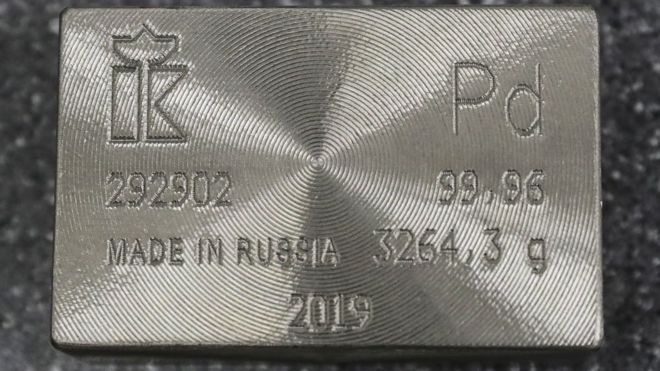
At about $2,500 (£1,922) an ounce of palladium is more expensive than gold, and the pressures forcing its price up are unlikely to ease anytime soon.

But what is palladium, what is it used for, and why is its price rising?

What is palladium?

It is a shiny white metal in the same group as platinum, along with ruthenium, rhodium, osmium, and iridium.

The majority of the world’s palladium comes from Russia and South Africa. Most of it is extracted as a byproduct in the mining of other metals, usually platinum and nickel.

What is it used for?

Its key commercial use is as a critical component in catalytic converters – a part of a car’s exhaust system that controls emissions – found mainly in petrol and hybrid vehicles.

The vast majority of palladium, more than 80%, is used in these devices that turn toxic gases, such as carbon monoxide, and nitrogen dioxide, into less harmful nitrogen, carbon dioxide, and water vapour. Image copyright Getty Images Image caption Catalytic converters are relatively easy to remove from vehicles

It is also used, to a far lesser extent, in electronics, dentistry, and jewellery.

The metal’s soaring value in recent years has seen a jump in the theft of catalytic converters around the world.

London’s Metropolitan police said the number of thefts in the first six months of 2019 were more than 70% higher than the whole of the previous year.

Why is its price rising?

In short, it is because demand for palladium outstrips supply, and it has done for some time.

The amount of the metal produced in 2019 is forecast to be below global demand for the eighth year in a row.

As a secondary product of platinum and nickel extraction, miners have less flexibility to increase palladium output in response to rising prices.

And that shortfall looks set to continue, with South Africa, which produces around 40% of the world’s supply, last week saying its output of platinum group metals, including palladium, fell by 13.5% in November compared to a year earlier.

Meanwhile, demand for palladium from car makers has increased sharply for a number of reasons.

Around the world governments, notably China, are tightening regulations as they attempt to tackle air pollution from petrol vehicles.

At the same time the diesel emissions scandal in Europe has also had an impact. Consumers there have been shifting away from diesel cars, which mostly use platinum in their catalytic converters, and are instead buying petrol-driven vehicles, which use palladium.

The US-China trade deal, which was signed earlier this month, has also boosted prices. Traders expect the agreement to help ease downward pressure on global economic growth and slow the decline in Chinese car sales.

Source: https://www.bbc.com/news/business-51171391

It’s Now Time To Look At Junior Gold Developers And Explorers – Red Cloud SPONSOR: Affinity Metals $AAF.ca $SII.ca $TUD.ca $GTT.ca $AMK.ca $OSK.ca $RKR.ca

Posted by AGORACOM at 2:54 PM on Tuesday, January 21st, 2020

Sponsor: Affinity Metals (TSX-V: AFF) a Canadian mineral exploration company building a strong portfolio of mineral projects in North America. The Corporation’s flagship property is the Drill ready Regal Property near Revelstoke, BC. Recent sampling encountered bonanza grade silver, zinc, and lead with many samples reaching assay over-limits. Click Here for More Info

(Kitco News) – The merger and acquisition activity that swept through the mining sector in 2019 is only going to pick up momentum this year as mine developers and junior explorers are next on the auction block, according to one financing company.

In a recent webinar, Derek Macpherson, vice president of research at Red Cloud, said that with gold in the early inning of a new bull market, he expects to see more M&A activity in the mining sector.

However, he added that sentiment is a little different than it was in 2019.

“The M&A activity we saw last year focused on production assets,” he said. “As we see fewer of those assets become available companies will have to look further down cap. I think we are getting a lot closer to seeing junior explorers benefit from M&A activity.”

The comments come as junior explorers continue to struggle to attract investor attention. The sector was still largely ignored in 2019 as the M&A activity focused on creating mega-gold companies and larger producers.

Macpherson said that although some companies are struggling to attract attention, investors should focus on the companies that are activity developing and de-risking their projects.

“In this environment and with the potential for more M&A activity, the drill bit is the key to value,” he said.

Macpherson added because of solid production and higher prices in 2019 many mid-tier mining companies are in good shape to go shopping in the market again. Further divestitures from the major gold producers also means more opportunities to buy.

Not only are miners in a hurry to replace dwindling reserves, but Macpherson noted that a strong gold price will add to growing confidence in the marketplace. He noted that there are growing calls for $2,000 gold.

“I think gold at $1,600 is in the mix but I also don’t think $2,000 is out of the realm of possibilities,” he said.
Looking at the gold market, the financial firm sees strong investment demand for the yellow metal as central banks around the world maintain ultra-loose monetary policy.

“More money printing and negative yielding debt make gold a very attractive asset class,” he said.

Macpherson also noted that with equity markets at record valuations, it wouldn’t take much for investors jump out off the S&P and into more safe-haven assets.

SOURCE: https://www.kitco.com/commentaries/mining/2020-01-20/It-s-now-time-to-look-at-junior-gold-developers-and-explorers-Red-Cloud.html

Graphene-Enhanced Batteries Could Be About To Finally Hit The Market SPONSOR – ZEN Graphene Solutions $ZEN.ca $LLG.ca $FMS.ca $NGC.ca $CVE.ca $DNI.ca

Posted by AGORACOM at 2:06 PM on Tuesday, January 21st, 2020

SPONSOR: ZEN Graphene Solutions: An emerging advanced materials and graphene development company with a focus on new solutions using pure graphene and other two-dimensional materials. Our competitive advantage relies on the unique qualities of our multi-decade supply of precursor materials in the Albany Graphite Deposit. Independent labs in Japan, UK, Israel, USA and Canada confirm this. Click here for more information

The battery race shows no sign of letting up, even though the gains feel increasingly marginal. Whether it’s phones or portable consoles, maximising the life eked out of a slim lithium-ion battery is getting harder and harder. 

For some time, graphene has been touted as one possible solution, a material that hasn’t been efficiently harnessed yet but which could help improve charging times and battery life in one fell swoop. Now Real Graphene, a tech business from Los Angeles, is apparently preparing to change that. 

It has a range of portably power banks on the market, and ambitious plans to crowdfund the wider production of banks that go even further with their use of Graphene. For now, Real Graphene’s banks come in two sizes, a 10,000mAh version and another with 20,000mAh, and have a number of apparent advantages over lithium banks.

For one thing, they charge far more quickly themselves, with the smaller variant charging completely in 50 minutes, far less time than the hours most banks need to power themselves up. 

Graphene as a material is also extremely lightweight, so down the line it could lead to lighter batteries, always a welcome change. However, for now, even Real Graphene’s own batteries are not pure graphene — they’re a blend of graphene and lithium which gains in speed but remains affordable to build and sell.

Even so, the reality is that graphene-enhanced batteries will be more expensive than current lithium equivalents, to the tune of a 30% bump in cost at Real Graphene’s own estimation. That’s a sizeable leap, so it shouldn’t be a huge surprise if the tech can’t make too many mainstream waves until it’s even more affordable in comparison.

SOURCE: https://www.pocket-lint.com/phones/news/150808-graphene-enhanced-batteries-could-be-about-to-finally-hit-the-market

Volvo to Build an Electric Vehicle Battery Plant in the U.S. SPONSOR: Lomiko Metals $LMR.ca $CJC.ca $SRG.ca $NGC.ca $LLG.ca $GPH.ca $NOU.ca

Posted by AGORACOM at 12:26 PM on Tuesday, January 21st, 2020

SPONSOR: Lomiko Metals is focused on the exploration and development of minerals for the new green economy such as lithium and graphite. Lomiko owns 80% of the high-grade La Loutre graphite Property , Lac Des Iles Graphite Property and the 100% owned Quatre Milles Graphite Property. Lomiko is uniquely poised to supply the growing EV battery market. Click Here For More Information

Swedish automaker Volvo announced plans to build an electric battery plant at its assembly factory in Ridgeville, South Carolina to support the launch of electrified Volvo models for the U.S. market. Construction of the battery assembly plant will be completed by the end of 2021.

While many people consider Detroit home of the automobile, the southeast region of the U.S. is becoming a hotbed for auto manufacturing. Automakers BMW, Mercedes Benz, Volvo, Toyota, Honda and Hyundai built assembly plants in the region to manufacture vehicles for the U.S. and global markets. 

Most recently, Toyota and Mazda recently announced they will be opening a new $1.6 billion plant in Huntsville, Alabama, adding around 4,000 new jobs to the region. Now Volvo becomes the latest automaker to expand its U.S. manufacturing with a new electric vehicle battery plant.

The automaker announced plans to build an electric battery plant at its assembly plant in Ridgeville, South Carolina to support the launch of electrified Volvo models for the U.S. market. Construction of the battery assembly plant will be completed by the end of 2021, a Volvo spokeswoman said to Automotive News.

The battery production plant is part of a previously announced $600 million project that is already underway at Volvo’s plant in Ridgeville, S.C., which includes adding a second production line and Volvo Car University. The 2.3 million sq. ft. facility includes a body shop, paint shop, final assembly, a vehicle processing center and an office building.

The Ridgeville plant is Volvo’s first in the U.S. Construction began in 2015. 

At that facility, employees will assemble and test the lithium ion battery packs that will power the electric XC90. By assembling the packs on at the plant, Volvo hopes to reduce shipping costs involved in transporting the heavy batteries.

Dallas Bolen, a manager with Volvo’s product launch group, told local media outlet the Post and Courier that local battery production would be more cost-effective than building batteries off-site then having to transport them to the factory.

The Ridgeville plant is currently the production home of the Volvo S60 sedan. The U.S.-built S60s are exported around the world through the Port of Charleston, one of the busiest ports in the U.S.

Volvo’s next EV will be the XC40 Recharge. It will arrive at U.S. dealers later this year.

The South Carolina plant will become the global production center for the third-generation XC90 flagship crossover. Volvo plans to build the next generation XC90 sport utility vehicle in 2022, along with a fully-electric version. The plant has the capacity to build 150,000 vehicles annually.

Volvo has not said how much of the XC90’s production at the $1.1 billion factory will be devoted to the battery-electric variant. 

That next-generation XC90 will be built on the next version of Volvo’s Scalable Product Architecture platform, referred to as SPA2. The new electric vehicle architecture is designed to make it easy to add new technology, such as microprocessors, sensors and camera technology.

Volvo declined to release its production capacity for the battery assembly plant or say how many jobs it will create. Overall, the planned XC90 production line is expected to create about 1,000 jobs.

The XC90 would be Volvo’s third battery-powered model following the electric version of the popular XC40 compact crossover, was unveiled in October. 

The electric XC40 is expected to arrive in U.S. dealerships in the fourth quarter of 2020. The crossover will be competitively priced under $48,000, after the $7,500 federal tax credit, Volvo said.

The new battery plant will support Volvo’s push to electrify around half of its lineup. The automaker aims for EVs to account for half of its global sales by 2025. Over the next five years, Volvo expects to launch a fully electric vehicle every year.

“A Volvo built in 2025 will leave a carbon footprint that is 40 percent lower than a car that we build today,” Volvo CEO Hakan Samuelsson said during a press event in October. “We made safety part of the brand. We should do the same with sustainability.”

In November 2019, Volvo Cars announced it will be the first carmaker to implement global traceability of cobalt used in its batteries by applying blockchain technology, ensuring that customers can drive battery-powered Volvos knowing the raw materials for the batteries has been responsibly sourced.

SOURCE: https://www.futurecar.com/3731/Volvo-to-Build-an-Electric-Vehicle-Battery-Plant-in-the-U-S-

Empower Clinics $CBDT.ca – Global #pot execs descend on #Davos for cannabis conference $WEED.ca $CGC $ACB $APH $CRON.ca $HEXO.ca $OGI.ca

Posted by AGORACOM-JC at 12:00 PM on Tuesday, January 21st, 2020

SPONSOR:

Why Empower Clinics

  • A leading owner/operator of physician staffed health and pain management clinics.
  • Patient database of over 165,000 patients 
  • Platform generating $1.4M USD (9 months ending Sept. 30, 2019)
  • Proprietary technology platforms including Electronic Health Records portal and e-Commerce for CBD product distribution
  • Recently launched CBD extraction facility
  • First extraction system capacity = 6,000 Kg per year.
  • CBD based products are poised to be a $20B global industry by 2022
  • Medical cannabis is poised to be a $100B global industry by 2025

Global pot execs descend on Davos for cannabis conference

  • Cannabis executives will be touching down in Davos, Switzerland for the second year in a row as the industry looks to influence some of the participants of this year’s World Economic Forum.

Bloomberg News reports that one of the sponsors of the Davos “Cannabis House” aims at having a more formal and professional presence at the event than last year. Some of the topics that will be discussed include sustainability, climate change, social equity and impact investing. Speakers from Israel, Switzerland and Asia will also be present, ensuring that the two-day conference isn’t rife with commentary from executives in North America, which has so far been the epicentre of the legal cannabis space.

Source: BNN Bloomberg – http://links.mkt2011.com/servlet/MailView?ms=MzEwNTgyMzQS1&r=MjU5OTkyNTIyMjg1S0&j=MTYyNDIwMzk2MwS2&mt=1&rt=0

Gold at $1,600 Is The ‘Bare Minimum’ for 2020 SPONSOR: Loncor Resources $LN.ca $ABX.ca $TECK.ca $RSG $NGT.to

Posted by AGORACOM at 11:37 AM on Tuesday, January 21st, 2020
This image has an empty alt attribute; its file name is Loncor-Small-Square.png

Sponsor: Loncor is a Canadian gold exploration company that controls over 2,400,000 high grade ounces outside of a Barrick JV. Exploration is currently being conducted by Barrick. The Ngayu property is 200km southwest of the Kibali gold mine, operated by Barrick, which produced 800,000 ounces of gold in 2018. Barrick manages and funds exploration at the Ngayu project until the completion of a pre-feasibility study on any gold discovery meeting the investment criteria of Barrick. Click Here for More Info

  • Gold is a hedge against inflation that is being used more and more
  • Goldex CEO pointed to a recent Goldman Sachs report that pointed to gold as being a better hedge than oil.
  • This view is the new consensus that will increase demand for gold.

(Kitco News) What can take the gold market from $1,550 to $1,600 and higher? Goldex CEO and founder Sylvia Carrasco told Kitco News that she is not ruling out the $1,900 an ounce level this year if geopolitical and trade tensions escalate in the current economic climate.

There are a number of strong drivers supporting gold prices this year, including geopolitical and trade tensions, global debt, dovish central banks, weakening U.S. dollar as well as the political situation in the U.S., Carrasco said on Thursday.

“Last year, I said that the perfect storm was forming and I think I would use this phrase again. The perfect storm is now happening,” Carrasco noted. “Gold should be around $1,600 if nothing else crazy happens. At this moment in time, I can see gold between the $1,500 and the $2,000 mark during 2020.”

If the market sees a further increase in geopolitical tensions or additional trade concerns this year, gold will surge towards $1,900, Goldex CEO pointed out. And if things do calm down, Carrasco does not see gold falling much below $1,500 an ounce.

“It is going to be another record year,” she said, referring to gold hitting record-highs in many currencies last year. “And it will be mainly due to geopolitical tensions raising prices higher.”

“With the current economic climate, gold should be between $1,500 and $1,600. If on top of that bare minimum, you add very strong geopolitical tensions or commercial trade issues, then you take it from $1,600 up to $1,900,” she added.

At the time of writing, the spot gold price was trading at $1,560.40, up 0.24% on the day and up 2.8% since the start of the year.

Gold is a hedge against inflation that is being used more and more by investors who are realizing the benefits of the yellow metal, Carrasco said.

“Gold is the hedge that people should be using. I wouldn’t build my personal wealth portfolio just on gold. But gold is more and more clearly overtaking oil and any other hedging mechanisms … Gold will be a good trade whether for speculative reasons or for trading,” she noted.

Goldex CEO pointed to a recent Goldman Sachs report that pointed to gold as being a better hedge than oil. Carrasco added that this view is the new consensus that will increase demand for gold.

Gold began the year with a bang as U.S.-Iran tensions flared up and surprised the markets in the first two weeks of January.

“The rally we’ve seen is based on geopolitical tensions between the U.S. and Iran. We need to see also the reasons behind Trump’s approach when it comes to Iran … In September, the U.S. ended up a positive net exporter of oil for the first time in history. That gives you a reason why Trump thinks he is not affected by the tensions even though the rest of the world is affected,” Carrasco described.

Also, U.S. President Donald Trump was driven by the goal to distract the market from the impeachment proceedings against him, she added.

Going forward, gold prices are likely to rise further, especially considering that most of the major central banks around the world are not planning to start raising rates any time soon.

“Central banks using unconventional ways … Is there going to be an increase in interest rates in Europe or in the U.S.? The answer is no. And if interest rates are not going to increase, gold is the first one that is affected,” Carrasco said.

On top of that, the central banks will remain significant gold buyers in 2020. “That’s another reason why gold prices will increase this year,” she said.

Growing debt also supports higher gold prices this year, the CEO added. “We’ve been talking about debt for years — how corporate debt and government debt continues to increase. More debt effectively means a potentially weaker U.S. dollar. The moment the U.S. dollar is weak, where do you go? The only safe place is gold. And I think we are going to be seeing a weakening dollar as the year continues,” Carrasco described.

Source: https://www.kitco.com/news/2020-01-20/Gold-at-1-600-is-the-bare-minimum-for-2020-Goldex-CEO.html

CLIENT FEATURE: CardioComm Solutions $EKG.ca – Connecting Your Heart To The Cloud $EKG.ca – $ATE.ca $TLT.ca $OGI.ca $ACST.ca $IPA.ca

Posted by AGORACOM-JC at 11:15 AM on Tuesday, January 21st, 2020

Global Leaders in Mobile  ECG Connectivity

  • 20 years of medical credibility licensing technologies to hospitals, physicians, remote patient monitoring  platforms, research groups and commercial call centers
  • Sold into > 20 countries, with the largest customer base located in the US
  • Class II medical device clearances and device agnostic for collecting, viewing, recording, analyzing and  storing of ECGs for management of patient and consumer health
  • ECG solutions for both consumer (OTC) and medical (Rx) markets
  • Owns all IP and source code
  • Market expert contributor for reports in m‐health, mobile cardiac monitoring and new advances in  consumer health and wellness monitoring

Recent Highlights

Physician Groups Order The Heartcheck(TM) Cardibeat For In-Home Arrhythmia And Atrial Fibrillation Monitoring

  • Confirms market traction with orders being placed by physician groups for the newly launched HeartCheck™ CardiBeat Handheld ECG monitor and GEMS™ Mobile Smartphone app for prescribed in-home arrhythmia monitoring.
  • Partners in Advanced Cardiac Evaluation, the largest arrhythmia practice in Ontario (Canada) placed a first order of the HeartCheck™ CardiBeat Handheld ECG monitors and is recommending its patients to use the devices for one year of in-home, self-monitoring with an emphasis on detecting a recurrence of Atrial Fibrillation following cardiac ablation treatment for AF.

Industry News

Company Accolades

FULL DISCLOSURE: CardioComm Solutions Inc. is an advertising client of AGORA Internet Relations Corp.

#Bitcoin 2020 Rally; Financial Advisors Opening Clients’ Doors To #Crypto SPONSOR: ThreeD Capital $IDK.ca $HIVE.ca $BLOC.ca $CODE.ca

Posted by AGORACOM-JC at 10:45 AM on Tuesday, January 21st, 2020

SPONSOR: ThreeD Capital Inc. (IDK:CSE) Led by legendary financier, Sheldon Inwentash, ThreeD is a Canadian-based venture capital firm that only invests in best of breed small-cap companies which are both defensible and mass scalable. More than just lip service, Inwentash has financed many of Canada’s biggest small-cap exits. Click Here For More Information.

Bitcoin’s 2020 Rally; Financial Advisors Opening Clients’ Doors To Crypto

Get Forbes’ top crypto and blockchain stories delivered to your inbox every week for the latest news on bitcoin, other major cryptocurrencies and enterprise blockchain adoption.

CRYPTO MARKETS

  • Bitcoin reached its highest level in more than two months this week, climbing to $8,848 on Tuesday. By Wednesday, the price had risen to $8,897.
  • The digital asset has been following a broad, upward trend all week, pushing higher after reaching a 2020 low of $6,852 on January 3.

Some market observers have cited hopes the cryptocurrency will enjoy greater adoption in 2020 when explaining these gains. Others have pointed to anticipation surrounding the upcoming halving, scheduled to take place in May, as another factor in bitcoin’s recent push higher.

Plus, why is bitcoin driving altcoins higher? The short answer: beta. Read more here

FINANCIAL ADVISORS CONSIDER CRYPTO

According to a new survey of more than 400 financial advisors conducted by cryptocurrency investment firms Bitwise and ETF Trends, 13% of advisors are now allocating crypto for their clients. That’s more than double the 6% of advisors that were allocating crypto in 2019. 

The number one factor driving that uptick? Crypto returns. Of the financial advisors polled, 54% cited that as the reason to allocate more investment dollars to digital currency. 

According to Bitwise managing director and head of research Matt Hougan, financial advisors are opening their clients’ doors to crypto by either acting in an advisory role—showing clients how to purchase crypto in a secure and safe environment—investing in the Grayscale Bitcoin Trust, which trades over-the-counter, or purchasing shares in private funds that provide access to cryptocurrency.

GRAYSCALE’S RECORD YEAR

Bitcoin and cryptocurrency asset manager Grayscale revealed inflows of $600 million in 2019, more than 2013 through 2018 combined, after its best quarter on record. $147 million of last year’s investments came from new clients—24% of the total.

“If the persistent question is ‘where are the institutional investors in crypto?’ the answer is that they’re here and showing up in a meaningful size,” Michael Sonnenshein, managing director at Grayscale, said on the sidelines of the Crypto Finance Conference in Switzerland.

“With 71% of assets raised in Grayscale products during 2019 coming from institutions, we now have empirical data that this is part of a longer term trend—one that we have no reason to believe won’t be sustained into 2020.”

Source: https://www.forbes.com/sites/cryptoconfidential/2020/01/21/bitcoins-2020-rally-financial-advisors-opening-clients-doors-to-crypto/#456e1283321e

Applied BioSciences $APPB: How CBD and The Endocannabinoid System Work Together $APH.ca $GBLX $PFE $ACG.ca $ACB.ca $WEED.ca $HIP.ca $WMD.ca $CGRW

Posted by AGORACOM at 10:43 AM on Tuesday, January 21st, 2020

SPONSOR: Applied BioSciences is a vertically integrated company focused on the development and commercialization of novel, science-driven, synthetic cannabinoid therapeutics / biopharmaceuticals; targeting the endocannabinoid system to treat a wide-range of diseases across multiple therapeutic areas. Click Here for More Info

Before we can take a look at how CBD and the Endocannabinoid System (ECS) work together, we must first understand the ECS.

The human body has an endocannabinoid system, just like it has an endocrine system and a number of other systems that work together to function. The ECS is what makes it possible for CBD, THC, and other cannabinoids in the marijuana and hemp plants – there are hundreds – to work on the body.

In 1988, researchers found the first cannabinoid receptor in the brain of a rat. They found that the receptors interacted exclusively with receptors found in the cannabis compound, THC. That’s the cannabinoid everyone’s most familiar with because it is the compound responsible for the stoned feeling associated with marijuana consumption.

The researchers discovered that the receptors were concentrated in areas of the brain that plays a role in a number of physiological and mental processes, including emotion, motor coordination, high cognition, and memory.

In 1993, another cannabinoid receptor was discovered. It was found distributed throughout the immune system and peripheral body tissues. It displayed the same reaction to THC as the first receptor.

In 1995, the two receptors, that had been named CB1 and CB2, were found not only in rats, but in humans, and thousands of other species.

As technology advanced, researchers further explored the relationship between cannabinoid receptors in the body, known as endocannabinoids, and the cannabinoid receptors in cannabis compounds such as CBD oil and THC – known as phytocannabinoids.

What is the Purpose of Endocannabinoids?

The endocannabinoid system was discovered in the late 1990s, and since then, researchers have learned a great deal about the relationship between phytocannabinoids and endocannabinoids.

Because we know endocannabinoids are present throughout the body in numerous functions, researchers believe they may help maintain these functions.

Imagine for a moment the body is a machine, where each system works together to keep the machine moving and working. The immune system, for instance, would be the filtration system. The brain would be the motherboard, and the endocannabinoids help to maintain the systems.

CB1 receptors are concentrated in the brain and central nervous system. Your central nervous system is responsible for maintaining all the core functions such as pain perception, stress response, motor activity, and memory.

CB receptors are located in many of the peripheral organs in the body, suggesting they are core components of the cardiovascular system, the immune system, and the muscular system.

Why Phytocannabinoids Matter

Machines, whether due to natural aging, poor maintenance, or damage, may malfunction. And like those machines, our body’s systems and parts can break down and malfunction, causing issues within the entire body and any number of health conditions.

Endocannabinoids help maintains your body’s health, but if the level of endocannabinoids in the body declines, in theory, they’d only be able to maintain the body’s current state of health. As such, there likely wouldn’t be enough to stop it from declining any further. Over time, the health level decreases gradually, and in the process, creates bigger health problems.

That’s where phytocannabinoids, such as CBD come into play.

How CBD Works in the Body

Research has taught us that when CBD bonds with either the CB1 or CB2 receptors in the body, it either alters or improves that receptor’s capabilities, which improves that receptor’s functionality.

If the body is suffering a cannabinoid deficiency, adding them to your body, for example, by using CBD gummies for stress, helps to equalize the deficiency. Right now, studies point to the theory that cannabinoids are a finite resource. The deficiency of cannabinoids may cause a number of health issues, including irritability and headaches.

Essentially, using CBD enables us to boost our ECS. Because it bonds with our CB1 and CBD2 receptors, CBD helps the body maintain vital health functions and helps restore balance, also known as homeostasis, within the body. This is the reason it has so many health benefits.

CBD Benefits

When you really think about it, the majority of health problems can be traced back to an imbalance somewhere in the body.

In a healthy body, all is as it should be, and the body is balanced. In an unhealthy body, however, there is either too much or too little of something (or multiple somethings). This creates a disruption in homeostasis and presents a variety of symptoms, which vary depending on the nature of the imbalance.

Think about the various health conditions that are a result of imbalance, and how CBD can help improve these conditions by restoring balance:

  • Inflammation: This is often characterized by a part of your body swelling, and sometimes becoming hot. It can be incredibly painful, and range from mild, to severe enough to incapacitate someone. Inflammation in the body is linked to autoimmune disorders, arthritis, and bacterial infections. CBD can be helpful to treat inflammation because it suppresses the inflammatory pathways and responses, stimulates regulatory cell production, and manages our pain perception.
  • Seizures: Seizures are the result of erratic electrical impulses in the brain, which causes violent shaking in the body. In patients suffering from two severe forms of epilepsy known as Lennox Gaustat Syndrome and Dravet Syndrome, CBD reduces the number of seizures because it slows down the excitatory nerve activity and subdues the brain’s reaction to the intense signals that cause the overload.
  • Anxiety and stress: Most people experience stress and anxiety as a response to situations that are perceived as unwanted, dangerous, or risky. Hormonal imbalance or excessive messages in the brain boosts cortisol levels and causes you to feel stress. CBD combats this by regulating how your brain responds to stress signals and maintaining normal cortisol levels.

These, of course, are only a few examples of the studies supporting CBD as an effective treatment.

There are hundreds of other studies supporting its use to treat a wide number of other conditions, such as addiction, acne, depression, schizophrenia and more. It’s all because of our ECS, and the fact that our bodies contain parts linked directly to the cannabis plant is pretty amazing.

SOURCE: https://www.latintimes.com/how-cbd-and-endocannabinoid-system-work-together-454648

Tartisan #Nickel $TN.ca – Global #EV sales to reach 54mn by 2030 $ROX.ca $FF.ca $EDG.ca $AGL.ca $ANZ.ca

Posted by AGORACOM-JC at 4:06 PM on Monday, January 20th, 2020

SPONSOR: Tartisan Nickel (TN:CSE)  Kenbridge Property has a measured and indicated resource of 7.14 million tonnes at 0.62% nickel, 0.33% copper. Tartisan also has interests in Peru, including a 20 percent equity stake in Eloro Resources and 2 percent NSR in their La Victoria property. Click her for more information

Tc logo in black

Global EV sales to reach 54mn by 2030

  • Global electic vehicle (EV) sales are expected to reach 54mn by 2030
  • Changing lithium-ion battery chemistry will transform battery metals demand in the coming years, delegates at the Advanced Automotive Battery Conference (AABC) in Wiesbaden, Germany, heard yesterday.

Worldwide, EVs will have a 40pc market share by 2030, with cumulative sales of up to 54.3mn, according to forecasts from P3 Automotive. By 2025, global EV sales are expected to have exceeded 30mn and make up 25pc of the market. And this year, they are expected to pass 10mn, making up just under 10pc of new car sales.

The growth is expected to come as limits for vehicles’ CO2 emissions are reduced.

In China, average vehicle emissions are expected to fall to 71g/km in 2030 from 119g/km this year. The number of EVs in China is expected to rise to 23mn from 5.8mn over the same period, making China the largest market globally. In the EU, CO2 emissions must fall to 59g/km in 2030, down from 95g/km this year, and number of EVs is expected to rise to 10.7mn by 2030, up from 2.1mn this year.

If carmakers do not hit these targets, they could face large government penalties, especially in the EU, where Groupe PSA expects fines exceed €240mn for each gram above the target.

Battery chemistry to shift by 2025

A shift in the chemistry of batteries towards higher lithium and nickel density and lower cobalt levels will also define battery metals demand in the coming years, according to Lux Research.

As buyers demand greater range and duration between charges, battery manufacturers will move towards higher nickel cathodes, which offer improved capacity. There will also be a move towards silicon anodes by 2025, before a switch to solid state lithium anodes by 2030.

Currently, most lithium-ion batteries contain cathodes that are made from lithium-nickel-manganese-cobalt-oxide (NMC), with a ratio of either 5 parts nickel-3 parts manganese-2 parts cobalt, or a 6-2-2 ratio and a graphite anode.

To cut costs and maximise efficiency, battery manufacturers are looking to reduce the cobalt and manganese content, moving to an 8-1-1 ratio. This can be dangerous. Cobalt stabilises battery chemistry and reducing it can lead to explosions, but this year China will launch the first commercial car to contain an 8-1-1 battery. China is a testing ground for riskier forms of battery chemistry.

As cooling technology improves, the risk of electrical fires is reduced, and cell makers are expected to shift to this chemistry. By 2025, Lux says most manufacturers will use some form of 8-8-1 battery.

As a result, cobalt demand growth could be slower than expected after 2025, but nickel and especially nickel sulphate demand could grow sharply.

The use of silicon in anodes is also expected to increase. Silicon improves battery performance, but it expands and contracts, which can cause problems. Still, incremental gains mean the market could start to see widespread inclusion of silicon from 2023. Demand for extremely pure grades of silicon metal would increase, while demand growth for graphite would slow.

Demand for metals being used less in battery chemistry would still grow thanks to exponential growth expected in the EV market between now and 2030.

Source: https://www.argusmedia.com/en/news/2053192-global-ev-sales-to-reach-54mn-by-2030?backToResults=true