Agoracom Blog

BREAKING …. CTV News Cites #Datametrex $DM.ca For Proof That Foreign-Controlled Bot Networks Hit Canadian Election

Posted by AGORACOM-JC at 10:58 AM on Tuesday, November 26th, 2019
  • Prior to the election, Canada’s electronic spy agency issued a stark warning about the potential for foreign cyber interference.
  • Datametrex (DM:TSXV) believes foreign actors not only attempted to do so — they succeeded.
  • Using Artificial Intelligence designed to follow and analyze online narratives, Datametrex published a report investigating issues related to the election.
  • The report, in collaboration with Defence Research and Development Canada, found evidence of Russian bots meddling in Twitter discussions 
  • intention was focused on boosting extreme viewpoints and creating further polarization among groups with similar political views.
  • The report was presented to NATO in mid-October.
  • Datametrex has been awarded $40,000 contract for United States Air Force (USAF)

Foreign actors tried to influence Canadian election talk, but did they succeed?

Police have revealed new details of a ‘SIM swapping scam’ that could have serious implications for victims. (iStock/Bombuscreative)

  • “It doesn’t seem that there is a political agenda. Whether it’s bots or people, they’re engaging the ‘useful idiots’ who sit around on social media and regurgitate anything that fits their social or political agenda,” Marshall Gunter, CEO of Datametrex, said during a phone interview with CTVNews.ca earlier this month.

Nicole Bogart, CTVNews.ca Writer

Published Monday, November 25, 2019 11:43AM EST

TORONTO — Despite concerns of foreign interference and disinformation, a growing epidemic of toxic political dialogue found in online echo chambers should have been at the top of Canada’s concerns going into the federal election, analysts say.

As the dust settles on Parliament Hill, research suggests that foreign-controlled bot networks tapped into growing partisanship in Canada’s online conversations, taking advantage of those dead set in their political beliefs.

“It doesn’t seem that there is a political agenda. Whether it’s bots or people, they’re engaging the ‘useful idiots’ who sit around on social media and regurgitate anything that fits their social or political agenda,” Marshall Gunter, CEO of Datametrex, said during a phone interview with CTVNews.ca earlier this month.

Prior to the election, Canada’s electronic spy agency issued a stark warning about the potential for foreign cyber interference.

The Communications Security Establishment (CSE) said it was “highly likely” that interference in Canada’s democratic process would be done using tactics similar to those used against other countries, including the amplification of polarizing political issues.

Gunter and his team believe foreign actors not only attempted to do so — they succeeded.

“It starts with a wave and turns into a tsunami,” Gunter said, referencing how foreign bad actors work to disrupt political spheres online. “That’s their way of interfering.”

Using machine-learning based technology called Nexalogy, designed to follow and analyze online narratives, Datametrex recently published a report investigating issues related to the election.

The report, in collaboration with Defence Research and Development Canada, found evidence of Russian bots meddling in Twitter discussions on political wedge issues in Canada, including ethical issues, pipelines, and climate change.

But that meddling did not seem to fit a political agenda, such as having a particular candidate elected over another. Instead researchers say its intention was focused on boosting extreme viewpoints and creating further polarization among groups with similar political views.

“Within Canada, the focus is more about distracting the population,” reads the report obtained by CTVNews.ca.

“Upsetting well-established democracies by increasing the divisions between citizens with opposing views is an effective method; while the people of that country are busy ‘fighting’ each other, Russia is able to move with greater freedom with less scrutiny.”

The report was presented to NATO in mid-October.

Although the data analyzed in the report was gathered between June and August, months before the election was officially called, Datametrex president Jeff Stevens said that his team has continued to collect and analyze Twitter conversations related to Canadian politics, including “Wexit,” flagging similar suspicious activity.

This isn’t the first allegation of foreign actors amplifying Canadian political conversations.

In September, analysis of about 34,000 tweets from approximately 4,896 accounts by researcher Marc Owen Jones revealed that 15 per cent of accounts using the hashtag #TrudeauMustGo were ones that primarily identified with U.S. right-wing politics.

Those accounts also showed evidence of spam or bot-like activity.

Speaking to CTVNews.ca in October, Jones said he continued to see this type of activity on Canadian political hashtags despite Twitter downplaying the concerns, saying its investigations found no “substantial bot activity amplifying the cited hashtag.”

When asked about both reports, a government spokesperson told CTVNews.ca by email that the Critical Election Incident Public Protocol panel — designed to respond to threats to the democratic process — did not observe any activities that “met the threshold for public announcement or affected Canada’s ability to have a free and fair election.”

Not everyone is buying the idea of foreign entities meddling in our political discourse.

“Partisanship is the real pernicious force here in the Canadian online discourse,” Taylor Owen, digital media professor, said during an interview on the Attention Control podcast in October.

“It determines who you follow, it determines the language you use, the type of policy you support. It dissuades you from being able to be fact-checked. It really is the variable that causes a lot of the problems that we’ve flagged.”

Owen, director of the Digital Democracy project, spent the course of the election looking at instances of disinformation and interference.

He says his team did not find any evidence of foreign actors driving conversations on Canadian issues.

“One of the things we really saw in our projects is real echo chambers in online debate where partisans were really just talking to each other,” Owen said.

“We didn’t see a lot of what we call formal disinformation campaigns, foreign or domestic.”

Owen suggests that banning foreign ad spending as part of bill C-76 likely decreased the potential for large-scale foreign interference attempts.

Either way, researchers on both sides agree that Canadians are becoming more divided.

“I don’t think this content affected the vote, what it did is degraded the public discourse. It entrenched partisanship and further confirmed their biases,” said Owen.

Source: https://www.ctvnews.ca/politics/foreign-actors-tried-to-influence-canadian-election-talk-but-did-they-succeed-1.4701228

CardioComm Solutions $EKG.ca – #Mhealth Market is Presumed To be Valued at US$118.4 billion by 2025 $ATE.ca $TLT.ca $OGI.ca $ACST.ca $IPA.ca

Posted by AGORACOM-JC at 10:07 AM on Tuesday, November 26th, 2019

SPONSOR: CardioComm Solutions (EKG: TSX-V) – The heartbeat of cardiovascular medicine and telemedicine. Patented systems enable medical professionals, patients, and other healthcare professionals, clinics, hospitals and call centres to access and manage patient information in a secure and reliable environment.

Mhealth Market is Presumed To be Valued at US$118.4 billion by 2025

  • According to experts from TMR, the global mHelath market stood at US$23.9 bn in 2017.
  • This revenue is expected to gain an impressive value of US$118.4bn by the end of 2025.
  • Experts project this growth to occur with a meteoric CAGR of 22.1% during the forecast period from 2017 to 2025.

The global mHelath market bears a highly fragmented vendor landscape, says Transparency Market Research (TMR) in a recently published report. This is solely because of the existence of large, medium, and small-scale players in the market. Withings, FitBit, Apple Inc., Jawbone, and Dexcom are the dominant players working in the global mHelath market.

Out of the various strategic alliances adopted by players in the global mHelath market to hold a sizeable stakes, capitalizing on the emerging opportunities and acquiring latest technologies and tools has gained maximum popularity. The level of competition among leading vendors is getting escalated with rising use of technologies and smart devices such as wearables. The global mHelath market is expected to grow steadily due to the presence of highly established players who are concentrating on improving their product quality, facilitating product differentiation, and enhancing geographical reach. These companies are also attempting to introduce advanced and new products into the industry on a daily basis.

According to experts from TMR, the global mHelath market stood at US$23.9 bn in 2017. This revenue is expected to gain an impressive value of US$118.4bn by the end of 2025. Experts project this growth to occur with a meteoric CAGR of 22.1% during the forecast period from 2017 to 2025.

Among various products in the global mHelath market, connected medical devices hold substantial share, which is expected to boost the global mHelath market during the forecast period. This is because of rising focus towards fitness and increasing use of heart rate monitors among people.  Region wise, North America is expected to lead the global mHelath market in the coming years. This is attributed to a strong technological infrastructure along with high healthcare expenditure in the region.

Integration of Wireless Technologies to Fuel mHealth Market’s Growth

Health-related technologies and mobile applications are often known as mHealth, which helps in managing patients’ experiences. Such health mobile technologies and apps utilize advanced data analytics to help medical professionals in providing their patients best care at low cost. These health mobile applications facilitate easy and better health management through simple apps such as diet, exercise trackers, and calorie-counting.

Such USPs are driving the global mHelath market. Along with this, rising penetration of internet connections and smartphones, and rapid technological advancements in healthcare industry are the factors majorly fueling growth in the global mHelath market.

Furthermore, mHelath ensures continuous communication between medical professionals and patients, thereby allow physicians to monitor, and diagnose patients without seeing them in person. Such benefits are also boosting the global mHelath market. Apart from these, rapid adoption of connected devices for monitoring various chronic diseases, and increasing demand for cost-effective medical services are also propelling expansion in the global mHelath market.

Read More: http://newsdescription.com/2019/11/26/mhealth-market-is-presumed-to-be-valued-at-us118-4-billion-by-2025/

ThreeD Capital Inc. $IDK.ca – #Crypto is Unstoppable — Bitcoin Will Hit $100K, Says Cardano Founder #Bitcoin #Ethereum $HIVE.ca $BLOC.ca $CODE.ca

Posted by AGORACOM-JC at 9:44 AM on Tuesday, November 26th, 2019

SPONSOR: ThreeD Capital Inc. (IDK:CSE) Led by legendary financier, Sheldon Inwentash, ThreeD is a Canadian-based venture capital firm that only invests in best of breed small-cap companies which are both defensible and mass scalable. More than just lip service, Inwentash has financed many of Canada’s biggest small-cap exits. Click Here For More Information.

‘Crypto is Unstoppable’ — Bitcoin Will Hit $100K, Says Cardano Founder

  • Ethereum (ETH) co-founder turned Cardano (ADA) creator Charles Hoskinson said that he expects Bitcoin (BTC) to be back over $10,000 and reach $100,000 in the future.
  • In a tweet published on Nov. 22, Hoskinson urged the cryptocurrency community that Bitcoin is more than speculation, putting the blame on the latest drop in price on news media “FUD” — or fear, uncertainty and doubt — and market manipulation. 

A global movement

Because there’s more to Bitcoin than just price movements, he expects the world’s biggest cryptocurrency to see more gains in the future. He said:

“Bitcoin’s price is going down? Remember everyone, after the FUD, news trading and manipulation clears out, we still have a global movement that’s going to change the world. We will see 10k btc again and welcome 100k. Crypto is unstoppable. Crypto is the future.”

Bitcoin’s recent price action

As Cointelegraph reported, Bitcoin and altcoins have seen a notable price decrease yesterday. More precisely, Bitcoin briefly dipped below $7,000 before settling slightly higher.

Still, as Cointelegraph’s market analysis pointed out, Bitcoin dominance is up for the week at 69%, meaning that BTC has once again outperformed other cryptocurrencies during the despite its decline this week.

Shortly after the price drop, Bitcoin futures daily volumes on digital asset platform Bakkt have hit a new all-time high, showing an increased interest in capitalizing on the renewed volatility.

In October, Hoskinson also expressed the idea that if Bitcoin fails, the entire cryptocurrency industry could fail.

Source: https://cointelegraph.com/news/crypto-is-unstoppable-bitcoin-will-hit-100k-says-cardano-founder

INTERVIEW: $HPQ.ca #Silicon and PyroGenesis $PYR.ca Actively Evaluating JV to Manufacture Nanoscale Structure Silicon Powders for Li-ion Batteries $FSLR $SPWR $CSIQ $PYR.ca $XMG.ca

Posted by AGORACOM-JC at 5:01 PM on Monday, November 25th, 2019

While Nanoscale Structure Silicon Powders improve Li-ion battery performance, high performance Silicon anodes are not presently commercially feasible due to high manufacturing costs.  Specifically, two major issues have been identified as major impediments to commercial feasibility;

1.      The cost of the high purity Silicon feed material needed

2.      The cost of transforming Silicon into Nanoscale Structure Silicon Powders for Li-ion batteries

HPQ Silicon and Pyrogenesis might have the solution…

Combining the HPQ PUREVAP™ Quartz Reduction Reactor technology with PyroGenesis Plasma Atomization knowhow to manufacture Nanoscale Structure Silicon powders, could potentially resolve these 2 issues and lead the way to full commercialization of Nanoscale Structure Silicon Powders.  If successful, that should subsequently lead to their wide scale adoption in the battery space.  

If this occurs it would go without saying, HPQ and PyroGenesis would be well positioned to assume a market leading role.

Grab your favourite beverage and watch this interview with HPQ CEO Bernard Tourillon.

Tartisan #Nickel $TN.ca – Nickel prices seen driven by Indonesia export ban, auto industry demand $ROX.ca $FF.ca $EDG.ca $AGL.ca $ANZ.ca

Posted by AGORACOM-JC at 3:33 PM on Monday, November 25th, 2019

SPONSOR: Tartisan Nickel (TN:CSE)  Kenbridge Property has a measured and indicated resource of 7.14 million tonnes at 0.62% nickel, 0.33% copper. Tartisan also has interests in Peru, including a 20 percent equity stake in Eloro Resources and 2 percent NSR in their La Victoria property. Click her for more information

Tc logo in black

Nickel prices seen driven by Indonesia export ban, auto industry demand — Fitch Solutions

  • NICKEL prices are expected to gradually increase between 2020 and 2022 due to tight supply as a result of the export ban imposed by Indonesia, the mineral’s top producer, and the growing demand from the automotive industry, Fitch Solutions Macro Research said.
  • “While prices could still head lower in the coming weeks, we believe that they will rebound from spot levels as we move into 2020 and remain elevated throughout next year, buoyed by a tight fundamental picture,” Fitch Solutions said in its Commodity Price Forecast published on Nov. 22.

In 2020, it projects average nickel prices of $15,000 per ton, upgrading a previous estimate of $14,500. This is expected to increase to $15,500 in 2021 and 2022, then easing to $15,250 in 2023.

Fitch noted that the increase in price will be influenced by Indonesia’s nickel export ban starting January.

“In the longer term, we believe that prices will continue heading higher up until 2022 as the market will remain in deficit or balanced,” it said, and added that the ban could also limit refining activity in China next year. Chinese refining output is now expected to grow an average of 2.5% year-on-year, down from 3% projected for 2019.

However, supply concerns due to the ban have started to dissolve due to a realization that the Philippines could fill part of the gap as suspended mines resume their operations.

The United States Geological Survey noted in a report published February that Indonesia produced 560,000 tons of nickel last year, making it the top producer, followed by the Philippines with 340,000 tons.

The Philippine Mines and Geosciences Bureau (MGB) said that in the first half of the year, nickel ore production increased 3% to 11.306 million dry metric tons (DMT).

Nickel prices will also be influenced by demand from the automotive industry, a major user of stainless steel, which is the main application for nickel. Automotive demand will come into greater prominence amid an expected slowdown in the Chinese construction industry.

“Vehicle production will continue to record positive average annual growth of 1.0% over 2020-2028, lending some support to nickel demand. Other major nickel-consuming markets such as South Korea and India will also provide an upside to demand due to strong average vehicle production growth of 9.1% and 11.4%, respectively, over the next 10 years,” Fitch Solutions said.

The booming electric vehicle market will also drive demand for nickel, with most of the demand coming from China for the production of lithium-ion batteries. China is expected to expand the minimum range of vehicles eligible for subsidies to 150 kilometers (km) from 100 km. This will increase demand for nickel since longer-range electric vehicles need higher nickel content in their batteries.

“We forecast China to witness average EV sales growth of 10.9% year-on-year over 2019-2028, which will drive global electric vehicle sales growth and lead to an additional nickel demand during the period,” Fitch Solutions said. — Vincent Mariel P. Galang

Source: https://www.bworldonline.com/nickel-prices-seen-driven-by-indonesia-export-ban-auto-industry-demand-fitch-solutions/

Iconic Minerals $ICM.ca – #Lithium Ion #Battery Market Growth Factors, Demand and Trends $LI.ca $MGG.ca $PAC.ca $CYP.ca $NEV.ca $SX.ca Forecast

Posted by AGORACOM-JC at 2:00 PM on Monday, November 25th, 2019

SPONSOR: Iconic Minerals Ltd. ICM:TSX-V Bonnie Claire Lithium Property hosts Inferred resource of 11.8 billion pounds of lithium carbonate equivalent and has the potential to be the largest lithium resource globally. Learn More.

Lithium Ion Battery Market Growth Factors, Demand and Trends Forecast

  • In recent years, the growth in the industrial automation has been highly eye-catching
  • This has been particularly beneficial for the development of the global lithium ion battery market for the application of material handling equipment
  • Global lithium ion battery market is driven by the growing penetration of smartphones, tablets, PCs, power tools, and digital cameras
  • Also witnessing an increase from the flourishing automobile industry

By: tmrresearch

Lithium Ion Battery Market – Snapshot

Lithium ion batteries are a type of rechargeable batteries that have high energy density. These batteries have a very wide range of application. However, primarily these lithium ion batteries are used in portable devices and equipment. The global lithium ion battery market is expected to witness a considerable growth over the course of the given forecast period with a considerable rise in the use of tablets, PC, smartphones, digital camera, and other power tools. These batteries have gained immense popularity in recent years, especially in the automobile production sector as they provide a solid alternative to the nickel metal batteries that are primarily used in manufacturing of electric cars. Another reason for their growing use is because of their light weight and small size that make them an ideal fit for a wide range of applications.

In recent years, the growth in the industrial automation has been highly eye-catching. This has been particularly beneficial for the development of the global lithium ion battery market for the application of material handling equipment. Over the years, several technological advancements have brought considerable growth in the material handling equipment sector. Some of the highly popular material handling equipment are automated guided vehicles, intralogistics systems, industrial trucks, and elevating equipment. Interestingly, all of these machine handling equipment are battery operated. With lithium ion’s stronger energy density, long lasting power, compact size, and light weight, these batteries are the most preferred option to be fitted across the equipment. Naturally, this has helped in the development of the global lithium ion battery market.

Lithium-ion batteries are rechargeable batteries that have high energy density and are used extensively in portable equipment. The global lithium ion battery market is driven by the growing penetration of smartphones, tablets, PCs, power tools, and digital cameras. The demand for Li-ion batteries is also witnessing an increase from the flourishing automobile industry. The demand for electric vehicles is increasing and with it, the demand for lithium ion batteries. The popularity of these batteries is increasing among automobile manufacturers as they are small in size and light in weight as compared to nickel metal batteries.

The lithium ion battery market is greatly fragmented with a large number of domestic players. These domestic players are accounting for a high share in the lithium ion battery market. There are small, medium, and large scale players in the industry and this is the reason behind the extreme competitive environment within the global lithium-ion battery market. The introduction of innovative and new technologies will help with the growth of the market. Many players are also investing in research and development and this will trigger increased competition among existing players. Product launches are a key strategy adopted by players in the industry. The lithium ion battery market players are also adopting the strategy of mergers and acquisitions so as to gain competitive edge and increase their customer base.

Global Lithium Ion Battery Market: Overview

Lithium-ion batteries are rechargeable batteries, in which lithium ions move from positive electrode to negative electrode during charging and back when discharging. These batteries are commonly used in consumer electronics. They make use of an intercalated lithium compound as an electrode material, compared to the metallic lithium used in a non-rechargeable lithium battery.  Besides that, their popularity is growing rapidly across sectors such as military, automotive, aerospace, and industrial.

Global Lithium Ion Battery Market: Key Trends

The various advantages offered by lithium ion batteries such as lightweight, rechargeable, environment-friendliness, high energy density, and no memory effect are boosting their adoption in smartphones, tablets, and automobiles. Hence, the proliferation of smartphones and tablets is providing a fillip to the global lithium ion battery market. Moreover, the escalating need for efficient and green solutions for power supply and energy storage is augmenting the market. Traditional batteries such as nickel-metal-hybrid, lead-acid, and sodium-sulfur have hazardous effects on the environment. In addition, the rising production of hybrid electric vehicles and electrical vehicles is creating a staggering volume of demand for these batteries in the automotive sector.

On the flip side, the higher cost of lithium ion batteries as compared to traditional batteries is limiting their widespread adoption. Furthermore, the risk of overheating and a subsequent fire associated with these batteries can pose a major threat to cars and other electronic devices, which in turn is restricting the lithium ion battery market from realizing its utmost potential.

Global Lithium Ion Battery Market: Market Potential

Several players in the global lithium-ion battery market are aiming at expanding their lithium ion battery facilities to enhance their visibility in the market. A case in point is Utility San Diego Gas and Electric (SDG&E) and AES Energy Storage, a subsidiary of Automotive Energy Supply Corporation, which in February 2017, inaugurated their new energy storage facility in Escondido, California, which they claim to be the world’s largest lithium-ion battery energy storage site. The capacity of this system is 30MW/120MWh and has the ability to store energy for the equivalent of 20,000 customers for four hours. Such steps taken by players are likely to scale up energy storage capacity and drive the market over the coming years.

Global Lithium Ion Battery Market: Regional Outlook

The segments covered in the lithium ion battery market report on the basis of geography are Asia Pacific, Latin America, North America, Europe, and the Middle East and Africa. Asia Pacific is expected to represent a sizeable share in the market throughout the review period. The domicile of a large number of key manufacturers is providing an edge to the region over other regions. Countries such as India, China, Singapore, Australia, and Japan will be sights of high growth in APAC. The growth of the lithium ion battery market in these countries can be attributed to the increasing regulations to reduce the carbon footprint and lead pollution.

North America will be a prominent lithium ion battery market during the same period. The increasing sales of electric vehicles along with the burgeoning demand for high-quality consumer electronics products are contributing to the growth of the region.

Global Lithium Ion Battery Market: Competitive Landscape

The global lithium ion battery market is highly consolidated in nature. Strict regulatory framework for the manufacturing of conventional batteries is attracting new players to invest in the market. The influx of new manufacturers is likely to make this market fragmented over the coming years. However, prominent players offer stiff competition to new entrants due to their competitive advantage in their terms of strong foothold and easy access to raw materials.

Research and development activities are expected to be the top priority for the majority of players to increase their shares in the market. Some of the key companies operating in the global lithium ion battery market are LG Chemical Power, Johnson Controls, Hitachi Chemical, Panasonic, Samsung, Toshiba, Sony, and AESC.

Source: https://statsflash.com/lithium-ion-battery-market-growth-factors-demand-and-trends-forecast-to-2025/420030/

Loncor $LN.ca – Gold is Looking More and More Attractive $ABX.ca $TECK.ca $RSG $NGT.to

Posted by AGORACOM at 1:42 PM on Monday, November 25th, 2019
This image has an empty alt attribute; its file name is Loncor-Small-Square.png

Sponsor: Loncor is a Canadian gold exploration company focused on two projects in the DRC – the Ngayu and North Kivu projects. Both projects have historic gold production. Exploration at the Ngayu project is currently being undertaken by Loncor’s joint venture partner Barrick Gold. The Ngayu project is 200km southwest of the Kibali gold mine, operated by Barrick, which produced 800,000 ounces of gold in 2018. Barrick manages and funds exploration at the Ngayu project until the completion of a pre-feasibility study on any gold discovery meeting the investment criteria of Barrick. Click Here for More Info

Rising US liabilities for entitlements could undermine the dollar

The Dutch Central Bank recently argued in an article that if there were to be a major monetary reset, “gold stock can serve as a basis” to rebuild the global monetary system. “Gold bolsters confidence in the stability of the central bank’s balance sheet and creates a sense of security.”

Talk of gold, however, does not. Investor Ray Dalio recently spooked attendees at the Institute for International Finance conference when he mentioned the possibility of a flight to gold because of his concerns about America’s fiscal position.

That is not a new point. Since at least 2016, financial titans including JPMorgan chief Jamie Dimon and hedge fund manager Stanley Druckenmiller have pointed out that unfunded pension and healthcare entitlements are a looming iceberg for the US economy. Indeed, one theory about the recent crisis in the “repo” overnight lending market is that it was caused by the federal deficit and the increasing unwillingness of investors outside the US to fund it.

But Mr Dalio went further, concluding that the American entitlement crisis meant the US Federal Reserve would have to continue to inflate its own balance sheet indefinitely, and keep rates low (or even negative) well into the future so the US could keep paying its bills.

That would depreciate the US dollar. Taken to its extreme, that never ends well. Prior experiments with rapidly falling currencies include late-third century Rome, Germany’s interwar Weimar Republic and Zimbabwe. At some point, Mr Dalio argued, nobody would want to own US debt or the dollar, and investors would look to other assets for safety. “The question is, what else?” he asked. “That’s the environment I think that we’ll be in. And there’s a saying that gold is the only asset you can have that’s not somebody else’s liability.”

I haven’t bought any gold yet myself, though I did sell out of equities entirely in August. That decision has been somewhat painful given the recent upsurge in the S&P 500, and yet it is one that I do not regret. There is logic in believing — as I do — that US blue-chips and bonds are no longer a safe haven while also believing that prices could stay high for some time to come. After all, holding two seemingly contradictory thoughts in your head at once is the sign of a mature mind. I believe US stock prices are staying up for precisely the same reason that investors might need to be in gold someday.

Analyst Luke Gromen laid out the mathematical logic of this very well in a recent newsletter. He calculates that US annual entitlement payments, which he defines as Medicare, Medicaid and Social Security, plus defence spending plus interest on the federal debt adds up to 112 per cent of US federal tax receipts.

That total has risen from 103 per cent only 15 months ago and 95 per cent two years ago, as government revenue fell due to President Donald Trump’s tax cuts. The proceeds of those cuts helped to further inflate equity prices. The US has become “utterly dependent on asset price inflation for tax receipts”, Mr Gromen writes, adding that the only way the US will be able pay its yearly bills is for asset prices to climb on their own, or for the Fed to “print enough money to make asset prices rise”.

I expect the Fed will, like every central bank before it, do what is politically required. Neither the US nor the world can afford for America to nominally default on its Treasury bills. So, stock prices will rise — for now. The essence of economic policy is, as Joseph Schumpeter reportedly put it, “politics, politics, politics”.

Share price inflation has been under way since the Fed switched gears and began lowering rates in July. It will probably be helped along by the easing of financial regulations enacted after the 2008 crisis, and possibly even a new round of tax cuts before the 2020 elections. Mr Trump measures his own success by that of the market.

But in the longer run, this financially engineered growth must erode confidence in the dollar, particularly at a time when the US and China are going in different directions. China is now the world’s largest natural gas buyer, and is looking to start setting prices for this and other commodities in its own currency. China is also doing more business in euros, as it tries to woo Europe into its own economic orbit. China recently issued its first euro-denominated bonds in 15 years. It is also moving away from buying oil in dollars and strengthening ties with EU companies such as Airbus.

The de-dollarisation of Eurasia would support Mr Dalio’s worldview. So would a shift to a non-dollar reserve asset such as gold. Such a change would force the US to sell dollars in order to settle its balance of payments in the new, neutral reserve asset.

One could argue that even if the US dollar were to weaken and creditors to lose faith in America’s ability to repay its debt, markets might still remain high for a period of time. But we are undergoing a period of deglobalisation. And history shows that when that happens, it eventually tends to trigger asset price collapses in whatever country is associated with the “old order”. No wonder gold bugs abound.
Source: [email protected]

Affinity Metals $AAF.ca – Five Reasons Why Gold Stocks Make Sense $SII.ca $TUD.ca $GTT.ca $AMK.ca $OSK.ca

Posted by AGORACOM at 10:56 AM on Monday, November 25th, 2019

Sponsor: Affinity Metals is a Canadian mineral exploration company building a strong portfolio of mineral projects in North America. The Corporation’s flagship property is the Drill ready Regal Property near Revelstoke, BC. Recent sampling encountered bonanza grade silver, zinc, and lead with many samples reaching assay over-limits.  Further assaying of over-limits has been initiated, results will be reported once received. (TSX-V: AFF) Click Here for More Info

data:image/jpeg;base64,/9j/4AAQSkZJRgABAQAAAQABAAD/2wCEAAkGBxMTEhUTExMVFhUXGBgbFxgYGBsgIBodGhoYGB0dGh8gHSgiHh0nGxgdITEhJSktLi4uFx8zODMtNygtLisBCgoKDg0OGxAQGysmICUtLS0tMC8tLS03NS0tKy0tLS0tLS0tKy8tLS0tLS0tLS0tLS0tLS0tLS0tLS0tLS0tLf/AABEIAKgBLAMBIgACEQEDEQH/xAAcAAADAAMBAQEAAAAAAAAAAAAEBQYCAwcAAQj/xAA7EAABAwMDAgQEAwgCAgMBAQABAgMRAAQhBRIxQVEGImFxEzKBkUKhwQcUI1Kx0eHwM2IVciSC8UMW/8QAGgEAAgMBAQAAAAAAAAAAAAAAAgMAAQQFBv/EADARAAICAQMDAwEHBQEBAAAAAAECABEDEiExBEFREyJhcTKBkaHB0fAjM0Kx4fEF/9oADAMBAAIRAxEAPwDllfa+7aIsXAlUkUpsoAsQgpnxqzWr8J+1F27RaUFFP3pk9rgA8iaT3V245ycdqwnJkyfaFCNAAO0pn9QZW2lKAN0ZJpY1auBY+DuJ6BMz9IpM3PSupfs81qx+EUXBS26nO8/jOeD0gR5RWHIjYF9m/wBZovVzFGk+JPhNqQtJD5UBuUkS2gRO0HhROSfQUbqmltOMF5JQgDhElS1H1PUzycAdKptWXZagykuNLO07Q8gQoRwZjg9iKg9Q0+6sVhzasshXkWRiAZG4dOZzilYuoTIdI2PiCUI3qbYQhCUFEdV7grdx0GBnAmaATduKc/8AjtFKgIGT2iQO8dqa/wDl2rmVOBCVEGVEq9MpSOVTgD3nuPK01SNrzfH4FHBVIMwOuOYkDvTKq7kDERDfWt0lZS8lQVyQUg89cAiM8+tF2DlzZJUW1NCZISsSDwdyMeUnpxWd7cuqj4jihtnPUzHXqcRmhmLZsyp34uD80Yjp3AJ9x1oibFGq8RgNyg8Kasl54Nr2MrncQ9gOSDG0GAR/cUZ4uSy7sCmm0PA7CERxhIAIEmORM1H32pNuIDZaTAUfOY3RjAJHpzE1ptwpDgdhx1oECFmDHQhQGSB6RST03u1Ka+P+/vDu+Y/vvDt5ZJS7ykiQUnzJ/wDZPPHJEjvFW/hvW2NTbNo+ja4EyhQ6kDMTJnkx/ao678YB0JS4FbkhQS2Rt2p/Cr1xyR2ofRPD7jyVXKXfg+aGzB86h/LGfTcOtHjzNj3yiv1imx2Nov1FstuqbOClRBHtjsPf61XaE7aWTabi4PxXlJC22wCEpByCVEckGew9aUWjdpbuNF5al3CXHPiNGdpAHlIUBkydwMwYgxS+30cFXmUpxIJ27pAjoY6mI+1NDKvui9Nyh1P9ot7dFSLcBpvjcOnruP6VPt2WSVkuKJmScTn702+GEjMY78D9KU3WtNztaIcVPCeOnXilNmyZTtHJjAn15snk8D2AmqXwd4VW+r4kQ3nzAJzn1OOOx9qkHwVE7yooESEwB/mO5qqf8cpFum2sEfBRHnUvPodueozNFiQXbHaVlP8AiOZ0FadPsdocWgEEEBRlQOYV36n0HQCkHi3x61HwmUhQkStWEiDOOp+neuXOvRJBKldz/ufrQLrCnDKiTHetRzWNI2ESMJ5MptU11q7HwAAVqOFxgZn3ilznhsJPmVIPylNP/wBnfhJNwsuFRCUCBtAJJPPMxjrB5rorfgZgCACn1kk/cnn8vQUoK5/t8SNpU0ZyG0s3kfLMUYm5PDiSD3rrD+h2rCCopC1JByojPuOPyrn3iDWrH+IICFx5dvftAMUt1a6PPxIGgDerJAgGlepj4qgaRG5881deHlNqQJjPpz70LL6Xuh2W2k+3oK1iUpml99o7jeSkgV0g3bbRMEVMeJNWQsGIz/s1Medy0mjaRym+9aFskVsUVE1uZzzXTXKyxOkGY6Tp6nnAgT6nsK6rYMJZQlCRgCkHhXTw2kudVcU9U7WoNqFxZFQlxrcMUF8RScVvauZ4rJSgetFKnI02lM2rVtkgPtL3dlAgfb2oowOE+1XbF0y+wd7aFqUOuT/g15/qerOMDbYzTjx6pGt/DcBKG0eXgdTnAAAyaF1PRsBRQpBI8oViR0MdulMG9MetXQ+0jcEEkIV2iPrzxTbSPEabo/DuSkKKlEuFIlIzI7nOAOO9EjgjUhkZCDvIVWmKnpxjIH3ms7e3KUyRO7t2qm1awTuOwKKR1PXsYHHtzSQ6USqADJ4HFH6pPMJGowjRNdetido3tE5bOPqPWqa+8XIuEJbTuUo/MhXPrH0/pUs7oikKG1UyJ5Aj3zWaG2UJLq3VpfQR8KBBB6zGR+uazZMGHI2ut/j9Zo1bSm1XwbbqaDlq9tcgFSVQEzHEcj3GOandP1NbDg+MhLgA2hK/MmB/L7V7/wD0dw6ppDhRtJgupSZzypwAZx27V0K6s7Bu3SgttXQdAhaT5oj5sZEd0xUDZMf93cRTKO3MS27Fs7bm4cWEZ/40n0ACQOSST8x4zzSW90t/apxpCg2qSCApSUjIHOQJBEnseayvPCbyWy/by4yCZBIBT6CY3fTPpTDwx4qUhSkrJ3xCZMBJxuJEc7R+XrTVZWFrxAKkGTQdgkwJIAkARyCZkHtzW8MPubfgjaFEJSkHMnGISPU49a6Tregt3Vup5oJDhG+Dk7cxuhBWCU5gnmKg2L0IO0pSrYrdxAMTzgE1HBG4EtXiROkuqK0L2oUno4CCrvtMcjuYqg0rxmtplKTDhA27VCCgCBKCkAZAGDnBM5ow6Iq9aU401JTuJKVc/KopSmPmHxB6c8xS6+0QNFa0/E+Ak7dy0wUqjIXIAJk9KpwMiU4hBt5691O0WSsQV+XcSmM4JCQcwOK0uaycfDbK/cwP9+lI1Xba1DduISMFCRJz1zkdKPackkbEoSenzKxHX8Jx07mp6CoN/wA4WsHiJfFenagE73wr4ZTvAT8u05nHP1461u8LG3Fq4tbgS5kJASCQcfNPCVA8g8jg1QazqX/w1Mq/40pIHpu6kjJzGKlPCDjTNwfi7gjaQcA5lJyfoela1f1MB248d4qiG+sp7phtbm5AWluEgNk9kgEqjEEiYHetbyJ546QMD2rMaghUhpKj2kED6nv7VqvvB+oXJUgFDZTB+ESUkzxE8/WKyi2b3mh8xuyCBPXSArYDvX/KnP3invh3w8q8cCFLDaRlRz9k9CanvBVom3vvh3YCCE9QDPtIImq3VrtkNt/AeVkK3tpESSrBJAHToZjvTMihGobjz5+kHWSKHM6TYXVjprJbQ4k7fmMglR9YEVFeJ/2rY2sAz3qGu1EiCSB2pZcWp7QO5/Smrk1CuB4gelW55mWreKLp6d7qoPQE1v8AB/hd+/dASPInK1q4H9zWi00sHJ+5qp0vxYbBpSEKSd2YHeIq2yge3GN4JTzGWr+BlBKimFbe3WO1SNl8VtRAnBrcrxzcOqDaOVGPuavdE8E3LiQpQCZySo8zmRFJC5F9rC7g2BIbUC4U9RS2109azzXbHfBjSGz8RZ3AfT6f5qPvtJZShRQvzD2zVDIUFVLuzcmGrEJEHmtlpZhbgAHXNbUtFRzTzR7PbKqPDbOBIxAEPICQAOBWsLFZrNBPkiutEzG4UUGRx1rcl2c1oaBcO0Cn1pZpQkJAq5RnM3dRJORH9KO07Vi3JgdwOh6Ujcuf+g7cn+9fQFkSEn6A1yMmEMtETRjajKxPidATLiVKUYgGCn/Z6UPb6Z+/rKkbGYMdp+581IbTTVuIKxt2BQSZUBBOciZj1o22v3GikkFSUYTiSO3vWY4Bjs4vtTReuMnUXOmvAOpSuMpUDKRPUdjjqMfamAeZuiClavjqlUkwE84J9hM8UovNdVcCDu2gjcrbkEwMj9K+v+GHkNfHbW2tHJKD39MEcgQRVgnT/V2MUy1xN+rWLqRCj5SZgAAH7R/poVlFtIDjZT0nccnv6AexrbpXiRaD8N3IKgTvmR3I+/5CqRrQGrllTzaykAkAKMrWUxycCMjgdYyaLQRtK1ESNWlpK1CVESQmMY5wYGfX8q1N26t2+3KmiR5kx5ViZgx7D1pmuwhXm+aTCVT0xJnOPSa1v2rgBG4gGJERMd+3oM1d1GKwj9HjFlLZYU2m3UIUlsKKguRBIXMKJPQgEUXp/he3fY/eX1OIncAUxMz5ds/MfQ1CizLhKVQBkwsEzHWYP3olvWHmglAccdbBkNqVxgCUqJ8uIEdhiKU3Tiy2M038/n6wqsV2lRo/iN3TnF/ET8Zt0Ru6mD+KeCASNv8A25NKDZG4dAZbUlC9xQpX8qTKjyEqIBiB6VnoNq5eLKjBSiASuNo6wsdv69JonUjdMrQ0FjZb7w3AgjeQTOP94qxmr+m53EWyb2Jnp/jMpZRbsNrSElSlqSYUpcnaSY4ECR1iKT6rc3Nwf/kvLczOwEBIP9K2IRtO5Uex4+3+80u1bxCw2I3b19kZ+/QUQfI7VjEvQq7mfU2oHYdwMf5rC4v0tY6/yjmkDWrvXDiW2wEbjGCZzjJ7fSqu10ptPw96CUhQLq5M89yeYHFOfFoI9TnxLDCrEHb0G71Fvaw0doMrKjAAHGTjnoJPpTbwz4EXbOxeFDaM7lBUhOCQVKjbMx5QZyKPe8YvMj93tTt2HyqQE7TMypSdpEmeJAH0pI/buukOPuKWZnJ6/wBB9BRHKq49PAiwWLWI4GqW7bs2zAfAJ/iPiSskzu7AYxiiEau+p34y3FFYwkDASOw+9K2uI4HQCtF3qqWsDzLOAOgnEmsTZGY6UEYMXmJvGr613bLswv5pGIz/AINMrl5ClFZWM9hP+KN0/wAOLMuuqBWW1KgqiewHalyLUABSiSrsBx796azqygXxtDAAO0+fE6oTHqcn/H0oRzGTk0cpKlEJSCSeAMk0wR4ZWBufUGhzHKvtwPrS/VRPtGEVJ5kZfXDisDA7CgFWThOQfrVlcqaSdrKZP8xya1fugHmcP0rWnVaRsKiWxi9zKD9kGh2geLtxCnEwWwrgHMkDv7107xH45tbVJlQUofhTXBbvWgjDePWkT90tw5JNOxNmNkmriHVbl54r/aO5cKOwlCeIFJfDqbm6d2oC1Dr2qet7QkgRk1+gP2Yobt7VKFbQrlRFC4Rdu57yEGphofgTAL5j/qP1NLL1kIWtKRACiAB6Yqk1bxywhXwm1b1nEDpUst3cok8kk/em9NjUG1gG+80OJrWLcrwPrR7bO72okgDA4reBF3NNnbBAx962FVYvLocumrkkRplrboK1qhzbiEudem7EhPrFM3r5ttlS96ULUTDSFBQj5Y/EYMckj60svm1bQ3hKPQASfU8qPTJPFJ1WwSZVkVxQobkx11xD3LsKG1DSEqV+MSTAHHb1nmhH7N1CQpTa0pPyqIMH2PFNk6Q2hAcS6iIBVt49EpJMqXI6JgU01fVLVaBvIcSEoAAPmCoiQMDEZSRB7zQlqIC7iNU+ZKWCl7wtoFTic8SO3mBwRmIPeqbWFuMlH7wyGN6RC2lAtLHJAj15GaXNqdKh8G3gkCFKSJMc7ZgFJBEjMYzxWCmnlJBd3JbG4J4KZJIKQSYB6xPSY61TAN9ofvDB3h+s3TTraEAoMcFMQPqBgn3rWvTri1Sh1DqViJCATuTIPTg8zIM5pZetIti2q1USFj+I26kGDmSj/r6z961nVFuq+HsUFHIbkknEyI54oFwsoGg2ve4Ro8y40fWbd8Nh1R3yYbERP/GhMkTu5O4nE4zT13wmHFFDTwS4EgqQRuQBkAA8pH3J5rmllYoJSUulC5yqD5Tzj+YeoP0pvp99d2Ct6kq2GM9FdUhXUZ6VepNVflFFTzA9c09bTpadTtIx1g+okTB9qGuNNSFAkj4ZGS2eDHqnvzXQNYu2L/TxcqKUvM4WABKjxHscEfWoC1cJUEpSVE4AGfyomBU+3iUGPeCfvqW5S3O5KpQ6nyqIn8Xfp6Ua+7fXKAts7glPnIQenJUric/WunpsNNsGNr5ZLsElSgCVHnHWB2qYvPHiiSLFkJB25UMAxnEwfSrZQKND74S5DxJlfhS5KUuXCCEKiFOGE9gInAJ79DNEaI3YIB/eWELSrd8qcpKTJT/9sQodgOJom5YubzzXL5VEkI6A+nQf1rTb6RBicdh1P5+39qU3UINrhaXPMU63b21g8zcW4KmyrrOJTuTPZQ6inb14XvjILAbQ98IgbpMoSmCk9Mg4M/N6VOeOHQv4duggncVQPwgSkA9pkn6Uy0a/Q2lLa2zKUhJUVBIlPPAUTkcjuaY5Y4Q45P8Aq9pAlnfgQxi0CTtSMnge39TW+7dSlMrIEYgEfb0oIXLroX8JIShPzbQRPueT9TQ/7kFFO6SeT6Z4ispTe3MIHxPrd0VnA8vfp/mjtUuWlsEBpAWhKipYESI4ok2UpAjA/Kkt87CXGkDcpaYxkJHeaiMGb2w6vmGs3wU0ny+YpHnHNaQpAPnV9BzQTA2JS3vUqBECi7e2La0uFIgEHaevvRFFFyywE1nxK4hQbt2NkmN56+6uYqov/D6y3LtyFKKZEcA9jnj1pd4kunLlpSwhKAlP39oFDaEVOJRvWSIiSaBtAXWoArnufxlDUZot7M9B9aL/APDqIk8VQOXduyIHmV/vFI9Q1Fbp/lTWdc2TIbAoeZdASY1bTkSdsk+lLNKsFKeCFykdyK6DY2JR5gySD1UKnvGV2UAKAgg10cHUlj6S733iGAB1VMtS09FsQQrdiQf0pbeeJ3CnYkwPTrSq81VTyRuMxWzR9GduFbUD3J4Fa8PT7Xk3MXkyb7Rn4RWpdykmTzXTEW/U0HoWjIt0ADK4yqOaOcdreiVM5NzYpyK0m4rQ87Qa36ZKhzrooUvUOX6HU5mrkjK+8YtvNhl5hDL8hLiiITAgyY83I+WY95EJLzTErClMoVsBA8xG5RjJgYAjJyQnqegnLm4U5EkkD5e4+tMNG8QuWpIjcgwCDymDMoP4Tk+mfYjjEs255mgoBxBXbVSQQklIPIB5/OJoK1bU2sLgGDwqKqmHLZ9BWpWxZVwIICR3HKlE9o6k4rXqHhx1KQsNuFChhUY7/T6gVA/YwSIKfETRBO0hcymAmAeMHoI9DM570vvL914BKtomAYEbogCcwOOgFa3bYpPmT9xRNhcJaWlexKgDO0kwfsarSq7rCDnvMXfDlwgAqbyr5RuSVK9kg7j9q+o0N4q2qbUmCBI6KxABCoCjPUg4PY1SXviRl1KSobdifIkDO4yDtATEd95nGCKQ3V04QdjKWQoDdtKoV9CYyc8YIxQLkc8xu0xS4plz+Ml5yFQU4Dk47iFweRg+vf7ea0q4xJ2g8HkdII6UO/o91O9aFnrJM+g5OaytGiD8QL2uJnlIPoUqmen8wioyYz7u8LV2h9voTnw1OJXCfxJ9P96UwebtT+8t2zqiYaLayOVJEqBwIBJPtFfNP8RthCm1rS2mMgIUUKOSe5SfTIngigre6t0AlLyPQfmVQPas4fKL1D6bS/TF7T7b6HJC3Vhf1n8u1O7ZtKRAAwOgpGdfTnYgq/7HyiP6/wBKJsrVu+CmFPuNmFEJSAEkAfiIMnOMg80tsWTIfeaH87S7VZsf1xlCikK3qH4UZz6ngfel9/furV8NS/hTyAQIH/ZXsBxW60sWrZtbLaN7ykSF7ynYCVJwnG6dvMkQaaLcylCm0BTQCZgEykkbtxBO4yRzGBii0Yse43l6idhJvUbNptam2NroMS8RtkxmJyRM5ovStKQTKwXD0HCR69zRd9pxH8RUbe9abbxQyg7GRvWOsYHuaM5Xdf6Yv+eYITzKyy0mB/EhLfVIwkflA/OhbzULVkkMfxV9dvyj/wBldamte1VSwn4zpUo5KflSB0xS2xaed8rYIR3Ix/vqazp0rMNWRtvwH/ZZYKa7xxqmtKcHnUAOiE4H+awtGHFpGPhp9Rk/T+9F6dZstDco7lfn9/7V81HXUEwhIHTHFWCB7ca/fC0s3O0EefS1htP1Ioph5JTuWc0Ct+RJAM1lZWiVZcXA/l/zRMLG8IKFh93el1hTDSCSrBVQen6OUIAUqI6U3XrIUAy0EgDsB/prZp7SkL+I4ZAzSi/pKVH1lCzxPmnaKpxQ2jaP5lc/Sq230W2t/OuFL5lX6DpSV3xKVKhtJJ9KAumbh4yswO0/1rKMHVdR2IHxIdK/aMM13xSjKWxNcx15l+5VtAmTwM1dI8PknKgB1inFhpzbI8oz1J5Ndv8A+f0BwGwK+sRmzIRQkN4f/Z+qQp4wP5epq8tNPbZTtQkCtjlxFDOXPrXZAAmMm5m47FBPv1ref9aDdeq7lTY6960K47WlxdaVKNS5IQHaxK6EW7Fajd+tS5Is0O+W2ChTPxmTPlIIUkxy2oZHGRkY460Uxd26k87lZJAEFI+3mHrWu7uEqASy2MATtExA5BMkE8npxigm7RSXfNLbqJII3AyB1Kcj3H1rlMA+52m5TCLlAKpQCBjIGJ9R0qp0bxi/bqQh+S2hO0CJBiTnuZMVOt6wlGHGpIEBSDAPqvmTWD4WuFkkBQlPYienfIpfu4YbeZGQTp7blneJl5tsEIClONkpCd2dvqR1kETUn4k8NFkhTKXFtETvKQQP/snBH0FTrQcBgTk/Q11X9ml+qSyrduOSknp6fr70IPuAuKZdpyxpsSJnHUdKcJtW0EuIX8VIHC+Rx0Iiaq/2keFUoWbhtXznzJ7eo9Kk9M0hTqtqeavICDRlLDE3jai0ClRSmRmAYOQIyMGfvW1/wLd3KwppsJSfxLMCPzJx2HSugeHfD9tZpDrmFbRPxCPKecDvQt/+0lGUsMqUrMKX5U+/epiTGp1O1fEvUx2AnPLzwLd28qdCRHCgQUn3JiPaKQlsHcEp3LAJUYASM8Yp/wCJdVu7tX8ZyUDOxAhI/U1q0rRSpMJlIPMf2/3igfMi+641Vaqgmg6apZ3LUoqBjYiAB7q6j6cdaqtO0ZSiomUk445HOYn885FCM3rFpjzLUP8A+aDJkwJUQYBiYmlupa7d3BKEH4KY4SfMRIHmV3/Ksb+tnbbZfJ/aGAFEVahetp1G4SVYSAhBE8pBxj/2NMbzUi4SWkQVEklXcnoK023h4JSFtA7SIWokK8x9R1PbkCnFvYsMNpW8vzKGGxzHQn19OKfmfEKrcgAfh8SKYmc0ddwkJcdXtJ9kgge2f996z8ONWto6UON/FWUGUyBkyBBoXUNUJVKMfX9KU6XrCGb5Rf8AMktKb7wVAEH6GnouVkPiroSMQPvlDrr6XUW7fwkJDUkn8a1HneeoHTPTpQz2tbU7N3HRIgUqvr0k7EkKA4UmQDPvms9P0j4ijvOR+AfrVsgKg5OBCVAnE0m9celLcqUeg4HuelHab4fX8z7hP/VPH1NN0FplISClMdMR9evNYr1BC21IC5nt/Se3+KU2diKxihJ9TPiLlsAhMYrUcqBJTHaaFs7QlSUAYPX0601e0sK3FCvKndBMDAgfrQFVU8yF4CWtpKtp9IrFzUHiQgHB57it1zYfCWU71K822UGUn1GOPWvPhKTAlRByf81e17i5Ax7R7pziW4A+pqhS+kiah0OnkfWaZWt/Ijg9q6PS9QtaZjyobuUSnxWly47UsVdY5rQ4/W3XE1C3rntQjtxQzjtDvPVRaXUIddrQXqGcfoVy49arVJUMceoN+7ihnbknAzQrrSjzQnKBLCmeub89KVOXK55pipoCgnImoMly6qUWpXbCBDICpiTBgwSSTM7VcDBIilr14tZGQmOIMc9zTGw0wur2J2YBKtxgJHoefoO9UFhZNtFRKd5CSkFSoCSrEqxIrmtkRPkxwJMiGGiflz6c0x0n47K4QnyuDKFoKkrCSflHO4E4KSCKZXhS0mVwXFrUFhDgmEkDp8p+4IpU/qCwlKQolKSVIkk7ScGO3FHqZtqhg1KDQtfaaQQ4gOOEmAseUdtvXdJ4xWTf71bPfGUS0eQJyAfT17VLtKW4raoSSMTg4pjYX7jSv4yVOA/KSQSCIjJmR6etZmwaSWXnv/yMsGU16+7eLCru5+ENvllMT2kfnQbTSmkEJcO9KyErGBAggjufvRxbTcrLi3EOoKTBBjzApEFPKcE0KvTyoiSlKEokkqAAhRHeelZ/XJ2bnvB9PeF6k+9deZxRUoAccfQUoQyUK8/51lfeIUW6SGQp5Q5hJ2j3Paot3xA/cvBDyggKVwMD2puDp82Wyfs/n+EKwu0sNS1FtAPwxv8AQEY980E1cvugp3lCOoTj8+TjtTZ3R7dpHlWVJKU7vRZgmP5kxIzH1oF2+R8qAQn04J7n1qLpGyi/mXzxGWieE1KIBSNkyolzbiDzAM5I+x96a3y7O0+Yi4XnjAmZ8wB82epmpF/XtiSgq56T/pqcvtSgkKVtPO2JP26fWrTpc+Zvedvj95R0jkyq1rxncO+UFKGxwhIAA7VO3F91JJJ78/QVrt9NdWAo+RJEieY/SjLe0aQYHnXicdf1961rjxYhS/l+ph8QRDTrgJT5R3VX3SdI+E8hTu1e48kn34gn601NylAlZA9AKG/fVAgoQMg55PtzVjI5BAFA/wA5gNV3KXxGLZbbQtm1JVMuqO0mACITHSc4FLrW4BAaSrAnJ5B6z9TWuzv8gL2+sCtl0226QUkJV0I6/wDt3FZDY9rfjCBiu80ZzeIlQJ+b+sd6wt2FtKMrBTxnHt9aYodcbIHABBnO0/2ol1v94zICxnI/zn/TTfWYCmqoGgDea9PvAErVMLIhM8QeTRjr6lhO6AAAAUwB2nAEmOvWp+9tlsqnduT1MYntnk/0protqkBKzACySlEkqMGDGMZn7UOTEK1CVq33hTI7Djj37n7zX210947jCcGBJyrBVgdoBJPFMLlTZB8m2MJAJJJnlXQEQcDb9a1G0ehBEIIiCVEqOZkgZAiB04mkgjvIb+k2uuMkQUuNuJSIAJO9XlJlJwAZxwAJOTAoRxG8AnCv9zR15bHaEiUAkJUopIBXyQpUd+nbpWlNsEoBcBmVSCrt04kHdzkeg5qb88QPgRa6XGzCpKfzrWNQBp8suuhAIBSTtBJ7A9zgR6R5Z70j1HTgZjkc+la8XUEbNAKAzX+91rcfmlV5vbEwVe1LzqKjwIrWGLCxB0R047WCUA5JpUlxRwTTG0aEYOfWlZGIHMYqRsm4aS2tCG5WqAlR5HsPX+tTF0t0ZJkGm7TymjuBgwR98GlrygrgTS8OxhsBADeLiIHvQS1Lnmm5aAGeaxRbkiQ2T6wa2q47CJKjvKvUdHeYJLiHEBMCQARJEgSOsUuRfuHckTt9s5rtVpcC7tVB5O/ykFQQFQcieOYyMVyi4tP3chSFSQfMlaSCJkQR7da5oYHkSbiIrbT1L3HcBHM04RZNHa2r5oAJPSeSO4mtDj2+ABtUTyOs9PvVFbeDr1SUuFEDHzHMYzHt/SrdiZQ2g9loNzctOLI3EYTuBlURlBPWOxPaKQptlqVCSoFOEg89oP8ASu1M/u1mlCJUo9N3U+1R3jba84PhpQHTjaCBB9aWXodoxTIh62cakKlK8EKBwfet+iaRdXSoabUs9VmYH14po3pre1BdeBVuhaUnIAOY+nemOo+NAhsMWwU2hEZCvMe8mlesx2QWfMcNUbafojOnpKrm6TvcSUqbTkQRkQeT1mK494rvULvgURtSUQYiRMyr1g031a+U6ZWo7ZmSSfr1J+lIBpjtwtb+wpZEStUJSAAEgSYBMDgZrb0WIoxyZG7VF5FOwlPd3y21XDC1DaFyQByUkgZ7ZpabkqG0D7D9f8VuS6wWU5KoMJlRMDrtB4pnbaggABDLIiPOAdxj1UTH0A6VXtXtHE+IrX4YdeaW4gpShsSsgCR185J3fp6UvY01LBEoLjkkDsD7d6o33XFOhwuFQCcIOMiI4weIzQuk3iFrKFeRZJndyfQev+5ohnyaT3EXoF33gbiXl5UQOMSBHHT61leOrQMAADJI5iYOZ4j+tVLXh8PLCGyAszlRxjJgc9+aTarpSm5B3QJk8ZiCMjHtnmlJnRiJCDEmltBw/wATkTHqZ7RzVou0SGkyhI2Dzr253GVQSccAgZ6JgGSak7F9LS0rKFbQTHOSPXiRj8qZDVUlShKiFmSDH2os4dm24gqBCXW2j8kEyeR+EAces8zEVofe2obCgkLJKjHYSB96327YIhIICuYPOcUU14dNxcbSv4RBgpPKUgHABj7dZNJUrdGFVQNlzeBiT/vJrWqxUBuSCBJ4PaO2QM+1ULbjdqwr4K0lSyJESuP5ZxKY+bEGYE1q+MHQrf5SrltGBOSSs8Dn5R6cRQF9O44hWe8F0i9IkPNB5ITGRkeuOQBTa08LfHRNg6CAJUhSoMyekfMewgARk0Lp+jvEEtyQDwTEnMRPWJzRbXw5QppxTL6YB6Z6nHzfXOOtD6oU7jaURfEXJ0t23WUXAWiCYMQD/wCpGI+tNm7hMpW2iRGQoyMcqzIJ7eUD061V23igKSm2v2sOYLn4FDpI6Hv25xX3V/ACSCu1dKJzsVlPoEkZAjvNaDh9Qa8RuI10fcJFNuqfnar5BiBMcA4xgTPQQO1bVttttuAqB2gJCVbZkRuPPOIwIicjEhvWbrLik+ZtQMTHU5EHiSKADCQofHK1ICgYHp37/UUjRW3/ALC1gwx+53f8CQAYyomJEiecnoI5jpJrFiwcClJc+ICPMtS0kBM8FWCQDj7imVxfsBJ2oSEE4UdqnAO4P9o6UnuNZLp2tpycFW0gqEzKz1qKSdlEhHmEX+mQhK1FI3TxOCCeQe/p3qY1HSYJIEGqVvT1lMlRKQZVHQdTH60W/btggBQWlXBPI4/OmJkKcGS5zyCDBrNLhHFWD/hcu7ijpOKR2mlKU6WShRPccCO9alcPxL1QBb24eYyaLsNHfegIQdvc4Aqy0fwg22Qpzzq7dBVGkJSIAAFa8fTeYl83iS+leD20eZw71flVAi1QkQEgD2rcVVqWoVrVQvEzlieZLeGfGbltPmkEyUHv3GMGqL9opQ/bW12EwXJAzz2x9OneoHWX2nAAhMKBPmHJ96faLr29hLD6Soo2JtyBwoH3ieM+nrXCB9uqvumxlozRZWClFO2fiIIIEcbYMq9qrWvGq2SEvKDkgxt6H1qQuN4ecUlRSr5dqevvWlNmoZXj196Qzg73GLjHeZax4iW878QySMAHtNLHLmSVrJknoaxv32EGErk9k5rJenEhJKTuVwgSVehP9hTQF2J2uMCgRc/cEkxis7W2Wo8HvJ7d+31o1nT0tg71AOSRs6pgjKv7UxtfD1w6C5hTaZ8qVHhOCoek4pxcAUJC4ETtXLDclatypiIH596Xas6q4S2Np2pJAMmEjOIOKKvGEpUSgADpiTQDjhckStRPQYFNxAXrEW73zC5QhKUJyf60watHEJClpUmflGzn6/8A7zQvh/S5UorEAd+3WrDUL7yoeWv4pUZCZmMQQR04mkZsgB0jeUCTvJBTywflJ9xWa4WR8RBkcHg/5p28UrR5RCgMHiSev+KSX9x/EQkDdsEe5PJqkbUdhUgJEOZultLS6BvgxukyBAGRPQVZ2LtutpCnSXBlXG5PMYjIV6HFSem2txtLnw1KRJzj8u/0pgqYS42Qy8R5j+BY7LT0PqIrPl5jNmlu94Atrm3/AIKh5spVMgExJMcmABUUfAi7ZzbcKhKgrZsiVkEYzwYzmqjw7rq2wuYYWr8Kv+NeI/hnor86o7LVLW+HwrgDcCISvBJ9COc9qZjzq40DY/PESyspvtIWy15m1a2JRAWsmPLvKQflcVzHaCKCuPFLri1Bo7UqCgAEpKoUZV5oxPvXRdb/AGc2lxJSn4SoABRxjuOD71JvaPc6c042WEuNKMlxIk+yuoH0iiyYWQaiCZFcHiLtH0NaxBCGwsElav5Rnk98DFM9M0q2QEKcWCSFAg9xwUj26mcxSpeurfCEuKiIEjt/+U3C7dkZTuUVAhwmSIzisZcgw6vmDsai44tLBKrdoEplaYOTIk+uPSc0NeWLbbaYVucKlBQ+pgpI9O9brrVFuh1Bhe9UgxmtFtoqnEKc3bSnBQZnnk9h1qXql3U2DWSkfCf/AIrcR3Ke0GqfQNTcQ3ut1h5Mf8SzCgYPCvoMVOt6dbIWG3V7vLlST1PER/TP1pEV/Bd3NKJ2qxPXtIqkBU3jajBJse4TryH7a/bDbqSlcAlKpSoK9OpifbNRXiPwY8wHFoHxGgCqZEgDPmGPyovR/FDTpSm4TsdBJSsiIPGDVtZaoDCVkKTEb5Gf/YVtTqkynRn2bsf3iihG68TiunMBRkJAB6qPX0oxt9tAkSHBwO/+KN/aNowt3klmYcJVA4HH6k0F4X04F4KuFbQMjrJ9fSgdCDuZUfeGdC/fEOOIXsUFAECYUDlQOcTPbpXR7PRrdlASltACTPHUdST19albnxNp9khxLTidyjuKW4JKlZjsP0qCv/Gl08oQotpMAIBkk/8AY/2itOJlx/42ZRBM6tqWpW6VAJKT8xUEATJHU/70qRQ2lJJSMnk9TQmnIKUeb5jk/Wty3I5roYMR+23J/KJduwmxxyhVv1it+aEcrTF3N6rs9KCcuFTXxTlaFKqSXJDRNVFurztJdbJ8yDyOkpPf3p7r91ZutpNo4oKDiVpSqQUwASPuDQdj4KvHQVBohsT51YwOsc1mUN2pAlKwDJUUiRiIrgZfTLhl+18frOip8w1rxMwkkpbK3Fd+AaW6la39+DswjjanAkdPej7PxM0NyLSxStxRnesAwccHoJp/oGh3CEh65uQ0JnYiPXB7Vnc4+m99Ue17n7hC1atgJAeENJS1dpRdEIggmeon+9VTuqIaaeuhHxXHVpTidrfdPQEkVA+Nr4fvivhLJSk4V75NHOXxftUmTuBO4dJ710MmJsgXK3+VX8QEosV8TzF0XkrUeUkwDznP9aK0jUnm/wDjcUkgEFJPQ8iOxqatw4lwFIM+vBHrTy3uA4oBQ2r/AN4NHlx6eOP9RlBhOg6Pq9rchlhbaGFwEqXtEKI6k+vr1NbPE37PHGSt9kpLQG5QGDHpUX/45wp3pBIFU/hrxs62EsvkrZ4KTzHoewjisg07kRLKREKHQAQmciM1pUpQwEzOBXT9W8GW1618a0UErIkAfKfftUmtv93AacRCxhRPX69QaWw0C65kVjxA2/Dt0dv8MDd8snviT2o7TNMRaJcVcshagYBkET1I7/Ud6zHiVwhbafMCIBJGPyoT/wAa+8AHFqUCZycZjn70suao7Q9pmnXlJ+GlgykTIPyiSSRS64tHrhS1jdyZjgVRW+hsNNytzMiUzyJ7c5/KmKtRaSlQZbwRPAHb+0d6HWF3WS/ETt6e+1bQ7lH8iunqO30rC1WkJ/hy4IkpUfMlWMg9qYO2by9v70uEEA7QRmQDn1jrSHXXW2Fp/djjkxOKApqNDmGH8zoWl+JVNIAKt/BKVYWJ6ev+81T6dqzT42yCo8p7e9cpZ11q7/54QuPKsYyO/b+le0vXXWHt23clON46j1imYOpzYjpbcDsf0gtiVtxzOhaz4FtnlFaU/DWRynE/TioLV/DztqR8TKSSEq6V07w/rqbhG6QD2mmN1bNvJ2rSlaexANdI4MPUrqxGj4mfWyGmnHLO7CDKUiY5rE6y4lSik7SrCjjNZ+K9JVZvFI/41ElBPQdqVt7E+cndPSuUcRB3jg47Rrp2lFwEk7QOs5P16UarRPL/AA25PQ9/XrigdDS7cuhtuQjknsOtdYsNLCEbSZ7k9afhwM+yiLZ/M5QNGdfVt+GSU9BTKx025Z3I3ECPMlXaugXVzb2qVLWpKe5JzXKPGn7Smkuyyd5AjHH1NE3Tlhp5PiUG7xhorTLj6kvuBKACRkDIj/8AanPE+qhGxVuoEOIKVdY9vv8AlURf+IHbkwdqevalX78pBzJrVh6Fhz+EjP3lQwoBIGBHXrTrQGEqWFfapnQtPuLxt5xsANsp3OGeB+tVXh9O0AdhT8eKsm/aC7UsqlPQKBduJ61ruHaXLfroCZYw/eKxXdSKVquK0KuauSHOvVqL9BKfNaFPVJJQ+Lf2ordBbth8JviTG4/oKj0NocQFFZUo9zXq9XKbCFWxNyGzHrJ/dWkrQseeQf8ArHrSzVdfcfkIUdp5z5R6+tfa9WXBiVgcjbm5pb27CSdzox+YL357c9TFVBfZDKUJSUp2CArlKszxznv3r1erXkJyUGPEWihbIity9KgABEelZIZWfwn7V6vVWQ6BtBDEmUiPELpSlDiEp2gArAieckd+KOtmm7nLhCMYI616vVzsyKF1LsfiOXcbz1tqNxpqwptUoV0PHv71feFvEVrfpi4Q2HZgAiZnqJr1eo8Lk4g55iXUXUTeKvA62XAu0SpaTJKeo9vSkA1dxKfhq8qk4zyPf7V6vVeVFLRSkiY21ylwn4pMk46+9MHtaABSEwr0zPt/avV6sxUXUcDYuaAzc3CEpWYQDien6xW57RUpWmcpgkgxJjHHb+1fa9S2cjiUNzMrxuzS2oCN46jr7Rx7GlGm3qhIA8vYj+ler1NKjTvC44ju1tAQV27hSrqmTH1H6iqnwv4qCB8O48ih1JwfavV6sqZHTJsdxDIDijCvFrbN5a/FSQdkkH25rkTVqpxRSjp3r1erf6hb3HmZytbS+8Cakzbkh1QSoiMmifGn7UWGEqbt1hbvQjIHvXyvVq6W2tb25gsABc4jrniF+5UVOuKVPScfakoaKjAr1erpqAi+2K55jBNmGwQsiSO3FFXarZLKRAKuc816vUtFOSiTCLVFVrrTjYWhCiltZkpH+/lVh4f1QKSDOetfa9WlkUbiJJ2lF8cKFJry5gxXq9ViBA1XE1oXc16vUUk1OX1Cr1ATlQr1eq5YE//Z

Gold mining stocks have soared approximately 30% so far in 2019, based on the performance of the NYSE Arca Gold Miners Index (GDM) as of November 15.1 Over the last 12 months, the sector is up nearly 50%. Some investors may assume that gold stocks have run their course. On the contrary, we think that the gold mining equities still have a great deal of upside to offer.

In brief, we think we’re in the early stages of a prolonged bull market for gold. While the relationship between the prices for gold bullion and gold stocks isn’t a linear one, rising demand for the yellow metal commodity has historically driven stock performance. Moreover, despite the recent rally, gold mining stocks have yet to recover from the beating they suffered starting in 2011. Still, recent outperformance — coupled with improving fundamentals — creates momentum, a key factor in many quantitative strategies.

Gold has been a store of value since the beginning of civilization, and yet the nuances of investing in gold â€” be it the metal or miners â€”  is still a source of confusion. As we see it, that also means opportunity.

Here are five reasons to consider investing in gold equities now.

REASON #1. Rising Gold Prices Drive Demand

Figure 1. Gold Bull Market is Just Getting Started

Source: Bloomberg as of 11/15/19. Gold was $1,514 on 11/1/19, and $1,468 as of 11/15/19. 

Gold recently broke past $1,500 an ounce for the first time since 2013 (Figure 1), as global political and macroeconomic trends are driving demand for the yellow metal. Along with other strategists, we think gold bullion could surpass its all-time high of $1,900 within the next couple of years. Key factors driving long-term demand for gold as a store of value and defensive asset, especially among central banks and institutions, include low-to-negative interest rates, rising debt levels, trade tensions and intensifying geopolitical risk.

Price movements for physical gold and gold-mining stocks aren’t perfectly in sync, but the relationship between them is strong and persistent, across economic cycles.

Historically, rising (and falling) gold prices have a three-times multiplier effect on gold stocks: If the value of gold bullion increases by 10%, mining stocks tend to increase by 30%, and vice versa. The reason: Miners have significant fixed operating costs and high operating leverage, meaning big swings in physical gold prices have a larger impact on miners’ profitability.

This relationship cuts both ways, as we saw after physical gold prices peaked in late 2011. As the value of gold subsequently declined (Figure 2), the value of gold stocks plummeted even more. Between 2011 and 2018, the sector posted negative returns in six out of eight calendar years. Even with recent gains, gold mining stocks have yet to recover relative to historical valuations. Since the sector peak in April 2011, gold mining equities are still off by more than 60%.

Figure 2. Gold Mining Equities are Very Undervalued

Sprott: Gold Stocks are Undervalued

Source: Bloomberg as of 11/12/19.

Figure 3. Gold Demand Has Rebounded: Purchases by Central Banks

Central banks have been net buyers of gold over the past 10 years. Gold plays an important part in central banks’ reserves management, and they are significant holders of gold. According to the World Gold Council: “Today, central banks own almost 34,000 tonnes (t) of gold, making it the third-largest reserve asset in the world. The increase in central bank demand for gold reflects current geopolitical, political and economic conditions, as well as structural changes in the global economy. Gold is both a liquid, counter-cyclical asset and a long-term store of value. As such, it can help central banks meet their core objectives of safety, liquidity and return.” 

Source: Metals Focus, Refinitiv GFMS, World Gold Council. As of June 30, 2019.

REASON #2. Gold Stocks are Severely Undervalued

Given the amplified volatility of gold stocks relative to gold, investors need to go in with their eyes wide open. Nevertheless, multi-year declines may now set the stage for significant upside.

While miners as a group still trade below their net asset values, the discounts of smaller, “junior” miners are especially extreme, as much of the recent rally has been driven by the largest, “senior” gold miners. In fact, the valuation gap between North American junior and senior gold miners is the widest it’s ever been.

Figure 4. The Valuation Gap Between Senior and Juniors is at Historic Extremes

Sprott: Senior Miners vs. Junior Miners

Source: BMO Capital Markets, FactSet. North American senior vs. junior gold miners. As of 7/19/19.

Reason #3. Supplies are Limited

Most investors grasp the importance of investing in companies whose business models are protected by “competitive moats.” Gold miners have this in spades, as it can take 15 years from discovery of a new gold mine to successful ore production. The barriers to entry are enormous for newcomers in this sector, given the need for expensive and specialized equipment, environmental regulations and political considerations.

Meanwhile, the supply of gold is finite and there have been increasingly fewer gold discoveries in recent years. This dynamic — combined with depressed valuations of junior gold miners â€” is driving consolidation in the industry. It is far cheaper for senior miners to buy new gold production than to “build” capacity themselves. In fact, based on an analysis of recent transactions, there is a 35% discount for buying ounces in the market via acquisitions versus discovering new ounces (according to Scotiabank).

Figure 5. Major Gold Discoveries have Declined Significantly

Figure 5

Source: © Copyright by SNL Metals & Mining 2016. All rights reserved.

REASON #4. Momentum May Turn Positive

Investors love momentum â€” following positive trends in prices, earnings and other factors â€” and the rise of quantitative strategies has made this market phenomenon even more pervasive. For the last eight years, momentum has largely worked against the gold mining sector, but now there are signs the wind is shifting, and that momentum could soon work in its favor.

Analysts covering the sector have understandably been conservative in their estimates and may soon be playing catch up, given higher gold prices and a leveling off of mining costs. Any improvements in earnings outlooks could potentially accelerate positive momentum for the sector. As my colleague Paul Wong wrote earlier this month in The Sweet Spot for Gold Equities: ”At this stage in the gold cycle, we are in the sweet spot for gold mining company earnings. A starting low gold price base will result in earnings changes with a high percentage increase when measured quarter-over-quarter or year-over-year.” 

In Figure 6, we highlight the progression of 2020E EPS (estimates of earnings-per-share) revisions for the top-10 gold mining companies in SGDM2 versus the average 2020E EPS for the top-20 companies in the S&P 500 Index.3 Since January 2019, the average 2020E EPS for the top-10 gold mining companies had increased from $0.65 to $0.98 by the end of October, representing a 50% jump, compared to a decline of 9% for the S&P 500. After the Q3 reporting season, we would expect that 2020E EPS for gold miners will be revised even higher.

Figure 6. Sweet Spot for Gold Mining Company Earnings

Sprott: Gold Miners EPS on the Rise

Source: Bloomberg as of 10/31/19.

REASON #5. Gold Stocks Play a Different Role than Bullion

As with any investment, it’s important to think about the role of gold stocks in the context of a broader portfolio. One common misconception is that gold stocks and physical gold are two sides of the same coin. While their fates are certainly correlated, as asset classes they could not be more different.

Physical gold, whether it’s in the form of coin, bar or a trust (for example, Sprott Physical Gold Trust, NYSE Arca: PHYS), should be viewed as a stable store of value. It’s counter-cyclical and has proven over millennia to be an effective hedge against market turbulence and volatility.

As such, we recommend that investors allocate between 5% to 10% of their assets to physical gold and precious metals.

Gold stocks, conversely, should be viewed in the context of an investor’s overall equity portfolio; the size of the allocation will depend on many factors, including risk tolerance. Strategists advocate owning gold stocks continuously, in part because they have low correlations to the broader market. However, most investors view gold stocks as tactical investments. When valuations are severely depressed, as they are now, gold stocks may have the potential to outperform. 

At Sprott, we believe that it may be time to consider investing in gold stocks, in addition to physical gold.

BY Ed Coyne

SOURCE: https://sprott.com/insights/five-reasons-why-gold-stocks-make-sense/

PRIMO Nutraceuticals Inc. $PRMO.ca – What’s the difference between #CBD derived from #hemp and #cannabis? $CROP.ca $VP.ca NF.ca $MCOA

Posted by AGORACOM-JC at 10:45 AM on Monday, November 25th, 2019

SPONSOR:  PRIMO NUTRACEUTICALS INC. (CSE: PRMO) (OTC: BUGVF) (FSE: 8BV) (DEU: 8BV) (MUN: 8BV) (STU: 8BV) provides strategic capital to the thriving cannabis cultivation sector through ownership and development of commercial real estate properties. The company also offers fully built out turnkey facilities equipped with state-of-the-art growing infrastructure to cannabis growers and processors. Click here for more info.

What’s the difference between CBD derived from hemp and cannabis?

By: Emma Ston

  • What’s in a name? When it comes to CBD products derived from hemp, CBD products derived from cannabis, and what’s considered legal, a lot.
  • Understanding cannabis nomenclature and the chemical difference between the two plants is essential to making informed choices about CBD.

Cannabis refers to a genus of plants which has three species: indica, sativa, and ruderalis. Hemp is not a different species of the cannabis plant. The above classifications have been devised to differentiate intoxicating cannabis from non-intoxicating cannabis. Hemp is a sativa species, while cannabis can be sativa, indica, or ruderalis.

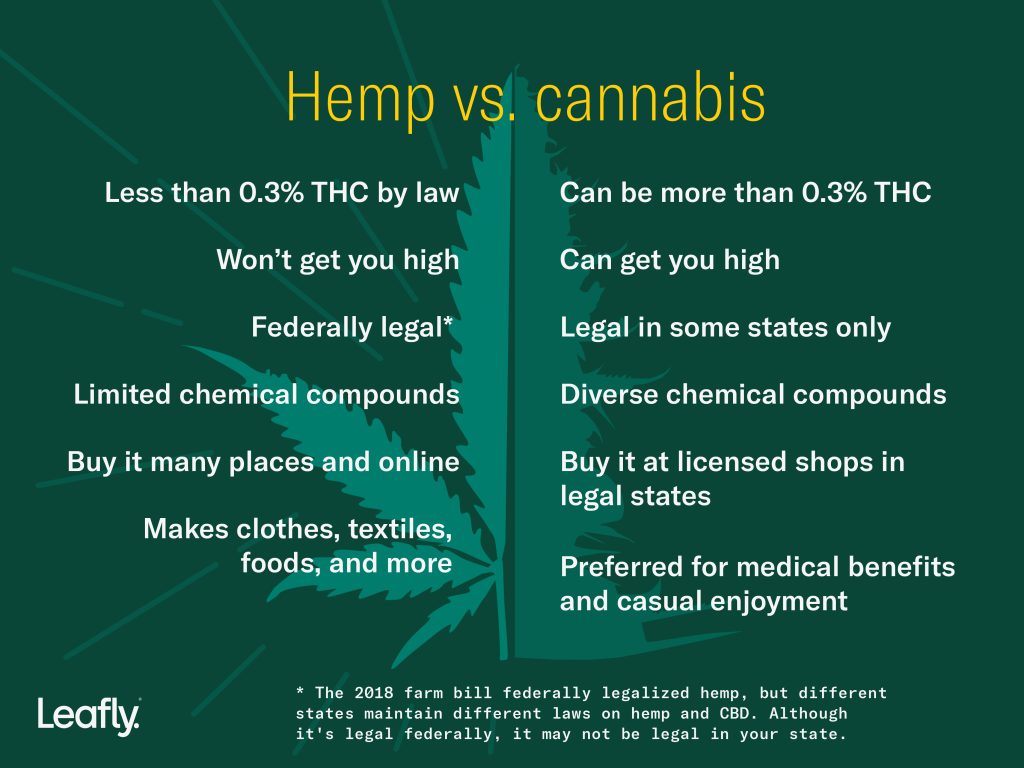
Although hemp and cannabis look (sort of) similar, from a functional and chemical perspective, they are distinctive. Here’s how you can distinguish the two.

(Leafly)

Hemp:

  • In order to be federally legal, it must contain 0.3% THC or less. For the uninitiated, THC is the cannabinoid that causes a high. With so little THC, hemp doesn’t have intoxicating effects.
  • Can be used to create products such as textiles, building materials, industrial products, paper, foods, and body care.
  • Is typically grown outdoors to maximize the size and yield of the plant. Hemp doesn’t require the same rigorous attention to lighting, humidity, and temperature that cannabis requires, and it can be grown in a range of different climates.
  • Tends to be tall and skinny with skimpy foliage, having an appearance similar to bamboo.

Cannabis:

  • Can contain 0.3% THC or more. Some high-THC strains can have 30% THC or more.
  • Is used for recreational or medicinal purposes. You won’t find cannabis plants being used to create hempcrete or denim.
  • Is generally grown in carefully managed and controlled conditions. Photoperiodic cannabis requires precise exposure to light in order to flower—its buds contain the valuable, potent compounds cannabis is famed for.
  • Tends to appear bushy, with large, full foliage.

Here’s the tricky thing: Both cannabis and hemp produce CBD. The CBD molecule is identical regardless of its cannabis source. However, from a legal perspective, CBD products derived from hemp and CBD products derived from cannabis are entirely different.

Hemp-derived CBD and cannabis-derived CBD: A legal perspective

According to federal law, cannabis—with 0.3% THC content or higher—is classified by the DEA as a Schedule I drug with no accepted medical use. CBD products sourced from cannabis, even those with 0% THC, are illegal at a federal level by virtue of their plant origin. Here’s the tricky thing: Both cannabis and hemp produce CBD. The CBD molecule is identical regardless of its cannabis source.

However, at a state level, the law changes. There are 33 US states which have medical cannabis programs, and CBD derived from cannabis is available from a licensed dispensary to eligible patients. The recreational use of cannabis is also legal in 11 states. In these states, cannabis-derived CBD products are available to those of age.

Industrial hemp, on the other hand, is no longer considered a Schedule I controlled drug. Following the 2018 farm bill, hemp was reclassified as an agricultural commodity. Since then, there has been an explosion of CBD products onto the market, prompting the U.S. Food and Drug Administration (FDA) to issue a statement that a regulatory framework for CBD products is still in the pipeline, and foods containing CBD, dietary supplements, and products making health claims are considered illegal.

CBD products sourced from hemp, such as oils and tinctures, are legal at a federal level, so long as they conform with other applicable laws. That said, certain states have their own legislation and regulations regarding CBD oil.

If you want to purchase CBD and err on the right side of the law, verify the legal status of hemp-derived CBD and cannabis-derived CBD in your state, so you know what you can or can’t purchase. Generally, hemp-derived CBD represents the more legal option.

Other differences between hemp-derived CBD and cannabis-derived CBD

CBD concentration

Cannabis represents a richer source of cannabinoids and terpenes than industrial hemp because it contains significantly more resin. Resin is the sticky, gooey substance found on female cannabis flowers, and to a lesser extent, on its leaves. Hemp contains resin on the flowers and leaves too, but much less. Most industrial hemp cultivators need to grow large quantities of hemp to produce CBD oil, although there are now more CBD-rich hemp strains being cultivated.

Safety

Hemp is a bioaccumulator, so it can absorb toxins such as residual pesticides and heavy metals from soil. When CBD is extracted from large quantities of industrial hemp cultivated in non-organic conditions, there is a possibility that contaminant residue will be passed into the final product. CBD products sourced from tainted hemp can compromise safety and efficacy.

Regulation

The hemp-derived CBD market is not yet subject to a widely enforced regulatory framework. For this reason, it’s essential to do your homework when buying hemp-derived CBD.

Look out for hemp-derived CBD that has been third-party tested. Products that have undergone this have been checked by an independent group outside of the producer using industry-approved techniques. The tester verifies the cannabinoid content of the product, along with heavy metals, pesticides, or microbes. Related

How to read a CBD label

A hemp-derived CBD product that has been third-party tested also guarantees you are getting what you paid for. Leafly’s investigation on CBD tested 47 products and found that almost half of them didn’t come within 20% of the labeled dosage. Third party testing confirms that the promised CBD content is present.

You can also look for hemp-derived CBD products with a USDA organic certification. This affirms that the growing conditions meet official USDA organic standards, and also provides assurance that the hemp extraction process was free of synthetic chemical additives.

In states where cannabis-derived CBD products are available from licensed dispensaries, there is greater regulation of these products. All are subjected to stringent testing from licensed facilities.

Effectiveness

Cannabis tends to have a wider terpene and cannabinoid profile than hemp. Cannabis-derived CBD from whole plant extract contains a range of beneficial terpenes and cannabinoids, including THC. These compounds work in concert with each other to provide additional benefits. This phenomenon is known as the entourage effect, and many cannabis experts assert that whole plant extracts offer greater therapeutic potential.

Hemp also contains some cannabinoids and terpenes, but not the range nor concentration of compounds present in cannabis. Hemp-derived CBD can be made into an full-spectrum extract that offers natural terpenes alongside minor cannabinoids. Broad-spectrum CBD is also available and contains minor cannabinoids and terpenes, but without the THC content.

However, full-spectrum and broad-spectrum hemp-derived CBD products may not have the potency of CBD derived from cannabis because trace amounts of THC appear to be less effective in treating certain symptoms.

CBD isolate

CBD can also be extracted from both hemp and cannabis to become an isolate. Isolates are identical whether derived from hemp or cannabis because they only contain CBD molecules. As there is more CBD in cannabis than hemp, it requires more hemp by dry weight to produce the same amount of CBD isolate.

CBD isolate is most commonly used in clinical trials to prove that results are linked to CBD rather than other compounds from either plant that may be present. Isolates may also be favored by those who wish to avoid THC entirely.

Source: https://www.leafly.com/news/cbd/hemp-vs-cannabis-derived-cbd-whats-the-difference

LOMIKO Metals $LMR.ca – Provides Shareholders Update On The Sale Of Subsidiary LOMIKO Technologies Inc. $CJC.ca $SRG.ca $NGC.ca $LLG.ca $GPH.ca $NOU.ca

Posted by AGORACOM at 10:11 AM on Monday, November 25th, 2019

Lomiko Metals Inc. (“Lomiko Metals”) (TSX-V: LMR, OTC: LMRMF, FSE: DH8C)   At the request of the Ontario Securities Commission, Lomiko Metals is issuing this release in order to better inform shareholders of the transaction that will be presented at the Annual Special General Meeting scheduled for November 29, 2019 at 11:00 am (Vancouver time) at Suite 1400, 885 West Georgia Street, Vancouver, BC, V6C 3E8 (the “Meeting”).  Lomiko Metals encourages shareholders to read, in detail, the Information Circular mailed to shareholders dated October 25, 2019 and filed on SEDAR at www.sedar.com.

 Sale of Assets

By agreement dated July 31, 2019, Lomiko Metals has agreed to sell its wholly-owned subsidiary, Lomiko Technologies Inc. (‘LTI’) to Promethieus Technologies Inc. (the “Purchaser”) for $1,236,625 plus $193,614.32 representing reimbursement of expenses (the “Asset Sale Transaction”). The transaction is non-arm’s length as (1)  A. Paul Gill is a director and officer of Lomiko Metals, a director of LTI and a director of the Purchaser; (2) Satvinder (Sat) Samra is a director of Purchaser and a shareholder of Lomiko Metals; and (3) Lomiko Metals is a 20% shareholder of the Purchaser at present, prior to its IPO and financing.

 Lomiko Metals Inc.’s independent directors to this transaction are Julius Galik and Gabriel Erdelyi (the “Independent Directors”) which comprise a Review Committee (‘Committee’) reviewing the transaction.

 Assets of Lomiko Technologies

               Smart Home Devices Ltd. (“SHD”)

 SHD is a private company developing a series of energy saving, connected building automation and security products and is focused on developing smart home automation and security devices for homes, offices, industrial buildings and hotels. SHD was formed to commercialize intellectual property jointly under development at the Megahertz Power Systems innovation lab (the majority shareholder of SHD and the initial developer of the Spider Charger concept).  SHD technology focuses on power savings, connectivity and security. LTI holds 1,792,269 shares of SHD.

 Lomiko Metals previously accounted for the equity value of SHD through direct costs that were incurred and in particular, incorporation expenses, purchase of inventory parts, patents, website, and share value. Lomiko Metals shareholding in SHD was diluted to 18.25% which caused significant loss of control over the future of SHD.  Lomiko Metals was of the opinion that it should discontinue the accounting for SHD using the equity method.  As at July 31, 2018, Lomiko Metals assessed that the investment in SHD was impaired and recorded a write-down of $1,136,574 to the investment to $1.

               Graphene ESD Corp. (“G-ESD”)

 G-ESD is a private company developing energy storage-based graphene platelets. On December 12, 2014, LTI purchased 1,800 shares of G-ESD Series A Preferred Stock at a purchase price of $101.27 US per share for a total consideration of $182,281 US. Each Series A Preferred Stock held by LTI may be convertible to common stock at the option of LTI and without the payment of additional consideration. Dividends would be payable at the rate per annum of $4.05 per share; however, over the period of four years there has been no activity in G-ESD and G-ESD continued to accumulate losses. As of July 31, 2019, LTI equity value in G-ESD was $56,572 and management assessed that the value in G-ESD was impaired and should be written off. 

 Reasons for the Asset Sale Transaction

 Lomiko Metals has been unsuccessful in financing LTI and its assets.  Both SHD and G-ESD achieved progress and created prototypes with SHD achieving partial advancement to underwriter’s lab testing and patent filings. In 2018 it became apparent that Lomiko Metals could not make any further cash investments to the assets as Lomiko Metals’ primary focus was the graphite project and alternative financing was required for LTI. Without further funding, the assets were considered without value. 

 Lomiko Metals had been funding various tech start-ups as a way to create alternative income sources.  It had funded from 2014 to present Graphene 3D Lab, G-ESD, SHD and Promethieus Technologies Inc.  The idea was to create a revenue-generating subsidiary that could act as a hedge against the vagaries of the junior mining market where the ability to raise funds for projects was and is very inconsistent.  Despite some initial success with Graphene 3D Lab and recovery of some of the funds put forward, the other projects did not see commercial success and were taxing the treasury.  Further, the market capitalization of Lomiko Metals become smaller and smaller and the percentage of technology interest increased to the point in January 2018 that the BC Securities Commission requested Lomiko Metals provide comment on whether it should undergo a Change of Business to a technology issuer.  It was at that time the concept of spinning out or creating a technology vehicle was conceived.  In 2018 Management sought funding sources for the advancement and/or sale of technology assets and settled on a plan to change the focus of the subsidiary Promethieus to a technology incubator that could qualify for listing in Europe as disclosed in April 6, 2018 and June 26, 2018 news releases.  The process is currently ongoing and confirmation of listing approval on an EU Exchange is still pending but near completion.

An initial concept of a sale of the technology assets to Promethieus was proposed by Management as a way to separate the metals and technology.  In September 2018 Promethieus changed its name to Promethieus Technologies Inc.  It was clear that Lomiko Metals needed funding in 2018-19 to complete its option and drilling and administration would tax the treasury.  During the progress of the strategy, the Independent Directors were provided progress reports regarding the inability to complete funding for Promethieus, SHD, and G-ESD during Directors meetings.  In 2019, Lomiko Metals was approached by the management of the Purchaser which made an offer to purchase SHD for $ 350,000.  Negotiations then ensued among the parties. Promethieus also became interested in licenses to manufacture SHD technology which was held by LTI and they were included in the negotiations.  After examination, Promethieus then offered to acquire all the assets of LTI and that included G-ESD shares.  Lomiko Metals then arranged to transfer its direct holdings of SHD to LTI.  The negotiations culminated in July 2019 with Promethieus offering to purchase all of the shares of LTI.  The Committee worked hard to establish a fair value for LTI and its sale.  The Committee’s main focus was to recover Lomiko Metals’ initial investment which was achieved.

 In determining that the terms and conditions of the Asset Sale Transaction contemplated thereby are in the best interests of the shareholders of Lomiko Metals, the Committee considered and relied upon a number of factors, including, among other things, the following:

 It is apparent that the status-quo of Lomiko Metals funding LTI was not economically viable as the assets were not advancing;

  • the consideration to be paid pursuant to the Asset Sale Transaction is all cash;
  • the Asset Sale Transaction is the result of a strategic review process conducted by a Committee comprised of Lomiko Metals Independent Board of Directors, which included reviewing a broad range of strategic alternatives available to Lomiko Metals;
  • The Committee reviewed Management’s equity funding efforts for Lomiko Metals as a whole and the specific projects to discover any ways to fund LTI without a sale of the assets;
  • The Committee reviewed Management efforts to seek funding via a debenture or loan;
  • The Committee communicated with the CEO of Promethieus to discover if the maximum value had been attained by Lomiko Metals for the assets;
  • The Committee confirmed with Auditors the expenditures of Lomiko Metals to fund LTI in the past and found the sale price was equal to the costs incurred by Lomiko Metals;
  • The Committee reviewed Management’s effort to attract buyers and investors in the projects;
  • The Committee considered an evaluation for the projects but determined that it would not be cost-effective or beneficial for Lomiko Metals, as the buyer would not pay more than the negotiated price;
  • At the conclusion of this Strategic Review, the Committee unanimously determined that the Asset Sale Transaction was the best alternative among the limited opportunities available to Lomiko Metals to maximize shareholder value having regard to Lomiko Metals current financial and operational position; 
  • the resolution approving the Asset Sale Transaction must be approved by a special resolution by a majority of the common shares represented and voted at the Meeting after excluding the votes required to be excluded under MI 61-101 (as defined below);
  • the terms and conditions of the Asset Sale Transaction, including the parties’ respective representations, warranties and covenants, and the conditions to their respective obligations have been disclosed;
  • the Committee believes that it is likely that the limited conditions to complete the Asset Sale Transaction will be satisfied;
  • to the knowledge of the Committee, there are no material regulatory issues which are expected to arise in connection with the Asset Sale Transaction so as to prevent completion, and it is anticipated that all required regulatory clearances are obtained; and
  • after conducting a review of Lomiko Metals’ financing and strategic alternatives, the Committee has determined that Lomiko Metals subsidiaries could not continue to operate as going concerns and was not likely to create greater value for shareholders than the value obtained for shareholders pursuant to the Asset Sale Transaction.

 The foregoing summary of the information and factors considered by the Committee is not, and is not intended to be, exhaustive. In view of the variety of factors and the amount of information considered in connection with its evaluation of the Asset Sale Transaction, the Committee did not quantify or otherwise attempt to assign any relative weight to each specific factor considered in reaching its conclusion and recommendation. The Committee’s recommendations were made after consideration of all of the above-noted factors and in light of the Committee’s collective knowledge of the business, financial condition and prospects of Lomiko Metals.

 Summary of Terms

 The following summary of the Asset Sale Transaction is qualified in its entirety by the terms of the Share Purchase Agreement, a copy of which has been filed on SEDAR at www.sedar.com. Any capitalized terms and section reference not otherwise defined herein shall have the meanings set forth in the Share Purchase Agreement.

 the Purchaser will acquire all of the shares of LTI;

  • the purchase price for all of the common shares of LTI is Cdn. $1,236,625 plus $193,614.32 representing reimbursement of expenses;
  • pending approval of the Asset Sale Transaction at the meeting and satisfaction of all conditions to closing set forth in the Share Purchase Agreement, closing is scheduled to occur within five (5) business days after all closing conditions have been met, and in any event no later than December 31, 2019;
  • major conditions to closing are:  (1) the approval of the Asset Sale Transaction at the Meeting; (2) a financing to be completed by the Purchaser of $3,670,750; (3) the approval of the TSX Venture Exchange; and (4) the representations and warranties being correct at the time of closing and no material adverse change having occurred at the time of closing;
  • Lomiko Metals has made normal-course representations and warranties; and
  • both Lomiko Metals and the Purchaser will be responsible for the payment of their own transaction costs, including legal, accounting, tax and regulatory compliance costs.

 Independent Valuation

Lomiko Metals has relied on an exemption to a Formal Valuation based on MI 61-101 Section 5(5)(g).   Lomiko Metals CFO, Jacqueline Michael, has verified Lomiko Metals expenditures and expenses for the financial years 2015, 2016, 2017 and 2018 relating to LTI. 

 TSX Venture Exchange Application

Lomiko Metals has filed its application for approval of the Asset Sale Transaction with the TSX Venture Exchange and has received conditional approval. 

 Effect of the Asset Sale Transaction on the Corporation and Plans of the Corporation Post-Closing

Assuming that the Asset Sale Transaction is approved at the Meeting and subsequently completed according to the terms disclosed herein, Lomiko Metals will still continue its exploration in the mining sector. 

 Summary of Anticipated Tax Consequences of Asset Sale Transaction

Lomiko Metals did not retain any formal tax opinion on the transaction but is of the view that there are no anticipated tax consequences passed on to the shareholders.

 Anticipated Ramifications of Failure to Approve the Asset Sale Transaction

 If the Asset Sale Transaction resolution is not approved by shareholders at the meeting, Lomiko Metals shall continue with its current operations. The Committee will continue to evaluate and consider strategic alternatives going forward but has unanimously recommended that shareholders vote in favour of the Asset Sale Transaction as they believe it is in the best interests of  Lomiko Metals for the reasons set out herein.

Required Shareholder Approvals for the Asset Sale Transaction

               Canada Business Corporations Act

 Although the Asset Sale Transaction is in the ordinary course of business, it is a non-arm’s length transaction that requires that the Asset Sale Transaction resolution must be approved by disinterested shareholder approval. 

               TSX Venture Exchange Policy 5.9 and MI 61-101

 Multilateral Instrument 61-101 – Protection of Minority Security Holders in Special Transactions (“MI 61-101”) is intended to regulate certain transactions to ensure equality of treatment among security holders, generally requiring enhanced disclosure, approval by a majority of security holders (excluding interested or related parties), independent valuations and, in certain circumstances, approval and oversight of the transaction by a special committee of independent directors.

 Lomiko Metals is subject to the provisions of MI 61-101 because the common shares are listed on the TSX Venture Exchange and Policy 5.9 of the TSX-V Corporate Finance Manual (the “Policy 5.9”) incorporates MI 61-101 into the policies of the TSX Venture Exchange and Policy 5.9 applies to all issuers listed on the TSX Venture Exchange.

 Lomiko Metals is a 20% holder of the Purchaser and this creates a requirement for review under MI 61-101.  MI 61-101 states that a “related party transaction” means, for an issuer, a transaction between the issuer and a person that is a related party of the issuer at the time the transaction is agreed to, whether or not there are also other parties to the transaction, as a consequence of which, either through the transaction itself or together with connected transactions, the issuer directly or indirectly (a) purchases or acquires an asset from the related party for valuable consideration, (b) purchases or acquires, as a joint actor with the related party, an asset from a third party if the proportion of the asset acquired by the issuer is less than the proportion of the consideration paid by the issuer, (c) sells, transfers or disposes of an asset to the related party,….”.  Pursuant to MI 61-101 this is a “related party transaction” and minority approval will be sought at the Meeting.

 Further, the Purchaser’s directors are A. Paul Gill and Sat Samra. Mr. Gill is a director and officer of Lomiko Metals and LTI. Mr. Samra is a director and officer of SHD and a shareholder of Lomiko Metals.  Therefore, Mr. Gill’s and Mr. Samra’s common shares will be excluded from voting on such matters for purposes of determining whether the required “minority approval” has been obtained as provided by MI 61-101.  Mr. Gill currently holds 5,725,910 common shares of Lomiko Metals, directly and indirectly. Mr. Samra holds 1,976,474 common shares of Lomiko Metals, directly and indirectly. 

Based upon the Committee’s consideration of, among other things, the current market conditions and other relevant matters as set forth herein, the Committee has unanimously determined that the terms and conditions of the Asset Sale Transaction contemplated thereby are fair to the shareholders and in the best interests of Lomiko Metals and the shareholders. 

A resolution shall be placed before shareholders at the Meeting scheduled for November 29, 2019 at 11:00 am (Vancouver time) at Suite 1400, 885 West Georgia Street, Vancouver, BC, V6C 3E8.

For more information on this transaction please contact Gabriel Erdelyi at [email protected].

 On Behalf of the Board,

LOMIKO METALS INC.

 â€œGabriel Erdelyi”

 Gabriel Erdelyi

Director