Agoracom Blog

Tartisan #Nickel $TN.ca – Nickel price catches battery, export ban fever. Again $ROX.ca $FF.ca $EDG.ca $AGL.ca $ANZ.ca

Posted by AGORACOM-JC at 9:15 PM on Sunday, July 21st, 2019

SPONSOR: Tartisan Nickel (TN:CSE)  Kenbridge Property has a measured and indicated resource of 7.14 million tonnes at 0.62% nickel, 0.33% copper. Tartisan also has interests in Peru, including a 20 percent equity stake in Eloro Resources and 2 percent NSR in their La Victoria property. Click her for more information

Tc logo in black
TN: CSE
Fact Sheet
—————————-

Nickel price catches battery, export ban fever. Again

  • Nickel is adding shine to the otherwise lacklustre 2019 industrial metals complex, as expectations of booming demand from electric vehicles and renewed supply worries rev prices to a one-year high.
  • Nickel is now up 37% since the start of the year, reaching $14,665 per tonne on Thursday in London and jumping 4% in Shanghai to the equivalent of $16,690.

By: Frik Els

Nickel is adding shine to the otherwise lacklustre 2019 industrial metals complex, as expectations of booming demand from electric vehicles and renewed supply worries rev prices to a one-year high.

Nickel is now up 37% since the start of the year, reaching $14,665 per tonne on Thursday in London and jumping 4% in Shanghai to the equivalent of $16,690.

Open interest in Chinese nickel futures is up by half in a fortnight and trading volumes have surged – indicating that the price spike is likely the result of speculation more than fundamentals.

Miners of the devil’s copper are used to wild swings in price. From the lows mid-2017 below $9,000 a tonne to around this time last year, the metal gained 79%, only to slump by nearly a third to its opening levels of 2019. And who can forget that in March 2007, nickel peaked at $51,780 per tonne.

The right chemistry

The electric vehicle (EV) narrative is an exciting one for the metal, but it is still early days. Very early days. Last year, only around 6% of nickel ended up in EV batteries. 70% of supply goes into making stainless steel.

That said the outlook is certainly rosy. Battery metals tracker Adamas Intelligence says electric vehicle manufacturers deployed 57% more nickel in passenger EV batteries in May this year, compared to 2018.

The deployment of nickel also outpaced the growth of the EV market overall. In May this year, total passenger EV battery capacity deployed globally was 48% higher year-on-year, according to Adamas data.

Nickel’s inroads is mainly due to shifting chemistries of nickel-cobalt-manganese (NCM) battery cathodes. First generation NCM111 batteries had a chemical composition of 1 part nickel, 1 part cobalt and 1 part manganese, but the industry is shifting towards an 811 mix. Roughly speaking NCM 811 batteries for light passenger EVs require more than 50 kilograms of nickel.

Andrew Cosgrove, senior mining and metals analyst for Bloomberg Intelligence at a recent conference predicted that nickel demand in batteries could outpace that of stainless steel in absolute terms, adding as much as 900,000 additional tonnes per year by 2030. That compares to current annual nickel production of less than 2.5m tonnes.

Jakarta jolts supply

China’s nickel pig iron production fed from Indonesian and Philippine mines dominate the global industry, and despite the economic slowdown in China, which imports some 50% of the world’s nickel, stainless steel production is growing rapidly.

Nickel also jumped this week due the mooted reinstatement of a ban on ore exports from Indonesia from 2022 onwards.

When Jakarta enforced the ban to encourage the building of domestic smelters from 2014 to 2016 the price gained initially, but Chinese NPI producers were able to switch to Philippine miners in a relatively short time, so it’s unclear the impact of export restrictions would be this time around.

NPI contains only 8–12% nickel and less than half of the total nickel output is so-called Class 1 product, which is suitable for conversion into nickel sulphate used in battery manufacture.

Class 1 nickel powder for sulphate production enjoys a large premium over LME prices, but for miners to switch to battery grade material requires huge investments to upgrade refining and processing facilities.

But confidence in future demand is such that BHP decided last year to hold onto Nickel West after many attempts to offload it, and is now spending hundreds of millions of dollars switching its Australian operations to battery-grade production.

Source: https://www.mining.com/nickel-price-catches-battery-export-ban-fever-again/

Enthusiast Gaming $EGLX.ca – The boom in #Egaming / #Esports $EPY.ca $FDM.ca $WINR $TCEHF $ATVI $TNA.ca

Posted by AGORACOM-JC at 9:00 PM on Sunday, July 21st, 2019

SPONSOR: Enthusiast Gaming Holdings Inc. (TSX-V: EGLX) Uniting gaming communities with 80 owned and affiliated websites, currently reaching over 75 million monthly visitors. The company exceeded 2018 target with $11.0 million in revenue. Learn More

Images
EGLX: TSX-V
———————————-

The boom in egaming/esports

  • Industry analytics house Newzoo forecasts esports (organised gaming at a professional level) to be worth $US1.1 billion in calendar 2019, rising to $US1.8 billion by 2022
  • The broader video games market is worth many billions more.

by Tim Boreham

For those who have never heard of Fortnite and are thus showing their advanced age, video gaming (egaming) has become a multi-billion dollar industry sector, which in its organised professional form is attracting serious sponsorship and advertising from mainstream consumer brands.

Egaming isn’t the preserve of vitamin D-deprived joystick jockeys in their dank bedrooms: it’s also a mass spectator sport with attendances at live tournaments eclipsing attendances at AFL football matches (the Adelaide and Essendon clubs have even acquired their own esports teams).

Professional esports teams tour the globe like rock stars, attracting a similar cult following as they pursue serious prize money. The site esportsearnings.com lists Germany’s Kuro Takhasomi as the sport’s biggest earner, having pocketed $6.2m in prize money from 98 tournaments.

Australia’s own Anathan Pham clocks in at number 11 on the esports rich list, reaping $4.15 million from 22 tournaments.

By the way, Fortnite is a Hunger Games style survival game that involves combatants dealing with adversaries such as zombies by, well, shooting them. While older game titles such as League of Legends and Dota2 remain popular, Fortnite’s popularity – especially among teenagers and even younger kids – is proving to be a game changer in heightening investor awareness.

Industry analytics house Newzoo forecasts esports (organised gaming at a professional level) to be worth $US1.1 billion in calendar 2019, rising to $US1.8 billion by 2022. The broader video games market is worth many billions more.

According to Esports Mogul (ESH, 1.3 cents) 20-25% of the broader population have played a mobile game. About half of 16-24s have watched esports and even in the crustier 45-65 year old bracket, 5% have done so.

 â€œIt’s evident the investment community is really only just coming to the fore of how big this sector is,” says Esports Mogul CEO Gernot Abl.

There’s also a strong element of ‘co-opetition’, with the companies executing a number of intertwined deals.  “We all know each other and support what we are doing,” Abl says.

Esports Mogul’s core focus is on a tournament platform called mogul.gg, which enables amateur gamers to hook up and test their wits out on each other.

The company this month hosted the Australian Apex Open Tournament on its platform, with 3850 gamers slugging it out for $35,000 or prize money.

Esports Mogul was also the exclusive platform provider for the Australian Esports League’s Girl Gamer festival, a global jamboree held in Sydney last month.

Meanwhile the South Africa based Emerge Gaming (EM1, 2.3 cents) has announced a string of collaborations, including  May’s memorandum of understanding with US games developer Digital Circus media to launch its products in North America.

These products include its GameCloud game streaming platform.

In June, Emerge teamed with Viacom International Media networks Africa to develop a kids-focused esports tournament platform called NickX, using Viacom’s Nickelodeon gaming content.

The company believes that as the professional market grows, so too will the market for amateur games based around a central hub.

 â€œMonetisation will be through brand take-up, premium subscriptions, in app subscriptions and advertising across the platform,” the company says.

In March, Emerge Gaming also signed a mobile gaming deal with ASX counterpart iCandy International (ICI, 3.8 cents), to broaden Emerge’s ArcadeX tournament platform. ArcadeX has been dubbed the “Netflix of gaming” in that it allows instant streaming of hundreds of 3D video games.

 iCandy will promote the offering to its 350 million global users. Separately, iCandy also plans to set up its own esports division, with first revenue by the end of 2019.

iCandy has also partnered with Animoca and Alibaba subsidiary 9Games to expand iCandy’s mobile game Groove Planet into the $29 billion mainland China market.

Perhaps not surprisingly, there’s a blockchain theme to the sectoral wheeling and dealing as well. In late June, Animoca said it would buy the US company Gamma Innovations, which enables gamers’ idle processing power to be used to ‘mine’ the cryptocurrency ethereum. The users are rewarded with loyalty-style points that that can be used to play their favourite games.

Despite the hype, the three smaller the ASX proponents have a long way to posting meaningful revenue. In the March quarter, Esports Hero turned over $20,000, “mainly by experimenting with subscription and sponsorship models.”

 iCandy generated $289,000, including from digital advertising and merchandising as well as the games themselves. Emerge had no revenue for the quarter but managed $129,600 of turnover in the December half, mainly from sponsorships of its online tournaments.

Animoca posted revenue from ordinary activities of $13.46 million in calendar 2018, up 107% and reduced its loss to $2.58 million from $8.26 million previously.

According to Esports chief commercial officer Jamie Skella, most of the value of the sector resides in sponsorship, advertising and media rights.

A professional Counter Strike and Cyberathlete League player, Skella sees emerging opportunities are in hosting micro tournaments (including merchandise) and holding ticketed live events.

Skella says egaming used to be the preserve of industry-focused advertisers such as hardware providers Razer Incorporated and Gigabyte Technology; now it’s attracting the interest of mainstream brands such as McDonald’s, Burger King, Coca Cola and the telcos.

 â€œThe 18-34 demographic is increasingly hard to reach but it’s a market segment of super high interest to advertisers,” he says.

All in all, the industry has gone a long way since the 1980s, when organised events for games such as Space Invaders, Pacman and Donkey Kong emerged. Online connectedness means combatants can play another competitor anywhere and at any time.

But for local investors, the reality is that the sector is in its infancy here.

At last glance, Esports Mogul, Emerge and iCandy had market capitalisations of $21 million, $15 million and $13 million respectively. Animoca is worth a less febrile $127 million and its shares have gained 75% since the start of the calendar year.

So while investors might be warming to the macro egaming story, it remains to be seen which stock will step up to the console with a serious winning manoeuvre.

Source: http://www.switzer.com.au/lifestyle/weekend-switzer/issue-188/the-boom-in-egamingesports/

Applied Biosciences $APPB: U.S. CBD Market to Grow 700% Through 2019 $WMD.ca $CGRW $APH.ca $GBLX $PFE $ACG.ca $ACB.ca $WEED.ca $HIP.ca

Posted by AGORACOM at 9:00 PM on Saturday, July 20th, 2019

SPONSOR: Applied Biosciences Corp. is a vertically integrated company focused on the development of science-driven cannabinoid therapeutics and biopharmaceuticals, as well as state-of-the-art testing and analytics.  As a leading company in the CBD, Pet and Health and Wellness space, the company is currently shipping to the majority of US states as well as to 5 International countries. Click Here for More Info

https://s3.amazonaws.com/s3.agoracom.com/public/companies/logos/564626/hub/APPB_logo.png
APPB : OTC
  • Brightfield Group 2019 U.S. CBD Market Report
  • Shifts across the U.S. CBD industry signal a seven-fold increase in the market
  • Bulk of growth coming from CVS, Walgreens, and Kroger entering the market and providing availability to consumers
  • 1.0% of CBD companies were in the top tier (with sales of $40+ million or being sold in greater than 1000 stores) while 92.9% of companies were in the low tier (with sales of <$1 million or being sold in 0-100 stores)

In their recent report, Brightfield Group, a leading market and consumer intelligence firm for the legal CBD and cannabis industries, uncovered numerous shifts across the U.S. CBD industry, signaling a seven-fold increase in the market. With hemp-derived CBD gaining in popularity – in line with health, wellness, and anti-pharma trends – and product availability and variety increasing, the market is on track to grow to $23.7 billion through 2023.

“The CBD market has been growing rapidly, but we will see unprecedented growth in 2019,” Brightfield Managing Director, Bethany Gomez, explains. “The bulk of this growth is coming from large retailers like CVS, Walgreens, and Kroger entering the market and providing that availability to consumers.”


Key highlights from the report:

  • Though they entered the market only this year, mass retail chains will eclipse all other channels in 2019, hosting 57% of sales this year
  • Although tinctures still dominate the market, driving 25% of sales, they are losing their lead as more mainstream consumer-friendly products surge
  • Topicals (17% of market) and skincare & beauty products (8%) have gained tremendous traction as mass retailers have signed on to carry these products first, since they are considered the safest bet under the current regulatory regime.
  • Natural food and smoke shop CBD revenues continue to grow and thrive – with increased uptake across the country and some level of saturation now that vendors feel more secure and confident carrying product. Notably, though the CBD market is no longer dominated by cannabis users, dispensaries and recreational shops have also seen an uptick in CBD-oriented traffic
  • 1.0% of CBD companies were in the top tier (with sales of $40+ million or being sold in greater than 1000 stores) while 92.9% of companies were in the low tier (with sales of <$1 million or being sold in 0-100 stores)

About Brightfield: Brightfield Group is a predictive market and consumer intelligence firm focused on the legal CBD and Cannabis industries. Their analytic solutions leverage data from millions of sources, enabling customers to get the most holistic view possible while drilling down into the fine details. They provide comprehensive, up-to-date, and actionable market and consumer insights that transform the best of research and technology into long-term business growth.
SOURCE: https://www.brightfieldgroup.com/press-releases/cbd-market-growth-2019

$LMR.ca Jason Gregg Joins Lomiko Board of Advisors $DNI.ca $CJC.ca $SRG.ca $NGC.ca $LLG.ca $GPH.ca $NOU.ca

Posted by AGORACOM at 11:17 AM on Friday, July 19th, 2019
https://s3.amazonaws.com/s3.agoracom.com/public/companies/logos/564363/hub/lomikoLogo300x100_copy.gif
LMR – TSX:V
  • Mr. Jason Gregg has joined the Lomiko Board of Advisors.
  • Mr. Gregg is a seasoned mining professional with a broad range of experience in leading Human Resources for mining projects in a variety of jurisdictions

Vancouver, B.C., July 19, 2019 (GLOBE NEWSWIRE) — Lomiko Metals Inc. (“Lomiko”) (TSX-V: LMR, LMRMF, FSE: DH8C, (ISIN: CA54163Q1028) (WKN: A0Q9W7) (LEI: 529900GJP51V4HR9MN94) is pleased to report that Mr. Jason Gregg has joined the Lomiko Board of Advisors.

“Mr. Gregg is a seasoned mining professional with a broad range of experience in leading Human Resources for mining projects in a variety of jurisdictions,” stated Mr. A. Paul Gill, CEO of Lomiko Metals.

Jason Gregg was most recently Executive Vice President, Human Resources for Alio Gold.   Mr. Gregg has more than 20 years of experience as a Human Resources professional. He holds a BBA (1995) and an MBA (2000) from Simon Fraser University. Before Alio Gold, he was Vice President of HR, Safety and Environment for Newmarket Gold. Before joining Newmarket, he provided HR consulting services to various mining organizations as well as other industries including forestry and technology. Prior to developing his consulting practice, he worked as a Human Resources executive in the mining industry with Farallon Mining and Nyrstar. Mr. Gregg has also held senior level human resource roles with HDI, International Forest Products, Canadian Forest Products, and Teck.

For more information on Lomiko Metals, review the website at www.lomiko.com, contact A. Paul Gill at 604-729-5312 or email: [email protected].

On Behalf of the Board,

“A. Paul Gill”

Chief Executive Officer

We seek safe harbor. Neither TSX Venture Exchange nor its Regulation Services Provider (as that term is defined in the policies of the TSX Venture Exchange) accepts responsibility for the adequacy or accuracy of this release

Attachment

A. Paul Gill
Lomiko Metals Inc. (TSX-V: LMR)
6047295312
[email protected]

American Creek $AMK.ca Reports That Treaty Creek JV Partner Tudor Gold Has Received a Further $3,000,000 in Exploration Funding from Eric Sprott $SEA.ca $SA $SKE.ca $TUD.ca $PVG.ca $MRO.ca $NGT.ca $SPMT.ca $GTT.ca $III.ca $GGI.ca

Posted by AGORACOM at 10:13 AM on Friday, July 19th, 2019
https://s3.amazonaws.com/s3.agoracom.com/public/companies/logos/562696/hub/HubLogoLarge2_copy.jpg
AMK – TSX:V
  • Eric Sprott places 3$ Million with Tudor
  • Sprott now owns 12.6% on a non-diluted basis, an increase from 7%
  • AMK holds 20% carried interest at Treaty Creek
  • 2018 drilling ended in 563M of 0.97g/t AU
  • 2019 drilling has begun at Goldstorm

Cardston, Alberta–(Newsfile Corp. – July 19, 2019) – American Creek Resources Ltd. (TSXV: AMK) (OTC Pink: ACKRF) (“American Creek”) is pleased to report that Canadian billionaire Eric Sprott has invested an additional $3,000,000 in JV partner Tudor Gold for the ongoing Treaty Creek drill program currently underway on the Treaty Creek property located in the Golden Triangle of Northwestern British Columbia.

Drilling is continuing on the gold enriched Goldstorm Zone which is on-trend with Seabridges’ Iron Cap Zone located five kilometers to the southwest. Drilling is designed to define a deposit with the potential of being open pit mined. For more details watch the Tudor Gold video here

Darren Blaney, CEO of American Creek stated: “This further significant investment by Mr. Sprott is a very solid endorsement of not only our partner, the Tudor Gold team, but more specifically of the potential of the flagship Treaty Creek project. Our 20% fully carried interest in the project is looking better and better.”

About American Creek

American Creek is a Canadian junior mineral exploration company with a strong portfolio of gold and silver properties in British Columbia. Three of those properties are located in the prolific “Golden Triangle”; the Treaty Creek and Electrum joint venture projects with Tudor Gold/Walter Storm as well as the 100% owned past producing Dunwell Mine.

The Corporation also holds the Gold Hill, Austruck-Bonanza, Ample Goldmax, Silver Side, and Glitter King properties located in other prospective areas of the province.

For further information please contact Kelvin Burton at: Phone: 403 752-4040 or Email: [email protected]. Information relating to the Corporation is available on its website at www.americancreek.com

ZEN Graphene Solutions: The Potential of Graphene in Aerospace: $ZEN.ca $CVE.ca $DNI.ca $LLG.ca $FMS.ca $NGC.ca

Posted by AGORACOM at 9:47 AM on Friday, July 19th, 2019

SPONSOR: ZEN Graphene Solutions: An emerging advanced materials and graphene development company with a focus on new solutions using pure graphene and other two-dimensional materials. Our competitive advantage relies on the unique qualities of our multi-decade supply of precursor materials in the Albany Graphite Deposit. Independent labs in Japan, UK, Israel, USA and Canada confirm this. Click here for more information

https://s3.amazonaws.com/s3.agoracom.com/public/companies/logos/564424/hub/Zen_logo.jpg
ZEN – TSX:V

A new paper on the potential of graphene within the aerospace industry has been launched by Aerospace Technology Institute (ATI) and National Graphene Institute (NGI) at The University of Manchester in the UK.

Jointly prepared by ATI and NGI, the INSIGHT paper features a sector perspective on the benefits of working with graphene and its potential market opportunities available to aerospace companies based in the UK.

Various consultations were carried out with stakeholders before the paper was produced.

Graphene is a two-dimensional material that has the potential to improve aircraft performance, cost, and fuel efficiency. It was isolated from graphite for the first time in 2004.   “According to the paper, aircraft safety and performance could be significantly enhanced by including atom-thin graphene in the materials used to manufacture aircraft.”

According to the paper, aircraft safety and performance could be significantly enhanced by including atom-thin graphene in the materials used to manufacture aircraft.Use of graphene is also expected to reduce the weight of the material, contributing to improved aircraft fuel efficiency.

ATI Technology for Manufacturing, Materials and Structures head Mark Summers said: “The UK has pioneered the research and development of graphene. The material has the potential to bring exciting applications and efficiencies into the sector.

“Although its exploitation into the aerospace sector is still in its infancy, it is anticipated that the scope of potential applications will continue to expand.

“We will seek to accelerate the maturation of graphene technology opportunities through our R&T programme, in a bid for the UK to remain ahead of the challenge and continue leading on the research and exploitation of the material in aerospace.”

Both ATI and NGI expect to continue collaboration on accelerating the technology development for graphene applications in the UK aerospace sector.

SOURCE: https://www.aerospace-technology.com/news/new-study-potential-graphene-aerospace-unveiled/

Iconic Minerals $ICM.ca – #lithium deployment in passenger #EVs up 47% y-o-y in May 2019 $LI.ca $MGG.ca $PAC.ca $CYP.ca $NEV.ca $SX.ca

Posted by AGORACOM-JC at 5:04 PM on Thursday, July 18th, 2019

SPONSOR: Iconic Minerals Ltd. ICM:TSX-V Bonnie Claire Lithium Property hosts Inferred resource of 11.8 billion pounds of lithium carbonate equivalent and has the potential to be the largest lithium resource globally. Learn More.

ICM: TSX-V

—————————–

lithium deployment in passenger EVs up 47% y-o-y in May 2019

  • In May 2019, 47% more lithium carbonate equivalent (LCE) was deployed globally in batteries of passenger EVs than the same month the year prior, according to Adamas Intelligence’s latest subscription-based “EV Battery Lithium Monthly” report.
  • In total, 47% of LCE deployed globally in passenger EV batteries in May 2019 went into NCM 523 cells (primarily in the form of lithium carbonate), up from 43% the same month the year prior.

This increase in LCE deployment was driven primarily by two factors, Adamas said.

  1. Global sales of passenger HEVs, PHEVs and BEVs collectively increased by 12% in May 2019 versus May 2018, translating to an increase in deployment of li-ion batteries.
  2. Sales of high-capacity BEVs, such as the Tesla Model 3, BYD Yuan and Nissan Leaf PLUS/e+, made up a greater share of total passenger EV sales this year than they did last year, boosting the sales-weighted-average battery capacity of all EVs sold by 33% over the same period, translating to greater use of LCE per vehicle.

In total, 47% of LCE deployed globally in passenger EV batteries in May 2019 went into NCM 523 cells (primarily in the form of lithium carbonate), up from 43% the same month the year prior.

Similarly, 14% of LCE deployed globally in passenger EV batteries in May 2019 went into NCM 622 cells (primarily in the form of lithium hydroxide), up from 8% in May 2018.

Moreover, 2% of all LCE deployed globally in passenger EV batteries in May 2019 went into NCM 811 cells (primarily in the form of lithium hydroxide) versus near-negligible quantities deployed the same month the year prior.

In total, the collective market share of NCM 622 and NCM 811 cathodes (by capacity deployed) has doubled since May 2018, indicating increasingly heavy demand for lithium hydroxide and other precursors used in these chemistries. Source: https://www.greencarcongress.com/2019/07/20190717-adamas.html

Esports Entertainment Group $GMBL – #Esports industry to reach $3 billion by 2025 says market reseracher $TECHF $ATVI $TTWO $GAME $EPY.ca $FDM.ca $TNA.ca

Posted by AGORACOM-JC at 3:02 PM on Thursday, July 18th, 2019
SPONSOR: Esports Entertainment $GMBL Esports audience is 350M, growing to 590M, Esports wagering is projected at $23 BILLION by 2020. The company has launched VIE.gg esports betting platform and has accelerated affiliate marketing agreements with 190 Esports teams. Click here for more information
GMBL: OTCQB

———————–

Esports industry to reach $3 billion by 2025 says market reseracher

Marta J.

  • The esports business seems to be booming
  • Eports is expected to grow with a 20% compound annual growth rate between 2019 and 2025.
  • That should see the market grow to more than $3 billion by the end of 2025.

According to ResearchandMarkets.com, esports is expected to grow with a 20% compound annual growth rate between 2019 and 2025. That should see the market grow to more than $3 billion by the end of 2025. This doesn’t come as a surprise, since esports’ popularity and support have been steadily growing worldwide.

The global esports market is likely to exceed a total revenue of over $1 billion for the first time this year, as it’s experiencing year-on-year growth of over 25%. According to Statista, the market generated $865 million in 2018.

Broadcasting rights have become a key source of revenue in esports with television networks like ESPN and ABC airing esports events alongside social media platforms like Twitch and YouTube.

That growth has extended to sponsorships even moreso. The field is by far esports’ strongest revenue stream, as it contributes to almost half of the total market revenue. This has been helped along by the increased attention from non-endemic brands like Nike and Puma who have begun sponsoring esports organizations Furia Esports and Cloud9, respectively.

It’s forecasted that the audience and the number of tournaments will continue increasing over the next five years, opening up opportunities for many potential vendors.

A major share of revenue to the global esports market is generated by North America, specifically the United States. Asia Pacific is one of the fastest-growing markets, with esports flourishing in China, Japan, South Korea, and Australia.

The vast majority of esports’ audience is male viewers aged 20-35.

That said, ResearchandMarkets.com states that esports’ growth “is mainly driven by cloud gaming and mobile gaming.” This makes matters a bit cloudy in regards to how much of that $3 billion is actually being funneled towards esports organizations, players, and tournament organizers.

The topic of inflated valuations in esports has become a hot one in recent months as multiple firms have had their methods questioned for their liberal definition for what counts as “esports.”

Source: https://win.gg/news/1673/esports-industry-to-reach-dollar-3-billion-by-2025-says-market-reseracher

CLIENT FEATURE: $GR.ca Great Atlantic’s Keymet Project a Mine Waiting to Happen $OM.ca $GGX.ca $GWM.ca $CNX.ca

Posted by AGORACOM at 11:36 AM on Thursday, July 18th, 2019
https://s3.amazonaws.com/s3.agoracom.com/public/companies/logos/564603/hub/GREATATLANTIC_LOGO_TESTER-e1480712241913.jpg
Keymet: A high priority precious metal – base metal property, located in northeast New Brunswick near Bathurst. The property covers an area of approximately 3400 hectares. Polymetallic veins (copper, lead, zinc, and silver) were mined during the 1950s in the northern region at the historic Keymet Mine.

Drilling Highlights:

  • Ky-18-14: 7.89% zinc equivalent over 34.3 meters (From 46.20 m to 80.50 m)
  • Ky-18-10: 10.91% zinc equivalent over 3.27 meters (From 85.03m to 88.30 m)
  • Elmtree 12 vein: System traced to approximately 145 meters depth, open at depth
  • Elmtree 12 vein: Strike length of approximately 110 meters and open along strike

Great Atlantic Hub on Agoracom

FULL DISCLOSURE: Great Atlantic is an advertising client of AGORA Internet Relations Corp

North Bud Farms Inc. $NBUD.ca – Booming Demand for #CBD Is Making Hemp the #Cannabis Cash Crop $WEED.ca $CGC $ACB $APH $CRON.ca $HEXO.ca $TRST.ca $OGI.ca

Posted by AGORACOM-JC at 11:28 AM on Thursday, July 18th, 2019

SPONSOR: North Bud Farms Inc. (NBUD:CSE) Sustainable low cost, high quality cannabinoid production and procurement focusing on both bio-pharmaceutical development and Cannabinoid Infused Products. Learn More.

NBUD: CSE

—————

Booming Demand for CBD Is Making Hemp the Cannabis Cash Crop

  • Players in the $340 billion global cannabis market are turning their attention to weed’s less-regulated cousin, hemp.
  • Hemp is a strain of cannabis whose fibers have traditionally been used in textiles and rope, and farmers can grow it even in countries with strict drug laws because it has different properties from marijuana.

By Craig Giammona and Bruce Einhorn

Mention legal cannabis, and many people think of the weed stores that have sprung up in Boston, Denver, Seattle, and other major U.S. cities. Inside, infused brownies and vape pens are sold next to branded joints and neatly packaged bags of marijuana presented in a way that wouldn’t be out of place in any American mall. In Canada you can even order pot through the mail, and some of the world’s alcohol giants have set up shop there to develop weed beer.

But the business of getting people high is only part of the cannabis craze. Marijuana is still banned for recreational use across much of the world, and even medical access, while expanding, is restricted in most countries. So players in the $340 billion global cannabis market are turning their attention to weed’s less-regulated cousin, hemp.

Marijuana 101

• THC: Tetrahydrocannabinol is the chemical in marijuana that produces a high.
• CBD: Cannabidiol, a nonintoxicating compound, can be derived from hemp and marijuana.
• Cannabis: Hemp and marijuana are both types of cannabis. Hemp faces fewer restrictions because it’s generally cultivated with lower levels of THC.

Hemp is a strain of cannabis whose fibers have traditionally been used in textiles and rope, and farmers can grow it even in countries with strict drug laws because it has different properties from marijuana. Most important to law enforcement officials, it’s low in THC, the compound that gets you stoned. But businesses are buzzed about its other defining characteristic: a higher concentration of cannibidiol, or CBD, a nonpsychoactive chemical at the center of a wellness trend sweeping the U.S. and expanding worldwide.

Global Market Share and Sales by Hemp Product Category in 2018

Data: Hemp Business Journal

CBD is being pitched as an all-natural way to alleviate ailments including pain, inflammation, anxiety, and insomnia. Despite a paucity of science to back up such claims, CBD has become a coveted ingredient in a host of consumer products, from skin lotions to sparkling water to tinctures to dog biscuits. The surge in demand is fueling a global Green Rush, even in countries where a legal market for cannabis products was unthinkable just a few years ago. “We are getting phone calls from big pharma groups in Asia, all parts of the world: ‘Can you get product? Can you supply to us?’ ” says Glenn Davies, chief executive officer of industrial hemp grower CannAcubed Pte. The Singapore-based startup planted its first commercial hemp crop in May in China’s Yunnan province. “It’s all about hemp.”

One of the first plants ever domesticated, cannabis was used for thousands of years for fiber, food, and medicine. Yet for the better part of the last century it’s largely been traded on the black market, banned in many countries alongside cocaine, heroin, and other controlled substances. Much of that bad-boy reputation faded last year when Congress legalized CBD in the U.S.

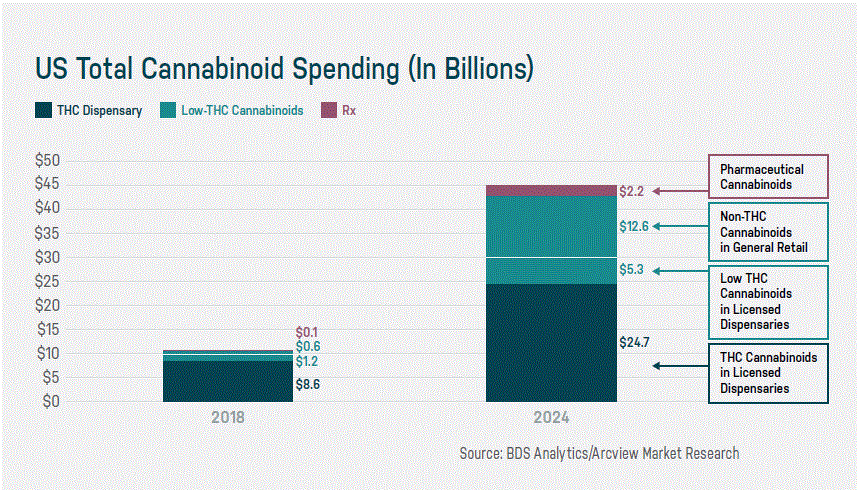
Researchers estimate the market for CBD in the U.S. alone could be worth almost $24 billion by 2023. In Canada sales of legal cannabis may reach $4.7 billion by that time, up from about $570 million last year, according to BDS Analytics. Annual sales of CBD could potentially be larger than those of marijuana, analysts say, because of the large number of products in which it can be used.

U.S. Hemp Imports by Source Region, 2017

Data: Hemp Business Journal

Investors are pouring money into massive CBD extraction facilities and processing plants in the U.S., hoping to be ready when Coca-Cola Co., Procter & Gamble Co., and other consumer giants finally embrace cannabis. Colorado CBD company Mile High Labs has developed technology to remove unrefined hemp extract from the plant, and it recently paid $18.8 million for a 400,000-square-foot former Novartis factory where it will make products such as lotions and tinctures.

American farmers are plowing into the hemp industry in Colorado, Kentucky, Montana, Oregon, and other states. This year, more than 200,000 acres of hemp are licensed to be planted in the U.S., up from roughly 25,000 two years ago. Asia, which has a long history with natural medicines, is also seeing growing interest in cannabis. In 2017, China planted at least 113,000 acres of hemp, according to New Frontier, an industry researcher. Cultivation is also on the rise in Colombia, Greece, Jamaica, and even the southern African nation of Lesotho. “You get the domino effect: The farmer in Bulgaria looking across at peers in Greece and asking questions, putting pressure on the government to make similar steps,” says Shane MacGuill, an analyst at Euromonitor International. “The more it happens, the more quickly we get the spread of cultivation.” Hemp producers in Asia and other lower-cost regions could ultimately undercut U.S. farmers, especially as the quality of their crop improves and a global market takes shape, with hemp moving freely across borders like any other agricultural commodity. In June, CannAcubed leased two factories in Yunnan, one of only three Chinese provinces that allows the production of hemp; it plans to expand them into CBD research and extraction facilities.

Not everyone is so sanguine. Mark Mees, CEO of Setek Therapeutics in New Zealand, sees cannabis becoming another agricultural commodity, with prices racing downward. And Mees, whose company has a license to grow medical marijuana in the country, says the CBD business has been overhyped. “You get a few hippies and that’s great. One thing that’s missing is old-fashioned business sense,” he says. “We will see a train wreck of small companies that completely underestimated the costs and the complexity of what they’re trying to do.”

Global Hemp Sales

Data: Hemp Business Journal

Restrictions on medical pot are loosening globally. More than 50 countries, including Australia, Brazil, and Germany, have legalized access to medicinal cannabis, according to Bloomberg Intelligence, making it easier for farmers to plant hemp or marijuana. But dealing with pot can still be tricky. In New Zealand, companies can grow medical weed only for research, though the government is working on a commercialization plan. Cannasouth Ltd. has struggled as New Zealand’s sole publicly traded cannabis company, with its shares falling 24% since its IPO on June 19.

As countries remove restrictions, cannabis prices could fall. That would hurt farmers, but potentially boost the profit margins of companies using cannabis as an ingredient. Worries about an industry bubble surfaced earlier this year in China after investors flocked to companies linked to cannabis. Regulators sought to rein in the enthusiasm, with the Shenzhen Stock Exchange telling companies to warn investors about uncertainties facing their industrial cannabis projects.

Canadian farmers have seen a hemp boom-and-bust cycle before. The crop was legalized for production in 1998, and farmers benefited when hemp seed took off as a health-food product. Business peaked in 2015 as South Korean demand drove the market. But China, becoming a cheaper supplier for Korean buyers, sucked profit away from Canada’s hemp-seed farmers. Still, that hasn’t deterred Canadians from trying to cash in on CBD. This year, hemp acreage in the country is expected to more than double, to about 82,000 acres.

In Asia, CannAcubed’s Davies is also unfazed by the risks. “Everybody is trying to have the same outcome and objective: Get this industry moving,” he says. —With Ashley Robinson BOTTOM LINE – Fueled by growing demand for CBD as a health-enhancing ingredient in foods and beauty products, sales of the cannabis derivative could hit $24 billion in the U.S. by 2023.  

Source: https://www.bloomberg.com/news/articles/2019-07-18/booming-demand-for-cbd-is-making-hemp-the-cannabis-cash-crop