Agoracom Blog

Strike Graphite Receives Drill Permit at Simon Lake Property

Posted by AGORACOM-JC at 10:01 AM on Wednesday, March 28th, 2012

VANCOUVER, BRITISH COLUMBIA–March 28, 2012) – Strike Graphite Corp. (TSX VENTURE:SRK) (the “Company” or “Strike”) is pleased to announce it has received exploration drill permits for its Simon Lake Property, located in northern Saskatchewan. The permit will allow the Company to begin the ground exploration on the approximately 25 km long conductive horizon that was recently confirmed with a high-resolution airborne TDEM survey (see news release of February 23, 2012).

The next stage of exploration is designed to accomplish the following:

  • Confirm with drill testing the known graphite occurrences along the 5.5 km long conductive trend
  • Drill test the new high-priority targets along the recently identified 25 km long conductive trend
  • Process drill-core material for graphite mineralogical characterization and initial metallurgical testing

The Company is finalizing the scope of its drilling program and anticipates mobilizing the field crew and drilling contractor within the next 1-2 weeks.

Dahrouge Geological Consulting Ltd. of Edmonton, Alberta, has been commissioned to plan, carry out, manage and report on exploration work at Simon Lake Property. A second phase of summer and fall exploration will consist of follow-up drilling in order to advance the highest priority graphite target in terms of large-flake and high recovery potential.

Geoff Balderson, President & CEO remarks, “We’re definitely pleased with the quick turn around on this permitting application as it further demonstrates support for management’s decision to target and secure strong graphite assets in a known mining friendly jurisdiction. From here, we can continue with our aggressive approach to aim for resource status (compliant to NI 43-101) as quickly as possible for the benefit of our vision for the company and our shareholders.”

About the Simon Lake Graphite Property:

The Simon Lake Graphite Project covers 11,800 hectares, and is located approximately 300 km northeast of La Ronge, Saskatchewan and is intersected by Highway 905. The property consists of several showings of flake graphite mineralization in historic drill holes, which were discovered during the exploration of base metals during the early 70′s. Historic Drill Hole 2-72 encountered a graphitic biotite gneiss with descriptions of “abundant graphite” over a 68 m interval.

Approximately 5.5 km to the southwest, along a the same conductive horizon, Drill Hole E42-5 encountered a graphitic biotite gneiss with core descriptions of “disseminated graphite” or “coarse graphite flakes” over 182.9 m of core, with narrower intervals described as “graphite flakes abundant” and “heavy graphite in 6 to 12 inch bands”.

Within the southwest part of the property, approximately 6 km east of Saskatchewan Highway 905, a large and highly conductive structure has been interpreted as a fold hinge. At this location, the conductive unit exceeds 5 km along strike and is more than 2 km wide; and may represent the strike extension of the graphite-bearing lithologies known at Simon Lake.

Neil G. McCallum, P.Geo. is the Qualified Person pursuant to NI 43-101, and has reviewed and approved the technical disclosure of this news release.

About the Company:

Strike Graphite Corp. is a progressive exploration company with seasoned management targeting strategic assets on a global scale. The Company is also advancing the Satterly Lake gold project in NW, Ontario, located just west of Gold Canyon Resources Inc.

On behalf of the Board of Directors,

Geoff Balderson, President and Chief Executive Officer

For more information on the above or to view the Company’s Corporate Presentation on its Graphite assets and opportunity, please visit the Company’s website at www.strikegraphite.com.

We seek safe harbor.

FOR FURTHER INFORMATION PLEASE CONTACT:

Geoff Balderson
Strike Graphite Corp.
President and Chief Executive Officer
604.669.9330
604.669.9335 (FAX)
[email protected]
www.strikegraphite.com

“Neither TSX Venture Exchange nor its Regulation Services Provider (as that term is defined in the policies of the TSX Venture Exchange) accepts responsibility for the adequacy or accuracy of this release.”

Corporate Website / Hub on AGORACOM

Source: http://agoracom.com/ir/StrikeGraphite/forums/discussion/topics/525858-strike-identifies-25-km-long-conductor-at-simon-lake-graphite-project/messages/1664660#message

Zenyatta finds graphite while exploring Ontario for nickel-copper

Posted by AGORACOM-JC at 3:06 PM on Tuesday, March 27th, 2012

Zentatta Ventures


By Greg Klein

On completing its December 2010 IPO of $9.9 million, Zenyatta Ventures (TSXV:ZEN)began 2011 with big ambitions. The company set out to explore its Albany Project in northern Ontario, which may sit on a structure related to the Mid-Continent Rift, home of a number of significant deposits around Lake Superior. Zenyatta hoped for a nickel-copper-polymetallic deposit comparable to the Norilsk Nickel mine in Siberia, Vale‘s Voisey’s Bay operation in Labrador or Rio Tinto‘s Eagle deposit in Michigan. So far, that goal has proved elusive. But what the Albany Project (aka Arc of Fire) drill results do show, says President/CEO Aubrey Eveleigh, might be equally compelling — the possibility of an exceptionally large deposit containing the exceptionally unusual occurrence of vein-type graphite.

Vein (or lump) graphite is the rarest, hence most expensive, type of natural graphite. At the other end of the scale, amorphous graphite is the type most commonly found and is widely used for steelmaking, auto parts, sports equipment and other applications. Flake graphite is essential to the emerging markets that include solar panels, fuel cells, pebble-bed nuclear reactors and the lithium-ion batteries that are becoming standard for electronic devices and electric vehicles. But little is spoken of vein graphite — likely because there’s so little to speak of.

Currently the world’s supply depends on Sri Lanka, whose mines contain exceptionally pure graphite, often grading over 90%. The product transmits heat and electricity more efficiently than other graphite types and is easier to mould. As a result, it’s in high demand for specialized uses such as the electric brushes used in motors and generators and in powder metallurgy used to manufacture parts for industries that include the automotive, aerospace, energy and medical/dental sectors.


So how did Zenyatta’s aspirations turn from a Voisey’s Bay to a Sri Lankan-type target? “We flew our property with an airborne survey and got a very large conductor that measures 1,400 metres by 800 metres,” explains Eveleigh. “That’s a whopping conductor. We thought it was copper-and-nickel massive sulphides. It’s covered with swamp so we had to drill blindly. But we started to get this graphite-rich breccia zone. Basically, from top to bottom we were getting all this graphite. So it’s pretty large and pretty unique because it’s a hydrothermal graphite deposit unlike what anybody is promoting in North America right now. There is one in Sri Lanka that’s similar to it, and that’s a vein-type graphite.”

Results announced January 19 from one hole show eight separate breccia zones, the first starting at 79.8 metres and the last ending at 522 metres. The following assays were released.

  • 4.6% carbon over 9.9 metres
  • 4.2% over 67.5 metres
  • 3.3% over 7.9 metres
  • 2.5% over 48.2 metres
  • 3% over 26.4 metres
  • 4.2% over 5.5 metres
  • 2.1% over 7.5 metres
  • 3% over 16 metres

A mineralogical study at Lakehead University found graphite ranging from fine (-270 mesh) to coarse (+40 mesh). The next step is bench-scale testing to better determine the deposit’s purity, flake-size distribution and recoverability. Results from SGS Canada are expected within two to four months.

“This could be exceptional; it could be very valuable; and certainly the market is bullish on graphite right now,” says Eveleigh.

Meanwhile, drilling will resume presently. “We need to determine the size of it. If we judge by the airborne conductor, it looks pretty big, but you still have to prove that. So we’re stepping out quite a ways, like 200-metre step-outs. If it’s still there, we can extrapolate in between and say this looks like a pretty big deposit. If it’s as big as the conductor suggests, it will be one of the biggest graphite deposits in the world.”

Advertisement

About 4,000 metres of drilling is planned. And the company’s still looking for that big nickel-copper find in its 121,000-hectare Albany Project. “We have 28 different claim blocks,” Eveleigh points out. “We found the graphite on one block and we’re advancing that, but we’re also exploring the other 27 blocks.”

The graphite deposit has “good access and good infrastructure,” he adds. It sits four kilometres from an all-weather logging road, 30 from the Trans-Canada Highway and 70 from a rail line.

As a geologist, Eveleigh’s career began with Noranda and includes a seven-year stint as a partner in a consulting firm that worked for around 50 juniors and majors. He also held a highly successful position with Wolfden Resources and is currently president of Eveleigh Geological Consulting, which has provided expertise for companies including Rio Tinto, Goldcorp (TSX:G), Agnico-Eagle (TSX:AEM), Diavik Diamond Mines andBHP Billiton.

Zenyatta’s team includes Barry Allan, an exploration geologist turned Senior Mining Analyst for Mackie Research Capital, and Cliff Davis, who boasts over 40 years’ experience in open-pit and underground mining. Brian Davey, a member of the Moose Cree First Nation, has 28 years’ experience in issues mostly related to First Nations economic development. Some other management and advisory staff include Don Bubar, president of Avalon Rare Metals (TSX:AVL) and Roland Butler, co-founder of Altius Minerals (TSX:ALS), which holds a 10% interest in a 3% Voisey’s Bay net smelter royalty.

The company has an 80% earn-in option with Cliffs Natural Resources (CLF), which calls for $10 million of spending over four years. Zenyatta has already earned 25% by completing its airborne survey. Cliffs holds 11.8% of Zenyatta’s shares.

“Cliffs also helps with technical support, so we’re moving this along together,” Eveleigh says. “They obviously like these projects, and they’re very supportive of us.”

Insiders hold 23.5% of Zenyatta shares while another 35% is institutional. At press time Zenyatta had 39.6 million shares trading at $0.15 for a market cap of $5.9 million.

Eveleigh will make a presentation at OnPage Media’s May 2 Graphite Express-Conference at Toronto’s Sheraton Hotel. Click here  for free registration.

Read more articles like this at resourceclips.com .

All information on this website is: (a) for informational purposes only; (b) not to be used or construed as an offer to sell, a solicitation of an offer to buy, or an endorsement, recommendation, investment advice or sponsorship of any entity or security; and (c) not necessarily reflective of the views or policy of the Financial Post. Prior to making any investment decision, it is strongly recommended that you seek advice from a qualified investment advisor. The Financial Post does not provide or guarantee any financial, legal, tax or accounting advice or advice regarding the suitability, profitability, or potential value of any particular investment, security or information source, especially as it relates to mining companies. For further details, please Section 22 ofhttp://www2.canada.com/aboutus/termsofservice.html .

Rare Earth Metals Growth Drivers: Siddharth Rajeev

Posted by AGORACOM-JC at 1:30 PM on Tuesday, March 27th, 2012

With so many moving variables in the rare earth space, how can investors evaluate investment opportunities? Siddharth Rajeev of Fundamental Research Corp. finds his top prospects by zeroing in on a specific material and tracking its growth drivers. Rajeev argues that critical materials used in viable new technologies will see increasing demand. In this exclusive interview with The Critical Metals Report, he explains how lithium-ion battery development and the forthcoming WTO ruling effect his outlook for graphite and niobium.

COMPANIES MENTIONED: COMMERCE RESOURCES CORP. – FLINDERS RESOURCES LTD. - FOCUS METALS INC. – GREAT WESTERN MINERALS GROUP LTD. - LOMIKO METALS INC. – LYNAS CORP. – MOLYCORP INC. - QUANTUM RARE EARTH DEVELOPMENTS CORP.

The Critical Metals Report: China recently announced it is maintaining its rare earth export quotas of 31,130 metric tons (t), but the U.S., the EU and Japan filed a claim at the World Trade Organization (WTO), saying that the restrictions are illegal. What will this controversy mean for rare earth prices?

Siddharth Rajeev: One of the main reasons for the run-up in rare earth prices is the export quotas set by China, which controls 97–98% of the supply. End users started looking for alternatives to rare earths, which is resulting in lower demand. As for the WTO case regarding China’s export quotas, Chinese officials think they are in line with WTO regulations. The WTO had previously ruled against China for restricting exports of bauxite, magnesium, zinc, etc., so it is possible the WTO might go against China here as well, which would negatively impact rare earth prices. In addition, companies outside China are now nearing production, including Molycorp Inc. (MCP:NYSE), Great Western Minerals Group Ltd. (GWG:TSX.V; GWMGF:OTCQX) in South Africa and Australia’s Lynas Corp. (LYC:ASX), may alleviate supply constraints, thus driving prices down. Still more projects are expected to come online in the next two years, which would further add to supply.

TCMR: When do you expect the WTO to decide on a ruling?

SR: It’s going to be a long process, but it’s something that could potentially affect long-term rather than short-term prices.

TCMR: Because rare earth materials are so varied, you use a fair-value metric instead of target prices when you evaluate these stocks. But how do you determine the intrinsic value of a critical metal stock when there is all of this uncertainty?

SR: Every commodity is priced based on expected long-term demand and supply. To forecast commodity prices, we project long-term demand based on the potential growth of the major demand drivers. Supply is projected based on the projects that may come onstream over the next 10 years. But as you mentioned, the forecast demand for critical elements is harder than, say, forecasting demand for copper or zinc. Demand for critical elements can be a moving target. We mitigate this problem by constantly updating our models to capture this variable. For example, major lithium demand drivers are expected to be lithium-ion batteries. Precisely forecasting demand for lithium-ion batteries depends on other growth drivers, such as electric vehicle proliferation. So we constantly update our models as to reflect projected demand in related sectors. That’s how we calculate price forecasts for all the commodities in the rare earth and critical metals space.

TCMR: You recently released a report on graphite and its uses for everything from brake linings to batteries and nuclear power. Graphite prices have jumped as much as $500/t in the last year for certain grades. How high could that price go, and what’s driving that?

SR: Over the long term, we are bullish on graphite. The main reasons are the following: First, we think the main demand growth drivers of graphite could be new applications, such as lithium-ion batteries, fuel cells and nuclear power. Natural graphite might take away a significant market share from the synthetic graphite market, because high-purity, high-grade graphite is required for these technological developments. Synthetic graphite currently trades at four to six times the price of natural graphite.

Second, on the supply side, China accounts for more than 70% of production. The U.S. imports its entire graphite consumption. So, again, we are seeing a highly concentrated supply in one area. Another thing, the blue-sky potential for graphite involves a product called graphene, which is made by chemically processing graphite. Graphene is very unique because it’s highly flexible, like rubber, yet stronger than steel, and it’s a very good conductor of heat, 10 times more effective than copper. It’s a recent technology and there is a lot of research going on in the sector. All things considered, we have a bullish outlook on graphite.

TCMR: What companies outside of China are you watching in this space?

SR: We’ll be initiating coverage on Focus Metals Inc. (FMS:TSX.V) in the next month or so. Its project, which it acquired from IAMGOLD Corp. (IMG:TSX; IAG:NYSE) in 2010, is located in Quebec. I have not seen any other project with such high grades of graphite in the deposit. Focus Metals has a grade of 16%, whereas most of the graphite deposits out there are less than 3%. It has large-flake material, which is highly in demand for applications such as lithium-ion batteries. Focus Metals recently completed a resource estimate. It’s working on a scoping study now. It’s a low-capital expenditure project, less than $75 million (M). The company has an extremely strong cash position, $16M. Market cap is just over $80M.

Another story we like is Flinders Resources Ltd. (FDR:TSX.V), a brand-new company. It started trading on the Toronto Stock Exchange Venture a few weeks ago. Its project is the Kringel project. A lot of historic work has been done on the project. It has a historical resource of 7 million tons (Mt) at 9% graphite, which is a high-grade material. It has a lot of catalysts coming up over the next 12 months, one of the biggest being its plans to convert the historic resource to an NI 43-101-compliant resource. It has a fully permitted mine that can be put into production in the next 18–24 months. It has a strong cash position of $5M, and its market cap is $60M.

Another company is Lomiko Metals Inc. (LMR:TSX.V). It’s a very early-stage project. It just acquired a project in Quebec. Some historic work has been done on the property. As for near-term catalysts, it is working on an NI 43-101 technical report [released 3/27/12], and it is going to commence an exploration program on the property.

TCMR: Lomiko is historically a gold company that just diversified into the graphite space. Is that common? Are a lot of companies following suit?

SR: Because of graphite’s highly attractive fundamentals and growing investor interest, we have been seeing a lot of new companies pop up or switch their focus to graphite, which is normal in the commodities sector. We saw the same pattern a few years ago when the rare earth boom started. The same has been the case with lithium. This is common, but bear in mind that a lot of companies might not survive the boom period.

TCMR: Do you see Lomiko’s stock going up because of the diversification?

SR: Our last report on Lomiko’s graphite came out a few months ago. The stock had doubled since the initial report. It’s dropped since then. As long as the graphite market stays in its current space, where I expect it to stay for a while, and if Lomiko’s exploration program produces positive results, that should reflect in the stock price. In other words, it’s too early to tell.

TCMR: You also focus on niobium, which is used in the technology, aviation and steel industries to make metals lighter and stronger. The price for ferro-niobium has come down from more than $46/kilogram (kg) to about $43. Is that a function of more supply or less demand?

SR: Niobium demand is highly correlated with steel demand, and steel demand is highly correlated with global gross domestic product (GDP) growth. The recent slowdown in global GDP growth, especially from China, has resulted in a softening of prices for commodities that service the steel industry.

TCMR: How does that price action affect your outlook for niobium suppliers, particularly in North America?

SR: The U.S. produces very little niobium. That’s been the case for a long time. Brazil is the number-one producer of niobium, accounting for about 92% of global production. Canada comes in a far second. We cover two North American companies in the space. The first is Quantum Rare Earth Developments Corp. (QRE:TSX.V; BR3:FSE; QREDF:OTCBB). It has the Elk Creek project in Nebraska, of which it owns 100%. In March 2011, it came up with an Inferred resource of 80 Mt at 0.62% niobium oxide, which is a significant deposit. This company has quite a few catalysts expected this year. In Q112, it expects a new NI 43-101 resource report, and in Q212 it expects some results of its metallurgical testing. These two numbers should give it enough information to commence a preliminary economic assessment (PEA) later this year.

TCMR: If those reports come out positive, could that override any niobium price challenges?

SR: Definitely.

TCMR: What other companies do you follow in that space?

SR: Another company is Commerce Resources Corp. (CCE:TSX.V; D7H:FSE; CMRZF:OTCQX). It has the Tantalum niobium project in British Columbia. It recently completed a PEA of the property, but its main asset now is its rare earth project in Quebec, which has produced a lot of positive news for the last 6 to 12 months. It recently came out with a huge increase in its resource estimate, and its initial estimate was one of the largest outside of China. The newer resource has doubled the figures, so that’s a significant development. It identified middle rare earths (MREEs) and heavy rare earths (HREEs), which are more valuable than light rare earths (LREEs),close to the surface of the property.

TCMR: Are the price dynamics different for HREEs and LREEs due to respective export quotas?

SR: Yes, exactly. Prices of light and abundant rare earths dropped much more than other rare earths that are more scarcely available. So there’s been a wide fluctuation, and different commodities in the rare earth sector have reacted differently. But overall, the rare earth market has been hit significantly in the last 6 to 12 months.

TCMR: Commerce has, as you mentioned, both MREEs and HREEs. Do you expect those prices to remain high or perhaps escalate?

SR: Overall, we saw significant price increases in the rare earth market, increasing as much as five- or tenfold in some cases over the last few years. We’ve since seen sort of a correction. But even at these relatively lower prices, a lot of projects are economic. So we wouldn’t need to see an increase in prices to make these companies look favorable.

TCMR: What other factors might impact this sector, particularly in an election year, that investors should take into consideration when considering critical metals companies?

SR: Global economic growth and price levels of critical metals are not directly linked. Critical metals are more influenced by new technologies. Any commodity that can be used for viable and efficient new technologies is going to see good growth and demand. This would include commodities like lithium and graphite, which are used in lithium-ion batteries. We have a strong outlook on lithium-ion batteries for electric cars. Those are the kinds of technologies that can be viable in the long run, and all the associated technologies are likewise going to see a significant increase in demand. Critical materials that figure into these developments will be less affected by shorter-term developments like the U.S. presidential election or a slowdown in the Chinese economy because many of these new technologies have a lot of room for upside, even before demand stabilizes.

Thank you for speaking with us today.

SR: My pleasure.

Siddharth Rajeev is vice president and head of research at Fundamental Research Corp., the largest independent equity research firm in Canada. He holds a bachelor of technology in electronics engineering from the Cochin University of Science & Technology and a Masters of Business Administration in finance from the University of British Columbia. He is also a CFA charter holder. He is ranked as a four-star analyst in the energy and mining sectors by Deutsche Asset Management.

Want to read more exclusive Critical Metals Report articles like this? Sign up for our free e-newsletter, and you’ll learn when new articles have been published. To see a list of recent interviews with industry analysts and commentators and learn more about critical metals companies, visit our Critical Metals Report page.

DISCLOSURE:
1) JT Long of The Critical Metals Report conducted this interview. She personally and/or her family own shares of the following companies mentioned in this interview: None.
2) The following companies mentioned in the interview are sponsors of The Critical Metals Report:Focus Metals Inc., Lomiko Metals Inc., Quantum Rare Earth Developments Corp. and Commerce Resources Corp. Streetwise Reports does not accept stock in exchange for services.
3) Siddharth Rajeev: I personally and/or my family own shares of the following companies mentioned in this interview: None. I personally and/or my family am paid by the following companies mentioned in this interview: None. I was not paid to do this interview. FRC has been paid by some companies mentioned in this article to initiate coverage.

Source: http://www.theaureport.com/pub/na/12926

AGORACOM Client Feature (MIS: CNSX) – Past Producer, NI 43-101 Report in progress

Posted by AGORACOM-JC at 11:18 AM on Tuesday, March 27th, 2012

The Omega Gold Property is located in Larder Lake, Ontario approximately 18 miles east of Kirkland Lake, and 4 miles west of Kerr Addison a former mine that produced in excess of 10 million ounces of gold. The Omega Property and Kerr Addison both are situated on the Larder Lake Cadillac fault system. This system has produced over 40 million ounces of gold just in the Kirkland/Larder Lake area and is still a productive wealthy mining camp.

Drilling highlights

·OM-12-67:1.787 g/t gold over 16 metres (including 2 metres of 5.84 g/t gold)

·OM-12-69:2.687 g/t gold over 12 metres (including 8 metres of 3.706 g/t gold)

·OM-12-70:0.997 g/t gold over 54 metres (including 10 metres of 2.421 g/t gold: Open Pit)

To date Mistango has drilled a total of 76 holes comprising of 21,478.9 metres. Infill drilling is continuing with three drills to establish a resource to 100 metres depth in the proposed open pit area and as well as potential below this level for an expanded open pit.

OTHER PROPERTIES IN KIRKLAND LAKE


Kirkland West

7 km of the Kirkland Larder Lake fault zones cross this property. One past producer (Baldwin Mine)


Sackville Property, VMS/Gold Thunder Bay

Sackville Property, High Grade boulders found containing Zinc, Gold and Silver. Work is ongoing. 43-101 report available. We continue to search for the source of the High Grade VMS boulders. An exploration program was completed in summer 2010. An Intense Geochemical survey followed by drilling is to be completed by 2011 year end.


Casa Berardi, VMS/Gold Quebec

Large land holdings covering the Casa Berardi fault zone. Several low grade gold zones located to date. The potential of the property has a historical background with producing mines nearby. Due to the terrain exploration on this property will be carried out during the winter.

IR Hub / Discussion Forum

Lomiko Releases 43-101 Technical Report On The Quatre Milles Graphite Property

Posted by AGORACOM-JC at 10:09 AM on Tuesday, March 27th, 2012

Lomiko Metals Inc. (TSX-V: LMR; OTC: LMRMF; FSE: DH8B, Europe: ISIN: CA54163Q1028, WKN: A0Q9W7) is pleased to announce that its 43-101 compliant report by Consul-Teck Exploration Services regarding the Quatre Milles Flake Graphite Property located in southwestern Quebec has been accepted by the TSX-Venture Exchange and has thus been filed with Sedar (Canadian Securities Administrators).

Lomiko recently optioned the Quatre Milles Graphite Property in Quebec to search for large flake, crystallite graphite which is sought after for use in electric cars, fuel cells, pebble-bed nuclear reactors and to create graphene, a newly discovered, chicken-wire shaped formation of carbon which is one-atom thick and has incredible properties that can make it 200 times stronger than steel, a superconductor at room temperature and heat-resistant. Research scientists world-wide are experimenting with new technology that uses graphene and at least 25 new patents have been filed.

Lomiko’s Quatre Milles Graphite Property

The Quatre Milles Property is road accessible and is located approximately 175 km northwest of Montreal and 17 km due north of the village of Sainte-Veronique, Quebec. The property consists of 28 contiguous claims totaling approximately 1,600 hectares.

The property was originally staked and explored by Graphicor Resources Inc. (“Graphicor”) in the summer of 1989 based on the results of a regional helicopter-borne EM survey. The underlying geology consists of intercalated biotite gneiss, biotite feldspar gneiss, marble, quartzite and calc-silicate lithologies of the Central Metasedimentary Belt of the Grenville Province.

Historical Highlights

-Graphicor completed reconnaissance mapping and prospecting as well as ground geophysics and a 26 hole diamond drill program totaling 1,625 metres.

-The work identified several conductive trends in the central portion of the property and at least three, relatively flat lying graphitic beds.

-Three surface samples were collected and analyzed returning results of 14.16% Cgf, 18.06% Cgf and 20.35% Cgf.

-23 of the initial 26 drill holes intersected graphite concentrations with graphite concentration in range of 4.69% in hole Q90-1 to a highlight of 8.07% Cgf over 28.60 metres in hole Q90-7.

-The highest individual assay was reported in hole Q90-10 reporting 15.48% Cgf over 0.50 metres.

A table of results from the 43-101 indicates:

 ------------------------------------------
 |HOLE NO.|FROM(M)|TO(M)|WIDTH (M)|GRADE  |
 |        |       |     |         |(% CGP)|
 |----------------------------------------|
 |Q90-1   |8.94   |10.46|1.52     |7.33   |
 |----------------------------------------|
 |Q90-2   |28.68  |30.13|1.45     |10.38  |
 |----------------------------------------|
 |Q90-3   |16.23  |17.84|1.61     |4.09   |
 |----------------------------------------|
 |Q90-4   |9.4    |14.1 |4.7      |3.95   |
 |----------------------------------------|
 |Q90-5   |2      |3.90 |1.90     |2.07   |
 |----------------------------------------|
 |Q90-5   |22.13  |23.25|1.12     |10.52  |
 |----------------------------------------|
 |Q90-6   |32.54  |41.19|8.65     |8.07   |
 |----------------------------------------|
 |Q90-6   |43.47  |44.05|0.98     |3.87   |
 |----------------------------------------|
 |Q90-7   |3.94   |32.54|28.60    |8.07   |
 |----------------------------------------|
 |Q90-8   |1.54   |2.16 |0.62     |14.89  |
 |----------------------------------------|
 |Q90-8   |5.23   |8.05 |2.82     |7.45   |
 |----------------------------------------|
 |Q90-9   |2.05   |3.10 |1.05     |8.47   |
 |----------------------------------------|
 |Q90-9   |5.76   |6.8  |1.04     |10.86  |
 |----------------------------------------|
 |Q90-10  |2.14   |5.54 |3.40     |8.02   |
 |----------------------------------------|
 |Q90-10  |7.03   |7.61 |0.58     |10.59  |
 |----------------------------------------|
 |Q90-10  |8.53   |9.03 |0.50     |15.48  |
 |----------------------------------------|
 |Q90-10  |9.27   |11.24|1.97     |12.37  |
 |----------------------------------------|
 |Q90-10  |14.16  |15.46|1.30     |4.26   |
 |----------------------------------------|
 |Q90-11  |26.82  |34.02|7.20     |4.63   |
 |----------------------------------------|
 |Q90-12  |0.94   |8.53 |7.59     |8.60   |
 |----------------------------------------|
 |Q90-12  |38.16  |43.61|5.45     |3.79   |
 |----------------------------------------|
 |Q90-13  |0.69   |10.28|9.59     |4.64   |
 |----------------------------------------|
 |Q90-13  |40.95  |43.14|2.19     |3.82   |
 |----------------------------------------|
 |Q90-14  |5.56   |7.22 |1.66     |8.12   |
 |----------------------------------------|
 |Q90-15  |2.21   |5.59 |3.38     |9.76   |
 |----------------------------------------|
 |Q90-16  |       |     |         |NSV    |
 |----------------------------------------|
 |Q90-17  |15.48  |18.63|3.15     |8.11   |
 |----------------------------------------|
 |Q90-17  |21.43  |23.67|2.24     |13.29  |
 |----------------------------------------|
 |Q90-17  |36.77  |47.97|11.20    |5.88   |
 |----------------------------------------|
 |Q90-17  |57.15  |58.21|1.06     |9.53   |
 |----------------------------------------|
 |Q90-17  |59.54  |69.82|10.28    |5.99   |
 |----------------------------------------|
 |Q90-18  |10.68  |12.90|2.22     |8.12   |
 |----------------------------------------|
 |Q90-19  |47.80  |49.25|1.45     |9.16   |
 |----------------------------------------|
 |Q90-19  |50.42  |58.49|8.07     |5.72   |
 |----------------------------------------|
 |Q90-20  |13.51  |16.98|3.47     |5.81   |
 |----------------------------------------|
 |Q90-21  |2.80   |4.98 |2.18     |5.56   |
 |----------------------------------------|
 |Q90-22  |17.37  |20.04|2.67     |2.58   |
 |----------------------------------------|
 |Q90-23  |       |     |         |NSV    |
 |----------------------------------------|
 |Q90-24  |1.78   |4.14 |2.36     |3.77   |
 |----------------------------------------|
 |Q90-24  |12.32  |13.09|0.77     |4.20   |
 |----------------------------------------|
 |Q90-24  |16.86  |18.66|1.80     |4.96   |
 |----------------------------------------|
 |Q90-25  |19.69  |21.24|1.55     |3.67   |
 |----------------------------------------|
 |Q90-25  |25.27  |26.65|1.38     |9.66   |
 |----------------------------------------|
 |Q90-26  |       |     |         |NSV    |
 ------------------------------------------

The Company cautions that it has not had the chance to verify the quality and accuracy of the historic sampling and drilling results reported in this news release which predate the introduction of NI 43-101 and cautions readers not to rely upon them. The historic figures were generated from sources believed to be reliable, however, they have not been confirmed. Although the sampling and drilling results are relevant, they have not been verified.

Graphite Market

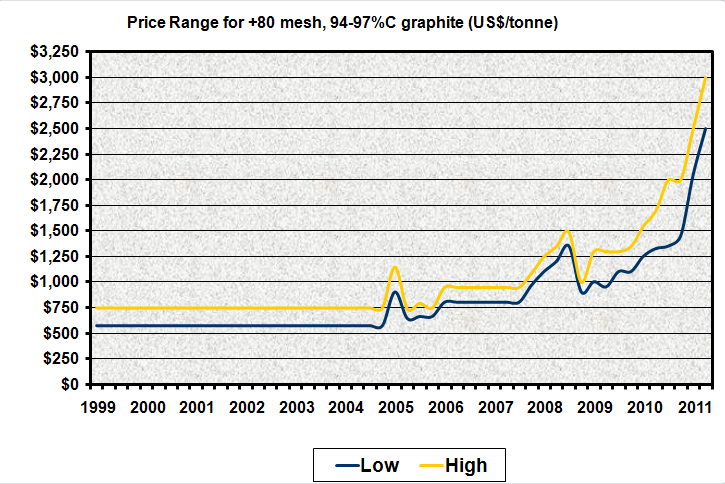
-The price for flake graphite is $ 2000-$3000 per tonne depending on flake size and grade.

-Graphite prices have been increasing in recent months and over the last couple of years prices for large flake, high purity graphite (+80 mesh, 94-97%C) have more than doubled.

-Graphite prices have almost tripled since 2005 due to the ongoing industrialization of China, India and other emerging economies and resultant strong demand from traditional steel and automotive markets.

-Demand for graphite is expected to rise as electric vehicles and lithium battery technology are adopted, nuclear reactors are built in China, and if fuel cells and graphene patents become products.

-China, which produces about 70 per cent of the world’s graphite, is seeing production and export growth leveling, and export taxes and a licensing system have been instituted.

-Europe and the USA have both indicated graphite is of economic importance and has a supply risk (Critical Raw Materials for the EU, July 2010).

Graphite Facts

-Natural graphite comes in several forms: flake, amorphous and lump.

-Southwestern Quebec is host to some of the most favorable geological terrain for graphite exploration in Canada and is known to host graphite resources, including the nearby Lac Des Iles mine operated by Timcal.

-Graphite has many important new applications such as lithium-ion batteries, fuel cells, and nuclear and solar power that have the potential to create significant incremental demand growth.

-There is roughly 20-30 times more graphite by weight needed to produce a lithium-ion battery than there is lithium.

-Of the 1.2 million tonnes of graphite produced annually, approximately 40 per cent is of the most desirable flake type.

-High-growth, high-value graphite applications require large-flake and high-purity graphite which is the prime exploration and development target at the Quatre Milles Property.

Near-Term Strategy

Lomiko plans to mount an aggressive exploration campaign on the Quatre Milles Graphite Property commencing with a complete compilation of historic geologic work followed by surface mapping, prospecting and follow-up diamond drilling.

Jean-Sebastien Lavallee (OGQ #773), geologist, a Qualified Person as defined by National Instrument 43-101, has reviewed and approved the technical content of this release.

For more information, review the website at www.lomiko.com, or contact A. Paul Gill at 604-729-5312 or by email at: [email protected].

On Behalf of the Board

“A. Paul Gill”

Chief Executive Officer

We seek safe harbor. Neither TSX Venture Exchange nor its Regulation Services Provider (as that term is defined in the policies of the TSX Venture Exchange) accepts responsibility for the adequacy or accuracy of this release.

Atocha Begins Work on Montpellier Graphite Property, Quebec

Posted by AGORACOM-JC at 9:00 AM on Tuesday, March 27th, 2012

Mar 27, 2012 (ACCESSWIRE-TNW via COMTEX) — March 27, 2012 – Vancouver, British Columbia, CANADA – Atocha Resources (the Company), TSX.V – ATT reports it has engaged the services of Dany Boilard Inc. to begin work on the newly purchased 25 claim (1,475 ha) Montpellier block located in the Grenville sub-province of the Precambrian Shield in Quebec. The Grenville sub-province is considered to be highly favourable for graphite plus gold, silver, copper, nickel, PGE (platinum group element) and REE (rare earth element) mineralization.

Atocha has hired Dany Boilard Inc. to carry out detailed exploration through GIS compilation, site visits and a mass mailing to the landowners in the Montpellier property area. All property data on the MRNF E-Sigeom database will be compiled to prepare a comprehensive exploration plan for the 2012 exploration season. The location and address of the private landowners will also be determined by a mass mailing and compilation of answers to build a data base of land ownership that can be accessed for exploration, as required under articles 235 and 236 of the Quebec mining act.

The Montpellier Property is situated approximately 90km to the northwest of Montreal, Quebec in Ripon-Hartwell-Suffolk townships with good road access. Historic diamond drilling in 1965 is reported in the Ripon township portion of the property. The Suffolk township claims have reported graphite occurrences in drill core from the latter part of the 1960′s.

Shareholders and Investors are encouraged to sign on to the Company mail list in order to receive timely updates. Please visit www.atocharesources.com   or email [email protected] to add your contact details.

ABOUT ATOCHA

Atocha is a natural resources company engaged in the acquisition and exploration of mining/exploration properties, mainly for copper and precious metals. The Company has a 100% undivided interest in the McGillivray Property, located in the Kamloops Mining Division of British Columbia. The Company has an option to acquire a 100% undivided interest in the Atkinson (Detour Lake) gold project in Ontario. Atocha owns the Sol Riche and Tresor Nord/Sud REE properties in Montviel Township of Quebec, the Trove, Descouverte and Bijou gold properties in the Abitibi of Quebec and the Strike 101-114 gold claims near Dawson City, Yukon.

For further information on Atocha, please refer to www.sedar.com   .

For further information, please contact:

Marcy Kiesman, Chief Executive Officer

Telephone: 604.696.1111

Facsimile: 888.266.3983

E-mail: [email protected]

Website: www.atocharesources.com 

Forward-Looking Statement

This document may contain or refer to forward-looking information based on current expectations, including, but not limited to timing of mineral resource estimates, future exploration or project development programs and the impact on the Company of these events. Forward-looking information is subject to significant risks and uncertainties, as actual results may differ materially from forecasted results. Forward-looking information is provided as of the date hereof and we assume no responsibility to update or revise them to reflect new events or circumstances. For a detailed list of risks and uncertainties, as it relates to Atocha Resources Inc., please refer to the Company’s Prospectus filed with SEDAR.

Small-Cap CEO Lesson – Why You MUST Issue Press Releases By 8:30 AM EST

Posted by AGORACOM at 8:50 AM on Tuesday, March 27th, 2012


I first published this story in August of 2007 – but it is even more important today than ever before.

Now that AGORACOM Small Cap TV  has cracked 400,000 views, one of the things we have noticed in our morning research is that small-cap companies continue to release news just at or before the open. This might have been a smart practice back in the day when only brokers could access press releases on their screens but it makes no sense whatsoever now that the web opens up your press releases to the entire world.

Why?

Folks, we are in a social media world (and never going back) in which investor communities are becoming invaluable sources of information for small-cap investors. As a result, small-cap and micro-cap information is being analyzed and discussed by and on AGORACOM, StockTwits, Twitter, Bloggers, Commentators, Podcasters, and Vloggers everyday.  Much of this collaboration takes place well before market open as online  investors prepare for their day.  The more time you give them to discover your news, the more time you give them to share it via their preferred networks …. for free!

THE LEAST THAT YOU COULD DO

Being the most recent news just prior to market open is no longer a smart strategy.  It’s a dumb strategy.  If you want your great news syndicated around the web by these incredible reporting sources, you have to give them a chance to see your news, digest it and report on it. That can’t happen at 9:15 because professional sources such as AGORACOM TV have a cut-off of 8:45 AM so that we can be published by 9:45.  Individual investors also have the reality of a job that most begin by no later than 9:00 AM, which explains why most are doing their research between 7:30 – 8:30.

As such, if your press release is coming out at 9:30, you’ve robbed yourself of potential mass coverage by one or more sources that might have otherwise picked up your news and sent it right around the world.

Bottom line – put your news out by no later than 8:30 AM EST.  In fact, somewhere between 8:00 and 8:30 AM EST makes the most sense …. unless shunning free coverage is actually part of your investor relations plan.

Best,
George

More Flake Graphite Needed to Keep Pace With Surging Battery Demand

Posted by AGORACOM-JC at 7:32 AM on Tuesday, March 27th, 2012

Consumer appetite for electronic gadgets such as laptops, iPhones, cell phones, and MP3 players is fueling demand for lithium-ion batteries, which contain twenty times more graphite than lithium. In addition, mankind’s quest for cleaner vehicles – such as electric cars, which also require lithium-ion batteries – is increasing demand for graphite, a metal once seen as a staple for the steel industry.

Brent Nykoliation, Vice President of Business Development at Energizer Resources Inc.  (TSX:EGZ ,OTCBB:ENZR,FWB:YE5), said that electric vehicles, which are already being developed, hold one of the biggest and most immediate potential offtakes for graphite in the coming years. China, for example, is reportedly  preparing to stock up on enough graphite to put one million vehicles a year on the road starting in 2015. At an average of 130 pounds of graphite needed per electric car battery, the net requirement per year will be 300,000 tons of graphite.

“Now multiply that by five million cars and you see the demand potential,” Nykoliation told Graphite Investing News in an interview. “And that’s just China. Morgan Stanley predicts electric vehicles and hybrid electric vehicles to have a 25 percent penetration level globally by 2025 from just 0.1 percent today. While many would think this is an overly aggressive estimate, just taking a five percent penetration of the 850 million vehicles globally today equals more than 40 million vehicles by 2025. Industry analysts agree that the big producers making graphite are concerned because they are not prepared to meet that level of demand.”

Global demand for graphite is currently about 1.2 million tons a year, and most of that comes from the steel industry. In 2008, according to GeoMega  (TSXV:GMA ), a Montreal-based exploration company, graphite demand for lithium-ion batteries was approximately 44,000 tonnes, or about ten percent of the flake market.

“Currently batteries account for roughly five percent of global graphite demand,” Chris Berry, founder of House Mountain Partners , told Graphite Investing News in an interview. “However, demand for lithium-ion batteries for use in various applications is growing by 20 percent per year. As you need 20 times more graphite in a lithium-ion battery than you do lithium, it is clear that there is potentially strong demand for large-flake, high-purity graphite in the future.”

3,000 tons of graphite to start nuclear reactor

Energizer’s Nykoliation added that there are several new applications that are entirely reliant on graphite, such as pebble-bed nuclear reactors. A one gigawatt pebble-bed nuclear reactor needs about 3,000 tons of graphite to start and up to 1,000 tons a year to operate. “A lot is happening, and these developments are going to create a huge demand for graphite.” Energizer is fast-tracking its Green Giant  project in Madagascar, with plans to mine large-flake graphite in 2014. The Toronto-headquartered company is developing what it believes is one of the largest graphite deposits in the world.

Canaccord  (TSX:CF ) estimated in a recent research report that lithium carbonate demand from lithium-ion batteries will reach 286,000 tonnes by 2020, requiring a six-fold increase  in annual flake graphite production to cater to the production of so many batteries. Northern Graphite Corp.  (TSX:NGC ) said that only flake graphite, which can be upgraded to 99.9 percent purity, can be used to make the spherical or potato-shaped graphite used in lithium-ion batteries. “The process is expensive and wastes 70% of the feedstock flake graphite. As a result, spherical graphite currently sells for $4-6,000/tonne, or twice the price of high quality flake graphite.”

Ryan Fletcher , a director at Zimtu Capital Corp. (TSXV:ZC ,OTC Pink:ZTMUF,FWB:ZCT1), a Vancouver-based firm that invests in resource companies, told Mineweb  in a recent interview that the steel industry and other historic applications of graphite use amorphous graphite, but these new emerging technologies use flake graphite. “About 40 percent of that 1.2-Mt market is flake and 60 percent amorphous, so the flake graphite market is just over 400,000 tons per year. Some of the players in the industry anticipate that just one application alone, the lithium-ion battery, could use well over 1.6 Mt of flake graphite per year by 2020, which is more than threefold the entire current market. Even if the market doubles, that’s 800,000 tons of graphite per year by 2020. A large-scale producer puts out only about 20,000 to 40,000 tons per year, which means a lot of new mines and a lot of opportunity.”

House Mountain’s Berry said “there are dozens of companies involved in the lithium-ion battery business for both technology and storage.” LG Chem  and A123 Systems (NASDAQ:AONE ,FWB:ALC) are two companies involved in producing lithium-ion batteries.

Considering the fact that a large-scale producer’s upper end of graphite production is 40,000 tons of flake graphite per year, and that there is an estimated additional demand of one million tons by 2020, about 25 new mines are needed by that time. WithChina  controlling more than 70 percent of the globe’s graphite production and calling for rare earth-style quotas on its export, there will be a premium placed on graphite mines in countries that are seen as more stable and less prone to resource nationalism.

Flinders financing set to fund restart of graphite mine in Sweden

Posted by AGORACOM-JC at 7:24 AM on Tuesday, March 27th, 2012

Graphite has been a hot commodity of late and one Canadian junior looks to have capitalized on market sentiment through a proposed C$15 million financing.

Posted:  Monday , 26 Mar 2012

HALIFAX, NS (MINEWEB) - –

After Flinders Resources (TSX-V: FDR) said it would raise C$15 million in a private placement on Monday morning, its shareprice leapt by more than a third in the first minutes of trading to as high as C$2.75.

It settled down soon thereafter, but was still well up by 19 percent to C$2.24 as of presstime late in the trading day. Share volume was strong over 1.5 million.

The private placement Flinders outlined was set at C$1.70 a unit with each unit comprising a share and a half-share purchase warrant @ C$2.20.

That Flinders shareprice revved well above the private placement purchase price suggested the appetite to get into Flinders stock and by extension its flagship graphite project in Sweden was hearty.

Graphite has recently caught a fair amount of attention. There were a noticeable number of graphite stories on display at the recent Prospectors and Development Association convention in Toronto, suggesting juniors are increasingly attuned to it as an investment story.

The reason for the buzz is a simple matter of price. Higher quality graphite especially, used in products as batteries and solar panels, has more than doubled in price in the past couple years.

Flinders’ chief selling point is that it owns a permitted past-producing graphite mine in Sweden, called the Kringel mine, which it could have up and running within two years, it has said. There it lists historic resources of 6.9 million tonnes @ 8.8 percent carbon.

“Importantly, with Kringel at such an advanced stage of development, the cost of re-starting operations will be relatively modest and this $15 million financing is expected to deliver to Flinders most if not all of its restart budget requirements,” said Martin McFarlane, Flinders president and CEO in a prepared statement.

The graphite deposits, Flinders has said, are enough to keep it going for over 30 years. The mine went out of production because of lacklustre graphite prices in the early 2000s.

Since then it has been on pause with infrastructure including tailings and milling facilities still in place.

One area the company looks keen to capitalize on is the battery market that requires high purity graphite – with 99.5 percent or more carbon. This high purity graphite fetches a premium price.

Flinders has said that it will conduct feasibility tests in a pilot plant to see if its worth upgrading its graphite products to near full carbon purity. Historically past operators produced graphite that was 85 to 94 percent carbon at the Kringel mine, Flinders said.

AGORACOM Interview: Bob Moriarty Says Graphite Is For Real & Gold Juniors Poised For 500% Gains

Posted by AGORACOM at 2:56 PM on Monday, March 26th, 2012

I’m very pleased to announce the completion of an interview with Bob Moriarty, one of the junior resource industry’s most respected commentators whose market thoughts can be found at 321gold.com and 321energy.com.   More than just a market commentator, I look forward to reading Bob Moriarty’s comments because he simply isn’t one to sit on the fence and hedge his words.  He makes a call and says it like it is.

This rare trait most likely stems from the fact that Bob was trained to make split-second life or death situations as a young man.  Specifically, Moriarty was a Marine F-4B pilot at the age of twenty and a veteran of over 820 missions in Vietnam. Becoming a Captain in the Marines at 22, he was one of the most highly decorated pilots in the war. He went on to ferry General Aviation aircraft all over the world for 15 years with over 240 over the water deliveries. He holds 14 International Aviation records including Lindbergh’s record for time between New York to Paris in two different categories.

As such, when someone like Bob Moriarty speaks, it behooves all of us to listen.  So what did we talk about today?

1. Why the explosion of interest, investment and growth in new graphite mine development? Is it for real?

2. Why graphite is an analog of oil.

3. Why the present ratio of the XAU (Philly Gold and Silver Index) over gold almost guarantees a 500% return on gold shares over the next two years.

4. Why the banking system is going to collapse / The implications of $708 trillion dollars in derivatives.

5. Middle East tension

This was a great interview.  One of the best we’ve had with a major market commentator, which have included the likes of  Eric Sprott, JF Tardif, Barry Ritholtz , Paul Kedrosky and Eric Coffin.  What made it one of our better ones? Though I agree with much that Bob had to say, I challenged him by playing Devil’s Advocate and arguing the case as presented by Wall Street and the mass media.  Though Bob didn’t budge and argued his case even harder, he was kind of enough to tell me how pleased he was with the interview.

The ultimate judge will be you, so listen in on the first few minutes and see if it carries you through to the fireworks at the end.

On behalf of myself and the entire listening audience, I want to thank Bob for taking time out of his Sunday to speak with us.

Regards,

George

This Blog Post Sponsored By                     Â