Posted by AGORACOM
at 2:39 PM on Wednesday, January 8th, 2020
Sponsor: Affinity Metals (TSX-V: AFF) a Canadian mineral exploration
company building a strong portfolio of mineral projects in North
America. The Corporation’s flagship property is the Drill ready Regal
Property near Revelstoke, BC. Recent sampling encountered bonanza grade
silver, zinc, and lead with many samples reaching assay over-limits.
Further assaying of over-limits has been initiated, results will be
reported once received. Click Here for More Info
Excerpts from Crescat Capitals November Newsletter:
Precious Metals
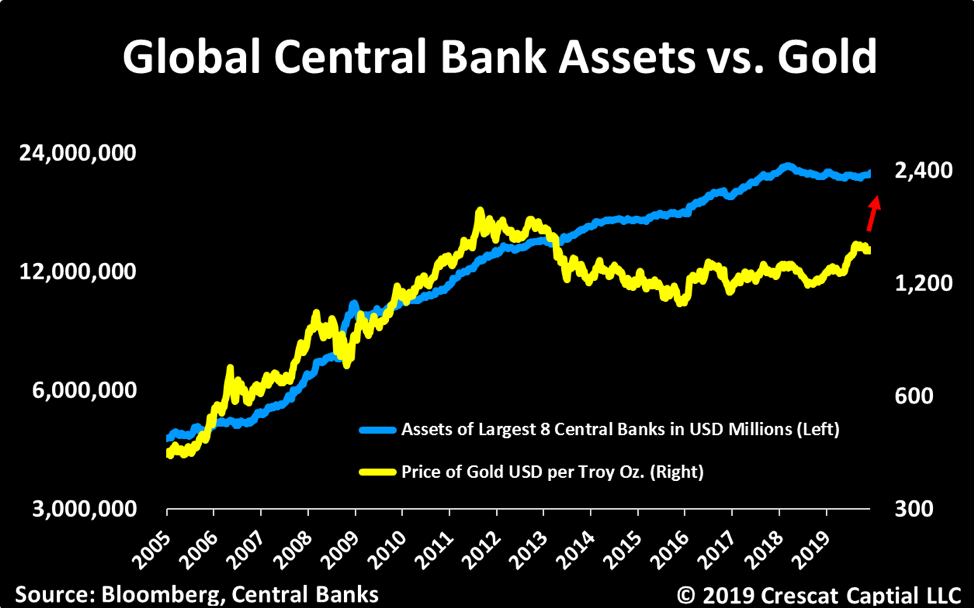
Precious metals are poised to benefit from what we consider to be the best macro set up we’ve seen in our careers. The stars are all aligning. We believe strongly that this time monetary policy will come at a cost. Look in the chart below at how the new wave of global money printing just initiated by the Fed in response to the Treasury market funding crisis is highly likely to pull depressed gold prices up with it.
The gold and silver mining industry endured a severe bear market from 2011 to 2015 and have formed a strong base over the last four years.
The imbalance between historically depressed commodity prices
relative to record overvalued US stocks remains at the core of our macro
views. On the long side, we believe strongly commodities offer
tremendous upside potential on many fronts. Precious metals remain our
favorite. We view gold as the ultimate haven asset to likely outperform
in an environment of either a downturn in the business cycle, rising
global currency wars, implosion of fiat currencies backed by record
indebted government, or even a full-blown inflationary set up. These
scenarios are all possible. Our base case is that governments and
central banks will keep their pedals to the metal to attempt to fend off
credit implosion or to mop up after one has already occurred until
inflation becomes a persistent problem.
The gold and silver mining industry is precisely where we see one of
the greatest ways to express this investment thesis. These stocks have
been in a severe bear market from 2011 to 2015 and have been formed a
strong base over the last four years. They are offer and incredibly
attractive deep-value opportunity and appear to be just starting to
break out this year. We have done a deep dive in this sector and met
with over 40 different management teams this year. Combining that work
with our proprietary equity models, we are finding some of the greatest
free-cash-flow growth and value opportunities in the market today
unrivaled by any other industry. We have also found undervalued
high-quality exploration assets that will make excellent buyout
candidates.
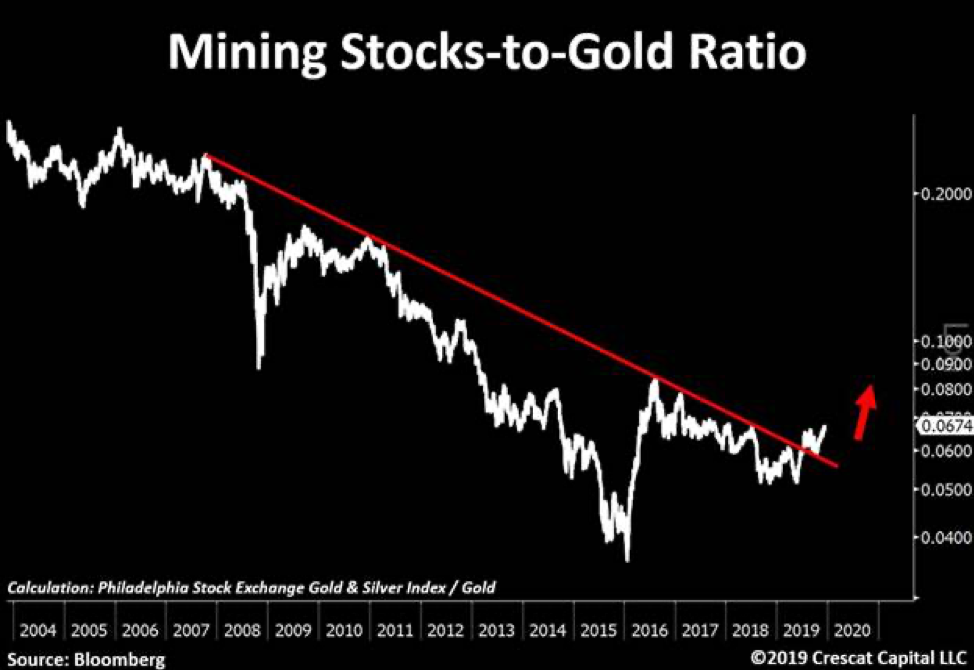
We recently point out this 12-year breakout in mining stocks relative
to gold now looks as solid as a rock. In our view, this is just the
beginning of a major bull market for this entire industry. We encourage
investors to consider our new Crescat Precious Metals SMA strategy which
is performing extremely well this year.
“This is just the beginning of a major bull market for this entire industry”
Zero Discounting for Inflation Risk Today
With historic Federal debt relative to GDP and large deficits into
the future as far as the eye can see, if the global financial markets
cannot absorb the increase in Treasury debt, the Fed will be forced to
monetize it even more. The problem is that the Fed’s panic money
printing at this point in the economic cycle may hasten the unwinding of
the imbalances it is so desperate to maintain because it has perversely
fed the last-gasp melt up of speculation in already record over-valued
and extended equity and corporate credit markets. It is reminiscent of
when the Fed injected emergency cash into the repo market at the peak of
the tech bubble at the end of 1999 to fend off a potential Y2K computer
glitch that led to that market and business cycle top. After 40
years of declining inflation expectations in the US, there is a major
disconnect today between portfolio positioning, valuation, and economic
reality. Too much of the investment world is long the “risk parityâ€
trade to one degree or another, long stocks paired with leveraged long
bonds, a strategy that has back-tested great over the last 40 years, but
one that would be a disaster in a secular rising inflation environment.
With historic Federal debt relative to GDP and large deficits into
the future as far as the eye can see, rising long-term inflation, and
the hidden tax thereon, is the default, bi-partisan plan for the US
government’s future funding regardless of who is in the White House and
Congress after the 2020 elections. The market could start discounting
this sooner rather than later. The Fed’s excessive money printing
may only reinforce the unraveling of financial asset imbalances today as
it leads to rising inflation expectations and thereby a sell-off in
today’s highly over-valued long duration assets including Treasury bonds
and US equities, particularly insanely overvalued growth stocks. We
believe we are in the vicinity of a major US stock market and business
cycle peak.
Source:”Running Hot”
Courtesy of Crescat Capital: https://www.crescat.net/running-hot/
Posted by AGORACOM
at 11:54 AM on Monday, January 6th, 2020
SPONSOR: Labrador Gold – Two successful gold explorers lead the way in the Labrador gold rush targeting the under-explored gold potential of the province. Exploration has already outlined district scale gold on two projects, including a 40km strike length of the Florence Lake greenstone belt, one of two greenstone belts covered by the Hopedale Project. Click Here for More Info
In this update I am not going to repeat the points made in the last
fairly comprehensive update, instead we are going to focus on the
importance of the resistance level just above where the price is now,
and impact of the killing of the Iranian General and its potential
implications for the gold price.
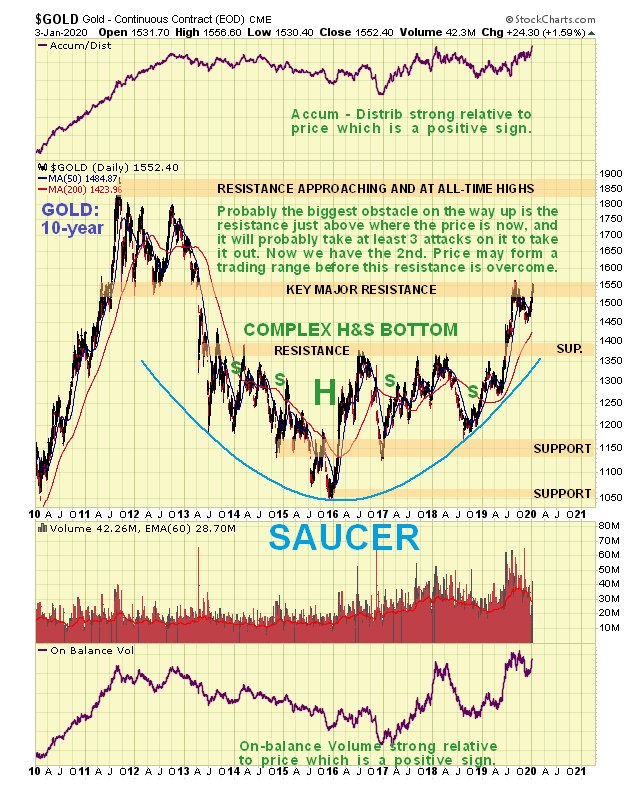
On the latest 10-year chart we can see that gold is making a 2nd
attack on the key major resistance level in the $1530 – $1560 zone,
which is hardly surprising considering what happened last week.
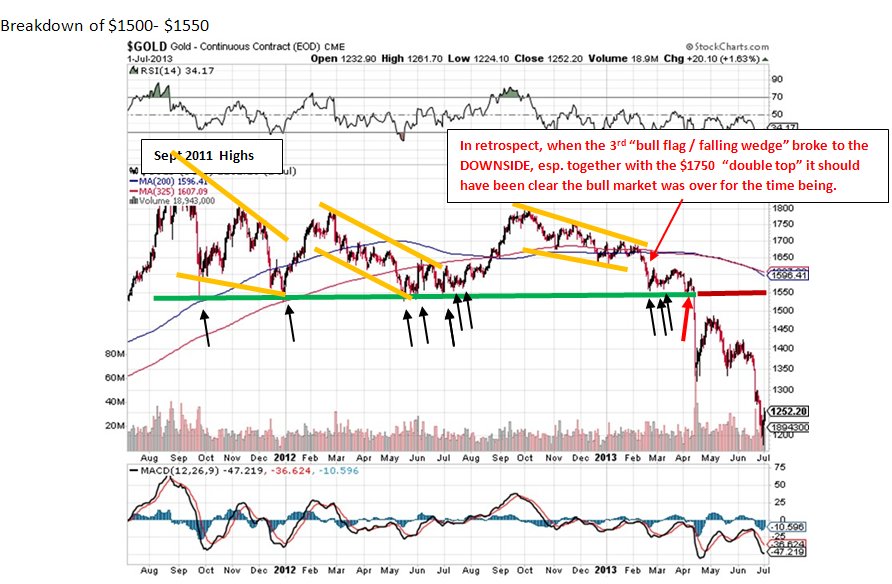
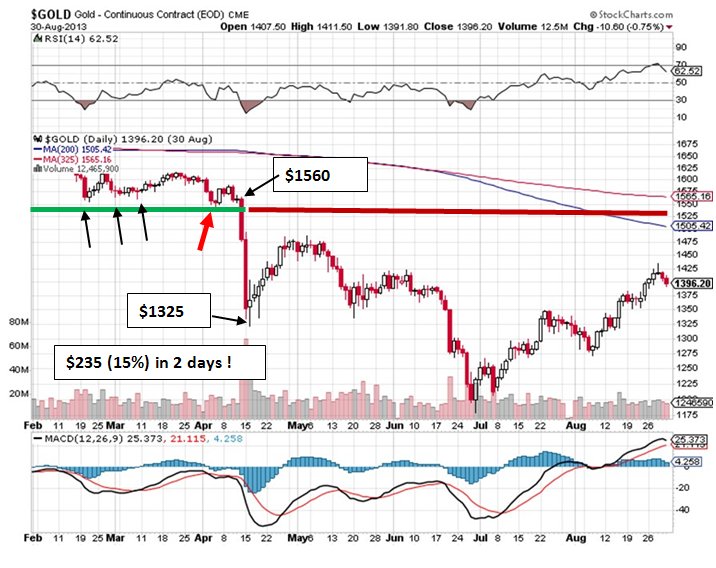
The reason that this resistance level is of such major
importance is made abundantly clear by the following chart made by a
subscriber and kindly forwarded to me, which I reproduce with his
permission. As we can see gold made no less than 5 significant lows at
this level between 2011 and 2013, before it finally crashed this support
and plunged 15% in 2 days, so it is clearly of huge significance and is
the biggest hurdle by far on the way up. Therefore, even given the
latest mayhem in the Mid-East, we should not be surprised if it now
stalls out here and possibly backs off for a while to form a trading
range, which is also made likely by its now being critically overbought
on its RSI indicator and by the latest COTs, which we will look at lower
down the page, coming in with really extreme readings again. This makes
sense given that we now at a time of maximum tension.
From a subscriber – highlighting gold’s key support at the $1530 – $1560 level, which is now of course strong resistance…
Detail showing the plunge that was triggered the failure of this support…
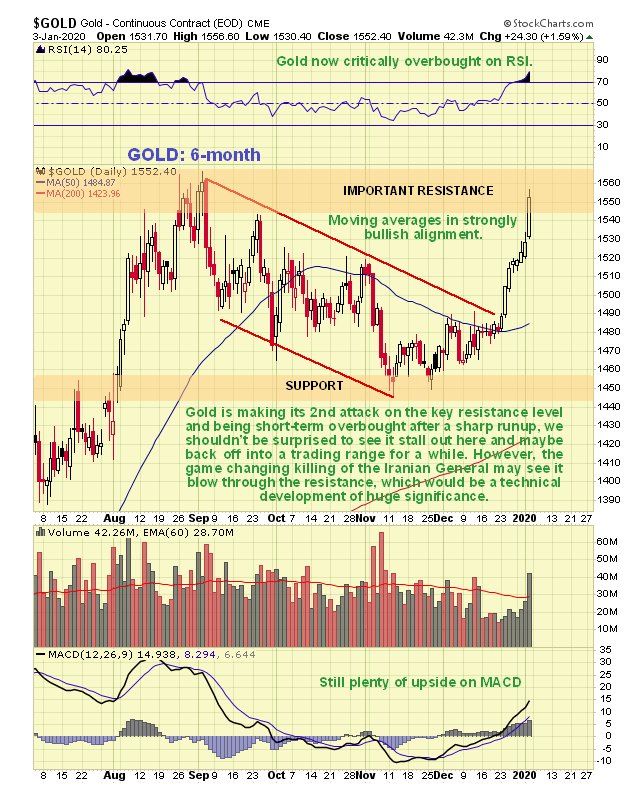
On the 6-month chart we can see how, after breaking out of the
corrective downtrend in force from early September, gold has risen
steeply, without one down day so far to become critically
overbought on its RSI indicator as it drives into the zone of strong
resistance with volume becoming heavy on Friday. This of course
increases the chances of its reacting back the moment tension over the
Mid-East situation eases, even if only slightly.
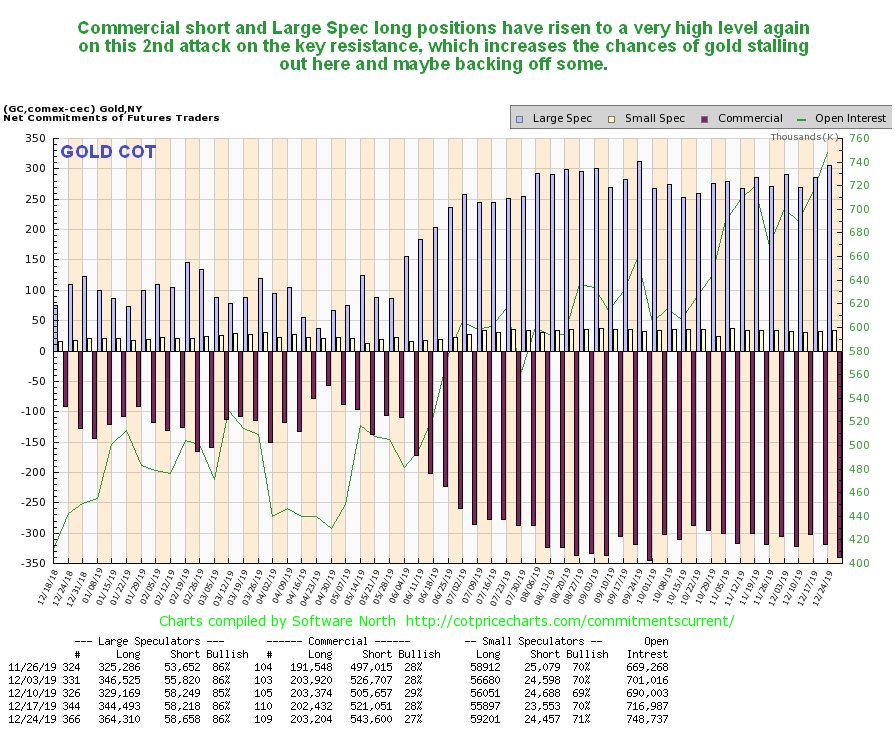
As for the COTs, they are showing extreme readings once more
(chart is for 24th December), which suggest that, especially if tension
over the Iran situation eases short-term, gold will probably back off
some into a consolidation pattern that will enable it to charge up
sufficiently to take out the key resistance in due course.
Click on chart to popup a larger, clearer version.
Now we come to the possible impact of the US killing of the top
Iranian General. In order to figure out the real motivation for this
act, we simply have to ask the usual question “Who stands to gain?†The
first interest group that stands to gain is the US military, which
receives about $700 billion of taxpayers’ money every year, and probably
about $500 billion of this is in excess of what it needs to defend the
Homeland. So in order to justify this bloated budget it creates enemies
and conflicts around the world. The next interest group is Israel, which
controls the US and uses the US military as a sledgehammer to achieve
its objectives which include dominance of the Mid-East. Iran is the big
prize. Finally the Republicans and Trump himself stand to gain at the
polls later this year as the population will predictably “rally round
the flag†as a result of conflict with Iran. Knowing all this, we can
quickly deduce that the killing of the Iranian General was an act of
extreme provocation designed to trigger some kind of counter attack by
Iran that can then be used as an excuse to launch a bombing campaign
against it. Even if Iran exercises maximum restraint and does nothing
beyond making empty threats to assuage its angry populace, it may still
fall victim to an onslaught after a calculated false flag attack which
is blamed on it. So whatever it does, it loses – it’s been put in a
classic “zugzwang†situation.
For all the bluster, Iran’s military is no match for that of the US
of course, which spends more than the rest of the world put together on
arms. The best way for Iran and Islam in general to “get even†with the
West for all its many decades of Colonial interference in the Mid-East,
exploitation and massive destruction inflicted on places like Iraq and
Libya and the Palestinians therefore (looked at from their point of
view) is to conduct “asymmetrical warfareâ€, invade Western countries and
attack their churches
and institutions etc, and then take them over gradually by outbreeding
them. Western societies are now too corrupt, decadent, morally bankrupt
and weak to stop this happening, and it is happening right now in
Europe, and the only reason it isn’t happening to the same extent in the
US is that it is a lot harder to pilot a rubber dingy across the
Atlantic Ocean than the Mediterranean Sea, although as we know the
Democrats and the Left appear to trying to take up the slack by
destroying the country from within in places like Portland, L.A. and San
Francisco, and this rot will spread unless right minded people take a
vigorous stand.
All this is mentioned because it is clear that the killing of the
Iranian General is the prelude to a military strike against Iran, which
will probably take the form of an extensive and intensive bombing
campaign that both Israel and the US have been looking forward to for
years, because a ground invasion is out of the question due to the
geography and logistics. The goal as usual will be to destroy its
military capability and wreck its infrastructure with the eventual aim
of installing a puppet government and opening up the country to Western
exploitation, and the wild card in all this will be whether Russia and
China will do anything to prevent it, or just stand and watch. It is
thought that they don’t have the nerve to intervene. In any event, if
such a campaign is launched, we can expect the world to be gripped by an
acute sense of crisis and gold will spike. Iran may have the ability to
disrupt the flow of oil out of the Persian Gulf, albeit temporarily,
which would trigger an oil price spike and a stockmarket crash.
Last week’s updates concluded with a look at the highly bullish
charts for gold measured against the Australian dollar and the Japanese
Yen, and this week we will look at gold against the Canadian dollar and
the Swiss Franc.
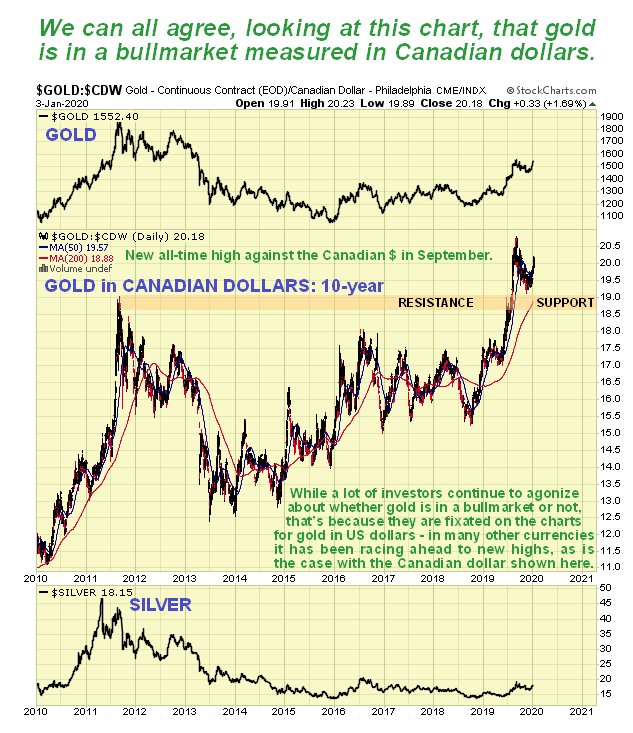
While many investors are still agonizing about whether gold is in a
bullmarket or not, that is because they are fixated on the charts for
gold in US dollars. When you look at gold in other currencies you
realize that it is already very much in a bullmarket, and recently made
new highs against many currencies, like the Canadian dollar shown below…
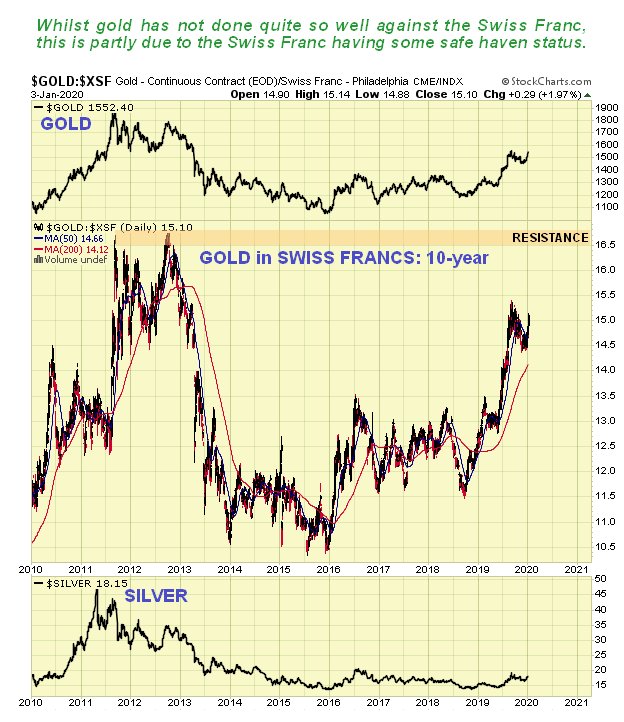
Even against the Swiss Franc, which amongst currencies enjoys
some safe haven status, gold is performing better than it is against the
dollar…
…and we should remember that the dollar may not remain as “king
of the hill†forever, especially as a number of major powers in the Asia
especially are preparing to ditch it.
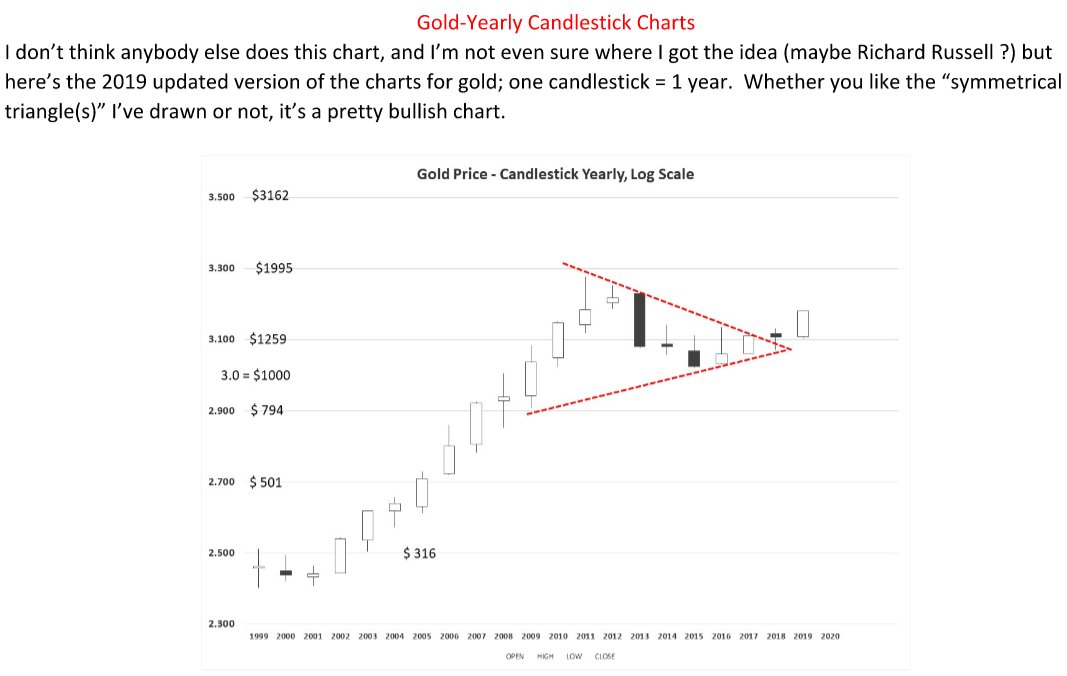
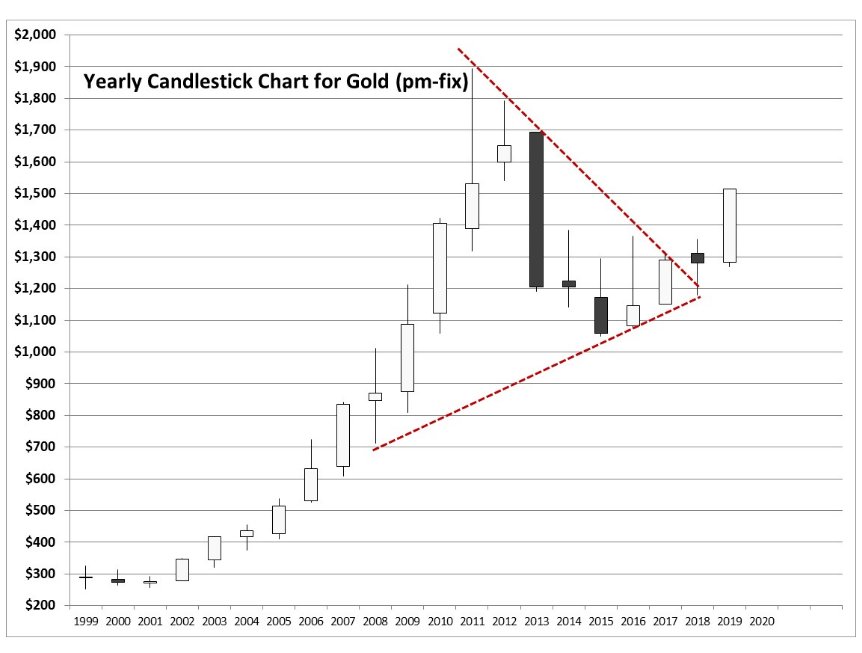
Finally, we are going to take a quick look at an unusual chart for
gold submitted by the same subscriber as some of the charts above. It is
unusual because it is a yearly candlestick chart, meaning that each
candle on it is for an entire year. Its supreme advantage is that it
keeps things simple. The Triangle shown on it is his interpretation, not
mine. It certainly looks positive here with a big white candle for
2019, with the arithmetic version shown looking even more bullish. This
type of chart also has a potential advantage for the writer, as if only
this chart were used, I would only have to write these updates once a
year.
Courtesy of Clive Maund: https://www.clivemaund.com/gmu.php?art_id=68&date=2020-01-05
Posted by AGORACOM
at 1:21 PM on Friday, January 3rd, 2020
Sponsor: Affinity Metals (TSX-V: AFF) a Canadian mineral exploration company building a strong portfolio of mineral projects in North America. The Corporation’s flagship property is the Drill ready Regal Property near Revelstoke, BC. Recent sampling encountered bonanza grade silver, zinc, and lead with many samples reaching assay over-limits. Further assaying of over-limits has been initiated, results will be reported once received. Click Here for More Info
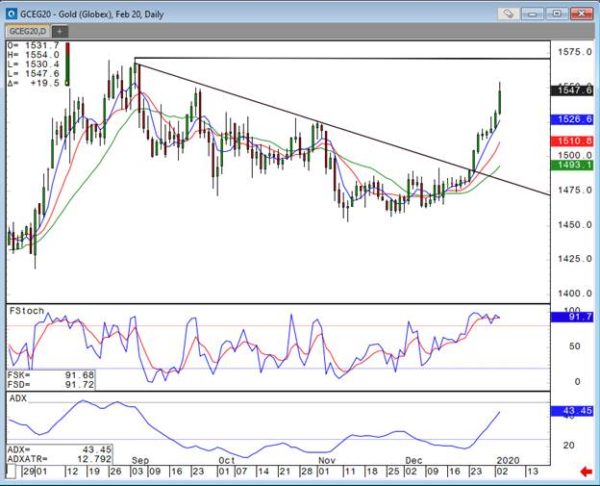
With an impressive start to the year this new heightened geopolitical development could be the catalyst to break out gold to multi year highs. The U.S. strike that killed a key Iranian general could have a ripple effect on the signing of the trade agreement on the 15th as China and Iran have recently worked together on joint military operations along with Russia. Any set back in the trade agreement would severely impact the direction of U.S. equities and the expectations for interest rate decisions globally. Price Analysis and Outlook The daily gold chart shows that momentum indicator slow stochastics are rising steadily and reaching overbought territory giving longer term indication that we have pushed into a Bull Market. While ADX, which measures strength of the trend, has turned up over 40 showing that the driving force behind the recent upward move is very strong. The 2 key levels of support to watch are the November 1st high of $1525.2 and the December 30th high of $1519.1. This should act as a consolidation level while a likely upside target completing this trend would be an objective of $1572
Posted by AGORACOM
at 3:03 PM on Wednesday, December 18th, 2019
Sprott is eager to believe junior gold miners are on the verge of striking the motherlode, but skeptical of nearly everything else related to the industry
One week before Halloween, Canada’s biggest gold enthusiast,
the septuagenarian billionaire Eric Sprott, wearing a neatly pressed tuxedo,
bounded onto a stage in a downtown Toronto ballroom and accepted his induction
into Canada’s Investment Industry Hall of Fame.
He declared himself both humbled and honoured, and then
rollicked into the wee hours of the night at his home in a nearby tower with
expansive views of the city’s sparkling skyline. The next morning, though 75
and technically retired, he showed up at his office, grumbling about a lack of
sleep, but dressed in a magenta-coloured, paisley button-up, ready for a 9 a.m.
meeting with a penny stock exploration company.
“I keep reading that people are never making (gold)
discoveries, the rate of discoveries is going down,†he said, occasionally
rubbing his temples and closing his eyes. “The funny thing, well, I guess I’m
the sucker then because I keep buying guys who say they’re making discoveries.â€
Just as the price of gold often moves in the opposite
direction of the stock market, Sprott has a strong contrarian streak that means
he also often moves in the opposite direction of the market. For example, this
past spring, after years of middling precious metal prices and declining
discoveries had led most investors to abandon Canada’s gold and silver
explorers, he decided to go all-in.
Sprott launched an investment blitz, the likes of which the
junior mining precious metals sector had seldom seen, doling out somewhere
between $200 and $300 million in a matter of just a few months to acquire large
stakes in about two dozen companies, most of which have never earned a dollar
of revenue
His investments between May and July accounted for about one
in every four dollars raised by junior miners, according to Vancouver-based
market research firm Oreninc. During that time, gold prices started to rise,
breaking through US$1,400 in June for the first time in six years, bringing
some investors back to the major miners — exactly where Sprott doesn’t want to
be.
“They’re the worst place to put money, okay?†he said.
Putting his money where his mouth is, he has been selling his position in Kirkland Lake Gold Ltd., one of, if
not the lowest-cost gold producers and one of the best-performing stocks on the
S&P/TSX Composite Index since 2016.
Sprott was an early investor in Kirkland Lake, was appointed
chairman in 2015, and one year later helped engineer its merger with Newmarket
Gold Inc., a small gold producer in Australia. Not long after, the newly merged
company discovered high-grade veins at two mines, which propelled its stock
upwards to $63 per share.
Many investors pride themselves on not selling when a stock
hits a bump, but Sprott said it is equally important to not sell when the stock
rises, at least not until it’s gone up five or even 10 times, a so-called
tenbagger.
“I’ve had lots of tenbaggers and the important thing is to
stay in it,†he said.
But when his stake in Kirkland Lake reached about $1.3
billion earlier this year, and it looked like gold prices would keep rising,
Sprott said he decided it was time to sell.
“Here’s what I say to the management of Kirkland Lake: you
will not be the No. 1 performing stock this year,†he said during an interview
in October. “You will not be, because companies like Eldorado (Gold Corp.) and
Detour (Gold Corp.) are going to kick your butt.â€
And yet, Sprott — who found out about the deal on a day he
was meeting with a junior mining company seeking investment — elected to
support the deal, and waxes enthusiastic about Detour.
It’s one of the reasons why Sprott doesn’t much care about Canada’s major gold miners.
The
best-run companies might provide 20- or 30-per-cent returns, or maybe
100 per cent in a few cases, but Sprott would rather invest in a company
that might strike gold and give him a 500-per-cent return, or even a
coveted 1,000-per-cent return.
In
July, Sprott had bought about 10 million shares at $3.10, meaning he
made about $25 million or a 75-per-cent return in just a few months. But
he was nonplussed, saying the buyout may have come a little early.
“You’ve got to have the dream, right?†he said. “You’ve got to have the dream you’re going to find something.â€
Therein
lies Sprott’s biggest paradox: he’s eager to believe that junior gold
miners are on the verge of striking the motherlode, but skeptical of
nearly everything else related to the gold industry.
You’ve got to have the dream, right? You’ve got to have the dream you’re going to find somethingEric Sprott
After a five-decade career in the financial
services industry, during which he worked as an investment banker and
founded an eponymous empire that includes fund and asset management
firms, a brokerage firm, bullion storage and more businesses, he is
skeptical of commercial banks, major precious metals miners, central
banks, the stated rate of annual inflation and, perhaps above all, gold
and silver prices.
“One of the things about the media, they never
talk about the gold conspiracy,†he said. “Look at the guys who are
paying fines for spoofing the precious metals markets. Every two weeks
some guy’s paying a fine.â€
Case in point, U.S. prosecutors in
September filed criminal charges against three JPMorgan Chase & Co.
bankers for allegedly spoofing the precious metals market, which means
placing fake orders and then quickly cancelling them to manipulate the
price. The indictment alleged a decade-long conspiracy.
Sprott
believes the futures market — where investors can buy options that
essentially allow them to place bets on the price of gold or silver
without actually having to own any of the metals — allows commercial
banks to exert way too much influence on the market for physical metals.
Stacked gold bars in Germany.
Michaela Handrek-Rehle/Bloomberg files
As someone who stockpiles bullion, and often gives it out as
a gift, he watches the prices of silver and gold so closely it often
colours his mood.
This fall, Sprott was out fishing for grouper on
a staffed boat somewhere warm on a Friday when he normally records his
podcast. In spite of his idyllic circumstances, he sounded distinctly
downtrodden when he called in to the podcast.
“I’ve had better days, you know, it’s a bit of a tough one,†he said.
As
the podcast progressed, it soon became clear that gold and silver
prices were both down, about four and six per cent, respectively, and
options market manipulation appeared to be the reason to him.
Juan
Carlos Artega, director of investment research at the World Gold
Council, is skeptical that banks are having a significant effect on gold
or silver prices through the futures market, but believes options do
have an impact on short-term prices.
As
someone who stockpiles bullion, and often gives it out as a gift, he
watches the prices of silver and gold so closely it often colours his
mood
“What you find is that the gold price is
responding to demand-and-supply dynamics including those on the
(options) market, but it’s only one component,†he said.
Artega
said central bank and consumer buying, production numbers, recycling,
investment in gold-backed exchange-traded funds and a host of other
factors play a role in determining long-term prices.
Sprott would
hear none of it, and said he’s long disagreed with the World Gold
Council about many things. His skepticism of the futures market ties in
to his skepticism of the financial market writ large.
“We have a weird financial system; it doesn’t make any sense to a rational thinker,†he said.
Gene
McBurney, co-founder of GMP Securities LP, once a competitor of Sprott
Inc. in the investment business and now a friend, said part of the key
to understanding Sprott is that he enjoys entertaining other people with
provocative comments.
Fine gold coins at a bullion dealer in London.
Chris Ratcliffe/Bloomberg files
“He’s told people there’s no gold in Fort Knox; that kicks off an interesting conversation,†he said.
But
McBurney added that he believes Sprott is extremely well versed in the
companies in which he invests, and he has even given some of his
personal money to Sprott to manage.
Peter Grosskopf, chief
executive of Sprott Inc., the asset management firm Sprott founded and a
mentee, said Sprott is always covered as being this “unbelievable gold
bug,†but there’s a lot more to it than that.
“I mean, he’s a savant at what he does,†said Grosskopf, who added that it’s not easy to explain how Sprott does what he does.
That’s
mainly because Sprott is investing in companies that have no revenue,
which means standard investment metrics, such as internal rate of
return, aren’t necessarily useful, never mind that he said they’re not
something he would use.
He’s a savant at what he doesPeter Grosskopf, chief executive of Sprott Inc.
Instead, he attempts to value companies based on whether they are likely to discover a deposit of precious metals.
Of
course, even if a company discovers a deposit, it would still need to
figure out whether it makes economic sense to extract the deposit,
including how much it would cost to build and operate a mine, which
requires further calculations about energy costs, transportation,
processing and refining, and so on.
Sprott said he focuses solely
on the deposit and how big it could be. Though he has no education in
geology, he said he has devised his own valuation method, which involves
looking at a few variables to determine the potential size of a
deposit.
“I want to turn it into numbers, like, okay, what could
this thing earn?†he said. “You know, you multiply the strike by the
depth by the width by 2.7 specific gravity times the ounces — it’s just
four or five things you’ve got to multiply, five things.â€
People
close to him said he studies junior mining companies and can recall the
details of his investments better than most fund managers.
“The
guy gets up at ungodly hours, he might get up at 2 a.m. studying,†said
Conor O’Brien, a former capital markets manager who joined Sprott in May
to help with the investment blitz. “Neither one of us are geologists,
we’re just financial people that can do mathematics, as opposed to the
geology. We more kind of conceptualize, and dream and kind of multiply.â€
Putting
his latest investment spree of more than $200 million in perspective,
the TSX Venture Exchange’s junior mining sector through August was on
course to raise $2 billion for all of 2019, about 27 per cent less than
it did in 2009.
Sprott takes a birdshot approach to investment
that spreads his money far and wide, so that his portfolio contains
companies exploring for high-grade and low-grade mines, potential
open-pit and potential underground mines, and so on.
“Most of them won’t make it,†he said. “But what about the ones that do? If I’m in early and I stay the ground, I press the bet. It’s like being at a table with a winning run, you keep doubling down.â€
Grosskopf said Sprott calls it “stealing value,†not because he’s
conning anyone, but because he’s investing in assets the market has
mispriced. He said the billionaire is an expert trader, adept at sizing
up an opportunity and timing his entrance and exit.
And because of
his outsized profile, recently juiced by his epic returns while
chairman of Kirkland Lake, there are hordes of investors who will follow
his lead, Grosskopf said.
Not all of Sprott’s bets work out, of course. In 2017, Sprott said he invested in Garibaldi Resources Corp., a nickel explorer, based on comments he read on an online chat board.
Its
stock surged 1,731 per cent that year, and Sprott has continued to
invest even though two years later, its stock has declined from a peak
above $4 in late 2017 to 87 cents today.
“They’re for sure
drilling, we know that, and they’ve announced some holes, and they’ve
got more to go,†Sprott said. “They haven’t found the motherlode they’re
looking for. Even I’ll say that.â€
Sprott’s vast ownership may
also have a downside: It’s not easy to liquidate his positions in
companies without attracting attention. But his vast wealth also means
he’s relatively insulated from a lot of threats, such as dilutive
financings or litigation, that smaller investors can’t afford to
participate in.
He also owns a private gold mining company in
Nevada called Jerritt Canyon Gold LLC, which he said made its first
profit in the third quarter.
Kevin Small, vice-president of
operations at that mine, said Sprott likes to be generous. In April, he
said Sprott showed up at the site and handed out silver coins to several
hundred people who work there.
“He said when you guys make lots of money, I’ll give you each a gold coin, but he hasn’t been back yet,†Small said.
Eric Sprott at his induction into Canada’s Investment Industry Hall of Fame in October.
Peter J. Thompson/National Post
But he added that Sprott has been investing heavily in the
operation, which has a capacity to produce 280,000 ounces of gold per
year, and predicted the company would soon be well known.
Colleagues
also add that he can be unrelenting when judging a company’s financial
performance. Case in point, one of his biggest gripes with Kirkland Lake
is that he wants it to increase its dividend, an issue he once again
raised in October after the miner posted solid quarterly results.
Kirkland
Lake pays a quarterly dividend of four cents, and chief executive Tony
Makuch said he may consider raising it, but the company still needs to
spend money on exploration so it can improve its reserves of gold.
“We’re
not an industry people should be buying for dividends,†Makuch said.
“You should be buying bank stocks or something else. If you look at our
share price, that comes from investing in new projects.â€
It’s a sentiment that Sprott would likely agree with.
“I still have a lot of money in Kirkland and it’s a great company, but it’s not a tenbagger from here,†he said. “And I like tenbaggers as opposed to 100 per cent. It’s just my nature.â€
Posted by AGORACOM
at 11:45 AM on Wednesday, December 18th, 2019
Sponsor: Affinity Metals (TSX-V: AFF) a Canadian mineral exploration company building a strong portfolio of mineral projects in North America. The Corporation’s flagship property is the Drill ready Regal Property near Revelstoke, BC. Recent sampling encountered bonanza grade silver, zinc, and lead with many samples reaching assay over-limits. Further assaying of over-limits has been initiated, results will be reported once received. Click Here for More Info
Central bankers have been voracious buyers of gold during the last two years, and analysts look for that trend to continue in 2020.
Through the end of October, net official-sector purchases this year
totaled 562 metric tons, reported Alistair Hewitt, director of market
intelligence with the World Gold Council. That 56.2-tons-a-month average
puts sales on pace to roughly match the 656 tons bought in 2018, which
were the most central-bank purchases since 1967, according to WGC data.
“This year has been exceptionally strong. We think that next year,
net buying will continue at a high level, even if it’s not as high as
this year,†said Philip Newman, director of the London-based consultancy
Metals Focus.
Goldman Sachs looks for global central banks to collectively acquire
around 650 tons in 2020, while Standard Chartered is projecting
central-bank purchases will total 525 tons.
“It’s still elevated,†said Suki Cooper, precious-metals analyst with
Standard Chartered. “That is still firmly on the buy side.â€
‘Safe, liquid and generates returns’
Hewitt commented that central banks are looking at three main
criteria when deciding to expand the amount of gold they hold within
their foreign-exchange reserves.
“For a central bank, gold is a fantastic asset because it’s safe, liquid and generates returns over the long term,†Hewitt said.
He also listed two more factors why the central-bank buying has suddenly jumped in recent years.
“One issue is we are seeing heightened geopolitical tensions,†Hewitt
said, with these involving major gold-buying countries and economies.
“Central banks are looking toward gold to balance some of that risk.
“We’ve also got negative rates and yields for a large number of sovereign bonds.â€
Newman added that many central banks are “trying to get away†from
the U.S. dollar. This is especially the case with Russia due to U.S.
sanctions, he added.
As recently as 2017, most of the official-sector buying came from a
handful of central banks, including Russia, Turkey and Kazakhstan. But
in 2018 and 2019, there have been a slew, including some that had not
been in the market for years.
“You’ve got a whole range of buyers,†Newman said.
The largest buyers during the first 10 months of the year were Turkey
with 144.8 tons; Russia, 139; Poland, 100; and China, 95.8.
Others include Kazakhstan, 26.9 tons; India, 17.7; Qatar, 11; Ecuador, 10.6; Serbia and the U.K., 9.9; Argentina, 7; Colombia, 6.1; Kyrgyz Republic, 3.2; Mongolia, 2.3; Belarus, 1.9; Guinea, 0.9; Egypt and Mauritania, 0.7; Albania and Malta, 0.6; and Ukraine and Greece, 0.3.
Goldman Sachs projected that central-bank purchases could amount to as much as 22% of global supplies during 2019.
Central banks ‘buy for an extended period’
Hewitt looks for official-sector buying momentum to continue.
Central banks tend to put a lot of thought into decisions to buy –
with a long, rigorous policy-making process — and purchase the metal
for strategic reasons, rather than simply reacting to day-to-day moves
in the price, Hewitt said.
“Once these people start buying, they continue to buy for an extended
period of time,†Hewitt said. For instance, he pointed out that
Kazakhstan has been a regular gold buyer since 2010.
“Both trade tensions and negative yields are still here,†Hewitt
said. “They may rear their ugly heads again and become more pronounced,
or they may fade away and become less pronounced. But those underlying
forces will remain ever present in the market. Certainly in the next
year or so, those two factors should continue to support and underpin
central-bank demand for gold.â€
Observers pointed out that not only have central-bank gold purchases
been strong, but sales have been light. Back in 1999, when European
central banks were selling the metal, they began following central-bank
sales agreements to try to limit how much was sold in any one year and
thereby keep this from being a destabilizing force in the gold market.
These agreements have been discontinued, Hewitt noted. Commerzbank
analysts pointed out they were no longer necessary since hardly any
European central banks are selling anyway. Germany’s central bank sells a
modest amount each year only for its coin-minting program, Hewitt said.
“The market was not bothered by the central-bank gold agreement
coming to an end, partly because the gold market is very different from
what it was in 1999,†Hewitt said, adding that there “dramatic sellingâ€
back then.
“The gold market today is just more diverse, more resilient and more
liquid. That’s why the market just shrugged its shoulder when the
central-bank gold agreement came to an end.â€
Further, analysts at Commerzbank, in their 2020 outlook, commented
that one or more Western European central banks might even enter the
market as a gold buyer.
“One possible candidate is the Dutch central bank (DNB), which in
October published a remarkable statement about the role of gold on its
website,†Commerzbank said. “In it, it described gold as an anchor of
trust for the financial system. According to the DNB, gold reserves
could serve as the basis for a new beginning in the event of a system
collapse.
“If one or more Western central banks indeed started to actively buy
gold, this would attract considerable attention and spark market
reactions.â€
Posted by AGORACOM
at 4:19 PM on Thursday, December 12th, 2019
SPONSOR: Labrador Gold – Two successful gold explorers lead the way in the Labrador gold rush targeting the under-explored gold potential of the province. Exploration has already outlined district scale gold on two projects, including a 40km strike length of the Florence Lake greenstone belt, one of two greenstone belts covered by the Hopedale Project. Click Here for More Info
Completed gold acquisitions have reached about $33 billion so far in 2019, the highest since 2011
A torrent of deal-making among gold producers that’s pushed M&A in the sector to an eight-year high is seen spilling over into the wider mining industry — if there’s a rally in global growth.
Pending and completed gold acquisitions have reached about
$33 billion so far in 2019, the highest since 2011, according to data complied
by Bloomberg. That’s as deals among all mining companies have declined about
29% from last year to $60-billion, the data show.
A revival in the economic outlook, with higher interest
rates and inflation, would prompt other metals producers to rethink their
current strategy of cutting debt and lifting shareholder returns — and focus
again on pursuing growth, according to Christopher LaFemina, a New
York-based analyst at Jefferies.
“Until now, the market has rewarded companies for austerityâ€
amid a chase for yield, LaFemina said in a phone interview. “We will see a
significant acceleration of M&A activity when global growth recovers.â€
In recent times, the biggest miners, including Rio Tinto and
BHP, have made only some small investments in undeveloped projects and
authorized new spending on expansions at existing operations.
Larger-scale M&A could be an option for Rio next year,
UBS Group analysts, including Glyn Lawcock, said in a report this month.
“Will 2020 see the shackles come off? Growth in the portfolio is limited,†they
said.
Rio has a “watching brief for attractive M&A
opportunities,†though intends to remain “absolutely disciplined,†CEO Jean-Sebastien
Jacques told investors at an October seminar. The company has said its
ventures team is evaluating opportunities in battery materials, including in
nickel. There would be “plenty of logic†for Rio in adding copper producer
First Quantum Minerals, according to Barclays.
BHP is also seeking to add oil, copper and nickel, and could
consider deals that offer an early entry into high-quality resource bases,
particularly before the value of a project is fully understood, CFO Peter
Beaven said in May.
Still, large companies and their investors continue to be
chastened by past failed deals, according to Paul Mitchell, EY’s global mining
and metals leader, and they remain cautious after a multi-year effort to repair
balance sheets in the wake of the 2015 price collapse.
Sectors such as base metals have fewer opportunities for
consolidation than precious metals, and a price downturn hasn’t yet forced
companies into distress, according to David Harquail, chief executive officer
at Franco-Nevada Corp., a mine streaming and royalty company.
Since January’s $10-billion gold mega-merger between then
Newmont Mining and Goldcorp, companies in the sector including Newcrest Mining
have added individual mines, while Kirkland Lake Gold and Zijin Mining Group
acquired smaller rivals. Barrick Gold and a partner on Tuesday agreed to a $430
million deal to sell a 90% stake in a project in Senegal to with Teranga Gold.
Gold’s rally means there’s been “a slightly improved
environment to be able to finally do transactions,†Harquail said. There’s a
prospect of further activity among gold producers into next year, with
investors ready to back proposals that reduce overheads and combine assets, he
said.
“I want to see smart consolidation, not the same thing that
we’ve seen in the past†among gold producers, said Joe Foster, a New York-based
portfolio manager at Van Eck. “There’s value to be created by consolidating
some of these single-asset companies.â€
Posted by AGORACOM
at 3:06 PM on Thursday, December 12th, 2019
Ken Konkin Discusses the Goldstorm Deposit at Treaty Creek (including recent outstanding drill results like 0.725 g/t over 838.5m), it’s Potential, and 2020 Development Plans
American
Creek is a Canadian junior mineral exploration company with a strong
portfolio of gold and silver properties in British Columbia.
Three
of those properties are located in the prolific “Golden Triangleâ€; the
Treaty Creek and Electrum joint venture projects with Tudor Gold/Walter
Storm as well as the 100% owned past producing Dunwell Mine.
The
Treaty Creek Project is a Joint Venture with Tudor Gold owning 60% and
acting as operator. American Creek and Teuton Resources each have 20%
interests in the project. American Creek and Teuton are both fully
carried until such time as a Production Notice is issued, at which time
they are required to contribute their respective 20% share of
development costs. Until such time, Tudor is required to fund all
exploration and development costs while both American Creek and Teuton
have “free ridesâ€.
The Corporation also holds the Gold Hill, Austruck-Bonanza, Ample Goldmax, Silver Side, and Glitter King properties located in other prospective areas of the province.
For further information please contact Kelvin Burton at: Phone: 403 752-4040 or Email: [email protected]. Information relating to the Corporation is available on its website at www.americancreek.com.
Hub on Agoracom FULL DISCLOSURE: American Creek is an advertising client of AGORA Internet Relations Corp.
Posted by AGORACOM
at 3:16 PM on Tuesday, December 10th, 2019
SPONSOR: Advance Gold AAX.v – Advance Gold controls 100% interest in the Tabasquena Silver Mine in Zacatecas, Mexico. A cluster of 30 Epithermal veins have been discovered, with recent emphasis on exploring a large anomaly to drill. Advance also owns 13.5% of the Kakamega JV attached to Barrick Takeover Offer for Acacia Mining. Click Here For More Info
Opportunities
2019 is on track to be a 50-year high in central banks’ net gold
purchases. Bloomberg Intelligence reports that central banks have been
absorbing about 20 percent of global gold mine supply. Based on the
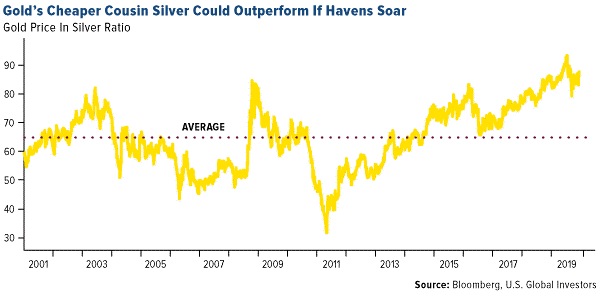
gold-to-silver ratio, it looks like silver might have more upside if
demand for safe haven assets rises. Bloomberg’s Eddie van der Walt
writes that the gold-silver ratio has dropped to 86 from 93 in July and
that means silver has outperformed on the back of gold’s gains. UBS
analyst Giovanni Staunovo is bullish on palladium and platinum. Staunovo
wrote in a December 5 report that palladium will likely enter its ninth
straight year of market deficit in 2020 and could climb above $2,000 an
ounce. Even as platinum is set to enter a surplus, its price could be
driven by gold. “As platinum is highly correlated to gold, our bullish
view for gold should mean higher platinum prices, which we expect to
trade at around $1,000 an ounce next year.â€
Zijin Mining Group Co. has agreed to buy Continental Gold in a
rare all-cash deal worth C$1.37 billion – the second big takeover in a
few weeks of a junior Canadian gold miner. Bloomberg reports the offer
reflects a 29 percent premium to the Continental Gold share price from
the past 20 days and that major shareholder Newmont Goldcorp was
supportive of the deal. In hostile M&A news, Centamin Plc rejected
Endeavour Mining Corp.’s $1.9 billion takeover offer saying that it
undervalues its assets, reports Bloomberg News. Centamin has been a
takeover candidate since the size of its Egyptian mine was discovered at
the start of the decade, though the company has faced many operational
setbacks.
Kinross Gold has been busy raising cash. Kinross announced this
week that it has agreed to sell its remaining shares of Lundin Gold for
C$150 million to Newcrest Mining and the Lundin Family Trust. Kinross
earlier announced that it has sold its royalty portfolio to Maverix
Metals for $74 million.
Threats
ABN Amro strategist Georgette Boele says they see gold weakening in the coming weeks and months with a price average of $1,400 an ounce. However, they do expect prices to increase to $1,600 by December of 2020. Before this happens, extreme net-long positioning would clear u p because “these positions currently hang over the market and prevent prices from moving substantially higher.â€
Another sign of a weakening economy was released last week. The ISM manufacturing PMI unexpectedly declined to 48.1 in November, below the median forecast of 49.2. The reading remains below the 50 level that indicates activity is shrinking.
Bloomberg’s Enda Curran writes that cheap borrowing costs have sent global debt to another record – $250 trillion of government, corporate and household debt. This level is almost three times global economic output and policymakers are now grappling with how to keep economies afloat – with more debt? According to Cornerstone Macro’s head of technical analysis Carter Worth, his S&P 500 chart signals a 5 to 8 percent decline in the coming months. Bloomberg reports that the S&P 500 fell 1.4 percent on Tuesday, pushing it below an upward trend line established in October.
Posted by AGORACOM
at 6:41 PM on Monday, December 9th, 2019
Sponsor: Affinity Metals (TSX-V: AFF) a Canadian mineral exploration company building a strong portfolio of mineral projects in North America. The Corporation’s flagship property is the Drill ready Regal Property near Revelstoke, BC. Recent sampling encountered bonanza grade silver, zinc, and lead with many samples reaching assay over-limits. Further assaying of over-limits has been initiated, results will be reported once received. Click Here for More Info
Posted by AGORACOM
at 2:21 PM on Thursday, December 5th, 2019
Ken Konkin Discusses the Goldstorm Deposit at Treaty Creek (including recent outstanding drill results like 0.725 g/t over 838.5m), it’s Potential, and 2020 Development Plans
American
Creek is a Canadian junior mineral exploration company with a strong
portfolio of gold and silver properties in British Columbia.
Three
of those properties are located in the prolific “Golden Triangleâ€; the
Treaty Creek and Electrum joint venture projects with Tudor Gold/Walter
Storm as well as the 100% owned past producing Dunwell Mine.
The
Treaty Creek Project is a Joint Venture with Tudor Gold owning 60% and
acting as operator. American Creek and Teuton Resources each have 20%
interests in the project. American Creek and Teuton are both fully
carried until such time as a Production Notice is issued, at which time
they are required to contribute their respective 20% share of
development costs. Until such time, Tudor is required to fund all
exploration and development costs while both American Creek and Teuton
have “free ridesâ€.
The
Corporation also holds the Gold Hill, Austruck-Bonanza, Ample Goldmax,
Silver Side, and Glitter King properties located in other prospective
areas of the province.
For further information please contact Kelvin Burton at: Phone: 403 752-4040 or Email: [email protected]. Information relating to the Corporation is available on its website at www.americancreek.com.
Hub on Agoracom FULL DISCLOSURE: American Creek is an advertising client of AGORA Internet Relations Corp.