Agoracom Blog Home

Posts Tagged ‘#smallcapstocks’

Use of #Blockchain in Major Industries by Numbers: Retail, Manufacturing, Finance, and Others $IDK.ca $HIVE.ca $BLOC.ca $CODE.ca

Posted by AGORACOM-JC at 9:54 AM on Tuesday, October 23rd, 2018

  • With billions of dollars being invested annually by major corporations in blockchain development, the emerging technology has become the focal point of the long-term vision of many companies internationally.
  • The exponential increase in demand and interest in blockchain technology has enabled multi-billion dollar markets for the blockchain in major sectors including manufacturing, agriculture, retail, supply chain, IoT, and payments.

Many startups, major conglomerates, supply chain operators, and distributors have attempted to integrate blockchain technology over the past two years, to increase transparency and reduce the power of central entities in data processing.

With billions of dollars being invested annually by major corporations in blockchain development, the emerging technology has become the focal point of the long-term vision of many companies internationally.

The exponential increase in demand and interest in blockchain technology has enabled multi-billion dollar markets for the blockchain in major sectors including manufacturing, agriculture, retail, supply chain, IoT, and payments.

Blockchain in manufacturing to be $566 million by 2025

On October 4, technology research firm ReportLinker disclosed in a research paper that the market for blockchain technology in the US manufacturing sector is expected to grow to $566 million by 2025, within the next seven years.

The researchers stated that the blockchain in manufacturing market is forecasted to be worth around $30 million by 2020, and the market will continue to grow at an annual growth rate of 80 percent, to $566 million by 2025.

While the report cited the increase in demand for blockchain-as-a-service (Baas) provided by technology conglomerates such as Microsoft and Intel as a major catalyst for the growth of the blockchain in manufacturing market, it cautiously suggested that the lack of regulatory clarity in the U.S. could limit the growth of the market.

Similarly, PricewaterhouseCoopers (PwC), a Big Four auditor, expressed its concerns in regards to regulatory uncertainty in the blockchain sector of the U.S., as it restricts the extent in which the blockchain can be integrated into the existing infrastructures of large conglomerates.

According to PwC blockchain head Steve Davies, many conglomerates and startups are exploring ways to integrate the blockchain at a commercial level. However, due to regulatory hurdles, companies are unable to commercialize the blockchain at a large scale:

“Businesses tell us that they don’t want to be left behind by blockchain, even if at this early stage of its development, concerns on trust and regulation remain. Blockchain by its very definition should engender trust. But in reality, companies confront trust issues at nearly every turn.”

China recognizes potential of blockchain technology in manufacturing

Other major cryptocurrency markets like Japan and South Korea have been encouraging the development of blockchain technology and utilization of decentralized systems across various industries.

South Korea recently recognized the blockchain as one of the three key technologies of the Fourth Industrial Revolution, alongside big data and artificial intelligence (AI), as the government disclosed its plans to promote blockchain training to bring young talent into the fast-growing industry.

But, as $393 billion Alibaba chairman Jack Ma emphasized, China operates the world’s biggest manufacturing hub, which is actively shifting to smart manufacturing strategies and technologies to optimize the creation and distribution of products.

The “Made in China 2025” initiative, a strategic plan established by the government of China to implement sophisticated and advanced technologies to revolutionize China as an innovative hi-tech manufacturing powerhouse, is encouraging local firms to apply smart solutions, green development, and emerging disruptive technologies like the blockchain to efficiently manufacture products.

In a total of ten industries that include robotics, railway transport, hi-tech ship development, energy, agriculture, new material manufacturing, IT, and aerospace equipment manufacturing, the “Made in China 2025” strategy will deploy many innovative solutions.

Forest Tian, a venture capitalist and founder of Precision Intelligent Technology, said that China is moving to automation in manufacturing, which requires AI and data processing technologies like the blockchain to eliminate manual labor.

“The biggest trend in manufacturing is that automation is irreversible. There will be huge demand for these machines.”

At World AI Conference 2018, Ma firmly emphasized that if the blockchain, AI, and IoT projects fail to target the manufacturing industry, the three technologies will eventually fall behind.

“AI, Blockchain and IoT will be meaningless tech unless they can promote the transformation of the manufacturing industry, and the evolution of the society towards a greener and more inclusive direction.”

Depending on the stance of the Chinese government towards blockchain technology, the blockchain in manufacturing market of China could surpass $1 billion, given the current size of the smart manufacturing market of the nation.

Less than four months ago, Chinese government-run national television network CCTV characterized the blockchain as a revolutionary technology that could be 10 times more valuable than the Internet.

“Blockchain is the second era of the Internet. The value of blockchain is 10 times that of the Internet. Blockchain is the machine that produces trust.”

The State Council of China also requested local government agencies to speed up the development of the blockchain, which could encourage the use of the blockchain in smart manufacturing.

“To build a regional equity market in Guangdong, according to the opening up of the capital market, timely introduction of Hong Kong, Macao and international investment institutions to participate in transactions. We will vigorously develop financial technology and accelerate the research and application of blockchain and big data technologies under the premise of legal compliance.”

How blockchain in agriculture enables a $430 million market

A study entitled “Blockchain: Agriculture Market Forecast until 2023” released on October 4, estimated the blockchain in agriculture and food supply market to be worth around $60.8 million. By 2023, within the next five years, researchers at ReportLinker stated that the market will grow to $429.7 million, at a compound annual growth rate of 47.8 percent.

“The blockchain market is expected to grow, owing to the increase in the demand for supply chain transparency along the agriculture and food verticals.”

Already, influential food product suppliers such as Dairy Farmers of America’s food supply chain and Dutch supermarket chain Albert Heijn, have started to utilize the blockchain to track certain products.

Intel, the $213 billion chip manufacturing giant, launched the Sawtooth Enterprise Blockchain in 2017, a decentralized network that prioritizes scalability and security to transfer seafood internationally with a higher level of transparency.

Hyperledger, a major blockchain consortium operated by the Linux Foundation, officially launched Sawtooth under the Hyperledger banner in January, to cooperate with its member conglomerates to test the blockchain.

With strong infrastructure being built by Intel, Hyperledger, and public blockchain projects, a growing number of food suppliers have started to run pilot tests on the blockchain. Walmart and Nestle, along with 10 corporations in the food industry have been working with IBM to operate IBM Food Trust, an initiative that utilizes the blockchain to improve the traceability of food products.

Frank Yiannas, Vice President of Food Safety at Walmart, said in an interview that the existing traceability systems employed by food suppliers are costly and impractical.

“We never had the intention of creating a product, all this started with the notion that we want to create a transparent food system. The way forward is decentralised as opposed to a supplier getting into a centralised database and putting data in there and the central authority owning the data. In this blockchain ecosystem, if you get into it and give data, it is your data, you own it.”

Considering the progress that has been made by 12 of the world’s largest food suppliers to actively test, utilize, and implement the blockchain, it can be said that the food supply industry could be one of the first sectors to see actual widespread adoption of blockchain technology.

Already, as IBM offering director and vice president of blockchain solutions Suzanne Livingston explained, IBM Food Trust and the 12 companies have tested the applicability of the blockchain for over a year, clearing 500,000 transactions.

“We have been in production for close to a year. We are working with a handful of companies. General availability will be announced in the third quarter. We can then onboard a higher volume of companies. We are starting on a small scale to make sure we’re getting it right. We are very close to being there.”

Biggest market of blockchain is retail, $2.3 billion market

In June, MarketsandMarkets published a new market research report “Blockchain in Retail Market by Provider, Application, Organization Size, and Region – Global Forecast to 2023,” disclosing that the blockchain in retail market is currently valued at $80 million.

By 2023, the researchers forecasted that the blockchain in retail market could grow to $2.339 billion, a Compound Annual Growth Rate (CAGR) of 96.4%. That is, the highest CAGR and forecasted growth amongst any blockchain-related industry.

The study suggested that the U.S. will lead the blockchain in retail market in the years to come, as the government has acknowledged blockchain technology as an important component of its innovation economy. Leading software-as-a-service (SaaS) providers have also started to offer blockchain-related solutions to conglomerates.

“Retailers have recognized the blockchain technology’s potential for the efficiency of supply chain systems and started adopting the technology to develop business applications. Moreover, the US government is exploring the blockchain technology to boost the innovation economy.”

For retail, a blockchain network that is able to handle at least 50,000 transactions per second is required to facilitate large supply chains that support merchants.

The researchers said that major blockchain vendors including IBM, SAP, Microsoft, Amazon Web Services (AWS), Bitfury, Auxesis Group, Cegeka, BTL, Guardtime, Loyyal, and BigchainDB are actively developing business applications of the blockchain.

Blockchain in finance: $3 trillion

The offshore banking market, which is mostly dominated by financial institutions and banks that oversee savings accounts for high profile retail traders and institutional investors, is estimated to be valued at around $32 trillion.

Coinbase alum and crypto investment firm 1Confirmation founder Nick Tomaino stated during an interview that based on speculation alone, the blockchain in finance market could achieve several trillion dollars in valuation.

“I see investing and speculating as adoption. I think it is possible that crypto gets from $200 billion to several trillion on just that [speculation]. From my perspective, what I’m seeing globally in terms of viewing this new investable asset class I think that’s possible.”

Most banks that operate in the offshore banking sector generate profit from transaction fees that occur when processing large transactions. For a transaction that surpasses $1 million, even on Transferwise, a platform that eliminates hidden bank fees, it costs over $7,500 to process it.

If the blockchain disrupts the global financial system, it is highly likely that the technology significantly impacts the offshore banking market by providing decentralized alternatives to investors that need to transfer value.

On October 16, a Bitcoin investor sent 29,999 BTC, the largest BTC transaction in recent months worth about $194 million, with a $0.01 fee. Given that it costs around 1 percent of the transaction to clear a $1 million payment in fiat currency, to send a $194 million transaction could easily cost hundreds of thousands of dollars with legacy systems.

As such, Alibaba chairman Jack Ma said in a recent speech that Alibaba is closely studying blockchain technology to ensure that a cashless society in which everyone is inclusive can be established.

“I pay special attention to cashless society and blockchain technology. Mine and Alibaba’s job is we will move the world into a cashless society. The society can make everybody equal, inclusive to get the money they need, make sure it is sustainable, and is transparent. I hate corruption. I don’t have opportunity is ok. But I don’t want somebody through a dirty way take away my opportunity. This is why we want a cashless society.”

There exists several public blockchain projects, such as Ripple and Stellar, that are working with banks and payment service providers to leverage the blockchain as a base layer to process payments.

Chain, which was acquired by Stellar to create Interstellar, collaborated with Visa to implement the blockchain prior to its deal with Stellar. Ripple has secured a partnership with Banco Santander to process payments on its mobile application with the Ripple blockchain network.

If some public blockchain networks can secure a fraction of the market share of the offshore banking sector and traditional stores of value like gold, then a multi-trillion blockchain market in finance could be achieved.

So far, blockchain in retail is predicted to be the biggest market for the new technology by 2023 at $2.3 billion. With analysts expecting blockchain technology in agriculture to be worth $430 million, and $500 million in manufacturing, a rapid growth of the technology has been foreseen.

Blockchain in energy and insurance are also predicted by MarketsandMarkets to grow to $7 billion and $1,4 billion respectively by the end of 2023, at a compound annual growth rate of 84.9 percent.

The $7 billion growth target of the blockchain in energy industry assumes exponential development will continuously be made in the blockchain in energy market, which remains uncertain at the current phase of growth.

Source: https://cointelegraph.com/news/use-of-blockchain-in-major-industries-by-numbers-retail-manufacturing-finance-and-others


PyroGenesis $PYR.ca Announces Can$745,000 Plasma Torch System Contract with European Entity $LMT $RTN $NOC $UTX $HPQ.ca $DDD.ca $SSYS $PRLB

Posted by AGORACOM-JC at 8:40 AM on Tuesday, October 23rd, 2018

Pyr header 1

  • Announced today that it has been awarded a plasma torch equipment contract from a European entity, the name and origin of which is not disclosed for competitive reasons
  • This contract, with a value of €497,000 (Can$ 745,000) will require PyroGenesis to manufacture and deliver a plasma torch system to test certain novel concepts

MONTREAL, Oct. 23, 2018 — PyroGenesis Canada Inc. (http://pyrogenesis.com) (TSX-V: PYR), a TSX Venture 50® high-tech company, (the “Company”, the “Corporation” or “PyroGenesis”) a Company that designs, develops and manufactures plasma waste-to-energy systems and plasma torch systems, announces today that it has been awarded a plasma torch equipment contract from a European entity (the “Client”), the name and origin of which is not disclosed for competitive reasons.

This contract, with a value of €497,000 (Can$ 745,000) will require PyroGenesis to manufacture and deliver a plasma torch system to test certain novel concepts.

“Final delivery is scheduled for Q2-2019,” said Mr. Massimo Dattilo, Vice President, Sales of PyroGenesis. “The Client will test certain novel concepts which will complement the Company’s strategy of developing cutting edge technologies and continue to produce game-changing processes. PyroGenesis shall have access and the right to use, on a worldwide, royalty free basis, any development or Intellectual Property (“IP”) arising from the work done by the Client, together with a right of first refusal on all future IP developed by the Client.”

“Extending our relationships with cutting-edge centers around the world fits well with our strategy to be the best plasma company in the world,” said Mr. Pierre Carabin, Chief Technology Officer and Chief Strategist of PyroGenesis. “By entering into such relationships, we leverage off of other people’s facilities/expertise and, as such, accelerate our growth.”

“PyroGenesis has one of the largest, if not the largest, concentrations of plasma expertise under one roof, and over the last two decades, we have successfully developed and commercialized plasma-based processes across several well-chosen industries,” said Mr. P. Peter Pascali, President and CEO of PyroGenesis. “This contract underscores the significant advantages in PyroGenesis offerings: the fact that plasma torches and plasma-based systems are our core competency.”

About PyroGenesis Canada Inc.

PyroGenesis Canada Inc., a TSX Venture 50® high-tech company, is the world leader in the design, development, manufacture and commercialization of advanced plasma processes. We provide engineering and manufacturing expertise, cutting-edge contract research, as well as turnkey process equipment packages to the defense, metallurgical, mining, advanced materials (including 3D printing), oil & gas, and environmental industries. With a team of experienced engineers, scientists and technicians working out of our Montreal office and our 3,800 m2 manufacturing facility, PyroGenesis maintains its competitive advantage by remaining at the forefront of technology development and commercialization. Our core competencies allow PyroGenesis to lead the way in providing innovative plasma torches, plasma waste processes, high-temperature metallurgical processes, and engineering services to the global marketplace. Our operations are ISO 9001:2015 certified, and have been since 1997. PyroGenesis is a publicly-traded Canadian Corporation on the TSX Venture Exchange (Ticker Symbol: PYR) and on the OTCQB Marketplace. For more information, please visit www.pyrogenesis.com

This press release contains certain forward-looking statements, including, without limitation, statements containing the words “may”, “plan”, “will”, “estimate”, “continue”, “anticipate”, “intend”, “expect”, “in the process” and other similar expressions which constitute “forward- looking information” within the meaning of applicable securities laws. Forward-looking statements reflect the Corporation’s current expectation and assumptions, and are subject to a number of risks and uncertainties that could cause actual results to differ materially from those anticipated. These forward-looking statements involve risks and uncertainties including, but not limited to, our expectations regarding the acceptance of our products by the market, our strategy to develop new products and enhance the capabilities of existing products, our strategy with respect to research and development, the impact of competitive products and pricing, new product development, and uncertainties related to the regulatory approval process. Such statements reflect the current views of the Corporation with respect to future events and are subject to certain risks and uncertainties and other risks detailed from time-to-time in the Corporation’s ongoing filings with the securities regulatory authorities, which filings can be found at www.sedar.com, or at www.otcmarkets.com. Actual results, events, and performance may differ materially. Readers are cautioned not to place undue reliance on these forward-looking statements. The Corporation undertakes no obligation to publicly update or revise any forward- looking statements either as a result of new information, future events or otherwise, except as required by applicable securities laws.

Neither the TSX Venture Exchange, its Regulation Services Provider (as that term is defined in the policies of the TSX Venture Exchange) nor the OTCQB accepts responsibility for the adequacy or accuracy of this press release.

SOURCE PyroGenesis Canada Inc.

For further information please contact: Clémence Bertrand-Bourlaud, Marketing Manager/Investor Relations, Phone: (514) 937-0002, E-mail: [email protected]

RELATED LINKS: http://www.pyrogenesis.com/

Monarques Gold $MQR.ca Partner Probe Metals $PRB.ca Intersects 5.9 g/t Gold over 10.5 Metres on Monique Property $GDX.ca $ECR.ca $MZZ.ca $QMX.ca $IMG.ca $IAG $MUX

Posted by AGORACOM-JC at 8:31 AM on Tuesday, October 23rd, 2018

  • Numerous new discoveries made during the regional exploration program surrounding the past-producing Monique Mine, five kilometres east of the New Beliveau Resource.
  • Near surface discovery grading 24.8 g/t Au over 2.2 metres within a larger zone of 5.9 g/t over 10.5 metres, located 400 metres northwest of the Former Monique Open Pit.
  • Near-surface discovery grading 20.5 g/t Au over 2.0 metres, located 200 metres north of the Former Monique Open Pit
  • A 350-metre-long gold structure intersected in five holes 50 to 200 metres southwest of the historic A and B gold zones (450-650 metres south of Monique Open Pit), includes near-surface intercepts grading 3.8 g/t Au over 7.0 metres, 1.1 g/t Au over 41.2 metres and 2.4 g/t Au over 12.8 metres
  • Winter drilling program planned to follow-up on new zones.

MONTREAL, Oct. 23, 2018 – MONARQUES GOLD CORPORATION (“Monarques” or the “Corporation”) (TSXV: MQR) (OTCMKTS: MRQRF) (FRANKFURT: MR7) is pleased to provide new results from Probe Metals Inc. (“Probe”) 2018 drill program on the Monique property (the “Property”) located near Val-d’Or, Quebec. Probe may earn a 60% interest in the Property by spending an aggregate of $2 million on exploration before January 2021. Results from 14 drill holes, totaling 4,783 metres, were received and showed significant new discoveries northwest of the Former Monique open-pit gold mine and southwest of the A and B gold zones (see figure 1). Probe is now preparing for the 2019 winter drill program to follow up on the recent discoveries. Significant drill results are presented below.

“These initial results from drilling by Probe on the Monique gold project demonstrates the value of working with solid partners to develop our non-core projects,” said Jean-Marc Lacoste, President and Chief Executive Officer of Monarques. “While these are still early-stage results, we believe that Probe’s technical team has the capacity to make the most of Monique’s strong exploration potential.”

Of the fourteen holes, seven were designed to test a large under-explored area North, West and northwest of the Former Monique Open Pit along the mineralized trend. Best assay results were from hole MO-18-03 at 159 metres depth (down hole), which returned 24.8 g/t Au over 2.2 metres in a larger interval grading 5.9 g/t Au over 10.5 metres. This hole is located 400 metres northwest of the Monique pit and proximal to our 100%-owned property.  Hole MO-18-09 was drilled 200 metres North of the Monique pit and also returned encouraging results with two gold zones intersected at 175 and 373 metres depth (down hole) grading respectively 20.5 g/t Au over 2.0 metres and 2.1 g/t Au over 7.6 metres. The deepest intercept corresponds to the extension of the in-pit gold mineralization 50 metres to the North and the other intercept is possibly the lateral extension of the new gold structure intersected in hole MO-18-03.

Five holes were drilled to test a weak IP anomaly located 50 to 200 metres southwest of the historic A and B gold zones, with all returning significant results between the surface and 130 metres depth. Gold mineralization is associated mainly with felsic dykes cross-cutting mafic volcanics. Holes MO-10-14, 11 and 10 returned the best intercepts grading respectively: 3.8 g/t Au over 7.0 metres, 1.1 g/t Au over 41.2 metres and 2.4 g/t Au over 12.8 metres.

The remaining two holes were drilled 1 kilometre northeast of the Monique pit and tested a lone IP anomaly.  Neither hole returned significant gold values.

Mineralization intersected along the Monique Gold Trend is characterized mainly by sulphide-bearing quartz-carbonate-tourmaline veins and veinlets in mafic to ultramafic rocks or associated with mineralized dioritic or felsic dykes. Gold is generally associated with 1% to 5% finely disseminated pyrite, and visible gold is common. Rock units are generally altered with variable amounts of chlorite, carbonate, sericite and/or silica. Albite and fuschite alteration are locally observed. The orientation of the quartz vein systems is roughly parallel to the stratigraphy and to the deformation zones.

Assay results from selected drill holes are reported in the following table:

Selected drill results from the Monique drilling program1,2

Hole Number From (m) To (m) Length (m) Au (g/t) Area/Host Rock
MO-18-01 125.0 131.0 6.0 2.4 SW of AB / Felsic Dyke
MO-18-02 54.0 62.0 8.0 0.7 NW of OP / UM Rocks
MO-18-03 158.5 169.0 10.5 5.9 NW of OP / UM Rocks
including 162.8 165.0 2.2 24.8 NW of OP / UM Rocks
MO-18-04 360.5 371.0 10.5 2.4 NW of OP / UM Rocks
including 363.0 367.0 4.0 5.0 NW of OP / UM Rocks
MO-18-09 175.0 177.0 2.0 20.5 N of OP / UM Rocks
373.4 381.0 7.6 2.1 N of OP / UM Rocks
MO-18-10 108.0 120.8 12.8 2.4 SW of AB / Felsic Dyke
including 117.2 119.0 1.8 12.3 SW of AB / Felsic Dyke
MO-18-11 86.0 127.2 41.2 1.1 SW of AB / Felsic Dyke
including 91.0 92.0 1.0 22.1 SW of AB / Felsic Dyke
MO-18-12 123.5 130.7 7.2 1.9 SW of AB / Felsic Dyke
MO-18-14 94.0 101.0 7.0 3.8 SW of AB / Felsic Dyke
136.0 145.0 9.0 1.0 SW of AB / Felsic Dyke
(1) All the new analytical results reported in this release and in this table, are presented in core length and uncut. Additional drilling is planned for the immediate area which will enable the true width determination.
(2) Definitions: SW of AB =southwest of the AB zones, NW of OP = Northwest of the Former Monique Open Pit, N of OP = Northwest of the Former Monique Open Pit

About the Monique Property:

The Monique property is located 25 km east of Val-d’Or, in Quebec, and consists of 17 claims and one mining lease covering a total area of 546 hectares in the Louvicourt township. The property hosts a current inferred mineral resource of 107,500 tonnes at a grade of 4.88 g/t for 16,850 ounces of gold. From 2013 to 2015, the Monique open pit mine was in operation and a total of 0.58 Mt of ore was extracted at a grade of 2.5 g/t Au, from the surface to 100 metres depth for a total of 45,694 ounces of gold.

Gold mineralization on the Monique property has been identified in 12 zones, which are generally hosted by one of three deformation zones that cross the property from east to west. Gold mineralization is defined by a network of quartz/tourmaline/carbonate veins and veinlets, with associated disseminated sulphides, in the altered wall rocks.  Gold is frequently observed in the quartz-tourmaline veins.

Qualified Persons

The scientific and technical content of this press release has been reviewed, prepared and approved by Mr. Marco Gagnon, P.Geo, Executive Vice President of Probe, who is a “Qualified Person” as defined by National Instrument 43-101 – Standards of Disclosure for Mineral Projects.

Quality Control

During the last drilling program, assay samples were taken from the NQ core by sawing the drill core in half, with one-half sent to a certified commercial laboratory and the other half retained for future reference. A strict QA/QC program was applied to all samples; which includes insertion of mineralized standards and blank samples for each batch of 20 samples. The gold analyses were completed by fire-assayed with an atomic absorption finish on 50 grams of materials. Repeats were carried out by fire-assay followed by gravimetric testing on each sample containing 3.0 g/t gold or more. Total gold analyses (Metallic Sieve) were carried out on the samples which presented a great variation of their gold contents or the presence of visible gold.

ABOUT MONARQUES GOLD CORPORATION

Monarques Gold Corporation (TSXV: MQR) is an emerging gold mining company focused on pursuing growth through its large portfolio of high-quality projects in the Abitibi mining camp in Quebec, Canada. The Corporation currently owns close to 300 km² of gold properties (see map), including the Wasamac deposit (measured and indicated resource of 2.6 million ounces of gold), the Beaufor Mine, the Croinor Gold (see video), McKenzie Break and Swanson advanced projects and the Camflo and Beacon mills, as well as five promising exploration projects. It also offers custom milling services out of its 1,600 tonne-per-day Camflo mill.

Forward-Looking Statements

The forward-looking statements in this press release involve known and unknown risks, uncertainties and other factors that may cause Monarques’ actual results, performance and achievements to be materially different from the results, performance or achievements expressed or implied therein. Neither TSX Venture Exchange nor its Regulation Services Provider (as that term is defined in the policies of the TSX Venture Exchange) accepts responsibility for the adequacy or accuracy of this press release.

View original content to download multimedia:http://www.prnewswire.com/news-releases/monarques-gold-partner-probe-metals-intersects-5-9-gt-gold-over-10-5-metres-on-monique-property-300735744.html

SOURCE Monarques Gold Corporation

View original content to download multimedia: http://www.newswire.ca/en/releases/archive/October2018/23/c5875.html

Jean-Marc Lacoste, President and Chief Executive Officer, 1-888-994-4465, [email protected], www.monarquesgold.com; Elisabeth Tremblay, Senior Geologist – Communications Specialist, 1-888-994-4465, [email protected], www.monarquesgold.comCopyright CNW Group 2018

#Copper climbs to one-week high on #China demand hopes $LBSR $TMBXF $MIN.ca

Posted by AGORACOM-JC at 11:06 AM on Monday, October 22nd, 2018

  • Copper prices climbed to one-week highs on Monday due to expectations of stronger demand after authorities in top consumer China said they would take measures aimed at bolstering growth and liquidity
  • Benchmark copper on the London Metal Exchange was up 1.2 percent at $6,292 a tonne at 0919 GMT from an earlier $6,331.50 a tonne, the highest since Oct. 15.

Imaduddin October 22, 2018

LONDON: Copper prices climbed to one-week highs on Monday due to expectations of stronger demand after authorities in top consumer China said they would take measures aimed at bolstering growth and liquidity.

Benchmark copper on the London Metal Exchange was up 1.2 percent at $6,292 a tonne at 0919 GMT from an earlier $6,331.50 a tonne, the highest since Oct. 15.

China’s central bank governor said last week it would roll out targeted measures to help ease company financing problems and encourage commercial banks to boost lending to private firms.

“The news from China is encouraging for metals,” said Eugen Weinberg, analyst at Commerzbank. “Measures that add liquidity will help in the short to medium term, but it won’t solve the problem of indebtedness, a problem for some years now.”

CHINA TAX: China’s tax cuts next year could exceed the equivalent of 1 percent of gross domestic product, a central bank adviser said, in a sign policymakers might be considering another round of tax reductions.

GROWTH: China’s economic growth cooled to its weakest quarterly pace since the global financial crisis, with regulators moving quickly to calm nervous investors as a years-long campaign to tackle debt risks and the trade war with the United States began to bite.

DEMAND: China accounts for about half of global copper demand estimated this year at around 24 million tonnes.

China is “multiplying its efforts to support the economy, and in particular, the infrastructure sector amid domestic and international headwinds,” such as the trade war with the United States and high debt levels, Fitch Solutions said in a note.

The country’s demand for copper, an economic bellwether, “will improve over the coming months as property completions and grid investment picks up and demand from the autos and consumer sectors remain buoyant,” added the research house.

TECHNICALS: Strong upside resistance for copper is at the 100-day moving average, currently at around $6,320 and support is at $6,115, the 55-day moving average.

STOCKS: Traders say significantly higher copper prices in China could encourage further outflows from LME approved warehouses to those monitored by the Shanghai Futures Exchange.

LME copper stocks at 154,225 tonnes have tumbled 27 percent since Sept. 24, while those in ShFE warehouses are up about 27 percent over the same period to 140,789 tonnes.

PRICES: Aluminium was up 1.2 percent at $2,028, zinc  gained 1.3 percent to $2,660, lead added 1.4 percent to $2,020, tin rose 0.1 percent to $19,190 and nickel was up 1.4 percent to $12,615 a tonne.

Source: https://www.brecorder.com/2018/10/22/448516/copper-climbs-to-one-week-high-on-china-demand-hopes/

Canada Running Short Of #Marijuana After Legalization $BOG.ca $NBUD.a $MCOA $TBP.ca $AERO $CBDS $CGRW $APH.ca $GBLX $ACG $ACB $WEED.ca $HIP.ca

Posted by AGORACOM-JC at 9:54 AM on Monday, October 22nd, 2018

  • Just two days after it legalized the sale and personal use of recreational marijuana on Oct. 17, Canada has found itself suffering from a shortage of the commodity
  • Canadian cannabis producers and stores apparently underestimated the huge surge in demand for cannabis following its legalization.

Oct 22, 2018 06:47 PM

The United States might be in for the same surprise when it legalizes the use of recreational marijuana or cannabis in the future.

Just two days after it legalized the sale and personal use of recreational marijuana on Oct. 17, Canada has found itself suffering from a shortage of the commodity. Canadian cannabis producers and stores apparently underestimated the huge surge in demand for cannabis following its legalization.

Under the new law, Canadian citizens will be allowed to carry up to 30 grams of cannabis in public and each household will be able to grow up to four marijuana plants.

Statistics Canada, the country’s national statistics agency, estimated that 5.4 million Canadians will buy cannabis from legal dispensaries in 2018. That’s about 15 percent of the population. In addition, some 4.9 million Canadians already smoke weed. These projections included a boost from legalization but were still off the mark due to the high demand for cannabis.

Bill Blair, who led the government’s cannabis legalization program, said the country is unable to supply enough to meet demand. He said the government expected “certain strains might run out and there would be a bit of a run on supply.”

Cannabis supply began running low on Oct. 19. The supply dearth saw retailers are turning people away because they’d run out of stock.

The Ontario Cannabis Retail Corporation, the sole legal retailer of recreational cannabis in the province of Ontario, said some cannabis items are unavailable on its website. It said given the scarcity of cannabis products across Canada, it expects “significant” short-term supply problems.

Cannabis retailers in Alberta and Prince Edward Island said certain cannabis products quickly sold out online after vigorous business on their cannabis sales websites on the first day of legalization. Experts said the supply shortage situation is the same across Canada.

Experts said the shortage of cannabis brings with it the risk Canada might soon run out of practically its entire inventory of cannabis products. The situation is due to supply and demand with many users stocking-up due to worries there might not be enough stock in the stores over the next few weeks.

Cannabis demand is under threat because supply didn’t ramp up to meet demand, said marijuana advocate Steven Stairs. He expects the government to step in and try to ensure supply by mitigating regulation and taxation.

The Cannabis Commerce Association of Canada said most of the cannabis produced in Canada right now doesn’t come from the black market but rather from medically licensed growers, or the grey market. These licensed growers weren’t able to ramp-up production in time to meet demand because weed wasn’t legal at the time so there was no sense in boosting production.

Growers also held off on planting more weed because licenses allowing them to do so weren’t available before Oct. 17. Those who applied on Oct. 17 are still waiting for their applications to be processed.

Source: http://en.businesstimes.cn/articles/104225/20181022/canada-running-short-marijuana-legalization.htm

#Uzi signs #Esports endorsement deal with #Nike $GMBL $ATVI $TTWO $GAME $EPY.ca $TCEHF $Game.ca $EPY.ca

Posted by AGORACOM-JC at 8:44 AM on Monday, October 22nd, 2018
  • Jian “Uzi” Zihao, a League of Legends player for Chinese organisation Royal Never Give Up, has signed an endorsement deal with American sportswear and apparel giant Nike.
  • Uzi will appear alongside Chinese actor Bai Jingting and basketballer LeBron James in the “Dribble &” campaign for James’ “Shut Up and Dribble” docuseries.
By Adam Fitch - October 21, 2018

Jian “Uzi” Zihao, a League of Legends player for Chinese organisation Royal Never Give Up, has signed an endorsement deal with American sportswear and apparel giant Nike.

Uzi will appear alongside Chinese actor Bai Jingting and basketballer LeBron James in the “Dribble &” campaign for James’ “Shut Up and Dribble” docuseries.

Further details of the campaign – including financial information – is currently unclear. The ad campaign was posted on Weibo explaining how LeBron James helped to motivate Uzi become the best player he can be.

This is the first instance of an individual from within the esports industry has signed an endorsement deal with Nike. Uzi is, without a doubt, one of the more popular players in esports at the moment – with the 2018 League of Legends World Championship being dubbed as his tournament to lose.

Royal Never Give Up itself has been entering non-endemic partnerships in recent times. In June of this year, the LPL team announced a one-year sponsorship with German car manufacturer Mercedes-Benz. More recently, in September, the organisation was also on the receiving end of a one-year sponsorship from KFC.

Esports Insider says: It’s easy to get ahead of ourselves and say this deal will open the floodgates for esports personalities and competitors in mainstream media, but it could well not be that way at all. Uzi is a force among a young Chinese audience and it’s clear that this ad campaign is targeted at that demographic, so it could be clever advertising more than acceptance for competitive video gaming.

Source: https://esportsinsider.com/2018/10/uzi-nike-endorsement/

CLIENT FEATURE: Peeks Social Users Increase 114% Following Launch of Web Platform $IDK.ca $BCOV $AVID

Posted by AGORACOM-JC at 12:30 PM on Friday, October 19th, 2018

  • Platform’s Monthly Active Users has increased by 114% since the launch of the web platform (www.peeks.social)
  • Also available on iOS and Android
  • MAUs grew to 314,168 for August 2018, as compared to 245,875 for July 2018, and 146,496 for June 2018.
  • Growth in MAUs was substantially all sourced from the web platform

Hub On AGORACOM

FULL DISCLOSURE: Peeks Social is an advertising client of AGORA Internet Relations Corp.

eMarketer Releases Latest US #Programmatic Ad Spending Forecast #adtech $GOOD.ca $TTD $RUBI $AT.ca $TRMR $FUEL

Posted by AGORACOM-JC at 12:30 PM on Friday, October 12th, 2018

In the US, programmatic advertising is digital display advertising. eMarketer estimates that more than four of every five digital display ad dollars in the US today transact via programmatic means. More than four fifths of mobile display and video ad dollars also already flow through programmatic channels.

eMarketer’s latest forecast and report, “US Programmatic Ad Spending Forecast Update: Video Powers Significant Growth Through 2020,” expects the vast majority of US digital display ad dollars (86.3%) will transact programmatically by 2020, up from 82.5% this year.

Subscribe to the “Behind the Numbers” podcast on SoundCloud, Apple Podcasts, or Stitcher.

Digital advertising analysts Lauren Fisher and Nicole Perrin, and marketing technology writer Ross Benes discuss the programmatic advertising world. They explain how many programmatic ad dollars will go to video? How companies are thinking about first and second party data? And what the importance of private setups tells us?

eMarketer PRO subscribers can access the forecast, this infographic as well as another explaining programmatic options, and the full report now.
Source: https://www.emarketer.com/content/emarketer-releases-latest-us-programmatic-ad-spending-forecast

Toronto #Overwatch #esports franchise starts to fill front office and raise funds $GMBL $ATVI $TTWO $GAME $EPY.ca $TCEHF $Game.ca $EPY.ca

Posted by AGORACOM-JC at 12:15 PM on Friday, October 12th, 2018
  • Unveiled last month, Toronto’s Overwatch League esports expansion franchise now has a general manager, coach and $21.5 million in equity financing
  • OverActive Media Group Inc., the ownership group behind the Toronto franchise, says the $21.5 million is the largest financing in Canadian history for an esports-focused business.

TORONTO — Unveiled last month, Toronto’s Overwatch League esports expansion franchise now has a general manager, coach and $21.5 million in equity financing.

OverActive Media Group Inc., the ownership group behind the Toronto franchise, says the $21.5 million is the largest financing in Canadian history for an esports-focused business.

While a large chunk of change, more will likely be needed. The original cost of a franchise was pegged at US$20 million in its first year of operation in 2018 with reports suggesting the next round would go for a minimum of US$35 million.

“The financing is necessary to meet the schedule of payments that we have anticipated,” said OverActive Media CEO and president Chris Overholt, the former CEO of the Canadian Olympic Committee.

Some will go towards the franchise fee. The rest will help fund initial operations.

Overholt says the initial financing “signals to the market for sure that people are taking this space seriously.”

“Overwatch,” a team-based first-person shooter, has spawned a blue-chip esports league backed by big names and big money.

The Toronto equity financing was led by original investors including tech entrepreneur Sheldon Pollack and Michael Kimel, part-owner of the Pittsburgh Penguins and co-founder of the Chase Hospitality Group.

Others have joined the principal investors, who also included venture capitalist Adam Adamou and the Kimel family led by Michael Kimel as principal owner.

“We’re working every day here. It’s exciting,” said Overholt. “We’ve got good momentum.”

Jaesun Won has been named team general manager with Lee (Bishop) Beom-joon, formerly of the London Spitfire, appointed head coach.

The team is also sorting out its name, with input from fans. The season starts in early 2019.

Vancouver is also joining the league, with Canucks Sports & Entertainment chairman Francesco Aquilini at the helm.

There are currently 12 teams: Boston Uprising, Florida Mayhem, Houston Outlaws, London Spitfire, New York Excelsior and Philadelphia Fusion in the Atlantic Division and Dallas Fuel, Los Angeles Gladiators, Los Angeles Valiant, San Francisco Shock, Seoul Dynasty and Shanghai Dragons in the Pacific Division.

Other expansion franchises for 2019 are Washington, D.C., Paris, and Chengdu and Hangzhou, China. Atlanta and Guangzhou, China, joined the fold last month.

The London Spitfire won the inaugural league championship — and $1 million — in July, defeating Philadelphia 3-0 at a soldout Barclays Center in Brooklyn, N.Y. Philadelphia collected $400,000 as runner-up.

The league is the brainchild of Overwatch developer Blizzard Entertainment, whose gaming portfolio also includes “World of Warcraft” and “StarCraft.” Blizzard says Overwatch is the fastest of its titles to reach more than 30 million players.

The league plans to continue staging its games at Blizzard’s esports arena in Burbank, Calif., in 2019 with plans to stage games in the franchise cities in 2020.

OverActive Media Group used to be The Ledger Group, rebranding in April to “to reflect its focus on the ownership of esports platforms.”

The company has already invested in Splyce Inc., a professional esports team involved in “League of Legends,” “Call of Duty” and “Halo” leagues. It also has interests in Askott Entertainment Inc., a leading esports gaming company, and Enthusiast Gaming Inc., an esports media company.

“We’re going to build out a professional esports company that holds franchises on the inside,” said Overholt.

“We expect to be major players in acquiring franchises for Toronto,” he added.

Follow @NeilMDavidson on Twitter

Source: https://www.vancourier.com/toronto-overwatch-esports-franchise-starts-to-fill-front-office-and-raise-funds-1.23457694

No. 1 Wall Street #pot analyst says the #marijuana market will be much bigger than she first thought $BOG.ca $NBUD.ca $MCOA $APPB

Posted by AGORACOM-JC at 10:53 AM on Friday, October 12th, 2018
  • The cannabis industry’s rapid evolution and new strategic partnerships with mainstream brands reveal a far larger possible market for legal marijuana than investors and analysts first anticipated, according to Cowen.
  • Cowen’s Vivien Azer nearly triples her 12-month price forecast on Canadian marijuana producer Tilray this week to $172 from $62.
  • Recreational use of cannabis in Canada becomes legal Oct. 17, though each of the country’s 10 provinces will be able to regulate the market within their jurisdiction.

Wall Street’s top pot analyst says marijuana market will be much bigger than she first thought   23 Hours Ago | 00:58

With Canada about to legalize recreational use of marijuana, the industry’s rapid evolution and new strategic partnerships with mainstream brands reveal a far larger possible market for pot than investors and analysts first anticipated, according to Cowen.

“With cannabis, you’re talking about this massive step change in terms of the addressable market,” Vivien Azer said on CNBC’s “Squawk Box” on Wednesday. “You’re bringing a $7 billion illicit market into the legal market and so it does require a different valuation framework.”

Azer, the only pot analyst from a major Wall Street research house, nearly tripled her 12-month price forecast on Canadian marijuana producer Tilray this week to $172 from $62. The new target for the stock, which trades in the U.S. on the Nasdaq, implies more than 30 percent upside from current levels. She also upped her forecast on Canadian pot company Canopy Growth.

Supply remains critical issues for cannabis companies, says analyst   8:17 AM ET Wed, 10 Oct 2018 | 01:51

Just how big the market will get is tough to put a number on right now, but Azer cites a cannabis executive who estimated the market could be one day worth $500 billion.

“Our broader, big picture view of cannabis goes beyond the adult use launch in Canada,” she wrote in a report this week. “Rather, we believe this is the first step toward the establishment of cannabis as a key functional ingredient touching multiple consumer categories with four key verticals: adult use, beauty and nutraceuticals, OTC pain and sleep, and pharmaceuticals.”

Recreational use of cannabis in Canada becomes legal Oct. 17, though each of the country’s 10 provinces will be able to regulate the market within their jurisdiction independent of Ottawa.

While it’s still early days for the marijuana business, the first signs of its broader applications are easily recognized.

Tilray shares, which are up more than 650 percent since their July IPO, posted one of their best days ever mid-September after the company announced approval from the Drug Enforcement Administration to import weed to the U.S. for medical research.

In a move likely foreshadowing broader pharmaceutical application, the company will work with the University of California San Diego Center for Medicinal Cannabis Research to study the safety, tolerability and efficacy of marijuana for a neurological disorder.

“If this study can identify cannabinoids as a potential treatment for patients suffering from essential tremor, we can conduct further research and potentially provide alternative effective methods of relief for the high numbers of patients with Essential Tremor,” said Catherine Jacobson, director of clinical research at Tilray.

The globe’s major alcohol companies have also wasted no time exploring joint ventures with a handful of lucky cannabis producers.

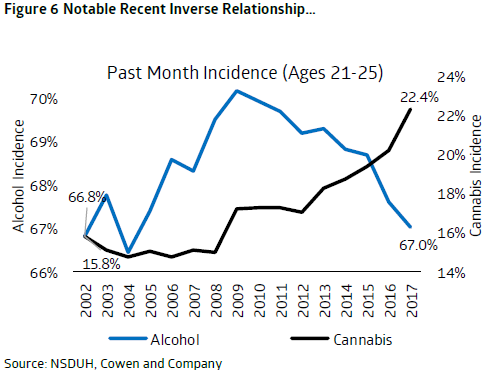
Alcohol vs. Cannabis use in the U.S.

Constellation Brands recently increased its investment in Canopy Growth with a 9.9 percent stake in the company, granting the Corona beer brewer a foothold in an industry it expects to soon be legal in the United States.

“We think that we’re by far the best company in the world — or in the best position in the world of any company — to capitalize on what is absolutely without a doubt going to be a huge market over the next 10 years, hundreds of billions of dollars,” Constellation CEO Robert Sands said in the company’s earnings call Thursday.

“We expect to reap the benefits of our cannabis investment, which we see as being incremental to our core beer, wine and spirits portfolio,” he added.

Richard Lautens | Toronto Star | Getty Images
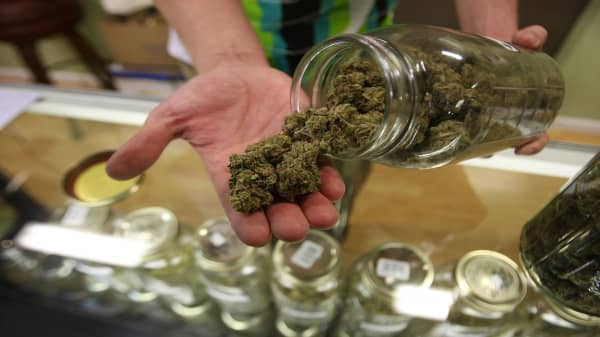
Dried plants are processed and trimmed by hand. A a state-of-the-art fully automated medical marijuana production facility is in a nondescript building in Scarborough.

And while the upside for Constellation appears obvious, the benefit is two-fold. A check from one of the world’s largest brewers is a welcome influx of capital for a handful of companies whose success will likely be defined by their ability to raise capital and scale production.

“Given the nascent stage of global cannabis, we believe that revenue growth should serve as the primary valuation methodology,” Cowen’s Azer said in her note. Specifically, Azer said her primary measurement when drawing price estimates is enterprise value divided by sales, divided by revenue growth, akin to a traditional price/earnings growth ratio.

Some Wall Street firms cover the pot stocks, but none the size of Cowen. It’s still an emerging industry.

To be sure, the spike in certain pot stocks — combined with a limited count of floating shares for some companies — has left stocks like Tilray and Canopy with lofty valuations and rampant volatility.

Tilray has about 93 million shares outstanding, but the float — those shares actually available for trading — is just 21 million, according to FactSet.

Tilray’s 2020 P/E ratio, meanwhile, is currently 300; Canopy’s is 125. Tilray’s stock price has posted no less than 12 days of double-digit moves on percentage basis in the last month.

“There have been no shortage of recent catalysts to spur market and investor interest,” Azer said. “As such, volatility should be seen as a natural occurrence in the cannabis market, and not dissimilar to other nascent industries.”

https://www.cnbc.com/2018/10/10/top-pot-analyst-says-weed-market-bigger-than-first-thought.html