Agoracom Blog Home

Archive for the ‘All Recent Posts’ Category

#Palladium to remain strong despite added Nornickel supply – SPONSOR: New Age Metals $NAM.ca $WG.ca $XTM.ca $WM.ca $PDL.ca $GLEN

Posted by AGORACOM-JC at 3:44 PM on Thursday, January 30th, 2020

SPONSOR: New Age Metals Inc. The company owns one of North America’s largest primary platinum group metals deposit in Sudbury, Canada. Updated NI 43-101 Mineral Resource Estimate 2,867,000 PdEq Measured and Indicated Ounces, with an additional 1,059,000 PdEq Ounces Inferred. Learn More.

Palladium to remain strong despite added Nornickel supply – analysts

  • Prices are likely to remain strong despite news that Russian producer Norilsk Nickel will release three metric tons of palladium ingots from its stockpiles, traders and analysts said.

By: Allen Sykora

(Kitco News)Palladium prices are likely to remain strong despite news that Russian producer Norilsk Nickel will release three metric tons of palladium ingots from its stockpiles, traders and analysts said.

As of 10:22 a.m. EST, spot palladium was up 17% so far in 2020 and trading at $2,261.10 an ounce. The metal hit a record of $2,556.95 on Jan. 20, with market watchers citing strong demand for automotive catalysts, particularly as countries like China increase regulations on emissions, which requires more use of platinum group metals.

Norilsk Nickel, the world’s largest producer of palladium, said Wednesday that its Global Palladium Fund would deliver three tons of ingots from its current stocks. A Nornickel official told Reuters that the company is concerned about higher borrowing and hedging costs, since the lack of ingots has led to higher lease rates, backwardation and market volatility.

“That [Nornickel action] would certainly lend some temporary relief … to the lease-rates markets,” said one desk trader of platinum group metals. Otherwise, he said, rates have been in the double digits.

“Along with that, you would expect to see some price reaction to the downside.”

But if so, this likely would only be temporary, he continued.

“I still believe that the long-term fundamentals – being what they are – still point to stronger palladium prices.”

The trader later added, “I think a lot of people view Russia as steady suppliers to the palladium market anyway. This is probably not too out of the ordinary in them shifting forms in how they supply the market, based on where the demand is. They’re probably getting a premium for it. So why wouldn’t they shift?”

TD Securities also sees potential for further gains in palladium prices despite the Nornickel news.

“While this will tighten the sponge discount, we do not see this reversing the years of chronic deficits in the market,” TDS said in a research note. “Considering this rally has been much more fundamentally driven, and demand is set to structurally increase … the path of least resistance remains to the upside for palladium in 2020.”

Earlier this week, analysts with Bank of America Securities said they see palladium soaring as high as $3,500 an ounce before the rally ends. At the same time, demand is strong as mine supply has been falling since 2004, Bank of America said.

Source: https://www.kitco.com/news/2020-01-29/Palladium-to-remain-strong-despite-added-Nornickel-supply-analysts.html

Imerys Closure of Wollastonite Mine a Supply and Demand Opportunity for Vertical Exploration’s St. Onge Deposit SPONSOR: Vertical Exploration $VERT.ca $TORR.ca $FA.ca $WEED.ca $CGC $ACB $APH $CRON.ca $HEXO.ca $TRST.ca $OGI.ca

Posted by AGORACOM at 2:17 PM on Thursday, January 30th, 2020
http://blog.agoracom.com/wp-content/uploads/2019/11/VERT-square-logo.png

SPONSOR: Vertical Exploration is developing its St. Onge Wollastonite as a soil additive for optimizing marijuana growth. Recently engaged AGRINOVA’s Phase 1 Reseach program also demonstrated Wollastonite can potentially become BNQ certified for agricultural use in Quebec. Recently signed distribution agreement with AREV Brands International to Supply St-Onge Wollastonite to the Cannabis and Hemp Industries. Click Here for More Info.

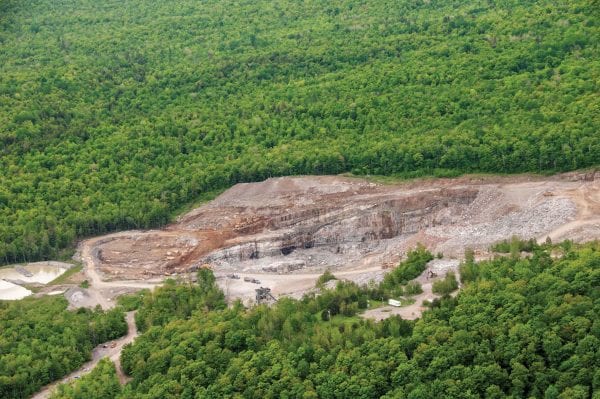
The former NYCO Minerals wollastonite mine. Photo by Carl Heilman II.

The Imerys ore processing operation in Willsboro is closed until further notice for cleaning of asbestos that has contaminated its wollastonite products.

A representative of union workers at the plant said the plant shutdown is temporary, and a plant spokesman preferred to call it a suspension of work.

The France-based Imerys, which acquired the former NYCO Minerals mining and processing operations in 2016, learned of the problem this summer from a customer. The closure brings the latest round of job uncertainties for a mine that New York voters in 2013 agreed to support by amending the state constitution to allow an Adirondack land swap that has yet to happen.

“A third party told them about asbestos. It’s in the ore,” said Ray Bettis, a representative of the United Auto Workers, the union for about 40 workers at the processing operation in Willsboro.

He said the entire workforce was called into a meeting on Wednesday afternoon. Many were relieved that the announcement was not that the plant was closing altogether, Bettis said.

Ryan Toohey, a spokesman for the company, confirmed the contamination problem and said the company intends to reopen for business. He emphasized the plant’s difficulties are not related to the bankruptcy protection sought on Wednesday by Imerys Talc America.

The Chapter 11 bankruptcy announcement was related to lawsuits alleging that the Imerys Talc subsidiaries are liable for products that have caused ovarian cancer and asbestos-related mesothelioma.

Wollastonite is a mineral used in ceramics, paints, plastics and auto-body parts.

In Essex County, the plant closure also worried workers because of repeated statements by company officials that sales of wollastonite at Willsboro, mined by Imerys in nearby Lewis, have been weak.

The plant has been closed since its third shift on Tuesday. The workers are being paid during the closure, Bettis said, and many will return on Monday to clean the premises. They will wear masks, he said.

Tests revealed trace levels of asbestos, and only in some products, the company said, and no contamination in the plant’s air. Toohey issued a statement that said Imerys has no reason to believe the wollastonite or the products sold  are unsafe for handling and use.

“Out of an abundance of caution, we are temporarily suspending production and are working to identify the earliest possible date to resume production with ore that meets our standards,” the company said. “We remain committed to producing high-quality wollastonite in Willsboro.”

The company, which has cut staff and farmed out some work in the past few years, has 59 employees. It had employed more than 100 six years ago.

It will be throwing out tons of ore and product from the past 12 months. When workers clean the plants in Willsboro they will be wearing enhanced safety gear because of expected dusty conditions.

Mark Buckley, a former administrator at the plant who served as its safety and health director, said an asbestos contamination issue arose about 16 years ago when a customer discovered the problem. At that time, the company closed for a few days of cleaning and investigation. Workers needed to be fitted for masks for protection then. The root of the asbestos was a rock formation adjoining the ore mine, he said.

The new issue surfaced amid inspections by the U.S. Mine Safety and Health Administration, which sends inspectors into the plant at least twice a year. Already, the plant has received 33 citations for violations this year, according the MSHA web site. An MSHA spokesman was unavailable.

The plant  has a long history as a major employer for mining and plant processing jobs in the Adirondack hamlets of Lewis and Willsboro, though Imerys has discontinued its mining employment and contracts the work to a Vermont excavator.

The plant also received the uncommon opportunity from New York voters to swap state forest preserve land for the rights to mine wollastonite in an area of Lewis known as Lot 8. Imerys has yet to take advantage of that opportunity, granted after heavy lobbying from the former owners who said they needed Lot 8 to preserve jobs. Voters approved a trade of 200 acres in the Jay Mountain Wilderness for lands of equal or greater value.

John Brodt, a spokesman for the Imerys mining division, said Imerys intends to continue testing the ore at Lot 8. Imerys wants to capitalize on the mining opportunity extended by voters in 2013, he said.

An application, submitted late last year, is pending before the state Department of Environmental Conservation to conduct horizontal drilling from the company’s land adjacent to Lot 8, he said. The goal is to add to previously collected test data before determining the value of Lot 8.

If the company and the state arrive at a land swap deal, the Lot 8 acquisition could happen in 2022, Brodt said.

SOURCE: https://www.adirondackexplorer.org/stories/asbestos-contamination-closes-adirondack-mine

Google Announces $1 Million Grant to Help Fight Fake News SPONSOR: Datametrex AI Limited $DM.ca

Posted by AGORACOM-JC at 2:00 PM on Thursday, January 30th, 2020

SPONSOR: Datametrex AI Limited (TSX-V: DM) A revenue generating small cap A.I. company that NATO and Canadian Defence are using to fight fake news & social media threats. The company announced three $1M contacts in Q3-2019. Click here for more info.

Google Announces $1 Million Grant to Help Fight Fake News in India

  • Technology giant Google on Wednesday, 29 January, announced a USD 1 million grant to promote news literacy among Indians.

The money will be given to Internews, a global non-profit, which will select a team of 250 journalists, fact checkers, academics and NGO workers for the project, a statement said.

The announcement, part of a USD 10 million commitment worldwide to media literacy, comes at a time when news publishers, especially on the digital front, have been found to have indulged in spreading misinformation.

Google said a curriculum will be developed by a team of global and local experts, who will roll out the project in seven Indian languages.

“The local leaders will then roll out the training to new internet users in non-metro cities in India, enabling them to better navigate the internet and assess the information they find,” the statement said.

With an eye to curb misinformation, Google News Initiative (GNI) India Training Network — a group of 240 senior Indian reporters and journalism educators — has been working to counteract disinformation in their newsrooms and beyond since last year.

GNI has given verification training for more than 15,000 journalists and students from more than 875 news organisations in 10 Indian languages, using a “train-the-trainer” approach over the past year, it said.

Source: https://www.thequint.com/news/webqoof/google-announces-dollar1-million-grant-to-help-fight-fake-news-in-india

A Remake of the Blues Brothers Driving a Tesla? SPONSOR: Lomiko Metals $LMR.ca $CJC.ca $SRG.ca $NGC.ca $LLG.ca $GPH.ca $NOU.ca

Posted by AGORACOM at 1:12 PM on Thursday, January 30th, 2020
https://youtu.be/swY2-K4DXSI
The Morning Drive: The Electric Vehicle Revolution Featuring Lomiko Metals
What is the Upside for Lomiko? We are glad you asked that question! That’s why we need sunglasses.
Below is a news report regarding our nearest neighbor that has gone through the PEA and Feasibility process with the result being a Discounted Net Present Value of $ 750 million and a $50+ million market capitalization.

Please note current tonnage amount at Lomiko’s La Loutre Graphene Battery Zone is 3%-3.6% and there is 36 million tonnes in the defined area. The new Refractory Zone at La Loutre was drilled in 2019 and will add much more tonnage, but more importantly, it will increase the grade reported in the new 43-101! Please see the drill map

After a Preliminary Economic Assessment, the La Loutre Project should generate a much larger Discounted Net Present Value than our current market capitalization of $ 4 million.

From news agency Stockwatch:
Pierre Renaud and Eric Desaulniers’s Nouveau Monde Graphite Inc. (NOU), unchanged at 20 cents on 219,000 shares, has signed a benefit-sharing agreement with the Municipality of Saint-Michel-des-Saints. Mr. Desaulniers, President and CEO, puts a colourful spin on the arrangement, which he says has strengthened the social, economic and environmental development partnership between the company and the town. Rejean Gouin, mayor of Saint-Michel, is proud of the deal, adding that he is “certain that it will benefit all citizens as well as future generations.”

Matawinie hosts nearly 96 million tonnes indicated at 4.28 per cent graphite and 14 million tonnes inferred at 4.19 per cent, all of it in the West zone of the company’s Tony claim block. A feasibility study, completed late in 2018, was based on a reserve of nearly 60 million tonnes at 4.35 per cent graphite, enough to last about a generation. The study contemplated a mine capable of producing 100,000 tonnes of graphite per year, enough to support a discounted net present value of $750-million after taxes. Still, before the town sees the annual cheques covering 3 per cent of after-tax cash flow, Mr. Desaulniers will have to find the $276-million to build the mine and get it running.

For more information on the Company, review the website at www.lomiko.com, contact A. Paul Gill at 604-729-5312 or email: [email protected]

On Behalf of the Board,

LOMIKO METALS INC.

A. Paul Gill,

Chief Executive Officer

#Edtech startup WizKlub raises nearly $1m in seed funding SPONSOR: BetterU Education Corp. $BTRU.ca $ARCL $CPLA $BPI $FC.ca

Posted by AGORACOM-JC at 1:00 PM on Thursday, January 30th, 2020
SPONSOR:  BetterU Education Corp. aims to provide access to quality education from around the world. The company plans to bridge the prevailing gap in the education and job industry and enhance the lives of its prospective learners by developing an integrated ecosystem. Click here for more information.

Edtech startup WizKlub raises nearly $1m in seed funding

  • Bengaluru-based edtech startup WizKlub has raised 70 million rupees (US$980,000) in a seed round led by seed and pre-seed stage VC firm Incubate Fund India.

By: Miguel Cordon

WizKlub founder and CEO Amit Bansal / Photo credit: WizKlub

The investment round, which also included participation from Insitor Impact Asia Fund, brings the startup’s total capital raised to 120 million rupees (US$1.7 million) so far, according to a statement.

WizKlub was established in 2018 by Amit Bansal, together with a leadership team with extensive experience in education. The startup’s programs help children aged five to 15 develop cognitive skills through an AI platform that delivers personalized learning experiences.

Its higher-order thinking skills (HOTS) program makes sure that every child is a smart reader and a smart problem solver. Its SmartTech course, on the other hand, helps children develop lifelong skills in tech through the application of coding, robotics, smart devices, and AI. AD. Remove this ad space by subscribing. Support independent journalism.

With the investment, WizKlub plans to further enhance its products and expand to other markets.

“Technology is transforming the world at an unprecedented pace, which necessitates children of this generation to be lifelong learners and adept problem solvers,” said Bansal. “Our HOTS and SmartTech programs are designed for maximum impact in these areas.”

To date, the startup has over 150 centers in Bengaluru, where it helped more than 3,000 children through its programs. The programs, which are offered on a subscription basis, are on track to onboard over 10,000 learners over the next few months, the startup said.

WizKlub’s fundraise is the latest in a string of investments in India-based edtech firms. Earlier this week, Bengaluru-based InterviewBit, which offers computer science courses through live online classes, raised US$20 million in a series A round led by Sequoia India and Tiger Global.

Think and Learn, the owner and operator of leading learning app Byju’s, also raked in US$200 million from Tiger Global this month, valuing the company at about US$8 billion.

Source: https://www.techinasia.com/wizklub-raises-1m-seed-funding

#Panasonic Enters #Edtech Market With #CareerEx, Xcelit Apps For College, School Students SPONSOR: BetterU Education Corp. $BTRU.ca $ARCL $CPLA $BPI $FC.ca

Posted by AGORACOM-JC at 2:15 PM on Wednesday, January 29th, 2020
SPONSOR:  BetterU Education Corp. aims to provide access to quality education from around the world. The company plans to bridge the prevailing gap in the education and job industry and enhance the lives of its prospective learners by developing an integrated ecosystem. Click here for more information.

Panasonic Enters Edtech Market With CareerEx, Xcelit Apps For College, School Students

  • Panasonic has launched two edtech platforms — CareerEx and XcellT
  • It will offer courses in technologies such as data science, cloud computing and more
  • India Skills Report 2019 found that 50% of the job applicants in India either have very basic or no required skills for the job

Yatti Soni

Looks like edtech is slowly becoming a lucrative sector, even for consumer tech giants. The Indian arm of Japanese multinational Panasonic has launched CareerEx and Xcelit to enter the Indian edtech market. Both products are aimed at solving the skill development gap in India’s deeptech sector. 

While CareerEx is designed to help college and university students get training in emerging technologies such as data science, cloud computing, machine learning, artificial intelligence and internet of things (IoT), Xcelit is focused on school students from Tier 2 and Tier 3 cities. The products are said to also help schoolgoers in their preparation for competitive exams. 

CareerEx courses are priced at the starting cost of INR 9999 per month, while Xcelit courses start from INR 999 per month. The products will also offer individual tests for INR 99. Both apps are available on Android and iOS devices.
Students on both apps can get a chance to work on Panasonic projects and internships. The company has collaborated with various educational institutions to develop courses in CareerEx and Xcelit. These products have been developed for students, colleges, and universities, to bridge the existing skill development gap between the education system and the employment needs of the industry in the future, Panasonic said.

According to Atsushi Motoya, head of Panasonic India Innovation Centre, the Japanese electronics major is looking to impacting over 100K students with these edtech products in the next five years. 

Skill Gap In Indian Market

The India Skills Report 2019 found that about 50% of the job applicants in India either have very basic or no required skills for the job, which highlights the need to train individuals in the skills, techniques and technology that businesses are actually using today. Other startups in this skilling space include Pesto, upGrad, Udacity, UnAcademy and others that offer professionals and students online upskilling and reskilling courses.

According to World Economic Forum, over half of the workers in India will need reskilling by 2022, to meet the future talent demands. Also according to a Datalabs by Inc42 study, the scarcity of high skilled labour in India was one of the biggest hindrances in the business growth of deeptech startups operating in India. 

Narendra Modi government had launched the Skill India initiative in 2015. The programme aimed to train more than 400 Mn people in different skills by 2022. However till June 2018, only 40 Mn people were trained, wherein 25 Mn people were trained under the skill development and entrepreneurship ministry.

Source: https://inc42.com/buzz/panasonic-enters-india-edtech-market-with-careerex-xcelit-apps-for-college-school-students/

How #Mhealth apps are providing solutions to the healthcare market’s problems – SPONSOR: CardioComm Solutions $EKG.ca – $ATE.ca $TLT.ca $OGI.ca $ACST.ca $IPA.ca

Posted by AGORACOM-JC at 2:00 PM on Wednesday, January 29th, 2020

SPONSOR: CardioComm Solutions (EKG: TSX-V) – The heartbeat of cardiovascular medicine and telemedicine. Patented systems enable medical professionals, patients, and other healthcare professionals, clinics, hospitals and call centres to access and manage patient information in a secure and reliable environment.

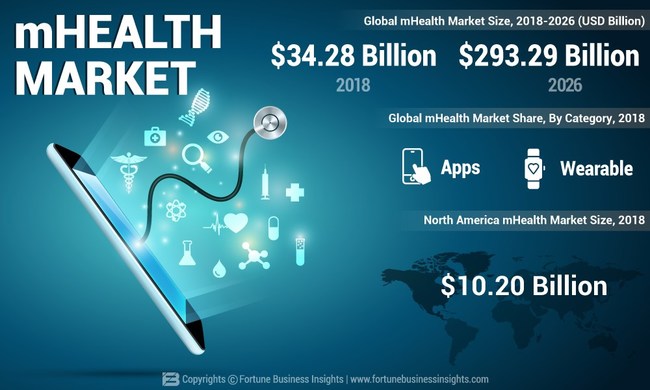
How mHealth apps are providing solutions to the healthcare market’s problems

  • Mobile health is the monitoring and sharing of health information via mobile technology – such as wearables and health tracking apps
  • The use of mobile devices and wireless technology to monitor symptoms and deliver care allows physicians to make diagnoses quicker and with fewer errors

By: Alicia Phaneuf

Today’s consumers don’t want to solely rely on yearly physicals or scattered drop-in appointments to monitor their health – they are seeking more individualized control over the way healthcare is accessed so that they can analyze personal health data and talk to healthcare professionals at all times.

By embracing mobile health, or mHealth, patients are able to keep track of their own health data in real time and inform healthcare providers of any abnormalities at the push of a button.  

What is mHealth (mobile health)?

Mobile health is the monitoring and sharing of health information via mobile technology – such as wearables and health tracking apps. The use of mobile devices and wireless technology to monitor symptoms and deliver care allows physicians to make diagnoses quicker and with fewer errors. 

And as tech giants like Apple and Google continue pushing their way into healthcare, mHealth will likely grow in popularity.

mHealth vs telehealth

Telehealth uses technology to extend the reach of healthcare professionals beyond traditional clinical settings. It’s a broad term describing how the healthcare market is taking advantage of digital development to enable remote care. Samsung Health is a platform where individuals can view activity trends, health insights and access telehealth services. Steve Kovach/Business Insider

Comparatively, mHealth is a subset of telehealth, referring specifically to the use of mobile technology to inform and educate consumers on healthcare. It uses mobile devices to monitor patients’ exercise, heart rate, and medication adherence.

Examples of different types of mHealth apps

Mobile health is gaining steam among consumers as Apple and Google continue to offer an array of mHealth applications on their app stores; there were more than 318,000 mHealth apps available for download worldwide as of November 2017. Some of the most common categories of mHealth apps include: 

  • Diabetes 
  • Pregnancy 
  • Weight loss 
  • Chronic illness 

Top mHealth apps on the market

With increasing consumer demand to monitor their own health comes the opportunity for healthcare companies and tech giants to develop mHealth applications. Here are some of the top mobile health apps on the market: AliveCor’s KardiaMobile allows users to take an EKG and have data stored directly onto their smartphone. Alivecor

  • Fitbit
  • Apple Heart Study
  • GoogleFit
  • Samsung Health 
  • AliveCor’s KardiaMobile
  • BlueStar

Benefits of mHealth app solutions

Stakeholders across the healthcare industry are looking to tap into the mHealth opportunity as Mobile health applications are beginning to integrate electronic health records (EHRs) and other wearable tech devices

According to Business Insider Intelligence, nearly half of all mHealth app publishers integrate with EHRs in order to provide a detailed representation of a patient’s health or medical history. Stakeholders across the healthcare industry are looking to tap into the mHealth opportunity. Business Insider Intelligence

Healthcare providers could reduce appointment costs by taking advantage of mHealth applications – which lowers the risk of patient rehabilitation. Instead of staying in a healthcare facility post surgical discharge, patients could utilize mHealth apps for recovery instructions and medication reminders. 

Payers – which handle the financial aspects of healthcare – can also capitalize on mHealth cost benefits. According to a 2018 Leavitt Partners report, clinical care only accounts for 20% of health, and social determinants account for the remainder. 

Health insurance providers could develop mobile apps that provide consumers with health education and send reminders to purchase healthy food – keeping patients largely responsible for their own healthcare.

mHealth industry trends & technologies

One concern consumers have regarding mHealth solutions has to do with data-sharing practices among multiple technologies and applications. According to Business Insider Intelligence, 79% of 24 top-rated mHealth apps shared user data with 55 entities, like app developers and third parties. 

Despite privacy concerns however, Business Insider Intelligence predicts that as big tech companies like Apple and Samsung continue to generate their own health features in smartphones, the adoption of mHealth apps will continue to grow.

In fact, Apple grew wearable revenue 42% year-over-year in 2018 and has the potential to hit $15 billion in healthcare-related revenue by 2021. 

Source: https://www.businessinsider.com/mhealth-apps-definition-examples

Tartisan #Nickel $TN.ca – Understanding Nickel Usage in Lithium Batteries $ROX.ca $FF.ca $EDG.ca $AGL.ca $ANZ.ca

Posted by AGORACOM-JC at 12:34 PM on Wednesday, January 29th, 2020

SPONSOR: Tartisan Nickel (TN:CSE)  Kenbridge Property has a measured and indicated resource of 7.14 million tonnes at 0.62% nickel, 0.33% copper. Tartisan also has interests in Peru, including a 20 percent equity stake in Eloro Resources and 2 percent NSR in their La Victoria property. Click her for more information

Tc logo in black

Understanding Nickel Usage in Lithium Batteries

  • CRU calculates that around 5% of nickel demand came from the battery sector in 2019
  • However, we forecast that growth will be rapid and the battery sectors use of primary nickel will reach 870,000 tonnes by 2030 and 1.5 Mt by 2040

LONDON, Jan. 29, 2020 — This Insight focuses on current nickel use in the battery sector, how it has changed in recent years, what is driving these changes and what our base case demand forecasts for nickel are.

Understanding nickel usage in lithium batteries (PRNewsfoto/CRU)

CRU calculates that around 5% of nickel demand came from the battery sector in 2019. However, we forecast that growth will be rapid and the battery sectors use of primary nickel will reach 870,000 tonnes by 2030 and 1.5 Mt by 2040. The evolution of the electric vehicle sector and the differing battery technologies within it, will increasingly shape the nickel market and represent a third of total demand by 2040.

There has been fierce debate surrounding the outlook for nickel usage in lithium batteries over the past few years. CRU has invested a large amount of time and resources into developing in-house long-term modelling capabilities for the automotive sector. This work has been undertaken not only to support our analysis of traditional automotive commodities like steel and aluminium, but also to shed light on the development and growth of the nascent electric vehicle (EV) sector and to better understand the resultant long-term impact for a wide range of commodities including cobalt, lithium, nickel, graphite and PGMs.

Of the various battery chemistries in widespread production four use nickel: nickel metal hydride (NiMH), nickel cadmium (NiCd), nickel-manganese-cobalt (NMC) and nickel-cobalt-aluminium oxide (NCA). Here, we will focus on NMC and NCA, which amount to more than 95% of nickel contained in batteries. NMC and NCA are lithium-ion batteries (LIBs), but NiMH and NiCd are not and we believe more applications will move towards using LIBs in the future.

Sourcing of nickel units for cathode markets shows high degree of flexibility

CRU’s in-house nickel sulphate supply model covers nine separate key processing routes. These can be classified into four categories, based on the raw materials used; sulphide ore, nickel briquettes, laterite ore and recycled nickel. Currently, sulphide ore, nickel briquettes are the dominate routes, but laterite ore and recycled nickel are growing.

Read the full story:

https://www.crugroup.com/knowledge-and-insights/insights/2020/understanding-nickel-usage-in-lithium-batteries/

Barrick is up 76% Under Mark Bristow’s Watch — That Even Beats Gold’s Meteoric Rise SPONSOR: Loncor Resources $LN.ca $ABX.ca $TECK.ca $RSG $NGT.to $GOLD

Posted by AGORACOM at 10:58 AM on Wednesday, January 29th, 2020
This image has an empty alt attribute; its file name is Loncor-Small-Square.png

Sponsor: Loncor is a Canadian gold exploration company that controls over 2,400,000 high grade ounces outside of a Barrick JV.. The Ngayu JV property is 200km southwest of the Kibali gold mine, operated by Barrick, which produced 800,000 ounces of gold in 2018. Barrick manages and funds exploration at the Ngayu project until the completion of a pre-feasibility study on any gold discovery meeting the investment criteria of Barrick. Click Here for More Info

The market is buzzing with speculation about Barrick Gold Corp. CEO Mark Bristow’s next move, with Freeport-McMoRan, owner of the giant Grasberg copper and gold mine in Indonesia, regarded as a potential takeover target.

A tough-talking South African on a mission to shake up the mining industry. For years the name that would have sprung to mind was Glencore boss Ivan Glasenberg, but not any more. The sector has another swashbuckling executive to watch: Mark Bristow, head of Barrick Gold.

Since the geologist took control of the world’s second-biggest gold miner just over a year ago he has been a whirlwind of activity. Highlights of the past 12 months include a hostile bid for its arch rival — now a partner in a joint venture — a buyout of struggling subsidiary Acacia Mining and more than US$1 billion of asset sales.

But this is just the beginning for 61-year-old Bristow, an adrenalin junkie who enjoys big game hunting and flying planes. “It has been an amazing year,” he said during a wide-ranging interview. “We now have a solid foundation to build on and probably the strongest balance sheet in the gold industry.”

The market is buzzing with speculation about Bristow’s next move, with Freeport-McMoRan, owner of the giant Grasberg copper and gold mine in Indonesia, regarded as a potential takeover target.

Bristow recently described copper as a “strategic metal” because of the role it would play in the shift to a greener economy. “The new, big gold mines are going to come out of the young geologies of the world,” he said. “And in young rocks, gold comes in association with copper or vice versa.”

Asked if he had discussed the merits of a deal with Freeport chief executive Richard Adkerson, Bristow said there had been “conversations” but these had been more theoretical.

“As the leader of the most valuable gold company in the world, I should be looking at the world’s best gold mines,” he said. “It makes sense for us to be interested in looking at Grasberg and asking ourselves whether Freeport is going to remain an independent company or not.”

A workaholic who maintains a punishing travel schedule, Bristow became chief of Barrick in early 2019 after the Toronto-listed company consummated a nil-premium merger with Randgold Resources, the Africa-focused miner he built into one of the world’s largest gold producers.

The idea behind the deal was to create a gold company focused around five “tier one assets,” mines capable producing more than 500,000oz of gold annually for at least a decade. The merged entity would be run the “Randgold Way” — the decentralised, hands-on management philosophy espoused by Bristow.

When the Randgold merger was announced in September 2018 there were worries about how Bristow would work alongside Barrick’s executive chairman John Thornton, a no-nonsense ex-Goldman Sachs banker.

However, Bristow and his close-knit team of executives have been given their head to run the company. One of his first moves on taking the helm was to cut almost 100 jobs at Barrick’s head office in Toronto in an effort to shape what he calls a “lean, mean machine at the top.” He has also changed the management teams across nearly all of the Barrick assets.

Analysts and investors say Bristow has delivered on the big promises he made at the time of the merger: balance sheet deleveraging, reducing head office costs and asset sales.

“If the gold price stays around US$1,500 an ounce and we generate the same sort of free cash flow as [2019 and] deliver on the rest of our promises as far as realizing the sale of non-core assets we will have zero net debt [by the end of 2020],” Bristow said.

Barrick and arch rival Newmont Corporation’s deal to combine their mines in Nevada into a joint venture, after Barrick dropped its hostile bid for the latter, has also won plaudits.
This has been reflected in Barrick’s share price, which has risen 76 per cent since the Randgold merger was announced — outperforming Newmont (46 per cent) and the gold price (31 per cent).

Barrick Gold Corp’s stock chart since the merger with Rangold was announced Sept. 24, 2018. Bloomberg

Still, some investors lament the passing of Randgold. One top-20 shareholder said it would have delivered a better share price performance had it remained independent — a view backed up by recent results, which show the Randgold side of the portfolio continuing to sparkle while the Barrick portion struggles.

Randgold also boasted a generous dividend policy, something Barrick has yet to match. Analysts estimate Barrick’s dividend would need to rise two to three times from where it is today to be comparable to Randgold’s payout. Bristow said Barrick would look at a long-term dividend policy once its 10-year strategic plan is put in place early this year.
Barrick also remains a very complex business with assets in the Americas, Africa and Asia, leaving Bristow and his management team stretched.

“There is a core of 10 Randgold executives who run the business. They used to fly around all the assets once a quarter,” said one analyst who used to follow Randgold but does not cover Barrick. “That is more difficult to do now given the size and scale of the business.”

A photo of Rangold’s open-pit gold mine in the Democratic Republic of Congo in 2014. Rangold Resources

James Bell, an analyst at RBC Capital Markets, also said the integration of the two companies had become more complicated because some of the assets flagged as potentially noncore at the time of the Barrick deal were now seen as less disposable.

“A good example is Porgera [a mine in Papua New Guinea]. This was an asset initially flagged as noncore but that’s an asset the company is now very excited about because management have seen the geological potential,” he added.

Bristow said Barrick would continue to divest assets where it makes “good, commercial sense”, citing the recent sale of its stake in the Massawa gold project in Senegal for an upfront payment of US$380 million.

Bristow, who had open heart surgery in 2017 after a doctor spotted a problem during a routine medical to renew his pilot’s licence, said he did not know when he would step down.

“I don’t have a particular timeframe but I gave the market a [promise of at least a] full five years. I am certainly committed to that,” he said, adding that there was already a pool of executives that are qualified to lead the organization. “And you can imagine how much better they are going to be with a bit of coaching in the next couple of years.”

Source: https://business.financialpost.com/financial-times/barrick-is-up-76-under-mark-bristows-watch-that-even-beats-golds-meteroric-rise

Why #Palladium Is on a Tear – SPONSOR: New Age Metals $NAM.ca $WG.ca $XTM.ca $WM.ca $PDL.ca $GLEN

Posted by AGORACOM-JC at 5:08 PM on Tuesday, January 28th, 2020

SPONSOR: New Age Metals Inc. The company owns one of North America’s largest primary platinum group metals deposit in Sudbury, Canada. Updated NI 43-101 Mineral Resource Estimate 2,867,000 PdEq Measured and Indicated Ounces, with an additional 1,059,000 PdEq Ounces Inferred. Learn More.

Why Palladium Is on a Tear

  • Story behind palladium’s move is that a physical shortage has developed in London
  • Traders sold metal they didn’t physically possess
  • Now they are being asked to deliver the bars and they are scrambling to secure the metal needed, bidding prices higher

Clint Siegner, Money Metals Exchange

Physical palladium and rhodium markets are buzzing. Reported prices for both metals leapt higher in recent days.

The story behind palladium’s move is that a physical shortage has developed in London. Traders sold metal they didn’t physically possess. Now they are being asked to deliver the bars and they are scrambling to secure the metal needed, bidding prices higher.

It looks like bullion bankers selling paper metal are finally getting called for selling way more than they can actually deliver!

People have complained about this practice in precious metals markets for decades.

More and more contracts have been sold, but inventories of actual physical metal have not kept pace. Price discovery is broken when the paper price of metal is detached from physical supply-and-demand fundamentals.

Today, there are hundreds of paper ounces floating around for every ounce of physical metal eligible for actual delivery.

As soon as a few contract holders lose confidence in their ability to redeem the paper for actual metal, the jig is up. The rush for physical bars will drain exchange vaults quickly and anyone still holding paper when the music stops will be out of luck.

That may be happening now in the market for palladium.

Sellers with an obligation to deliver physical metal can lease bars, rather than purchase them. But that is now a very expensive proposition. Lease rates spiked to near 30% last week in London.

Lessees must promise to return the quantity leased plus 30% in additional palladium ounces.

New Cautions on Rhodium

Rhodium prices have surged along with palladium. Price discovery in rhodium works differently than for other precious metals, so investors need to be especially careful.

The “spot” price for rhodium surged to $9,985 last week. However, that price does not come from a market where regular trading produces live, real-time prices.

Rather, the rhodium ask price is simply declared by major refiners. Johnson Matthey is one of the firms which publishes a price.

The price is generally updated twice per day during the trading week.

Lately the published ask prices jumped dramatically higher. Bid prices, on the other hand, have not kept up.

The bid/ask spread in the thinly traded rhodium market has always been wider than in other precious metals, but it’s wider now than ever. Current bids are roughly $2,000 below the published ask price.

If there really are industrial users paying the refiners’ $10,000 ask price for physical rhodium, it is quite an opportunity for arbitrage. Traders could theoretically purchase bars at the bid price and sell them at a very healthy profit to anyone paying the ask price.

That isn’t happening, at least as far as we can determine. Someone may have published a $10,000 ask price, but we can’t locate anyone actually paying that sum for rhodium bars.
Despite what the surging “spot” price for rhodium may imply, the bid for physical rhodium remains weak.

Money Metals has taken dozens of calls per day from sellers trying to cash in on spot prices near $10,000/oz. Many are disappointed to find actual prices are far lower which is a result of wholesalers dropping their bids. We believe one major rhodium buyer will cease further buying soon.

The rhodium market is tiny and illiquid. Price discrepancies like the one we are seeing are common. Our advice to clients would be not to put much credence in the “spot” price they see published until the spread is much tighter than it currently is.

The true price of rhodium, like all assets, is based on what real buyers are actually paying. That is currently closer to $8,000/oz, not $10,000/oz.

Source: https://www.fxstreet.com/analysis/why-palladium-is-on-a-tear-202001281550