Posted by AGORACOM-JC
at 2:22 PM on Monday, January 6th, 2020
Patient Self-Monitoring Extends Physicians’ Reach for Proactive Monitoring of Atrial Fibrillation Recurrence and any Arrhythmia.
Confirms market traction with orders being placed by physician groups for the newly launched HeartCheck™ CardiBeat Handheld ECG monitor and GEMS™ Mobile Smartphone app for prescribed in-home arrhythmia monitoring
Dr. Yaariv Khaykin, Physician Lead at PACE and Chief Medical Information Officer at Southlake Regional Health Centre, stated, “We are very excited at the opportunity to introduce the use of this home-based ECG/arrhythmia monitoring technology to our patients empowering them to take greater charge of their health.”
TORONTO, ONTARIO / January 6, 2020 / CardioComm Solutions, Inc. (TSX VENTURE:EKG) (“CardioComm” or the “Company“), a global provider of consumer heart monitoring and electrocardiogram (“ECG“) device and software solutions, confirms market traction with orders being placed by physician groups for the newly launched HeartCheck™ CardiBeat Handheld ECG monitor and GEMS™ Mobile Smartphone app for prescribed in-home arrhythmia monitoring.
Partners in Advanced Cardiac Evaluation (“PACE“),
the largest arrhythmia practice in Ontario (Canada) placed a first order
of the HeartCheck™ CardiBeat Handheld ECG monitors and is recommending
its patients to use the devices for one year of in-home, self-monitoring
with an emphasis on detecting a recurrence of Atrial Fibrillation (“AF“)
following cardiac ablation treatment for AF. The Company confirms that
additional hospital affiliated physician groups have also purchased the
HeartCheck™ CardiBeat ECG devices for evaluation in their respective
practices with additional orders expected in early 2020.
AF is a life-threatening arrhythmia that is difficult to treat.
Cardiac ablation is a procedure commonly used to correct AF; however, AF
recurrence after ablation is common and can be “silent”, occuring
without any symptoms, discomfort or warning to the patient (See Note 1).
PACE patients will use the GEMS™ Mobile Smartphone app to record ECGs
taken by the HeartCheck™ CardiBeat which will then be automatically
forwarded by CardioComm’s SMART Monitoring ECG service directly into the
patient’s cardiologist’s Electronic Medical Record (“EMR”). Should any
submitted ECG recordings show a recurrence of AF or a presence of other
cardiac arrhythmias, the patients are contacted by PACE and follow-up
visits scheduled. ECG reports generated through GEMS™ Mobile are
eligible for medical service reimbursement in both Canada and the US.
Dr. Yaariv Khaykin, Physician Lead at PACE and Chief Medical
Information Officer at Southlake Regional Health Centre, stated, “We are
very excited at the opportunity to introduce the use of this home-based
ECG/arrhythmia monitoring technology to our patients empowering them to
take greater charge of their health.”
The GEMS™ Mobile app is available in Android and Apple Smartphone
compatible versions as a free downloadable app and allows users to
generate unlimited ECG reports to show to their physician. The app also
allows users to request their ECG to be reviewed by CardioComm’s SMART
Monitoring ECG reading service where the user does not have direct
connectivity to their treating physician.
To learn more about CardioComm’s products and for further updates
regarding HeartCheck™ ECG device integrations, please visit the
Company’s websites at www.cardiocommsolutions.com and www.theheartcheck.com.
CardioComm Solutions’ patented and proprietary technology is used in
products for recording, viewing, analyzing and storing
electrocardiograms for diagnosis and management of cardiac patients.
Products are sold worldwide through a combination of an external
distribution network and a North American-based sales team. CardioComm
Solutions has earned the ISO 13485:2016 MDSAP certification, is HIPAA
compliant and holds clearances from the European Union (CE Mark), the
USA (FDA) and Canada (Health Canada).
This release may contain certain forward-looking statements and
forward-looking information with respect to the financial condition,
results of operations and business of CardioComm Solutions and certain
of the plans and objectives of CardioComm Solutions with respect to
these items. Such statements and information reflect management’s
current beliefs and are based on information currently available to
management. By their nature, forward-looking statements and
forward-looking information involve risk and uncertainty because they
relate to events and depend on circumstances that will occur in the
future and there are many factors that could cause actual results and
developments to differ materially from those expressed or implied by
these forward-looking statements and forward-looking information.
In evaluating these statements, readers should not place undue
reliance on forward-looking statements and forward-looking information.
The Company does not assume any obligation to update the forward-looking
statements and forward-looking information contained in this release
other than as required by applicable laws, including without limitation,
Section 5.8(2) of National Instrument 51-102 (Continuous Disclosure Obligations).
Neither TSX Venture Exchange nor its Regulation Services Provider (as
that term is defined in policies of the TSX Venture Exchange) accepts
responsibility for the adequacy or accuracy of this release.
Tags: EKG, mhealth, small cap stocks, stocks, tsx, tsx-v Posted in CardioComm Solutions | Comments Off on Physician Groups Order The Heartcheck(TM) Cardibeat For In-Home Arrhythmia And Atrial Fibrillation Monitoring – CardioComm Solutions $EKG.ca $ATE.ca $TLT.ca $OGI.ca $ACST.ca $IPA.ca
Posted by AGORACOM
at 1:14 PM on Monday, January 6th, 2020
SPONSOR: Lomiko Metals is focused on the exploration and development of minerals for the new green economy such as lithium and graphite. Lomiko owns 80% of the high-grade La Loutre graphite Property , Lac Des Iles Graphite Property and the 100% owned Quatre Milles Graphite Property. Lomiko is uniquely poised to supply the growing EV battery market. Click Here For More Information
Nissan will show its Ariya EV concept to the tech-oriented audience.
The former Consumer Electronics Show, now known simply as CES, lacks
the new-model cachet of a premiere world auto show. And automakers are
not yet using the Las Vegas electronics extravaganza to shine the
spotlight on their newest creations. But as the auto industry grapples
with technology-fueled disruption from electrification, autonomous
driving and upstart business models, CES is becoming the venue of choice
for brands to prove to consumers, and each other, that they are
embracing the future of mobility.
More than 160 automotive technology companies, including 10 major
automakers, will attend this year looking to forge partnerships and
recruit hard-to-find tech and engineering talent. Several top auto
industry executives will attend, including Daimler CEO Ola Kallenius,
Ford Chief Technology Officer Ken Washington and BMW r&d boss Klaus
Frohlich. U.S. Secretary of Transportation Elaine Chao will deliver a
keynote address on the state of innovation and DOT initiatives to
integrate new technologies into U.S. transportation systems.
Here’s a roundup of what automakers expect to show at CES.
BMW will tease an interior concept for its i3 EV.
The “BMW i3 Urban Suite,” said to have the “relaxed feel of a boutique
hotel,” features a large seat with footrest, a screen that flips down
from the headliner and a “personal Sound Zone.”
Fisker will debut the Ocean all-electric crossover,
powered by an 80-kWh lithium ion battery pack and with an expected range
of up to 300 miles. Production should begin at the end of 2021.
Ford will show its 2021 Mustang Mach-E crossover.
The highly anticipated mass-market EV, with a 300-mile range, is Ford’s
answer to Tesla, General Motors and others that beat it to the electric
market with long-range EVs.
GM will demo integration of Amazon’s Alexa Auto voice-controlled virtual assistant in a new Cadillac CT5.
Honda will showcase technologies being jointly
developed by its incubator Honda Xcelerator and startups focused on
improving workplace ergonomics and manufacturing efficiency. Honda will
demo exoskeleton devices and a voice-enabled, AI-powered personal
assistant developed with SoundHound. And it will show its “Smartphone as
Brain” technology, which allows motorists to safely use their phones
while on the road.
Hyundai will reveal details about a
flying vehicle concept and a “highly customizable” prototype car with
autonomous-driving capabilities. The automaker has said it plans to
evolve into a “smart mobility solution provider” by 2025 and will invest
more than $50 billion in electric and fuel cell cars, autonomous
driving, flying taxis and mobility services.
Mercedes will reveal a concept
vehicle it described as “envisioning a completely new form of
interaction between humans, technology and nature,” and show its EQ EVs.
Mercedes said it expects to introduce a fleet of 10 EVs by 2022,
starting with the EQC electric compact crossover set to arrive in the
U.S. in 2021.
Nissan will showcase its Ariya
electric crossover concept. A production version of the five-seater
could arrive in the U.S. in 2021. U.S. dealers briefed on the product
last summer said the new EV will have a 300-mile battery range and go
from 0 to 60 mph in less than 5 seconds.
Renault will demonstrate technology
that allows connected devices in the home to be controlled from a car
dashboard. The company also plans to show a battery-powered EV with a
hydrogen system that triples a zero-emission vehicle’s range.
Toyota will reveal details around its new mobility ecosystem and demo several concept vehicles.
Posted by AGORACOM
at 12:00 PM on Monday, January 6th, 2020
SPONSOR: Applied BioSciences is a vertically integrated company focused on the development and commercialization of novel, science-driven, synthetic cannabinoid therapeutics / biopharmaceuticals that target the endocannabinoid system to treat a wide-range of diseases across multiple therapeutic areas Click Here for More Info
If you have been studying cannabis products in depth to find out that
one full-spectrum CBD oil that would suit all your needs then you’d
have come across the word terpenes. But what are these terpenes, or as
others refer them, terpenoids?
Of course, if you are looking to buy CBD, you would be aware of what
cannabinoids are. these are compounds found in the cannabis plants, hemp
and marijuana. So now you have two terms cannabinoids and terpenoids –
but what’s the difference between the two? let’s take a look at this
below:
Cannabinoids
Cannabinoids like cannabidiol and tetrahydrocannabinol have
therapeutic properties. They interact with the natural endocannabinoid
system in your body. What they basically do is that they control the
functionality of cells – this means they manage cell signaling.
Cannabinoids regulate the receiving, processing, and sending of
messages between cells. A cannabinoid like CBD can interact with
cannabinoid receptors in the ECS and regulate your mood, anxiety,
inflammatory response, and much more.
While THC and CBD are the most popular cannabinoids that have studies
supporting their effects, there are hundreds of other cannabinoids too.
These include CBG and CBN among others. All cannabinoids come with
distinct features.
Terpenes
Terpenes or terpenoids are aromatic molecules not only found in
cannabis but in several other plants as well. These as well have
therapeutic properties. They are found in fruits as well. Terpenes in
the lavender flower are responsible for its unique aroma and soothing
properties.
Terpenes also found in citrus fruits and berries too. One terpene
that exists in both cannabis as well as a fruit, mango, is myrcene. The
aroma of weed that many people appreciate comes from this very terpene.
Inside plants, terpenes play a very important role. They protect against
the attack of pests, bacteria and other external agents. The amount and
type of terpenes in cannabis plants varies from one strain to another.
The Entourage Effect
Experts recommend you to go for a full-spectrum CBD formula because
it contains cannabinoids as well as terpenes. Cannabinoids and
terpenoids work together to provide better benefits. They have an
entourage effect together which enables you to get better result sooner.
This is because like cannabinoids, terpenes also have health profiting
qualities.
For instance, some terpenes have an anti-inflammatory nature while
others are great for stress relief. As you may already be aware, CBD
also provides these benefits. Of course, when in combination with other
compounds that have similar properties benefits that you drive are more.
Verdict
Cannabinoids and terpenes are compounds found in the cannabis plant. Both have therapeutic properties but are different. Terpenes are aromatic molecules responsible for the flavor of a plant and fragrance. Cannabinoids interact with the ECS of the body. Together they work even better which is why full-spectrum CBD is revered more than CBD isolate.
Posted by AGORACOM-JC
at 11:57 AM on Monday, January 6th, 2020
SPONSOR: BetterU Education Corp.
aims to provide access to quality education from around the world.
The company plans to bridge the prevailing gap in the education and job
industry and enhance the lives of its prospective learners by developing
an integrated ecosystem. Click here for more information.
The Future Of Edtech And Learning In India From An AR/VR Lens
Educators around the globe today have realised that AR/VR are big breakthroughs when it comes to learning — for a method as well as outcomes.
As Ankur Aggarwal, founder of VR-based edtech startup Veative told us the enduring objective of edtech is to improve the yearning to learn and AR/VR helps implement it in a spectacular manner.
In the 21st century, technology is taking over education — be it
skill-building programmes in universities, real-world technical training
and learning of abstract concepts in schools. The shift from
conventional means to experiential methods of transacting learning has
seen new-age technologies like augmented reality (AR), virtual reality
(VR) and mixed reality — a combination of AR/VR — have been playing a
key role in driving learning and edtech engagement.
Educators around the globe today have realised that AR/VR are big
breakthroughs when it comes to learning — for a method as well as
outcomes. As Ankur Aggarwal,
founder of VR-based edtech startup Veative told us the enduring
objective of edtech is to improve the yearning to learn and AR/VR helps
implement it in a spectacular manner.
“AR/VR has great potential in democratising the educational process
and making it a personalised learning experience for learners of all
stripes. AR/VR is not a gimmick when deployed correctly. They allow
learners to explore abstract concepts in a distraction-free environment
and allow them to connect with the concept,†Aggarwal added.
And that is not a lone opinion. Vivek Goyal, cofounder of AR edtech startup Playshifu, emphasises that learning today means much more than just remembering the facts. Anumukonda Ramesh,
country manager for the Indian subcontinent, Unity Technologies, one of
the biggest gaming engines in the world, also ascertains that the
Indian education system needs to leverage new technologies in order to
stay relevant in an ever-changing world.
What Is The Difference Between AR And VR?
While both are visual technologies that rely on non-traditional
interactions, AR and VR are fundamentally different. When used together,
it is often referred to as mixed reality. Reliance Jio is looking to
make mixed reality mainstream in India with the acquisition of deeptech startup Tesseract which has made an MR product called Holoboard.
Simply put, augmented reality or AR is a multi-sensory interactive
experience that involves real-world elements in a virtual environment.
It is known to offer perceptually-enriched experiences to users by using
real-world elements and adding a layer of information or visual aid on
top of it in a natural manner.
The most common examples of AR technology is seen in animated emojis
these days on smartphones such as Apple iPhones, Samsung Galaxy series
and more. In the industrial context, AR applications can help with
on-the-go learning for maintenance and troubleshooting, systems
maintenance work and other computer-aided learning and training.
On the other hand, virtual reality is a simulated experience
that can either offer a very realistic virtual experience that mimics
the real world or fantastically new visual experiences that transcend
the boundaries of reality and surrealism. Currently, standard virtual
reality systems either use VR headsets or multi-projected environments
to generate images, sounds and other sensations. VR applications have
found use in healthtech, edtech and consumer services sectors.
What Future Does AR/VR Have In Edtech?
As PlayShifu’s Goyal explains, we can broadly divide formal education
into three segments — early, secondary and tertiary learning (higher
education). For early learners, playing is the way to learn and AR/VR
can make a significant impact as it enhances any play experience 10x.
Learning about core fundamental skills like alphabets, numbers, logical
reasoning can be made so much more fun and engaging with AR-enabled
gameplay.
“For more advanced ages, we are already seeing a lot of hardware
development being done in terms of AR glasses. These will enable
grasping and practicing concepts more profoundly with the help of
life-size 3D animated content that students can manipulate and observe
in their learning space,†Goyal added.
Here are the primary reasons why AR/VR are believed to be the future of learning and education.
Boosts Learning Retention
Personalised Learning Experiences
Increases Possibilities Of Experimentation
Reduces Reliance On Learning By Rote
Empowering Educators And Learners
Encouraging Active Learning
The founders we spoke to believe that AR and VR technology can have
an impact not just for young ages but also for reskilling, corporate
learning, industrial applications and more.
AR/VR Boosts Learning Retention
Veative’s Aggarwal adds example of the ‘Cone of Learning’, created in 1969 by US educator Edgar Dale.
Aggarwal explained that after two weeks, the human brain tends to
remember just 10% of what it has read, 20% of what it hears, 30% of what
it sees and up to 90% of the actions performed or simulated.
This means immersive and innovative digital tools will facilitate
experiential learning in more effective ways. This will enhance the
learning process and help learners connect multiple concepts, work at
their own pace and according to their level of proficiency.
This brings us to personalised learning. Interactivity is the key
reason why AR/VR is so attractive for education purposes and this
purpose get more value when AI is introduced with this technology. This
will provide highly personalised learning experiences based on learning
patterns and behaviour. The seamless integration of AR and VR in the
education landscape will help to personalise learning and upskill
learners.
Other entrepreneurs such as Simulanis founder Raman Talwar and Skillveri founder Sabarinath Nair
also agreed with this. “We are witnessing a transgression from
one-size-fits-all learning methodology to a personalised and
experiential one, where learners’ learn by doing,†Talwar told us.
Increases Possibilities Of Experimentation
Unity’s Ramesh added that AR/VR provide safe sandboxes for complex
learning exercises, like giving children their own virtual chemistry lab
to kindle experimentation.
To cite an example, Apple’s ARKit platform is an incredible leap
towards immersive learning. It helps teachers create AR experiences in
which students explore 3D models of the human body. With its advanced
detection feature, they can see a computer-generated, detailed
simulation of the male and female anatomy. And what’s more, they can
manually trigger motions between the different parts of the human body
in the virtual space.
“Not only does this enable learners to visualise and design different
scenarios, but it also improves their manual dexterity. Thus, it
ensures a higher level of motivation and engagement,†added Next
Education’s CEO and founder Beas Dev Ralhan.
Reducing Reliance On Learning By Rote
Next Education’s Ralhan further adds that the biggest advantage of
using AR in the classroom environment is that it offers
visually-impressive experiences. AR/VR-based immersive and experiential
learning environment creates chances for focus and attention on a topic
or idea, which should positively affect retention rates of the subject
matter.
“An open and enthusiastic mind, in a distraction-free environment,
means that there is a far greater chance to get to higher-order thinking
skills, which are always more difficult to learn and to teach,†added
Veative’s Aggarwal.
Empowering Educators And Learners
Educators too have a lot to benefit from leveraging AR/VR techniques
for teaching, paired with the right content. Regardless of the medium,
content is king, and always will be, edtech startups told us. Just like
textbooks, without the right content, VR headsets will only gather dust
on a shelf.
With virtual labs, social media learning, and gamification, learning
can be made more engaging for learners and students. We will see AR/VR
could open a wide range of simulations. Books in the future could be
digital, infused with AR technology and educators can place helpful
milestones in the real world for students to stumble upon for practical
and hands-on learning. Subjects and digital counterparts of real-world
objects will make delivery of lessons simpler. New games with AR-enabled
assistants and immersive VR experiences can revolutionise the learning
and coaching experience for students.
Encouraging Active Learning
The AR/VR is a uniquely personal experience and should be used as
such. If providing a distraction-free environment which promoted focused
concentration on a subject was the only benefit to VR, then that alone
might be enough to justify using this tool.
Veative’s Aggarwal added that learners have a natural curiosity about
VR. “We never have a problem getting them interested in using the VR.
This very simple fact means that a young learner is coming into the
device with an open and curious mind, which is the best starting point
for learning to happen.
What Is The Market Opportunity For AR/VR In Edtech Space?
The education sector is forecast to spend more than $6 Bn annually on
augmented and virtual reality technologies by 2023, said Simulanis’
Talwar. “Funding for the technologies remains a major hurdle to
adoption, but price points for equipment are dropping rapidly, according
to a new market forecast from ABI Research,†he added.
Another report, “Augmented and Virtual Reality in Education,†added
that the market for augmented reality in education will hit $5.3 Bn in
2023, with the market for virtual reality head-mounted displays trailing
at $640 Mn.
Further, as Playshifu’s Goyal highlighted, anything that comes at a
relatively low cost is a big win for the schools. “As AR/VR hardware and
experiences hit sub-$300 price point in the next five years, we
anticipate a wave of mass adoption,†he said.
Ralhan also indicates towards the role AR/VR will be playing in
building future workforce. The government plans on building the first
augmented-reality based skill training center in IIT (Banaras Hindu
University) in Varanasi. Furthermore, since AR applications can work on
most modern smartphones, students do not have to spend extra money on
devices.
“Such initiatives call for more active participation from AR solution
providers in India such as Simulanis, Hedgehog Lab, IndiaNIC Infotech
Limited, Hyperlink InfoSystem, Chetu, Plutomen, and Intellify,†added
Ralhan.
AR/VR Trends, According To Edtech Startups
Classrooms in the future will not look like they do today. Founders
believe that AR will see a prominent push in the next 3 to 5 years in
India, and most schools will have dedicated tools. Higher education will
see faster adoption for AR and VR tools, given that the technology is
already present in such institutions.
India being the second-largest consumer of mobile phones (nearly 800
million) AR/VR offers students the flexibility to access educational
content seamlessly across devices. It could also open an opportunity for
social collaboration and spatial communication in a room-scale
environment, where teachers can teach students remotely, and students
can collaborate on various interactive and immersive experiences.
As the saturation point for regular school content is reached, more
companies would start focussing on the vocational training using AR/VR
content and simulations, in addition to the regular K-12. While these
applications are at a nascent stage currently, the central government is
working on promoting digital learning and improving teaching standards.
The Existing Gaps In AR/VR Adoption In Education?
Skillveri’s Nair highlighted a crucial challenge for AR/VR startups here. “These
technologies have to be seen as a means to an end, instead of an end in
itself. A framework is to be used to decide if a particular content or
concept will be better delivered through AR/VR, instead of mindlessly
applying the technology for everything,†he told Inc42.
The biggest barrier is the lack of knowledge about AR/VR across the
education ecosystem. Additionally, the existing curriculum has a proven
record of its efficacy, whereas AR/VR, being a new technology, still
needs approval by the school management hierarchy involving teachers,
and principals.
“The decision-making process should be streamlined in such a way that
relevant information about new tools are collected, experimented and
finally deployed to provide unprecedented learning opportunities to the
students,†said Talwar.
Here are some other existing challenges in the sector, according to entrepreneurs:
Cultural Diversity: For a country as diverse as
India — in terms of social, economic, linguistic, and cultural
conditions—like India, making a uniform and standardised AR-enabled
school curriculum is difficult. Unless private firms bring the costs
down and make content more region-specific, state governments will not
give adequate subsidy in the purchase and distribution of learning
material, or bring AR support to schools.
Learning Capacity Variance: Despite the fact that AR
is made to be self-learning with comprehensive guidelines for
first-time learners, not all students have the same learning capacity or
grasping potential. Therefore, adequate educator training is also very
important in AR.
Financial Constraints: State-run schools far
outnumber private schools in India. The majority of these schools have
severe financial constraints, so public-private partnerships can help
these schools to re-establish themselves to become part of the new
revolution in the teaching-learning process.
Lack Of Technical Know-How: AR/VR isn’t simple or
intuitive for first timers. There are regions in India where computer
skills are missing among teachers and students. So VR developers should
keep in mind about tech illiterate population for VR to truly shine in
education circle.
Shallow or Inadequate Learning Content: While VR
content developers have more recently gained prominence, most learning
content is not deep enough to have an impact or borders on the
cartoonish or childish. It’s hard to create the diversity of content
required for all kinds of learners. And most founders believe it will
take a long time to bring relevant VR content for all use-cases.
The Evolution Of Edtech Innovation
India is on the brink of an evolution in its education ecosystem.
This is perhaps the most exciting and disruptive stage of this sector
and innovators are ready to redesign the future of learning.
2020 is expected to be the start of a new era in online learning,
with edtech creating big waves. Learning and schools will incorporate
concepts of global collaboration, personalised learning, simulations,
AI, real-world learning systems, mobile classrooms and immersive
learning experiences.
As Ajit K. Chauhan, chairman, Amity University Online and Amity
Future Academy told us with an influx of educational technologies it is
very likely that the future years will see further integration of
blockchain, cloud computing, AR/VR, collaborative learning and edge
computing.
“Artificial intelligence is emerging as an integral part of the
eLearning ecosystem. We see several AI educational solutions coming to
the fore. It is predicted that AI can fill the need-gaps in learning and
teaching. It is expected to broaden the purview of schools and
teachers.â€
Posted in betterU Education Corp | Comments Off on The Future Of #Edtech And Learning In India From An AR/VR Lens SPONSOR: BetterU Education Corp. $BTRU.ca $ARCL $CPLA $BPI $FC.ca
Posted by AGORACOM
at 11:54 AM on Monday, January 6th, 2020
SPONSOR: Labrador Gold – Two successful gold explorers lead the way in the Labrador gold rush targeting the under-explored gold potential of the province. Exploration has already outlined district scale gold on two projects, including a 40km strike length of the Florence Lake greenstone belt, one of two greenstone belts covered by the Hopedale Project. Click Here for More Info
In this update I am not going to repeat the points made in the last
fairly comprehensive update, instead we are going to focus on the
importance of the resistance level just above where the price is now,
and impact of the killing of the Iranian General and its potential
implications for the gold price.
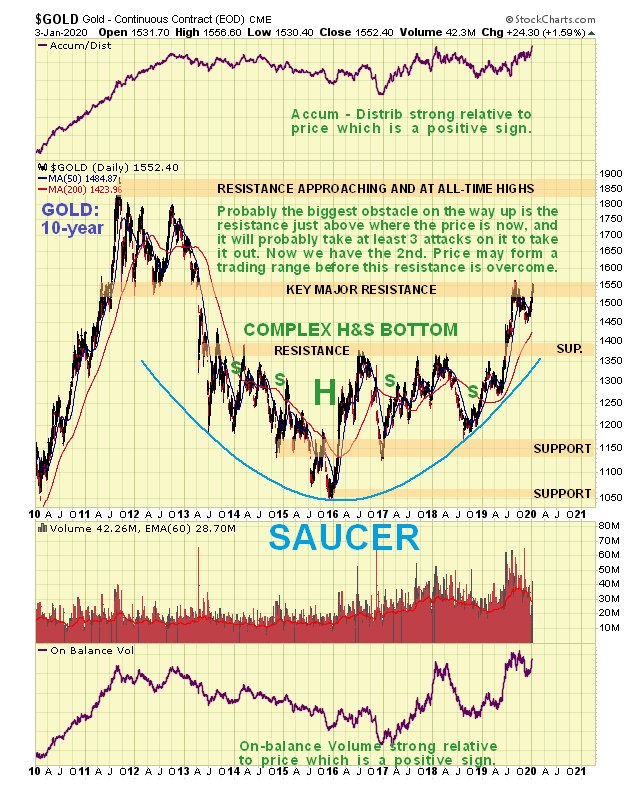
On the latest 10-year chart we can see that gold is making a 2nd
attack on the key major resistance level in the $1530 – $1560 zone,
which is hardly surprising considering what happened last week.
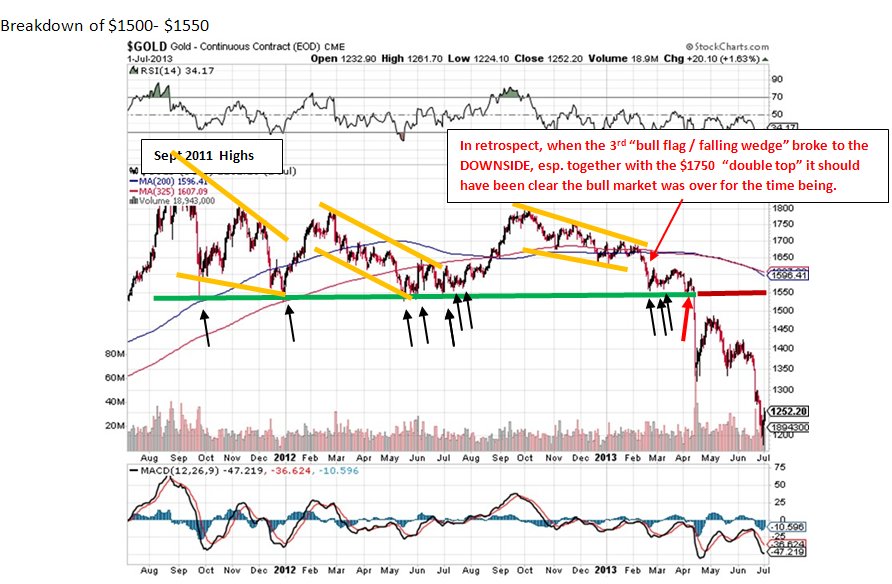
The reason that this resistance level is of such major
importance is made abundantly clear by the following chart made by a
subscriber and kindly forwarded to me, which I reproduce with his
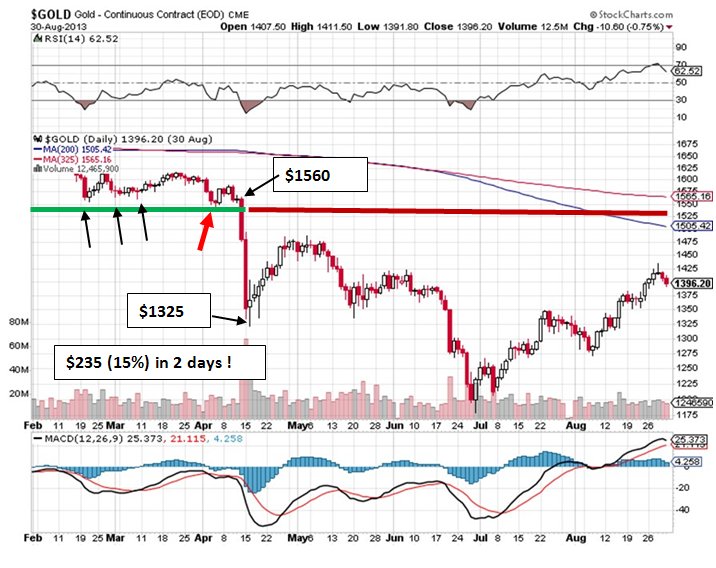
permission. As we can see gold made no less than 5 significant lows at
this level between 2011 and 2013, before it finally crashed this support
and plunged 15% in 2 days, so it is clearly of huge significance and is
the biggest hurdle by far on the way up. Therefore, even given the
latest mayhem in the Mid-East, we should not be surprised if it now
stalls out here and possibly backs off for a while to form a trading
range, which is also made likely by its now being critically overbought
on its RSI indicator and by the latest COTs, which we will look at lower
down the page, coming in with really extreme readings again. This makes
sense given that we now at a time of maximum tension.
From a subscriber – highlighting gold’s key support at the $1530 – $1560 level, which is now of course strong resistance…
Detail showing the plunge that was triggered the failure of this support…
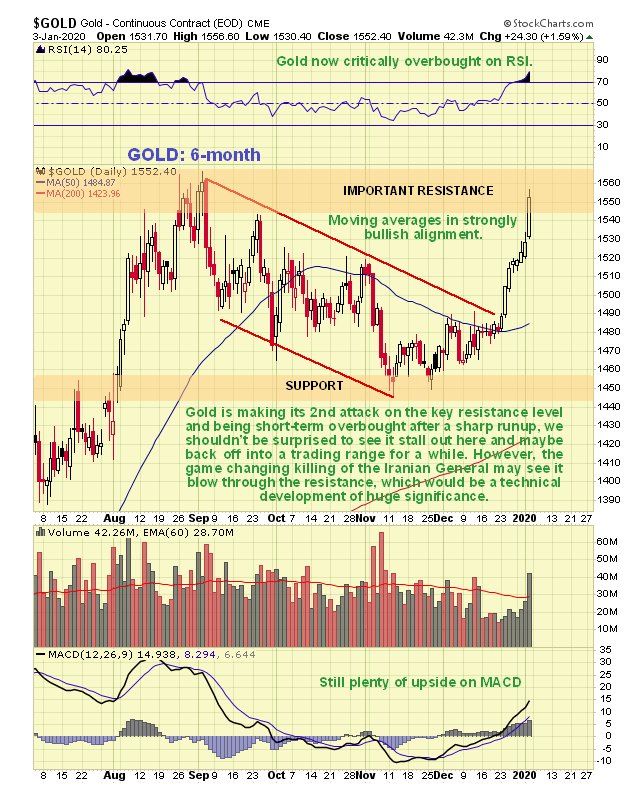
On the 6-month chart we can see how, after breaking out of the
corrective downtrend in force from early September, gold has risen
steeply, without one down day so far to become critically
overbought on its RSI indicator as it drives into the zone of strong
resistance with volume becoming heavy on Friday. This of course
increases the chances of its reacting back the moment tension over the
Mid-East situation eases, even if only slightly.
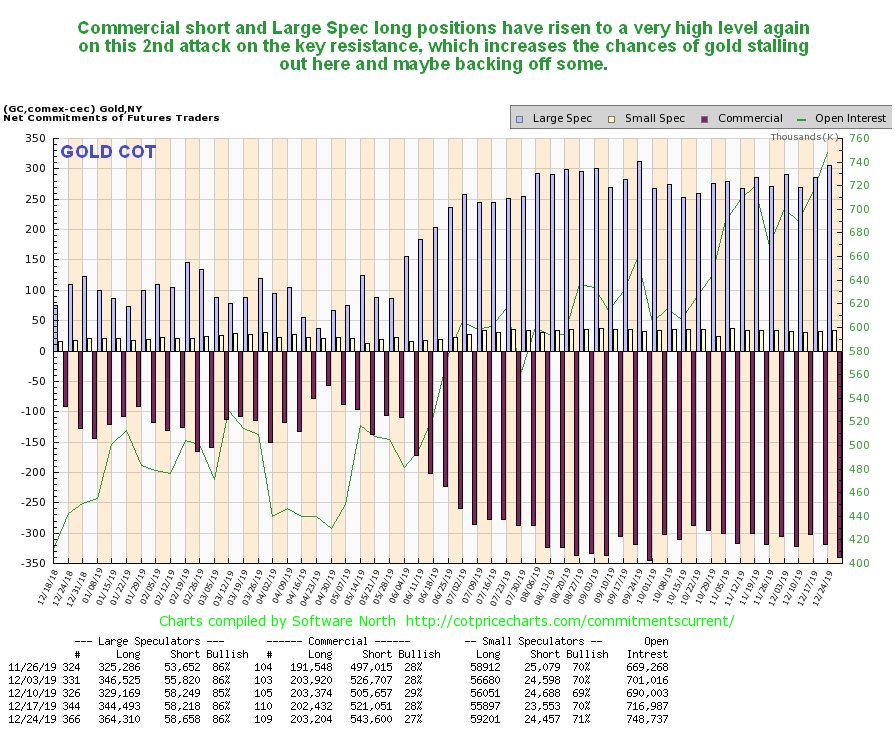
As for the COTs, they are showing extreme readings once more
(chart is for 24th December), which suggest that, especially if tension
over the Iran situation eases short-term, gold will probably back off
some into a consolidation pattern that will enable it to charge up
sufficiently to take out the key resistance in due course.
Click on chart to popup a larger, clearer version.
Now we come to the possible impact of the US killing of the top
Iranian General. In order to figure out the real motivation for this
act, we simply have to ask the usual question “Who stands to gain?†The
first interest group that stands to gain is the US military, which
receives about $700 billion of taxpayers’ money every year, and probably
about $500 billion of this is in excess of what it needs to defend the
Homeland. So in order to justify this bloated budget it creates enemies
and conflicts around the world. The next interest group is Israel, which
controls the US and uses the US military as a sledgehammer to achieve
its objectives which include dominance of the Mid-East. Iran is the big
prize. Finally the Republicans and Trump himself stand to gain at the
polls later this year as the population will predictably “rally round
the flag†as a result of conflict with Iran. Knowing all this, we can
quickly deduce that the killing of the Iranian General was an act of
extreme provocation designed to trigger some kind of counter attack by
Iran that can then be used as an excuse to launch a bombing campaign
against it. Even if Iran exercises maximum restraint and does nothing
beyond making empty threats to assuage its angry populace, it may still
fall victim to an onslaught after a calculated false flag attack which
is blamed on it. So whatever it does, it loses – it’s been put in a
classic “zugzwang†situation.
For all the bluster, Iran’s military is no match for that of the US
of course, which spends more than the rest of the world put together on
arms. The best way for Iran and Islam in general to “get even†with the
West for all its many decades of Colonial interference in the Mid-East,
exploitation and massive destruction inflicted on places like Iraq and
Libya and the Palestinians therefore (looked at from their point of
view) is to conduct “asymmetrical warfareâ€, invade Western countries and
attack their churches
and institutions etc, and then take them over gradually by outbreeding
them. Western societies are now too corrupt, decadent, morally bankrupt
and weak to stop this happening, and it is happening right now in
Europe, and the only reason it isn’t happening to the same extent in the
US is that it is a lot harder to pilot a rubber dingy across the
Atlantic Ocean than the Mediterranean Sea, although as we know the
Democrats and the Left appear to trying to take up the slack by
destroying the country from within in places like Portland, L.A. and San
Francisco, and this rot will spread unless right minded people take a
vigorous stand.
All this is mentioned because it is clear that the killing of the
Iranian General is the prelude to a military strike against Iran, which
will probably take the form of an extensive and intensive bombing
campaign that both Israel and the US have been looking forward to for
years, because a ground invasion is out of the question due to the
geography and logistics. The goal as usual will be to destroy its
military capability and wreck its infrastructure with the eventual aim
of installing a puppet government and opening up the country to Western
exploitation, and the wild card in all this will be whether Russia and
China will do anything to prevent it, or just stand and watch. It is
thought that they don’t have the nerve to intervene. In any event, if
such a campaign is launched, we can expect the world to be gripped by an
acute sense of crisis and gold will spike. Iran may have the ability to
disrupt the flow of oil out of the Persian Gulf, albeit temporarily,
which would trigger an oil price spike and a stockmarket crash.
Last week’s updates concluded with a look at the highly bullish
charts for gold measured against the Australian dollar and the Japanese
Yen, and this week we will look at gold against the Canadian dollar and
the Swiss Franc.
While many investors are still agonizing about whether gold is in a
bullmarket or not, that is because they are fixated on the charts for
gold in US dollars. When you look at gold in other currencies you
realize that it is already very much in a bullmarket, and recently made
new highs against many currencies, like the Canadian dollar shown below…
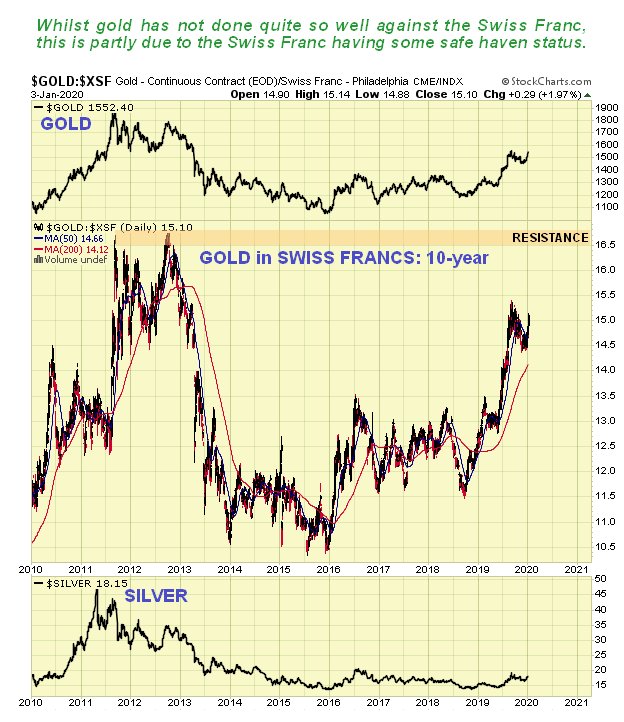
Even against the Swiss Franc, which amongst currencies enjoys
some safe haven status, gold is performing better than it is against the
dollar…
…and we should remember that the dollar may not remain as “king
of the hill†forever, especially as a number of major powers in the Asia
especially are preparing to ditch it.
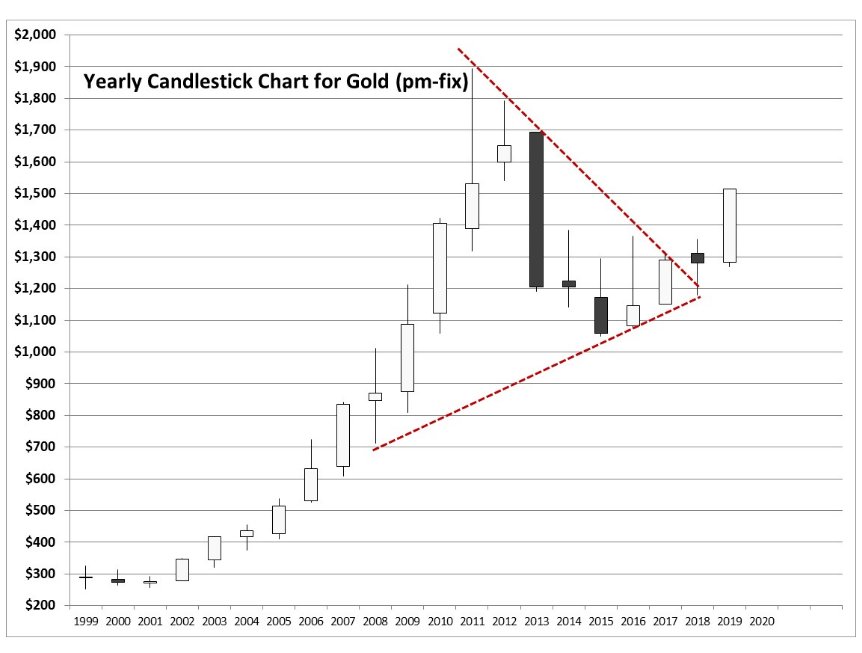
Finally, we are going to take a quick look at an unusual chart for
gold submitted by the same subscriber as some of the charts above. It is
unusual because it is a yearly candlestick chart, meaning that each
candle on it is for an entire year. Its supreme advantage is that it
keeps things simple. The Triangle shown on it is his interpretation, not
mine. It certainly looks positive here with a big white candle for
2019, with the arithmetic version shown looking even more bullish. This
type of chart also has a potential advantage for the writer, as if only
this chart were used, I would only have to write these updates once a
year.
Courtesy of Clive Maund: https://www.clivemaund.com/gmu.php?art_id=68&date=2020-01-05
Posted by AGORACOM-JC
at 10:34 AM on Monday, January 6th, 2020
SPONSOR:ThreeD Capital Inc. (IDK:CSE)
Led by legendary financier, Sheldon Inwentash, ThreeD is a
Canadian-based venture capital firm that only invests in best of breed
small-cap companies which are both defensible and mass scalable. More
than just lip service, Inwentash has financed many of Canada’s biggest
small-cap exits. Click Here For More Information.
Hundreds of Institutions Are Already Investing in Crypto: Coinbase CEO
According to the CEO of one of the biggest cryptocurrency exchanges
globally, institutions are already actively investing in the emerging
asset class and the trend is likely to continue throughout 2020.
Will institutions further bolster the crypto market in 2020?
Prior to 2019, institutional investors only really had Bitcoin
Investment Trust (GBTC) by Grayscale and CME Group’s futures market to
invest in bitcoin.
“We’ve already started to see small institutions enter the
cryptocurrency space. Hundreds have joined Coinbase Custody in the past
18 months. I would expect this rapid growth to continue in 2020, with
larger and larger institutions coming on board. Eventually just about
every financial institution will have some sort of cryptocurrency
operation, and most funds will keep a portion of their assets in
cryptocurrencies, partially due to the uncorrelated returns.â€
“Bakkt will be likely first a trickle and then a flood. The reality
is that most regulated futures contracts get low adoption on day1 simply
b/c not all futures brokers are ready to clear it, many ppl want to
wait and see, the tickers are not even populated on risk systems, etc,â€
Three Arrows Capital CEO Su Zhu said.
Independent funds seeing more institutional inflow
Despite a noticeable decrease in deal value in the latter half of
2019, in October of last year, Anthony Pompliano of Morgan Creek Digital
said that the firm’s crypto fund secured $60 million from institutional
investors.
Posted by AGORACOM-JC
at 9:21 AM on Monday, January 6th, 2020
SPONSOR: NORTHBUD (NBUD:CSE)
Sustainable low cost, high quality cannabinoid production and
procurement focusing on both bio-pharmaceutical development and
Cannabinoid Infused Products. Learn More.
Teas and edibles and vapes, oh my!
By: Kyle Mack
The latest in cannabis products will be available for legal sale in Ontario.
The Ontario Cannabis Store (OCS) is releasing 59 new products
including edibles, beverages, lotions, and concentrates in stores today
but online Jan 16.
Prices of edibles range from $7.50 to $16 per item while beverages
can cost between $4 to $10 and vapes falling between $25 – $125. Daniel
Safayeni, Director of Policy at The Ontario Chamber of Commerce has
previously released a statement on the THC limit per edible stating,
“The OCC supports a THC limit of 10-milligrams per discrete unit of
edibles, as well as the sale of multi-packs or multiple products—up to a
maximum of 100-milligrams of THC per package—within child-proof
packaging. As we outline in the report, single-packs are costly, while
multi-packs would allow licensed producers to create economies of scale.
The proposed regulations, however, limit the amount of THC per package
to only 10 milligrams, which is significantly lower than illegal
alternatives and lower in other U.S. jurisdictions where recreational
cannabis is legalâ€.
The THC cap may act as a barrier to shifting cannabis shoppers from
making illicit purchases, where higher THC contents can be found.
Posted by AGORACOM-JC
at 2:38 PM on Friday, January 3rd, 2020
SPONSOR: NORTHBUD (NBUD:CSE)
Sustainable low cost, high quality cannabinoid production and
procurement focusing on both bio-pharmaceutical development and
Cannabinoid Infused Products. Learn More.
Edibles, vapes and tea coming to legal Ontario cannabis shops Monday
Ontario’s cannabis distributor says dozens of new marijuana products will be available in retail shops starting Monday but supplies will be limited.
Unveiled 59 new items today including a variety of vapes, edibles and a tea.
TORONTO – Ontario’s cannabis distributor says dozens of new marijuana products will be available in retail shops starting Monday but supplies will be limited.
The Ontario Cannabis Store unveiled 59 new items today including a variety of vapes, edibles and a tea.
The products will be available in the province’s legal cannabis
retail stores starting next week and Cannabis edibles to hit store
shelves in January.
The distributor estimates that products will be in short supply until March as manufacturers ramp up production to meet demand.
The number of products will grow to 100 in the coming months as they receive regulatory approval.
The OCS says the new selection will help it combat black market sales across the province.
Posted by AGORACOM
at 1:21 PM on Friday, January 3rd, 2020
Sponsor: Affinity Metals (TSX-V: AFF) a Canadian mineral exploration company building a strong portfolio of mineral projects in North America. The Corporation’s flagship property is the Drill ready Regal Property near Revelstoke, BC. Recent sampling encountered bonanza grade silver, zinc, and lead with many samples reaching assay over-limits. Further assaying of over-limits has been initiated, results will be reported once received. Click Here for More Info
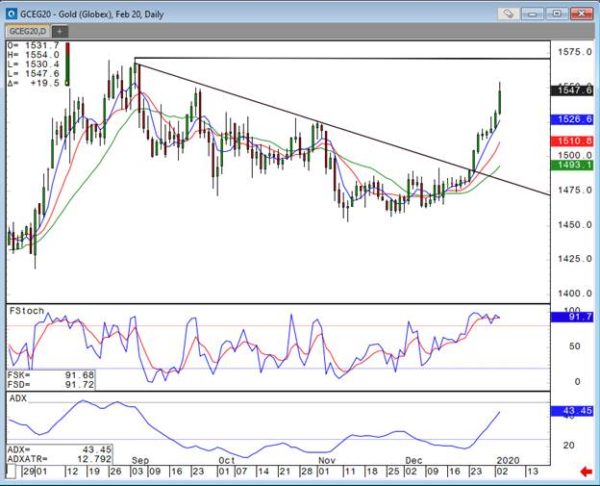
With an impressive start to the year this new heightened geopolitical development could be the catalyst to break out gold to multi year highs. The U.S. strike that killed a key Iranian general could have a ripple effect on the signing of the trade agreement on the 15th as China and Iran have recently worked together on joint military operations along with Russia. Any set back in the trade agreement would severely impact the direction of U.S. equities and the expectations for interest rate decisions globally. Price Analysis and Outlook The daily gold chart shows that momentum indicator slow stochastics are rising steadily and reaching overbought territory giving longer term indication that we have pushed into a Bull Market. While ADX, which measures strength of the trend, has turned up over 40 showing that the driving force behind the recent upward move is very strong. The 2 key levels of support to watch are the November 1st high of $1525.2 and the December 30th high of $1519.1. This should act as a consolidation level while a likely upside target completing this trend would be an objective of $1572
Posted by AGORACOM-JC
at 12:21 PM on Friday, January 3rd, 2020
SPONSOR: Tartisan Nickel (TN:CSE)
Kenbridge Property has a measured and indicated resource of 7.14
million tonnes at 0.62% nickel, 0.33% copper. Tartisan also has
interests in Peru, including a 20 percent equity stake in Eloro
Resources and 2 percent NSR in their La Victoria property. Click her for more information
THE nickel mining industry group is bracing for the possible increase in the global demand of nickel brought about by the boom of electric vehicles.
“The direction globally is really the EV (electric vehicle) industry and we have that global competitiveness because more than 50 percent of the component of the entire electric vehicle is really nickel. The batteries itself and the body need more nickel,†Philippine Nickel Industry Association (PNIA) Executive director Charmaine Capili said in a press conference, Friday. Capili explained battery companies are currently experimenting on putting more nickel mineral in batteries for electric vehicles.
“At present, the composition of the battery that is being used is six nickel, two cobalt, and two magnesium. [By] Late 2018, they already tried to use eight nickel, one cobalt, and one magnesium because they said it has lower production cost and higher efficiency, but they still have to test the durability and further its efficiency,†she said.
She said the growing demand for nickel is also foreseen in the goal of European countries to have zero-carbon emission by 2030 by shifting to electric vehicles.
She added that the demand is not only exclusive to other countries as it has been observed in the Philippine transportation.
“Daghang mga LGUs (local government units) karon nga naga-shift na especially sa Manila e-trike, e-jeep (A lot of LGUs right now are shifting into using electric-powered tricycle and electric-powered jeepneys),†Capili said.
Apart from batteries, she said the stainless steel used for the body of electric vehicles also has nickel in it.
Although the Philippines is one of the largest producers of the mineral’s ore along with Indonesia which is leading in the industry, she admitted there are still factor preventing the country to compete globally.
She said among the challenges are the limitations of exploring other areas because of the moratorium imposed by Executive Order (EO) 79.
“May limitations po sa explorations, no new permits. Kung ano lang yung na approved [areas] for existing operations, doon lang (We are only allowed to mine on those areas approved for operations),†she said.
“We have 9 million hectares available in the Philippines for minerals that is copper, gold, nickel. But the Philippines right now is only maximizing only 2 percent out of the 9 million [hectares], and out of the 2 percent, only 1 to 1.5 percent is operating. There is a very big potential,†she said citing data from the Department of Environment and Natural Resources – Mines and Geoscience Bureau (DENR-MGB).
She shared other challenges confronting the industry is the amount of resources, the low grade of nickel, high cost of electricity to process the mineral, and the technologies of extracting ores or for processing it.
Capili bared that to address these issues, PNIA, an association of seven mining companies operating in Surigao, Palawan, and Agusan is working with the DENR and the Department of Trade and Industry to establish a Nickel Industry Roadmap.
She said the roadmap also aims to create stable policies for the nickel mining industry and other industries reliant on nickel as well as programs that promote the sustainability of nickel mining in the country.
She also hoped that the moratorium will be lifted soon for the country to be globally competitive.
“Hopefully, by middle of this year, we can already share and launch the roadmap but we are still creating the composition of the Technical Working Group because we want to get inputs from the government, business sectors, European Chamber of Commerce in the Philippines, the Electric Vehicles Association of the Philippines, other nongovernmental organizations and academe,†she said.