Posted by AGORACOM
at 10:01 PM on Tuesday, October 8th, 2019
Labrador Gold is aggressively pursuing the under explored gold potential of Labrador.
2 large, separate, under-explored land packages that demonstrate potential for district scale gold discoveries.
Two successful gold explorers lead the way in the Labrador gold rush: Shawn Ryan and Roger Moss.
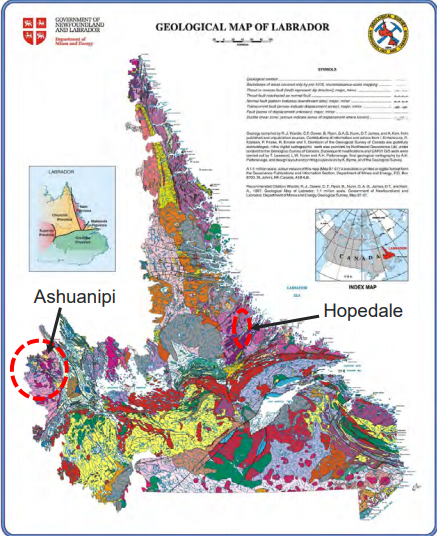
2 Key Exploration Properties: Hopedale and Ashuanipi
Hopedale:
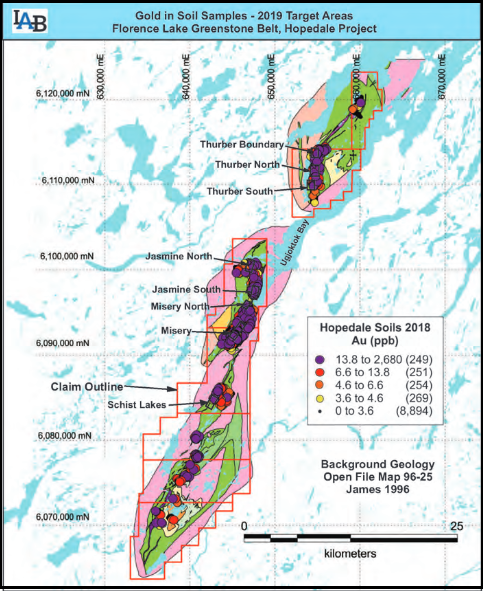
The Hopedale property covers much of the Hunt River and Florence Lake greenstone belts that stretch over 80 km. The belts are typical of greenstone belts around the world but have been underexplored by comparison. Initial work by Labrador Gold during 2017 show gold anomalies in soils and lake sediments over a 3 kilometre section of the northern portion of the Florence Lake greenstone belt in the vicinity of the known Thurber Dog gold showing where grab samples assayed up to 7.8g/t gold. In addition, anomalous gold in soil and lake sediment samples occur over approximately 40 kilometres along the southern section of the greenstone belt (see news release dated January 25th 2018 for more details). Labrador Gold now controls approximately 57km strike length of the Florence Lake Greenstone Belt.
Ashuanipi:
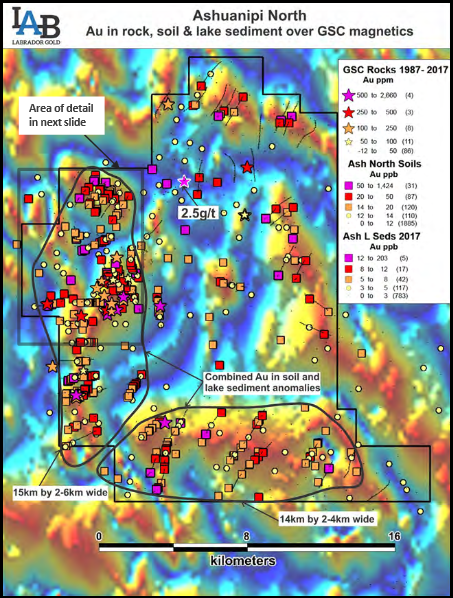
Two district scale gold anomalies outlined by soil and lake sediment survey: 15x3km north south anomaly and a 14 x 3km east west anomaly
2018 Soil Sampling identified: 164 samples with over 50 ppb gold, 67 samples over 100 ppb (0.1g/t) gold and a high of 8,973 ppb (8.97 g/t) Au
The Ashuanipi gold project is located just 35 km from the historical iron ore mining community of Schefferville, which is linked by rail to the port of Sept Iles, Quebec in the south. The claim blocks cover large lake sediment gold anomalies that, with the exception of local prospecting, have not seen a systematic modern day exploration program. Results of the 2017 reconnaissance exploration program following up the lake sediment anomalies show gold anomalies in soils and lake sediments over a 15 kilometre long by 2 to 6 kilometre wide north-south trend and over a 14 kilometre long by 2 to 4 kilometre wide east-west trend. The anomalies appear to be broadly associated with magnetic highs and do not show any correlation with specific rock types on a regional scale (see news release dated January 18th 2018). This suggests a possible structural control on the localization of the gold anomalies
Posted by AGORACOM
at 9:39 PM on Monday, October 7th, 2019
Pretium helped define the Golden Triangle with the discovery of high grade gold at Brucejack. Drilling success at American Creek’s Treaty Creek property just north of Pretium is demonstrating the opportunity for a second chance for those that missed out on Brucejack. Aiming to become a peer through sheer force of tonnage, American Creeks JV partner Tudor Gold is returning intercepts that are close to a mile in length, with 0.589 g/t Au over 1081.5m, including an upper interval of 0.828 g/t Au over 301.5m and a lower interval of 0.930 g/t Au over 207m that also demonstrated copper values before exceeding the length of the drill capabilities. Other holes include 0.725 g/t gold over 838.5m, 0.683g/t gold over 780m, and 0.98 g/t gold over 563m.
An equal measure of thanks should also be directed toward Ken Konklin, who made the discovery at at Brucejack, and is now Exploration Manager at Treaty Creek. He came out of retirement after putting the $3 billion Brucejack mine into place because he believes that Treaty Creek holds more potential than what’s he’s already accomplished. He has said that developing the Brucejack mine was a huge achievement but Treaty Creek is going to be his legacy: †The Goldstorm System shows no signs of weakening to the northeast and several more drill holes will be needed to find the length and depth of this huge gold system.Not only does the Goldstorm Zone remain open at depth and along strike, we are now seeing base-metal associations possibly as part of a zonation within the metal system.â€
Treaty Creek:
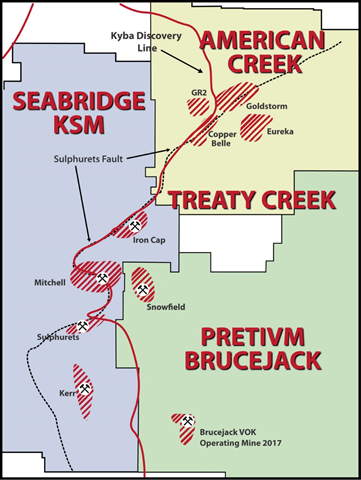
Part of the same Sulphurets Hydrothermal System that contains a mind boggling 188M oz gold, 1.2B oz silver and 55B lbs of copper (all categories) to date ( P&P reserves of 47M oz Au, 214M oz Ag, and 10B lbs Cu)
Same
trend – deposits occur about every 2-3 km going north with gold grades
increasing as the system extends northward – The Goldstorm zone on
Treaty Creek is the most northerly deposit to date
Huge logistical advantages by being on the right side of the mountain with direct access to power and highway
Potential open pit design requiring a fraction of the capital cost with a shorter payback period.
At the discovery stage of the mining life-cycle where biggest gains are typically made
Large deposits are found near the red “discovery line†and the Sulphurets fault
Has
already increased over 300% since spring and yet only the 2 sets of
assays have been released. Based on the geology, geophysics, extended
strike length and seemingly endless depth, it looks as though things
have just started for American Creek. A major drill program is
presently being conducted at Treaty Creek by JV partner and operator
Tudor Gold. There are now two drills working on the Goldstorm zone. The
Treaty Creek Project is a Joint Venture with Tudor Gold owning 60% and
acting as operator, with American Creek holding a 20% interest in the
project. American Creek is fully carried until such time as a Production
Notice is issued. Until such time, Tudor is required to fund all
exploration and development costs while American Creek has a “free
rideâ€.
For further information please contact Kelvin Burton at: Phone: 403 752-4040 or Email: [email protected]. Information relating to the Corporation is available on its website at www.americancreek.com
FULL DISCLOSURE: American Creek is an advertising client of AGORA Internet Relations Corp.
Posted by AGORACOM
at 2:07 PM on Thursday, October 3rd, 2019
SPONSOR: Lomiko Metals LMR:TSX-V – A Canadian exploration-stage company discovered high-grade graphite at its La Loutre Property in Quebec and is working toward a Pre-Economic Assessment (PEA) that will increase its current indicated resource of 4.1 Mt of 6.5% Cg to over 10 Mt of 10%+ Cg through a 21 hole program at the Refractory Zone. Click Here For More Information
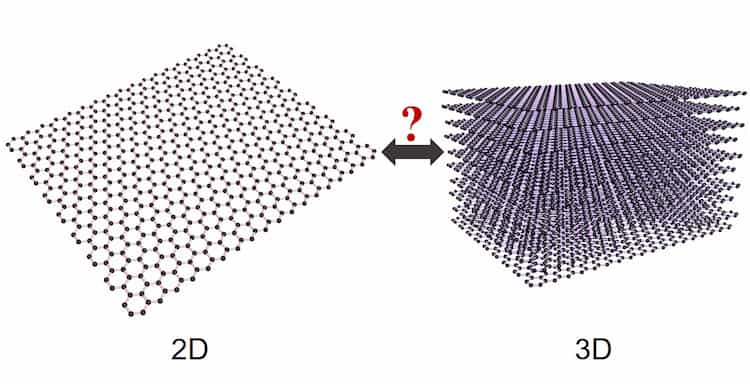
Contrary to what is believed, monolayer graphene (a sheet of carbon
just one atomic layer thick) has 3D mechanical properties and they can
now be properly measured and meaningfully described thanks to
high-pressure Raman spectra measurements on the material. This result,
from researchers at Queen Mary University of London, might have
implications for when graphene – and indeed other 2D materials – are
employed in applications such as mechanical sensors. It also highlights
the fact that Raman spectroscopy can be used as diagnostic tool to
measure the mechanical properties of graphene when it is employed as a
reinforcement for other materials.
“Graphene is called a 2D material because its carbon atoms lie in a two-dimensional plane,†explains team member Yiwei Sun.
“However, monolayer graphene has electrons in π-orbitals above and
below this plane. If we compress a sheet of graphene in a direction
normal to the sheet, graphene is strained because the π-electrons become
compressed and strained. If the sheet is compressed in all three
directions, it undergoes 3D strain, however. This means that 3D elastic
parameters can and must be defined for this material.
“So, graphene should really be thought of as a 3D material, not 2D, as far as certain mechanical properties are concerned.â€
Complementing previous experiments
Sun and colleagues also found that the stiffness of monolayer
graphene is the same as that of graphite (which is a stack of graphene
layers).
These results complement those from previous experiments in which
researchers studied the effect of pressure in graphene supported on a
substrate such as copper. The substrate strongly affects the contraction
of graphene and thus skews the result, says Sun.
Such experiments are performed in a diamond anvil cell (DAC). Here,
the samples are loaded into a pressure-transmitting medium, such as
water, in a hole of a 50-micron-thick metal gasket sandwiched between
two diamond culets 150 microns in size. Pressures of several gigapascals
are then applied to the cell.
“What is new in our work is that we studied unsupported monolayer graphene in solutionâ€, explains Sun.
The researchers started out in the usual way – with a monolayer of
graphene on a copper substrate. They then got rid of the substrate by
etching it away in a solvent after protecting the graphene by a polymer
film (PMMA) so that it floated on the etchant and could be located. They
took the graphene with the polymer out of the etchant, placed it on a
glass slide and rinsed it with de-ionized water. Next, they loaded the
graphene with the PMMA in DMF, which dissolved the PMMA leaving the
monolayer graphene free-standing in it. “We loaded the monolayer
graphene several times so that it was concentrated enough for a decent
Raman signal,†says Sun.
The DMF prevents the graphene from crumpling and/or bonding together
to form graphite for long enough to perform the high-pressure
experiments. These involved compressing the graphene-containing liquid
in a diamond anvil cell to pressures of 12 GPa and measuring its
in-plane and out-of-plane (normal to the plane) stiffness using optical
Raman spectroscopy.
In-plane and out-of-plane stiffnesses are the same for both graphene and graphite
The researchers compared their findings to those obtained on 3D
graphite and found that both the in-plane and out-of-plane stiffnesses
are the same for both materials, within the experimental errors of their
experiment.
“Stiffness is usually defined in terms of the stress and strain (the
change of thickness) a material can endure,†explains Sun. “We find that
under pressure the thickness of graphene decreases at the same rate as
that of graphite. Hence our claim that ‘graphene is graphite’ as regards
some key mechanical properties.â€
The team, led by Colin Humphreys and David Dunstan,
also reports on a shift to higher energy frequencies of in-plane
vibrations (phonons) of the unsupported monolayer graphene to
5.4/cm/GPa, which is very close to that of graphite (4.7/cm/GPa).
The in-plane force on graphene under pressure is significantly
reduced since graphene, like graphite, is very soft out-of-plane (this
is why we can write with the “lead†in pencils, which is graphite),†Sun
tells Physics World. “This reduction is what causes the
sublinear shift of its in-plane phonon frequency with pressure. This
physically meaningful experimental observable allows us to define the
thickness and strain of graphene in terms of the thickness of its
Ï€-orbitals.â€
The technique employed in this study, which is reported in Physical Review Letters, might be used on other unsupported 2D materials in solution, he adds.
“Fiddly handiworkâ€
“High-pressure experiments like these are easy to describe, but they are notoriously difficult to perform,†writes John Procter of the University of Salford in a related Viewpointarticle. Procter’s group was the first to study the effect of strain using Raman measurements of graphene in Si/SiO2 substrates
under high pressure. “Fiddly handiwork is required to align the DAC and
sample with micrometre-precision. Because of these demands, such
experiments also have a high failure rate. Sun and colleagues’ ability
to study graphene under a known high stress – a first – is therefore a
major achievement.â€
He adds that the research could help in the development of strain
sensors based on graphene. “It may also affect how Raman spectroscopy is
used as a diagnostic tool for new types of graphene composites that
serve to reinforce other materials. Here, the spectroscopy helps
determine the extent to which stress or strain is transferred from the
host material to the graphene reinforcement. Knowing graphene’s 3D
characteristics will help researchers optimize this reinforcing
behaviour.â€
Sun and co-workers say they are now looking at how the atmosphere affects the mechanical properties of graphene and graphite. Such studies will be important for when it comes to real-world applications of these materials. “For example, a graphene-based device may perform very differently in a humid Manchester in the UK to a dry Arizona in the US,†says Sun.
Posted by AGORACOM
at 1:52 PM on Thursday, October 3rd, 2019
SPONSOR: Advance Gold AAX.v – Advance Gold controls 100% interest in the Tabasquena Silver Mine in Zacatecas, Mexico. A cluster of 30 Epithermal veins have been discovered, with recent emphasis on exploring a large anomaly to drill. Advance also owns 15% of the Kakamega JV attached to Barrick Takeover Offer for Acacia Mining. Click Here For More Info
Recession fears are once again gripping financial markets and
pushing gold prices higher as sentiment within the U.S. service sector
fell more than expected, according to the latest data from the
Institute for Supply Management (ISM).
Thursday, the ISM said its nonmanufacturing index showed a reading
of 52.6% for September, down from August’s reading of 56.4%. The data
was much weaker than expected as consensus forecasts were calling for a
reading of 55.1%.
According to reports this is the lowest reading in three years.
Readings above 50% in such diffusion indexes are seen as a sign of
economic growth, and vice-versa. The farther an indicator is above or
below 50%, the greater or smaller the rate of change.
Ahead of the report, the gold market was holding its own above
$1,500 an ounce, recovering from a 2% selloff at the start of the week.
The latest economic data has added to gold’s gains. December gold
futures last traded at $1,518.80 an ounce, up 0.72% on the day.
Economists and analysts warned that disappointing service sector
data could boost recession fears as this is the largest component of
the U.S. economy.
The nonmanufacturing data comes just two days after the ISM said
that its manufacturing index fell even further into contraction
territory, also missing economist expectations.
“The non-manufacturing sector pulled back after reflecting strong
growth in August. The respondents are mostly concerned about tariffs,
labor resources and the direction of the economy,†said Anthony Nieves,
chair of the ISM Non-Manufacturing Business Survey Committee.
Looking at the components of the report, the Business Activity Index
dropped to a reading of 55.2%, down from August’s level of 61.5%.
The labor market also lost some momentum in September, with the
Employment Index falling to 50.4%, down from August’s level of 53.1%.
This indicator is closely watched by economists as it is used as a
predictor for Friday’s nonfarm employment report.
Some economists have noted that the miss in the ISM employment data points to downside risk to Friday’s employment report.
Posted by AGORACOM
at 12:36 PM on Thursday, October 3rd, 2019
VANCOUVER, BC / ACCESSWIRE / October 3, 2019 /VERTICAL
EXPLORATION INC. (TSXV:VERT) (“Vertical” or “the Company”) and
Venturevest Realty Partners LLC (“Venturevest”) are pleased to announce
that the two companies have signed a non- binding Letter of Intent (LOI)
to enter into discussions regarding the provision by Venturevest of a
secured Note Facility up to a maximum amount of $20 million CAD to
support the multi-phased development of the St-Onge Wollastonite
Deposit.
The Note Facility would be a staged credit facility that
would provide the required financing to allow Vertical to move forward
with four distinct phases of St-Onge development, from the initial
quarry style permitting and production phase through to the mining and
final processing plant stage. Vertical views this potential Note
Facility financing as a significant development that would enable the
Company to rapidly develop and expand its St-Onge Wollastonite Deposit.
Further
details regarding the Note Facility Agreement will be provided as soon
as all terms have been negotiated between Vertical and Venturevest. The
Agreement is subject to a due diligence period that is anticipated to be
completed within the next 60 days. This transaction is subject to the
approval of the TSX Venture Exchange.
ABOUT VENTUREVEST REALTY PARTNERS LLC.
Venturevest Realty Partners LLC (“Venturevest”) is a New York corporation.
ABOUT VERTICAL EXPLORATION
Vertical
Exploration’s mission is to identify, acquire, and advance high
potential mining prospects located in North America for the benefit of
its stakeholders. The Company’s flagship St-Onge Wollastonite property
is located in the Lac-Saint-Jean area in the Province of Quebec.
Posted by AGORACOM
at 9:49 AM on Tuesday, October 1st, 2019
Received additional encouraging preliminary results from the University of British Columbia-Okanagan (UBC-O) which has used ZEN’s Graphene to enhance the performance of aluminum casting alloys
These potential applications could lead to patents and significant markets for the Company.
ZEN will continue to support UBC-O as per the 3 year Memorandum of Understanding signed in June
Thunder Bay, Ontario–(Newsfile Corp. – October 1, 2019) – ZEN Graphene Solutions Ltd. (TSXV: ZEN) (“ZEN” or the “Company“)
is pleased to announce additional research and development results
using a ZEN Graphene additive in a sintered aluminium metal composite
and ZEN Graphene in a corrosion-inhibiting coating.
The
Company very recently received additional encouraging preliminary
results from the University of British Columbia-Okanagan (UBC-O) which
has used ZEN’s Graphene to enhance the performance of aluminum casting
alloys. UBC-O has mixed small volumes of Graphene with an aluminum
powder which was then sintered in Spark Plasma Sintering (SPS)
equipment. Preliminary results indicate that the Graphene resulted in a
significant increase in the electrical conductivity of the material with
a relatively small Graphene loading. Dr. Bichler commented: “Aluminum
with increased conductivity would have vast industrial applications.”
Test work will continue to optimize the Graphene loading to optimize the
electrical conductivity of the aluminum along with improvements in the
thermal and mechanical properties.
Additionally,
UBC-O reported encouraging preliminary results on the use of ZEN’s
Graphene in an epoxy corrosion-inhibiting coating for steel. UBC-O
tested four samples of steel: one uncoated, one coated with epoxy only,
one coated with an epoxy-graphite mixture, and one with an
epoxy-Graphene mixture. The four samples were then exposed to a
corrosive, highly saline solution for 10 days after which the level of
surface of corrosion was examined and quantified. The following
preliminary observations were reported by UBC-O:
Uncoated steel – 100% of surface corroded
Epoxy-coated steel – 67% of surface corroded
Epoxy-graphite mix coated surface – 93% of surface corroded
Epoxy-Graphene mix coated surface – only 3% of surface corroded
These
promising anti-corrosion results from the Epoxy-Graphene mix coated
surface will be followed up by additional test work to optimize the
Graphene loading in the epoxy resin to potentially develop an
anti-corrosion coating application.
ZEN
Graphene Solutions Ltd. is an emerging graphene technology company with
a focus on development of the unique Albany Graphite Project. This
precursor graphene material provides the company with a competitive
advantage in the potential graphene market as independent labs in Japan,
UK, Israel, USA and Canada have demonstrated that ZEN’s Albany Graphite
easily converts (exfoliates) to graphene, using a variety of simple
mechanical and chemical methods.
To find out more on ZEN Graphene Solutions Ltd., please visit our website at www.ZENGraphene.com. A copy of this news release and all material documents in respect of the Company may be obtained on ZEN’s SEDAR profile at www.sedar.ca.
Posted by AGORACOM
at 2:34 PM on Monday, September 30th, 2019
SPONSOR: Gratomic Inc. (TSX-V: GRAT) Advanced
materials company focused on mine to market commercialization of
graphite products, most notably high value graphene based components for
a range of mass market products. Collaborating with Perpetuus, Gratomic
will use Aukam graphite to manufacture graphene products for
commercialization on an industrial scale. For More Info Click Here
The wonder material is yet to live up to its potential but an Indian startup is weaving dreams with this form of carbon
The molecule is priceless, but it’s not the cost — a few lakh rupees
per kilo — that helped graphene win the epithet of “wonder material†or
“possibly the most remarkable substance discovered†in scientific
circles.
Graphene owes its impressive resume to its multiple attributes —
strong, flexible, light, transparent, waterproof and a good conductor of
electricity. Ever since it was discovered in 2004, scientists have been
speculating about its potential uses — replacing silicon in
electronics, indium in touchscreens and liquid polymer in bulletproof
vests. Unfortunately, the wonder material has failed to deliver on its
promises and still has a long way to go.
Despite that, scientists and entrepreneurs haven’t stopped pumping
billions of dollars and man hours into the quest for new inventions with
graphene that can transform sectors such as electronics, energy, health
and construction.
Log 9 Materials, a Bangalore-based nanotechnology start-up, has been
chasing the graphene dream since it was founded in 2015 by IIT-Roorkee
graduates Akshay Singhal and Kartik Hajela. It has been trying to tame
the material in many avatars — cigarette filters, batteries for
electronic vehicles and coatings for aircraft. Their latest foray is
into industrial clean up, including oil leaks and oil spills. Liquid
petroleum often gets accidentally released into oceans, bays and rivers
during transport and the spill does irreparable damage to aquatic life.
“The oil sorbent pads (LSP 20) innovated by us help contain and
absorb off-shore and on-shore [oil] spills as well as spills of other
chemicals,†says Akshay Singhal, co-founder and chief executive officer
of Log 9 Materials. “LSP 20 is able to absorb spills up to 86 times its
own weight. It has been tested against British Standards by third party
laboratories and has also been certified safe to incinerate and
dispose,†he adds.
There is always a risk of spillage during exploration, transportation
and storage of oil. Spills have the potential to cause irreparable
ecological damage in sea and on land. In situ combustion, oil booms and
oil skimmer vessels are used to clean up such spills but are not very
efficient. The products and particulates emitted through oil combustion
pollute the atmosphere while booms and skimmers, which are meant to
confine the spill to a specific location for collection, do not work
well in turbulent water.
One of the most economical and efficient means of removing oil spills
is to use sorbents that repel water (hydrophobic) but absorb oil
(oleophilic).
Akshay Singhal, co-founder and chief executive officer of Log 9 Materials
One of the most efficient means of removing oil spills is to use sorbents that repel water but absorb oil
Various natural absorbers such as expanded perlite and zeolites,
organic materials such as wool fibre, activated carbon and sawdust have
all been used as sorbents because of their extremely small pores.
However, these materials are incapable of absorbing oil without the
water. That is why new materials are needed that can sequester oil and
remove it. Various microporous polymers have been studied due to their
large specific surface area and hydrophobicity. Although they show
relative high absorption ability, the cost of these kinds of sorbents is
also high.
Graphene, discovered at the University of Manchester, UK, in 2004,
consists of thin flakes of carbon atoms arranged in a hexagonal
structure. It has a high surface area. While a typical carbon atom has a
diameter of about 0.33 nano metres, there are about three million
layers of graphene in 1mm of graphite — a crystalline form of the
element, carbon. Harder than diamond but more elastic than rubber,
tougher than steel yet lighter than aluminium, it can be processed into
various unique structures. Several graphene-based structures have been
designed and fabricated over the past decade to strongly repel water
(superhydrophobic) but absorb oil (superoleophilic) efficiently. These
characteristics make graphene an ideal candidate for selective
absorption of oil spills.
“We manufacture products to control spills of all forms, using
graphene. These products can be used to prevent, control and clean
spills in and around marine or terrestrial ecosystems,†says Dhananjay
Sharma, director and chief executive officer, Log 9 Spill Containment
Pvt. Ltd.
“The company has a larger agenda to educate various industries and
businesses about the value propositions attached to using graphene-based
products or offerings with respect to cost savings and environmental
impact,†he adds.
While graphene has countless potential applications, Log 9’s focus is
on two main areas: filtration and energy. Apart from the oil sorbent
pad, they are currently working on a metal-air battery which could
replace the current lithium ion batteries.
Says Singhal, “This battery makes use of the interaction of air,
water and aluminium. The air cathode made of graphene generates
electricity, thus making it lighter in weight compared to lithium ion
batteries.†Moreover, these batteries can run about 1,000km on a single
charge compared to 100-150km of the current ones.
Technology usually progresses at a slow pace. Swedish chemist Jakob
Berzilius purified silicon in 1824 but it took more than a century for
the semiconductor — used to run all modern electronic gadgets — industry
to develop. Most of the components of today’s smartphones, from
microprocessors to touchscreens, were also invented in the 1960s. It is,
therefore, expected that it will take some time for more horizons to
open up in the world of graphene. It is laudable that an Indian start-up
has dared to join graphene’s innovation race.
Posted by AGORACOM
at 9:46 AM on Monday, September 30th, 2019
Cardston, Alberta–(Newsfile Corp. – September 30, 2019) – American Creek Resources Ltd. (TSXV: AMK) (“American Creek”) (“the Corporation”) is pleased to announce composite results from JV partner Tudor Gold’s ongoing drill program being conducted at the Treaty Creek Project located in the Golden Triangle of NW British Columbia. As announced on September 23, 2019 we now have results from two deep vertical diamond drill holes (drilled to a depth of over 1,000m) and four definition drill holes. All six holes intercepted significant gold mineralization over wide intervals at the Goldstorm Zone.
Goldstorm Extension
Hole GS19-47 was drilled as a 150m step-out from hole GS19-42
(reported July 30, 2019 averaging 0.683 g/t Au over 780m) and was
drilled vertically to a total depth of 1,199m, ending in mineralization.
The hole contains strong stockwork with gold-bearing mineralization
accompanied by significant base-metal disseminated sulphide
mineralization averaging 0.589 g/t Au over 1081.5mincluding an upper interval of 0.828 g/t Au over 301.5m and a lower interval of 0.930 g/t Au over 207 m.
The hole was stopped in mineralization due to the drill rig reaching
its depth limitation, however, casing was left in the hole for possible
continuation next year.
This 150 meter step-out hole confirms that the Goldstorm system is
gaining strength to the northeast. With this strongly mineralized
intercept, the Goldstorm Zone has been extended by a total of 300m
this year from the best hole drilled in 2018 (CB18-39, averaging 0.981
g/t Au over 563.8m) and has now been traced along strike for over 800
meters.
Goldstorm Definition Drilling
A second deep vertical hole, GS19-48, was drilled to a total depth of
1035m from the same pad as CB18-39 (drilled in 2018). The results
exhibit excellent continuity of mineralization between holes and this
drill hole returned 0.725 g/t Auover 838.5m, including a near surface interval of 328.5m averaging 1.048 g/t gold Au.
Four footwall definition holes (GS19-43 to GS19-46) drilled on
section 109+00 NE, were successful in extending the width of the
mineralized zone, to the southeast into the footwall of the controlling
fault structure.
Hole GS19-43 returned an average of 0.566 g/t Au over 493.5m;
Hole GS19-44 returned an average of 0.807 g/t Au over 267m including 1.065 g/t Au over 150m;
Hole GS19-45 returned an average of 0.719 g/t Au over 325.5m including 1.000 g/t Au over 173m.
Hole GS19-46 returned an average of 0.510g/t Au over 594m including 0.734 g/t Au over 162m.
Tudor Gold Exploration Manager, Ken Konkin explains:
“Given the success of the two deep drill holes GS19-47 and GS19-48, the
Goldstorm System shows no signs of weakening to the northeast and
several more drill holes will be needed to find the length and depth of
this huge gold system. Hole GS19-47 showed a very strong quartz
stockwork system and was still in gold values at the end of the 1,199
meter drill hole. The bottom of GS19-47 averages 0.930 g/t Au over 207 meters.
This is the first time we’ve seen this strength of gold mineralization
at depth. Furthermore, a strong copper association was encountered with
gold values at depth in both GS19-47 and GS19-48.
A 151.5m zone of 0.22% copper with 0.572 g/t gold was intercepted from 665.0 to 816.5 meters in GS19-47 and a 66.0m zone of 0.35% copper with 0.958 g/t gold was intercepted from 874.5 to 940.5m in GS19-48.
Not only does the Goldstorm Zone remain open at depth and along
strike, we are now seeing base-metal associations possibly as part of a
zonation within the metal system.”
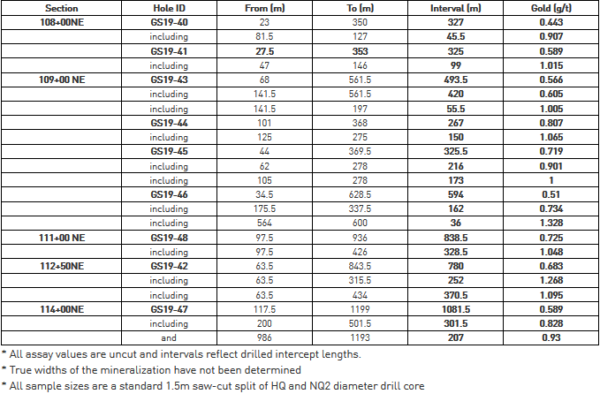
The following table provides gold composites from all nine 2019 drill
holes completed on five sections that cut the Goldstorm Zone
Table 1: Gold Composite Intervals for Drill Holes GS19-40 to GS19-48
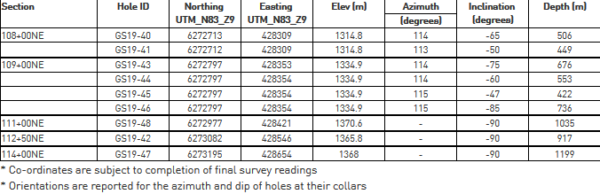
The following table contains diamond drill hole location data for the
drill holes completed in 2019. See the accompanying plan map that shows
drill hole locations and section lines.
Table 2: Diamond Drill Hole Co-ordinates
* Co-ordinates are subject to completion of final survey readings * Orientations are reported for the azimuth and dip of holes at their collars
Goldstorm Zone Drill Section 109+00 NE, 111+00 NE and 114+00 NE
Section 114+00 NE is a 300 m step-out on strike from 111+00 NE and
hole GS19-47 hosts what is now the longest and deepest gold intercept on
the project to date.
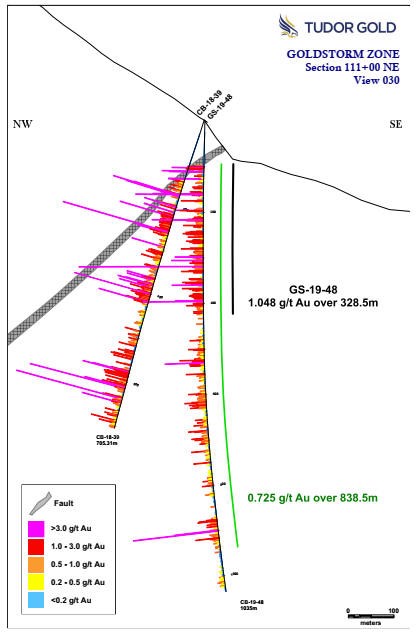
Section 111+00 NE shows the consistency of the upper horizon gold grades between holes and new depth extension in hole GS19-48.
Section 109+00 NE shows four definition holes drilled this season to better outline the extent of the zone to the southeast.
Goldstorm Zone Plan Map
The Goldstorm Zone now extends more than 800 meters in strike length
and remains open along strike to the Northeast and Southwest as well as
to depth.
Goldstorm zone drill sections and the plan map are included at the bottom of the news release.
The diamond drilling program continues with two drill rigs. Additional results will be announced as they become available.
Walter Storm, Tudor Gold President and CEO, stated:
“I am very pleased to see that all nine holes drilled have reported
very good results and we have not missed on any step-out targets nor any
footwall extension holes, they were all hits. These results have proven
that we have an excellent understanding of the structure, geology and
mineralogy of this massive gold system. I am looking forward to
continuing our exploration efforts in order to unlock the full potential
of this large gold system.”
Darren Blaney, American Creek CEO, stated: “The
Goldstorm deposit continues to produced world-class intercepts that are
both deep and yet very strong close to surface. Hole GS-19-48 carries 0.725 g/t Au over 838.5m including a near surface interval of 1.048 g/t over 328.5m. It’s just one of many holes that extend to depth ending in mineralization.
In referring to the step out hole GS-19-47 (0.589 g/t Au over
1081.5m including an upper interval of 0.828 g/t Au over 301.5m and a
lower interval of 0.930 g/t Au over 207 m), Eric Sprott stated “That’s
a huge, huge, huge intersection! I’ve always thought this thing has an
easy shot of coming up with 20 million ounces of low-grade gold and
there’s nothing in these results that will deter me from thinking that,
and they’re well positioned in terms of logistics”. What we’re
really excited about is the richer intersections for hundreds of meters
close to surface throughout the entire Goldstorm system. While this
system is proving to be very deep, the reality is it’s also becoming a
rich gold system close to surface that lends itself towards the
possibility of being open pit mined”.
QA/QC
Drill core samples were prepared at MSA Labs’ Preparation Laboratory
in Terrace, BC and assayed at MSA Labs’ Geochemical Laboratory in
Langley, BC. Analytical accuracy and precision are monitored by the
submission of blanks, certified standards and duplicate samples inserted
at regular intervals into the sample stream by Tudor Gold personnel.
MSA Laboratories quality system complies with the requirements for the
International Standards ISO 17025 and ISO 9001. MSA Labs is independent
of the Company.
Qualified Person
The Qualified Person for this news release for the purposes of
National Instrument 43-101 is Tudor Gold’s Exploration Manager, Ken
Konkin, P.Geo. He has read and approved the scientific and technical
information that forms the basis for the disclosure contained in this
news release.
About American Creek
American Creek is a Canadian junior mineral exploration company with a
strong portfolio of gold and silver properties in British Columbia.
Three of those properties are located in the prolific “Golden
Triangle”; the Treaty Creek and Electrum joint venture projects with
Tudor Gold/Walter Storm as well as the 100% owned past producing Dunwell
Mine.
A major drill program is presently being conducted at Treaty Creek by
JV partner and operator Tudor Gold. There are two drills working on the
Goldstorm zone at present.
The Treaty Creek Project is a Joint Venture with Tudor Gold owning
60% and acting as operator. American Creek and Teuton Resources each
have 20% interests in the project. American Creek and Teuton are both
fully carried until such time as a Production Notice is issued, at which
time they are required to contribute their respective 20% share of
development costs. Until such time, Tudor is required to fund all
exploration and development costs while both American Creek and Teuton
have “free rides”.
The Corporation also holds the Gold Hill, Austruck-Bonanza, Ample
Goldmax, Silver Side, and Glitter King properties located in other
prospective areas of the province.
For further information please contact Kelvin Burton at: Phone: 403 752-4040 or Email: [email protected]. Information relating to the Corporation is available on its website at www.americancreek.com
Figure 1: Goldstorm Zone Selected Results From Deep Step-out Holes
Posted by AGORACOM
at 8:25 AM on Wednesday, September 25th, 2019
SPONSOR: Applied Biosciences Corp. is a vertically integrated company focused on the development of science-driven cannabinoid therapeutics and biopharmaceuticals, as well as state-of-the-art testing and analytics. As a leading company in the CBD, Pet and Health and Wellness space, the company is currently shipping to the majority of US states as well as to 5 International countries. Click Here for More Info
CBD, or cannabidiol, is a non-psychoactive compound found in
cannabis. It has seen a lot of interest recently, which has created a
rush to establish a foothold in the rapidly-growing, emerging market.
Accelerating this market boom is CBD’s purported medicinal
properties, and since, for the most part, the compound, found in both
cannabis and hemp, is marketed as a nutritional supplement, the ability
to make health claims is encumbered only by a disclaimer that the FDA
has not evaluated said promises. Unsurprisingly, CBD today is marketed
as a miracle cure-all, treating everything from headaches to cancer, as
well as aid in mental wellness. But has the CBD market outpaced the
known science?
Two of the most popular ailments that proponents claim are sleep
improvement and anxiety. One recent study, published in January of 2019,
found promise in using CBD to treat anxiety-related disorders but
concluded that controlled, clinical studies are needed, especially in
light of so much interest within the lay population.
Pain management is another area in which CBD shows promise, with many
current and retired athletes, individuals known for pushing their
bodies for maximum performance, at the expense of lasting, chronic pain.
Traditional pain and inflammation treatments, such as Ibuprofen, can
cause long-term damage to internal organs, or in the case of more potent
pain killers, like OxyContin, lead to addiction. Last year, the World
Anti-Doping Agency removed CBD from its list of banned substances,
perhaps a sign of CBD’s popularity and efficacy. But once again,
research finds that while there is promise, no conclusive evidence
exists because of a lack of consistent studies, also cautioning that
longer-term trials are needed to understand the long-term effects and
efficacy of CBD with regards to pain management.
The FDA has approved a pharmaceutical version of cannabidiol, sold
under the name Epidiolex last summer, for the treatment of two rare and
severe forms of epilepsy, Lennox-Gastaut syndrome and Dravet syndrome.
Both syndromes begin to affect patients in childhood, with
Dravet-related seizures appearing within the first year of life. CBD
helps control seizures and improve quality of life. To date, the FDA has
not approved the use of CBD for any other conditions however.
Despite the science of how CBD works on our minds and bodies still
being less than conclusive, at least by medical standards, that hasn’t
stopped people from using and swearing by the curative properties of the
cannabis-derived substance. And since the supplement is not as tightly
regulated as medicine, those interested in using CBD should do their
research into the manufacturer, and discuss it with their physician
prior to use.
Posted by AGORACOM
at 1:43 PM on Tuesday, September 24th, 2019
SPONSOR: Labrador Gold – Two successful gold explorers lead the way in the Labrador gold rush targeting the under-explored gold potential of the province. Exploration has already outlined district scale gold on two projects, including over a 40km strike length of the Florence Lake greenstone belt, one of two greenstone belts covered by the Hopedale Project. Click Here for More Info
Investors are starting to pay more attention to junior miners but the
sector isn’t out of the woods when it comes to attracting much needed
capital, according to one mining executive.
Gold’s $200 rally this year has breathed new life in the precious
metals market, but the junior sector has seen only a small portion of
renewed investor interest. The TSX Venture Index ($JX),
which is heavily weighted with junior explorers is up less than 3% this
year, a disappointing performance compared to gold’s 18% rally so far
this year.
Following a busy and positive Beaver Creek Precious Metals Summit, Ioannis Tsitos, president of Goldsource Mines (TSX.V: GXS)
said that the junior exploration sector needs more than just higher
gold prices to attract investors; it needs new discoveries: greenfield
discoveries
“In the last decade we have seen a significant decline in budgets for
greenfield exploration and that has led to less discoveries and that
has led to less stories in the marketplace,†he said.
Greenfield exploration refers to projects in unchartered territory
where information on the region’s mineralization is unknown. Because of
that lack of initial mineral information greenfield projects are seen as
a higher risk compared to brownfield projects, where exploration is
done around an existing mime.
Tsitos added that not only are few deposits being discovered but
grades are also dropping, which leads to a general lack of excitement in
the industry.
“Investor sentiment is improving for the sector but junior explorers
still need to do a lot more work and show that they are finding new
deposits,†he said.
Tsitos’ comments come as the company
develops its Salbora project, in Guyana, South America, which isn’t
exactly a greenfield project as there has been some preliminary airborne
surveys of the area. The project is also 1.5 kilometers from the
company’s Eagle Mountain Gold Project. However, the company has been
doing a lot of work to define the project’s mineralization.
Earlier this spring the company was able to raise nearly $7.5 million
in an oversubscribed private placement deal. Tsitos added that the
company has spent about $2 million on an aggressive exploration,
targeting 4,000 to 5,000 meters drilled by the end of the third quarter.
“The private placement was oversubscribed in one day,†he said. “It just shows how starved investors are for a new discovery.â€
Tsitos added that his company didn’t set out to be a greenfield
explorer but have embraced this role as the company ran into production
issues when it started producing gold at Eagle Mountain. He added that
the company needed to expand its resource to make the original mine more
efficient.
“For us exploring in a greenfield was a necessity. We were driven by
internal forces and our organic growth objectives,†he said. “But being
on this side we see the need for new discoveries in the industry.â€