Agoracom Blog Home

Author Archive

CLIENT FEATURE: Vertical Exploration $VERT.ca- Consolidation of St-Onge Wollastonite Land Position an Indicator of Future Agricultural Demand $TORR.ca $FA.ca $WEED.ca $CGC $ACB $APH $CRON.ca $HEXO.ca $TRST.ca $OGI.ca

Posted by AGORACOM at 7:30 PM on Monday, August 19th, 2019
  • Acquired 5 new claims to consolidate the current St-Onge Wollastonite Project model
  • Surface area covers 1747 hectares (17.5 square kilometres)
  • The high-grade St-Onge Wollastonite deposit has pit-constrained mineral resources of: 7,155,000 tonnes Measured@ 36.20% Wollastonite & 6,926,000 tonnes Indicated@ 37.04%
  • B.C. Buds Testing Confirmed Wollastonite is Critical to Marijuana Growers
  • Engaged AGRINOVA over the past year to conduct research and testing of Vertical’s St-Onge wollastonite on a range of important agricultural end uses.
  • Vertical is researching the use of Wollastonite as a soil additive for optimizing marijuana growth
  • Phase Three trials involving cannabis grown with Wollastonite (CaSiO3) as a soil additive at BC Bud Depot’s (BCBD) ACMPR-licenced Research and Development facilities in Vancouver, BC
  • Phase Three trials measured and recorded significant improvements in root mass, powdery mildew control and pest elimination.
  • In every case the most optimal results occurred with an admixture rate of 10% to 15% Wollastonite to the growth medium

WOLLASTONITE

  • St-Onge-Wollastonite Deposit located approximately 90 kilometres Northwest of the city of Saguenay, in St-Onge township, in the Saguenay-Lac-St-Jean region of Quebec, Canada.
  • Wollastonite is a calcium inosilicate mineral that may contain small amounts of iron, magnesium, and manganese substituting for calcium
  • Research and testing in the Phase 1 program for use in cannabis growth was managed and monitored by AGRINOVA, a highly-regarded Center for Research and Innovation in Agriculture in Quebec

St-Onge-Wollastonite Deposit:

FULL DISCLOSURE: Vertical Exploration is an advertising client of AGORA Internet Relations Corp.

CLIENT FEATURE: Gratomic $GRAT.ca Developing Conductive Inks and Pastes from Aukam Graphite Mine $SRG.ca $NGC.ca $LLG.ca $GPH.ca $NOU.ca

Posted by AGORACOM at 1:40 PM on Monday, August 19th, 2019
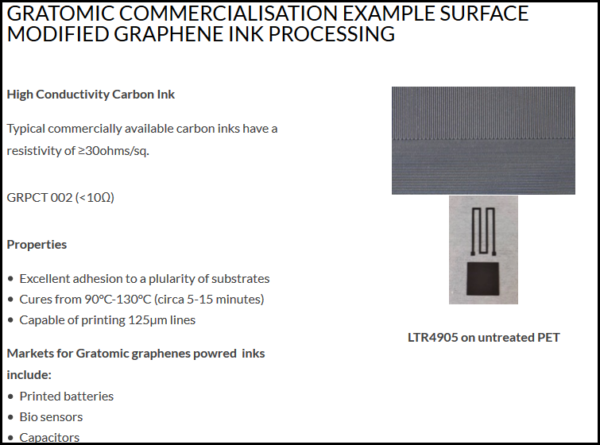
  • Launches Gratink, conductive inks and pastes
  • The inks and pastes (to the best of the Company’s knowledge) are amongst the most conductive carbon inks and pastes currently available within the global market place.
  • The Gratink product is formulated specifically to meet the needs of the printed flexible electronics and EMI shielding markets
  • The Gratink and paste applications based on surface modified nano graphene “enablers” offer a product for market penetration into the information technology sector that is now an important aspect of our everyday life.  

About Gratomic Inc.

Gratomic is an advanced material company focused on mine to market commercialization of graphite products, most notably high-value graphene-based components for a range of mass market products.

Gratomic Hub on Agoracom

FULL DISCLOSURE: Gratomic is an advertising client of AGORA Internet Relations Corp.

LOMIKO $LMR.ca #Graphene Technology Finally Grows Up $CJC.ca $SRG.ca $NGC.ca $LLG.ca $GPH.ca $NOU.ca $DNI.ca

Posted by AGORACOM at 11:42 AM on Friday, August 16th, 2019

SPONSOR: Lomiko Metals LMR:TSX-V – A Canadian exploration-stage company discovered high-grade graphite at its La Loutre Property in Quebec and is working toward a Pre-Economic Assessment (PEA) that will increase its current indicated resource of 4.1 Mt of 6.5% Cg to over 10 Mt of 10%+ Cg through a 21 hole program at the Refractory Zone. Click Here For More Information

The emergence of graphene technology back in 2004 sent physicists and electronics engineers into euphoric spasms about its operational potential.

 But as always with ground-breaking, technologies that old bean-counting devil called financial viability raised its head when it came to integrating graphene into commercial applications. 

Challenges With Graphene

One of the problems during those pioneering days was the fact the graphene technology had so many varied and attractive properties and this meant it’s possible applications were numerous, to say the least.

However, in the enthusiastic rush to use the technology pragmatism took a back seat and some developers drastically overlooked the practical challenges in applying graphene to certain commercial areas.

But those days are disappearing and graphene is starting to fulfil its promises in a whole raft of applications from both technical and financial perspectives.

Graphene Technology Breakthroughs

More on those later but firstly let’s take a look at a couple of the latest and very exciting graphene breakthroughs that have a direct impact on the electronics industry. Over at the Danish funded Centre for Nanostructured Graphene at DTU and Aalborg University, researchers have finally cracked a well-known problem with graphene which focuses on how holes are made in the material. 

This may sound simplistic but the pattern of holes dictates how the electrons in the material behave and this has direct relevance to how graphene can be designed into certain applications. 

graphene nanotechnology

For years the nub of the problem has been that making the incredibly tiny nanoscale holes in graphene can cause contamination in the material which detrimentally alters its operational characteristics. 

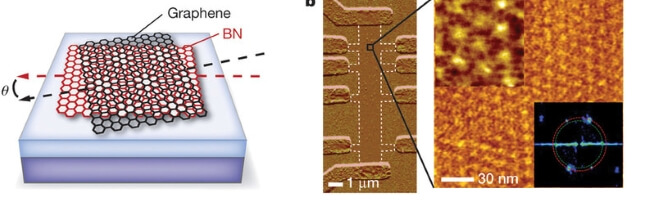
However, the team of scientists at the Centre have solved that problem by encapsulating the graphene inside another two-dimensional material, hexagonal boron nitride. This is a non-conductive material that can protect graphene’s properties. 

Electron beam lithography was used to create the pattern in the protective layer of boron nitride and graphene. And to give you some idea of just how complex this work is the holes have a diameter of about 20 nanometres and there are only 12 nanometres space between them. Don’t forget, one nanometre is a billionth of a metre, or put another way a human hair is approximately 80,000 nanometres wide. 

So why is this breakthrough such a big deal? One of the advantages of graphene is its potential application versatility, particularly in electronics but this versatility has until now been thwarted by the difficulty of introducing bandgap which is the difference between the top of the valence band, and the bottom of the conduction band. 

We know that graphene is an incredibly good conductor but without an integral bandgap, it can’t be switched off which is an essential element in semiconductor-related applications. Now though, and thanks to this breakthrough, the bandgap problem has been overcome and in addition to that, the flow of electrical current through graphene has been increased a 1000-fold. 

In another ground-breaking graphene development researchers at America’s Department of Energy’s Lawrence Berkeley National Laboratory have created a graphene device that easily switches from a superconducting material that conducts electricity without losing any energy, to an insulator that resists the flow of electric current, and back again to a superconductor. 

The device consists of three nano-thin layers of graphene which are contained within layers of boron nitride and this forms a moiré superlattice pattern. 

graphene material technology

The researchers feel this material could help scientists further understand high-temperature superconductivity where material can conduct electricity without resistance at temperatures higher than expected, although these temperatures are still hundreds of degrees below freezing.

Innovations in Graphene Application Progress

So what about all those applications I mentioned earlier where graphene is starting to fulfil both its technical and financial promises?

Let’s start with batteries and energy storage products. With the environmental push towards electric vehicles (EVs), graphene can now help with lithium battery technology because it can reduce electrode resistance without decreasing active material content. This characteristic translates into batteries have increased performance at high discharge rates, something that designers of EVs like. 

According to a report by IDTechEx Research graphene conductive inks are also becoming a reality. These had to prove that they offered both a performance and price advantage over carbon and metal-based products. However, these days graphene conductive inks are finding many applications in radio-frequency identification (RFID) antenna materials. 

Graphene Uses

Graphene is also proving successful in thermal applications and is doing particularly well as a thermal spreader in cell phones. It provides much better thermal conductivity to copper at a lower weight. 

SOURCE: https://www.electropages.com/blog/2019/08/Graphene-Technology-Finally-Grows-Up

Vertical Exploration $VERT.ca Acquires Additional Surface Rights and Initiates Field Sampling Program at its Flagship St-Onge Wollastonite Project in Quebec $TORR.ca $FA.ca $WEED.ca $CGC $ACB $APH $CRON.ca $HEXO.ca $TRST.ca $OGI.ca

Posted by AGORACOM at 8:28 AM on Thursday, August 15th, 2019
  • Vertical has acquired five (5) new claims in order to consolidate the current St-Onge Wollastonite Project model
  • The Company is currently assessing newly discovered graphite occurrences on its ground.

VANCOUVER, BC / ACCESSWIRE / August 15, 2019 / VERTICAL EXPLORATION INC. (TSX-V:VERT) (“Vertical” or “the Company”) is pleased to announce the acquisition of additional surface rights claims, from an arm’s length vendor, surrounding the Company’s advanced stage St-Onge Wollastonite Project located approximately 90 kilometres northwest of the city of Saguenay in the Saguenay-Lac-St-Jean region of Quebec.

Vertical has acquired the five (5) new claims in order to consolidate the current St-Onge Wollastonite Project model. A field sampling program is now underway on selected areas of the property, and the Company is currently assessing newly discovered graphite occurrences on its ground. Cumulative terms of the acquisition, in order to acquire a 100% interest, call for Vertical to issue an additional one (1) million common shares of the Company to the original arm’s length vendor of the St-Onge property (see August 2nd, 2017 news release). This transaction is subject to the approval of the TSX Venture Exchange.

With the addition of the five newly acquired claims, the St-Onge Wollastonite Project now consists of 31 map-designated cells covering a surface area of 1747 hectares (approximately 17.5 square kilometres). In 2018, Vertical filed a Technical Report on SEDAR in compliance with National Instrument 43-101 (NI 43-101) on the Company’s St-Onge Wollastonite Project’s mineral resources. The high-grade St-Onge Wollastonite deposit has pit-constrained mineral resources of : (i) 7,155,000 tonnes Measured @ 36.20 % Wollastonite & 6,926,000 tonnes Indicated @ 37.04 % Wollastonite for a total of 14,081,000 tonnes Measured & Indicated @ 36.61 % Wollastonite at a cut-off grade of 30%; plus (ii) 17,896,000 tonnes Inferred @ 40.25 % Wollastonite. Note that mineral resources are not mineral reserves and do not have demonstrated economic viability. However, the reported mineral resources are considered by the qualified persons to have reasonable prospects for economic extraction as per the CIM 2014 definitions (see April 24th, 2018 news release).

The St-Onge Wollastonite Project is located in the heart of the Lac-St-Jean Anorthosite Complex Quebec, some 100 km south-west of the Ariane Phosphate Lac-à-Paul Phosphate Deposit or 67 km North west of the Magris Resources Niobium Niobec Mine. The St-Onge Wollastonite site is already supplied by a power line and is accessed by year-round paved and forest roads that are easily passable with pick-up trucks and heavy equipment. The St-Onge site is also located within 40 km by road of urban facilities with a skilled work force and is approximately 140 km by road from the deep-water Port of Saguenay.

Peter P. Swistak, President /CEO of Vertical Exploration Inc., stated “The acquisition of these new surface rights claims and the addition of a new graphite prospect in our portfolio, further strengthens the Company’s ability to consolidate and quickly advance our high-grade Wollastonite deposit.”

Alain Berclaz, M.Sc., P.Geo, a Qualified Person under National Instrument 43-101, has approved the technical information contained in this news release.

ABOUT VERTICAL EXPLORATION

Vertical Exploration’s mission is to identify, acquire, and advance high potential mining prospects located in North America for the benefit of its stakeholders. The Company’s flagship St-Onge Wollastonite property is located in the Lac-Saint-Jean area in the Province of Quebec.

ON BEHALF OF THE BOARD
Peter P. Swistak, President/CEO

FOR FURTHER INFORMATION PLEASE CONTACT:

Telephone: 1-604-683-3995
Toll Free: 1-888-945-4770

Applied BioSciences $APPB Reports First Quarter FY2020 Financial Results and Provides Corporate Update $CGRW $APH.ca $GBLX $PFE $ACG.ca $ACB.ca $WEED.ca $HIP.ca $WMD.ca

Posted by AGORACOM at 8:23 AM on Thursday, August 15th, 2019

– Quarter marked by reinvigorated focus on purposefully built strategic business units leveraging science-driven cannabinoid research to address areas of significant unmet needs and access growing markets –

– Robust business development initiative to build biopharmaceuticals pipeline underway with expectation to announce at least one in-licensing agreement before year end –

– Multiple expected near-term value driving milestones –

Applied BioSciences Corp. (OTCQB: APPB) (“Applied” or the “Company”), a vertically integrated company focused on the development of science-driven cannabinoid biopharmaceuticals and the production of high-quality CBD products, today announced its financial results for the first quarter Fiscal Year 2020 ended June 30, 2019. The Company also provided an update on its corporate and clinical progress.

Q1 FY2020 Operational Highlights

  • Renewed strategy focused on leveraging endocannabinoid system to develop high-value products across three separate business units, including:
    • Biopharmaceuticals: goal to develop novel therapeutics to treat serious diseases across a range of therapeutic areas, including metabolic, peripheral neuropathy and progressive lung disease
    • CBD Products: multiple brands offering high-quality CBD products to the highest regulatory standards;
  • Bolstered leadership team with highly qualified individuals including Raymond W. Urbanski MD, PhD, as Chief Executive Officer, former business unit Chief Medical Officer at Pfizer Inc. and well-established industry-leading expert with over 20 years of experience in clinical development, research and pharmaceutical industry expertise across oncology, cardiology, endocrinology, and immunology;
  • Appointed Martin Schroeder to the Scientific Advisory Board and as President of Applied BioPharma. Mr. Schroeder has over 30 years of experience in the pharmaceutical and biotech industries and has helped many biotech and pharmaceutical companies conduct search and evaluation of compounds and molecules;
  • Launched multiple new products and expanded into the Beverage and Health / Wellness category with Remedi Spa and Remedi Beverage and Shot;
  • Commenced discussions regarding proposed scientific trials with two leading Universities specializing in Veterinary Medicine; and
  • Launched robust business development initiative to build biopharmaceuticals pipeline.

“Over the past quarter, our team has made diligent efforts to re-focus our corporate and clinical strategy and position ourselves to successfully execute on those goals. This is a transformative time in the Company’s history, and I believe that with the multiple near-term milestones ahead, Applied has the potential to drive value for all stakeholders and truly impact areas of significant unmet need,” commented Dr. Raymond Urbanski, Chief Executive Officer. “Discussions remain underway and we continue to make progress on our plans to build out a biopharmaceuticals pipeline through robust business development initiatives. We expect to announce at least one in-licensing agreement before the end the year. Additionally, we continue to be opportunistic as we look to enhance the profile of Applied BioSciences and position ourselves to uplist to a National Exchange. We remain steadfast on building a solid foundation from which we can launch future expansion and believe, with the combination of potential non-dilutive funding and accessing capital through strategic investments, we have the opportunity to build significant momentum and unlock the full potential of Applied Biosciences.”

Applied BioPharma

The Applied BioPharma business unit is focused on the development and commercialization of novel therapeutics to treat serious diseases by leveraging an industry leading pipeline of endocannabinoid system-targeted drug candidates.

The Company is actively seeking in-license opportunities with the goal of developing an industry leading pipeline of endocannabinoid system-targeted drug candidates that address significant unmet needs across a wide range of therapeutic areas. The Applied management team expects to announce at least one in-licensing agreement before year end.

Applied Products

The Applied Products business unit currently consists of eight different brands of hemp-derived, THC-free, pharmaceutical grade CBD isolates and distribution products, all of which ship to the majority of U.S., as well as to multiple non-US countries. The Company’s portfolio currently includes consumer, animal health, women’s health and sports medicine products.

Applied Products operates under a differentiated approach to quality and regulatory practices within the industry, which it believes well-positions them to be leaders in the market and access the significant opportunity for revenue generation. All CBD products utilize the most proven and effective production methods to ensure the highest quality output. The Company’s Full Spectrum products are made using CO2 Extraction, which allows for the proper retention of cannabinoids and terpenes vs a distillate, and a winterization process. Applied’s THC Free products are CBD Isolate infused. This isolation process leaves behind pure pharmaceutical grade CBD only, ensuring the highest quality is achieved. Additionally, the Company’s Nano CBD Isolate products use a specialized Nano-Particulizer, a process which creates a pure nano-molecule.

Trace Analytics, Inc.

Trace Analytics Inc., a majority owned subsidiary of Applied, is a leading cannabis science and technology company with significant footprints in lab testing, research and development and licensing. Trace Analytics was started by a group of scientists who specialized in analytical chemistry, genetics and molecular biology. The focus of the team is to ensure compliance with public safety standards and end user safety. Trace Analytics is in the process of expanding throughout the United States, and globally. With the goal of helping the rest of the world adopt “best practices” in cannabis and hemp testing, the Company also provides expert consulting services to legislators and regulators in many countries, states and municipalities around the world.

The Company is actively establishing a global medical and consumer platform and multiple brands through creating a platform to partner and invest in various segments in the consumer industry and establish key exclusive strategic alliances which serve to accomplish the task of becoming the market leader. For more information, please visit: http://traceanalytics.com.

Upcoming Milestones Expected to Drive Value

  • In-license product candidates to build robust pipeline for the Applied BioPharma division;
  • Explore strategic options for non-dilutive funding with Trace Analytics;
  • Successfully execute overall strategy of the Company and Business Development efforts;
  • Engage with key stakeholders in the investment community and execute on the robust effort to raise awareness of the Company; and
  • Uplist to a National Exchange.

Summary of Financial Results for First Quarter FY2020 Ended June 30, 2019

For the quarter ended June 30, 2019, the Company reported net loss of approximately $423,897 or net loss per diluted share of $0.03, compared to a net loss of approximately $395,501 or a net loss per diluted share of $0.04, for the quarter ended June 30, 2018.

During the three months ended June 30, 2019, revenue from Applied BioSciences’ CBD product lines was $85,740 as compared to $10,434 for the three months ended June 30, 2018. The increase reflects higher sales across all of the Company’s CBD brand product lines, most notably in its topical products, combined with expansion into sales of bulk hemp seed and raw CBD. Service revenue resulting from the Company’s lab testing is attributed solely to the acquisition of Trace Analytics in January 2019, and totaled $125,717 for the three months ended June 30, 2019.

General and administrative expenses increased $236,903 to $444,049 for the three months ended June 30, 2019 as compared to $207,146 for the three months ended June 30, 2018. The increase can be attributed to the acquisition of Trace Analytics, with general and administrative expenses for the remainder of the Company essentially flat compared to the three months ended June 30, 2018.

The Company ended the quarter with $37,940 in cash and cash equivalents. The Company is actively evaluating opportunities to fund continued growth in its products and services revenue along with planned business development activities for Applied BioPharma, and anticipates closing a financing by the end of second quarter Fiscal Year 2020.

About Applied BioSciences Corp.

Applied BioSciences is a vertically integrated company focused on the development of science-driven cannabinoid therapeutics / biopharmaceuticals and delivering high-quality CBD products as well as state-of-the-art testing and analytics capabilities to our customers.

Applied BioSciences is focused on, testing and analytics, consumer and OTC brands, and partnership opportunities in the medical, health and wellness, and nutraceuticals.

The Company has several strategic partnerships currently in place and is actively pursuing additional partnerships and other strategic growth opportunities. For more information, visit the Company’s website.

Investors and Media:
[email protected]
(833) 475-8247

CLIENT FEATURE: Applied BioSciences $APPB – Leveraging Science Based Cannabinoid for Future Success $CGRW $APH.ca $GBLX $PFE $ACG.ca $ACB.ca $WEED.ca $HIP.ca $WMD.ca

Posted by AGORACOM at 2:00 PM on Wednesday, August 14th, 2019
  • Key Management appointments, including Raymond W. Urbanski MD, PhD, former business unit Chief Medical Officer at Pfizer Inc., as Chief Executive Officer provides extensive industry leading expertise, strategic focus and discipline on the execution of corporate initiatives
  • Purposefully built strategic business units focused on leveraging science-driven cannabinoid research to address areas of significant unmet needs and access growing markets

Corporate Highlights

  • Renewed strategy focused on leveraging endocannabinoid system to develop high-value products across three separate business units, including:
  • Biopharmaceuticals: goal to develop novel therapeutics to treat serious diseases across a range of therapeutic areas, including metabolic, peripheral neuropathy and progressive lung disease
  • CBD Products: multiple brands offering high-quality CBD products to the highest regulatory standards;
  • Bolstered leadership team with highly qualified individuals including Raymond W. Urbanski MD, PhD, as Chief Executive Officer, former business unit Chief Medical Officer at Pfizer Inc. and well-established industry leading expert with over 20 years of experience in clinical development, research and pharmaceutical industry expertise across oncology, cardiology, endocrinology, and immunology;
  • Appointed Martin Schroeder to the Scientific Advisory Board and as President of Applied BioPharma. Mr. Schroeder has over 30 years of experience in the pharmaceutical and biotech industries and has helped many biotech and pharmaceutical companies conduct search and evaluation of compounds and molecules;
  • Launched multiple new products and expanded into the Beverage and Health / Wellness category with Remedi Spa and Remedi Beverage and Shot;
  • Commenced discussions regarding proposed scientific trials with two leading Universities specializing in Veterinary Medicine;
  • Announced the acquisition of Trace Analytics with over 65 years of combined experience in the global testing market for Cannabis and Hemp;
  • Partnered with Boxing Heavyweight Champion, Shannon “The Cannon” Briggs to launch Champ Organics, an athlete-focused cannabidiol (“CBD”) based health and wellness supplements product line that enhances training and recovery; and
  • Launched robust business development initiative to build biopharmaceuticals pipeline.

About Applied BioSciences Corp.
Applied BioSciences Corp. (www.appliedbiocorp.com), is a diversified company focused on multiple areas of the medical, bioceutical and pet health industry. As a leading company in the CBD and Pet health space, the company is currently shipping to the majority of US states as well as to 5 International countries.  The company is focused on select investment, consumer brands, and partnership opportunities in the recreational, health and wellness, nutraceutical, and media industries.

About Trace Analytics Inc.
Trace Analytics Inc. is a leading cannabis science and technology company with significant footprints in lab testing, research and development and licensing. Trace Analytics was started by a group of scientists who specialized in analytical chemistry, genetics and molecular biology.  The focus of the team is to ensure compliance with public safety standards and end user safety. Trace Analytics is in the process of expanding throughout the United States, and globally. With the goal of helping the rest of the world adopt “best practices” in cannabis and hemp testing, the company also provides expert consulting services to legislators and regulators in many countries, states and municipalities around the world. For more information, please visit: http://traceanalytics.com

Contact
Email: [email protected]  or [email protected] Official Website: www.appliedbiocorp.com / www.traceanalytics.com

Brands:
www.remedishop.com
www.herbalpet.com
www.canagel.com

Follow us:
Facebook @remedicbd & @HerbalPetMeds
Instagram @remedishop & @herbal_pet
Twitter @remedishop & @herbal_pet

Link to AppliedBioSciences Hub

FULL DISCLOSURE: Applied BioSciences is an advertising client of AGORA Internet Relations Corp

CLIENT FEATURE: $LMR.ca Lomiko Metals Aims To Develop Graphite Anode Material for EVs $CJC.ca $SRG.ca $NGC.ca $LLG.ca $GPH.ca $NOU.ca $DNI.ca

Posted by AGORACOM at 9:49 AM on Wednesday, August 14th, 2019
  • Estimates point to 2022 as equilibrium between Electric and Combustible Sales
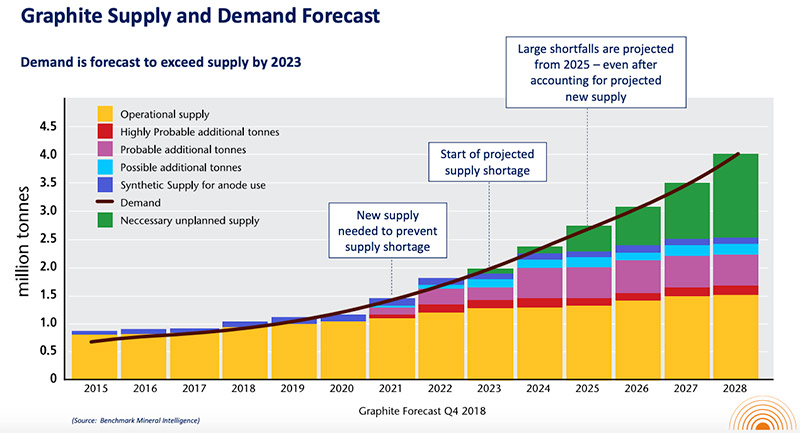
  • Graphite anode demand is set to increase from 194,160 tonnes in 2017 to 1,080,360 tonnes by 2023 and 1,747,800 tonnes by 2028
  • Automakers are taking action to put millions of electric vehicles on the road
  • Quebec and B.C Governments dedicated to “Green Economy”
https://gallery.mailchimp.com/2fe0087a9b2278d50d87798f3/images/c1dcd6f5-0041-4102-bc3e-71bab6f55e7e.jpg
Graphite Demand To OUtstrip Supply

Lomiko Metals Inc. has been keenly watching the lithium-ion battery market in anticipation of identifying an opportunity to participate in the supply of materials for electric vehicles with its La Loutre graphite project located in Quebec, Canada.  Lomiko is focused on advancing the La Loutre graphite property and is looking to deliver an NI 43-101 graphite resource based on the success of its recently completed drilling campaign at the Refractory Zone.  This will add to the previously announced 43-101 graphite resource at the adjacent Graphene-Battery zone announced March, 2016.

A. Paul Gill, CEO states, “Lomiko believes that it is in an ideal position to participate in the burgeoning Electric Vehicle market, with the potential to become a North American supplier of graphite materials, a market currently dominated by foreign supply from China. Graphite is a major and critical material in the manufacture of lithium-ion and other batteries, specifically battery anodes”.

  • According to Benchmark Minerals, graphite anode demand is set to increase from 194,160 tonnes in 2017 to 1,080,360 tonnes by 2023 and 1,747,800 tonnes by 2028. [Source: INN Graphite Investing News]
    On February 4, 2019, Simon Moores of Benchmark Mineral Intelligence raised supply and demand concerns in a submission to the US Senate which was echoed by Energy and Natural Resource Committee Chair Senator Lisa Murkowski in a February 5, 2019 News Release: “In contrast to the energy sector, our nation is headed in the wrong direction on mineral imports. This is our Achilles’ heel that serves to empower and enrich other nations, while costing us jobs and international competitiveness,” Murkowski said. Lomiko brought this crucial opportunity to the attention of shareholders in a February 8, 2019.
  • Recent announcements and cooperation agreements on electric vehicle and self-driving cars between Ford and Volkswagen indicates automakers are taking action to put millions of electric vehicles on the road.  Raw material demand for graphite, lithium and nickel sourced from North American is likely to increase as a result. Ford said its battery electric vehicle rollout will start in 2020 with a performance utility, and it plans to launch 16 battery electric vehicles by 2022.
  • In other positive developments, Quebec Premier Francois Legault reiterated his commitment to make the Province the ‘Green Battery’ of North America through investments in electric buses and trams while British Columbia Premier John Horgan aims to eliminate all gas-powered cars by 2040.
     
    For more information on Lomiko Metals, review the website at www.lomiko.com, contact A. Paul Gill at 604-729-5312 or email: [email protected].

LOMIKO Hub on Agoracom

FULL DISCLOSURE: LOMIKO Metals is an advertising client of AGORA Internet Relations Corp.

Lomiko EV Battery Material Supply Strategy Includes Spherical Graphite Production from La Loutre Suitable for Graphite Anodes $LMR.ca $CJC.ca $SRG.ca $NGC.ca $LLG.ca $GPH.ca $NOU.ca $DNI.ca

Posted by AGORACOM at 11:08 AM on Tuesday, August 13th, 2019
  • Identified spherical graphite production as a key waypoint in plans to supply graphite anodes for Electric Vehicles (EVs) Li-ion battery megafactories
  • “We are at the beginning of the battery materials bull market with 91 Lithium-ion mega-factories built or to be built worldwide.

(Vancouver, British-Columbia) August 13, 2019 – Lomiko Metals Inc. (TSX-V: LMR, OTC: LMRMF, FSE: DH8C) (Lomiko or the “Company”) has identified spherical graphite production as a key waypoint in plans to supply graphite anodes for Electric Vehicles (EVs) Li-ion battery megafactories in the North American market discussed in a July 16th, 2019 release.  Testing for spherical graphite is to be included in a Preliminary Economic Assessment (PEA) which is planned for the La Loutre graphite project located in Quebec, Canada.  The development of a strategy that identifies a way to create value-added products is necessary to establish a long-term, profitable business model prior to  extensive capital outlay is crucial to the success of the company.

A. Paul Gill, CEO states, “We are at the beginning of the battery materials bull market with 91 Lithium-ion mega-factories built or to be built worldwide.  However, potential North American Suppliers of graphite materials are facing investor skepticism because graphite materials coming from African mines such as Syrah Resources are satisfying Chinese graphite anode demand at present.  Lomiko sees an opportunity in creating a stable and integrated North American value chain for North American EV manufacturers to African graphite or Chinese anodes which are susceptible to political strife or trade wars.”

Graphite Sector Analysis

The price for 95% C (purity), 15 microns Spherical Graphite is $2,700-2,800 USD/tonne, far above the price of other forms of graphite as indicated by the Industrial Minerals.  Lomiko’s Preliminary Economic Assessment (PEA) will include costs and the potential market for this key product.  In order to start the PEA, Lomiko must first deliver its second resource prepared in compliance with NI 43-101 Regulations from La Loutre.

Industrial Minerals indicates China imported 21,486 tonnes of flake graphite in June 2019, 14,864 tonnes came from Mozambique, accounting for 70% of total Chinese imports.  The principal source of graphite flake in Mozambique is Syrah Resources, which primarily produces 94% C, -100 mesh material. Increased exports from Mozambique has weighed on the market since Syrah began commercial production at the start of this year. June’s import volumes into China were the highest since at least January 2017.

In the first half of this year, China imported 105,462 tonnes of flake graphite in response to the healthy development of the lithium-ion anode industry in China.

At least half of total imported flake graphite was used in the anode industry, with the refractory sector the second largest consumer, according to market sources.

The use of large flake graphite as a refractory (heat-resistant) material began before 1900 with the graphite crucible used to hold molten metal. In the mid-1980s, the carbon-magnesite brick became important, and a bit later alumina-graphite material.  Graphite blocks are also used in parts of blast furnace linings where the high thermal conductivity of the graphite is critical.

Graphite electrodes are another long-term market for natural flake graphite.  Graphite conductors which release electric energy in the form of an electric arc, are used to heat and melt the steel scraps in an electric arc furnace. They are currently the only products with high electrical conductivity and are able to maintain extremely high heat generation in this demanding environment. With the growing demand for quality steel in the aerospace, automotive and electronics industries, graphite electrodes are also becoming increasingly popular. 

For more information on Lomiko Metals, review the website at www.lomiko.com, contact A. Paul Gill at 604-729-5312 or email: [email protected].

On Behalf of the Board,

“A. Paul Gill”

Chief Executive Officer

We seek safe harbor. Neither TSX Venture Exchange nor its Regulation Services Provider (as that term is defined in the policies of the TSX Venture Exchange) accepts responsibility for the adequacy or accuracy of this release

Labrador Gold $LAB.ca – #Gold Responds to the Trade and Currency War $RIO.ca $WHM.ca $SIC.ca $NXS.ca

Posted by AGORACOM at 8:59 AM on Tuesday, August 13th, 2019

SPONSOR: Labrador Gold – Two successful gold explorers lead the way in the Labrador gold rush targeting the under-explored gold potential of the province. Exploration has already outlined district scale gold on two projects, including over a 40km strike length of the Florence Lake greenstone belt, one of two greenstone belts covered by the Hopedale Project. Click Here for More Info

  • At all-time highs in six of the world’s top currencies
  • Gold is up 25% in sterling; 22% in the yuan; 21.5% in euros; 19.7% in Australian dollars; 18% in rupee; 13% in Canadian dollars and 12% in Japanese yen

The charts posted immediately below tell one of the quiet, but perhaps most important stories unfolding in the world of high international finance. Gold has appreciated sharply in the currencies of all of the world’s top economies.  In five of the top eight economies – the United Kingdom, Japan, Canada, Australia, and India – it is priced at all-time highs. In short, as currencies race for the bottom, gold is racing to the top. Investors everywhere are moving to insulate their portfolios against the combined threats of recession, plummeting yields, currency depreciation, and stock market instability. An over-arching nemesis not likely to relinquish its place any time soon has unleashed those four horsemen – the burgeoning trade and currency war. 

Gold is up 25% in sterling; 22% in the yuan; 21.5% in euros; 19.7% in Australian dollars; 18% in rupee; 13% in Canadian dollars and 12% in Japanese yen.  It is up sharply against a long list of emerging country currencies as well. By way of perspective, gold is up 16% in U.S. dollars thus far in 2019. “A host of global factors mean gold’s price is set to maintain its strength at least for the next six to 12 months,” said Howie Lee, an economist at Singapore’s Oversea-Chinese Banking Corporation, in a recent CNBC interview. “The world right now is in a precarious state and gold is due to benefit from this situation,” With the world – from Asia to Europe, the United States and a long list of emerging countries – now acutely attuned to gold ownership, it might not be long until we begin to see strains on the limited physical supplies. 

Source: https://www.usagold.com/cpmforum/anv-august/

Gratomic $GRAT.ca – University of Illinois Team Finds that Defects in Graphene Membranes may Improve Biomolecule Transport $SRG.ca $NGC.ca $LLG.ca $GPH.ca $NOU.ca

Posted by AGORACOM at 3:58 PM on Monday, August 12th, 2019

SPONSOR: Gratomic Inc. (TSX-V: GRAT) Advanced Materials company focused on mine to market commercialization of graphite products, most notably high value graphene based components for a range of mass market products. Collaborating with Perpetuus, Gratomic will use Aukam graphite to manufacture graphene products for commercialization on an industrial scale. Click Here for More Info

  • Nanopore membranes have generated interest in biomedical research because they help researchers investigate individual molecules – atom by atom – by pulling them through pores for physical and chemical characterization
  • Researchers have not yet produced a membrane with spiral defects in the laboratory, but that task may be easier than trying to rid a graphene membrane of the current molecule-immobilizing step defects

Researchers at the University of Illinois examined how tiny defects in graphene membranes, formed during fabrication, could be used to improve molecule transport. They found that the defects make a big difference in how molecules move along a membrane surface. Instead of trying to fix these flaws, the team set out to use them to help direct molecules into the membrane pores.

Nanopore membranes have generated interest in biomedical research because they help researchers investigate individual molecules – atom by atom – by pulling them through pores for physical and chemical characterization. This technology could ultimately lead to devices that can quickly sequence DNA, RNA or proteins.

In 2014, University of Illinois physics professor Aleksei Aksimentiev and graduate student Manish Shankla demonstrated a graphene membrane that controlled a molecule’s movement through a nanopore by means of electrical charge. They discovered that once the molecules are on the surface of the membrane, it is very difficult to get them to shuffle into the membrane’s pores because molecules like to adhere to the surface.

While on sabbatical at Delft University of Technology in the Netherlands, Aksimentiev found that DNA tends to accumulate and stick along the edges of fabrication-formed defects that occur as linear steps spanning across the membrane’s surface. The Illinois team’s goal was to find a way to use these flaws to direct the stuck molecules into the nanopores, as a principle that can also apply to the delivery, sorting and analysis of biomolecules.

To refine and confirm their observations, the researchers used the Blue Waters supercomputer at the National Center for Supercomputing Applications at Illinois and the XSEDE supercomputer to model the system and molecule movement scenarios at the atomic level.

“Molecular dynamics simulations let us watch what is happening while simultaneously measuring how much force is required to get the molecule to clear a step,” Aksimentiev said. “We were surprised to find that it takes less force to move a molecule down a step than up. Although it may seem intuitive that gravity would make stepping down easier, it is not the case here because gravity is negligible at the nanoscale, and the force required to move up or down should be the same.”

Aksimentiev said team members originally thought they could use concentric defect patterns that form around the pores to force the molecules down, but their simulations showed the molecules congregating along the edges of the steps. That is when it dawned on them: A defect with edges that spiral into a pore, combined with an applied directional force, would give the molecule no other option than to go into the pore – kind of like a drain.

“This way, we can drop molecules anywhere on the membrane covered with these spiral structures and then pull the molecules into a pore,” he said.

The researchers have not yet produced a membrane with spiral defects in the laboratory, but that task may be easier than trying to rid a graphene membrane of the current molecule-immobilizing step defects, they said.

“When manufactured at scale, defect-guided capture may potentially increase the DNA capture throughput by several orders of magnitude, compared with current technology,” Shankla said.

“After a long development process, we are excited to see this principle used in a variety of other materials and applications such as delivery of individual molecules to reaction chambers for experiments,” the researchers said.Source: Nature NanotechnologyEurekalert

Source: Nature Nanotechnology