Posted by AGORACOM
at 5:48 PM on Thursday, January 9th, 2020
American Creek owns a 20% Carried Interest to Production at the Treaty Creek Project in the Golden Triangle. 2019’s first hole averaged 0.683 g/t Au over 780m in a vertical intercept. The Treaty Creek property is located in the same hydrothermal system as the Pretivm and Seabridge’s KSM deposits.
Low-cost gold-backed ETFs in the US have seen positive flows for 18 of the past 19 months
Global gold-backed exchange-traded funds (ETFs) and similar products
had $19.2 billion or 400 tonnes of net inflows in 2019 after holdings
rebounded in December, the World Gold Council (WGC) reports. In the fourth quarter, ETF holdings reached an all-time high of 2,900 tonnes.
Overall, gold-backed assets under management (AUM) grew by 37% in
dollar terms during the year owing to positive demand and an 18.4%
increase in the gold price.
From a regional perspective, North American funds led the way with
inflows of 206 tonnes ($10.1 billion, 14.4% AUM). SPDR Gold Shares – the
world’s biggest gold ETF—and iShares Gold Trust accounted for nearly
half of last year’s inflows.
Low-cost gold-backed ETFs in the US have seen positive flows for 18
of the past 19 months and increased their collective holdings by 60%,
according to the latest WGC data.
Elsewhere, holdings in European funds increased by 188 tonnes ($8.8
billion, 13.6%), while funds listed in Asia were nearly flat, recording
an outflow of 0.1 tonnes ($12 million, 0.3%). The remaining regions had
combined inflows of 6.3 tonnes ($311 million, 16.3%).
Looking ahead, WGC analysts said that they expect investor demand to remain robust through 2020.
“The strength of gold was mainly the byproduct of a dovish shift in monetary policy. Our research indicates that a shift from a hawkish or neutral stance to a dovish one has historically led gold to outperform,†a WGC analyst said.
About American Creek
American Creek is a Canadian mineral exploration company with a strong portfolio of gold and silver properties in British Columbia. Three of those properties are located in the prolific “Golden Triangleâ€; the Treaty Creek and Electrum joint venture projects with Tudor Gold/Walter Storm as well as the 100% owned past producing Dunwell Mine.
The Corporation also holds the Gold Hill, Austruck-Bonanza, Ample Goldmax, Silver Side, and Glitter King properties located in other prospective areas of the province.
For further information please contact Kelvin Burton at: Phone: 403 752-4040 or Email: [email protected]. Information relating to the Corporation is available on its website at www.americancreek.com
Posted by AGORACOM-JC
at 4:48 PM on Thursday, January 9th, 2020
SPONSOR: Spyder Cannabis (SPDR:TSXV) An established chain of high-end vape stores. Aggressive expansion plan is already in place that will focus on Canadian retail and US Hemp derived kiosks in high traffic areas. Click here for more info.
However, there seems to be a gap between cannabis demand and supply in Canada
It’s been a year since Canada legalized marijuana, but it seems consumers in the country are still struggling to obtain legal cannabis
This demand-supply imbalance took a toll on cannabis companies’ revenues and stock prices last year
Let’s take a closer look at the demand-supply imbalance in Canada.
The cannabis demand-supply landscape in Canada
Health Canada has come up with a national Cannabis Tracking System to
keep track of the cannabis produced and sold across the country. The
intention is to keep a check on illegal cannabis sales. Health Canada requires federal license holders and provincial and territorial growers to report this data on a monthly basis.
Another objective behind this move could be to ensure that cannabis
producers aren’t growing marijuana illegally. Such was the case last
year with CannTrust (NYSE:CTST). The company was found to be growing marijuana illegally and was reportedly in violation of Health Canada’s regulations.
The monthly report tracks the sales of medical and recreational
marijuana. It also takes into account the cannabis inventories held by
retailers and distributors. Here are a few details from the report for
the period that ended on September 30, 2019:
Total sales of dried cannabis fell by 0.4% to 12,922 kilograms on a month-to-month basis.
Cannabis oil total sales rose by 4.8% to 11,187 liters on a month-to-month basis.
The total amount of finished dried cannabis inventory rose by 5% to 64,151 kilograms on a month-to-month basis.
The total amount of finished cannabis oil inventory rose by 1.1% to 102,060 liters on a month-to-month basis.
“Finished inventory†here implies that the products are ready and
packed for sale. The finished inventory for dried cannabis was higher
for both provincial and territorial distributors and retailers and
federal license holders.
For dried cannabis, federal license holders saw a 5.7% increase in
finished inventories, while provincial and territorial distributors and
retailers saw a 4.3% increase. Additionally, for cannabis oil, federal
license holders saw a 2.6% increase in inventories, while provincial and
territorial distributors and retailers saw a 1.4% decrease.
What caused the imbalance?
Canada legalized marijuana in October 2018. The demand for marijuana
was high in the country. Thus, producers cultivated more cannabis,
hoping to meet this demand. However, regulatory procedures were slow and
strenuous, which resulted in a delay in the licensing and opening of
new legal stores. The delay resulted in higher inventories and caused
supply issues. Hence, cannabis sales
were affected across Canada. Looking at the data for September, we can
conclude that most retailers had products ready for sale. However, the
lack of stores caused a supply issue and a rise in inventory.
Moreover, the licensing process isn’t that simple. A Cannabiz Media article stated,
“The amount of time to obtain a license to grow marijuana in Canada’s
legal market was excessive with some cultivators waiting months or even a
year. Once a grower obtained a cultivation license, it needed to
produce two full crops, have them tested, get its sales software
audited, and apply for a sales license, which could take another year.â€
How’s the marijuana demand and supply situation in the US?
While we’re on the subject, let’s talk about the demand and supply
situation in the US. Marijuana isn’t legal at the federal level in the
US. However, 33 states and the District of Columbia allow medical
marijuana. Additionally, 11 states and the District of Columbia allow
recreational marijuana.
Black market sales are a matter of concern even in the US. California,
which legalized medical marijuana in 1996 and adult-use marijuana in
2016, also suffers from illicit cannabis activity. An article by
Cannabis Business Plan discussed how cannabis consumers in the state
will initially be inclined toward the illegal market to avoid regulatory costs. The article also stated
that predictions show that by 2022, the marijuana market in the state
could be worth $7.7 billion driven mostly by recreational marijuana.
Cannabiz Media also discussed how states such as Michigan are facing
supply shortages due to a lack of licensed growers. Recently, recreational marijuana sales went live in Michigan. Pennsylvania faced similar problems when demand for medical cannabis couldn’t match supply in the state.
Furthermore, the abundance of marijuana resulted in losses for many
licensed cultivators as prices fell. Obtaining capital for cannabis
businesses is still an issue in the US. Banks and financial institutions
are scared to provide help to cannabis companies because marijuana is
still illegal federally. However, hopes are that the passing of the SAFE
Act could smooth this process.
How are cannabis companies coping with the demand-supply situation?
The demand-supply imbalance hit cannabis companies’ revenues and
profitabilities last year. After Canada legalized cannabis, companies
increased their production capacities to match demand. However, the lack
of legal stores caused a supply issue. Initially, Ontario was strict
with its cannabis laws. Recently, though, after the second phase of
legalization, Ontario relaxed its laws to tackle the problem of black market sales. Canada’s three largest provinces now expect higher sales this year from the Cannabis 2.0 expansion.
Cannabis edibles are in high demand among marijuana products. Hence,
consumers turned to the black market to obtain these products when
Canada hadn’t legalized edibles. The prices of cannabis products on the
black market are also lower than they are on the legal market. Now, with
Cannabis 2.0 products ready to hit the stores, marijuana companies
expect to recover their losses in 2020. These companies are ready with a
variety of edibles, vapes, and beverages.
Though analysts expect a turnaround in 2020,
they’ve kept a subdued outlook on marijuana companies’ 2020 revenues.
Some analysts feel regulations and licensing delays could still affect
Cannabis 2.0 revenues this year. Companies’ 2020 revenue estimates are
as follows:
Cronos Group’s fiscal 2020 revenue could be around 146.1 million Canadian dollars.
HEXO’s fiscal 2020 revenue could be around 79.1 million Canadian dollars.
Final thoughts
The demand-supply imbalance in the cannabis market is an important
issue. However, we also have to consider that the industry is a growing
one and will have its ups and downs. Currently, the flow of regulations
isn’t smooth, which is causing licensing and cultivation delays. It may
take some time for things to smooth out in the industry.
Many also feel that federal legalization will help balance the demand-supply issue in the US. Nevertheless, considering the efforts by Canada and certain states in the US, we can expect a turnaround in 2020.
Stay tuned to learn more about the ins and outs of the marijuana industry.
Posted by AGORACOM
at 1:55 PM on Thursday, January 9th, 2020
Sponsor: Loncor is a Canadian gold exploration company focused on two projects in the DRC – the Ngayu and North Kivu projects, both have historic gold production. Exploration at the Ngayu project is currently being undertaken by Loncor’s joint venture partner Barrick Gold. The Ngayu project is 200km southwest of the Kibali gold mine, operated by Barrick, which produced 800,000 ounces of gold in 2018. Barrick manages and funds exploration at the Ngayu project until the completion of a pre-feasibility study on any gold discovery meeting the investment criteria of Barrick. Click Here for More Info
Another year of covering commodities and select junior mining stocks is all but done and dusted.
We’ve seen palladiumprices
more than double those of platinum, its sister metal, on tight supply
and high demand for catalytic converters in gas-powered vehicles, as
smog-belching diesel cars and trucks get phased out to meet tighter air
emissions standards particularly in Europe and China.
Indonesia advanced a 2022 deadline for banning the export of mineral ores, including nickel,
prompting a massive surge in the price of the stainless steel and
electric-vehicle battery ingredient. In September, nickel powered past
$8 a pound, before slipping back to around $6/lb after the resumption of
Indonesian ore exports and weaker demand from the stainless
steel industry.
Palladium and nickel are both in-demand metals for the foreseeable
future, nickel for its use in batteries and stainless steel, and
palladium as an important ingredient of catalytic converters found in
gas-powered/ hybrid vehicles.
Zinc inventories
in February fell to the point where there were less than two days worth
of global consumption locked in London Metal Exchange (LME) warehouses.
The paucity of the metal used to prevent rusting caused prices to spike
to the highest since June 2018.
Gold started off the year around $1,300/oz,
and didn’t do much for the first half on account of higher interest
rates holding prices down. In July though, gold started to run when the
US Federal Reserve reversed course and began cutting interest rates
instead of raising them. The ECB and a number of other central banks
followed suit, wanting to keep interest rates low to try and boost
flagging economic growth.
The yellow metal advanced
to $1,550 in early September due to a combination of factors including
negative real interest rates (always good for gold), a sluggish dollar,
and safe haven demand owing to US tensions with Iran, impeachment,
Brexit fears, etc.
Copper had an off year in 2018 over fears of slowing
Chinese growth and the US-China trade war, but as we at AOTH have
always maintained, the market fundamentals are solid. Over
200 copper mines currently in operation will reach the end of their
productive life before 2035. Most of the low-hanging copper “fruit†has
been picked. New copper mines will be lower-grade and farther afield,
meaning higher capex and production costs.
Although copper prices suffered in the second and third quarter,
things are looking up for the essential base metal needed for plumbing
and wiring, power generation, communications, 5G networks, and electric
vehicles, which use around four times as much copper as a conventional
car or truck.
Energized by a rip-roaring fourth quarter, copper bulls are back on
board. From its 52-week low in August of $2.51/lb, the red metal gained
an impressive 11%, reaching a pinnacle of $2.83/lb Dec. 12, on
expectations of a trade war resolution between the world’s number one
and two economies, and the improved economic growth prospects that would
entail. Copper has risen 7% in December alone.
We pinned our thesis on three key points: 1/ Commodities are
cyclical, and the timing is right to get in now; 2/ The US dollar
is falling, and will likely continue to fall or be range-bound going
forward. A resolution to the trade war between the US and China, and a
looser monetary policy by the Federal Reserve (both of which are likely)
will weigh on the dollar and be good for commodities; 3/ The need for
infrastructure spending is not going to let up.
Close to a year later, our commodities hypothesis rings true. The dollar’s upward march in 2018 (DXY moved from 89 to 97) did stop
in 2019, helping commodities priced in US dollars. The US-China trade
war escalated but as we predicted, there was a resolution – not a
complete trade deal – but enough hope for one, to send copper, the most
important base metal, soaring in recent weeks.
At the beginning of the year, as stock markets bounced back from
their awful fourth-quarter 2018, everyone thought that the US economy
was roaring. We weren’t so sure, and presented evidence of a less
sanguine picture including negative fallout from the trade war with
China and a yield curve inversion which is a very accurate indicator of a
coming recession.
The US Federal Reserve appeared to agree. Worried about low growth,
globally and in the US, the Fed slammed the brakes on the interest rate
hikes it started in 2015, and began lowering them in July, 2019. That
immediately juiced gold and silver. Investors piled into precious metals as an alternative to near-zero or negative-yielding sovereign bonds. Looser monetary policy, check.
In later articles we showed the bullish cases for zinc, nickel and palladium.
The palladium price tripled from the start of 2016 to spring of 2019,
beating gold just under a year ago for the first time in 16 years.
Palladium has been in deficit for eight straight years, because of low
mined output and smoking-hot demand from the auto sector. So far in 2019
it has gained 47%.
Battery companies have been developing nickel-rich batteries in
two of the dominant chemistries for EVs, the nickel-manganese-cobalt
(NMC) battery used in the Chevy Bolt (also the Nissan Leaf and BMW i3)
and the nickel-cobalt-aluminum (NCA) battery manufactured by
Panasonic/Tesla. Added to Indonesia’s on and off export ban, a demand
boost from nickel’s growing use in electric-vehicle batteries, and
dwindling global stockpiles, have helped support nickel prices.
According to the USGS, despite new zinc mines opening in Australia
and Cuba, supply failed to keep up with consumption. Some very large
zinc mines have been depleted and shut down in recent years, with not
enough new mine supply to take their place. As a result, the zinc market
was in deficit in 2018.
Tighter environmental restrictions in China are lessening the amount
smelters can produce. National production of refined zinc in 2018 fell
to just 4.53 million tonnes, the sharpest downturn since 2013. The
result has been a record amount of refined zinc imported by the world’s
largest metals consumer, 715,355t in 2018. The high demand in China has
also pulled a lot of zinc out of LME warehouses.
In October zinc prices hit a four-month high due to falling zinc
stocks – inventories in London Metal Exchange-registered warehouses
plunged to 57,775 tonnes – a smidgen higher than the 50,425t in April,
the lowest since the 1990s, Reuters said.
Tough market for explorers
It’s good to see we were right about so many metal markets.
Regrettably however, the valuations of mineral exploration companies
have yet to follow the prices of the metals they are hunting.
Indeed the junior mining sector has been in a funk since around 2012.
The juniors’ place in the mining food chain is to provide projects to
be turned into mines for larger mining companies whose reserves are
running low. This is becoming a growing problem as all the low-hanging, high-grade deposit fruit has been picked. Such is the case for gold, silver, copper, palladium,
zinc and nickel, all of which are encountering, or will shortly
encounter, supply deficits, amid booming demand for battery metals and
precious metals.
Finding the kind of grades at amounts that will make a mine
profitable usually requires going farther afield or deeper – greatly
adding to costs per ounce or tonne.
Here’s the problem juniors have been facing: At the same time as
investment capital has been pulled out of the mining majors and
mid-tiers – by investors tired of seeing falling or stagnant stock
prices/ red ink balance sheets – there’s been a dearth of speculative
capital flowing into exploration companies.
The ascendance of index funds has also made it harder for juniors to
attract money, because they are too small to be in the funds that these
vehicle track.
According to a 2019 report by PDAC –
the association that puts on the annual mining show in Toronto –
and Oreninc, a junior financing tracker, equity financing in 2018 was
35% less than in 2017 – a decade-low $4.1 billion.
A good chunk of that cash went to marijuana stocks, as dozens of
companies emerged to take advantage of the pot legalization bill passed
by the Canadian federal government. Whereas weed stock IPOs attracted
$491.1 million in investment dollars in 2018, mining IPOs only accounted for $51.6 million, a startling drop from the $830 million in 2017.
That’s a lot of speculative capital pulled out of resource stocks.
However it’s not all gloom and doom, according to TD Securities mining
investment bankers, who say “current market conditions and historical
precedents make them optimistic generalist investors will return in
greater numbers to mining stocks,†Bloomberg reported:
“The current market is reminiscent of the late 90’s and early 2000’s,
[TD Securities’ Deputy Chairman Rick] McCreary says. At the time,
investors had low interest in mining, and companies found it hard to
raise capital. That was followed by waves of consolidation and a mining
bull run. A similar trend may be building as this ‘period of
consolidation’ rolls on.â€
Gold M&A
As far as that goes, mining companies, especially in the gold space,
have realized since the vicious 2012-16 bear market, they have cut as
much as they can and the next step is to bring assets and companies
together. On top of that, the top gold miners are running out of
reserves, and are looking to replace them with high-margin projects that
have the right combination of grade, size and infrastructure.
This explains Barrick combining with South Africa’s Randgold, the Barrick-Newmont joint venture in Nevada,
the fusing of Newmont and Goldcorp, a $1-billion deal for Lundin Mining
to acquire a Brazilian copper-gold mine from Yamana Gold, Newcrest’s
70% purchase of Imperial Metals’ Red Chris mine in British Columbia, and
other recent examples of gold mining M&A.
Among December’s gold deals are Zijin Mining’s cash purchase of
Continental Gold’s Buriticá project in Colombia, for CAD$1.3 billion;
and a $770 million merger between two mid-tier gold miners, Equinox Gold
and Leagold Mining. The latter arrangement will keep the Equinox name
and create a company valued at $1.75 billion with six mines spread
across Brazil, Mexico and the United States.
Junior resource M&A?
The goal of every junior resource investor is for the company(ies)
they are invested in to get bought out, resulting in a 5, 10, even
20-bagger.
The question is, will the current round of mergers and acquisitions
at the major and mid-tier level trickle down to the juniors? PwC appears
hopeful. In its 2019 report ‘Shifting Ground’ the mining consultancy states,
The heightened level of deal activities, most of which have been
in the gold sector, may well spark further moves among intermediate
players seeking to grow into multi-project companies. A new phase of
industry consolidation could pave the way for more exploration and mine
development and boost investor interest and activity.
Another optimistic opinion comes from Tom Palmer, chief operating officer at Newmont, who told the Wall Street Journal that smaller
players are waiting to see what the bigger miners sell once they have
completed their mergers before they start their own M&A.
“Fast forward two or three years, there will be countless more†mergers, he said.
In fact we are already starting to see this happening. Nevada has
witnessed the return of junior gold explorers, and majors, after a lull
in activity between 2012 and 2016. According to an industry report,
exploration in Nevada increased by 15% in 2017, with 19,040 new claims.
The tide has continued to turn in mining’s favor, with 198,337 active
claims as of January, 2019 – 7% more than in 2018.
In 2018 Idaho-based Hecla Mining snapped up Klondex Mines for US$462
million, delivering three more Nevada properties – Fire Creek, Midas and
Hollister – to Hecla’s stable of mines and adding 162,000
gold-equivalent ounces to its annual production.
Also in Nevada, last year Alio Gold paid Rye Patch Gold $128 million
for the Vancouver-based company and its past-producing Florida Canyon
mine.
The 2019 creation of Nevada Gold Mines (the Barrick-Newmont JV) has
piqued the interest of other companies looking to discover and develop
new ounces in the golden state. Major miners with new projects include
AngloGold Ashanti, Coeur Mining and Kinross Gold. For the details read Getchell’s Gold
And for an inspiring story of junior mining success in Canada, look
no further than Great Bear Resources. Working the historic Red Lake gold
camp in Ontario, Great Bear’s drills discovered the “LP Fault Zoneâ€
this past May. That eureka moment, the realization that most of the gold
on its property is structurally controlled, prompted a massive 90,000m
drill program aimed at identifying the parameters. The discovery of
three new gold zones with high-grade intercepts, along with the earlier
nearby Hinge-Dixie Limb discoveries, caught the market’s attention;
within 18 months, Great Bear’s stock catapulted 2,000%.
Conclusion
I firmly believe that 2019 has been a pivotal year for junior mining.
Coming out of 2018’s slump in several commodities, due mostly to the
uncertainty associated with the US-China trade war, this year we saw
very strong performances from gold, silver, copper, palladium, nickel
and zinc – having correctly predicted price corrections for each.
While it’s disappointing not to see a rising tide of junior miner
stock prices to accompany these bullish calls, we continue to believe.
After all, we want to own the cheapest most in demand metals we can
find to reap the maximum coming rewards. That means buying it while it’s
still in the ground.
The fact is junior resource companies – the owners of the world’s
future mines – are on sale. If you like their management teams, their
projects and their plans for 2020, perhaps now is the time to be
acquiring a position.
Posted by AGORACOM-JC
at 9:56 AM on Thursday, January 9th, 2020
GEMS™ Mobile and the HeartCheck™ CardiBeat to be integrated with the CareOS smart mirror
Entered into a partnership agreement with CareOS SAS , a subsidiary of Baracoda Group (“CareOS“), to provide consumer ECG monitoring technologies through the CareOS Poseidon smart mirror health and beauty hub.
TORONTO, ONTARIO /January 8, 2020 / CardioComm Solutions, Inc. (TSXV:EKG)(OTCPINK:EKGGF)(“CardioComm” or the “Company“), a global provider of consumer heart monitoring and electrocardiogram (“ECG“) device and software solutions, is pleased to confirm it has entered into a partnership agreement with CareOS SAS (France), a subsidiary of Baracoda Group (“CareOS“), to provide consumer ECG monitoring technologies through the CareOS Poseidon smart mirror health and beauty hub.
The partnership will see CardioComm’s FDA and Health Canada cleared
GEMS™ ECG management software and Smart Monitoring ECG reading service
integrated into the touch and gesture controlled smart mirror. The
GEMSTM software will be capable of recognizing ECG devices made by
multiple device manufacturers which will permit CareOS customers more
options in choosing a device of their preference. The HeartCheck™
CardiBeat will be a CareOS recommended device given its availability in
Canada, the US and Europe. When taking an ECG, the user will activate
the smart mirror’s display to connect to a selected ECG device. The
Smart mirror will also display the ECG trace in real-time during the
recording. Once recorded the ECG can be replayed and there will be no
limit to the number of ECG reports the user can generate. Users will
also have the option to send any of the recorded ECGs to CardioComm’s
SMART Monitoring ECG reading service to have the ECG reviewed and a
triage ECG report provided.
CareOS’ interest to integrate CardioComm’s easy-to-use ECG monitoring
technologies into the Poseidon smart mirror compliments both companies’
objectives to produce a credible, privacy-first, intuitive personal
care platform that improves wellbeing and long term health. The
innovative Poseidon smart mirror was also awarded the Consumer
Electronics Show (“CES“) Innovation Award in the Smart Home category for a second consecutive year.
CardioComm was the first company to enter the personalized ECG
monitoring market and it did so to address an unmet availability of
medically credible heart monitoring solutions to the consumer market.
The Company is motivated to develop partnerships with innovative
organizations like CareOS, to assist in bringing new “firsts” to market
that can leverage medically credentialed technologies that physicians
are already familiar with and that will enhance the consumer’s health
monitoring experience.
CardioComm is listed as a partner on the CareOS website and the Company will also be present at CES.
To learn more about CardioComm’s products and for further updates
regarding HeartCheck™ ECG device integrations please visit the Company’s
websites at www.cardiocommsolutions.com and www.theheartcheck.com.
About CardioComm Solutions
CardioComm Solutions’ patented and proprietary technology is used in
products for recording, viewing, analyzing and storing
electrocardiograms for diagnosis and management of cardiac patients.
Products are sold worldwide through a combination of an external
distribution network and a North American-based sales team. CardioComm
Solutions has earned the ISO 13485:2016 MDSAP certification, is HIPAA
compliant and holds clearances from the European Union (CE Mark), the
USA (FDA) and Canada (Health Canada).
About CareOS
CareOS, digital center of self care, is a privacy-first, intuitive,
open platform for personal intelligence that works naturally into an
individual’s hygiene, beauty, wellness and preventative care rituals. It
makes the best possible use of time we spend in front of a mirror to
improve our health and appearance by organizing and enhancing
information from connected devices, digital services and CareOS’s own
AI, powered by Tensorflow Lite. CareOS is a Baracoda Group company, led
by experts with decades of experience in connected devices and wellness,
specifically to provide support to consumers in their bathrooms,
salons, spas and retail stores. To learn more about CareOS, please visit
the Company’s website at https://care-os.com/.
This release may contain certain forward-looking statements and
forward-looking information with respect to the financial condition,
results of operations and business of CardioComm Solutions and certain
of the plans and objectives of CardioComm Solutions with respect to
these items. Such statements and information reflect management’s
current beliefs and are based on information currently available to
management. By their nature, forward-looking statements and
forward-looking information involve risk and uncertainty because they
relate to events and depend on circumstances that will occur in the
future and there are many factors that could cause actual results and
developments to differ materially from those expressed or implied by
these forward-looking statements and forward-looking information.
In evaluating these statements, readers should not place undue
reliance on forward-looking statements and forward-looking information.
The Company does not assume any obligation to update the forward-looking
statements and forward-looking information contained in this release
other than as required by applicable laws, including without limitation,
Section 5.8(2) of National Instrument 51-102 (Continuous Disclosure Obligations).
Neither TSX Venture Exchange nor its Regulation Services Provider (as
that term is defined in policies of the TSX Venture Exchange) accepts
responsibility for the adequacy or accuracy of this release.
Posted by AGORACOM
at 9:52 AM on Thursday, January 9th, 2020
Labrador Gold Corp. (TSX-V: LAB) (“LabGold†or the “Companyâ€) is
pleased to provide a review of its exploration activities completed
during 2019. During 2020, LabGold intends to test the continuity of
recently discovered mineralization at its Hopedale Project with a
drilling program.
Roger Moss, President and CEO stated: “Exploration on both of our
Labrador Projects during 2019 continued to successfully define areas of
gold mineralization. These include the discovery of a new gold showing
with assays from 1.67 to 8.26 g/t gold in grab samples at the Hopedale
Project. This is located 500 metres along strike from the known Thurber
Dog gold showing within a broader three kilometre stretch of anomalous
gold in rock and soil. We look forward to continuing our systematic
exploration, including drilling, of this mineralized system in 2020.â€
2019 Hopedale Project Highlights
Discovered a new gold showing north of the Thurber Dog gold
occurrence, grab samples from which assayed between 1.67 and 8.26 g/t
Au.
The Thurber Dog gold occurrence has assays in grab and channel
samples from below detection up to 7.866 g/t Au, with 5 samples greater
than 1 g/t Au and 16 samples assaying greater than 0.1 g/t Au.
The discovery extends the potential strike length of gold
mineralization by approximately 500 metres along strike to the north.The
new showing occurs within a larger 3km trend of anomalous gold in rock
and soil associated with the contact between mafic/ultramafic volcanic
rocks and felsic volcanic rocks.
2019 Ashuanipi Project Highlights
Discovered a gold enriched zone near a high grade (8,973ppb) soil sample taken in 2018.
The zone is defined by anomalous gold
in both soil (below detection up to 1,746ppb Au and including 12 samples
over 100ppb Au) and grab rock samples (below detection up to 2.35 g/t
Au) that cover an area of 450 metres by 450 metres.A second area of gold
mineralization associated with garnet-bearing gossanous gneiss also
shows potential.
Grab rock samples show values from
below detection to 0.68 g/t Au with 10 samples showing values greater
than 0.1 g/t Au over an area of 200m by 120m within a larger anomalous
area of gold in soil samples.
Note that grab samples are selected samples and are not necessarily representative of mineralization on the properties.
Location of the new showing, Thurber Dog, Thurber North
and Thurber South occurrences within the 3km long mineralized Thurber
trend:
New Showing with rusty zones due to the presence of pyrite and arsenopyrite:
What to expect in 2020
Hopedale Project
Exploration at Hopedale during 2020 will focus on determining the
extent of the Thurber Dog mineralized trend. Such work would aim to fill
in the gaps between showings over the three-kilometre strike length
with sampling and VLF-EM surveys. LabGold also intends to carry out an
initial drill program targeting prospective areas along this trend,
including the new showing.
Ashuanipi Project
LabGold’s priority at Ashuanipi is to reach an agreement with the
Matimekush-Lac John First Nation to enable continued exploration of the
property. The 2019 election of the new Chief and Council has been
challenged in Federal Court in Quebec with a court date scheduled for
the end of February. As such, community engagement and negotiations are
on hold until the court case is settled.
Borden Lake Extension Project
During 2019, Newmont Goldcorp announced the start of commercial
production at their Borden Mine. The Borden Lake Extension project is
located less than five kilometres from the Borden Mine along the
southeast trend of the Borden Gold zone. Note that mineralization hosted
on nearby properties is not necessarily indicative of mineralization
that may be hosted on the Company’s property.
Given the start of mining at Borden, follow up of past results at the
Borden Lake Extension project will be undertaken in 2020. Such work
will likely include additional till sampling and geochemical surveys to
better define the previously outlined anomalous zones as well as a
reinterpretation of VLF-EM data using the latest inversion software. Due
to the glacial cover in the area, overburden drilling, guided by
results of this work, would be the best means to define targets for
follow up diamond drilling.
Location of the BLE property and anomalous gold zones along trend to the southeast of Newmont-Goldcorp’s Borden Gold Zone.
All samples were shipped to the Bureau Veritas laboratory in
Vancouver, BC, where they were crushed and split and a 500g sub sample
pulverized to 200 mesh. Samples of 30g were analyzed for gold by fire
assay with an atomic absorption finish and another 15g sample for 36
elements by ultratrace ICP-MS (inductively coupled plasma-mass
spectrometry) following an aqua regia digestion. Over limit samples
(greater than 10g/t Au) are re-assayed using fire assay with a
gravimetric finish. In addition to the QA-QC conducted by the
laboratory, the Company routinely submits blanks, field duplicates and
certified reference standards with batches of samples to monitor the
quality of the analyses.
Roger Moss, PhD., P.Geo., is the qualified person responsible for all technical information in this release.
The Company gratefully acknowledges the Newfoundland and Labrador
Ministry of Natural Resources’ Junior Exploration Assistance (JEA)
Program for its financial support for exploration of the Ashuanipi
property.
About Labrador Gold:
Labrador Gold is a Canadian based mineral exploration company focused
on the acquisition and exploration of prospective gold projects in the
Americas. In 2017 Labrador Gold signed a Letter of Intent under which
the Company has the option to acquire 100% of the Ashuanipi property in
northwest Labrador and the Hopedale property in eastern Labrador.
The Hopedale property covers much of the Florence Lake greenstone
belt that stretches over 60 km. The belt is typical of greenstone belts
around the world but has been underexplored by comparison. Initial work
by Labrador Gold during 2017 show gold anomalies in soils and lake
sediments over a 3 kilometre section of the northern portion of the
Florence Lake greenstone belt in the vicinity of the known Thurber Dog
gold showing where grab samples assayed up to 7.8g/t gold. In addition,
anomalous gold in soil and lake sediment samples occur over
approximately 40 kilometres along the southern section of the greenstone
belt (see news release dated January 25, 2018 for more details).
The Ashuanipi gold project is located just 35 km from the historical
iron ore mining community of Schefferville, which is linked by rail to
the port of Sept Iles, Quebec in the south. The claim blocks cover large
lake sediment gold anomalies that, with the exception of local
prospecting, have not seen a systematic modern day exploration program.
Results of the 2017 reconnaissance exploration program following up the
lake sediment anomalies show gold anomalies in soils and lake sediments
over a 15 kilometre long by 2 to 6 kilometre wide north-south trend and
over a 14 kilometre long by 2 to 4 kilometre wide east-west trend. The
anomalies appear to be broadly associated with magnetic highs and do not
show any correlation with specific rock types on a regional scale (see
news release dated January 18, 2018). This suggests a possible
structural control on the localization of the gold anomalies. Historical
work 30 km north on the Quebec side led to gold intersections of up to
2.23 grams per tonne (g/t) Au over 19.55 metres (not true width)
(Source: IOS Services Geoscientifiques, 2012, Exploration and geological
reconnaissance work in the Goodwood River Area, Sheffor Project, Summer
Field Season 2011). Gold in both areas appears to be associated with
similar rock types.
The Company has 57,039,022 common shares issued and outstanding and trades on the TSX Venture Exchange under the symbol LAB.
For more information please contact: Roger Moss, President and CEO Tel: 416-704-8291 Or visit our website at: www.labradorgold.com Twitter: @LabGoldCorp
Posted by AGORACOM
at 2:39 PM on Wednesday, January 8th, 2020
Sponsor: Affinity Metals (TSX-V: AFF) a Canadian mineral exploration
company building a strong portfolio of mineral projects in North
America. The Corporation’s flagship property is the Drill ready Regal
Property near Revelstoke, BC. Recent sampling encountered bonanza grade
silver, zinc, and lead with many samples reaching assay over-limits.
Further assaying of over-limits has been initiated, results will be
reported once received. Click Here for More Info
Excerpts from Crescat Capitals November Newsletter:
Precious Metals
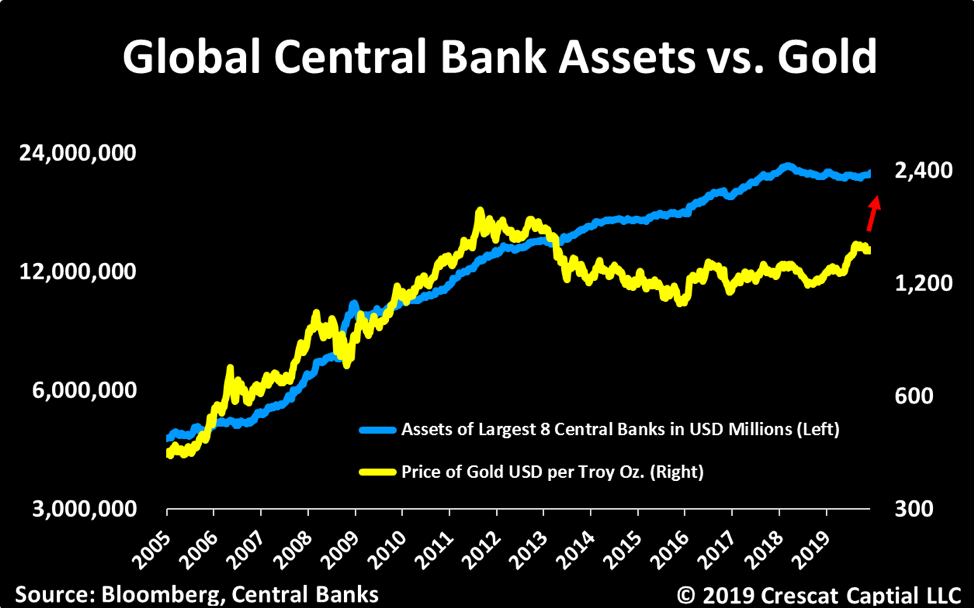
Precious metals are poised to benefit from what we consider to be the best macro set up we’ve seen in our careers. The stars are all aligning. We believe strongly that this time monetary policy will come at a cost. Look in the chart below at how the new wave of global money printing just initiated by the Fed in response to the Treasury market funding crisis is highly likely to pull depressed gold prices up with it.
The gold and silver mining industry endured a severe bear market from 2011 to 2015 and have formed a strong base over the last four years.
The imbalance between historically depressed commodity prices
relative to record overvalued US stocks remains at the core of our macro
views. On the long side, we believe strongly commodities offer
tremendous upside potential on many fronts. Precious metals remain our
favorite. We view gold as the ultimate haven asset to likely outperform
in an environment of either a downturn in the business cycle, rising
global currency wars, implosion of fiat currencies backed by record
indebted government, or even a full-blown inflationary set up. These
scenarios are all possible. Our base case is that governments and
central banks will keep their pedals to the metal to attempt to fend off
credit implosion or to mop up after one has already occurred until
inflation becomes a persistent problem.
The gold and silver mining industry is precisely where we see one of
the greatest ways to express this investment thesis. These stocks have
been in a severe bear market from 2011 to 2015 and have been formed a
strong base over the last four years. They are offer and incredibly
attractive deep-value opportunity and appear to be just starting to
break out this year. We have done a deep dive in this sector and met
with over 40 different management teams this year. Combining that work
with our proprietary equity models, we are finding some of the greatest
free-cash-flow growth and value opportunities in the market today
unrivaled by any other industry. We have also found undervalued
high-quality exploration assets that will make excellent buyout
candidates.
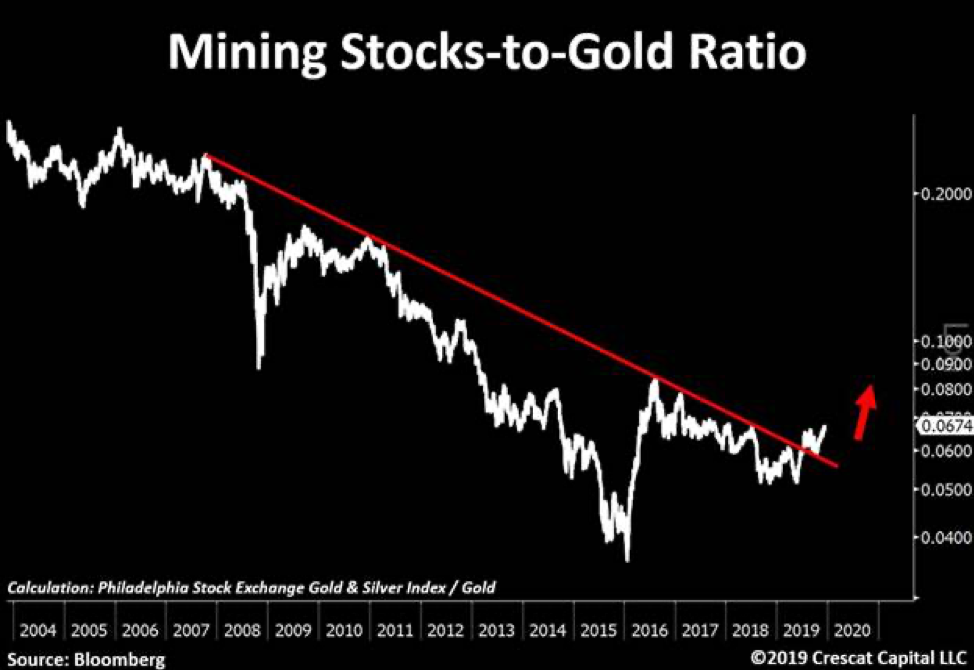
We recently point out this 12-year breakout in mining stocks relative
to gold now looks as solid as a rock. In our view, this is just the
beginning of a major bull market for this entire industry. We encourage
investors to consider our new Crescat Precious Metals SMA strategy which
is performing extremely well this year.
“This is just the beginning of a major bull market for this entire industry”
Zero Discounting for Inflation Risk Today
With historic Federal debt relative to GDP and large deficits into
the future as far as the eye can see, if the global financial markets
cannot absorb the increase in Treasury debt, the Fed will be forced to
monetize it even more. The problem is that the Fed’s panic money
printing at this point in the economic cycle may hasten the unwinding of
the imbalances it is so desperate to maintain because it has perversely
fed the last-gasp melt up of speculation in already record over-valued
and extended equity and corporate credit markets. It is reminiscent of
when the Fed injected emergency cash into the repo market at the peak of
the tech bubble at the end of 1999 to fend off a potential Y2K computer
glitch that led to that market and business cycle top. After 40
years of declining inflation expectations in the US, there is a major
disconnect today between portfolio positioning, valuation, and economic
reality. Too much of the investment world is long the “risk parityâ€
trade to one degree or another, long stocks paired with leveraged long
bonds, a strategy that has back-tested great over the last 40 years, but
one that would be a disaster in a secular rising inflation environment.
With historic Federal debt relative to GDP and large deficits into
the future as far as the eye can see, rising long-term inflation, and
the hidden tax thereon, is the default, bi-partisan plan for the US
government’s future funding regardless of who is in the White House and
Congress after the 2020 elections. The market could start discounting
this sooner rather than later. The Fed’s excessive money printing
may only reinforce the unraveling of financial asset imbalances today as
it leads to rising inflation expectations and thereby a sell-off in
today’s highly over-valued long duration assets including Treasury bonds
and US equities, particularly insanely overvalued growth stocks. We
believe we are in the vicinity of a major US stock market and business
cycle peak.
Source:”Running Hot”
Courtesy of Crescat Capital: https://www.crescat.net/running-hot/
Posted by AGORACOM
at 2:03 PM on Wednesday, January 8th, 2020
SPONSOR: Lomiko Metals is focused on the exploration and development
of minerals for the new green economy such as lithium and graphite.
Lomiko owns 80% of the high-grade La Loutre graphite Property , Lac Des
Iles Graphite Property and the 100% owned Quatre Milles Graphite
Property. Lomiko is uniquely poised to supply the growing EV battery
market. Click Here For More Information
Graphite Market to hit $27.03 Billion by 2025 – Analysis by Demand, Size, Share, Price, Growth Drivers and Business Opportunities: Adroit Market Research
The staggering
growth in hybrid and fully electric vehicles to be an influential
driving factor for the futuristic graphite industry expansion. Synthetic
graphite market is projected to account for a revenue share of >85%
of the total market in 2025
The global graphite market projected to be valued at around USD 27.03 billion by 2025. Furthermore, global graphite demand is anticipated to grow at a remarkable pace at a CAGR of 6.3% over the forecast period. Graphite finds numerous applications in refractories, steel making, foundries, as lubricating agent among many others. Presently, usage of graphite in car batteries for electric and hybrid electric vehicles is estimated to significantly boost the demand for graphite over the forecast period.
The Adroit Market Research recently published its research study on the graphite industry. The report covers all the major aspects of the graphite industry. The study is a comprehensive dataset which also includes qualitative aspects pertaining to the graphite industry. The market data is provided from 2015-2025 where 2015 to 2017 is the historic data, 2018 is considered as the base year and forecast period is from 2019 to 2025. The report provides a holistic view of the supply chain of the graphite industry which includes insights relevant to all the players in the graphite market value chain.
The research report on global graphite market is segmented on the basis of type, application, and region. The report includes the industry landscape in the form of market drivers, restraints and market opportunities. The study also highlights the impacts of related industries on graphite and analyses the market for various aspects using the Porter’s five forces analysis, PESTEL analysis and value chain.
Graphite is a naturally occurring allotropic form of carbon. It is a non-metal with several beneficial properties such as high melting point, thermal resistance, and high electrical and thermal conductivity. Also, graphite is available in adifferent form, owing to which it finds high usage across several industry verticals.
Graphite is either derived naturally or produced synthetically. Natural graphite mines are majorly found in China which is followed by Brazil and India. Flake, amorphous, and vein graphite are the major types of natural graphite forms which are commercially available at present. Flake graphite accounts for the highest demand in the global graphite industry with ~1.6x times growth expected further during the forecast period.
Synthetic graphite is produced by using several processes such as pyrolitic process and graphitization owing to which price of this type is much higher than natural graphite. Synthetic graphite is of high purity which is used in graphite electrodes, carbon fibers, and carbon blocks among other applications. Graphite electrode is projected to continue its dominance owing to the high degree of usage in steel making process.
By application, the batteries segment is projected to offer substantial growth owing to its applicability for new generation electric and hybrid electric vehicles. Constant technological innovations for making fully autonomous cars is projected to emerge as the biggest application which will drive the future demand for graphite. The battery segment is estimated to show a staggering growth with a 7.9% CAGR over the forecast period.
By region, Asia Pacific is estimated to continue its dominance owing to high demand from end use segments such as construction, automotive, and packaging industries. Increasing spending power is projected to further support the growth. North America and Europe are projected to show positive growth owing to high demand for hybrid and fully electric vehicles. Middle East is also projected to offer lucrative opportunities owing to high demand in the automotive industry.
The global graphite market is expected to be highly competitive, owing to a significant fragmentation in the industry. Large number of players are present across the value chain which are into manufacturing of synthetic graphite types. Boom in the natural graphite has also led to a growth in number of mining companies outside China. Showa Denko K.K., Toray Industries, Inc., Teijin Limited, Northern Graphite Corporation, Asbury Carbons are some of the key players in the graphite industry. Acquisition and capacity expansion are the key strategies followed by these players to maximize their presence in market.
For more information on the Company, please visit our website at www.lomiko.com, contact A. Paul Gill at 604-729-5312 or email: [email protected]
Posted by AGORACOM-JC
at 10:10 AM on Wednesday, January 8th, 2020
SPONSOR:ThreeD Capital Inc. (IDK:CSE)
Led by legendary financier, Sheldon Inwentash, ThreeD is a
Canadian-based venture capital firm that only invests in best of breed
small-cap companies which are both defensible and mass scalable. More
than just lip service, Inwentash has financed many of Canada’s biggest
small-cap exits. Click Here For More Information.
Crypto Today: Bitcoin is ready for a massive bull’s run
Here’s what you need to know on Wednesday
Markets:
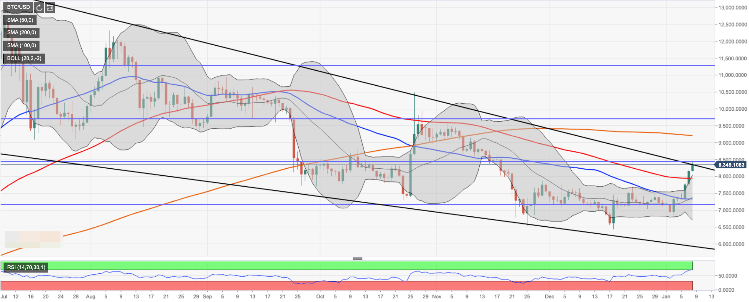
The BTC/USD is currently trading at $8,347 (+5.8% on a day-to-day
basis). The coin has been moving within a strong bullish trend and hit a
new 2020 high at $8,464.
The ETH/USD pair is currently trading at $144.7 (+1.18% on a
day-to-day basis). The Ethereum retreated from the intraday high of
$147.96; now, it is moving within a short-term bullish trend amid low
volatility.
XRP/USD settled at $0.2145 after a spike to $0.2255 on Tuesday. The coin is down 1.15% in recent 24 hours.
Among the 100 most important cryptocurrencies, the best of the day
are Quant (QNT) $3.9 (+17.5%), Synthetix Network Token (SNX) $0.9973
(+13.57%) and Horizen (ZEN) $8.43 (+13.16%), The day’s losers are,
Decentraland (MANA) $0.0335 (-8.5%), MaidSafeCoin (MAID) $0.0810
(-7.42%) and Komodo (KMD) $0.5434 (-5.92%).
Bitcoin (BTC) rallied to as high as $8,464 amid the escalation of
geopolitical tensions in the Middle East. While the correlation is not
clear, many experts believe that Bitcoin is growing due to rising
conflict between the United States and Iran as a push towards the recent
high occurred amid the news that Iran had attacked US military bases in
Iraq.
Tether (USDT) market capitalization increased by $500 million on
CoinMarketCap due to the rating adjustments; however, some experts
believe that this development might have served as a buy signal for algo
bots and set Bitcoin’s bullish ball rolling. BTC/USD started
snowballing in a few hours after CoinMarketCap updated its Tether
capitalization.
Cryptocurrencies may be an exciting concept, but they won’t threaten
the dominant position of the US dollar, according to International
Monetary Fund (IMF) chief economist, Gita Gopinath. She believes that
the technologies have not reduced the costs of moving between the
currencies, which is the critical barrier on the way to overtaking USD.
Industry:
Istanbul update implemented on Etheereum network at the end of 2019
increased the scalability of StarkEx protocol for centralized exchanges,
StarkWare experts noted.
“StarkEx *measurements* (not approximations, nor estimates) break
Ethereum’s scalability record post-Istanbul, with a 2000X improvement
over Ethereum Layer-1: 9K trades/sec at 75 gas/trade (or 18K
payments/sec) (1/5)”
Binance Charity Foundation launched a program aiming to help
Australia mitigate the consequences of bushfire. The blockchain-based
charity platform created by one of the world’s leading cryptocurrency
exchanges invites everyone to participate in the program and donate
funds to support Australia. Binance intends to donate $1 million.
Berlin-based bitcoin bank Bitwala included ether (ETH) to the list
of available services. The bank allows customers buying ETH, the
second-largest cryptocurrency asset by market capitalization, right from
their current accounts. The company explained the decision by
Ethereum’s significant role in decentralized finance (DeFi) movement,
Posted by AGORACOM
at 10:22 AM on Tuesday, January 7th, 2020
Sponsor: Loncor is a Canadian gold exploration company focused on two projects in the DRC – the Ngayu and North Kivu projects, both have historic gold production. Exploration at the Ngayu project is currently being undertaken by Loncor’s joint venture partner Barrick Gold. The Ngayu project is 200km southwest of the Kibali gold mine, operated by Barrick, which produced 800,000 ounces of gold in 2018. Barrick manages and funds exploration at the Ngayu project until the completion of a pre-feasibility study on any gold discovery meeting the investment criteria of Barrick. Click Here for More Info
Recent strong price gains are a bullish upside technical ‘breakout’ from recent trading levels, to suggest still more price gains are very likely in the coming weeks and months, or longer
Bullion’s price has benefited from heightened political tensions but also has enjoyed softness in the dollar,
Gold futures on Monday marked their highest settlement since April of 2013, as the killing last week of a top Iranian military commander, Qassem Soleimani, reverberated through financial markets, momentarily upending appetite for assets considered risky and boosting traditional haven assets like gold.
February gold GCG20, +0.23%
on Comex added $16.40, a gain of 1.1%, to settle at $1,568.80 an
ounce, after it briefly touched $1,590.90 in intraday action. The most
active contract saw its highest settlement since April 9, 2013,
according to FactSet data. Gold also rose for a ninth consecutive
session, its longest period of straight gains since an 11-day streak
that ran from December 2018 to January 2019.
March silver SIH20, +0.28%
edged up by 2.8 cents, or 0.2%, to finish at $18.179 an ounce, pulling
back from a high of $18.55, which was the highest intraday level since
late September.
Last week, the most-active gold contract gained 2.3%, its second week
of gains, while silver prices added 1.1%, also landing it higher for
two consecutive weeks.
“History shows that a big spike up in prices amid higher volatility
tends to produce near-term market tops sooner rather than later, after
that initial spike up,†said Jim Wyckoff, senior analyst at Kitco.com.
“That means in the coming days the gold market could put in a
‘near-term’ top that will last for a moderate period of time.â€
“However, for the longer-term investors in gold, it’s important to
note that the recent strong price gains are a bullish upside technical
‘breakout’ from recent trading levels, to suggest still more price gains
are very likely in the coming weeks and months, or longer,†he said in
daily commentary.
On Sunday, the Iraqi parliament passed a nonbinding resolution to
expel American troops in the wake of the U.S. drone strike that killed
Soleimani, leader of the foreign wing of Iran’s Islamic Revolutionary
Guard Corps, on Iraqi soil.
That act has intensified tensions in the Middle East, boosting the
appeal of assets considered safe during global political conflicts.
Trump has threatened harsh sanctions against
Iraq if it expels U.S. troops, and doubled down on earlier comments
threatening to target Iranian cultural sites if Iran strikes back. Iran has said it would no longer honor the 2015 nuclear deal with a group of world powers, which the U.S. backed out of in 2018.
Meanwhile, the benchmark 10-year Treasury yield TMUBMUSD10Y, +0.24% was up at 1.7917%, after tapping a four-week low on Friday after the Iranian military leader’s killing.
Bullion’s price has benefited from heightened political tensions but
also has enjoyed softness in the dollar, which has occurred as investors
shift to Swiss franc USDCHF, +0.3719% and Japanese yen USDJPY, +0.09% amid the potential for political turmoil.
The U.S. ICE Dollar Index DXY, +0.33%,
a measure of the buck against a half-dozen currencies, was down 0.2% at
96.661 and has posted weekly declines in the last two weeks.
A weaker buck can make gold more attractive to buyers using other
currencies, and lower bond yields can also help boost the comparative
appeal of gold against government debt.
“Gold continues its breakout higher as it is now at the highest level
since April 2013,†wrote Peter Boockvar, chief investment officer at
Bleakley Advisory Group, in a Monday research report.
“I remain bullish but caution not to buy it on geopolitical concerns
because as stated they are usually temporary. Buy it instead because the
dollar continues to weaken and real yields continue to fall,†he said.
Among other metals, March copper HGH20, -0.11% added 0.1% to $2.79 a pound. April PLJ20, -0.34% shed 2.4% to $966.20 an ounce, but March palladium PAH20, +0.87%
added 1.7% to $1,989.60 an ounce. Palladium futures notched a record
high, as they’ve done each day so far this year and many times
throughout 2019.
The platinum group markets are “not concerned that recent geopolitical events could derail the global economy and therefore demand for auto catalysts,†analysts at Zaner Metals, wrote in daily note. “Instead, it is apparent that platinum and palladium are being considered as safe haven instruments, with classic physical market fundamentals being pushed to the sidelines.”
Posted by AGORACOM
at 9:35 AM on Tuesday, January 7th, 2020
American Creek has strengthened its position both financially and strategically
Treaty Creek will be advancing in a major way
Eric Sprott made two separate investments of $1,000,000 making Mr. Sprott the largest external investor in Treaty Creek
American Creek Resources Ltd. (TSXV: AMK) (OTC Pink: ACKRF)
(“American Creek”) (“the Corporation”) is pleased to report that 2019
was a pivotal year for the company which is now positioned to take full
advantage of the precious metals bull run that many experts believe we
are only in the early stages of, even though gold hit a 7 year high of
$1,580 this week. Looking back, on the first day of trading in 2019 AMK
closed at $0.03 and on the last day of trading in 2019 AMK closed at
$0.09 representing a significant annual increase. Management envisions
positive developments to continue in 2020 through the geological
advancements of its properties including the potential for a world class
resource on the Treaty Creek JV project located in the “Golden
Triangle” of Northwestern British Columbia.
Darren Blaney, CEO of
American Creek stated: “This past year was a significant turning point
for the company and will be the catalyst for more exciting developments
in 2020. The company has strengthened its position both financially and
strategically and is poised to benefit from not only a strengthening
gold and silver market but also from the investment community becoming
more aware of the company’s projects and potential. The Treaty Creek
project will be advancing in a major way and several of our other
projects including the Dunwell and Gold Hill will also be the focus of
attention this year. We very much look forward to 2020 and wish all of
our shareholders the very best this upcoming year!”
Image of the Goldstorm Zone found along the base of this hill at Treaty Creek.
The
company raised over $3.3 million in 2019 through common and
flow-through shares along with the exercise of warrants. Through these
events the company was able to strengthen existing alliances and create a
number of new highly strategic relationships bringing strength,
credibility and future increased exposure to American Creek.
Of
note, Canadian billionaire Eric Sprott made two separate investments of
$1,000,000 into American Creek as well as an additional $8,400,000
investment in our JV partner Tudor Gold for the development of the
Treaty Creek property. This makes Mr. Sprott the largest external
investor in Treaty Creek. He recently stated that he is “very excited about the opportunity there as the project has a great shot at having 20 million ounces.”
Geological Position
TREATY CREEK
The
2019 drilling at Treaty Creek was very successful and produced some of
the most significant gold intercepts in the exploration industry. The
focus has been on the gold enriched Goldstorm Zone which is on trend
with, and part of, the same geological system as Seabridge Gold’s
neighboring KSM deposits. With approximately one billion tonnes of gold
enriched rock identified (potential for a resource calculation in
2020), the Goldstorm has potential to become a world class gold deposit.
The 2019 drilling was designed to define a gold deposit with the
potential of being open pit mined. The upcoming 2020 drilling is
designed to significantly expand the deposit as the system is open to
the north, the east and at depth.
The Treaty Creek Project is a joint venture with Tudor Gold owning 3/5th and acting as project operator. American Creek and Teuton Resources each have a 1/5th
interest in the project. American Creek and Teuton are both fully
carried until such time as a Production Notice is issued, at which time
they are required to contribute their respective 20% share of
development costs. Until such time, Tudor is required to fund all
exploration and development costs while both American Creek and Teuton
have “free rides”.
DUNWELL MINE
A maiden drill program was
initiated in 2019 on the 100% owned Dunwell Mine project located in the
heart of the Golden Triangle a few kilometers outside of Stewart, BC.
This past producing high grade mine (gold, silver, lead, zinc) holds
tremendous potential and may have the best logistics found in the Golden
Triangle. Assays from the program are currently pending.
GOLD HILL AND OTHER PROJECTS
The
Gold Hill property is believed to contain the principle source lode for
Canada’s fourth largest placer deposit located downstream (Wild Horse
River Gold Rush) which produced over 48 tonnes gold (and is still
producing). Work is planned for 2020 which will advance this highly
prospective project.
American Creek also holds several other high
potential projects in other prospective areas of BC such as the
Austruck-Bonanza, Ample Goldmax, Silver Side, and Glitter King.
Marketing
American
Creek will be going to great lengths in 2020 to increase the
Corporation’s exposure and recognition. Near future events including
attending many conferences including the Vancouver Resource Investment
Conference (Vancouver), AME Roundup (Vancouver), Red Cloud (Toronto),
Raise Capital (Toronto), and the Prospectors and Developers Association
of Canada (PDAC) convention (Toronto).
About American Creek
American
Creek is a Canadian mineral exploration company with a strong portfolio
of gold and silver properties in British Columbia. Three of those
properties are located in the prolific “Golden Triangle”; the Treaty
Creek and Electrum joint venture projects with Tudor Gold/Walter Storm
as well as the 100% owned past producing Dunwell Mine.
The
Corporation also holds the Gold Hill, Austruck-Bonanza, Ample Goldmax,
Silver Side, and Glitter King properties located in other prospective
areas of the province.
For further information please contact Kelvin Burton at: Phone: 403 752-4040 or Email: [email protected]. Information relating to the Corporation is available on its website at www.americancreek.com