Posted by AGORACOM-JC
at 10:11 AM on Friday, August 16th, 2019
EGLX: TSX-V
Adds over 2 million followers to combined network of over 200 million
Signed international Fortnite influencer, Yelo, to its roster of over 50 professional esports players and video gaming influencers.
Yelo’s combined social network reaches over 2 million followers across all social channels, a substantial addition to the 200 million plus fans the combined organization currently reaches.
TORONTO, Aug. 16, 2019 — Enthusiast Gaming Holdings Inc. (TSXV: EGLX) (OTCQB: EGHIF), (“Enthusiast†or the “Companyâ€), one of the largest vertically integrated video gaming media companies in North America, is excited to announce that Luminosity Gaming (“Luminosityâ€) has signed international Fortnite influencer, Yelo, to its roster of over 50 professional esports players and video gaming influencers. Yelo’s combined social network reaches over 2 million followers across all social channels, a substantial addition to the 200 million plus fans the combined organization currently reaches.
The amalgamation of Enthusiast and Luminosity creates one of the
largest esports organizations in the world. The organization is
comprised of the top players and content creators in the esports
ecosystem. Yelo joins Luminosity’s team of players and influencers which
currently reaches over 60 million followers across social media.
Combined with Enthusiast’s network of over 150 million monthly visitors,
the collective reach totals over 200 million gaming enthusiasts across
85 websites, 900 YouTube channels, 8 professional esports teams and over
50 social influencers.
Steve Maida, President of Luminosity commented, “We
are excited to sign Yelo to our talent roster and social audience of 60
million followers. With over 2 million social media followers, he is
rapidly growing into one of the biggest Fortnite influencers on the
scene. Yelo joining the Luminosity and Enthusiast Gaming family
of players is further validation of the Luminosity brand power as one
of the fastest growing esports organizations in the world, attracting
top talent in the industry.â€
About Enthusiast Gaming
Enthusiast Gaming is one of the largest vertically integrated video
game companies and has the fastest-growing online community of video
gamers. Through the Company’s organic and acquisition strategy, it has
amassed a platform of over 150 million monthly visitors across its
network of websites and YouTube channels. Enthusiast also owns and
operates Canada’s largest gaming expo, Enthusiast Gaming Live Expo,
EGLX, (eglx.ca) with approximately 55,000 people attending in 2018. For more information on the Company, visit www.enthusiastgaming.com.
About Luminosity Gaming
Luminosity Gaming is one of the largest globally recognized esports
organizations in the world, with over 60 million registered active
users. Luminosity has 8 world class esports teams competing across top
games such as Fortnite, Apex, Rainbow Six: Seige, Counter Strike, Call
of Duty, Madden, Smite, etc. For more information visit www.luminosity.gg
CONTACT INFORMATION:
Investor Relations: Julia Becker Head of Investor Relations & Marketing [email protected] (604) 785.0850
This news release contains certain statements that may constitute
forward-looking information under applicable securities laws. All
statements, other than those of historical fact, which address
activities, events, outcomes, results, developments, performance or
achievements that Enthusiast anticipates or expects may or will occur in
the future (in whole or in part) should be considered forward-looking
information. Such information may involve, but is not limited to,
comments with respect to strategies, expectations, planned operations
and future actions of the Company. Often, but not always,
forward-looking information can be identified by the use of words such
as “plans”, “expects”, “is expected”, “budget”, “scheduled”,
“estimates”, “forecasts”, “intends”, “anticipates”, or “believes” or
variations (including negative variations) of such words and phrases, or
statements formed in the future tense or indicating that certain
actions, events or results “may”, “could”, “would”, “might” or “will”
(or other variations of the forgoing) be taken, occur, be achieved, or
come to pass. Forward-looking information is based on currently
available competitive, financial and economic data and operating plans,
strategies or beliefs as of the date of this news release, but involve
known and unknown risks, uncertainties, assumptions and other factors
that may cause the actual results, performance or achievements of
Enthusiast to be materially different from any future results,
performance or achievements expressed or implied by the forward-looking
information. Such factors may be based on information currently
available to Enthusiast, including information obtained from third-party
industry analysts and other third-party sources, and are based on
management’s current expectations or beliefs regarding future growth,
results of operations, future capital (including the amount, nature and
sources of funding thereof) and expenditures. Any and all
forward-looking information contained in this press release is expressly
qualified by this cautionary statement. Trading in the securities of
the Company should be considered highly speculative.
Neither the TSX Venture Exchange nor its Regulation Services
Provider (as that term is defined in the policies of the TSX Venture
Exchange) accepts responsibility for the adequacy or accuracy of this
release.
The securities of the Corporation have not been and will not be
registered under the United States Securities Act of 1933, as amended
and may not be offered or sold in the United States absent registration
or an applicable exemption from the registration requirement. This press
release shall not constitute an offer to sell or the solicitation of an
offer to buy nor shall there be any sale of the securities in any
jurisdiction in which such offer, solicitation or sale would be
unlawful.
Posted by AGORACOM-JC
at 11:34 AM on Thursday, August 15th, 2019
SPONSOR: Spyder Cannabis (SPDR:TSXV) went public just a couple of months ago and hit the ground running with 5 operating Canadian retail locations – and a 6th one on the way via an 8,000 sq ft super store in Alberta. Most companies would be ecstatic to have this number of locations – but Spyder just announced a major move into the United States, with a 5 location deal for boutique stores up and down the US Eastern seaboard. The news gets better. If all goes well with these 5 locations, the US outlet partner has a total of 39 locations across 20 states for Spyder to grow into to. Click here for more info.
(TSX-V: SPDR)
Cannabis industry overview: all you need to know
Consumers around the world spent around $12.2 billion on legal cannabis in 2018, according to marijuana research firm BDS Analytics, rising from around $9.5 billion in 2017 and $6.9 billion in 2016.
The firm predicts spending this year will jump 38% to $16.9 billion and believes the industry will deliver a compound annual sales growth of 27% from 2018 to 2022, at which time it expects the market to be worth over $31 billion.
Consumers around the world spent around $12.2 billion on legal
cannabis in 2018, according to marijuana research firm BDS Analytics,
rising from around $9.5 billion in 2017 and $6.9 billion in 2016. The
firm predicts spending this year will jump 38% to $16.9 billion and
believes the industry will deliver a compound annual sales growth of 27%
from 2018 to 2022, at which time it expects the market to be worth over
$31 billion.
Analysts at Jefferies, which reported similar spending figures for
2018 as BDS, believe the legal cannabis market could be worth as much as
$130 billion by 2029. However, that forecast assumes both medicinal and
recreational marijuana is broadly legalised in further major markets
like the US, Europe and Latin America, and that established industries
like pharmaceuticals, beauty and drinks producers start using it in new
products. If the legal picture remained largely the same as it is now,
then the market’s estimated value in a decade is just $50 billion –
which is a huge jump from where sales sit now but ultimately way below
the full potential that could be delivered if the drug was embraced
further.
It is clear the market is set for exponential growth over the coming
years. The global market for illegal marijuana is estimated to be worth
somewhere in the region of $150 billion to $200 billion, so the
legalised market has all that value to chase in addition to new
opportunities, such as formulating new alternative cannabis-based
products.
What is driving the cannabis market forward?
Below are some of the key reasons why the legalised cannabis market is driving forward.
Deregulation and acceptance
From a recreational standpoint, marijuana is the most widely used
drug in the world. Although it still won’t be for everyone, legalisation
is attracting new types of users – and most of them have already tried
marijuana before. According to Deloitte, legalisation is expected to
‘attract more of a conservative experimenter’, those with bigger incomes
and higher education than the typical user using the black market
today. Still, Deloitte reckons that nearly three quarters of all
consumers likely to use legalised marijuana have had prior experience
with recreational cannabis, and over 40% have used it in the past five
years.
There are only two countries that have formally legalised
recreational use of marijuana. Uruguay became the first country to fully
legalise marijuana back in 2013 and was followed by Canada last year.
However, recreational cannabis laws are relaxed in many other countries,
such as in the Netherlands and Portugal where the drug has been
decriminalised, and over 40 countries have legalised medicinal cannabis
in some form, some of which are outlined below:
Argentina
Australia
Canada
Chile
Colombia
Croatia
Cyprus
Czech Republic
Denmark
Finland
Germany
Greece
Irael
Italy
Jamaica
Luxembourg
Macedonia
Malta
Mexico
Netherlands
Norway
Peru
Poland
South Africa
South Korea
Sri Lanka
Switzerland
UK
Uruguay
Zimbabwe
The world is hoping Canada will be able to demonstrate how a fully
legalised marijuana industry can form part of a modern, industrialised
nation in the western world. But the next trigger moment that many are
waiting for is federal approval in the US. Medicinal marijuana has been
legalised by over 30 US states and a further 11 have approved
recreational use with more expected to follow in the coming years.
However, it is yet to be legalised at the federal level, which would
apply one law across the entire country rather than forcing companies to
operate on a state-by-state level.
The picture in Europe is similar. Individual countries are pushing
ahead with their own policies on marijuana use while the law at the EU
level lags behind. The European Monitoring Centre for Drugs and Drug
Addiction says ‘cannabis should be allowed only for “medical and
scientific purposes”‘ and that most countries still regard possession as
a crime that can result in imprisonment. Yet, it adds that several
member states have reduced their penalties for cannabis users, and some
have permitted supply of the drug, which it admits is opening up
discussion. It says European policy is complicated by ‘conflicting
claims’, including decriminalisation or legalisation, medical or
recreational use, and policy success or failure. The initial sign is
that Europe is warming more to reducing the harm of drugs and
decriminalising them, but is further away from embracing the drug in the
same way North America has.
Acceptance of marijuana use is growing. Mexico and Argentina are
leading the charge in Latin America. South Africa and Zimbabwe have
taken the first steps in Africa, while South Korea recently became one
of the first major Asian nations to take steps to make medicinal
marijuana legal.
Billions of investment
There are serious sums being ploughed into this new market as
companies try to get ahead of the game. Data from Dealogic shows there
was over $10 billion worth of mergers and acquisitions (M&A)
activity in the marijuana industry last year – seven times higher than
2017 and not far off the value of the entire legalised cannabis market
worldwide.
Much of the money is coming from well-regarded, established
businesses operating in the pharmaceutical, tobacco, alcohol and
consumer goods businesses that are coming under increasing pressure to
formulate a marijuana strategy as acceptance grows. For example, Constellation Brands,
the maker of Corona beer, completed the biggest deal to date in the
industry after investing $4 billion into Canopy as it pursues new
opportunities in areas like cannabis-infused beverages.
Some have taken a more collaborative approach, with the likes of Molson Coors working with Canadian grower HEXO to develop cannabis-infused drinks, and Canadian cannabis giant Tilray teaming up with both alcohol giant ABInBev and pharmaceutical powerhouse Novartis.
Consolidation among cannabis pure-plays is expected to accelerate over
the coming years, as is the amount of cross-sector investment coming
from other industries.
New cannabis-based products will also widen the appeal of the market
and the growth opportunity for both medicinal and recreational
marijuana. The key for the medicinal market will be providing proven
cannabidiol (CBD) products that can be safely dosed and delivered
without the need to smoke. For the recreational market, where smoking
marijuana will remain (at least in the short term) the preferred method
of choice, the possibilities are endless – baked goods, drinks, olive
oil and honey are just some of the products being infused with cannabis
at present. These ‘edibles’, as they are known, will start to take off
in Canada this year after the government forbid the sale of them during
the first year of recreational use being legalised.
Developing new cannabis products will be key to adoption and uptake.
The main reasons that marijuana users are likely to move to the legal
market is because they expect to get things the black market can’t
offer: such as guaranteed and verifiable quality, new products, or
because they have more control over the potency and type of cannabis
product they purchase.
What could hold the cannabis market back?
Below are some of the key reasons why the legalised cannabis market could be held back.
Regulatory outlook
Although it is highly likely that more countries will embrace
marijuana in the coming years there are several major hurdles to clear.
Having marijuana legalised at the federal level in the US is the key
breakthrough many are waiting for. Letting states manage their own
legislation over the matter causes a string of problems for the market.
Many US cannabis companies can’t get access to banking or financial
services from large lenders in the country who are unwilling to lend to
what is regarded as a ‘grey area’. Marijuana grown in one state can not
be transferred and sold in another, which is one of the key reasons for
the acceleration in consolidation as firms race to buy their way in to
new markets. Marketing, distribution and security laws can also differ
state to state. The complex mismatch of legislation ultimately creates
an uncertain outlook for the US market and raises the costs of
operation.
It is important to stress that there is no guarantee marijuana will
be legislated at the federal level. Although many are expecting it to be
a hot topic in the 2020 election it is unlikely to be a make-or-break
policy area for candidates, especially if they can please both sides of
the argument (by raking in the profits of marijuana through state
legislation without publicly approving it at the federal level). Until
then, it is unlikely the current Republican government, regarded as far
less upbeat on the drug compared to their Democrat rivals, will look to
legalise marijuana at the federal level.
Those countries that have already embraced medicinal marijuana are
the most likely to legalise it at the recreational level. But many
countries that have embraced medicinal marijuana have done so
reluctantly. For example, the UK’s laws on medicinal cannabis are still
very strict and were only introduced following huge media and public
pressure over the case of a very ill 12-year-old boy who had found an
effective treatment using CBD oil. And yet, the UK is the largest
producer of medicinal cannabis in Europe – all of which it is more than
happy to export to the rest of the world.
The attitude in Europe is also vastly different to that of North
America. This is demonstrated by vaping, which in the UK is treated as a
smoking cessation aide aimed at getting people to quit smoking
cigarettes while in the US it is widely marketed much the same way
cigarettes were all those decades ago. While recreational use is common
in some member states there is no appetite to regulate it at the
EU-level. Medicinal marijuana will play a bigger role in Europe over the
coming years but there is unlikely to be any major shift in
recreational laws. While discussion in the US is around how far to take
legalisation and commercialisation, talk in Europe is more on
decriminalisation and reducing harm.
There is little doubt that legislation will warm to marijuana as time
goes on, but there is little certainty over how it will be embraced and
what regulatory model will be deployed.
Financing
As mentioned, the state-by-state management of the marijuana industry
in the US has made it difficult for some to get hold of proper
financing. While a handful of companies such as Tilray, Aurora and Canopy
have emerged as early leaders, none of them are profitable and yet all
of them require the huge sums needed to build an entirely new market and
supply chain. Acquiring and developing the vast land needed to grow the
product, the processing equipment, distribution capabilities and sales
channels is not cheap.
This is one of the reasons why many of the larger players have gone
public so early on, so they can access money from the markets. This has
not been the case in the past: many big tech names refrained from going
public during the tech boom because they had access to plenty of cash
from the banks and private equity. But even the lack of federal law to
govern marijuana in the US complicates things for publicly-listed firms.
For example, a publicly-listed company in Canada cannot operate a
cannabis operation in the US because it is not approved at the federal
level, but a publicly-listed firm in the US can operate anywhere so long
as it is legal there.
With that in mind, many cannabis stocks have funded mergers and
acquisitions using stock, diluting existing investors. Plus, many have
issued convertible notes that provide an immediate injection of cash
into the business but ultimately allow lenders to invest at a huge
discount later on, again diluting other shareholders and placing
pressure on share prices.
With the largest cannabis stocks valued on their future growth
potential rather than past performance, getting access to the crucial
finance needed to deliver that growth is vital.
Taxation and the black market
It can be forgotten that legalising cannabis is about undermining
illicit trade and bringing existing users out of the black market rather
than creating new users, although this will undoubtedly be one
consequence. For this to be successful, governments need to delicately
balance efforts between regulating the industry without placing it under
a huge cost burden.
Drug dealers don’t concern themselves with matters like tax, minimum
wages, cultivation licenses or sales permits. They will always be able
to produce marijuana at a far cheaper cost than a legal operation but
that does not mean legal cannabis can’t be profitable, just that they
won’t enjoy the vast margins enjoyed by illicit traders.
How legalised cannabis – particularly for the recreational market –
is priced will be key to attracting consumers. Data from Deloitte
suggests those currently buying cannabis through illegal channels are
willing to pay more for legal cannabis, so long as it is of a
certifiable quality. However, if legal cannabis is significantly pricier
than what can be bought from a drug dealer then there is a real risk
that many will return to the black market. This could end up being a
volatile cycle: if legal prices rise and waves of customers return to
the black market then there will be an oversupply of legal cannabis,
which in turn would eventually bring the price down again and attract
people back from the black market. In fact, prices in the black market
could be much more stable than that of the legal market. However, this
will not be the case in the medicinal market as it will offer products
designed for specific ailments that won’t be freely available on the
black market. This will also protect the ability of medicinal marijuana
products to charge a much higher price point than a recreational joint
or cannabis cookie.
It is clear, however, that creating a legal cannabis market will not
fully replace existing black markets overnight. Mexico is advancing
toward legalisation and that would represent a significant moment as it
would be the first country that has a prolific drug manufacturing
problem to do so. Still, Vicente Fox, the former president of Mexico
(2000-2006) and now board member of Canadian cannabis company Khiron Life Sciences,
has said legalisation in Mexico as well as the US (where most Mexican
drugs are smuggled into) will only cut around 40% of income flowing to
cartels – a sizeable chunk but far from the levels needed to cripple the
black market.
Governments need to ensure they do not overtax an industry that
already needs large sums to grow and look at the wider picture when
legislating the industry, such as how it could affect healthcare, social
and justice budgets.
Regulatory redtape
When a new industry is emerging there is a battle between industry
and government over who shapes the regulation and who responds to it.
More often than not, industry plays a major role in deciding how it is
regulated through lobbying and governments simply draw the lines of
where the regulation stops. For example, governments around the world
are still trying to figure out how to rein in the likes of Google and Facebook,
who have enjoyed huge regulatory freedom up until recently, and
cryptocurrencies are far from a clean-cut issue but are still being used
by people everyday.
The same will apply to the cannabis industry, which needs to convince
governments not to overburden it. But the health and social
implications of legalising any drug means governments will not allow the
industry to steam ahead like it has with big tech or cryptocurrencies.
However, governments and policy-makers move at a snail’s pace compared
to entrepreneurship and business, and this will slow the progress of
legalised cannabis firms. This has already proven true in places that
have embraced marijuana: initial tax revenues in Canada and California
were much lower than expected during the first year of legalisation
because regulatory red tape stopped the industry from realising its
potential. Big backlogs of sales permits and cultivation licenses were
to blame, demonstrating the infrastructure is not yet in place.
Finding the perfect formula that allows cannabis to be effectively
regulated without hampering the business opportunity will not be easy.
Bricks vs clicks
At a time when bricks-and-mortar stores are falling out of favour and
retailers are shifting their operations online, physical retail outlets
– recreational stores or medical dispensaries – are proving crucial for
legal marijuana sellers in North America. Around 95% of all legal
cannabis sales in some Canadian provinces including Quebec and Nova
Scotia are completed in a physical store with just 5% being bought
online. The need to see and feel the product and the desire to discuss
what is on offer with someone in-the-know is proving an important
selling point for consumers. This is a similar trend to what has
happened with vaping stores, which offer advice and the ability to try
different flavours or strains.
This model means another huge expense for the industry. Running
stores, hiring staff and investing in the logistical and distribution
capabilities needed to supply a network of stores is not cheap, and that
is exacerbated by the fact consumers expect them to be open for long
hours.
The need for a physical place to pick medicinal marijuana is greater
than the need for a store to buy recreational cannabis, in the same way
people prefer to go to a pharmacy to pick up a prescription. However,
more recreational consumers are likely to purchase online once they have
become familiar with the market and some companies are already banking
on this, such as Namaste Technologies which is being dubbed the ‘Amazon
of cannabis’. Although an online model will reduce the costs compared to
opening and running a network of stores, it adds greater pressure on
the need to have the ability to deliver products far and wide – and
quickly. Deloitte has found two-thirds of those willing to purchase
cannabis online expect it to be delivered for free and within two days.
Cannabis is the next big thing but is far from a risk-free ride
There is very good reason to be bullish on the future of cannabis but
finding where the true value in the market at this early stage is
difficult for investors. The biggest cannabis stocks like Tilray, Aurora
and Canopy have already been assigned huge valuations running into the
tens of billions of dollars when they only make hundreds of millions in
revenue each year and report large losses. As was the case with
companies like Twitter to Tesla, it will all be about maintaining
momentum and delivering growth over the coming years and turning to a
profit before the money runs out.
Others may be more attracted to the stocks from the pharmaceutical,
alcohol, tobacco or consumer goods industries that have dipped their toe
into the market because they have established businesses to fall back
on and the financial firepower needed to propel legal cannabis into the
mainstream.
It will be a slow ride for investors looking to get in early and far
from a risk-free journey. Many companies are spending big to carve out a
lead in the market but there is no guarantee that any of them will make
it.
Posted by AGORACOM
at 8:28 AM on Thursday, August 15th, 2019
Vertical has acquired five (5) new claims in order to consolidate the current St-Onge Wollastonite Project model
The Company is currently assessing newly discovered graphite occurrences on its ground.
VANCOUVER, BC / ACCESSWIRE / August 15, 2019 / VERTICAL
EXPLORATION INC. (TSX-V:VERT) (“Vertical” or “the Company”) is pleased
to announce the acquisition of additional surface rights claims, from an
arm’s length vendor, surrounding the Company’s advanced stage St-Onge
Wollastonite Project located approximately 90 kilometres northwest of
the city of Saguenay in the Saguenay-Lac-St-Jean region of Quebec.
Vertical
has acquired the five (5) new claims in order to consolidate the
current St-Onge Wollastonite Project model. A field sampling program is
now underway on selected areas of the property, and the Company is
currently assessing newly discovered graphite occurrences on its ground.
Cumulative terms of the acquisition, in order to acquire a 100%
interest, call for Vertical to issue an additional one (1) million
common shares of the Company to the original arm’s length vendor of the
St-Onge property (see August 2nd, 2017 news release). This transaction
is subject to the approval of the TSX Venture Exchange.
With the
addition of the five newly acquired claims, the St-Onge Wollastonite
Project now consists of 31 map-designated cells covering a surface area
of 1747 hectares (approximately 17.5 square kilometres). In 2018,
Vertical filed a Technical Report on SEDAR in compliance with National
Instrument 43-101 (NI 43-101) on the Company’s St-Onge Wollastonite
Project’s mineral resources. The high-grade St-Onge Wollastonite deposit
has pit-constrained mineral resources of : (i) 7,155,000 tonnes
Measured @ 36.20 % Wollastonite & 6,926,000 tonnes Indicated @ 37.04
% Wollastonite for a total of 14,081,000 tonnes Measured &
Indicated @ 36.61 % Wollastonite at a cut-off grade of 30%; plus (ii)
17,896,000 tonnes Inferred @ 40.25 % Wollastonite. Note that mineral
resources are not mineral reserves and do not have demonstrated economic
viability. However, the reported mineral resources are considered by
the qualified persons to have reasonable prospects for economic
extraction as per the CIM 2014 definitions (see April 24th, 2018 news
release).
The St-Onge Wollastonite Project is located in the heart
of the Lac-St-Jean Anorthosite Complex Quebec, some 100 km south-west
of the Ariane Phosphate Lac-Ã -Paul Phosphate Deposit or 67 km North west
of the Magris Resources Niobium Niobec Mine. The St-Onge Wollastonite
site is already supplied by a power line and is accessed by year-round
paved and forest roads that are easily passable with pick-up trucks and
heavy equipment. The St-Onge site is also located within 40 km by road
of urban facilities with a skilled work force and is approximately 140
km by road from the deep-water Port of Saguenay.
Peter P. Swistak,
President /CEO of Vertical Exploration Inc., stated “The acquisition of
these new surface rights claims and the addition of a new graphite
prospect in our portfolio, further strengthens the Company’s ability to
consolidate and quickly advance our high-grade Wollastonite deposit.â€
Alain
Berclaz, M.Sc., P.Geo, a Qualified Person under National Instrument
43-101, has approved the technical information contained in this news
release.
ABOUT VERTICAL EXPLORATION
Vertical
Exploration’s mission is to identify, acquire, and advance high
potential mining prospects located in North America for the benefit of
its stakeholders. The Company’s flagship St-Onge Wollastonite property
is located in the Lac-Saint-Jean area in the Province of Quebec.
ON BEHALF OF THE BOARD Peter P. Swistak, President/CEO
Posted by AGORACOM
at 8:23 AM on Thursday, August 15th, 2019
– Quarter marked by reinvigorated focus on purposefully built
strategic business units leveraging science-driven cannabinoid research
to address areas of significant unmet needs and access growing markets –
– Robust business development initiative to build
biopharmaceuticals pipeline underway with expectation to announce at
least one in-licensing agreement before year end –
– Multiple expected near-term value driving milestones –
Applied BioSciences Corp.
(OTCQB: APPB) (“Applied” or the “Company”), a vertically integrated
company focused on the development of science-driven cannabinoid
biopharmaceuticals and the production of high-quality CBD products,
today announced its financial results for the first quarter Fiscal Year
2020 ended June 30, 2019. The Company also provided an update on its
corporate and clinical progress.
Q1 FY2020 Operational Highlights
Renewed strategy focused on leveraging endocannabinoid system to
develop high-value products across three separate business units,
including:
Biopharmaceuticals: goal to develop novel therapeutics
to treat serious diseases across a range of therapeutic areas, including
metabolic, peripheral neuropathy and progressive lung disease
CBD Products: multiple brands offering high-quality CBD products to the highest regulatory standards;
Bolstered leadership team with highly qualified individuals
including Raymond W. Urbanski MD, PhD, as Chief Executive Officer,
former business unit Chief Medical Officer at Pfizer Inc. and
well-established industry-leading expert with over 20 years of
experience in clinical development, research and pharmaceutical industry
expertise across oncology, cardiology, endocrinology, and immunology;
Appointed Martin Schroeder to the Scientific Advisory Board and as
President of Applied BioPharma. Mr. Schroeder has over 30 years of
experience in the pharmaceutical and biotech industries and has helped
many biotech and pharmaceutical companies conduct search and evaluation
of compounds and molecules;
Launched multiple new products and expanded into the Beverage and
Health / Wellness category with Remedi Spa and Remedi Beverage and Shot;
Commenced discussions regarding proposed scientific trials with two
leading Universities specializing in Veterinary Medicine; and
Launched robust business development initiative to build biopharmaceuticals pipeline.
“Over the past quarter, our team has made diligent efforts to
re-focus our corporate and clinical strategy and position ourselves to
successfully execute on those goals. This is a transformative time in
the Company’s history, and I believe that with the multiple near-term
milestones ahead, Applied has the potential to drive value for all
stakeholders and truly impact areas of significant unmet need,â€
commented Dr. Raymond Urbanski, Chief Executive Officer. “Discussions
remain underway and we continue to make progress on our plans to build
out a biopharmaceuticals pipeline through robust business development
initiatives. We expect to announce at least one in-licensing agreement
before the end the year. Additionally, we continue to be opportunistic
as we look to enhance the profile of Applied BioSciences and position
ourselves to uplist to a National Exchange. We remain steadfast on
building a solid foundation from which we can launch future expansion
and believe, with the combination of potential non-dilutive funding and
accessing capital through strategic investments, we have the opportunity
to build significant momentum and unlock the full potential of Applied
Biosciences.â€
Applied BioPharma
The Applied BioPharma business unit is focused on the development and
commercialization of novel therapeutics to treat serious diseases by
leveraging an industry leading pipeline of endocannabinoid
system-targeted drug candidates.
The Company is actively seeking in-license opportunities with the
goal of developing an industry leading pipeline of endocannabinoid
system-targeted drug candidates that address significant unmet needs
across a wide range of therapeutic areas. The Applied management team
expects to announce at least one in-licensing agreement before year end.
Applied Products
The Applied Products business unit currently consists of eight
different brands of hemp-derived, THC-free, pharmaceutical grade CBD
isolates and distribution products, all of which ship to the majority of
U.S., as well as to multiple non-US countries. The Company’s portfolio
currently includes consumer, animal health, women’s health and sports
medicine products.
Applied Products operates under a differentiated approach to quality
and regulatory practices within the industry, which it believes
well-positions them to be leaders in the market and access the
significant opportunity for revenue generation. All CBD products utilize
the most proven and effective production methods to ensure the highest
quality output. The Company’s Full Spectrum products are made using CO2
Extraction, which allows for the proper retention of cannabinoids and
terpenes vs a distillate, and a winterization process. Applied’s THC
Free products are CBD Isolate infused. This isolation process leaves
behind pure pharmaceutical grade CBD only, ensuring the highest quality
is achieved. Additionally, the Company’s Nano CBD Isolate products use a
specialized Nano-Particulizer, a process which creates a pure
nano-molecule.
Trace Analytics, Inc.
Trace Analytics Inc., a majority owned subsidiary of Applied, is a
leading cannabis science and technology company with significant
footprints in lab testing, research and development and licensing. Trace
Analytics was started by a group of scientists who specialized in
analytical chemistry, genetics and molecular biology. The focus of the
team is to ensure compliance with public safety standards and end user
safety. Trace Analytics is in the process of expanding throughout the
United States, and globally. With the goal of helping the rest of the
world adopt “best practices” in cannabis and hemp testing, the Company
also provides expert consulting services to legislators and regulators
in many countries, states and municipalities around the world.
The Company is actively establishing a global medical and consumer
platform and multiple brands through creating a platform to partner and
invest in various segments in the consumer industry and establish key
exclusive strategic alliances which serve to accomplish the task of
becoming the market leader. For more information, please visit: http://traceanalytics.com.
Upcoming Milestones Expected to Drive Value
In-license product candidates to build robust pipeline for the Applied BioPharma division;
Explore strategic options for non-dilutive funding with Trace Analytics;
Successfully execute overall strategy of the Company and Business Development efforts;
Engage with key stakeholders in the investment community and execute on the robust effort to raise awareness of the Company; and
Uplist to a National Exchange.
Summary of Financial Results for First Quarter FY2020 Ended June 30, 2019
For the quarter ended June 30, 2019, the Company reported net loss of
approximately $423,897 or net loss per diluted share of $0.03, compared
to a net loss of approximately $395,501 or a net loss per diluted share
of $0.04, for the quarter ended June 30, 2018.
During the three months ended June 30, 2019, revenue from Applied
BioSciences’ CBD product lines was $85,740 as compared to $10,434 for
the three months ended June 30, 2018. The increase reflects higher sales
across all of the Company’s CBD brand product lines, most notably in
its topical products, combined with expansion into sales of bulk hemp
seed and raw CBD. Service revenue resulting from the Company’s lab
testing is attributed solely to the acquisition of Trace Analytics in
January 2019, and totaled $125,717 for the three months ended June 30,
2019.
General and administrative expenses increased $236,903 to $444,049
for the three months ended June 30, 2019 as compared to $207,146 for the
three months ended June 30, 2018. The increase can be attributed to the
acquisition of Trace Analytics, with general and administrative
expenses for the remainder of the Company essentially flat compared to
the three months ended June 30, 2018.
The Company ended the quarter with $37,940 in cash and cash
equivalents. The Company is actively evaluating opportunities to fund
continued growth in its products and services revenue along with planned
business development activities for Applied BioPharma, and anticipates
closing a financing by the end of second quarter Fiscal Year 2020.
About Applied BioSciences Corp.
Applied BioSciences is a vertically integrated company focused on the
development of science-driven cannabinoid therapeutics /
biopharmaceuticals and delivering high-quality CBD products as well as
state-of-the-art testing and analytics capabilities to our customers.
Applied BioSciences is focused on, testing and analytics, consumer
and OTC brands, and partnership opportunities in the medical, health and
wellness, and nutraceuticals.
The Company has several strategic partnerships currently in place and
is actively pursuing additional partnerships and other strategic growth
opportunities. For more information, visit the Company’s website.
Posted by AGORACOM-JC
at 2:53 PM on Wednesday, August 14th, 2019
SPONSOR:ThreeD Capital Inc. (IDK:CSE) Led by legendary financier, Sheldon Inwentash, ThreeD is a Canadian-based venture capital firm that only invests in best of breed small-cap companies which are both defensible and mass scalable. More than just lip service, Inwentash has financed many of Canada’s biggest small-cap exits. Click Here For More Information.
IDK: CSE
Large Enterprises Are Betting On Blockchain In 2019
First half of this year was full of blockchain developments led by large enterprises in almost all important sectors, including insurance, financial services, supply chain, healthcare and trade finance.
2019 is the year when the blockchain ecosystem and the crypto
industry as a whole had to get sober. After a wild 2017 and a bear 2018,
the blockchain space is back on an upwards trajectory with new developments.
There are no more Initial Coin Offerings (ICOs) to distract the crypto
ecosystem and the building mentality is back on. This post-ICO and
post-useless-PR-partnerships age urges the blockchain community to be
less focused on the current price of bitcoin and more focused on
producing meaningful services and advancements. Big projects from
established enterprises like Facebook Libra are taking all the media space now and this is net positive for the enterprise blockchain space as well.
The first half of this year was full of blockchain developments led
by large enterprises in almost all important sectors, including
insurance, financial services, supply chain, healthcare and trade
finance.
There is a huge benefit in joining a specialized industry-focused
blockchain consortium because you sit at the same table with your main
competitors but at the same time you work toward the same goal. You are
not alone in figuring out the benefits, implementations and roll-out of
distributed ledger technologies. There is also a financial benefit when
commonly building applications as sometimes the membership fee is lower
than the cost of hiring and training blockchain developers. Some of the
big names in leading blockchain consortia networks that have made
significant progress so far in 2019 are:
B3i, a blockchain consortium focused on the insurance
industry, recently launched its first live product on R3’s Corda
platform. Their members include big insurance and reinsurers companies
like Allianz, Munich Re, Swiss Re, Tokio Marine, XL Catlin and Zurich.
Energy Web Foundation (EWF) launched their
enterprise-grade public blockchain with 17 applications already on it.
That network consists of 100 affiliate members like Total, Shell, GE,
Siemens, Duke Energy and PG&E.
Global Shipping Business Network (GSBN) was created by
five of the ten largest container carriers: CMA CGM, COSCO SHIPPING
Lines, Evergreen Marine, OOCL, and Yang Ming.
Two of the largest health insurance companies in
the United States, Humana and UnitedHealth Group, have teamed up to
tackle the massive datasets of provider demographic data from hospitals
and medical partners.
Health Utility Network
was formed by Aetna, Anthem, Health Care Service Corporation, PNC Bank
and IBM to drive digital transformation and blockchain enabled-solutions
within the healthcare industry.
The owners of the famous Louis Vuitton label, LMVH, launched a special blockchain that will help prove the authenticity of expensive goods. It is built on Ethereum with the help of Microsoft.
Samsung launched a consortium including six major South
Korean companies, focused on launching a blockchain-based mobile ID
system. The company is already pretty advanced in their blockchain and
crypto developments with the release of the Galaxy S10 phone with
designated crypto wallet and Blockchain Keystore online app marketplace.
Moreover, Samsung released a developer-friendly Blockchain SDK.
The IBM Food Trust network launched. Built on
Hyperledger Fabric, the network aims to create a traceable audit log for
time-sensitive foods and when an issue occurs, the network participants
will be able to pinpoint exactly where the damaged items shipped and
won’t have to empty all their shelves. The consortium consists of
companies like the European giant Carrefour, Walmart, Nestle, Dole Food,
Tyson Foods, Kroger and Unilever.
Walmart, similarly to Samsung, is involved on several
different tracks with blockchain. They have joined MediLedger, a private
consortium that aims to create a drug supply chain. Apart from that
they are also partnering with KPMG, Merck and IBM as part of the FDA’s
program to evaluate the use of blockchain to protect pharmaceutical
product integrity. Recently it become public that Walmart also filed a patent for issuing a digital currency on a blockchain, or stablecoin, as they are known in the industry.
The whole private consortia ecosystem is still in early development
but the right mentality is there. We will see how the technology
develops over time to support those formations. A popular approach might
be a hybrid infrastructure, where consortium members interact with each
other in a permissioned environment or a shard but eventually anchor to
some public blockchain for audit and reference purposes.
From the enterprise blockchain technology perspective, this first
half of 2019 was pretty interesting and the major blockchain platforms
made progress in not only improving and maturing their services but
releasing new products. The general sentiment has been to focus on
privacy, consensus options and digital asset standardization in
anticipation of the tokenization revolution.
Digital Asset is another of the big names that made
great progress in 2019. While work with the Australian Stock Exchange
(ASX) is still going as planned, they have completely open-sourced their
modeling language, called DAML. That
move was very well accepted by the blockchain developer community as
DAML is a great language to code smart contracts with.
The Hyperledger family got bigger with a new tool called Transact,
which should provide advanced transaction execution and state
management. The long-awaited version of Fabric 2.0 is still in the shop
but once released it will provide performance improvements in many
areas, such as data storage, privacy and consensus layer, over the
current 1.4.2 version.
Pantheon,
the open source enterprise Ethereum client from PegaSys, launched
version 1.2 with extensive privacy features like on-chain smart contract
node and account rules, whitelisting nodes and others.
Microsoft was very active during H1 2019 and launched a decentralized online identity platform on top of the bitcoin blockchain called ION.
More than that, they continued to expand on their Azure Blockchain
development kit, which is very helpful from a developer perspective.
R3 achieved a large milestone this year by releasing
version 4 of their Enterprise Corda protocol. Now their well-rounded
team is perfectly capable of publishing regular releases on both the
open source and the enterprise versions of Corda. Another great
achievement was releasing the Token SDK;
now it is easier to implement and work with tokens on the Corda
network. Recently also R3 announced a large expansion of their London
office and growing of IT team.
Ernst & Young released their project Nightfall,
which uses zero-knowledge proof (ZKP) technology to enable transfers of
Ethereum-based tokens with complete privacy. There are a few things
that E&Y are doing here that deserve acknowledgment. They are using
the permissionless public Ethereum network, which is the complete
opposite of the permissioned and siloed approach adopted by similar
enterprises. Then they rely on privacy and implement ZKP to achieve
that. It remains to be seen what they will decide to support when
Ethereum 2.0 becomes a thing and the current chain might split as not
nodes will migrate.
2019 has proven to be a year when blockchain technology has gotten
down to business. Going further from the wild early days of bitcoin and
cryptocurrencies, blockchain is making large steps in nearly every
industry, from insurance to pharmaceuticals to luxury goods. Backed by
large enterprises, we saw the maturing of the underlying protocols and
improvements in security and privacy aspects. There is still a lot to be
done as the core blockchain infrastructure needs to mature enough to be
prime-time ready, and like Q1 and Q2, the second half of 2019 is
certain to be filled with new developments.
Posted by AGORACOM
at 2:00 PM on Wednesday, August 14th, 2019
Key Management appointments, including Raymond W.
Urbanski MD, PhD, former business unit Chief Medical Officer at Pfizer
Inc., as Chief Executive Officer provides extensive industry leading
expertise, strategic focus and discipline on the execution of corporate
initiatives
Purposefully built
strategic business units focused on leveraging science-driven
cannabinoid research to address areas of significant unmet needs and
access growing markets
Corporate Highlights
Renewed
strategy focused on leveraging endocannabinoid system to develop
high-value products across three separate business units, including:
Biopharmaceuticals:
goal to develop novel therapeutics to treat serious diseases across a
range of therapeutic areas, including metabolic, peripheral neuropathy
and progressive lung disease
CBD Products: multiple brands offering high-quality CBD products to the highest regulatory standards;
Bolstered
leadership team with highly qualified individuals including Raymond W.
Urbanski MD, PhD, as Chief Executive Officer, former business unit Chief
Medical Officer at Pfizer Inc. and well-established industry leading
expert with over 20 years of experience in clinical development,
research and pharmaceutical industry expertise across oncology,
cardiology, endocrinology, and immunology;
Appointed
Martin Schroeder to the Scientific Advisory Board and as President of
Applied BioPharma. Mr. Schroeder has over 30 years of experience in the
pharmaceutical and biotech industries and has helped many biotech and
pharmaceutical companies conduct search and evaluation of compounds and
molecules;
Launched
multiple new products and expanded into the Beverage and Health /
Wellness category with Remedi Spa and Remedi Beverage and Shot;
Commenced discussions regarding proposed scientific trials with two leading Universities specializing in Veterinary Medicine;
Announced
the acquisition of Trace Analytics with over 65 years of combined
experience in the global testing market for Cannabis and Hemp;
Partnered with Boxing Heavyweight Champion, Shannon “The Cannon†Briggs to launch Champ Organics,
an athlete-focused cannabidiol (“CBDâ€) based health and wellness
supplements product line that enhances training and recovery; and
Launched robust business development initiative to build biopharmaceuticals pipeline.
About Applied BioSciences Corp. Applied BioSciences Corp. (www.appliedbiocorp.com),
is a diversified company focused on multiple areas of the medical,
bioceutical and pet health industry. As a leading company in the CBD and
Pet health space, the company is currently shipping to the majority of
US states as well as to 5 International countries. The company is
focused on select investment, consumer brands, and partnership
opportunities in the recreational, health and wellness, nutraceutical,
and media industries.
About Trace Analytics Inc. Trace Analytics Inc.
is a leading cannabis science and technology company with significant
footprints in lab testing, research and development and licensing. Trace
Analytics was started by a group of scientists who specialized in
analytical chemistry, genetics and molecular biology. The focus of the
team is to ensure compliance with public safety standards and end user
safety. Trace Analytics is in the process of expanding throughout the
United States, and globally. With the goal of helping the rest of the
world adopt “best practices†in cannabis and hemp testing, the company
also provides expert consulting services to legislators and regulators
in many countries, states and municipalities around the world. For more
information, please visit: http://traceanalytics.com
Posted by AGORACOM-JC
at 12:10 PM on Wednesday, August 14th, 2019
SPONSOR: Enthusiast Gaming Holdings Inc. (TSX-V: EGLX) Uniting gaming communities with 80 owned and affiliated websites, currently reaching over 75 million monthly visitors. The company exceeded 2018 target with $11.0 million in revenue. Learn More
EGLX: TSX-V
FIFA eWorld Cup 2019 Grand Final generates record viewership
Online viewership increased by 60 per cent from 29m views in 2018 to 47m views in 2019
FIFA eWorld Cup™ Grand Final match carried by 21 broadcasters in more than 75 territories
More than 140m views across EA SPORTS™ FIFA 19 Global Series season since October 2018
FIFA and Electronic Arts Inc. announced today that the FIFA eWorld
Cup™ 2019 experienced another increase in total viewership and achieved
new record figures, generating more than 47 million views across online
platforms during the three-day event.
After impressive numbers throughout the season, FIFA eWorld Cup™ 2019
views increased 60 per cent compared to last year, becoming the most
viewed event of the EA SPORTS™ FIFA 19 Global Series.
The action was streamed in six languages for the first time – Arabic,
Chinese, English, German, Portuguese and Spanish – and was broadcast to
more than 75 territories around the world. Additionally, the EA SPORTS™
FIFA 19 Global Series generated more than 140 million total views
across the 2018/2019 season since kicking off in October 2018.
At the FIFA eWorld Cup™ 2019, the world’s best 32 EA SPORTS™ FIFA 19
players competed to be named champion. Mohammed ‘MoAuba’ Harkous from
Germany was ultimately crowned FIFA eWorld Cup™ Champion 2019, winning
the grand prize of USD 250,000 and an exclusive invitation to The Best FIFA Football Awards™, which take place in Milan on 23 September.
The pinnacle of the EA SPORTS™ FIFA 19 Global Series enjoyed a
fitting climax, with an enthusiastic crowd watching on from The O2,
London’s revered riverside arena, which created a one-of-a-kind
atmosphere in one of the most iconic music and entertainment venues in
the world.
After an expanded calendar which included 17 worldwide league
partners, new events such as the FIFA eNations Cup™ and the eChampions
League, as well as new events all over the globe, the FIFA eWorld Cup™
2019 crowned the world’s best EA SPORTS™ FIFA 19 player.
Speaking about the event, Luis Vicente, Chief Digital Transformation
and Innovation Officer at FIFA said: “The FIFA eWorld Cup™ 2019
showcased once more the growing interest in competitive FIFA and the
huge potential for both viewership and on-site live audiences.
Surpassing 100 million views across the season is another record
milestone for us and our partner EA SPORTS™. With the newly introduced
event structure and rankings this season, the competition level at the
FIFA eWorld Cup™ was the most competitive we’ve ever seen.â€
Vicente added: “With a 60 percent year-on-year increase in
viewership, the new elements added to the FIFA eWorld Cup™ 2019 like the
on-site production in six languages and live music acts complemented
another record-breaking event, resulting in a unique and exciting live
experience for fans at The O2 in London, as well as an enhanced
livestream experience for viewers on FIFA’s digital channels.â€
Reflecting on the FIFA eWorld Cup™ 2019 and the EA SPORTS™ FIFA 19
Global Series, Todd Sitrin, SVP and GM of the EA Competitive Gaming
Division said: “Competitive FIFA viewership growth has skyrocketed. This
growth was fuelled by an expanded EA SPORTS™ FIFA 19 Global Series
which now includes millions of competitors, 17 football league partners
hosting top-flight leagues, and dozens of licensed events being executed
throughout the year. We’re very happy with the results and the fact
that the eSports industry has recognized this franchise as a tier one
eSport.â€
Posted by AGORACOM-JC
at 10:31 AM on Wednesday, August 14th, 2019
SPONSOR: Betteru Education Corp.
aims to provide access to quality education from around the world. The
Company plans to bridge the prevailing gap in the education and job
industry and enhance the lives of its prospective learners by developing
an integrated ecosystem. Click here for more information.
BTRU: TSX-V
The art of new-age learning: A dynamic phenomenon
The e-learning market, valued at over USD 0.25 billion in 2016 is expected to grow to almost USD 1.96 billion by the end of 2021. But this begs the question, why is e-learning on the rise?
E learning, digital education, advantages of e learning, digital learning
It was always going to happen. Art of learning, as we have seen has
always been a dynamic phenomenon. What started as a fiefdom of few in
the age of gurukuls became a fraternity of educators and educated at the
advent of the 21st century.
But what has remained constant is the movement towards a
system that grants more autonomy to the learners, more avenues and tools
to educators and an overall impetus to the knowledge economy. The rise
of e-learning should be viewed in that neon light.
Over the years, numerous articles, blogs, and testimonials have been
written eulogizing, admonishing or elucidating the e-learning fad. All
of them capture one or the other facet of this emerging avenue. But
never have they been so (ir) relevant than now. India, at the moment, is
going through; perhaps its biggest development phase in the education
sector, particularly the one which deals the way knowledge is
disseminated and consumed. Byju, Toppr, Extraclass, you name it.
The probability will be that there are millions who have
heard their name or have used it once. The e-learning market, valued at
over USD 0.25 billion in 2016 is expected to grow to almost USD 1.96
billion by the end of 2021. But this begs the question, why is
e-learning on the rise?
Why is e-learning on the rise?
There are certain benefits to being on an e-learning platform. From
some obvious ones like the flexibility to learn anytime and anywhere to
personalized learning level matching your learning curve, the new way of
teaching offers something that was never possible before.
E-learning platforms offer you with not just a plethora of
disciplines to choose from but also come hard packed with methods that
are easy to grasp and easier to understand.
The application of audio-visual tools, fun animations and
colorful subject material makes it much easier for both the students and
tutors to understand and convey the concepts the books so desperately
try to achieve.
The dearth of physical infrastructure, a reality in many government
run schools, is something that can be easily overcome by adopting
neo-learning tools. All that one need is a working internet connection,
if the course is online or enough electricity hours to charge the
tablets that come in hand. And these are far cheaper to provide than the
usual infrastructures needed to run a school.
Major advantages
Another major advantage that these platforms offer, particularly
extraclass.com is the motivation to learn. It might sound far-fetched
but one of the primary reasons students hate schools or even colleges is
due to lack of motivation to sit in the class the whole day and still
learn nothing by the end of it. The problem is not with teachers, though
they too could use a bit of brushing, but in the mode of education. Not
everyone is blessed with a capability to sit out 8 hours at a stretch.
And faculties, burdened by their already heavy course structure have
little proclivity to make any changes or spare a word or two of
motivation to the students, since there’s syllabus to be completed,
assignments to be checked and administrative work to be done. What we
instead do is assign every child a mentor, a sort of guiding person who
helps them out not just with their course module but also with helping
them chalk out their career opportunities.
Main focus of EdTech startups
But behind this rosy picture lies a disconcerting reality, one which
still needs a lot of work to get affixed. While it is no surprise that
most of the EdTech startups begin by focusing mostly on Tier I and Tier
II cities, the trend is beginning to change. extraclass.com, for
instance, has made it an objective to start from the grassroots and then
make its way upward.
While it’s true that part of it is largely shaped by
relative saturation of the sector in the select cities, the fact remains
that focus on rural areas makes more sense, economically. With
competitive pricing, localized user interface and relevant product
placements, companies can tap into areas that have largely remained
untouched.
The size and demand of the education sector in the country is too
large to be manageable by government or few private players alone. The
time has come to engage players that have solutions that are more in
line with the changing trend of education. And that doesn’t demand
complete replacement of school systems with e-learning.
Both are needed. There is enough space to co-exist. A child is the
greatest asset of a nation and all of us have a role to play in shaping
him/her for the future of their nation, for their society and for
themselves.
Posted by AGORACOM
at 9:49 AM on Wednesday, August 14th, 2019
Estimates point to 2022 as equilibrium between Electric and Combustible Sales
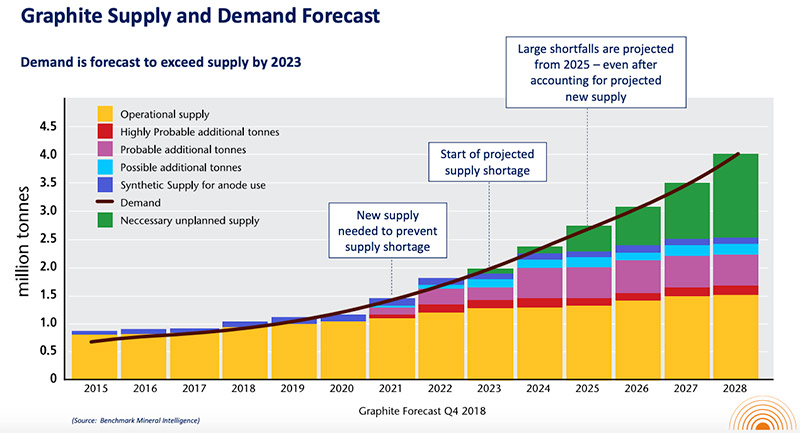
Graphite anode demand is set to increase from 194,160 tonnes in 2017 to 1,080,360 tonnes by 2023 and 1,747,800 tonnes by 2028
Automakers are taking action to put millions of electric vehicles on the road
Quebec and B.C Governments dedicated to “Green Economyâ€
Lomiko Metals Inc. has been keenly watching the lithium-ion battery market in anticipation of identifying an opportunity to participate in the supply of materials for electric vehicles with its La Loutre graphite project located in Quebec, Canada. Lomiko is focused on advancing the La Loutre graphite property and is looking to deliver an NI 43-101 graphite resource based on the success of its recently completed drilling campaign at the Refractory Zone. This will add to the previously announced 43-101 graphite resource at the adjacent Graphene-Battery zone announced March, 2016.
A. Paul Gill, CEO states, “Lomiko believes that it is in an ideal position to participate in the burgeoning Electric Vehicle market, with the potential to become a North American supplier of graphite materials, a market currently dominated by foreign supply from China. Graphite is a major and critical material in the manufacture of lithium-ion and other batteries, specifically battery anodesâ€.
According to Benchmark Minerals, graphite anode demand is set
to increase from 194,160 tonnes in 2017 to 1,080,360 tonnes by 2023 and
1,747,800 tonnes by 2028. [Source: INN Graphite Investing News] On
February 4, 2019, Simon Moores of Benchmark Mineral Intelligence
raised supply and demand concerns in a submission to the US Senate
which was echoed by Energy and Natural Resource Committee Chair Senator
Lisa Murkowski in a February 5, 2019 News Release: “In contrast to the
energy sector, our nation is headed in the wrong direction on mineral
imports. This is our Achilles’ heel that serves to empower and enrich
other nations, while costing us jobs and international
competitiveness,†Murkowski said. Lomiko brought this crucial
opportunity to the attention of shareholders in a February 8, 2019.
Recent
announcements and cooperation agreements on electric vehicle and
self-driving cars between Ford and Volkswagen indicates automakers are
taking action to put millions of electric vehicles on the road. Raw
material demand for graphite, lithium and nickel sourced from North
American is likely to increase as a result. Ford
said its battery electric vehicle rollout will start in 2020 with a
performance utility, and it plans to launch 16 battery electric vehicles
by 2022.
In other positive developments,
Quebec Premier Francois Legault reiterated his commitment to make the
Province the ‘Green Battery’ of North America through investments in
electric buses and trams while British Columbia Premier John Horgan aims
to eliminate all gas-powered cars by 2040.
For more information on Lomiko Metals, review the website at www.lomiko.com, contact A. Paul Gill at 604-729-5312 or email: [email protected].
Posted by AGORACOM-JC
at 7:37 AM on Wednesday, August 14th, 2019
Announced the launch of a new same-day delivery service for customers in the Greater Toronto Area.
Spyder customers in the Greater Toronto Area now have the option, for a nominal fee, of choosing guaranteed same-day delivery for vapes and cannabis accessories on orders placed before 2pm.
Vaughan, Ontario–(August 14, 2019) – Â Spyder Cannabis Inc. (TSXV: SPDR) (“Spyder“), an established Canadian cannabis and vape retail operator, announces the launch of a new same-day delivery service for customers in the Greater Toronto Area.
Spyder customers in the Greater Toronto Area now have the option, for
a nominal fee, of choosing guaranteed same-day delivery for vapes and
cannabis accessories on orders placed before 2pm.
“Our decision to launch our same-day delivery service in the GTA is a
clear example of our customer-centric approach. We are committed to
providing our customers with the highest quality products and the most
convenient and personalized service available, “said Dan Pelchovitz,
President and CEO of Spyder Cannabis. “We believe that our same-day
delivery service will give Spyder a significant competitive advantage in
the vapes and cannabis accessory market. We hope to expand the same-day
delivery service to other major Canadian centers in the near future,”
added Dan.
About Spyder Cannabis
Founded in 2014 Spyder is an established chain of three high-end vape
stores, and two cannabis accessory stores, in Ontario, with locations
in Woodbridge, Scarborough, Burlington, Pickering and Niagara Falls. The
Spyder brand is defined by its high-quality proprietary line of
e-juice, liquids and exclusive retail deals, dispensed in uniquely
designed stores creating the optimal customer experience. Spyder is
building off this leading retail, distribution and branding eCig and
vapes company and is pursuing expansion into the legal cannabis and hemp
derived market. Spyder has developed a scalable retail model with plans
to create a significant footprint with targeted and disciplined retail
distribution strategy focusing on Canadian retail and U.S. boutique
retail and kiosks in high traffic peripheral areas
FOR ADDITIONAL INFORMATION, PLEASE CONTACT:
For more information, please contact:
Spyder Cannabis Inc. Dan Pelchovitz President & Chief Executive Officer Contact: Investor Relations Phone: 1-888-504-SPDR (1-888-504-7737) Email: [email protected]
Neither the TSX Venture Exchange nor its Regulation Services Provider
(as that term is defined in the policies of the TSX Venture Exchange)
accepts responsibility for the adequacy or accuracy of this release.
This news release includes statements containing certain
“forward-looking information” within the meaning of applicable
securities laws (“forward-looking statements”). Forward-looking
statements are frequently characterized by words such as “plan”,
“continue”, “expect”, “project”, “intend”, “believe”, “anticipate”,
“estimate”, “may”, “will”, “potential”, “proposed” and other similar
words, or statements that certain events or conditions “may” or “will”
occur..
These statements are only predictions. Various assumptions were used
in drawing the conclusions or making the projections contained in the
forward-looking statements throughout this news release. Forward-looking
statements are based on the opinions and estimates of management at the
date the statements are made. Any number of risks and uncertainties and
other factors that could cause actual events or results to differ
materially from those projected in the forward-looking statements.