Posted by AGORACOM
at 3:47 PM on Thursday, March 5th, 2020
SPONSOR: Mota is seeking to become a vertically integrated global CBD brand. Mota is looking to establish sales channels and a distribution network internationally through the acquisition of the Sativida and First Class CBD brands. Low cost production, coupled with international, direct to customer sales channels will provide the foundation for the success of Mota. Click Here for More Info
New Frontier Data’s second consumer report in its EU CBD series
provides a comprehensive overview of the European CBD consumer
experience
New Frontier Data,
the global authority in data, analytics and business intelligence on
the cannabis industry, publishes the second volume of its EU CBD Consumer Report Series: Segmentation & Archetypes, in partnership with Deep Nature Project and Mile High Labs.
Drawing from the groundbreaking surveying of over 3,000 European CBD
consumers across 17 European nations, this study results in the most
comprehensive consumer archetype report for European CBD consumers to
date.
“Europe’s booming consumer interest in CBD and CBD-infused products
across the Food & Beverage and Health & Beauty sectors continues
to create material B2B and B2C market opportunities. Data-driven
insights of both EU and North American CBD consumerism, drawing from not
only comparative analysis but also known geo-centric market dynamics
and drivers, helps us educate and guide brands on how to address CBD
consumer priorities while managing known or expected challenges in this
new CBD space,†said New Frontier Data Founder & CEO Giadha Aguirre
de Carcer. “This report fills a major gap in business intelligence in
the CBD industry not only in Europe, but worldwide, providing new and
existing cannabis or hemp industry stakeholders with a uniquely valuable
and timely resource.â€
Key findings from the report include:
4 of the 5 consumer archetypes have purchased CBD; the Ambivalent & Experimental Consumers instead source CBD from family and friends
The largest consumer archetype, the Integrative & Consistent Consumers, are frequent users and staunch believers in CBD’s medical efficacy
26% of Europeans aged 18-34 have tried CBD, compared to 16% of the general population
73% of self-reported consumers claimed CBD has positively affected their quality of life
A third (34%) of non-consumers are somewhat or very curious about trying CBD
49% of CBD purchasers who did not themselves consume indicated buying it for a family member
Male consumers report spending more on CBD products than female
consumers, with more than a third of men (35%) reporting spending €100
or more per month
72% of consumers and 17% of non-consumers considered themselves likely to purchase CBD in the next 6 months
Consumers who use CBD primarily for medical reasons were the most
frequent CBD consumers, with nearly half (45%) consuming it at least
daily
New Frontier Data is an independent, technology-driven analytics
company specializing in the global cannabis industry. It offers vetted
data, actionable business intelligence and risk management solutions for
investors, operators, researchers and policy makers. New Frontier
Data’s reports and data have been cited in over 80 countries around the
world to inform industry leaders. Founded in 2014, New Frontier Data is
headquartered in Washington, D.C., with additional offices in Denver, CO
and London, UK.
New Frontier Data does not take a position on the merits of cannabis
legalization. Rather, its mission and mandate are to inform
cannabis-related policy and business decisions through rigorous,
issue-neutral and comprehensive analysis of the legal cannabis industry
worldwide. For more information about New Frontier Data, please visit: https://www.NewFrontierData.com.
Posted by AGORACOM
at 2:34 PM on Thursday, March 5th, 2020
SPONSOR: Lomiko Metals is focused on the exploration and development of minerals for the new green economy such as lithium and graphite. Lomiko owns 80% of the high-grade La Loutre graphite Property, Lac Des Iles Graphite Property and the 100% owned Quatre Milles Graphite Property. Lomiko is uniquely poised to supply the growing EV battery market. Click Here For More Information
The value of metals used in batteries for the nascent electric vehicle industry measured for the first time
It is worth remembering that the first all-electric vehicle to use a
lithium-ion battery – the Tesla roadster – only rolled off assembly
lines in 2008.
And the blue-sky scenarios and exuberant forecasts for electric
vehicle demand and mining only really started to make headlines three or
four years ago.
And those headlines came just at the right time for an industry at
the bottom of a brutal business cycle and in desperate need of a
feelgood news story.
Not that the feeling lasted all that long.
All of mining is mercifully free of the ravages of price stability, but even tulip bulbs took longer from boom to bust than EV metals.
But how does falling prices for lithium, cobalt, graphite and nickel
square with demand forecasts that all start in the bottom left corner
and end in the top right?
Pedal to the metal
To get a better grip on the nascent sector, MINING.COM combined two sets of data:
First, prices paid for the mined minerals at the point of entry into the global battery supply chain.
London-based Benchmark Mineral Intelligence,
a global battery supply chain, megafactory tracker and market
forecaster, provides MINING.COM with monthly sales-weighted price data.
Second, the sales weighted volume of the raw materials in electric and hybrid passenger car batteries sold around the world.
Toronto-based Adamas Intelligence,
which tracks demand for EV batteries by chemistry, cell supplier and
capacity in over 90 countries provides the data for the raw materials
deployed.
Benchmark has been tracking megafactory construction since Tesla
broke ground on the first of its kind in June 2014. Adamas completes the
chain, recording all that battery power hitting the road.
That makes the MINING.COM EV Metals index more than a mine to market measure. More like mine to, er, garage.
The inaugural MINING.COM EV Metals Index shows an industry in better
shape than what tanking prices and dismal headlines would suggest.
In fact, the nickel sub-index is at a record high and cobalt bulls
would be happy to know that the metal feeding the battery supply chain
had its biggest month in nine.
If you take Tesla’s stock price as a guide (and I know a bunch of
short sellers who would rather pluck their own eyes out than do that)
the essential ingredients of muskmobiles should not be languishing at multi-year lows.
Last year, Elon Musk said getting more Teslas on the road is
dependent on scaling battery production and to scale at the fastest rate
possible it may be necessary to get into mining, “at least a little bit.â€
The last auto exec to venture into mining was Henry Ford
The last auto exec to venture into mining was Henry Ford. When the
equivalent of an over the air update was a hand crank and cars could
only be had in black and not four (wow!) other colours like the Model
S.
Crucially, at the time the cost of raw materials had a much bigger
bearing on the final price of a car. In EV production the battery can be
up to 50% of the cost of production and raw materials the bulk of
that.
A seminal study on EVs by UBS showed the only commodity your average
EV (Chevy Bolt) and ICE car (VW Golf) have in equal amounts, is rubber.
(Ford, btw, also owned a rubber plantation in Brazil.)
That’s how much of a change the switch to electric vehicles represents in the auto industry’s raw material supply chain.
Rocks down to electric avenue
Yet here we are.
Newbie investors are taking a crash course in surviving a sector that can turn on a dime.
Juniors are being scared off. Bodies are piling up among developers.
Producers’ grand ambitions have been thwarted. Contracts have been
reneged on.
It’s difficult to see the disconnect on fundamentals lasting that
much longer – governments’ green demands and emissions strictures are
only intensifying and carmakers’ programs are only becoming more
lavish.
Volkswagen promises 80 all electric models across its brands by 2025. Three hundred by the end of the decade.
While miners are encountering the pitfalls of vertical integration,
the global auto industry is getting a crash course in mining lead times
A year ago already, Wolfsburg said it was allocating $48 billion for EV development.
And then you also read that Audi (a VW brand) and Mercedes Benz had
to suspend production due to a battery shortage (long before
coronavirus).
While miners are encountering the pitfalls of vertical integration,
the global auto industry is getting a crash course in mining lead times
and how tiny markets (annual global cobalt mining revenue is less than
what VW collects in a week) can impact giant industries.
In total, the world’s automakers have committed $300 billion for
making rides you have to plug into a wall, Benchmark estimates. Or to
use the car industry term, $300 billion for ushering in a new epoch of
sustainable mobility.
Neither is there a shortage of government support for the transition. Unlike AOC’s,
the EU’s $1 trillion green new deal may actually get off the starting
grid, and Beijing has ordered 25% of cars sold must be EVs within five
short years.
Lithium nirvana
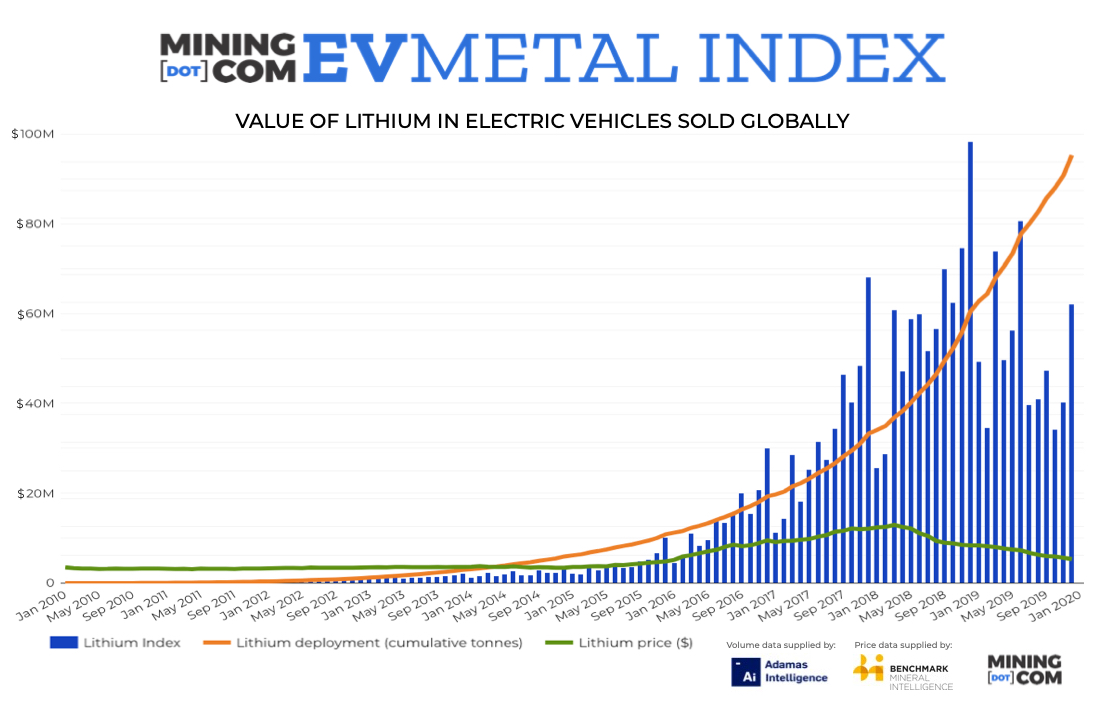
MINING.COM compiled the data for lithium prices from Benchmark and lithium deployment from Adamas going back eleven years.
It just shows again that the EV raw materials industry is in its infancy.
For calendar year 2009, the electric and hybrid cars sold around the
world contained a paltry 31 tonnes of lithium in their batteries worth a
combined $182K (that’s a K not an m).
Eleven years later, the industry had grown 3,330-fold for a value of
$609m. Ok, that’s just having fun with the base effect, but measured
just over the last five years the annualized value of lithium in EVs are
up more than 1,000%.
And that’s despite a contraction in 2019. Lithium price tripled
between April 2015 and peaked three years later, only to tumble by 60%
in value since then.
Graphite was the first to peak in early 2012, but has since halved.
The value of graphite deployed in EVs is up 370% in three years. And as a
percentage of the index, graphite has in fact steadily increased its
share.
The bigger picture is one of an industry that is still expanding. And at a breakneck pace.
Cobalts from the blue
Given its tricky fundamentals, cobalt is always going to be a conundrum for investors and a headache for carmakers.
It’s the priciest component and the most volatile.
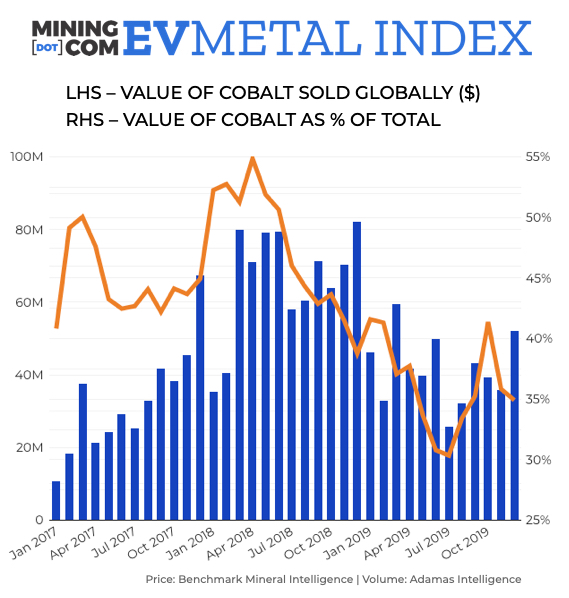
At its peak, Co made up as much as 55% of the cost of raw materials for
batteries. Despite a plummeting price and ongoing thrifting, it still
makes up a third of the input cost.
Given that almost two-thirds primary supply is from the Congo and
more than 80% of processing capacity is located in China, cobalt’s spike
to just shy of $110,000 a tonne in April 2018 was understandable.
That 15 months later it was below $26,000, less so.
At the stroke of a pen, Beijing can change market dynamics
completely. Its subsidy cuts last year crumpled a market growing at more
than 60% the year before.
In February, Tesla – which in good months sells more battery capacity than its three nearest rivals combined – surprised cobalt and nickel bulls by opting for batteries at its Shanghai plant that forego both.
At the time of writing, the impact of the four Cs –
cobalt-Congo-China-coronavirus – is far from clear. But as the graph
shows, cobalt bulls had something to celebrate in the second half of last year.
Better than the devil’s copper you know
Batteries account for only 6% of global nickel demand today, meaning
investors buying into the sulphates story also take a hit when Jakarta
convulses the nickel pig iron trade.
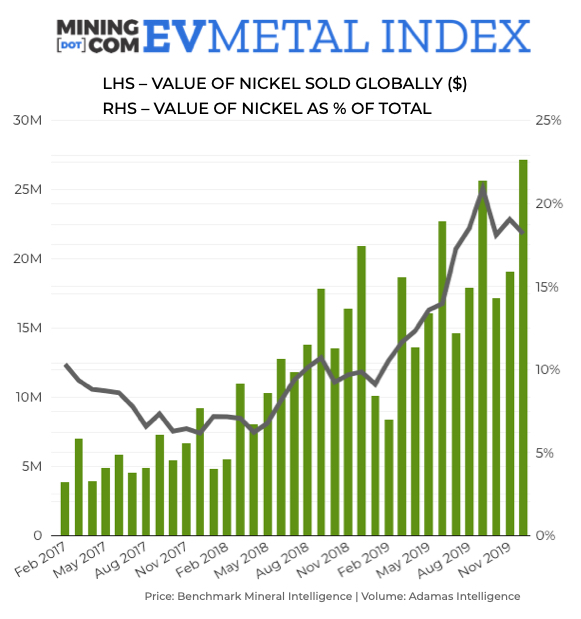
MINING.COM’s inaugural index shows nickel setting a new monthly record at the end of last year, despite the sharp retreat in prices since September.
The increasing use of nickel rich cathodes also means its
contribution to the value mix has almost doubled in a year to more than
18%.
As nickel-rich chemistries increasingly dominate the EV market, the
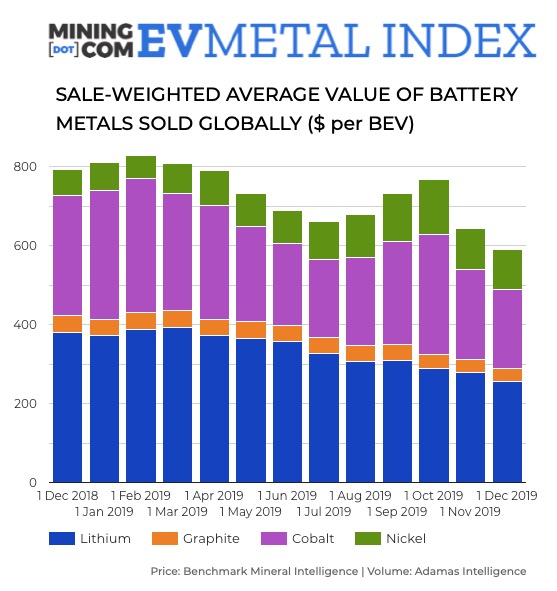
average sales weighted value of nickel on a per vehicle basis is rising
sharply – to over $100 in December from $67 a year earlier or from less
than a quarter of the cost of the cathode’s cobalt to half that.
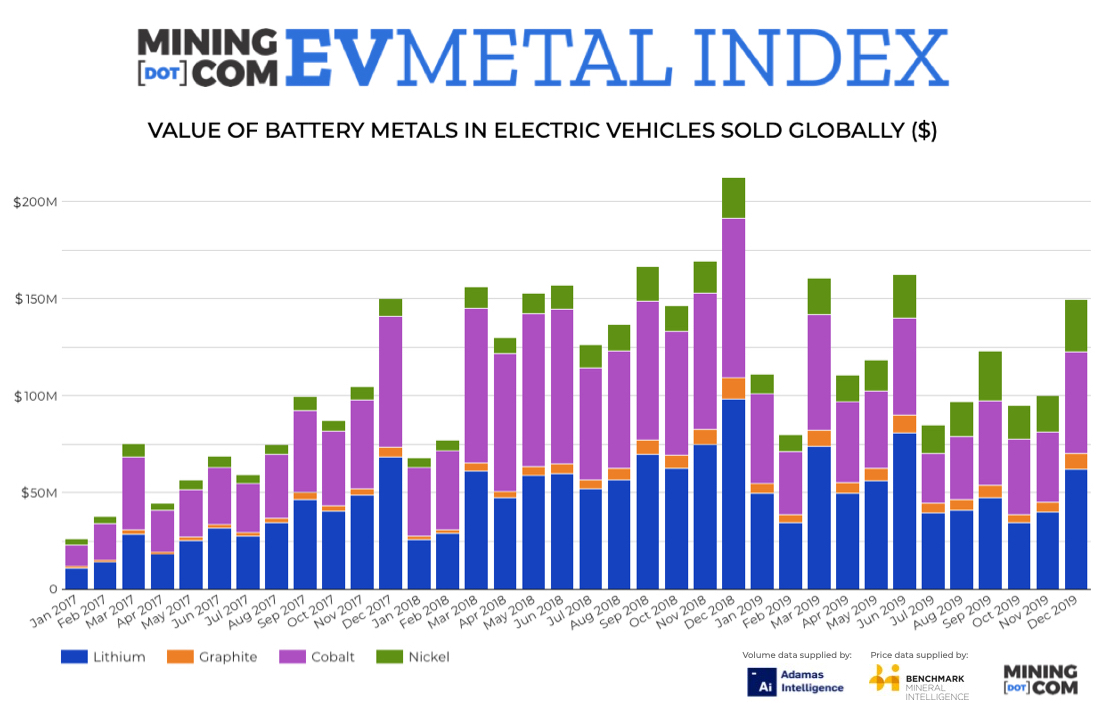
The combined value of lithium, graphite, cobalt and nickel based on sales weighted average deployed per vehicle was under $600.
When prices were peaking in early 2018 those raw materials cost more
than $1,500 per vehicle. Not the battery, just the raw materials.
In the longer run, nickel for batteries could be as big a market as
for stainless steel, which would be equivalent to gold’s use in
electronics, becoming a $100 billion industry, from an afterthought
today.
Kalahari thirst
Adamas data shows that NCM (nickel-cobalt-manganese) and NCA
(nickel-cobalt-aluminum) cathodes had a 94% market share in December,
based on total battery capacity deployed globally.
MINING.COM is not tracking manganese as EV dynamics have almost no bearing on its price.
High-purity manganese sulphate usually sells at a healthy premium,
but as a component of NCM batteries, no auto exec is losing sleep over
manganese costs or supply.
Likewise aluminum, despite significantly higher use in EVs.
That said, in an all-EV world battery-grade manganese demand could
make the Kalahari desert, home to the oldest population of humans on
earth and 70% of global reserves, a point of contention not unlike
cobalt and the Congo (minus the child labour and ongoing violent
conflict).
We lose money on every sale, but make it up on volume
Call them giga or mega, your average battery manufacturing plant is huge.
There are more than 100 megafactories in the pipeline around the world – 14 of them in Europe.
MINING.COM’s prediction is that 2019 wasn’t only the first annual fall in the index, but also the last
Last year battery power deployed rose 30% globally. In Europe, gigawatt hours hitting the road grew 89%.
To feed those factories to power those cars requires the extraction
of lithium, graphite, cobalt and nickel to increase by magnitudes.
The MINING.COM EV Metals Index shows that the gap between future supply and future demand has become a chasm.
MINING.COM’s prediction is that 2019 wasn’t only the first annual fall in the index, but also the last.
Posted by AGORACOM
at 12:23 PM on Thursday, March 5th, 2020
SPONSOR: Labrador Gold – Two successful gold explorers lead the way in the Labrador gold rush targeting the under-explored gold potential of the province. Exploration has already outlined district scale gold on two projects, including a 40km strike length of the Florence Lake greenstone belt, one of two greenstone belts covered by the Hopedale Project. Recently acquired 14km of the potential extension of the new discovery by New Found Gold’s Queensway project to the south.Click Here for More Info
Conglomerate gold player, Novo Resources, has swapped scrip to take a piece of New Found Gold Corp, giving it exposure to the Newfoundland gold prospect
Dr. Quinton Hennigh said: “We
at Novo think the Queensway Project represents a very promising new
high-grade gold discovery. It appears the Queensway Project encompasses
an area highly prospective for high-grade, epizonal orogenic gold
mineralization
TSX-listed, Pilbara-focused gold player, Novo Resources, has acquired
15.97 per cent of New Found Gold Corp via a scrip-for-scrip deal that
gives Novo access to New Found’s stellar gold prospect on the east coast
of Canada. Novo says that the New Found tenement package is the largest
in the Province of Newfoundland and Labrador.
A recent drill intercept at New Found’s Queensway project located
near the town of Gander in central Newfoundland returned 19m at 3 ounces
to the tonne from 98m, including 6m at a staggering 9oz/tonne gold.
Novo says the intercept has an estimated true width of around 70 per
cent of the 19m hit, making it an extraordinary hole.
According to New Found’s management, this drill hole is adjacent to
historical surface workings and only 2km from an historical gold
resource.
Novo said that Eric Sprott, a director of Novo, was sitting on 16.79%
of the issued and outstanding shares of New Found immediately prior to
the acquisition. New Found is considered a non-arm’s length party to
Novo pursuant to TSX Venture Exchange policies and the deal is subject
to the approval of the Exchange.
Under the terms of the acquisition, Novo also has the right to
appoint a director to the board of directors of New Found at any time
for a period of three years from the acquisition date provided that the
company holds no less than 10% of New Found’s issued and outstanding
shares. Novo has also agreed to certain voting restrictions for a period
of three years.
President and Chairman of Novo Resources, Dr. Quinton Hennigh said: “We
at Novo think the Queensway Project represents a very promising new
high-grade gold discovery. It appears the Queensway Project encompasses
an area highly prospective for high-grade, epizonal orogenic gold
mineralization. We are very pleased to have the opportunity to be part
of this exciting discovery and, upon completion of the Acquisition, look
forward to supporting New Found as they advance work around hole
NFGC-19-01 and the many other high-grade showings across the Queensway
Project.â€
Whilst Novo has been and remains focused on delivering its
Pilbara-based conglomerate gold project, the acquisition of an interest
in New Found is the second of its kind for Novo. The TSX-listed company
announced back in January this year that it had subscribed for shares in
ASX-listed Kalamazoo Resources in a financing arrangement that will,
upon closing, give Novo 8.17 per cent of Kalamazoo’s issued and
outstanding shares.
Novo said that Kalamazoo has a string of prospects in the
Bendigo-Castlemaine region of Victoria in Australia and its prospects
have strong similarities to the 1Moz Fosterville gold deposit being
mined underground by TSX-listed Kirkland Lake Gold at an average grade
of 31g/t gold.
Interestingly, Eric Sprott, Novo director, is also a shareholder in Kalamazoo.
With a market cap approaching the equivalent of half a billion
Australian dollars, Novo can make scrip-based acquisitions such as New
Found and Kalamazoo with ease.
The impact on its share capital is minimal but the upside is
potentially serious if either of its current or future based bets come
good – and with 19m going 3 ounces to the tonne, New Found just might
fit into that category.
Posted by AGORACOM-JC
at 12:14 PM on Thursday, March 5th, 2020
SPONSOR: CardioComm Solutions (EKG: TSX-V)
– The heartbeat of cardiovascular medicine and telemedicine. Patented
systems enable medical professionals, patients, and other healthcare
professionals, clinics, hospitals and call centres to access and manage
patient information in a secure and reliable environment.
DEA Proposes New Mhealth Rule for Substance Abuse Treatment
A proposed rule change would allow providers to use mHealth tools
more freely in substance abuse treatment programs, but it isn’t the rule
that telehealth advocates have been anticipating.
March 04, 2020 – Federal officials have proposed easing restrictions
on the use of mHealth in substance abuse programs – but the changes
aren’t what everyone has been expecting.
“The NTP registrants that operate or wish to operate mobile
components (in the state that the registrant is registered in) to
dispense narcotic drugs in schedules II-V at a remote location for the
purpose of maintenance or detoxification treatment would not be required
to obtain a separate registration for a mobile component,†a summary of
the rule states.
“This proposed rule would waive the requirement of a separate
registration at each principal place of business or professional
practice where controlled substances are dispensed for those NTPs with
mobile components that fully comply with the requirements of the
proposed rule, once finalized,†the summary continues. “These revisions
to the regulations are intended to make maintenance or detoxification
treatments more widely available, while ensuring that safeguards are in
place to reduce the likelihood of diversion.â€
The notice is different from what telehealth and mHealth providers
have been waiting for: a rule that would ease federal restrictions on
the prescription of scheduled drugs via telemedicine, and one that
federal officials had been expected to unveil. It even prompted Virginia
Sen. Mark Warner to issue a press release congratulating the DEA on
making that move.
“The opioid and addiction epidemic has had a devastating impact on communities in Virginia and across the country,†Warner, who had sent a letter to the DEA in January,
said in a press release that has since been deleted. “We need to use
every tool at our disposal to ensure that individuals struggling with
addiction can access the treatment they need, and telehealth is an
important part of that. I am pleased the DEA has finally issued proposed
rulemaking that will improve telehealth access for these patients and I
hope they will work quickly to finalize this rulemaking once
stakeholders have had an opportunity to weigh in.â€
That deadline passed without action. In November, the Justice Department announced plans to issue a proposed rule to
create that registration process. But nothing has happened since then,
and the DEA and other federal agencies have refused to give any updates.
Last month’s ruling leaves healthcare providers looking for more
leeway in treating substance abuse issues both pleased and disappointed.
It’s a step in the right direction for programs using digital health
tools, but not the leap forward that so many have been anticipating.
Posted by AGORACOM
at 12:09 PM on Thursday, March 5th, 2020
SPONSOR: ZEN Graphene Solutions: An emerging advanced materials and graphene development company with a focus on new solutions using pure graphene and other two-dimensional materials. Our competitive advantage relies on the unique qualities of our multi-decade supply of precursor materials in the Albany Graphite Deposit. Independent labs in Japan, UK, Israel, USA and Canada confirm this. Click here for more information
An optical image of the graphene device (shown above as a square gold pad) on a silicon dioxide/silicon chip. Shining metal wires are connected to gold electrodes for electrical measurement. The tiny graphene device has a length and width of just one-tenth of a millimeter. (Credit: Guorui Chen/Berkeley Lab)
Berkeley Lab scientists tap into graphene’s hidden talent as an electrically tunable superconductor, insulator, and magnetic device for the advancement of quantum information science
Ever since graphene’s discovery
in 2004, scientists have looked for ways to put this talented,
atomically thin 2D material to work. Thinner than a single strand of DNA
yet 200 times stronger than steel, graphene is an excellent conductor
of electricity and heat, and it can conform to any number of shapes,
from an ultrathin 2D sheet, to an electronic circuit.
Last year, a team of researchers led by Feng Wang, a faculty scientist in Berkeley Lab’s Materials Sciences Division and a professor of physics at UC Berkeley, developed a multitasking graphene device
that switches from a superconductor that efficiently conducts
electricity, to an insulator that resists the flow of electric current,
and back again to a superconductor.
Now, as reported in Nature today,
the researchers have tapped into their graphene system’s talent for
juggling not just two properties, but three: superconducting,
insulating, and a type of magnetism called ferromagnetism. The
multitasking device could make possible new physics experiments, such as
research in the pursuit of an electric circuit for faster,
next-generation electronics like quantum computing technologies.
Optical image of a trilayer graphene material sandwiched between
boron nitride layers during the nanofabrication process (left); and the
trilayer graphene/boron nitride device with gold electrodes (right).
(Credit: Guorui Chen/Berkeley Lab)
“So far, materials simultaneously showing superconducting,
insulating, and magnetic properties have been very rare. And most people
believed that it would be difficult to induce magnetism in graphene,
because it’s typically not magnetic. Our graphene system is the first to
combine all three properties in a single sample,†said Guorui Chen, a
postdoctoral researcher in Wang’s Ultrafast Nano-Optics Group at UC
Berkeley, and the study’s lead author.
Using electricity to turn on graphene’s hidden potential
Graphene has a lot of potential in the world of electronics. Its
atomically thin structure, combined with its robust electronic and
thermal conductivity, “could offer a unique advantage in the development
of next-generation electronics and memory storage devices,†said Chen,
who also worked as a postdoctoral researcher in Berkeley Lab’s Materials
Sciences Division at the time of the study.
The problem is that the magnetic materials used in electronics today
are made of ferromagnetic metals, such as iron or cobalt alloys.
Ferromagnetic materials, like the common bar magnet, have a north and a
south pole. When ferromagnetic materials are used to store data on a
computer’s hard disk, these poles point either up or down, representing
zeros and ones – called bits.
Graphene, however, is not made of a magnetic metal – it’s made of carbon.
So the scientists came up with a creative workaround.
By applying electrical voltages through the graphene device’s gates,
the force from the electricity prodded electrons in the device to circle
in the same direction, like tiny cars racing around a track. This
generated a forceful momentum that transformed the graphene device into a
ferromagnetic system.
More measurements revealed an astonishing new set of properties: The
graphene system’s interior had not only become magnetic but also
insulating; and despite the magnetism, its outer edges morphed into
channels of electronic current that move without resistance. Such
properties characterize a rare class of insulators known as Chern
insulators, the researchers said.
Even more surprising, calculations by co-author Ya-Hui Zhang of the
Massachusetts Institute of Technology revealed that the graphene device
has not just one, but two conductive edges, making it the first observed
“high-order Chern insulator,†a consequence of the strong
electron-electron interactions in the trilayer graphene.
Scientists have been in hot pursuit of Chern insulators in a field of
research known as topology, which investigates exotic states of matter.
Chern insulators offer potential new ways to manipulate information in a
quantum computer, where data is stored in quantum bits, or qubits. A
qubit can represent a one, a zero, or a state in which it is both a one
and a zero at the same time.
“Our discovery demonstrates that graphene is an ideal platform for
studying different physics, ranging from single-particle physics, to
superconductivity, and now topological physics to study quantum phases
of matter in 2D materials,†Chen said. “It’s exciting that we can now
explore new physics in a tiny device just 1 millionth of a millimeter
thick.â€
The researchers hope to conduct more experiments with their graphene
device to have a better understanding of how the Chern insulator/magnet
emerged, and the mechanics behind its unusual properties.
Researchers from Berkeley Lab; UC Berkeley; Stanford University; SLAC
National Accelerator Laboratory; Massachusetts Institute of Technology;
China’s Shanghai Jiao Tong University, Collaborative Innovation Center
of Advanced Microstructures, and Fudan University; and Japan’s National
Institute for Materials Science participated in the work.
Founded in 1931 on the belief that the biggest scientific challenges are best addressed by teams, Lawrence Berkeley National Laboratory
and its scientists have been recognized with 13 Nobel Prizes. Today,
Berkeley Lab researchers develop sustainable energy and environmental
solutions, create useful new materials, advance the frontiers of
computing, and probe the mysteries of life, matter, and the universe.
Scientists from around the world rely on the Lab’s facilities for their
own discovery science. Berkeley Lab is a multiprogram national
laboratory, managed by the University of California for the U.S.
Department of Energy’s Office of Science.
DOE’s Office of Science is the single largest supporter of basic
research in the physical sciences in the United States, and is working
to address some of the most pressing challenges of our time. For more
information, please visit energy.gov/science.
Posted by AGORACOM-JC
at 11:54 AM on Thursday, March 5th, 2020
SPONSOR: BetterU Education Corp.
aims to provide access to quality education from around the world. The
company plans to bridge the prevailing gap in the education and job
industry and enhance the lives of its prospective learners by developing
an integrated ecosystem. Click here for more information.
Tech Reskilling in India a Necessity
Behind the AI and data analytics boom, lies the story of a massive talent gap as workforce struggles to remain employable
The skills’ shelf life has shortened, with technology changing exponentially over the last decade, skills that were relevant at the beginning of the career have become obsolete
While skill development gets a major chunk of CSR funding, reskilling
in India isn’t a priority. Even with the third-largest developer base
and a substantial tech-savvy talent pool, India lags behind its peers on
major AI indicators. This is despite a thriving startup ecosystem,
high-growth companies which have made a substantial investment in
setting up CoEs (centres of excellence) and the Government investing in
building a robust tech infrastructure.
Behind the AI and data analytics boom, lies the story of a massive
talent gap as workforce struggles to remain employable. The skills’
shelf life has shortened, with technology changing exponentially over
the last decade, skills that were relevant at the beginning of the
career have become obsolete. In order to remain employable, the
workforce needs reskilling in India.
Reskilling in India can fill gaps
The rise of edtech companies in India is not surprising, given the
huge clamour for continuous learning that has taken root in the
professional sphere. This is backed by the rise of emerging technologies
— Artificial Intelligence, its subset Machine Learning and Data Science
which has spawned a booming job market revolving around new
technologies that has substantially transformed India’s IT labour
market.
The changing job economy has resulted in new opportunities for the Indian workforce. As estimated by a consulting major,
AI has the potential to add 15% of India’s current gross value in
2035. The booming economy, fuelled by AI and advanced analytics requires
more Indians to enter the workforce with a different skill-set. As per
estimates, close to 97,000 AI positions lie vacant in India.
However, the challenges are also increasing multifold — on the one
hand Indian companies are struggling with disruptions like automation
that are redefining jobs and secondly, it is grappling with finding the
right talent with the right skillset for AI/ machine learning and data
science teams. Meanwhile, the upcoming generation that will enter the
workforce soon is fed on an outdated curriculum that hasn’t kept up with
the industry’s demands.
What can key players do?
In order to capitalise on these opportunities, IT companies,
educators and policymakers need to develop a deeper understanding of the
existing workforce, the skill-set required in the future, and the gaps
that will need to be addressed. This implies that these three key
players need to align the broader economic developer agenda with the
shifting job market and work towards building a strong talent that has
the baseline and digital skills required for current landscape.
The government’s involvement in reskilling in India is a must. A
joint report by industry body NASSCOM and FICCI level says that the IT
workforce will become obsolete without government involvement. Policy
makers will have to assess secondary and postsecondary education and
align it with the skills that are required for tomorrow. Many leading
Indian IT majors have undertaken employer-training initiatives,
pre-employment training and have also provided their own courseware.
Collectively, the key stakeholders can foster a workforce development ecosystem and provide domain specific training
with a job-first approach. Given this scenario — educational
stakeholders have made a very strong business case for reskilling in
India and have actively partnered with renowned educational institutions
to launch technical certifications and degree programmes tailored to
fill the skill gap.
Posted by AGORACOM
at 11:09 AM on Thursday, March 5th, 2020
Sponsor: Loncor, a Canadian gold explorer controlling over 2,400,000 high grade ounces outside of a Barrick JV. The Ngayu JV property is 200km southwest of the Kibali gold mine, operated by Barrick, which produced 800,000 ounces of gold in 2018. Barrick manages and funds exploration at the Ngayu project until the completion of a pre-feasibility study on any gold discovery meeting their Tier One investment criteria. Newmont $NGT$NEM owns 7.8%, Resolute $RSG owns 27% Click Here for More Info
What if you gave a party and no one came? The Fed found themselves in that embarrassing position on Tuesday as they dumped a .5% drop in the Fed Funds rate onto a startled market. The market wasn’t startled at the interest rate decline, the market was startled because when the Fed spiked the punch one more time no one would drink the Kool Aid.
I’ve said for months the Fed would stick another Band-Aid on a
fatally wounded financial system yet they would fail. I felt that way
because I spent almost two years fighting a useless and pointless war.
You see we are all raised to believe that governments are all
powerful. But if you watch a squadron of 27 B-52s each loaded with 117
bombs carpet sweep an area and your enemy armed only with a bolt action
rifle gets up and shoots back at you, you begin to understand that
government only think they are all powerful. There is always a limit to
power. The Fed just reached it.
The Fed found that out on March 3rd. And it wasn’t even a tiny virus
from a laboratory in Wuhan that defeated the Fed. It was a totally
dysfunctional financial system where outright frauds such as Tesla can
double in a week.
I’ll say it again. The Everything Bubble just burst, some because of
the virus, some because of an out of balance useless financial system
and a lot because of a now broken Just in Time manufacturing system
totally dependent on China.
The metals are going to be included for a period as the margin clerks
man their phones and whisper sweet words of doom to their clients.
Everything is going to get sold. We are going into a massive period of
deflation. At the end all those million dollar MacMansions will be going
for pennies on the dollar. Gold might be $500 an ounce but will buy ten
times what it does today. We have sailed off the edge of the known
world.
I cannot predict the price of gold; many believe in error that they
can. I can just say that after many trials and tribulations the world
will realize that an honest monetary system is the only cure to what
ails us. It will include a jubilee and a metals based currency.
So it would behoove investors to be looking around for production or near production stories.
Someone came to me a week ago with a compelling story of a company
effectively off the radar screens of investors. Part of the reason is
that the founder of Loncor Resources (LN-T) Arnold Kondrat owns 29% of
the shares. Resolute Mining owns another 27% and Newmont 7.6%. With 64%
of the shares in the strongest of strong hands, there hasn’t been all
that much inclination to tell their story.
Loncor operates in the DRC, the Democratic Republic of the Congo. The
company has such a massive land position that it’s fairly hard to
understand why they have been so far off the radar of investors.
Loncor has 43-101 gold ounces of over 2.4 million. To use USD
figures, at today’s stock price Loncor is worth $19 per ounce in the
ground of gold. That no doubt will tend to set a floor under the price.
At their stage of development they should be getting more like $50-$60
USD an ounce.
It’s pretty hard to fathom the incredible size of Loncor’s land
position in the DRC. They hold 3,534 square km in the Ngayu greenstone
belt with similar endowment and geology with the greenstone belt to
their east in Tanzania home to several big gold mines. Within their
Ngayu land position they have a joint venture with Barrick on 1,894
square km of the total property. Barrick has an active trenching and
ground sampling program and is preparing to drill some of the six drill
ready targets already identified. Drilling begins this month.
The JV with Barrick is interesting. First of all, Barrick knows the
greenstone belt with big mines both in the DRC and in Tanzania. Barrick
wants at least four million ounces and would prefer high grade. Barrick
funds and runs the exploration program across the 1,894 square km all
the way to completion of a pre-feasibility study.
The DRC has a 10% carried interest and Barrick will have 65% of the
remainder with Loncor getting the remaining 35% of what is left after
the DRC gets their cut. At that point Loncor pays their own way on their
piece of the pie.
In Loncor’s fact sheet
they mention something interesting. Loncor’s Ngayu Greenstone belt is
home to a 130 km BIF. (Banded Iron Formation) Readers with a really good
memory may recall me writing about BIF
before when I was talking about where the gold showed up in the Western
Australia Pilbara Basin, also near the giant iron projects of WA.
Basically the iron was dissolved in seawater. When single cell
cyanobacteria began to produce oxygen some 3 billion years or so ago, as
the chemistry of the water changed, the iron precipitated out of
solution. Quinton Hennigh came up with the theory years ago that that is
how the world’s biggest gold properties got their gold. Gold and BIF
are similar in age and where you find one, you almost always find the
other.
Loncor is cheap. Yes, they may get cheaper but I find them attractive
enough that I bought some shares in the open market. Investors are
probably going to find it difficult to pick up a large position. The
shares pretty much trade by appointment. With a Barrick JV and with gold
in the ground at $19 an ounce in USD I don’t expect them to remain
cheap for long.
Loncor is an advertiser. I own shares. That makes me biased. I don’t
share in your gains or losses so take some responsibility for your own
trading decisions. It’s your money after all.
Posted by AGORACOM-JC
at 8:24 AM on Thursday, March 5th, 2020
Announced the advancement of its previously announced Joint Venture Partnership with Heritage Cannabis Holdings Corp. (CSE: CANN), based in Sandy, Oregon, USA.
Now advancing the JV with the order and installation of extraction and post-production equipment units at Empower’s existing licenced hemp processing facility in Sandy, Oregon,
Will immediately begin performing hemp-based product manufacturing for proprietary formulations, tolling services, and third-party white labelling services for other distributors throughout the United States
VANCOUVER, BC / March 5, 2020 / EMPOWER CLINICS INC. (CSE:CBDT) (OTC:EPWCF) (Frankfurt 8EC) (“Empower” or the “Company“), a vertically integrated and growth-oriented life sciences company is pleased to announce the advancement of its previously announced Joint Venture Partnership (“JV”) with Heritage Cannabis Holdings Corp. (CSE: CANN) (“Heritage”), based in Sandy, Oregon, USA.
In September 2019, Empower announced it had entered into a Letter of
Intent (“LOI”) to form a 50/50 ownership JV with Heritage for the
extraction of hemp for CBD oil production, and formulated CBD products.
The JV is equally funded by both parties and since formation CDN$250,000
has been provided to the JV.
Heritage and Empower are now advancing the JV with the order and
installation of extraction and post-production equipment units at
Empower’s existing licenced hemp processing facility in Sandy, Oregon,
in order to immediately begin performing hemp-based product
manufacturing for proprietary formulations, tolling services, and
third-party white labelling services for other distributors throughout
the United States.
The proprietary branded products will be distributed through
Empower’s corporately owned physician staffed health clinics in Oregon
and Arizona, online at www.sunvalleyhealth.com and in upcoming new franchise locations, which currently have access to over 165,000 patients.
Additionally, related downstream equipment is now being installed
including gel cap processing, tincture bottle and vape cartridge
filling, as well as labelling, packaging, storage and shipping services,
to offer full-service end-to-end products to third parties.
Heritage is providing training and supervision related to the
proprietary methods of extraction and oil production that is already
being successfully produced in Canada by Heritage.
“Having the backing of an experienced partner with the financial
strength of Heritage Cannabis is proving to be so beneficial for the
development of our first extraction facility”, said Steven McAuley,
Chief Executive Officer of Empower. “Together, we have already
identified numerous opportunities to bring new orders to the JV
facility, ensuring we leverage the capacity we are building.”
“We are very pleased to be advancing our U.S. strategy through this
mutually beneficial partnership with Empower, which provides Heritage
ease of access to the world’s largest cannabis market”, stated Clint
Sharples, Chief Executive Officer of Heritage. “The installation of
extraction units is the next phase of the JV and another step toward
successfully furthering our growth strategies.”
ABOUT EMPOWER
Empower is a vertically-integrated health & wellness brand with
it’s first hemp-derived CBD extraction facility under development, the
Company produces its proprietary line of cannabidiol (CBD) based
products and distributes products through company owned and franchised
clinics, with wholesale partnerships, online channels and with new
retail opportunities nationwide in the U.S. The company is a leading
multi-state operator of a network of physician-staffed wellness clinics,
focused on helping patients improve and protect their health, through
innovative physician recommended treatment options. The company has
commenced activity on how to connect its significant data, to the
potential of the efficacy of alternative treatment options related to
hemp-derived cannabidiol (CBD) therapies.
About Heritage Cannabis Holdings Corp.
The Company is focused on becoming a vertically integrated cannabis
provider that currently has two Health Canada approved licenced
producers, through its subsidiaries Voyage Cannabis Corp. and CannaCure
Corp. both regulated under the Cannabis Act Regulations. Working under
these two licences, Heritage has two additional subsidiaries, Purefarma
Solutions, which provides extraction services, and a Medical Services
Division which is focused on cannabis based medical solutions. Heritage
as the parent company, is focused on providing the resources for its
subsidiaries to advance their products or services to compete both
domestically and internationally.
Investors: Dustin Klein SVP, Business Development [email protected] 720-352-1398
For French inquiries: Remy Scalabrini, Maricom Inc., E: [email protected], T: (888) 585-MARI
DISCLAIMER FOR FORWARD-LOOKING STATEMENTS
This news release contains certain “forward-looking statements”
or “forward-looking information” (collectively “forward looking
statements”) within the meaning of applicable Canadian securities laws.
All statements, other than statements of historical fact, are
forward-looking statements and are based on expectations, estimates and
projections as at the date of this news release.Forward-looking statements
can frequently be identified by words such as “plans”, “continues”,
“expects”, “projects”, “intends”, “believes”, “anticipates”,
“estimates”, “may”, “will”, “potential”, “proposed” and other similar
words, or information that certain events or conditions “may” or “will”
occur. Forward-looking statements in this news release include
statements regarding; the Company’s intention to open a hemp-based CBD
extraction facility, the expected benefits to the Company and its
shareholders as a result of the proposed acquisitions and partnerships;
the effectiveness of the extraction technology; the expected benefits
for Empower’s patient base and customers; the benefits of CBD based
products; the effect of the approval of the Farm Bill; the growth of the
Company’s patient list and that the Company will be positioned to be a
market-leading service provider for complex patient requirements in 2019
and beyond. Such statements are only projections, are based on
assumptions known to management at this time, and are subject to risks
and uncertainties that may cause actual results, performance or
developments to differ materially from those contained in the
forward-looking statements, including; that the Company may not open a
hemp-based CBD extraction facility; that legislative changes may have an
adverse effect on the Company’s business and product development; that
the Company may not be able to obtain adequate financing to pursue its
business plan; general business, economic, competitive, political and
social uncertainties; failure to obtain any necessary approvals in
connection with the proposed acquisitions and partnerships; and other
factors beyond the Company’s control. No assurance can be given that any
of the events anticipated by the forward-looking statements will occur
or, if they do occur, what benefits the Company will obtain from them.
Readers are cautioned not to place undue reliance on the forward-looking
statements in this release, which are qualified in their entirety by
these cautionary statements. The Company is under no obligation, and
expressly disclaims any intention or obligation, to update or revise any
forward-looking statements in this release, whether as a result of new
information, future events or otherwise, except as expressly required by
applicable laws.
Tags: CSE, Hemp, Marijuana, small cap, small cap stocks, stocks Posted in Empower Clinics Inc. | Comments Off on Empower Clinics $CBDT.ca Announces Advancement of Joint Venture with Heritage Cannabis in the United States $WEED.ca $CGC $ACB $APH $CRON.ca $HEXO.ca $OGI.ca
Posted by AGORACOM
at 6:03 PM on Wednesday, March 4th, 2020
C:MOTA – Mota Ventures Corp
Mota Ventures Highlights
$29,000,000 in combined sales with EBITDA of approximately 12.5% (2019)
Revenue generating, EBIDTA positive Direct to Consumer E-commerce retailer
One of the Leaders in Online CBD Sales in North America with First Class CBD
Formalized Joint Venture With Bevcanna Enterprises Read More
Will share equal ownership in the Joint Venture and will be jointly responsible for developing and funding its operations
Company will provide manufacturing, marketing and distribution infrastructure in the European market.
Parties have determined an initial product launch and will provide further details on specific regions and timing once finalize
Announced Collaboration for Sativida US Expansion Read More
Unified Funding will provide assistance to Sativida with product sourcing, packaging, shipping, payment infrastructure and marketing
Sativida has become the number one search-ranked online retailer of CBD products in Spain and Mexico
Entered into Licensing Agreement with Phenome One Read More
A privately held full-service live genetic and seed preservation cannabis company.
Mota will have full access to Canada’s largest live genetic cannabis library with over 350 cultivars
Mota will have the right to propagate, cultivate, harvest and process a minimum of 10 selected cultivars
Mota
Ventures Corp. (CSE:MOTA) (FSE: 1WZ:GR) (OTC: PEMTF)
(the “Company“) is pleased to announce the
launch of a “CEO Verified†Discussion Forum on AGORACOM. The forum will serve
as the Company’s primary social media platform to interact with both
shareholders and the broader investment community in a fully moderated
environment.
The
Company announces that it has engaged AGORA Internet Relations Corp.
(“AGORACOMâ€) for an initial twelve month term, to provide online advertising
and marketing services to the Company.
In consideration for the provision of services, AGORA is entitled to a
fee of $60,000, to be paid in five equal tranches over the term. AGORA has agreed to accept the fee in common
shares of the Company, to be determined based on the market price of the shares
at the time of issuance. All common
shares of the Company issued to AGORA will be subject to a
four-month-and-one-day statutory hold period in accordance with the policies of
the Canadian Securities Exchange.
Mota
will receive exposure through content brand insertions on the AGORACOM network
and extensive search engine marketing over the next 12 months. In addition,
exclusive sponsorships of invaluable digital properties such as the AGORACOM home page
and the AGORACOM Twitter
account will serve to significantly raise brand awareness of the Company among
small cap investors. AGORACOM is the only small cap marketing firm to hold a
Twitter Verified badge.
AGORACOM
is the pioneer of online marketing, broadcasting, conferences and investor
relations services to North American small and mid-cap public companies, with
more than 300 companies served.
About Mota Ventures
Corp.
Mota Ventures Corp. is seeking to
become a vertically integrated CBD company with operations in Europe and the
Americas. Its wholly-owned subsidiary, First Class CBD, is a profitable online
retailer of CBD and CBD-infused products in the United States and the Company
is currently in the process of acquiring Sativida, a successful online retailer
CBD and CBD products in Europe. Mota Ventures, through a wholly-owned
subsidiary, holds a license to cultivate non-psychoactive cannabis and produce
CBD in Colombia and is developing cultivation operations on its 2.5-hectare
site in Guasca, Colombia. Mota Ventures believes that low cost CBD production
at its property in Colombia coupled with its international, direct-to-customer
sales channels will propel its continued success.
ON BEHALF OF THE BOARD OF DIRECTORS
MOTA VENTURES CORP. Ryan Hoggan
Chief Executive Officer
For further information, readers are encouraged to contact
Joel Shacker, President at +604.423.4733 or by email at [email protected] or www.motaventuresco.com
Neither the Canadian Securities Exchange
nor its Regulation Services Provider (as that term is defined in the policies
of the Canadian Securities Exchange) accepts responsibility for the adequacy or
accuracy of this press release, which has been prepared by management.
All statements in this press release,
other than statements of historical fact, are “forward-looking informationâ€
with respect to the Company within the meaning of applicable securities laws,
including with respect to research and development
projects with the University, its
plans to become a vertically integrated global CBD brand, its plans to
cultivate and extract cannabis to produce CBD and high-quality value added CBD
products in Latin America for distribution domestically and internationally and
its plans to acquire revenue-producing CBD brands and operations in Europe and
North America. The Company provides forward-looking statements for the purpose
of conveying information about current expectations and plans relating to the
future and readers are cautioned that such statements may not be appropriate
for other purposes. By its nature, this information is subject to inherent
risks and uncertainties that may be general or specific and which give rise to
the possibility that expectations, forecasts, predictions, projections or
conclusions will not prove to be accurate, that assumptions may not be correct
and that objectives, strategic goals and priorities will not be achieved. These
risks and uncertainties include but are not limited those identified and reported
in the Company’s public filings under the Company’s SEDAR profile at
www.sedar.com. Although the Company has attempted to identify important factors
that could cause actual actions, events or results to differ materially from
those described in forward-looking information, there may be other factors that
cause actions, events or results not to be as anticipated, estimated or
intended. There can be no assurance that such information will prove to be
accurate as actual results and future events could differ materially from those
anticipated in such statements. The Company disclaims any intention or
obligation to update or revise any forward-looking information, whether as a
result of new information, future events or otherwise unless required by law.
Posted in All Recent Posts, Mota Ventures Corp. | Comments Off on AGORACOM Welcomes Mota Ventures With Combined Total Sales of Almost $29,000,000 with a EBITDA of Approximately 12.5% in 2019 $APH.ca $GBLX $PFE $ACG.ca $ACB.ca $WEED.ca $HIP.ca $WMD.ca $CGRW
Reported (Q3-2019) revenues of $1,683,985 compared to $589,648, up by 186%
For the nine months operations, company reported revenues of $2,559,068 compared to $1,872,944, up by 37%
Cash position improved significantly, $812,853 compared to $66,296 in the previous quarter
Recent Achievements:
Secured the second contract of a multi
phase R&D program through the Department of National Defence’s
Innovation for Defence Excellence and Security (IDEaS) program with a
value of approximately $945,094.
Software licencing contract with
GreenInsightz Limited for the use of its proprietary Nexalogy’s
Artificial Intelligence software platform for a value of approximately
$1 million in cash and shares
Secured another contract with a division of Lotte for approximately $1,000,000.
Participated in NATO Research Task Group in Paris, France.
The Technology:
NexaIntelligence
Social-media discovery and monitoring platform for those who need to extract actionable insights out of discussions to inform decision-making.
Current languages supported: English, French, Russian, and Korean (more coming soon).
The system collects and analyses data from Twitter, Facebook, Tumblr, blogs, web forums, online news sites, Google Alerts and RSS feeds. With it, you’ll be able to make qualitative analyses based on both quantitative and qualitative data so you can provide context for the numbers, not just spreadsheets.
When exploring Twitter data, users immediately have access to:
An interactive timeline showing peaks of activity
Most frequent publishers and most frequently mentioned accounts
Most common words and hashtags
A lexical map that automatically clusters conversations to show common patterns of interactions and key topics
A geolocation-based heat map
FULL DISCLOSURE: Datametrex AI Limited is an advertising client of AGORA Internet Relations Corp.