Agoracom Blog

Bougainville Ventures Inc $BOG.ca – The #CBD boom is reshaping America’s farmland $CROP.ca $VP.ca NF.ca $MCOA

Posted by AGORACOM-JC at 10:31 AM on Monday, August 19th, 2019
SPONSOR:  Bougainville Ventures Inc (CSE: BOG) provides strategic capital to the thriving cannabis cultivation sector through ownership and development of commercial real estate properties. The company also offers fully built out turnkey facilities equipped with state-of-the-art growing infrastructure to cannabis growers and processors. Click here for more info.
—————–

The CBD boom is reshaping America’s farmland

  • As the CBD boom continues, farmers across the country are ditching their former crops in favor of something more chill: hemp.
  • According to US Department of Agriculture data, the amount of farmland planted with hemp quadrupled in the past year, Quartz reports.

How did this all happen so fast?

Two words — decriminalization and demand.

First, the 2018 Farm Bill made hemp farming legal last year, allowing farmers to start producing hemp plants as long as they are less than 0.3% THC by dry weight.

Then, when the first CBD products appeared — mostly in pain-relieving wellness products — they were hugely successful. 

Demand for CBD-infused everything soon followed… Now, shoppers can buy CBD-infused fast food burgers (thanks, Carl’s Jr.), tea, honey, beer, chocolate, dog treats, bath salts, deodorants, protein powders, hot sauce, coffee, gummy candy, shampoo, and face creams… and the list goes on.

But all that CBD comes from hemp… 

And all that hemp has to be grown

So farmers are scrambling to grow the newest, chillest cash crop. Even farmers who formerly had no interest in hemp are starting to grow it. 

Why? Consider this: An acre of soybeans will make a farmer $500. An acre of hemp could make them as much as $30k.

For now, hemp farming may be a great deal for farmers. But regulators have yet to develop proper oversight practices, and some industry groups worry that hemp prices are still too volatile to take seriously.

No one knows when the high (prices) will wear off…

“The boom is coming mostly from word-of-mouth reports about hemp’s profitability,” reports the Hemp Industry Daily. 

For now, growth is poised to continue: Planting of industrial hemp increased 368% from 2018 to 2019, outpacing all other crops, and some big producers — like Ben & Jerry’s — have expressed interest in buying CBD but are holding off until federal laws become more clear.

But if it turns out that the market for CBD dog treats isn’t as big as it’s being billed, the CBD boom could quickly go bust for the farmers who put all their hemp in one basket…

Source: https://thehustle.co/hemp-cbd-agriculture-farmers-demand/

Tartisan #Nickel $TN.ca – Nickel price keeps going higher $ROX.ca $FF.ca $EDG.ca $AGL.ca $ANZ.ca

Posted by AGORACOM-JC at 10:19 AM on Monday, August 19th, 2019

SPONSOR: Tartisan Nickel (TN:CSE)  Kenbridge Property has a measured and indicated resource of 7.14 million tonnes at 0.62% nickel, 0.33% copper. Tartisan also has interests in Peru, including a 20 percent equity stake in Eloro Resources and 2 percent NSR in their La Victoria property. Click her for more information

Tc logo in black
TN: CSE
Fact Sheet
—————————-

Nickel price keeps going higher

After dropping below US$5 a pound at the end of 2018, metal reaches US$7.31 Friday

  • Worries about supply and expected demand for electric cars kept pushing up the price of nickel this week
  • Metal staying above US$7.31 a pound on the London Metals Exchange on Friday.

Prices are up by 50 per cent the start of the year, when nickel was struggling to stay above US$5 a pound. Prices haven’t risen this fact in a decade. Indonesia, one of the biggest suppliers in the world, plans to ban exports in 2022, and rumours the ban could be imposed sooner has accounted for some of nickel’s recent strength, analysts say.

Kieran Clancy, assistant commodities economist at UK-based Capital Economics, told Bnamericas on Friday that global supply shortages are expected to worsen since no major mines are coming into operation any time soon.

“What’s more, there are a number of tail risks, the most notable of which being the prospect that Indonesia implements a ban on nickel ore exports sooner than 2022, although they now have significant domestic smelting capacity which would cushion the blow somewhat,” Clancy said.  

And in a livewiremarkets.com story Friday, Eddy Haegel of BHP said demand for high grade nickel (which is mined in Sudbury) for electric car batteries will really take off sometime next year.

“We do not expect to see a meaningful impact on the nickel market from batteries until the mid – late 2020s,” Haegel said. “Only then, do we expect to see serious industry investment by Class 1 nickel producers.

“However, we will not rest waiting for that day to arrive. We are actively developing options to position ourselves for this once-in-a-generation opportunity.’’

Source: https://www.sudbury.com/local-news/nickel-price-keeps-going-higher-1644440

$HPQ.ca Silicon PUREVAP™: Impacting the Global #Silicon, #Solar and Battery Industries $FSLR $SPWR $CSIQ $PYR.ca $XMG.ca

Posted by AGORACOM-JC at 9:08 AM on Monday, August 19th, 2019
  • Since the 2015 commencement of the Company’s quest to improve the global economics and supply concerns of the Silicon market, the PUREVAP™ project has reached several substantial operational milestones:
  • Unique Proprietary Capability of converting low quality inputs in to high purity Silicon (Si) [2];
  • Production yields may exceed 90% of input material;
  • Demonstrating to the market that the technology functions as expected.

MONTREAL, Aug. 19, 2019 – HPQ Silicon Resources Inc.TSX-V: HPQ; OTCPink: URAGF; FWB: UGE – (“HPQ” or “the Company”) is pleased to present the market with key metrics on the impact of the Company’s progress since the H2 2018 closing of a CDN$ 5,250,000 financing1 and provide guidance for H2 2019 for the PUREVAP™ Quartz Reduction Reactor (QRR) technology.

Since the 2015 commencement of the Company’s quest to improve the global economics and supply concerns of the Silicon market, the PUREVAP™ project has reached several substantial operational milestones:

  1. Unique Proprietary Capability of converting low quality inputs in to high purity Silicon (Si) [2];
  2. Production yields may exceed 90% of input material3;
  3. Demonstrating to the market that the technology functions as expected.4

The potential economic implications for the global downstream Silicon market and shareholders is extremely significant in that the HPQ PUREVAP™ QRR technology may:

  1. Reduce raw material cost by 50%, representing a direct 20% reduction in OPEX5;
  2. Reduce HPQ Silicon Manufacturing CAPEX by 90% or more versus all other manufacturer6.

The addressable market for PUREVAP™ Silicon (“Si”) is enormous with applications growing beyond just solar.  The market for standard grade material is estimated to increase from US$ 7.5B in 2018 to US$ 12B in 20237.

The global solar energy market is forecasted by Deutsche Bank to grow 10x by 2035 to be a US $ 400B industry.  The Solar Grade Silicon (“SoG-Si”) sub-market is expected to grow from US $7.1B to US $11.8B by 20288. 

Although not commercialized it is well publicized that silicon could replace graphite anodes in Lithium batteries.  As reported by CNBC, private Venture Capital backed firms are exploring the use of silicon in batteries and are positioning to provide the auto industry with the solutions it needs to substantially improve vehicle performance. Presently, Silicon content in lithium-ion battery anodes is roughly 6% and is estimated to represent an addressable market value of US $ 1B by 20229.  If Silicon replaces other materials in batteries, this new addressable market will grow exponentially.

Bernard Tourillon, President & CEO of HPQ Silicon Resources Inc. stated: “HPQ is ready to solve the real world challenges facing Silicon markets today.  We are ready to start commercializing our PUREVAP™ QRR technology. We are aiming to completely revolutionize the economics of the $24B industry and create significant cash flow.”  Mr. Tourillon continued: “In the coming months we will be meeting with end users to see exactly what specs they will be needing for their applications and tweaking our output for them.”

In H2 of 2019 the Company anticipates that the Gen3 Pilot Plant will be operational and should prove scalability. Throughout H2 the Company will be meeting with industry participants and, by the end of H2, start sending test material from the Gen2 unit with a goal of booking orders for material produced by the Gen3 Pilot Plant, as soon as operationally feasible.

___________________________________________
1 HPQ August 13th 2018 Release
2 HPQ February 26th 2019 Release
3 HPQ April 25th 2019 Release
4 HPQ May 23 2019 Release
5 HPQ June 17th 2019 Release
6 HPQ July 11th 2019 Release
7 CRU – Silicon Market Outlook – November 14 2018 (Pages 20 – 23)
8 HPQ_NEW_DECK_JUNE_2019_AGM_V2.pdf
9 Source Marketandmakerts.com


About Silicon

Silicon (Si) is one of today’s strategic materials needed to fulfil the renewable energy revolution presently under way. Silicon does not exist in its pure state; it must be extracted from quartz, one of the most abundant minerals of the earth’s crust and other expensive raw materials in a carbothermic process.

About HPQ Silicon

HPQ Silicon Resources Inc. is a TSX-V listed company developing, in collaboration with industry leader PyroGenesis (TSX-V: PYR) the innovative PUREVAPTM “Quartz Reduction Reactors” (QRR), a truly 2.0 Carbothermic process (patent pending), which will permit the transformation and purification of quartz (SiO2) into Metallurgical Grade Silicon (Mg-Si) at prices that will propagate its significant renewable energy potential.

HPQ is also working with industry leader Apollon Solar to develop a metallurgical pathway of producing Solar Grade Silicon Metal (SoG Si) that will take full advantage of the PUREVAPTM QRR one-step production of high purity silicon (Si) and significantly reduce the Capex and Opex associated with the transformation of quartz (SiO2) into SoG-Si.

HPQ focus is becoming the lowest cost producer of Silicon (Si), High Purity Silicon (Si) and Solar Grade Silicon Metal (SoG-Si). The pilot plant equipment that will validate the commercial potential of the process is on schedule to start in 2019.

This News Release is available on the company’s CEO Verified Discussion Forum, a moderated social media platform that enables civilized discussion and Q&A between Management and Shareholders. 

Disclaimers:

The Corporation’s interest in developing the PUREVAP™ QRR and any projected capital or operating cost savings associated with its development should not be construed as being related to the establishing the economic viability or technical feasibility of the Company’s Roncevaux Quartz Project, Matapedia Area, in the Gaspe Region, Province of Quebec.

This press release contains certain forward-looking statements, including, without limitation, statements containing the words “may”, “plan”, “will”, “estimate”, “continue”, “anticipate”, “intend”, “expect”, “in the process” and other similar expressions which constitute “forward-looking information” within the meaning of applicable securities laws. Forward-looking statements reflect the Company’s current expectation and assumptions, and are subject to a number of risks and uncertainties that could cause actual results to differ materially from those anticipated. These forward-looking statements involve risks and uncertainties including, but not limited to, our expectations regarding the acceptance of our products by the market, our strategy to develop new products and enhance the capabilities of existing products, our strategy with respect to research and development, the impact of competitive products and pricing, new product development, and uncertainties related to the regulatory approval process. Such statements reflect the current views of the Company with respect to future events and are subject to certain risks and uncertainties and other risks detailed from time-to-time in the Company’s on-going filings with the securities regulatory authorities, which filings can be found at www.sedar.com. Actual results, events, and performance may differ materially. Readers are cautioned not to place undue reliance on these forward-looking statements. The Company undertakes no obligation to publicly update or revise any forward-looking statements either as a result of new information, future events or otherwise, except as required by applicable securities laws.

Neither the TSX Venture Exchange nor its Regulation Services Provider (as that term is defined in the policies of the TSX Venture Exchange) accepts responsibility for the adequacy or accuracy of this release.

For further information contact
Bernard J. Tourillon, Chairman, President and CEO Tel (514) 907-1011
Patrick Levasseur, Vice-President and COO Tel: (514) 262-9239
http://www.hpqsilicon.com Email: [email protected]

INTERVIEW: American Creek Resources $AMK.ca – Eric #Sprott Is Shooting For A 10-20 MILLION Ounce Discovery $SII.ca $SA $SEA.ca $TUD.ca $PVG.ca

Posted by AGORACOM-JC at 9:11 PM on Sunday, August 18th, 2019

30 days ago, American Creek Resources (AMK:TSXV) was well known only amongst investors that believe in the Golden Triangle of Northern B.C.  Then, it all changed overnight when Eric Sprott stated the following on July 19, 2019 about the Company’s Treaty Creek project:

“It’s drilling a monster play just like the GT Gold play … It’s in the perfect logistical place to develop it …. what we’re shooting for is to define a 10 or 20-million-ounce discovery, so you’re paying nothing for this discovery.”

To add further fuel to the fire, the Company’s JV partner is Tudor Gold, whose CEO (Walter Storm) startup funded Osisko to a $4.5 BILLION market cap.  Drill results were so good at the end of July that Tudor Gold brought in a second drill, while Eric Sprott personally invested $1,000,000 into AMK 8 days later.
If 3rd party validation is important to you in the world of gold exploration, it doesn’t get better than having Eric Sprott and Walter Storm in your corner.

Grab your favourite cold beverage and watch this interview with CEO Darren Blaney and Investor Relations officer Kelvin Burton …. the laughter and smiles on their faces are priceless.

#ZeU files New Provisional Patent for New Internet Communication Protocol & Introduces the Infrastructure Layer for the Internet of Ledgers $SX $SX.ca $SXOOF

Posted by AGORACOM-JC at 7:03 PM on Sunday, August 18th, 2019
  • Filed this week with the US Patent Office a provisional patent application for a New Internet Communication Protocol
  • The protocol will enable a smoother transition of legacy systems into the distributed digital economy, or Web 3.0.

Montreal – August 18, 2019 St-Georges Eco-Mining Corp. (CSE:SX) (OTC:SXOOF) (FSE:85G1) is pleased to inform the public that its subsidiary, ZeU Crypto Networks Inc., has filed this week with the US Patent Office a provisional patent application for a New Internet Communication Protocol. The protocol will enable a smoother transition of legacy systems into the distributed digital economy, or Web 3.0.

ZeU’s Internet of Ledgers starts with a communication protocol enabling infinite, distributed, and trustless network connections on data, executable code, digital assets, and the next big thing yet to be invented.

The US Provisional Patent: “A Method and System for a Transactional Decentralized Communication Protocol Infrastructure; (Using ZeU Cross-Chain Multi-Chain Atomic Swap)”

This patent describes a method to create a highly-scalable, smart contract-less communication protocol, much like TCP/IP, using distributed consensus, an atomic transaction framework, Unspent Transaction Output (UTXO), and a Byzantine Fault Tolerance standard. This protocol leverages the cross-chain, multi-chain particularities of ZeU’s Atomic Swap.

Decentralized Transactional Communication Protocol (DTCP)

The Decentralized Transactional Communication Protocol (DTCP) is a grassroots alternative to tackle DLT-based industry problems such as interoperability and scalability. It enables any number of participants to communicate in a transactional way. They can exchange data (even executable code or direct streaming bytes packets) or digital assets or both. It can create communication channels in a continuous or one-time manner. The protocol does not use blockchain or a token and is ledger-agnostic, as it uses a user protocol-centric approach to decentralized escrows. It is decentralized utilizing a network of nodes, which mine the transaction in a specific way.

The protocol leverages participants’ virtual machines (VM) to create a scalable alternative to Lightning Networks or state channels.

The protocol uses a mix of distributed VMs and derives asymmetric encryption (BIP32), multisig digital wallets, and a transactional flow. To settle on mutually agreed terms, participants synchronize and accept the mutual terms of communications, much like TCP/IP and SSL handshakes, to establish commitments. The protocol is built for all participants and nodes to verify the authenticity and the validity of any transactional request. It uses a decentralized escrow system to disable double-spends and other such attacks.

The protocol is Byzantine fault-tolerant and follows a UTXO approach using the concept of commitment rollbacks. These rollback commitments are established at the same time as the request commitments on a hard fail or a timeout-based on the length, i.e. number of Participants, in the transaction chain.

The protocol can enable use cases such as:

– High Volume/Speed Trading;

– Micropayments;

– DApp ledger interoperability;

– Streaming;

– Exchange of distributed executable logic, similar to smart contracts.

Frank Dumas, CEO of ZeU Crypto Networks, commented: “(…) DTCP is built for Web 3.0. It’s a grassroots way to redefine asynchronous distributed communication in a decentralized way which removes the need for trust between third parties. It will enable interoperability, scalability, and a token-less economic model in the world of digital assets as data, cryptocurrency, and distributed executable code, such as smart contracts, using methods similar to the emergence of internet protocols (…) as a communication protocol, DTCP is ledger-agnostic and enables any number of participants in any transaction. As the web transit to the digital economy, this protocol allows any participant to create their own mini internet with other participants (…) this newest addition to ZeU’s IP portfolio should grow our pool of commercial opportunities exponentially. To accelerate its universal adoption, a dedicated team will be working around the clock to publish a comprehensive proof of concept to use by third-party developers before year-end. (…)

Use Cases of the DTCP Protocol

Use Case 1: High volume micropayments for streaming involving Alice, Bob, and Chris

Alice has an online paid streaming engine (AliceApp) and distributes content to her users in exchange for crypto micro-payment. Bob and Chris are consumers of Alice’s service. Bob pays in ETH and Chris in BTC. Bob and Chris put an amount of asset (1 ETH, 0.1 BTC) into their AliceApp account by enabling it to be held in escrow. Note that Alice does NOT have the funds yet, but she can prove the funds exists and are available.

Bob and Chris create a streaming request, i.e., a transaction request, by clicking on the video to start.

AliceApp will start trading streaming packets in exchange for Bob and Chris’ pseudo-transaction signed receipt, perhaps 0.00001 ETH or 0.000001 BTC per megabytes. The payments are settled only when one of the two conditions are met.

– Agreed schedule, e.g., AliceApp as a 24h settlement cycle;

– The total committed amount of any participant is met, e.g., Chris has reached 0.1 BTC.

Use Case 2: DApp interoperable remittance system with David, Esther, and Kate

DavidApp is a gambling DApp enabling participants to bet on live sporting matches built on EOS. EstherApp is a remittance micro-payment system built on BCH. Kate is a DavidApp user. David is using EstherApp to reward the winner using the user’s chosen asset.

Kate is playing DavidApp by sending her bet from her mobile device while she is enjoying the match. Every time she places a bet, she sends the related data and an asset, e.g., 0.00001 ETH, which she has requested to be rewarded with BCH. Multiple times within the established time frame, e.g., the length of the match, Kate wins, and DavidApp responds with a winning event in which he rewards Kate with 0.01 BCH.

Kate receives her BCH, if applicable, from EstherApp at the end of the match, the agreed cycle. She was able to bet hundreds of times, sometimes winning, sometimes losing. David also has access to the ETH at the end of the match. EstherApp exchanges a sum of ETH for the required BCH and the EOS to pay for the platform bandwidth.

EstherApp may use a multilateral atomic swap with its affiliated partner to ensure liquidity in any requested digital asset.

Use Case 3: Decentralized Liquidity Pool with George, Hannah, Iris, Jared & Kalvin

All Liquidity Pool Participants desire easy access to each other’s available assets to create liquidity for their application, e.g., EstherApp in Use Case 2.

– George has BTC

– Hannah has BCH

– Iris has LTC

– Jared has XRP

– Kalvin has ETH

All participants commit funds to the pool. Note that none of the other participants have access to any of the funds but can have their funds returned.

The participants can exchange pseudo-transactions, either micro or macro, which will only settle once the agreed-upon cycle is met or any participant has reached their committed funds.

Note that the participants can use a transaction bridge to automate the repopulation/refund of their escrow accounts using distributed code logic and trusted signals, i.e., oracles, e.g. a DApp signal based on asset fluctuation price.

ON BEHALF OF THE BOARD OF DIRECTORS

“Frank Dumas”

FRANK DUMAS

DIRECTOR & COO, ST-GEORGES ECO-MINING

PRESIDENT & CEO, ZEU CRYPTO NETWORKS

The Canadian Securities Exchange (CSE) has not reviewed and does not accept responsibility for the adequacy or the accuracy of the contents of this release.

LOMIKO $LMR.ca #Graphene Technology Finally Grows Up $CJC.ca $SRG.ca $NGC.ca $LLG.ca $GPH.ca $NOU.ca $DNI.ca

Posted by AGORACOM at 11:42 AM on Friday, August 16th, 2019

SPONSOR: Lomiko Metals LMR:TSX-V – A Canadian exploration-stage company discovered high-grade graphite at its La Loutre Property in Quebec and is working toward a Pre-Economic Assessment (PEA) that will increase its current indicated resource of 4.1 Mt of 6.5% Cg to over 10 Mt of 10%+ Cg through a 21 hole program at the Refractory Zone. Click Here For More Information

The emergence of graphene technology back in 2004 sent physicists and electronics engineers into euphoric spasms about its operational potential.

 But as always with ground-breaking, technologies that old bean-counting devil called financial viability raised its head when it came to integrating graphene into commercial applications. 

Challenges With Graphene

One of the problems during those pioneering days was the fact the graphene technology had so many varied and attractive properties and this meant it’s possible applications were numerous, to say the least.

However, in the enthusiastic rush to use the technology pragmatism took a back seat and some developers drastically overlooked the practical challenges in applying graphene to certain commercial areas.

But those days are disappearing and graphene is starting to fulfil its promises in a whole raft of applications from both technical and financial perspectives.

Graphene Technology Breakthroughs

More on those later but firstly let’s take a look at a couple of the latest and very exciting graphene breakthroughs that have a direct impact on the electronics industry. Over at the Danish funded Centre for Nanostructured Graphene at DTU and Aalborg University, researchers have finally cracked a well-known problem with graphene which focuses on how holes are made in the material. 

This may sound simplistic but the pattern of holes dictates how the electrons in the material behave and this has direct relevance to how graphene can be designed into certain applications. 

graphene nanotechnology

For years the nub of the problem has been that making the incredibly tiny nanoscale holes in graphene can cause contamination in the material which detrimentally alters its operational characteristics. 

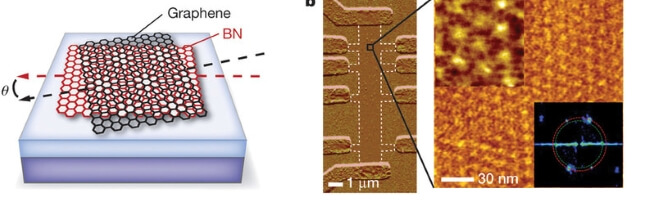
However, the team of scientists at the Centre have solved that problem by encapsulating the graphene inside another two-dimensional material, hexagonal boron nitride. This is a non-conductive material that can protect graphene’s properties. 

Electron beam lithography was used to create the pattern in the protective layer of boron nitride and graphene. And to give you some idea of just how complex this work is the holes have a diameter of about 20 nanometres and there are only 12 nanometres space between them. Don’t forget, one nanometre is a billionth of a metre, or put another way a human hair is approximately 80,000 nanometres wide. 

So why is this breakthrough such a big deal? One of the advantages of graphene is its potential application versatility, particularly in electronics but this versatility has until now been thwarted by the difficulty of introducing bandgap which is the difference between the top of the valence band, and the bottom of the conduction band. 

We know that graphene is an incredibly good conductor but without an integral bandgap, it can’t be switched off which is an essential element in semiconductor-related applications. Now though, and thanks to this breakthrough, the bandgap problem has been overcome and in addition to that, the flow of electrical current through graphene has been increased a 1000-fold. 

In another ground-breaking graphene development researchers at America’s Department of Energy’s Lawrence Berkeley National Laboratory have created a graphene device that easily switches from a superconducting material that conducts electricity without losing any energy, to an insulator that resists the flow of electric current, and back again to a superconductor. 

The device consists of three nano-thin layers of graphene which are contained within layers of boron nitride and this forms a moiré superlattice pattern. 

graphene material technology

The researchers feel this material could help scientists further understand high-temperature superconductivity where material can conduct electricity without resistance at temperatures higher than expected, although these temperatures are still hundreds of degrees below freezing.

Innovations in Graphene Application Progress

So what about all those applications I mentioned earlier where graphene is starting to fulfil both its technical and financial promises?

Let’s start with batteries and energy storage products. With the environmental push towards electric vehicles (EVs), graphene can now help with lithium battery technology because it can reduce electrode resistance without decreasing active material content. This characteristic translates into batteries have increased performance at high discharge rates, something that designers of EVs like. 

According to a report by IDTechEx Research graphene conductive inks are also becoming a reality. These had to prove that they offered both a performance and price advantage over carbon and metal-based products. However, these days graphene conductive inks are finding many applications in radio-frequency identification (RFID) antenna materials. 

Graphene Uses

Graphene is also proving successful in thermal applications and is doing particularly well as a thermal spreader in cell phones. It provides much better thermal conductivity to copper at a lower weight. 

SOURCE: https://www.electropages.com/blog/2019/08/Graphene-Technology-Finally-Grows-Up

CardioComm Solutions $EKG.ca – Consumers want mobile health #Mhealth convenience $ATE.ca $TLT.ca $OGI.ca $ACST.ca $IPA.ca

Posted by AGORACOM-JC at 11:01 AM on Friday, August 16th, 2019

SPONSOR: CardioComm Solutions (EKG: TSX-V) – The heartbeat of cardiovascular medicine and telemedicine. Patented systems enable medical professionals, patients, and other healthcare professionals, clinics, hospitals and call centres to access and manage patient information in a secure and reliable environment.

EKG: TSX-V
———————-

Consumers want mobile health convenience

  • According to an article in HealthPayer Intelligence published on May 16, 2018, “Telehealth is a promising opportunity to increase member engagement because a greater number of individuals are open to the use of telehealth services.
  • Telehealth and remote care provide an exceptional customer experience opportunity for payers.

by Mike Greiwe, MD

According to an article in HealthPayer Intelligence published on May 16, 2018, “Telehealth is a promising opportunity to increase member engagement because a greater number of individuals are open to the use of telehealth services. Telehealth and remote care provide an exceptional customer experience opportunity for payers. Consumers want telehealth as a convenient way to receive checkups, preventive care and non-critical services without the need for travel and wait times.”

A study cited by mHealth Intelligence suggests patients are willing, the technology is ready, but clinical providers and insurance payers have lagged behind data that show patients are ready for the convenience found in mobile health applications. Of the 400 consumers surveyed, 77% said they would be more likely to pick a doctor who offered telemedicine applications over one that hadn’t yet adopted the technology. Data showed the reasons behind the interest in mobile health virtual visits included that:

  • Patients want the option of skipping a time-consuming trip to the doctor for a simple recheck or non-urgent visit; and
  •  Short wait times and the convenience of receiving a virtual house call are attractive to patients.

When combined with data showing that telehealth reduces costs in the medical practice, it seems clear there are new options in health care that may improve the bottom line.

Keep the customer satisfied — Mobile health in the orthopedic practice

According to a Beckers Hospital CFO Report, “This direct link between patient satisfaction and revenue will likely become stronger because the U.S. Department of Health and Human Services has set a goal of linking 90% of Medicare payments to quality or value by 2018.”

Although many orthopedic providers continue to express their concern that patients will not be willing to evolve from traditional visits, the most recent research does not hold up this assumption. A 2017 Advisory Board study of patients’ attitudes toward the virtual visits shows 77% would be willing to at least try the model.

The Accenture study highlighted what patients say are the primary benefits of telehealth:

•          faster diagnosis and treatment;

•          reduced costs;

•          providing and receiving high-quality care;

•          more flexibility in scheduling; and

•          time savings for physicians and doctors.

A 2018 article in The New England Journal of Medicine suggests the current model of traditional in-patient visits will eventually be flipped to the visit of last resort over mobile health or telehealth options. The authors suggested, “Face-to-face interactions will certainly always have a central role in health care, and many patients prefer to see their physician in person. However, a system focused on high-quality non-visit care would work better for many others  â€” and quite possibly for physicians as well.”

Some of the systems leading the way are Kaiser Permanente, with 52% of their 100 million-plus patient encounters each year conducted as virtual visits. However, a large health system has the budget to establish telehealth applications while retraining clinical providers and their patients on best practices for using the service. How can a small medical practice find the time and energy to reinvent itself under a mobile health framework?

The answer may lie in the individual practice seeking innovative ways to obtain a competitive advantage. An article by a solo orthopedist in AAOS Now recounted his experience in using telehealth applications to treat postoperative patients. His decision to use the technology was tied to improved patient experience, lower overheads and higher quality of care.

Is it time for your practice to discuss the opportunities to offer mobile health as an option for your patients? OrthoLive has developed a cloud-based affordable telehealth model designed specifically for the orthopedic practitioner. Contact us to find out more.

Source: https://www.healio.com/orthopedics/business-of-orthopedics/news/blogs/%7Bcf0e8b3d-850f-4328-9a71-971b5f29cf36%7D/business-minded-surgeon/blog-consumers-want-mobile-health-convenience

Tartisan #Nickel $TN.ca – #EV’s will make nickel a once-in-a-generation investment opportunity, says #BHP $ROX.ca $FF.ca $EDG.ca $AGL.ca $ANZ.ca

Posted by AGORACOM-JC at 10:30 AM on Friday, August 16th, 2019

SPONSOR: Tartisan Nickel (TN:CSE)  Kenbridge Property has a measured and indicated resource of 7.14 million tonnes at 0.62% nickel, 0.33% copper. Tartisan also has interests in Peru, including a 20 percent equity stake in Eloro Resources and 2 percent NSR in their La Victoria property. Click her for more information

Tc logo in black
TN: CSE
Fact Sheet
—————————-

EV’s will make nickel a once-in-a-generation investment opportunity, says BHP

  • More EVs and more nickel in each of them will drive nickel demand through the roof, says the head of BHP’s Nickel West arm.
  • His forecast is great news for those juniors with large nickel deposits awaiting development, such as the Jaguar project just acquired by Centaurus from Brazilian giant Vale.

By: Barry FitzGerald

The display of oomph at last week’s Diggers & Dealers conference in Kalgoorlie was not restricted to the gold stocks.

The nickel stocks made sure of that, with none other than BHP leading the charge in a presentation by its Nickel West president, Eddy Haegel.

Nickel West is the formerly unloved BHP unit that has come into its own in response to what Haegel described as a once-in-a-generation opportunity presented by the gathering nickel-rich battery boom.

Haegel said that in addition to the rapid growth in electric vehicles sales, BHP expects nickel-in-vehicle demand to surge, driven by three factors.

The first is batteries are becoming bigger to improve vehicle range and performance. Next, nickel-based cathodes are taking market share from non-nickel cathodes because they’re “simply better”.

And finally, increasing nickel in battery chemistries increases energy density, delivering better performance and lower costs.

“It is important to understand that a 60kwh NMC811 battery needs 9kg of cobalt, 11kg of lithium and a massive 70kg of nickel,” Haegel said.

While stainless steel still accounts for about 70% of nickel consumption, batteries is the fast growing subset, to the point where EV’s alone could account for all of the current production in the late 2020s.

Haegel sounded a note of caution about the here and now. While BHP thinks there is going to be a significant increase in global nickel demand, it is a case of not just yet.

“We do not expect to see a meaningful impact on the nickel market from batteries until the mid – late 2020s. Only then, do we expect to see serious industry investment by Class 1 nickel producers,’’ Haegel said.

“However, we will not rest waiting for that day to arrive. We are actively developing options to position ourselves for this once-in-a-generation opportunity.’’

It is against that backdrop that the nickel price has been a strong performer of late. The current price of $US7.17/lb compares with the 2018 (calendar) average of $US5.95/lb, and the 2017 average $US4.72/lb.

CENTAURUS METALS:

Talking about once-in-a-generation opportunities, Centaurus Metals (CTM, trading at 0.9c for a market cap of $24m) has just seized one which gives it a ticket to the battery-led nickel party discussed above.

In what was probably the most significant announcement by a junior at D&D, Centaurus made everyone sit up and take notice when it revealed it had struck an option deal to acquire the Jaguar nickel sulphide project in Brazil from Vale, no less.

Jaguar comes with a foreign resource estimate of a near-surface 40.4mt grading 0.78% nickel for a total of 315,000t of contained metal across a cluster of deposits, with lots of exploration upside to boot.

It is a lot of nickel for a company with a $24m market, particularly, as was mentioned here on May 31 when Centaurus was trading at 0.8c, its market value is pretty much covered by its Jambreiro iron ore project in Minas Gerais state.

Assume long-term-term iron ore prices of $US60-$80/t, Jambreiro could be good for $A20-$A25m in pre-tax operating cashflow. But it is not in production and it has to be said its importance to Centaurus has been overwhelmed by Jaguar.

Jaguar sits in the western portion of the Carajas mineral province and covers 30sqkm of land containing the known foreign resource estimate (based on 55km of diamond drilling by Vale) and at least four exploration targets.

To complete the acquisition, Centaurus is up for a $US250,000 upfront cash payment, the transfer of its Salobo West copper-gold exploration tenements to Vale, two deferred payments totalling $US6.75m and a production royalty of 0.75%.

Vale will have offtake rights (its Onca-Puma nickel mine is in the region) and importantly, preliminary metallurgical testwork by Vale has indicated a high-grade and quality nickel concentrate can be produced from Jaguar’s sulphide mineralisation.

It is not a deal that would have been available to others as it reflects both Centaurus’ long-term commitment to Brazil and Vale’s interest in Salobo West, which is near its Salobo mine, its biggest copper operation.

Centaurus hits the Eastern States next week to promote the Jaguar deal and assuming a good reception, raising some funds to get cracking on Jaguar’s near-term potential as an open-cut producer from higher grade sections of its resource base will a key talking point.

VENTUREX:

Venturex boss AJ Saverimutto had a good reason to be wearing a sharp suit at an investor lunch at the Palace Hotel on the opening day of the D & D conference.

AJ had just announced Venturex (VXR, trading at 18c for a market cap of $54m) had locked away a $100m senior debt funding package with commodities trader Trafigura for its Sulphur Springs copper-zinc project in the Pilbara, 145km south of Port Hedland.

The debt deal means that Sulphur Springs is pretty much on its way – once the equity component of the $169m capex project is locked away – to becoming Australia’s next base metals producer in an ASX market where leveraged investment opportunities for copper in particular are thin on the ground.

As much as nickel is needed for batteries in the electric vehicle and the storage of renewable energy revolution, copper is even more so. About 80kg of the red metal is required for an EV alone, a fact that underwrites expectations that the world will be short about 4mpta of copper come 2025.

Sulphur Springs’ high-grades – it nets out at about 3.3% copper equivalent – from five years of open cut mining, followed by five years of underground mining as the starting point, makes it a development for the times.

Based on realistic metal price assumptions, the 1.2mtpa operation (easily expandable to 2mtpa on the conversion of exploration upside to additional resources/reserves) will generate revenue of about $209/t and a before-tax margin of $65/t.

Multiply that out and Sulphur Springs is good for about $80m in average annual free cashflow, or $800m over the initial 10 year mine life. That’s why Venturex has been able to lock away the $100m in debt funding in a market where debt funding for projects held by juniors is virtually non-existent.

Northern Star has been a supporter of the story since 2012 and is Venturex’s biggest shareholder with a 19.8% stake.

AJ said a number of equity options would be looked at to complete the financing, including the possible introduction of a strategic partner who would be happy with Trafigura’s 100% offtake for the first 11 years, 50% thereafter.

Broker valuations of the stock which pre-date the debt component of Sulphur Springs, a major de-risking event if there ever was one, were multiples of the current price.    

Source: https://www.livewiremarkets.com/wires/ev-s-will-make-nickel-a-once-in-a-generation-investment-opportunity-says-bhp

#Luminosity Gaming Signs Popular #Fortnite Influencer, #Yelo – Adds over 2 million followers to combined network of over 200 million $EGLX.ca $EPY.ca $FDM.ca $WINR $TCEHF $ATVI $TNA.ca

Posted by AGORACOM-JC at 10:11 AM on Friday, August 16th, 2019
EGLX: TSX-V

Adds over 2 million followers to combined network of over 200 million

  • Signed international Fortnite influencer, Yelo, to its roster of over 50 professional esports players and video gaming influencers.
  • Yelo’s combined social network reaches over 2 million followers across all social channels, a substantial addition to the 200 million plus fans the combined organization currently reaches.

TORONTO, Aug. 16, 2019 — Enthusiast Gaming Holdings Inc. (TSXV: EGLX) (OTCQB: EGHIF), (“Enthusiast” or the “Company”), one of the largest vertically integrated video gaming media companies in North America, is excited to announce that Luminosity Gaming (“Luminosity”) has signed international Fortnite influencer, Yelo, to its roster of over 50 professional esports players and video gaming influencers. Yelo’s combined social network reaches over 2 million followers across all social channels, a substantial addition to the 200 million plus fans the combined organization currently reaches.

The amalgamation of Enthusiast and Luminosity creates one of the largest esports organizations in the world. The organization is comprised of the top players and content creators in the esports ecosystem. Yelo joins Luminosity’s team of players and influencers which currently reaches over 60 million followers across social media. Combined with Enthusiast’s network of over 150 million monthly visitors, the collective reach totals over 200 million gaming enthusiasts across 85 websites, 900 YouTube channels, 8 professional esports teams and over 50 social influencers.

Steve Maida, President of Luminosity commented, “We are excited to sign Yelo to our talent roster and social audience of 60 million followers. With over 2 million social media followers, he is rapidly growing into one of the biggest Fortnite influencers on the scene. Yelo joining the Luminosity and Enthusiast Gaming family of players is further validation of the Luminosity brand power as one of the fastest growing esports organizations in the world, attracting top talent in the industry.”

About Enthusiast Gaming

Enthusiast Gaming is one of the largest vertically integrated video game companies and has the fastest-growing online community of video gamers. Through the Company’s organic and acquisition strategy, it has amassed a platform of over 150 million monthly visitors across its network of websites and YouTube channels. Enthusiast also owns and operates Canada’s largest gaming expo, Enthusiast Gaming Live Expo, EGLX, (eglx.ca) with approximately 55,000 people attending in 2018. For more information on the Company, visit www.enthusiastgaming.com.

About Luminosity Gaming

Luminosity Gaming is one of the largest globally recognized esports organizations in the world, with over 60 million registered active users. Luminosity has 8 world class esports teams competing across top games such as Fortnite, Apex, Rainbow Six: Seige, Counter Strike, Call of Duty, Madden, Smite, etc. For more information visit www.luminosity.gg

CONTACT INFORMATION:

Investor Relations: 
Julia Becker
Head of Investor Relations & Marketing
[email protected]
(604) 785.0850 

This news release contains certain statements that may constitute forward-looking information under applicable securities laws. All statements, other than those of historical fact, which address activities, events, outcomes, results, developments, performance or achievements that Enthusiast anticipates or expects may or will occur in the future (in whole or in part) should be considered forward-looking information. Such information may involve, but is not limited to, comments with respect to strategies, expectations, planned operations and future actions of the Company. Often, but not always, forward-looking information can be identified by the use of words such as “plans”, “expects”, “is expected”, “budget”, “scheduled”, “estimates”, “forecasts”, “intends”, “anticipates”, or “believes” or variations (including negative variations) of such words and phrases, or statements formed in the future tense or indicating that certain actions, events or results “may”, “could”, “would”, “might” or “will” (or other variations of the forgoing) be taken, occur, be achieved, or come to pass. Forward-looking information is based on currently available competitive, financial and economic data and operating plans, strategies or beliefs as of the date of this news release, but involve known and unknown risks, uncertainties, assumptions and other factors that may cause the actual results, performance or achievements of Enthusiast to be materially different from any future results, performance or achievements expressed or implied by the forward-looking information. Such factors may be based on information currently available to Enthusiast, including information obtained from third-party industry analysts and other third-party sources, and are based on management’s current expectations or beliefs regarding future growth, results of operations, future capital (including the amount, nature and sources of funding thereof) and expenditures. Any and all forward-looking information contained in this press release is expressly qualified by this cautionary statement. Trading in the securities of the Company should be considered highly speculative.

Neither the TSX Venture Exchange nor its Regulation Services Provider (as that term is defined in the policies of the TSX Venture Exchange) accepts responsibility for the adequacy or accuracy of this release.

The securities of the Corporation have not been and will not be registered under the United States Securities Act of 1933, as amended and may not be offered or sold in the United States absent registration or an applicable exemption from the registration requirement. This press release shall not constitute an offer to sell or the solicitation of an offer to buy nor shall there be any sale of the securities in any jurisdiction in which such offer, solicitation or sale would be unlawful. 

Esports Entertainment Group $GMBL – Kellogg’s $K shifts sports-related ad spending to #Esports $TECHF $ATVI $TTWO $GAME $EPY.ca $FDM.ca $TNA.ca

Posted by AGORACOM-JC at 1:52 PM on Thursday, August 15th, 2019
SPONSOR: Esports Entertainment $GMBL Esports audience is 350M, growing to 590M, Esports wagering is projected at $23 BILLION by 2020. The company has launched VIE.gg esports betting platform and has accelerated affiliate marketing agreements with 190 Esports teams. Click here for more information
GMBL: OTCQB

———————–

Kellogg’s shifts sports-related ad spending to esports

  • The advertiser is shifting more advertising spending to esports because it offers something that most traditional sports cannot — almost unprecedented access to younger people between the ages of 21 and 34 who have high incomes.
  • For Kellogg’s, esports has gone from an experimental investment to a continuous one

by Seb Joseph

Competitive gaming campaigns are now a staple, rather than a test, on media plans for most Kellogg’s brands.

The advertiser is shifting more advertising spending to esports because it offers something that most traditional sports cannot — almost unprecedented access to younger people between the ages of 21 and 34 who have high incomes. Since it jumped on the esports bandwagon two years ago, Kellogg’s has steadily made inroads, moving from experiential activations at tournaments to being the headline sponsor of them. For Kellogg’s, esports has gone from an experimental investment to a continuous one, said Dominik Schafhaupt, marketing manager for snacks in Northern Europe at Kellogg’s.

The scale of those investments will flex depending on the brand and its target audience as well the market they are based in, said Schafhaupt who revealed that the advertiser is changing how it funds its association with esports now that it’s a mainstay on media plans. Previously, advertisers like Kellogg’s dipped into sponsorship budgets to fund early forays into the world of competitive gaming. But as the stakes of making those activations work got bigger so too did the budgets for them, which meant advertisers turned to digital and broader marketing budgets.

“Esports is an element of our communications mix, and there isn’t a single spend pillar it is funded by,” said Schafhaupt.

Perhaps nowhere is this more obvious at Kellogg’s than on its Pringles brand.

The snacks brand has paid to sponsor the League of Legends European Championships this summer in a deal with its organizer Riot Games. The partnership comes just seven months after Kellogg’s signed a deal with gaming community N3rd Street Gamers, which runs its own tournaments.

Marketing partnerships like this tend to average around $2 million (£1.6 million) to $4 million (£3.3 million) per year and are often done as multiyear deals, said Rich Routman, president at sports media company Minute Media. Generally, deals like the one between Kellogg’s and Riot Games usually consist of marketing rights similar to standard sports leagues with broadcaster advertising placements, event marketing assets and marketing partnership rights across the vertical crucial to the company’s business, said Routman. Yet how all of those assets are added up for commercial fees depends on the seller. Since there is such a difference in maturity between esports organizations, sponsorship costs and assets can greatly differ and the market hasn’t had time to mature properly to dictate the costs.

The deal between Kellogg’s and Riot Games, for instance, is based on one of several tiered packages sold by the latter. Each package is weighted toward either media exposure or experiential activations, which are supported by media impressions and a rate card for the various assets that can be used. Having that scope between each package means Riot can create bespoke sponsorships depending on what an advertiser wants, said Alban Dechelotte, head of business development and sponsorship for Riot Games.

The Pringles logo will appear on the streams of the tournaments alongside a call to action when players are entering the game. Those streams — and subsequently the Pringles brand — will be on both YouTube and Twitch, which are watched on average by 1.6 million people daily during the normal season of League of Legends matches, according to Riot Games. The number of people watching the matches at the same time each week has hit a peak of over 300,000, up 40% for the same event in 2018, according to Riot Games.

“Gaming and esports are places where our core target group is, and so now is the time to get into the community around competitive gaming,” said Schafhaupt.

Aside from media exposure, Kellogg’s is also exploring in-game activations.

Millions of Pringles cans across Europe will sport a unique code that players can redeem to take part in a raffle to win rare characters to use in the game. Unlike similar activations, which can feel gimmicky, Kellogg’s is hoping its decision to allow people to use the code to redeem characters that have been retired and, therefore, are unavailable swells its cache among the notoriously advertising-adverse gaming audience.

“I would love to measure my sales off the back of the sponsorship, but I can’t because we have distribution partners that sit between us and consumers,” said Schafhaupt. “At the moment, the industry looks at measurement in esports from a media-value perspective. It’s one of the areas we’re building on with the sponsorship by looking at how the community responds to our brand and also the redemption rates of the code.”

Source: https://digiday.com/uk/its-a-continuous-investment-kelloggs-gets-serious-about-esports/