Posted by AGORACOM
at 4:05 PM on Monday, January 27th, 2020
SPONSOR: ZEN Graphene Solutions: An emerging advanced materials and graphene development company with a focus on new solutions using pure graphene and other two-dimensional materials. Our competitive advantage relies on the unique qualities of our multi-decade supply of precursor materials in the Albany Graphite Deposit. Independent labs in Japan, UK, Israel, USA and Canada confirm this. Click here for more information
Researchers at the India-based Central Mechanical Engineering Research Institute (CMERI) are developing an economical graphene-based supercapacitor
that can present an effective alternative to providing energy to
various applications, including state-of-the-art military equipment,
mobile devices and modern vehicles.
Graphene has been used in the newly developed ultra-capacitors to
replace the expensive activated carbon, and the switch seems to have
also reduced the supercapacitors’ weight and cost by ten times.
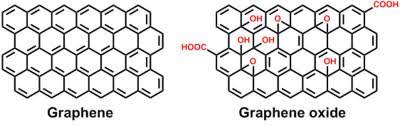
The team has developed a new technique for making graphene oxide, which is being used to produce new ultra-capacitors.
CMERI scientist Dr. Naresh Chandra Murmu stated that “scientists have
developed a technique for producing graphene oxide. The production cost
of one kilogram of graphene oxide using this technique comes to around
ten thousand rupees, which is much lesser than the cost of activated
carbon used in supercapacitors. We have modified the surface of graphene
oxide in our research, due to which it has also succeeded in reducing
its weight. We have now reached the advanced stage of making
ultra-capacitors by using this graphene oxide, which can be useful in
various sectors.â€
Former Senior Defense Development Research Organization (DRDO)
official M.H. Rahman said that such devices not only cater to civilian
applications, but can be applicable in strategic and defense
applications as well.
Posted by AGORACOM
at 2:31 PM on Monday, January 27th, 2020
SPONSOR: Applied BioSciences is a vertically integrated company focused on the development and commercialization of novel, science-driven, synthetic cannabinoid therapeutics / biopharmaceuticals; targeting the endocannabinoid system to treat a wide-range of diseases across multiple therapeutic areas. Click Here for More Info
An endocannabinoid deficiency can result in a host of patient afflictions, but this innovative CBD balancing strategy can help patients
All cannabidiol (CBD) is not
created equal in clinical practice in terms of implementation. The most
frustrating thing for clinicians and also for patients is when an
intended protocol doesn’t work. As I discuss later under the “With
treatment, start low†section of this article, there are ways to use CBD
most effectively.
You probably weren’t taught this in medical school, but CBD works on
the endocannabinoid system (ECS). The ECS contains CB1 and CB2
receptors, in addition to other receptors that are activated by the
naturally occurring endocannabinoids made in our bodies, called
anandamide and 2-AG. We all have CB1 or CB2 receptors within our body —
if you have a cat or dog, they have these receptors too. All mammals do.
How could it be that we did not even know of the predominance of the
ECS until 1992?
What the endocannabinoid system can do
Patients coming in worn out can be a sign of endocannabinoid deficiency
and the inability to support their pathways optimally, much like
adrenal fatigue. Phytocannabinoids like CBD obtained from hemp products
can act on the same receptors as endocannabinoids made in the body. CBD
receptors, much like opioid receptors, control pain, but via a different
mechanism.
Patients arrive at our clinical practices fatigued, anxious, in pain,
inflamed, and lots reach a point of adrenal burnout, adrenal fatigue.
Indeed, that is often the case because they are suffering from an
endocannabinoid deficiency. We see people who have low adrenal function
at noon, and in the evening, they are tired, dragging, eat lunch, get a
little spike, and then they start free falling again. They’re
flat-lining. How is it that we wake up each morning anticipating with
trepidation and run with go, go, go pace and finish the day glad to have
survived another day? Life is meant for more than that; it is time to
shift our goals from merely surviving to thriving mode!
Researchers observed approximately six years ago that people were
more anxious and depressed in the middle of the summer than ever before,
a new phenomenon. This goes against what we previously believed, that
depression spiked mostly in the holiday season and Thanksgiving and
after the winter solstice. But now we’re seeing people are worn out even
in summer. Indeed, the endocannabinoid system plays a role here.
Anandamide is one of our endocannabinoids. When it becomes lower,
patients are more anxious. There is less healing of the brain, less
neurogenesis, and the hypothalamic-pituitary axis is triggered, causing a
whole cascade of events to occur. What we now know is that the
endocannabinoid system naturally, or with the use of CBD, alters our microbiome
in our gut, beneficially affecting the gut-brain axis. The GI tract is
the site of many receptors. We make about 70% of our serotonin, the
happy-brain chemical, in the GI tract. About 70-80% of our immune system
is in our GI tract, so is it any surprise that we have CB1, CB2
regulatory pathways in our GI tract that work via the endocannabinoid
system to control inflammation? These same pathways can be regulated
using an innovative CBD strategy.
Migraines and the endocannabinoid system
With endocannabinoid deficiency symptoms patients can get migraines.
We thought migraines were just triggered by tyramine-rich foods, such
as cheese, fermented foods, and salami and other such foods; along with
other triggers as well.
However, the endocannabinoid pathway is designed to control pain and
inflammation and also regulate the immune system to a large degree. I
have found in my clinical practice that innovative CBD strategies can be
useful in supporting the health of migraine sufferers.
Treat the brain, treat the pain
The body is designed with innate intelligence to sustain optimal
performance. People ask, “Well, how is CBD metabolized?†It’s primarily
metabolized through the liver, and as a result, it goes through the
cytochrome 450 and other pathways. Wellness is ultimately about
homeostasis. We all know the term entropy, the tendency for the universe
to move toward chaos. But our body exerts a phenomenal amount of energy
to maintain order and wellness. However, if the endocannabinoid system
becomes deficient, this will adversely affect wellness. This
endocannabinoid deficiency, in turn, affects the microbiome,
contributing to a less healthy endocannabinoidome.
CBD can conserve anandamide that is made by the body, and CBD can
support anandamide conservation in an attempt to bring the body back
into homeostasis.
The endocannabinoid system supports brain health. By treating the
brain, it addresses the pain, because if we didn’t have a brain, we
wouldn’t feel the pain from a perception perspective.
Anxiety also is a biochemical process. It’s real. A lot of people
say, “It’s all in my head.†No, stress is real because it’s a
physiological effect. There is biochemistry involved in anxiety. We want
to use innovative CBD strategies to support calming pathways and bring
peace and harmony into the brain.
Endocannabinoid deficiency issues
If a patient has brain inflammation, neuroplasticity
is not going to be as healthy or robust. And the fact is, on a typical
day, we lose about 86,400 brain cells. CBD is an anti-inflammatory
application. And from a neuropathic perspective, activation of
cannabinoid receptors is essential. I’ve looked at research involving
the endocannabinoid system relative to cancer medications and so forth.
Not being an oncologist, I am not suggesting this is a treatment for
cancer, but there are pain, stress and immune challenges that often need
to be associated with this disease state, so visiting with one’s
provider in this arena is vital.
We can start manifesting symptoms of migraines, fatigue, irritable
bowel, whatever it might be, as a result of being subpar, insufficient
or deficient of endocannabinoids. An endocannabinoid deficiency
manifests itself as simply that the body has gotten worn down, much like
low adrenal function, often called adrenal fatigue. So we need to
support that pathway to bring it back on track like we would any other
functional biochemistry, which our body is designed to do. And since
we’re designed to make endocannabinoids, we need to bring those levels
back up to par.
With treatment, start low
The goal is to start low and go slow, as a little bit can go a long
way for many patients. More is not always better, as each person
responds differently based on genetics, biochemistry and individual
need.
Just like if you’re performing an adjustment, a little bit of a
movement might get the job done. Work with gentle modulation of the
endocannabinoid system. You’re working within the innate ability of the
body.
Fifteen to 25 milligrams per day is what I start my patients on. In a
week or two, if I need to move them up to 25 mg two to three times a
day, I will. Once again, if a little bit gets the job done, why more? It
is of paramount importance to respect the innate delicate balance
physiology of the body. Some patients will need much higher doses
because of their endocannabinoid insufficiency or potential genetic
polymorphisms. You’re going to encounter genetic polymorphisms, or what I
termed mutations of the CBD receptors and the CBD pathway.
I never go to high-milligram doses, especially on patients taking
pharmaceutical drugs, without working with their pharmacists, because
CBD can affect similar liver detoxification, as well as other
biochemical pathways of how drugs are metabolized, much like grapefruit
juice, can impact many of the same medications. We want to also support
those drug-metabolizing pathways with diet and lifestyle.
CBD, when dosed properly, can positively supplement a
health-promoting diet and lifestyle. It’s not a substitute for these
things. So, we want to ensure we’re taking steps to support the body at a
foundational level. Additionally, we always want to ensure the THC levels in the CBD you are using are less than 0.3%, or that the CBD contains no THC, when targeting hemp-derived CBD.
We all get broken or get older
Endocannabinoid deficiency is associated with low cortisol, stress
and adrenal fatigue. We’re all getting older. Our mitochondria are
wearing down. Our nitric oxide levels aren’t as robust as they used to
be, and we need support at a fundamental level. In regards to the 65
potential molecular targets that are currently known for CBD, there is a
lot of untapped potential here relative to stress and aging. Innovative
CBD use is a new area; it can be a scary area, but remember, our bodies
have been producing endocannabinoids for millennia. All we’re doing is
supporting a natural pathway.
Posted by AGORACOM
at 1:56 PM on Monday, January 27th, 2020
Sponsor: Loncor is a Canadian gold exploration company that controls over 2,400,000 high grade ounces outside of a Barrick JV.. The Ngayu JV property is 200km southwest of the Kibali gold mine, operated by Barrick, which produced 800,000 ounces of gold in 2018. Barrick manages and funds exploration at the Ngayu project until the completion of a pre-feasibility study on any gold discovery meeting the investment criteria of Barrick. Click Here for More Info
Barrick Gold’s Kibali mine beat its 2019 production guidance of 750,000 ounces by delivering 814,027 ounces
Kibali is 200km to the southwest of Loncor’s JV with Barrick in search for further Tier Once mining assets
KINSHASA, Democratic Republic of Congo, Jan. 27, 2020 (GLOBE NEWSWIRE) — Barrick Gold Corporation (NYSE:GOLD) (TSX:ABX) - Barrick Gold Corporation’s Kibali mine beat its 2019 production guidance of 750,000 ounces of gold by a substantial margin, delivering 814,027 ounces in another record year.
Barrick president and chief executive Mark Bristow told a media briefing here that Kibali’s continuing stellar performance was a demonstration of how a modern, Tier One gold mine could be developed and operated successfully in what is one of the world’s most remote and infrastructurally under-endowed regions.  He also noted that in line with Barrick’s policy of employing, training and advancing locals, the mine was managed by a majority Congolese team, supported by a corps of majority Congolese supervisors and personnel.
Already one of the world’s most highly automated underground gold
mines, Kibali continues its technological advance with the introduction
of truck and drill training simulators and the integration of systems
for personnel safety tracking and ventilation demand control. The
simulators will also be used to train operators from Barrick’s Tanzanian
mines.
“The completion of the Kalimva Ikamva prefeasibility study has
delivered another viable opencast project which will help balance
Kibali’s opencast/underground ore ratio and enhance the flexibility of
the mine plan. Down-plunge extension drilling at Gorumbwa has
highlighted future underground potential and ongoing conversion drilling
at KCD is delivering reserve replenishment. All in all, Kibali is well
on track not only to meet its 10-year production targets but to extend
them beyond this horizon,†Bristow said.
“We’re maintaining a strong focus on energy efficiency through
the development of our grid stabilizer project, scheduled for
commissioning in the second quarter of 2020. This uses new battery
technology to offset the need for running diesel generators as a
spinning reserve and ensures we maximize the use of renewable hydro
power. The installation of three new elution diesel heaters will also
help improve efficiencies and control power costs. It’s worth noting
that our clean energy strategy not only achieves cost and efficiency
benefits but also once again reduces Kibali’s environmental footprint.â€
Bristow said despite the pace of production and the size and complexity of the mine, Kibali was maintaining its solid safety and environmental records, certified by ISO 45001 and ISO 14001 accreditations. Â It also remained committed to community upliftment and local economic development. Â In 2019, it spent $158 million with Congolese contractors and suppliers and in December, it started work on a trial section for a new concrete road between Durba and the Watsa bridge.
Posted by AGORACOM
at 2:34 PM on Friday, January 24th, 2020
VANCOUVER, BC / January 24, 2020 / VERTICAL EXPLORATION INC. (TSXV:VERT) (“Vertical” or “the Company”) announces that it has arranged a non-brokered private placement of up to 26 million units (“Units”) at a price of $0.05 per Unit for aggregate gross proceeds of $1,300,000.00 (the “Offering”).
Each unit will be comprised of one common share (“Share”) and one-half of one transferable Share purchase warrant of the Company (“Warrant”). Each full Warrant will entitle the Subscriber to purchase one Warrant Share for a 24-month period after the Closing Date at an exercise price of $0.07 per share. Proceeds raised from the Offering will be used to advance the Company’s St. Onge project in Quebec, for general working capital and unallocated funds as per Tier 2 status requirements.
Finders’ fees may be payable on the private placement, subject to the policies of the TSX Venture Exchange.
This offering is subject to TSX Venture Exchange acceptance.
ABOUT VERTICAL EXPLORATION
Vertical Exploration’s mission is to identify, acquire, and advance high potential mining prospects located in North America for the benefit of its stakeholders. The Company’s flagship St-Onge Wollastonite property is located in the Lac-Saint-Jean area in the Province of Quebec.
ON BEHALF OF THE BOARD
Peter P. Swistak, President
FOR FURTHER INFORMATION PLEASE CONTACT: Telephone: 1-604-683-3995 Toll Free: 1-888-945-4770
Posted by AGORACOM
at 2:04 PM on Wednesday, January 22nd, 2020
SPONSOR: American Creek owns a 20% Carried Interest to Production at the Treaty Creek Project in the Golden Triangle. 2019’s first hole averaged of 0.683 g/t Au over 780m in a vertical intercept. The Treaty Creek property is located in the same hydrothermal system as the Pretivm and Seabridge’s KSM deposits. Click Here for More Info
For the second time in as many weeks, the world’s largest hedge fund is once again talking up gold as an important diversifier for investors.
Speaking to CNBC’s Squawk Box on the sideline of the World Economic
Forum in Davos, Switzerland, Ray Dalio, founder of Bridgewater
Associates, said that in the current environment, investors should hold a
global diversified portfolio that includes some gold.
“Cash is trash,†he declared in the interview. He warned that investors should get out of cash as central banks continue to print money.
However, Dalio tempered his comments on the precious metal, saying that “a bit of gold is a diversifier.â€
But it is not only cash that Dalio railed against. He also didn’t
have anything nice to say about bitcoin, which is neither a medium of
exchange nor a store of value.
He said that investors shouldn’t go anywhere near bitcoin because of
its volatility. When it comes to a store of value, central banks will
continue to prefer to hold hard assets.
“What are [central banks] going to hold as reserves? What has been
tried and true? They are going to hold gold. That is a reserve
currency, and it has been a reserve currency for a thousand years,†he
said.
Although Dalio said that he sees a low chance of a recession in
2020, he warned investors to look further out. The risks are that
because of where monetary policy is right now, it will be less
effective when the downturn does come.
“At a point in the future, we still are going to think about what’s a
storeholder of wealth. Because when you get negative-yielding bonds or
something, we are approaching a limit that will be a paradigm shift,â€
he said.
Dalio has been fairly bullish on gold and for nearly three years has
advocated that investors hold at least 5% to 10% of their portfolio in
gold.
Dalio’s latest comments come less than a week after Greg Jensen,
co-chief investment officer at Bridgewater Associates, said in an
interview with the Financial Times that he sees gold pushing to $2,000
an ounce.
Jensen said that he sees higher gold prices through 2020 as
inflation picks up but central banks, in particular the Federal Reserve,
step away from the fight.
“The Fed won’t be pre-emptive,†he said.
Jensen said that he is also bullish on gold as geopolitical uncertainty dominates financial markets and investor sentiment.
“When you look at the geopolitical strife, how many foreign entities
really want to hold dollars? And what are they going to hold? Gold
stands out,†he said.
Posted by AGORACOM
at 11:58 AM on Wednesday, January 22nd, 2020
SPONSOR: Labrador Gold – Two successful gold explorers lead the way in the Labrador gold rush targeting the under-explored gold potential of the province. Exploration has already outlined district scale gold on two projects, including a 40km strike length of the Florence Lake greenstone belt, one of two greenstone belts covered by the Hopedale Project. Click Here for More Info
At first glance gold looks like it may be about to advance out of a
bull Flag, but there are a number of factors in play that we will
examine which suggest that any near-term advance won’t get far before it
turns and drops again, and that a longer period of consolidation and
perhaps reaction is necessary before it makes significant further
progress.
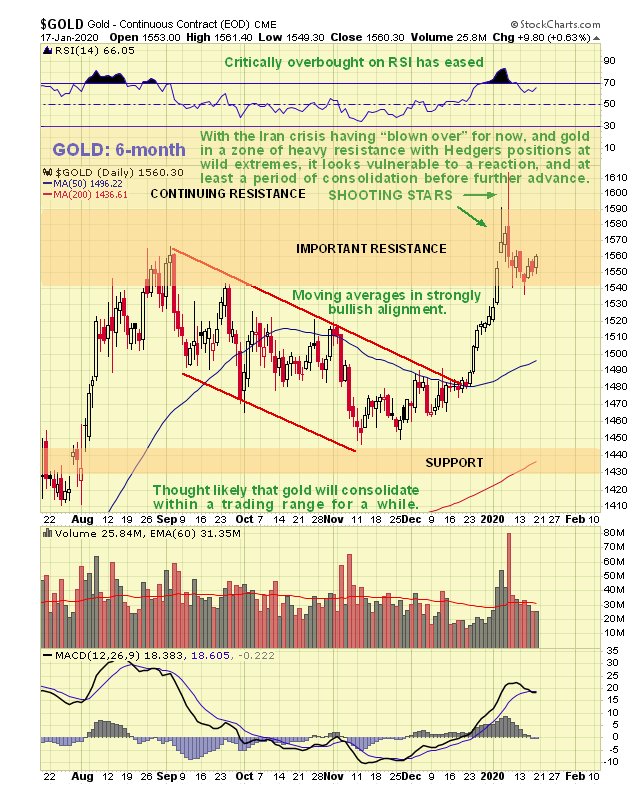
On the 6-month chart we can see how gold stabbed into a zone of
strong resistance on the Iran crisis around the time Iran’s General was
murdered, but after a couple of bearish looking candles with high upper
shadows formed, it backed off into what many are taking to be a bull
Flag.
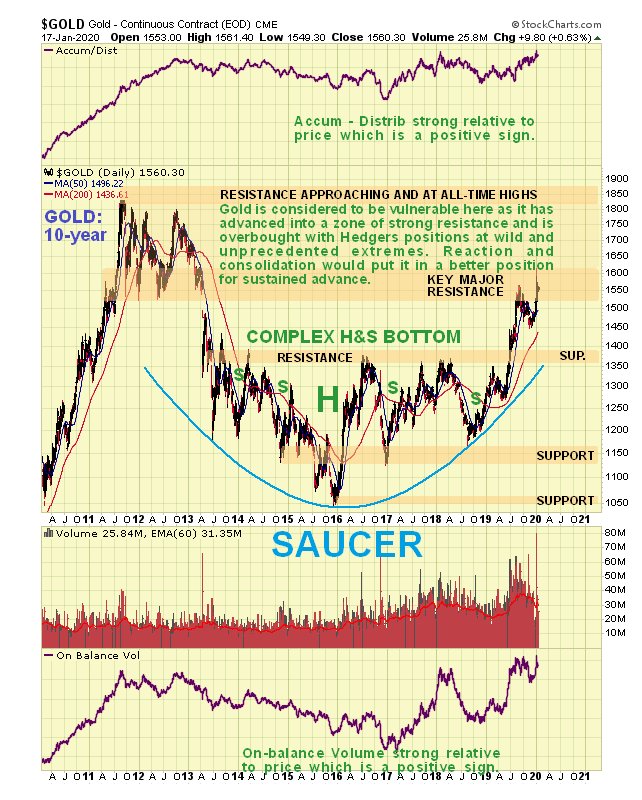
The 10-year chart makes it plain why gold is vulnerable here to
reacting back over the short to medium-term, because it has advanced
deep into “enemy territory†– the broad band of heavy resistance
approaching the 2011 highs, with a zone of particularly strong
resistance right where it is now. It would be healthier and increase
gold’s chances of breaking out to new highs if it now backed off into a
trading range for a while to moderate what now looks like excessive
bullishness.
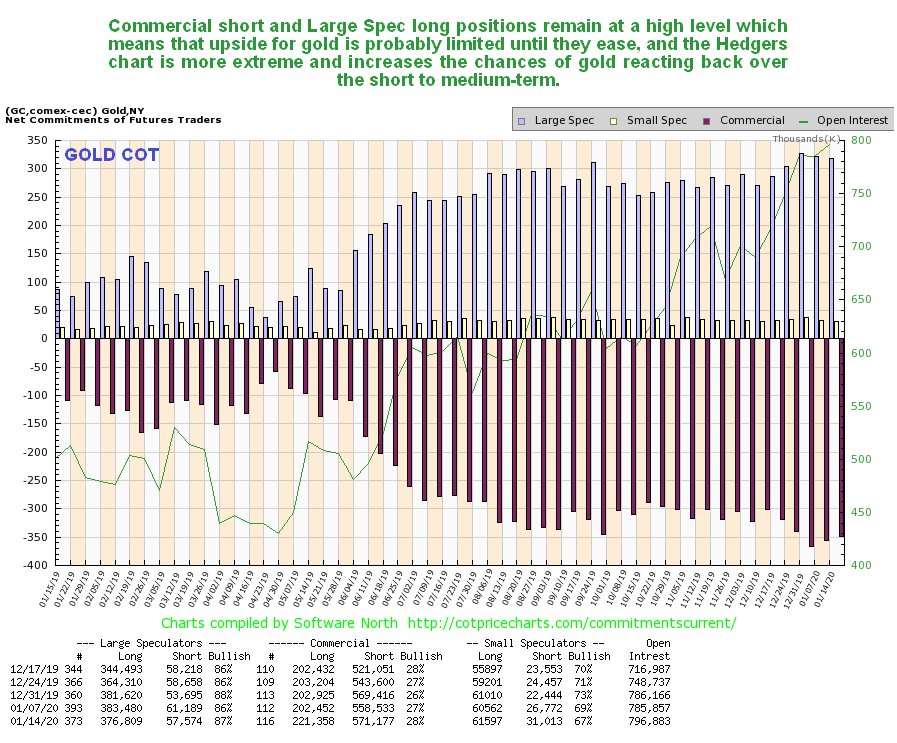
Thus it remains a cause for concern (or it should be for gold
bulls) to see gold’s latest COTs continuing to show high Commercial
short and Large Spec long positions. Is it “going to be different this
time� – the latest Hedgers charts that we are now going to look at
suggest not.
Click on chart to popup a larger, clearer version.
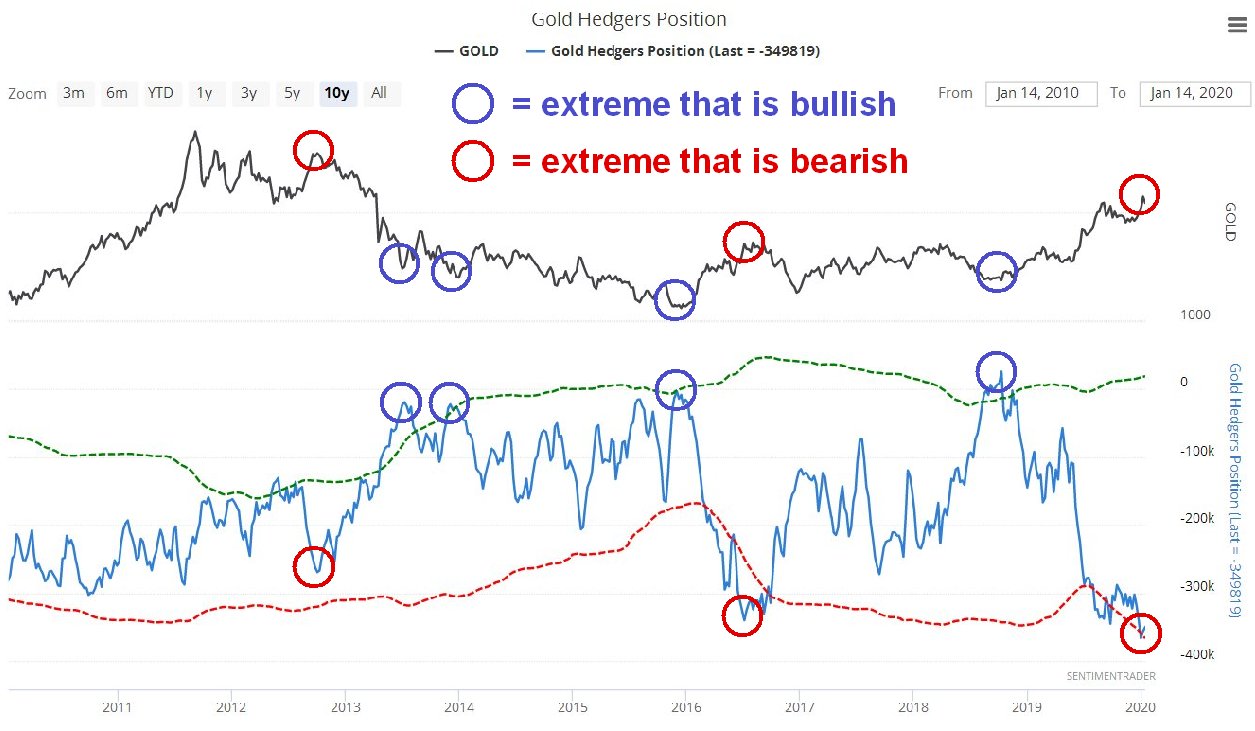
The COT chart only goes back a year. The Hedgers charts shown
below, which are a form of COT chart, go back many years, and frankly,
they look pretty scary.
We’ll start by looking at the Hedger’s chart that goes back to before
the 2011 sector peak. On it we see that current Hedgers positions are
at extremes that way exceed even those at the peak of the 2012 sucker
rally, which was followed by the bulk of the decline in the bearmarket
that followed. Does this mean that we are going to see another
bearmarket like that – no it doesn’t, but it does mean that these
positions will probably need to moderate before we see significant
further gains.
Click on chart to popup a larger, clearer version.
Chart courtesy of sentimentrader.com
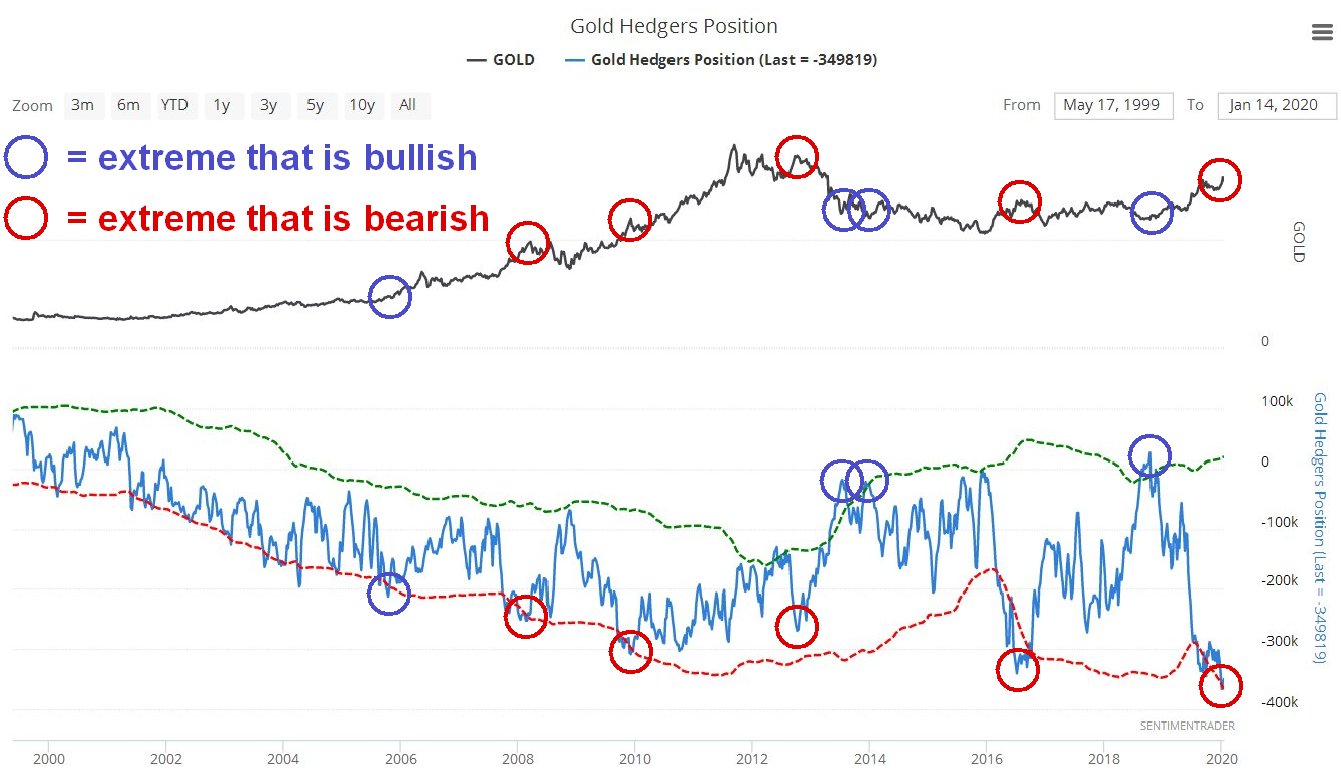
Looking at the Hedgers chart going way back to before the year
2000, we see that the current readings are record readings by a
significant margin and obviously increase the risks of a sizeable
reaction. We can speculate about what the reasons for a decline might
be, one possibility being the sector getting dragged down by a
stockmarket crash after its blowoff top, which may be imminent, as
happened in 2008, since it remains to be seen whether investors will
rush into the sector as a safe haven in the event of a market crash.
Click on chart to popup a larger, clearer version.
Chart courtesy of sentimentrader.com
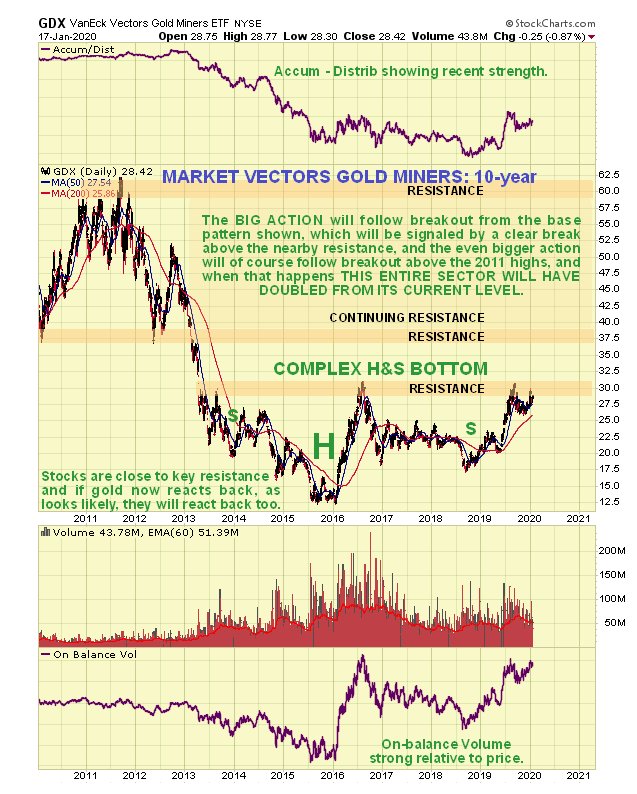
Turning now to Precious Metals stocks, we see on its latest
10-year chart that GDX still looks like it is completing a giant
Head-and-Shoulders bottom pattern. However, it is currently dithering
just beneath resistance at the top of this base pattern, which means
that it is vulnerable to backing off.
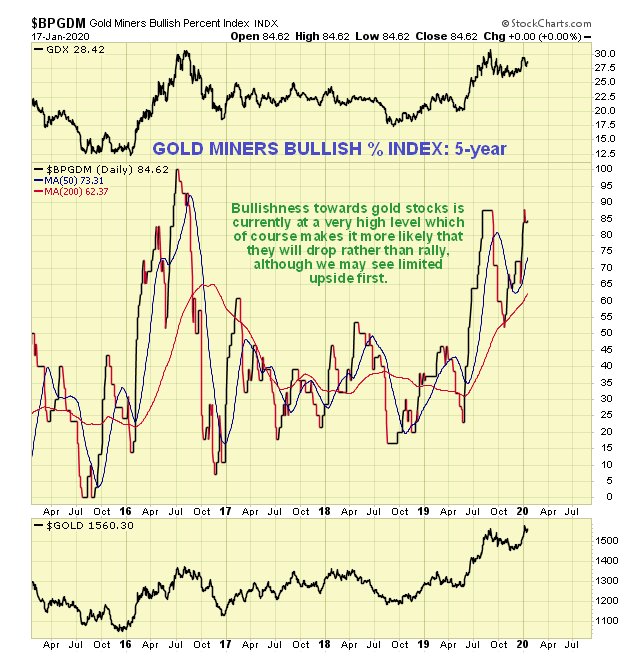
So, how then does gold stock sentiment look right now? As we can
see on the 5-year chart for the Gold Miners’ Bullish Percent Index,
bullishness towards the sector is now at a very high level, 84.6%, which
makes it more likely that stocks will drop soon rather than rally, and
what they could do of course is rally some to increase this level of
bullishness still further, and then drop.
Does all this mean that investors in the sector should suddenly
rush for the exits? No, it doesn’t, especially as the charts for many
individual stocks across the sector look very bullish, and it may be
that all that is needed is a cooling period of consolidation. However it
does make sense to use Hedges at extremes, such as leveraged inverse
ETFs and better still options as insurance, which have the advantage of
providing protection for a very small capital outlay, a fine example
being GLD Puts which are liquid with narrow spreads. We did this just ahead of the recent peak
when Iran lobbed a volley of missiles at Iraq. We will not be selling
our strongest gold and silver stocks, but instead look to buy more on
dips.
Posted by AGORACOM
at 5:40 PM on Tuesday, January 21st, 2020
SPONSOR: Gratomic Inc. (TSX-V: GRAT) Advanced materials company focused on mine to market commercialization of graphite products, most notably high value graphene based components for a range of mass market products. Collaborating with Perpetuus, Gratomic will use Aukam graphite to manufacture graphene products for commercialization on an industrial scale. For More Info Click Here
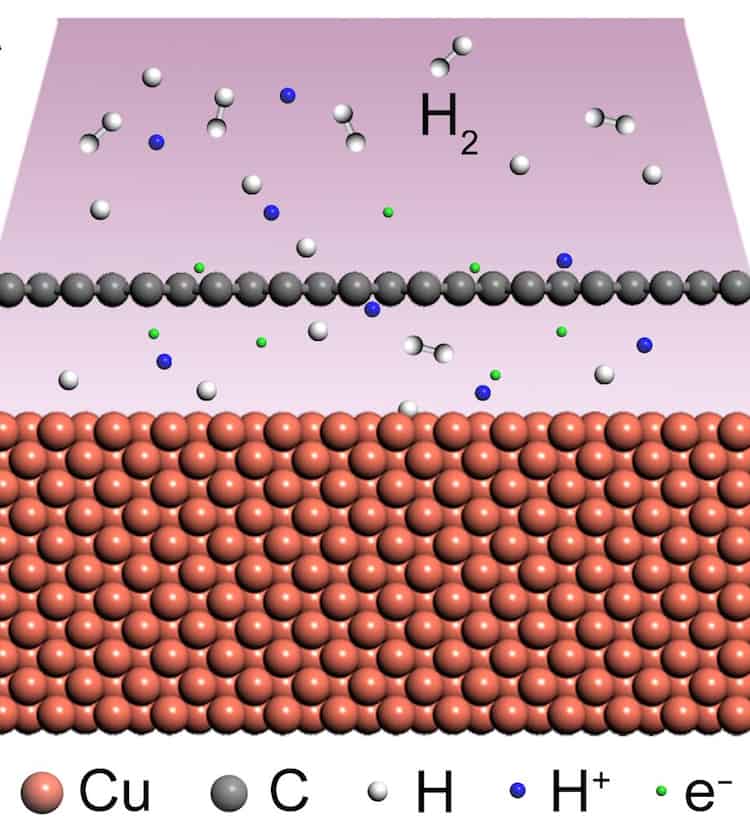
A new technique to make ultra-flat, wrinkle-free films of graphene
could pave the way for a host of applications, including graphene-based
flexible electronics and high-frequency transistors. The technique works
by introducing protons into the film as graphene is synthesized using
chemical vapour deposition (CVD), and its inventors say that it might be
extended to other two-dimensional materials such hexagonal boron
nitride (h-BN) and the transition-metal dichalcogenides (TMDCs). It
could also aid the development of hydrogen storage devices made from
layered 2D structures.
Graphene – a 2D honeycomb of carbon atoms just one atom thick –
boasts several unique electronic properties. In contrast to conventional
semiconductors, which have an energy gap between the electron valence
and conduction bands, graphene is a “zero-gap†semiconductor. This means
its electron valence and conduction bands just touch each other. At the
point of contact, the electrons move at near-ballistic speeds, and
their behaviour is governed by the Dirac equation for relativistic
electrons – hence the name “Dirac point†for this section of graphene’s
band structure.
Linear defects
So far, this electronic behaviour has only been observed in small
flakes of graphene that have been shaved off, or exfoliated, from
samples of bulk graphite. These flakes are not big enough to be
practical for electronic circuits, and although larger, wafer-sized
graphene films can easily be produced via CVD, their electronic
performance is not as good. This is because CVD-grown graphene, unlike
the exfoliated type, contains grain boundaries, atomic vacancies,
impurities and wrinkles. These defects act as centres off which
electrons can scatter as they travel, thus degrading the material’s
electronic properties.
CVD-produced graphene is prone to wrinkling because the graphene must
adhere to the surface of a substrate as it grows. If the thermal
expansion coefficient of the substrate does not match that of the
graphene itself, a change in temperature can lead to linear defects –
wrinkles – forming as the ensemble strives to release compressive
strain.
Researchers have attempted to reduce wrinkling by performing CVD at
low temperatures, using substrates with a similar thermal coefficient to
that of graphene, and developing single-crystalline substrates. A team
of researchers led by Libo Gao at China’s Nanjing University has now shown that reducing the interaction between graphene and its substrate might be a good, alternative, strategy.
Intercalating hydrogen molecules
The Nanjing team began by introducing a plasma of protons – hydrogen
ions – into the graphene’s growth chamber. During the CVD process, some
of this hydrogen became intercalated between the graphene and its
substrate, causing the two materials to decouple.
Gao and colleagues found that some of the wrinkles disappeared
entirely from the graphene thanks to this proton penetration. They
believe this is due to decreased van der Waals interactions between the
carbon sheet and the substrate, as well as – possibly – an increase in
the substrate’s distance from the growth surface thanks to the
intercalation process.
High-quality bilayer graphene goes large
The researchers also found that the electronic band structure of
their graphene films shows a V-shaped “Dirac cone†(representing the
density of states around the Dirac point) similar to the one observed in
exfoliated graphene. They argue that this proves the proton-assisted
CVD-grown graphene is indeed decoupled from its substrate.
The technique, which is detailed in Nature,
could be extended to grow ultra-flat versions of other 2D materials,
such as h-BN and the TMDCs, Gao says. It might also make it possible to
develop hydrogen storage devices made from these layered materials.
“The physical and electronic properties of our ultra-flat graphene
films are homogenous on the large scale, which means they might now be
used in higher-performance electronic and photoelectronic devices,†he
tells Physics World.
Posted by AGORACOM
at 2:54 PM on Tuesday, January 21st, 2020
Sponsor: Affinity Metals (TSX-V: AFF) a Canadian mineral exploration company building a strong portfolio of mineral projects in North America. The Corporation’s flagship property is the Drill ready Regal Property near Revelstoke, BC. Recent sampling encountered bonanza grade silver, zinc, and lead with many samples reaching assay over-limits. Click Here for More Info
(Kitco News) – The
merger and acquisition activity that swept through the mining sector in
2019 is only going to pick up momentum this year as mine developers and
junior explorers are next on the auction block, according to one
financing company.
In a recent webinar, Derek Macpherson, vice president of research at
Red Cloud, said that with gold in the early inning of a new bull market,
he expects to see more M&A activity in the mining sector.
However, he added that sentiment is a little different than it was in 2019.
“The M&A activity we saw last year focused on production assets,â€
he said. “As we see fewer of those assets become available companies
will have to look further down cap. I think we are getting a lot closer
to seeing junior explorers benefit from M&A activity.â€
The comments come as junior explorers continue to struggle to attract
investor attention. The sector was still largely ignored in 2019 as the
M&A activity focused on creating mega-gold companies and larger
producers.
Macpherson said that although some companies are struggling to
attract attention, investors should focus on the companies that are
activity developing and de-risking their projects.
“In this environment and with the potential for more M&A activity, the drill bit is the key to value,†he said.
Macpherson added because of solid production and higher prices in
2019 many mid-tier mining companies are in good shape to go shopping in
the market again. Further divestitures from the major gold producers
also means more opportunities to buy.
Not only are miners in a hurry to replace dwindling reserves, but
Macpherson noted that a strong gold price will add to growing confidence
in the marketplace. He noted that there are growing calls for $2,000
gold.
“I think gold at $1,600 is in the mix but I also don’t think $2,000 is out of the realm of possibilities,†he said.
Looking at the gold market, the financial firm sees strong investment
demand for the yellow metal as central banks around the world maintain
ultra-loose monetary policy.
“More money printing and negative yielding debt make gold a very attractive asset class,†he said.
Macpherson also noted that with equity markets at record valuations,
it wouldn’t take much for investors jump out off the S&P and into
more safe-haven assets.
Posted by AGORACOM
at 2:06 PM on Tuesday, January 21st, 2020
SPONSOR: ZEN Graphene Solutions: An emerging advanced materials and graphene development company with a focus on new solutions using pure graphene and other two-dimensional materials. Our competitive advantage relies on the unique qualities of our multi-decade supply of precursor materials in the Albany Graphite Deposit. Independent labs in Japan, UK, Israel, USA and Canada confirm this. Click here for more information
The battery race shows no sign of letting up, even though the gains
feel increasingly marginal. Whether it’s phones or portable consoles,
maximising the life eked out of a slim lithium-ion battery is getting
harder and harder.
For some time, graphene has been touted as one possible solution, a
material that hasn’t been efficiently harnessed yet but which could help
improve charging times and battery life in one fell swoop. Now Real
Graphene, a tech business from Los Angeles, is apparently preparing to
change that.
It has a range of portably power banks on
the market, and ambitious plans to crowdfund the wider production of
banks that go even further with their use of Graphene. For now, Real
Graphene’s banks come in two sizes, a 10,000mAh version and another with
20,000mAh, and have a number of apparent advantages over lithium banks.
For one thing, they charge far more quickly themselves, with the
smaller variant charging completely in 50 minutes, far less time than
the hours most banks need to power themselves up.
Graphene as a material is also extremely lightweight, so down the
line it could lead to lighter batteries, always a welcome change.
However, for now, even Real Graphene’s own batteries are not pure
graphene — they’re a blend of graphene and lithium which gains in speed
but remains affordable to build and sell.
Even so, the reality is that graphene-enhanced batteries will be more
expensive than current lithium equivalents, to the tune of a 30% bump
in cost at Real Graphene’s own estimation. That’s a sizeable leap, so it
shouldn’t be a huge surprise if the tech can’t make too many mainstream
waves until it’s even more affordable in comparison.
Posted by AGORACOM
at 12:26 PM on Tuesday, January 21st, 2020
SPONSOR: Lomiko Metals is focused on the exploration and development of minerals for the new green economy such as lithium and graphite. Lomiko owns 80% of the high-grade La Loutre graphite Property , Lac Des Iles Graphite Property and the 100% owned Quatre Milles Graphite Property. Lomiko is uniquely poised to supply the growing EV battery market. Click Here For More Information
Swedish automaker Volvo announced plans to build an electric battery plant at its assembly factory in Ridgeville, South Carolina to support the launch of electrified Volvo models for the U.S. market. Construction of the battery assembly plant will be completed by the end of 2021.
While many people consider Detroit home of the automobile, the
southeast region of the U.S. is becoming a hotbed for auto
manufacturing. Automakers BMW,
Mercedes Benz, Volvo, Toyota, Honda and Hyundai built assembly plants
in the region to manufacture vehicles for the U.S. and global markets.
Most recently, Toyota and Mazda recently announced they will be
opening a new $1.6 billion plant in Huntsville, Alabama, adding around
4,000 new jobs to the region. Now Volvo becomes the latest automaker to
expand its U.S. manufacturing with a new electric vehicle battery plant.
The automaker announced plans to build an electric battery plant at
its assembly plant in Ridgeville, South Carolina to support the launch
of electrified Volvo models for the U.S. market. Construction of the
battery assembly plant will be completed by the end of 2021, a Volvo
spokeswoman said to Automotive News.
The battery production plant is part of a previously announced $600
million project that is already underway at Volvo’s plant in Ridgeville,
S.C., which includes adding a second production line and Volvo Car
University. The 2.3 million sq. ft. facility includes a body shop, paint
shop, final assembly, a vehicle processing center and an office
building.
The Ridgeville plant is Volvo’s first in the U.S. Construction began in 2015.
At that facility, employees will assemble and test the lithium ion
battery packs that will power the electric XC90. By assembling the packs
on at the plant, Volvo hopes to reduce shipping costs involved in
transporting the heavy batteries.
Dallas Bolen, a manager with Volvo’s product launch group, told local
media outlet the Post and Courier that local battery production would
be more cost-effective than building batteries off-site then having to
transport them to the factory.
The Ridgeville plant is currently the production home of the Volvo
S60 sedan. The U.S.-built S60s are exported around the world through the
Port of Charleston, one of the busiest ports in the U.S.
Volvo’s next EV will be the XC40 Recharge. It will arrive at U.S. dealers later this year.
The South Carolina plant will become the global production center for
the third-generation XC90 flagship crossover. Volvo plans to build the
next generation XC90 sport utility vehicle in 2022, along with a
fully-electric version. The plant has the capacity to build 150,000
vehicles annually.
Volvo has not said how much of the XC90’s production at the $1.1
billion factory will be devoted to the battery-electric variant.
That next-generation XC90 will be built on the next version of
Volvo’s Scalable Product Architecture platform, referred to as SPA2. The
new electric vehicle architecture is designed to make it easy to add
new technology, such as microprocessors, sensors and camera technology.
Volvo declined to release its production capacity for the battery
assembly plant or say how many jobs it will create. Overall, the planned
XC90 production line is expected to create about 1,000 jobs.
The XC90 would be Volvo’s third battery-powered model following the
electric version of the popular XC40 compact crossover, was unveiled in
October.
The electric XC40
is expected to arrive in U.S. dealerships in the fourth quarter of
2020. The crossover will be competitively priced under $48,000, after
the $7,500 federal tax credit, Volvo said.
The new battery plant will support Volvo’s push to electrify around
half of its lineup. The automaker aims for EVs to account for half of
its global sales by 2025. Over the next five years, Volvo expects to
launch a fully electric vehicle every year.
“A Volvo built in 2025 will leave a carbon footprint that is 40
percent lower than a car that we build today,” Volvo CEO Hakan
Samuelsson said during a press event in October. “We made safety part of
the brand. We should do the same with sustainability.”
In November 2019, Volvo Cars announced it will be the first carmaker
to implement global traceability of cobalt used in its batteries by
applying blockchain technology,
ensuring that customers can drive battery-powered Volvos knowing the
raw materials for the batteries has been responsibly sourced.