Agoracom Blog Home

Archive for the ‘All Recent Posts’ Category

Applied BioSciences $APPB – CBD Oil For Dogs: Everything You Need To Know $CGRW $APH.ca $GBLX $PFE $ACG.ca $ACB.ca $WEED.ca $HIP.ca $WMD.ca

Posted by AGORACOM at 10:48 AM on Wednesday, October 9th, 2019

SPONSOR: Applied Biosciences Corp. is a vertically integrated company focused on the development of science-driven cannabinoid therapeutics and biopharmaceuticals, as well as state-of-the-art testing and analytics. As a leading company in the CBD, Pet and Health and Wellness space, the company is currently shipping to the majority of US states as well as to 5 International countries. Click Here for More Info

For how quickly the world fell in love with CBD, it seemed like we automatically made it okay for our dogs to take it too.

Perhaps one of the first instances where a new medical craze was brought along to our furry friends as well, there’s been a growing trend of people giving their dogs CBD Oil for an array of issues including everything from socializing problems to digestive issues. Yes, for as much as we hear about CBD being a miracle drug for humans, we have heard just as much about it being amazing for our dogs as well. Granted, we understand the skepticism (which we’ve felt too), which is why we wanted to learn more too.

Although we’re still in the infancy of studying CBD, early signs have pointed that it’s not only great for humans but other animals with an endocannabinoid (the receptors of CBD) too, (including man’s best friend). And if you’ve been considering taking the leap to give your dog CBD oil soon, then there are a few things you should consider beforehand. Luckily for you, we’ve put together the lowdown on what you need to know about your dog taking CBD and how to get them into it proper. Check it out below:

The Best Products

I’ve compiled the best CBD dog products here. It’s important you pick products that are not only healthy for your dog but also taste good. If you can get your pup on the habit of taking CBD consistently, the products on the list above should be able to help a variety of ailments including anxiety, crate training, new environment, arthritis, natural aging, and agitation.

The Big Boom

The passing of the 2018 Farm Bill, industrial hemp became federally legal for the first time since the early 1900s. This legalized a large portion of the CBD industry nationally, primarily the plants that don’t contain THC (the psychoactive ingredient in marijuana) which usually is derived from female plants (which contain THC and CBD). Instead, industrial hemp is primarily grown as male plants, which only contains CBD, and thus, giving us an entirely new industry all across the United States that’s estimated to hit $22 billion by 2022, according to Rolling Stone. Yes, we’re entering a new ‘Green Rush’, one where a lot of entrepreneurs across the spectrum (including in the pet industry) have wanted to get their hands on.

Despite CBD still being in its early stages, the lineup of products we’ve seen has had a serious boom over the years. According to Consumer Reports, an estimated 64 million people have tried CBD, which is anticipated to rise even further as word-of-mouth over the products spread. Furthermore, the plant isn’t just used by young people, with Baby Boomers becoming one of the fastest-growing segments of users out, increasing at 25 percent over the past year alone, as noted by AARP. And for something to spread so quickly, we have to pause and ask: what value do people (let alone our pets) take from this?

What Do We Use CBD For?

Perhaps the most complicated aspect of learning about CBD is understanding why exactly people take it. If you were to ask any current CBD user the exact question of “what do you use CBD for?”, you’ll be given a different each time, with some people reporting that it heals everything from aches and pain to others stating it alleviates anxiety. While a lot of these reports have been unproven, there’s been not only a strong word-of-mouth presence in support that has a solid amount of action to stand behind it; in fact, in 2017, we reported that nearly half of people who use CBD stopped taking traditional medicine. Phenomenons like that don’t happen often, which begs the question: Does this really work?

Granted, the effectiveness of CBD depends on quite a few factors, including the source, strength, medium of ingestion, or even if it’s really CBD (according to a 2017 survey by U Penn, over 70 percent of CBD sold online was mislabeled). While the industry has made strides since federal legalization, there’s also a fair amount of bad actors who are out to sell whatever they can. However, this is why before you buy for yourself (or your pets) there are a few things you should consider about sourcing.

With CBD, there are a few different extraction processes, which are commonly referred to as CBD isolate (no THC), broad-spectrum (might contain THC), and full-spectrum (contains all aspects of the plant, including THC). The majority of products you’ll see in states where recreational and medical marijuana are illegal will contain isolate, as it has the least amount of THC in it, however, that’s not to say there aren’t evangelists for broad or full spectrum. 

A big reason that people are more into broad or full spectrums is they argue that the effects are better. Additionally, as it goes with many other health crazes, a lot of the CBD industry tries to keep as much of the product as natural as possible, which is why so many focus on having vegan or organic lines. While it’s heavily contested and disputed, the juries still out on how exactly the strength compares in each spectrum. This is why it’s an interesting time to look into not only the different uses of CBD  but which patients find their version of the medicine effective.

The most common reasons people take CBD include pain relief, anxiety (which includes PTSD, general anxiety, stress, depression, and social anxiety), epilepsy, and now with legalization, other uses like athletic performance enhancement/recovery have sprung up as well. 

Finally, CBD is often labeled as a ‘miracle drug’ because it naturally fits with our Human Endocannabinoid System, which UCLA Health’s Cannabis Lab refers to as “arguably one of the most widespread and versatile signaling molecules known to man.” This is essentially how our body takes in CBD, which is why so many people have found different uses for its effectiveness. However, that still doesn’t answer why did we start giving it to our dogs.

Why We Started Giving CBD Oil To Our Dogs

The odd thing about giving CBD to our pets is that it’s probably one of the only substances we started taking and immediately found it okay for animals to do as well. Part of the reason we found acceptance so quickly is that not only is CBD natural, but natural for dogs to take as well; in fact, as noted by Canine Journal, both humans and dogs have an endocannabinoid system…the same as we mentioned above for ourselves. And for that, we started experimenting with how CBD could possibly help our furry friends with the same issues we face too.

The popularity of CBD for dogs started out because there was a genuine belief that what it did for us could also be done for dogs. In many ways, the same social phenomenon we saw in humans started to reflect in pet owners as well, with claims that it helped older dogs with joints pains to skittish dogs with anxiety from fireworks. Although the research is still in its infancy, this has blown up as an industry, which CNBC notes that research estimates for pet CBD alone could be worth $1.16 billion by 2022. Despite its popularity though, we’re still working through how exactly CBD works for our pooches.

While there have been some studies conducted, the overarching research is limited. In light of these setbacks, early quantitative research that examines the effects of CBD on dogs has been promising. Especially as many of these use cases are the same we’ve found in humans, the parallels have been outstanding, and provide promise into what the future could hold between our dog’s relationship with CBD as well as how it correlates with our own. Here are a few of the categories on what we’ve found: 

Pain Management

One of the first early uses of CBD for dogs has been pain management. While we often hear about older pet owners using CBD for their dog’s joint pains, the usage has become much more extensive than that, with research to back it up as well. According to a study by Cornell University published by the Frontiers in Veterinary Science, CBD was shown to be helpful in a sample size of older dogs with arthritis pain. We’ll note that the study, while conducted properly, still showcases a good point in how we look at researching subjects like pain management and CBD for dogs: it’s hard to gauge just how effective the management actually is.

As we’ve already seen different CBD companies offering dog treats in different dosages, the general assumption is that the owners are giving these recommended amounts based upon the dog’s weight and size. While that’s the conservative norm, there already have been early cases of owners giving their dog too much CBD, which can pose greater health risks within itself. Yet, it’s difficult for us to understand how much pain our dog might be in beyond them outright screaming, which is why it’s best to bring your dog to the vet if you feel as though they might be experiencing any aches or pains before administering them CBD.

When talking with your vet, it’s important to get a good gauge on how much pain your dog might be in, as well as what dosage of CBD might be right for them. Although there’s a grey area in regards to veterinarians actually giving CBD as a recommendation, a lot of them agree that they’ve had patients who’ve claimed that it can help. The most common use that’s been seen is recurring aches (particularly, joint pains in taller or bigger dogs), which often come with old age regardless. Even still, talking with your vet will help in understanding if CBD is right for your pooch, as well as what type of CBD product might be best for them (such as infusions with fish oil or Omega-3s for inflammation). 

Seizures

As we’ve seen CBD being used for human seizures and epilepsy, the treatment might remarkably be the same for pets as well. The American Kennell Club is noted for trying to test this theory, particularly in early clinical trials that involve 12-week sprints of using CBD versus a placebo. Although the research is still early, this could become a pretty interesting development, because while canine epilepsy only impacts less than 1 percent of dogs, it opens the door to exploring just how CBD can be used in impacting common ailments between our pets and ourselves as well.

Gastrointestinal Issues

As noted by Lola Hemp, one area of high ECS (endocannabinoid systems) is in the gut, which is why many pet owners have noted CBD to be helpful in easing gut health. The particular places it’s been helpful have included digestion problems such as IBS (irritable bowel syndrome), constipation, acid reflux, and nausea. Furthermore, CBD has also been helpful in easing food allergies or gluten sensitivity. Although still an early candidate, early studies have suggested that CBD can help quite a bit in our dog’s digestive health (as well as with humans too!). 

Anxiety

Anxiety is always most visible in dogs, with many dealing with certain instances of anxiousness (such as separation anxiety) or holding onto a specific learned behavior from their past (such as lashing out at someone that resembles an abuser). What makes a dog’s anxiety so difficult to deal with is the frequency and severity of it; for example, a dog that might get scared of fireworks on the 4th of July may or may not need CBD, while trying to treat separation anxiety with only CBD might be more of a challenge. For this reason, it’s important to take a step back and look at what exactly it means to be responsible administrators of CBD for anxiety in our pets.

One of the dangers people face when treating their dog’s anxiety with CBD is becoming reliant on it as a crutch. Quite simply, there are certain behaviors we need to train out of our dogs, such as learning how to stay calm when we’re not home or not lunging at other dogs or people. This can be a challenge communication-wise because once a dog has been administered the CBD, it’s hard to get a gauge on when it weens off. However, that’s why (like with pain management), it’s best to consult with an expert to truly get a diagnosis and action plan.

When speaking with your vet, be mindful that the focal point of your conversation shouldn’t be “should I give my dog CBD?” but rather “what’s the best plan for alleviating my dog’s anxiety, and how can CBD possibly help?” Ultimately, your vet will probably want to go over what your dog has been doing, any behavioral things you can begin teaching in your day-to-day, and how you plan on implementing CBD into this routine. Try to establish checkpoints of how your dog’s treatment has been going, as well as how you can start weening them off of their dosage or CBD entirely. Remember, this is a catalyst to helping your dog into a better life, not the end solution.

As one of the most exciting developments in CBD for dogs, treating anxiety with it could be an absolute gamechanger. An incredibly popular option amongst pet owners, it’s going to be interesting to see how the market develops, particularly in what products might be infused with CBD to further help pets in other things going on as well. However, even with all the hype, the traditional veterinary world still has its concerns, which has opened a whole can of worms over what comes next.

How Has The Veterinary World Responded?

While the veterinary industry isn’t exactly against CBD, there’s still some concern in regards to coming up with a consensus opinion. As noted by CNBC, neither the FDA nor the American Veterinary Medical Association has yet to make a public statement in support or against our pets taking CBD, which makes sense given how the industry is still by-and-large at its foundation. However, that’s not to say there aren’t certain overall concerns that those working in the field haven’t brought up.

Perhaps the biggest criticism of CBD for our pets that come from vets is simply not employing what they were educated to do…and rightfully so. Diagnosing what could potentially be wrong with a dog is not up to the owner, but a medical professional, and regardless of how natural or harmless some people believe CBD can be, it doesn’t negate the fact that it’s still a substance being given to an animal that has an elementary level of communication with us. Furthermore, vets (as well as researchers) are still trying to figure out how CBD reacts with certain breeds of dogs over others, which can play a pretty pivotal role in how it gets diagnosed and in what dosages. However, despite these limitations, many vets are still giving CBD the green light.

Even with the limited knowledgebase behind diagnosing CBD relative to the rest of the veterinary field, many vets are still working with owners if they want to give their pet a shot with the substance. The primary reasoning behind this goes back to the inherent design of CBD in our pet’s bodies, which is that it’s reactive with our endocannabinoid systems, defining it as a natural remedy. Furthermore, most vets agree that as long as a patient isn’t self-diagnosing or consulting an amateur on how much CBD their dog should take, then it’s a relatively harmless substance to ingest. However, the dangers behind it have started to rise up with increased usage, which has been the cause of some concern between vets, owners, and the dog community as a whole.

The Dangers of Dogs Using CBD Oils

Although there’s yet to be a reported overdose of a dog on CBD, there certainly have been plenty of cases of poisoning. According to the ASPCA’s Poison Control Center, there’s been a 700 percent increase in marijuana-related pet poisonings in 2019 alone, which is a grave cause for concern amongst owners. While it’s true that every new substance like CBD is going to have those who overdo things, this is still a widely unregulated industry, which comes with the territory.

Beyond just consulting with your vet over if CBD is right for your dog and how much they should take, the other half of the equation is what products they should be taking. The industry hosts a lot of bunk items, which while most will be harmless to your dog, others can be made with filler or junk, which can cause trouble in itself. Furthermore, while mixing an oil or tincture into your dog’s food might be fine, going overboard on certain CBD treats can not only cause tummy aches but lead to real issues as well. And finally, don’t forget that in states where marijuana is recreationally legal, some treats that are designed to be CBD treats for dogs can contain slight to moderate amounts of THC in them, which your dog might have a terrible reaction to. 

Ultimately, talking with your vet will help in preventing the most common issues that could occur with your dog, which is why we stress it as a first solution. However, if you do find yourself where an accident may have occurred, the ASCPA lists the following as common symptoms of CBD/THC pet overdose:

  • Lethargy
  • Ataxia
  • Urinary incontinence
  • Vomiting
  • Hyperesthesia
  • Some pets with larger exposures have even become recumbent

Granted, as most dog owners will tell you, there could be any number of reasons that these symptoms are occurring. The difficult part here is determining if it was the CBD that caused or not, as well as how heightened your emergency might be. A good rule of thumb with our pets is that it’s better to be safe than sorry, so even if it turns out your dog was coincidentally throwing up from eating too much grass, having that assurance over knowing it was because of a new CBD regiment could literally be a lifesaver. Finally, if you feel as though your dog had CBD that was either a bad batch or poisoned, contact the ASPCA’s Poison Control Center ASAP at the number listed at the bottom of this article.

Final Thoughts

Perhaps the most impressive aspect of the CBD dog industry is that it’s still very much in its infancy. In a lot of ways, this is the most exciting time to be involved, getting in and learning about the potential of how we can improve the lives and health of our furry friends. On a much larger level, however, there are still some concerns over how this industry will develop, as well as to what regulatory bodies will oversee the production of CBD for dogs and the types of ingredients being allowed. Remember, even though most of what we’re making can be consumed by humans too, we still don’t know small things such as how CBD might interact with other substances once ingested by a dog, and for that, we’re still very much experimenting.

The biggest issue with this ‘experimental’ phase is oversight over scalability, which could become dangerous if regulators don’t act quickly. According to Bloomberg, in 2019 alone it’s estimated that approximately 10 percent of the CBD market will go towards pets, making them a primary consumer more so than in any other natural remedy or industry. As one of the first times that we’ve had a substance we can share with our pets, this is an exciting time, but also one with its hesitations over what they can and can’t ingest.

One of the first things we should consider with implementing regulation on CBD dog oils, tinctures, and treats is what substance that can and can’t be used in combination with the CBD. Even those who are making CBD oils for humans that they advertise as safe for dogs needs to be thoroughly checked that a dog can have some as well. Additionally, improving labeling on the packaging, including what ingredients are in there as well as the potential side effects for our pets is an absolute must, as well as looking into how different combinations of foods or other substances that might affect the dog too. While we already have a relatively good grasp on what dogs can and can’t have, this is still a subject we’re learning about, and when it comes to innovation, sometimes new things can have unfortunate consequences.

All-in-all, it’s an exciting time to be in the CBD industry (especially for our furry friends). While there are some roadblocks and setbacks ahead regarding an ironclad set of what they can and can’t have, the future is looking good. A big part of this will be how we can continue to create new and great solutions for our dogs, which could even improve certain everyday functions with them as well, such as easing them on car trips or helping them gain their appetite back. If done right, CBD could establish a foundation for dogs to live the best we’ve ever seen them, which is a remarkable feat in its own right.

Tips For Easing Your Dog Into CBD

Consult Your Vet

As we stated above, your vet is going to know best, which is why you should talk to them first about if CBD is right for your dog. Make sure to be forthright and honest with everything you know, as well as walk out of the office (or call) knowing the exact amount of CBD you should be giving your dog per their weight and diet restrictions, as well as if there are any red flags you should look out for. Even though this is a new medicine, your veterinarian knows much, much more than you do about your dog (no offense) which is why they should always be your first go-to with any new substance. 

Know Why Your Dog Needs It

While administering CBD has been a growing trend for dog owners, that doesn’t necessarily mean your pet needs it. Despite its wonders in curing things like anxiety or appetite, these can sometimes be symptoms of bigger problems that CBD alone can’t solve. Ultimately, CBD can either play a great catalyst in helping get over existing problems, or in helping to cope with life-long ones. Remember, this is a medicine, which while humans might take it recreationally or for problems like social anxiety, that doesn’t mean your dog needs to be like you. Quite simply, sometimes man’s best friend is just fine how they are.

Have An Action Plan For How They’re Taking It

Even if your dog does need CBD, that doesn’t necessarily mean they’re going to like it. To combat this, a helpful tip is putting your dog’s CBD oil in their food or inside a treat like a scoop of peanut butter. Certain companies have started to develop CBD dog treats, which have been a great alternative to trying to squeeze tinctures in their mouths. Ultimately, you know your dogs taste best, so pick which method you think they’ll love the most and ease them into things gradually and slowly.

The other half of your action plan needs to understand when and why they’re taking CBD. Even though you might have CBD in your possession doesn’t mean it’s the appropriate time or emergency for your dog to be taking it. Consult with your vet what symptoms you see that require them to take CBD, as well as the proper way to dose them on it.

Know What To Do In An Emergency

As all of us would be heartbroken if something happened to our pet, it’s imperative you have a backup plan in case your dog has a bad reaction to CBD. Write down the ASPCA’s Poison Control Center’s number at 1-888-426-4435 and place it on your fridge or store it in your phone. Trust us, it might be a lifesaver.

Keep Your Behavior Consistent

With your dog getting used to CBD, it’s important you keep your relationship and routine the same with them. For example, if you’re giving your dog CBD for social anxiety, then going about socializing with them normally will help in the process when you eventually ween them off. In short, this isn’t a time to give your dog CBD and let them be, but rather embrace this an opportunity to get to know them better, as well as grow your relationship further.

Souce https://www.forbes.com/sites/joresablount/2019/10/01/cbd-oil-for-dogs-everything-you-need-to-know/#601a35d67c9e:
CLIENT FEATURE: Sean Ryan Looking to Repeat Discovery Process with Labrador Gold $RIO.ca $WHM.ca $SIC.ca $NXS.ca

Posted by AGORACOM at 10:01 PM on Tuesday, October 8th, 2019
  • Labrador Gold is aggressively pursuing the under explored gold potential of Labrador.
  • 2 large, separate, under-explored land packages that demonstrate potential for district scale gold discoveries.
  • Two successful gold explorers lead the way in the Labrador gold rush: Shawn Ryan and Roger Moss.
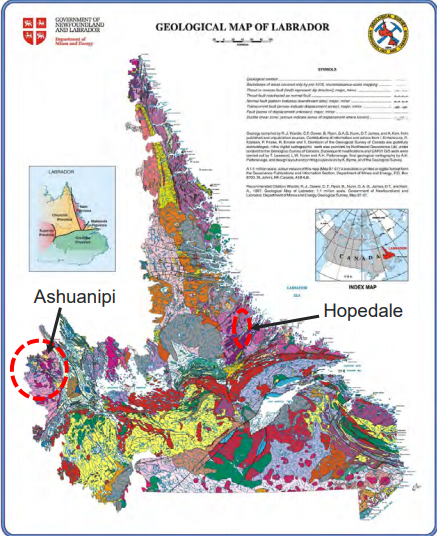
  • 2 Key Exploration Properties: Hopedale and Ashuanipi

Hopedale:

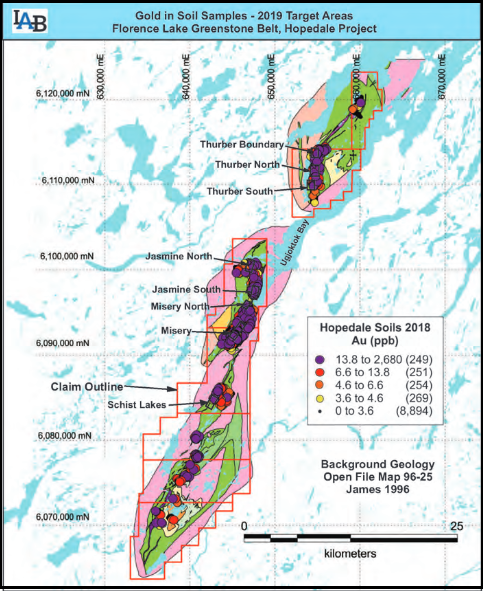
The Hopedale property covers much of the Hunt River and Florence Lake greenstone belts that stretch over 80 km. The belts are typical of greenstone belts around the world but have been underexplored by comparison. Initial work by Labrador Gold during 2017 show gold anomalies in soils and lake sediments over a 3 kilometre section of the northern portion of the Florence Lake greenstone belt in the vicinity of the known Thurber Dog gold showing where grab samples assayed up to 7.8g/t gold. In addition, anomalous gold in soil and lake sediment samples occur over approximately 40 kilometres along the southern section of the greenstone belt (see news release dated January 25th 2018 for more details). Labrador Gold now controls approximately 57km strike length of the Florence Lake Greenstone Belt.

Ashuanipi:

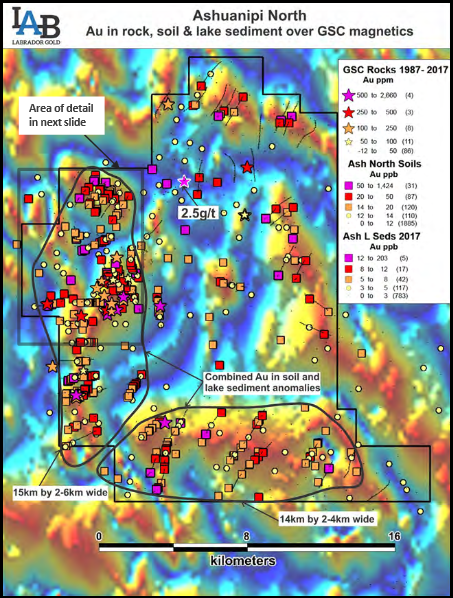
  • Two district scale gold anomalies outlined by soil and lake sediment survey: 15x3km north south anomaly and a 14 x 3km east west anomaly
  • 2018 Soil Sampling identified: 164 samples with over 50 ppb gold, 67 samples over 100 ppb (0.1g/t) gold and a high of 8,973 ppb (8.97 g/t) Au

The Ashuanipi gold project is located just 35 km from the historical iron ore mining community of Schefferville, which is linked by rail to the port of Sept Iles, Quebec in the south. The claim blocks cover large lake sediment gold anomalies that, with the exception of local prospecting, have not seen a systematic modern day exploration program. Results of the 2017 reconnaissance exploration program following up the lake sediment anomalies show gold anomalies in soils and lake sediments over a 15 kilometre long by 2 to 6 kilometre wide north-south trend and over a 14 kilometre long by 2 to 4 kilometre wide east-west trend. The anomalies appear to be broadly associated with magnetic highs and do not show any correlation with specific rock types on a regional scale (see news release dated January 18th 2018). This suggests a possible structural control on the localization of the gold anomalies

LAB Hub on Agoracom

FULL DISCLOSURE: Labrador Gold is an advertising client of AGORA Internet Relations Corp.

INDUSTRY BULLETIN: Impala #Platinum offers $1B for Toronto-based North American #Palladium $PDL.ca $NAM.ca $WG.ca $XTM.ca $WM.ca

Posted by AGORACOM-JC at 2:27 PM on Tuesday, October 8th, 2019

SPONSOR: New Age Metals Inc. The company also owns one of North America’s largest primary platinum group metals deposit in Sudbury, Canada. Updated NI 43-101 Mineral Resource Estimate of 2,867,000 PdEq Measured and Indicated Ounces, with an additional 1,059,000 PdEq Ounces Inferred. Learn More.

———————

$1-billion sales agreement announced Monday represents the culmination of a six-year turnaround for Toronto-based miner North American Palladium Inc., its president and CEO says.

On a conference call to discuss the deal to sell the company to South African miner Impala Platinum Holdings Ltd., Jim Gallagher said NAP was in severe financial distress following a poorly executed mine expansion in 2013 when financier Brookfield Capital Partners stepped in with a US$130-million loan.

In 2015, with the company still struggling, Brookfield converted its loan to equity to become the majority owner, on the understanding that it would sell its stake when the turnaround was complete.

“That day has come today. We have a sale of the company in an all-cash deal at near-record palladium prices and, except for a two-day blip in March of this year, at near-record high share prices,” said Gallagher on a conference call to discuss the deal.

“From virtual bankruptcy four years ago, we now have a sale to the tune of $1 billion.”

Impala Platinum, which uses the nickname Implats, has offered to pay $16 per share to Brookfield Business Partners LP, the majority shareholder with 81 per cent of the stock, and $19.74 per share for the remaining stake, resulting in an average price per share of $16.77.

Negotiations with Implats began in July and the companies had unofficially set a price of around $16 per share, Gallagher explained. The higher price for minority shareholders was agreed upon in recognition of the more recent rise in share prices.

North American Palladium has been producing palladium, a lustrous white material valued for its use in pollution-control devices for cars and trucks, for 25 years at its Lac des Iles Mine at Thunder Bay, Ont. It’s also involved in two exploration projects.

“Implats has had an exploration presence in Canada for more than two decades and over the past three years we have developed a strong relationship with and understanding of NAP and its management team and operations,” said CEO Nico Muller in a news release.

“It is Implats’ view that the palladium market will remain in a structural deficit in the medium term, which should lend considerable support to stronger-for-longer pricing.”

Implats said it was attracted to North American Palladium because of its fully mechanized mine, which means low labour costs and leading safety statistics, an estimated mine life of at least 15 years, and its future exploration opportunities. About 700 people work at the mine.

The companies have agreed to a 30-day period during which a termination fee of $24.5 million would be payable to Implats if a higher bid is accepted, with the fee increasing to $37.7 million thereafter. Implats would have the right to match any offer.

Closing of the transaction is expected in the fourth quarter, subject to North American Palladium shareholder approval and other customary conditions.

Source: https://www.bnnbloomberg.ca/impala-platinum-offers-1b-for-toronto-based-north-american-palladium-1.1327825

New Age Metals $NAM.ca Reports Size of Prospective #PGM #Copper #Nickel Mineralization Doubled at Genesis PGM-Cu-Ni Project, Alaska $WG.ca $XTM.ca $WM.ca $PDL.ca $GLEN

Posted by AGORACOM-JC at 9:13 AM on Tuesday, October 8th, 2019
  • Harry Barr, Chairman & CEO, stated; “We are pleased to announce that this summers exploration efforts have doubled the strike length of prospective mineralization at our road accessible Genesis PGM-Ni-Cu Project in Alaska.

October 8th, 2019 – Rockport, Canada – New Age Metals Inc. (NAM) (TSXV:NAM) (OTC:NMTLF) (FSE:P7J) Harry Barr, Chairman & CEO, stated; “We are pleased to announce that this summers exploration efforts have doubled the strike length of prospective mineralization at our road accessible Genesis PGM-Ni-Cu Project in Alaska. Our Alaskan geological consultant, Avalon Development, has outlined subsequent stages of exploration including reconnaissance level prospecting, geologic mapping and geochemical sampling for all of the newly identified PGM-Cu-Ni targets. Ground-based geophysics and/or closely spaced airborne magnetics and EM surveys should also be conducted to provide better three-dimensional control on mineralization. Following these efforts, prioritization of targets is recommended followed by first-ever scout drilling.”

Genesis Summer 2019 Exploration Program Results

Two independent contractor evaluations were conducted earlier this summer on the Genesis project. These evaluations included imagery processing and interpretation of ASTER (Advanced Spaceborne Thermal Emission and Reflection Radiometer) and associated LANDSAT8 satellite data to help map potential alteration targets to aid district-scale PGM-Cu-Ni sulfide exploration. This effort was conducted by Denver-based Image2Map Services, Inc. The second effort involved reinterpretation of 400m spaced airborne magnetic and resistivity surveys previously flown by the State of Alaska Div. of Geological and Geophysical Surveys and limited ground IP surveys conducted by a previous owner of the Genesis project. This effort was conducted by Denver-based Condor Geophysics.

Previous exploration on the Sheep Hill massif in the central part of the Genesis project revealed stratabound sulfides over an 800 metre strike length, with consistent PGM-Cu-Ni metal grades over multiple meter intervals, including 6 metres grading 804 ppb platinum and 1,018 ppb palladium, and 12 meters grading 5,938 ppm nickel. There has been no drilling on this district-scale project and the strike and depth extent of Ni-Cu-PGE mineralization remains open to expansion. The geophysical signature of the Sheep Hill mineralization is strongly magnetic and moderately conductive. The first-ever application of ASTER and LANDSAT8 imagery over Sheep Hill shows a remarkably consistent correlation between a distinctive strong iron oxide alteration signature and the geological and geophysical trace of the previously discovered PGM-Cu-Ni sulfide mineralization hosted by a dunite-lherzolite unit (Figure 1). ATSER and LANDSAT imagery revealed at least two other sub-parallel alteration zones adjacent to, and east of the known PGM-Cu-Ni mineralization at Sheep Hill. These two zones are separated from each other and the known Sheep Hill zone by talus fields composed of unaltered and unmineralized ultramafic rocks that lie upslope from the PGM-Cu-Ni mineralization. Combining ASTER and LANDSAT8 results with airborne magnetics and resistivity data indicate the total length of the stratabound PGM-Cu-Ni mineralization on Sheep Hill is at least 2,000m and open under alluvial cover in both strike directions.


Click Image To View Full Size

Figure 1: Combined ASTER serpentine alteration thematics and LANDSAT iron oxide alteration thematics, Sheep Hill massif, Genesis project, Alaska. Location of previous geochemical sampling shown in red squares.

At the adjacent Bernard Mt. massif, centered about 7.5 kilometers west of Sheep Hill, ASTER and LANDSAT8 results combined with airborne magnetics and resistivity data indicate a well constrained northeast trending band of conductive and magnetic iron oxide alteration extending for at least 2,250 metres along the south flank of Bernard Mt. (Figure 2). The stratigraphic position, ASTER and LANDSAT8 alteration and airborne magnetic and resistivity signatures are identical to those at Sheep Hill. Unlike Sheep Hill, there has been virtually no prospecting, mapping or geochemical sampling along the prospective target horizon at Bernard Mt.


Click Image To View Full Size

Figure 2: Landsat 8 iron oxide alteration thematics over the Bernard Mt. massif, Genesis project, Alaska. Location of previous geochemical sampling shown in red squares.

Based on previous geological and geochemical data combined with newly generated and/or interpreted ASTER, LANDSAT8, airborne magnetics and airborne resistivity data, a total of 23 exploration targets have been identified on the Genesis project. The most prospective targets include 7 separate zones on Bernard Mt. and an additional 9 zones on Sheep Hill. None of the targets on Bernard Mt. have been explored, even at the reconnaissance level, and only the western edge of one target zone, which return significant PGM-Cu-Ni mineralization, has been mapped and sampled at Sheep Hill. There has been no drilling on any of the targets identified on Sheep Hill or Bernard Mt.

NAM management is actively seeking an option/joint-venture partner for this road accessible PGM and Multiple Element Project using the Prospector Generator business model.

About Genesis

The Genesis project is a PGM-Cu-Ni property located in the northeastern Chugach Mountains, 75 paved road miles north of the all-season port city of Valdez, Alaska. The project is within 3 km of the all-season paved Richardson Highway and a high capacity electric power line. The project is covered by 4,144 hectares of State of Alaska mining claims owned 100% by New Age Metals. Past exploration has revealed the presence of chromite-associated platinum and palladium mineralization and stratabound Ni-Cu-PGE mineralization within magmatic layers of the Tonsina Ultramafic Complex. Pyrrhotite, pentlandite, and chalcopyrite occur in disseminations and net textured segregations associated with platinum and palladium sulfides. There has been limited exploration over the Genesis project and there has been no past exploration drilling on the project. NAM management is actively seeking an option/joint-venture partner for this road accessible PGM and Multiple Element Project using the Prospector Generator business model.

About NAM’s PGM Division

NAM’s flagship project is its 100% owned River Valley PGM Project (NAM Website – River Valley Project) in the Sudbury Mining District of Northern Ontario (100 km east of Sudbury, Ontario). Recently the Company announced the results of the first PEA (see News Release – June 27, 2019) completed on the River Valley Project. The PEA has been developed by various independent consultants – P&E Mining Consultants Inc. (P&E) was responsible for the open pit mining, surface infrastructure, tailings facility, and project economics; DRA Americas Inc. (“DRA”) was responsible for all metallurgical test work and processing aspects of the Project; and WSP Canada Inc. (“WSP”) was responsible for the Mineral Resource Estimate. The PEA is a preliminary report, however, it has demonstrated that there are potentially positive economics for a large-scale mining open pit operation, with 14 years of Palladium and Platinum production.

Qualified Person

The contents contained herein that relate to Exploration Results or Mineral Resources is based on information compiled, reviewed or prepared by Curt Freeman, a consulting geoscientist for New Age Metals. Mr. Freeman is the Qualified Person as defined by National Instrument 43-101 and is the owner of Avalon Development Corp. and Anglo Alaska Gold Corp, which is the vendor of the Genesis PGM Project. Mr. Freeman has reviewed and approved the technical content of this news release.

Stock Option Grant

In addition, the Company announces that it has granted 1,400,000 incentive stock options to directors, officers and consultants of the Company at an exercise price of $0.05 per share for a period of five (5) years from the date of grant in accordance with the Company’s Stock Option Plan. The Stock Options granted will be subject to vesting restrictions, acceptance by the TSX Venture Exchange and will be subject to regulatory hold periods in accordance with applicable Canadian Securities Laws.

On behalf of the Board of Directors
“Harry Barr”
Harry G. Barr, Chairman and CEO

For further information on New Age Metals, please contact Harry Barr at 613-659-2773, or [email protected]

Neither the TSX Venture Exchange nor its Regulation Services Provider (as that term is defined in the policies of the TSX Venture Exchange) accepts responsibility for the adequacy or accuracy of this release.

Cautionary Note Regarding Forward Looking Statements: This release contains forward-looking statements that involve risks and uncertainties. These statements may differ materially from actual future events or results and are based on current expectations or beliefs. For this purpose, statements of historical fact may be deemed to be forward-looking statements. In addition, forward-looking statements include statements in which the Company uses words such as “continue”, “efforts”, “expect”, “believe”, “anticipate”, “confident”, “intend”, “strategy”, “plan”, “will”, “estimate”, “project”, “goal”, “target”, “prospects”, “optimistic” or similar expressions. These statements by their nature involve risks and uncertainties, and actual results may differ materially depending on a variety of important factors, including, among others, the Company’s ability and continuation of efforts to timely and completely make available adequate current public information, additional or different regulatory and legal requirements and restrictions that may be imposed, and other factors as may be discussed in the documents filed by the Company on SEDAR (www.sedar.com), including the most recent reports that identify important risk factors that could cause actual results to differ from those contained in the forward-looking statements. The Company does not undertake any obligation to review or confirm analysts’ expectations or estimates or to release publicly any revisions to any forward-looking statements to reflect events or circumstances after the date hereof or to reflect the occurrence of unanticipated events. Investors should not place undue reliance on forward-looking statements

American Creek’s $AMK.ca Goldstorm Deposit A Rare Opportunity for Investors Who Missed Pretium’s Brucejack Discovery $PVG.ca $SII.ca $SA $SKE.ca $TUD.ca $SPMT.ca $GTT.ca $III.ca $GGI.ca $SEA.ca $AFF.ca

Posted by AGORACOM at 9:39 PM on Monday, October 7th, 2019

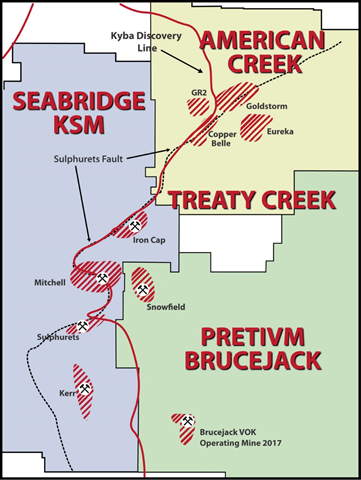
Pretium helped define the Golden Triangle with the discovery of high grade gold at Brucejack. Drilling success at American Creek’s Treaty Creek property just north of Pretium is demonstrating the opportunity for a second chance for those that missed out on Brucejack. Aiming to become a peer through sheer force of tonnage, American Creeks JV partner Tudor Gold is returning intercepts that are close to a mile in length, with 0.589 g/t Au over 1081.5m, including an upper interval of 0.828 g/t Au over 301.5m and a lower interval of 0.930 g/t Au over 207m that also demonstrated copper values before exceeding the length of the drill capabilities. Other holes include 0.725 g/t gold over 838.5m, 0.683g/t gold over 780m, and 0.98 g/t gold over 563m.

An equal measure of thanks should also be directed toward Ken Konklin, who made the discovery at at Brucejack, and is now Exploration Manager at Treaty Creek. He came out of retirement after putting the $3 billion Brucejack mine into place because he believes that Treaty Creek holds more potential than what’s he’s already accomplished. He has said that developing the Brucejack mine was a huge achievement but Treaty Creek is going to be his legacy: ” The Goldstorm System shows no signs of weakening to the northeast and several more drill holes will be needed to find the length and depth of this huge gold system. Not only does the Goldstorm Zone remain open at depth and along strike, we are now seeing base-metal associations possibly as part of a zonation within the metal system.”

Treaty Creek:

  • Part of the same Sulphurets Hydrothermal System that contains a mind boggling 188M oz gold, 1.2B oz silver and 55B lbs of copper (all categories) to date ( P&P reserves of 47M oz Au, 214M oz Ag, and 10B lbs Cu)
  • Same trend – deposits occur about every 2-3 km going north with gold grades increasing as the system extends northward – The Goldstorm zone on Treaty Creek is the most northerly deposit to date
  • Huge logistical advantages by being on the right side of the mountain with direct access to power and highway
  • Potential open pit design requiring a fraction of the capital cost with a shorter payback period.
  • At the discovery stage of the mining life-cycle where biggest gains are typically made

 Large deposits are found near the red “discovery line” and the Sulphurets fault

Treaty Creek Project Summary Click Here: Treaty Creek Summary

Has already increased over 300% since spring and yet only the 2 sets of assays have been released. Based on the geology, geophysics, extended strike length and seemingly endless depth, it looks as though things have just started for American Creek.  A major drill program is presently being conducted at Treaty Creek by JV partner and operator Tudor Gold. There are now two drills working on the Goldstorm zone. The Treaty Creek Project is a Joint Venture with Tudor Gold owning 60% and acting as operator, with American Creek holding a 20% interest in the project. American Creek is fully carried until such time as a Production Notice is issued. Until such time, Tudor is required to fund all exploration and development costs while American Creek has a “free ride”.

For further information please contact Kelvin Burton at: Phone: 403 752-4040 or Email: [email protected]. Information relating to the Corporation is available on its website at www.americancreek.com

    FULL DISCLOSURE: American Creek is an advertising client of AGORA Internet Relations Corp.

Another First for the #Pot Industry: A Licensed Cannabis Restaurant SPONSOR: NORTHBUD $NBUD.ca $CGC $ACB $APH $CRON.ca $HEXO.ca $TRST.ca $OGI.ca

Posted by AGORACOM-JC at 10:01 AM on Monday, October 7th, 2019

SPONSOR: NORTHBUD (NBUD:CSE) Sustainable low cost, high quality cannabinoid production and procurement focusing on both bio-pharmaceutical development and Cannabinoid Infused Products. Learn More.

NBUD: CSE
—————————–

Another First for the Pot Industry: A Licensed Cannabis Restaurant

  • Cannabis edibles are a growing segment of the market and are expected to reach $4.1 billion in 2022, combining Canadian and U.S. sales.
  • In 2017, that figure was just $1 billion among the two countries. The segment is going to be key to the industry’s long-term growth.

By: David Jagielski

Cannabis edibles are a growing segment of the market and are expected to reach $4.1 billion in 2022, combining Canadian and U.S. sales. In 2017, that figure was just $1 billion among the two countries. The segment is going to be key to the industry’s long-term growth.

Restaurants haven’t been able to take advantage of that growth since the U.S. Food and Drug Administration has still not permitted cannabidiol (CBD) to be infused into food. While the FDA has held hearings on CBD, there’s no indication that changes are coming anytime soon.

One restaurant, however, has been able to get around that problem. Lowell Farms opened its doors earlier this month in West Hollywood, Calf., and it’s the first restaurant with a lounge licensed for cannabis use. Customers will be able to eat food and consume pot at the same establishment. That doesn’t mean the restaurant will be able to make and serve cannabis food. Instead, cannabis edibles will be permitted only if they are “produced by an outside source.” 

One of the other restrictions the restaurant will face is not being able to sell alcohol to diners. It’s a small price to pay to let them consume cannabis, since pot lounges remain a rarity in the industry. Las Vegas is among the cities looking at permitting such lounges, but that could be years away because there’s still a lot of opposition to it. 

Will a bar someday be a place to enjoy pot with friends? Image source: Getty Images.

Why lounges could be big for the industry

While marijuana has been legalized in many parts of the U.S., that doesn’t mean it’s possible to consume it at bars or sporting events, unlike alcohol where there are many places that users can drink in a social setting. Allowing that could unlock another avenue of growth for the industry.

Cannabis beverages are on the rise and expected to grow globally at a rate of more than 15% per year from now until 2025, reaching $4.5 billion in market size by then. So there’s going to be a growing need for places to enjoy such drinks with friends without always having to do so at home. And that doesn’t even factor in the growth of edibles that could be consumed at lounges, such as candy, cookies, and chocolate.

In Canada, there’s potential for Canopy Growth to test its products in one lounge that was made legal earlier this year. In many ways, the emerging Canadian cannabis edibles market, which is going to be legalized later this month and where the first products will be available in December , could prove to be a good indicator of how successful some of these concepts will be in the U.S. And for Canopy Growth, it could be an important way to get closer to breakeven.

For now, Canopy Growth can be a good opportunity for investors to take advantage of the new edibles market in Canada. Not only is the company well-positioned for success in the beverages segment, but in a recent interview with BNN Bloomberg, CEO Mark Zekulin said the company was working on more than 50 different products for the edibles market. That could lead to significant growth for Canopy Growth and get investors excited about the stock once again.

Here’s The Marijuana Stock You’ve Been Waiting For

A little-known Canadian company just unlocked what some experts think could be the key to profiting off the coming marijuana boom.

And make no mistake – it is coming.

Cannabis legalization is sweeping over North America – 10 states plus Washington, D.C., have all legalized recreational marijuana over the last few years, and full legalization came to Canada in October 2018.

And one under-the-radar Canadian company is poised to explode from this coming marijuana revolution.

Because a game-changing deal just went down between the Ontario government and this powerhouse company…and you need to hear this story today if you have even considered investing in pot stocks.

Source: https://www.fool.com/investing/2019/10/06/another-first-for-the-cannabis-industry-a-licensed.aspx

LOMIKO Metals $LMR.ca – High-Pressure Experiments Reveal Graphene’s 3D Nature $CJC.ca $SRG.ca $NGC.ca $LLG.ca $GPH.ca $NOU.ca

Posted by AGORACOM at 2:07 PM on Thursday, October 3rd, 2019

SPONSOR: Lomiko Metals LMR:TSX-V – A Canadian exploration-stage company discovered high-grade graphite at its La Loutre Property in Quebec and is working toward a Pre-Economic Assessment (PEA) that will increase its current indicated resource of 4.1 Mt of 6.5% Cg to over 10 Mt of 10%+ Cg through a 21 hole program at the Refractory Zone. Click Here For More Information

Contrary to what is believed, monolayer graphene (a sheet of carbon just one atomic layer thick) has 3D mechanical properties and they can now be properly measured and meaningfully described thanks to high-pressure Raman spectra measurements on the material. This result, from researchers at Queen Mary University of London, might have implications for when graphene – and indeed other 2D materials – are employed in applications such as mechanical sensors. It also highlights the fact that Raman spectroscopy can be used as diagnostic tool to measure the mechanical properties of graphene when it is employed as a reinforcement for other materials.

“Graphene is called a 2D material because its carbon atoms lie in a two-dimensional plane,” explains team member Yiwei Sun. “However, monolayer graphene has electrons in π-orbitals above and below this plane. If we compress a sheet of graphene in a direction normal to the sheet, graphene is strained because the π-electrons become compressed and strained. If the sheet is compressed in all three directions, it undergoes 3D strain, however. This means that 3D elastic parameters can and must be defined for this material.

“So, graphene should really be thought of as a 3D material, not 2D, as far as certain mechanical properties are concerned.”

Complementing previous experiments

Sun and colleagues also found that the stiffness of monolayer graphene is the same as that of graphite (which is a stack of graphene layers).

These results complement those from previous experiments in which researchers studied the effect of pressure in graphene supported on a substrate such as copper. The substrate strongly affects the contraction of graphene and thus skews the result, says Sun.

Such experiments are performed in a diamond anvil cell (DAC). Here, the samples are loaded into a pressure-transmitting medium, such as water, in a hole of a 50-micron-thick metal gasket sandwiched between two diamond culets 150 microns in size. Pressures of several gigapascals are then applied to the cell.

“What is new in our work is that we studied unsupported monolayer graphene in solution”, explains Sun.

The researchers started out in the usual way – with a monolayer of graphene on a copper substrate. They then got rid of the substrate by etching it away in a solvent after protecting the graphene by a polymer film (PMMA) so that it floated on the etchant and could be located. They took the graphene with the polymer out of the etchant, placed it on a glass slide and rinsed it with de-ionized water. Next, they loaded the graphene with the PMMA in DMF, which dissolved the PMMA leaving the monolayer graphene free-standing in it. “We loaded the monolayer graphene several times so that it was concentrated enough for a decent Raman signal,” says Sun.

The DMF prevents the graphene from crumpling and/or bonding together to form graphite for long enough to perform the high-pressure experiments. These involved compressing the graphene-containing liquid in a diamond anvil cell to pressures of 12 GPa and measuring its in-plane and out-of-plane (normal to the plane) stiffness using optical Raman spectroscopy.

In-plane and out-of-plane stiffnesses are the same for both graphene and graphite

The researchers compared their findings to those obtained on 3D graphite and found that both the in-plane and out-of-plane stiffnesses are the same for both materials, within the experimental errors of their experiment.

“Stiffness is usually defined in terms of the stress and strain (the change of thickness) a material can endure,” explains Sun. “We find that under pressure the thickness of graphene decreases at the same rate as that of graphite. Hence our claim that ‘graphene is graphite’ as regards some key mechanical properties.”

The team, led by Colin Humphreys and David Dunstan, also reports on a shift to higher energy frequencies of in-plane vibrations (phonons) of the unsupported monolayer graphene to 5.4/cm/GPa, which is very close to that of graphite (4.7/cm/GPa).

The in-plane force on graphene under pressure is significantly reduced since graphene, like graphite, is very soft out-of-plane (this is why we can write with the “lead” in pencils, which is graphite),” Sun tells Physics World. “This reduction is what causes the sublinear shift of its in-plane phonon frequency with pressure. This physically meaningful experimental observable allows us to define the thickness and strain of graphene in terms of the thickness of its π-orbitals.”

The technique employed in this study, which is reported in Physical Review Letters, might be used on other unsupported 2D materials in solution, he adds.

“Fiddly handiwork”

“High-pressure experiments like these are easy to describe, but they are notoriously difficult to perform,” writes John Procter of the University of Salford in a related Viewpoint article. Procter’s group was the first to study the effect of strain using Raman measurements of graphene in Si/SiOsubstrates under high pressure. “Fiddly handiwork is required to align the DAC and sample with micrometre-precision. Because of these demands, such experiments also have a high failure rate. Sun and colleagues’ ability to study graphene under a known high stress – a first – is therefore a major achievement.”

He adds that the research could help in the development of strain sensors based on graphene. “It may also affect how Raman spectroscopy is used as a diagnostic tool for new types of graphene composites that serve to reinforce other materials. Here, the spectroscopy helps determine the extent to which stress or strain is transferred from the host material to the graphene reinforcement. Knowing graphene’s 3D characteristics will help researchers optimize this reinforcing behaviour.”

Sun and co-workers say they are now looking at how the atmosphere affects the mechanical properties of graphene and graphite. Such studies will be important for when it comes to real-world applications of these materials. “For example, a graphene-based device may perform very differently in a humid Manchester in the UK to a dry Arizona in the US,” says Sun.

Source: https://physicsworld.com/a/high-pressure-experiments-reveal-graphenes-3d-nature/

Advance Gold $AAX.ca Gold Prices Shoot Higher After ISM Service Sector Drops Sharply in September $SIL.ca $FA.ca $ANG.jo $ABX.ca $NGT.ca $MGG.ca

Posted by AGORACOM at 1:52 PM on Thursday, October 3rd, 2019

SPONSOR: Advance Gold AAX.v – Advance Gold controls 100% interest in the Tabasquena Silver Mine in Zacatecas, Mexico. A cluster of 30 Epithermal veins have been discovered, with recent emphasis on exploring a large anomaly to drill. Advance also owns 15% of the Kakamega JV attached to Barrick Takeover Offer for Acacia Mining. Click Here For More Info

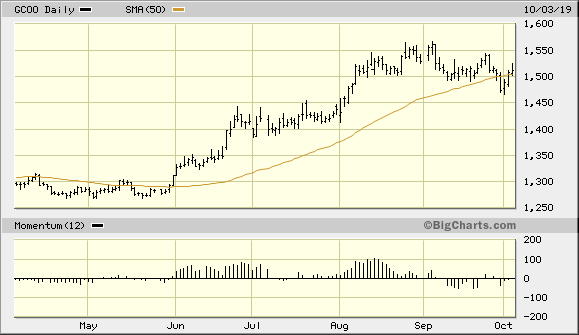
Recession fears are once again gripping financial markets and pushing gold prices higher as sentiment within the U.S. service sector fell more than expected, according to the latest data from the Institute for Supply Management (ISM).

Thursday, the ISM said its nonmanufacturing index showed a reading of 52.6% for September, down from August’s reading of 56.4%. The data was much weaker than expected as consensus forecasts were calling for a reading of 55.1%.

According to reports this is the lowest reading in three years.

Readings above 50% in such diffusion indexes are seen as a sign of economic growth, and vice-versa. The farther an indicator is above or below 50%, the greater or smaller the rate of change.

Ahead of the report, the gold market was holding its own above $1,500 an ounce, recovering from a 2% selloff at the start of the week. The latest economic data has added to gold’s gains. December gold futures last traded at $1,518.80 an ounce, up 0.72% on the day.

Economists and analysts warned that disappointing service sector data could boost recession fears as this is the largest component of the U.S. economy.

The nonmanufacturing data comes just two days after the ISM said that its manufacturing index fell even further into contraction territory, also missing economist expectations.

“The non-manufacturing sector pulled back after reflecting strong growth in August. The respondents are mostly concerned about tariffs, labor resources and the direction of the economy,” said Anthony Nieves, chair of the ISM Non-Manufacturing Business Survey Committee.

Looking at the components of the report, the Business Activity Index dropped to a reading of 55.2%, down from August’s level of 61.5%.

The labor market also lost some momentum in September, with the Employment Index falling to 50.4%, down from August’s level of 53.1%. This indicator is closely watched by economists as it is used as a predictor for Friday’s nonfarm employment report.

Some economists have noted that the miss in the ISM employment data points to downside risk to Friday’s employment report.

Source: By Neils Christensen

Vertical Exploration $VERT.ca Enters into an LOI with Venturevest Realty Partners for Note Facility to Support Significant St-Onge Wollastonite Development $TORR.ca $FA.ca $WEED.ca $CGC $ACB $APH $CRON.ca $HEXO.ca $TRST.ca $OGI.ca

Posted by AGORACOM at 12:36 PM on Thursday, October 3rd, 2019
http://www.smallcapepicenter.com/Vert%20Square.png

VANCOUVER, BC / ACCESSWIRE / October 3, 2019 /VERTICAL EXPLORATION INC. (TSXV:VERT) (“Vertical” or “the Company”) and Venturevest Realty Partners LLC (“Venturevest”) are pleased to announce that the two companies have signed a non- binding Letter of Intent (LOI) to enter into discussions regarding the provision by Venturevest of a secured Note Facility up to a maximum amount of $20 million CAD to support the multi-phased development of the St-Onge Wollastonite Deposit.

The Note Facility would be a staged credit facility that would provide the required financing to allow Vertical to move forward with four distinct phases of St-Onge development, from the initial quarry style permitting and production phase through to the mining and final processing plant stage. Vertical views this potential Note Facility financing as a significant development that would enable the Company to rapidly develop and expand its St-Onge Wollastonite Deposit.

Further details regarding the Note Facility Agreement will be provided as soon as all terms have been negotiated between Vertical and Venturevest. The Agreement is subject to a due diligence period that is anticipated to be completed within the next 60 days. This transaction is subject to the approval of the TSX Venture Exchange.

ABOUT VENTUREVEST REALTY PARTNERS LLC.

Venturevest Realty Partners LLC (“Venturevest”) is a New York corporation.

ABOUT VERTICAL EXPLORATION

Vertical Exploration’s mission is to identify, acquire, and advance high potential mining prospects located in North America for the benefit of its stakeholders. The Company’s flagship St-Onge Wollastonite property is located in the Lac-Saint-Jean area in the Province of Quebec.

ON BEHALF OF THE BOARD

Peter P. Swistak, President/CEO

FOR FURTHER INFORMATION PLEASE CONTACT:

Telephone: 1-604-683-3995
Toll Free: 1-888-945-4770
https://vertxinc.com/

NORTHBUD $NBUD.ca – As Canada gears up for pot 2.0, more shortages are on the menu $CGC $ACB $APH $CRON.ca $HEXO.ca $TRST.ca $OGI.ca

Posted by AGORACOM-JC at 12:07 PM on Thursday, October 3rd, 2019

SPONSOR: NORTHBUD (NBUD:CSE) Sustainable low cost, high quality cannabinoid production and procurement focusing on both bio-pharmaceutical development and Cannabinoid Infused Products. Learn More.

NBUD: CSE
—————————–
  • Canada’s legalization of pot edibles later this year is facing an even more shambolic start than the dried flower market, which is still struggling to meet demand, according to industry players.

Kristine Owram, Bloomberg News

Canada’s legalization of pot edibles later this year is facing an even more shambolic start than the dried flower market, which is still struggling to meet demand, according to industry players.

“At least that time we knew what the permissible product types were going to be and were already making them in the medical context,” said cannabis lawyer Trina Fraser, a partner at Brazeau Seller Law in Ottawa.

Canada will add edibles, extracts and topicals to the list of legal cannabis products no later than Oct. 17. Many analysts agree these products will generate better demand and margins than dried flower. But the federal government has not yet issued regulations for the new formats, making it difficult for producers to prepare lest they unknowingly violate some rule.

A spokeswoman for Health Canada declined to comment on when the regulations will be released.

In addition, a huge licensing backlog has built up at Health Canada, the government agency that oversees cannabis regulations. About 614 applications were waiting in the queue as of March 31.

“A full rollout amongst a nice wide array of producers and a wide array of these new product types is going to take time, literally years, because we have such a licensing backlog,” Fraser said.

Company Stockpiling

Canada’s market for edibles and other alternative pot produces will eventually be worth C$2.7 billion ($2 billion) annually, but consumers should expect “missteps, delays and frustration” in the early days, Deloitte said in a report published Monday. Jennifer Lee, Deloitte Canada’s cannabis national leader, estimated it will be a minimum of 24 months before the industry normalizes.

In the meantime, many pot companies are stockpiling, choosing to forgo revenue today to ensure they have enough supply for the new high-value products. This is exacerbating the shortage of dried flower, but executives say it’s worth it.

“We’ve made a very conscious effort to delay revenue,” said Chuck Rifici, chief executive officer of Auxly Cannabis Group Inc. Selling into the market today doesn’t build brand recognition because shelves are empty and consumers are buying whatever’s available, he added. “I would much rather save that product, get a multiple of margin on that brand and make sure that I have enough inventory.”

Lab Delays

This is proving to be a boon for extraction companies like Valens GroWorks Corp. Valens has contracts with many of the biggest pot companies, including Canopy Growth Corp., Hexo Corp. and Tilray Inc., to extract cannabis oil from their plants, which is then used for products like edibles and vape cartridges. It’s also investing heavily in its testing labs in the belief that Health Canada will have stringent regulations to ensure pesticides and other contaminants don’t make it into the new consumer products.

“Even in labs today there’s delays where people are waiting three weeks to a month to get lab results back and I think that will only get worse,” said Everett Knight, Valens’ executive vice president of strategy and investments.

Companies are also making big bets on what products will be in demand, with Canopy and Hexo leaning toward cannabis beverages and others toward vaping.

Be Prepared

“Why do I want an edible or a drink when I can have a vape?” Irwin Simon, interim CEO of Aphria Inc., said in an interview on the sidelines of a cannabis conference last month. “I see the margins and the opportunities there.”

Rifici at Auxly also believes vape pens will be “the most important category by far.” But there are many unanswered questions. For example, will the government require companies to engrave its mandatory THC warning symbol into the pen itself, or will a sticker suffice?

This is why Valens is offering its customers 196 different options for its white-label vape pens. “You’ve got to make sure you cover your bases and prepare for all the possibilities,” Knight said.

Despite the uncertainty, it’s better to be prepared even if plans and production lines have to be tweaked once the regulations come out, said Bruce Linton, CEO of Canopy, which is building a 197,000 square foot bottling plant for cannabis beverages in Smiths Falls, Ontario.

“We’re in a situation where it’s better to spend money to be ready than to save money and be late,” he said.

 Cannabis Canada is BNN Bloomberg’s in-depth series exploring the stunning formation of the entirely new – and controversial – Canadian recreational marijuana industry. Read more from the special series here and subscribe to our Cannabis Canada newsletter to have the latest marijuana news delivered directly to your inbox every day.

Source: https://www.bnnbloomberg.ca/as-canada-gears-up-for-pot-2-0-more-shortages-are-on-the-menu-1.1268844