Agoracom Blog

12-Year Breakout in Mining Stocks Relative to Gold – SPONSOR: Labrador Gold $LAB.ca – $RIO.ca $WHM.ca $SIC.ca $NXS.ca

Posted by AGORACOM at 3:34 PM on Friday, January 10th, 2020
This image has an empty alt attribute; its file name is LAB-square-logo-2.png

SPONSOR: Labrador Gold – Two successful gold explorers lead the way in the Labrador gold rush targeting the under-explored gold potential of the province. Exploration has already outlined district scale gold on two projects, including a 40km strike length of the Florence Lake greenstone belt, one of two greenstone belts covered by the Hopedale Project. Click Here for More Info

Excerpts from Crescat Capitals November Newsletter:

Precious Metals

Precious metals are poised to benefit from what we consider to be the best macro set up we’ve seen in our careers. The stars are all aligning. We believe strongly that this time monetary policy will come at a cost. Look in the chart below at how the new wave of global money printing just initiated by the Fed in response to the Treasury market funding crisis is highly likely to pull depressed gold prices up with it.

The imbalance between historically depressed commodity prices relative to record overvalued US stocks remains at the core of our macro views. On the long side, we believe strongly commodities offer tremendous upside potential on many fronts. Precious metals remain our favorite. We view gold as the ultimate haven asset to likely outperform in an environment of either a downturn in the business cycle, rising global currency wars, implosion of fiat currencies backed by record indebted government, or even a full-blown inflationary set up. These scenarios are all possible. Our base case is that governments and central banks will keep their pedals to the metal to attempt to fend off credit implosion or to mop up after one has already occurred until inflation becomes a persistent problem.

The gold and silver mining industry is precisely where we see one of the greatest ways to express this investment thesis. These stocks have been in a severe bear market from 2011 to 2015 and have been formed a strong base over the last four years. They are offer and incredibly attractive deep-value opportunity and appear to be just starting to break out this year. We have done a deep dive in this sector and met with over 40 different management teams this year. Combining that work with our proprietary equity models, we are finding some of the greatest free-cash-flow growth and value opportunities in the market today unrivaled by any other industry. We have also found undervalued high-quality exploration assets that will make excellent buyout candidates.

We recently point out this 12-year breakout in mining stocks relative to gold now looks as solid as a rock. In our view, this is just the beginning of a major bull market for this entire industry. We encourage investors to consider our new Crescat Precious Metals SMA strategy which is performing extremely well this year.

Zero Discounting for Inflation Risk Today

With historic Federal debt relative to GDP and large deficits into the future as far as the eye can see, if the global financial markets cannot absorb the increase in Treasury debt, the Fed will be forced to monetize it even more. The problem is that the Fed’s panic money printing at this point in the economic cycle may hasten the unwinding of the imbalances it is so desperate to maintain because it has perversely fed the last-gasp melt up of speculation in already record over-valued and extended equity and corporate credit markets. It is reminiscent of when the Fed injected emergency cash into the repo market at the peak of the tech bubble at the end of 1999 to fend off a potential Y2K computer glitch that led to that market and business cycle top.
After 40 years of declining inflation expectations in the US, there is a major disconnect today between portfolio positioning, valuation, and economic reality. Too much of the investment world is long the “risk parity” trade to one degree or another, long stocks paired with leveraged long bonds, a strategy that has back-tested great over the last 40 years, but one that would be a disaster in a secular rising inflation environment.

With historic Federal debt relative to GDP and large deficits into the future as far as the eye can see, rising long-term inflation, and the hidden tax thereon, is the default, bi-partisan plan for the US government’s future funding regardless of who is in the White House and Congress after the 2020 elections. The market could start discounting this sooner rather than later.
The Fed’s excessive money printing may only reinforce the unraveling of financial asset imbalances today as it leads to rising inflation expectations and thereby a sell-off in today’s highly over-valued long duration assets including Treasury bonds and US equities, particularly insanely overvalued growth stocks. We believe we are in the vicinity of a major US stock market and business cycle peak.

Source:”Running Hot”

Courtesy of Crescat Capital: https://www.crescat.net/running-hot/

Thanks to

Kevin C. Smith, CFA
Chief Investment Officer

Tavi Costa
Portfolio Manager

Gold’s Outlook for 2020 – SPONSOR: American Creek Resources $AMK.ca $TUD.ca $SII.ca $GTT.ca $AFF.ca $SEA.ca $SA $PVG.ca $AOT.ca

Posted by AGORACOM at 2:20 PM on Friday, January 10th, 2020

This article is an overview of the economic conditions that will drive the gold price in 2020 and beyond. The turn of the credit cycle, the effect on government deficits and how they are to be financed are addressed.

In the absence of foreign demand for new US Treasuries and of a rise in the savings rate the US budget deficit can only be financed by monetary inflation. This is bound to lead to higher bond yields as the dollar’s falling purchasing power accelerates due to the sheer quantity of new dollars entering circulation. The relationship between rising bond yields and the gold price is also discussed.

It may turn out that the recent extraordinary events on Comex, with the expansion of open interest failing to suppress the gold price, are an early recognition in some quarters of the US Government’s debt trap.

The strains leading to a crisis for fiat currencies are emerging into plain sight.

Introduction

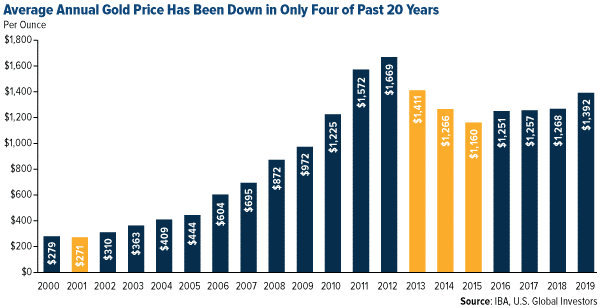
In 2019, priced in dollars gold rose 18.3% and silver by 15.1%. Or rather, and this is the more relevant way of putting it, priced in gold the dollar fell 15.5% and in silver 13%. This is because the story of 2019, as it will be in 2020, was of the re-emergence of fiat currency debasement. Particularly in the last quarter, the Fed began aggressively injecting new money into a surprisingly illiquid banking system through repurchase agreements, whereby banks’ reserves at the Fed are credited with cash loaned in return for T-bills and coupon-bearing Treasuries as collateral. Furthermore, the ECB restarted quantitative easing in November, and the Bank of Japan stands ready to ease policy further “if the momentum towards its 2% inflation target comes under threat” (Kuroda – 26 December).

The Bank of Japan is still buying bonds, but at a pace which is expected to fall beneath redemptions of its existing holdings. Therefore, we enter 2020 with money supply being expanded by two, possibly all three of the major western central banks. Besides liquidity problems, the central bankers’ nightmare is the threat that the global economy will slide into recession, though no one will confess it openly because it would be an admission of policy failure. And policy makers are also terrified that if bankers get wind of a declining economy, they will withdraw loan facilities from businesses and make things much worse.

Of the latter concern central banks have good cause. A combination of the turn of the credit cycle towards its regular crisis phase and Trump’s tariff war has already hit international trade badly, with exporting economies such as Germany already in recession and important trade indicators, such as the Baltic dry index collapsing. No doubt, President Trump’s most recent announcement that a trade deal with China is ready for signing is driven by an understanding in some quarters of the White House that over trade policy, Trump is turning out to be the turkey who voted for Christmas. But we have heard this story several times before: a forthcoming agreement announced only to be scrapped or suspended at the last moment.

The subject which will begin to dominate monetary policy in 2020 is who will fund escalating government deficits. At the moment it is on few investors’ radar, but it is bound to dawn on markets that a growing budget deficit in America will be financed almost entirely by monetary inflation, a funding policy equally adopted in other jurisdictions. Furthermore, Christine Lagarde, the new ECB president, has stated her desire for the ECB’s quantitative easing to be extended from government financing to financing environmental projects as well.

2020 is shaping up to be the year that all pretence of respect for money’s role as a store of value is abandoned in favour of using it as a means of government funding without raising taxes. 2020 will then be the year when currencies begin to be visibly trashed in the hands of their long-suffering users.

Gold in the context of distorted markets

At the core of current market distortions is a combination of interest rate suppression and banking regulation. It is unnecessary to belabour the point about interest rates, because minimal and even negative rates have demonstrably failed to stimulate anything other than asset prices into bubble territory. But there is a woeful lack of appreciation about the general direction of monetary policy and where it is headed.

The stated intention is the opposite of reality, which is not to rescue the economy: while important, from a bureaucrat’s point of view that is not the greatest priority. It is to ensure that governments are never short of funds. Inflationary financing guarantees the government will always be able to spend, and government-licenced banks exist to ensure the government always has access to credit.

Unbeknown to the public, the government licences the banks to conduct their business in a way which for an unlicensed organisation is legally fraudulent. The banks create credit or through their participation in QE they facilitate the creation of base money out of thin air which is added to their reserves. It transfers wealth from unsuspecting members of the public to the government, crony capitalists, financial speculators and consumers living beyond their means. The government conspires with its macroeconomists to supress the evidence of rising prices by manipulating the inflation statistics. So successful has this scheme of deception been, that by fuelling GDP, monetary debasement is presented as economic growth, with very few in financial mainstream understanding the deceit.

The government monopoly of issuing money, and through their regulators controlling the expansion of credit, was bound to lead to progressively greater abuse of monetary trust. And now, in this last credit cycle, the consumer who is also the producer has had his income and savings so depleted by continuing monetary debasement that he can no longer generate the taxes to balance his government’s books later in the credit cycle.

The problem is not new. America has not had a budget surplus since 2001. The last credit cycle in the run up to the Lehman crisis did not deliver a budget surplus, nor has the current cycle. Instead, following the Lehman crisis we saw a marked acceleration of monetary inflation, and Figure 2 shows how dollar fiat money has expanded above its long-term trend since then.

In recent years, the Fed’s attempt to return to monetary normality by reducing its balance sheet has failed miserably. After a brief pause, the fiat money quantity has begun to grow at a pace not seen since the immediate aftermath of the Lehman crisis itself and is back in record territory. Figure 1 is updated to 1 November, since when FMQ will have increased even more.

In order to communicate effectively the background for the relationship between gold and fiat currencies in 2020 it is necessary to put the situation as plainly as possible. We enter the new decade with the highest levels of monetary ignorance imaginable. It is a systemic issue of not realising the emperor has no clothes. Consequently, markets have probably become more distorted than we have ever seen in the recorded history of money and credit, as widespread negative interest rates and negative-yielding bonds attest. In our attempt to divine the future, it leaves us with two problems: assessing when the tension between wishful thinking in financial markets and market reality will crash the system, and the degree of chaos that will ensue.

The timing is impossible to predict with certainty because we cannot know the future. But, if the characteristics of past credit cycles are a guide, it will be marked with a financial and systemic crisis in one or more large banks. Liquidity strains suggest that event is close, even within months and possibly weeks. If so, banks will be bailed, of that we can be certain. It will require central banks to create yet more money, additional to that required to finance escalating government budget deficits. Monetary chaos promises to be greater than anything seen heretofore, and it will engulf all western welfare-dependent economies and those that trade with them.

We have established that between keeping governments financed, bailing out banks and perhaps investing in renewable green energy, the issuance of new money in 2020 will in all probability be unprecedented, greater than anything seen so far. It will lead to a feature of the crisis, which may have already started, and that is an increase in borrowing costs forced by markets onto central banks and their governments. The yield on 10-year US Treasuries is already on the rise, as shown in Figure 3.


Assuming no significant increase in the rate of savings and despite all attempts to suppress the evidence, the acceleration in the rate of monetary inflation will eventually lead to runaway increases in the general level of prices measured in dollars. As Milton Friedman put it, inflation [of prices] is always and everywhere a monetary phenomenon.

Through QE, central banks believe they can contain the cost of government funding by setting rates. What they do not seem to realise is that while to a borrower interest is a cost to set against income, to a lender it reflects time-preference, which is the difference between current possession, in this case of cash dollars, and possession at a future date. Unless and until the Fed realises and addresses the time preference problem, the dollar will lose purchasing power. Not only will it be sold in the foreign exchanges, but depositors will move to minimise their balances and creditors their ownership of debt.

If, as it appears in Figure 3, dollar bond yields are beginning a rising trend, the inexorable pull of time preference is already beginning to apply and further rises in bond yields will imperil government financing. The Congressional Budget Office assumes the average interest rate on debt held by the public will be 2.5% for the next three years, and that net interest in fiscal 2020 will be $390bn, being about 38% of the projected deficit of $1,008bn. Combining the additional consequences for government finances of a recession with higher bond yields than the CBO expects will be disastrous.

Clearly, in these circumstances the Fed will do everything in its power to stop markets setting the cost of government borrowing. But we have been here before. The similarities between the situation for the dollar today and the deterioration of British government finances in the early to mid-1970s are remarkable. They resulted in multiple funding crises and an eventual bail-out from the IMF. Except today there can be no IMF bail-out for the US and the dollar, because the bailor gets its currency from the bailee.

Nearly fifty years ago, in the UK gold rose from under £15 per ounce in 1970 to £80 in December 1974. The peak of the credit cycle was at the end of 1971, when the 10-year gilt yield to maturity was 7%. By December 1974, the stock market had crashed, a banking crisis had followed, price inflation was well into double figures and the 10-year gilt yield to maturity had risen to over 16%.

History rhymes, as they say. But for historians the parallels between the outlook for the dollar and US Treasury funding costs at the beginning of 2020, and what transpired for the British economy following the Barbour boom of 1970-71 are too close to ignore. It is the same background for the relationship between gold and fiat currencies for 2020 and the few years that follow.

Gold and rising interest rates

Received investment wisdom is that rising interest rates are bad for the gold price, because gold has no yield. Yet experience repeatedly contradicts it. Anyone who remembers investing in UK gilts at a 7% yield in December 1971 only to see prices collapse to a yield of over 16%, while gold rose from under £15 to £80 to the ounce over the three years following should attest otherwise.

Part of the error is to believe that gold has no yield. This is only true of gold held as cash and for non-monetary usage. As money, it is loaned and borrowed, just like any other form of money. Monetary gold has its own time preference, as do government currencies. In the absence of state intervention, time preferences for gold and government currencies are set by their respective users, bearing in mind the characteristics special to each. It is not a subject for simple arbitrage, selling gold and buying government money to gain the interest differential, because the spread reflects important differences which cannot be ignored. It is like shorting Swiss francs and buying dollars in the belief there is no currency risk.

The principal variable between the time preferences of gold and a government currency is the difference between an established form of money derived from the collective preferences of its users, for which there is no issuer risk, and state-issued currency which becomes an instrument of funding by means of its debasement.

The time preference of gold will obviously vary depending on lending risk, which is in addition to an originary rate, but it is considerably more stable than the time preference of a fiat currency. Gold’s interest rate stability is illustrated in Figure 4, which covers the period of the gold standard from the Bank Charter Act of 1844 to before the First World War, during which time the gold standard was properly implemented. With the exception of uncontrolled bank credit, sterling operated as a gold substitute.


Admittedly, due to problems created by the cycle of bank credit, these year-end values conceal some significant fluctuations, such as at the time of the Overend Gurney collapse in 1866 when borrowing rates spiked to 10%. The depression following the Barings crisis of 1890 stalled credit demand which is evident from the chart. However, wholesale borrowing rates, which were effectively the cost of borrowing in gold, were otherwise remarkably stable, varying between 2-3½%. Some of this variation can be ascribed to changing perceptions of general borrower risk and some to changes in industrial investment demand, related to the cycle of bank credit.

Compare this with dollar interest rates since 1971, when the dollar had suspended the remaining fig-leaf of gold backing, which is shown in Figure 5 for the decade following.


In February 1972 the Fed Funds rate was 3.29%, rising eventually to over 19% in January 1981. At the same time gold rose from $46 to a high of $843 at the morning fix on 21 January 1980. Taking gold’s originary interest rate as approximately 2% it required a 17% interest rate penalty to dissuade people from hoarding gold and to hold onto dollars instead.

In 1971, US Government debt stood at 35% of GDP and in 1981 it stood at 31%. The US Government ran a budget surplus over the decade sufficient to absorb the rising interest cost on its T-bill obligations and any new Treasury funding. America enters 2020 with a debt to GDP ratio of over 100%. Higher interest rates are therefore not a policy option and the US Government, and the dollar, are ensnared in a debt trap from which the dollar is unlikely to recover.

The seeds of the dollar’s destruction were sown over fifty years ago, when the London gold pool was formed, whereby central banks committed to help the US maintain the price at $35, being forced to do so because the US could no longer supress the gold price on its own. And with good reason: Figure 6 shows how the last fifty years have eroded the purchasing power of the four major currencies since the gold pool failed.


Over the last fifty years, the yen has lost over 92%, the dollar 97.6%, the euro (and its earlier components 98.2% and sterling the most at 98.7%. And now we are about to embark on the greatest increase of global monetary inflation ever seen.

The market for physical gold

In recent years, demand for physical gold has been strong. Chinese and Indian private sector buyers have to date respectively accumulated an estimated 17,000 tonnes (based on deliveries from Shanghai Gold Exchange vaults) and about 24,000 tonnes (according to WGC Director Somasundaram PR quoted in India’s Financial Express last May).

It is generally thought that higher prices for gold will deter future demand from these sources, with the vast bulk of it being categorised as simply jewellery. But this is a western view based on a belief in objective values for government currencies and subjective prices for gold. It ignores the fact that for Asians, it is gold that has the objective value. In Asia gold jewellery is acquired as a store of value to avoid the depreciation of government currency, hoarded as a central component of a family’s long-term wealth accumulation.

Therefore, there is no certainty higher prices will compromise Asian demand. Indeed, demand has not been undermined in India with the price rising from R300 to the ounce to over R100,000 today since the London gold pool failed, and that’s despite all the government disincentives and even bans from buying gold.

Additionally, since 2008 central banks have accumulated over 4,400 tonnes to increase their official reserves to 34,500 tonnes. The central banks most active in the gold market are Asian, and increasingly the East and Central Europeans.

There are two threads to this development. First there is a geopolitical element, with Russia replacing reserve dollars for gold, and China having deliberately moved to control global physical delivery markets. And second, there is evidence of concern amongst the Europeans that the dollar’s role as the reserve currency is either being compromised or no longer fit for a changed world. Furthermore, the rising power of Asia’s two hegemons continues to drive over two-thirds of the world’s population away from the dollar towards gold.

Goldmoney estimates there are roughly 180,000 tonnes of gold above ground, much of which cannot be categorised as monetary: monetary not as defined for the purposes of customs reporting, but in the wider sense to include all bars, coins and pure gold jewellery accumulated for its long-term wealth benefits through good and bad times. Annual mine production adds 3,000-3,500 tonnes, giving a stock to flow ratio of over 50 times. Put another way, the annual increase in the gold quantity is similar to the growth in the world’s population, imparting great stability as a medium of exchange.

These qualities stand in contrast to the increasingly certain acceleration of fiat currency debasement over the next few years. Anyone prepared to stand back from the financial coalface can easily see where the relationship between gold and fiat currencies is going. Most of the world’s population is moving away from the established fiat regime towards gold as a store of value, their own fiat currencies lacking sufficient credibility to act as a dollar alternative. And financial markets immersed in the fiat regime have very little physical gold in possession. Instead, where it is now perceived that there is a risk of missing out on a rise in the gold price, investors have begun accumulating in greater quantities the paper alternatives to physical gold: ETFs, futures, options, forward contracts and mining shares.

Paper markets

From the US Government’s point of view, gold as a rival to the dollar must be quashed, and the primary purpose of futures options and forwards is to expand artificial supply to keep the price from rising. In a wider context, the ability to print synthetic commodities out of thin air is a means of suppressing prices generally and we must not be distracted by claims that derivatives improve liquidity: they only improve liquidity at lower prices.

When the dollar price of gold found a major turning point on 17 December 2015, open interest on Comex stood at 393,000 contacts. The year-end figure today is nearly double that at 786,422 contracts, representing an increase of paper supply equivalent to 1,224 tonnes. But that is not all. Not only are there other regulated derivative exchanges with gold contracts, but also there are unregulated over the counter markets. According to the Bank for International Settlements from end-2015 unregulated OTC contracts (principally London forward contracts) expanded by the equivalent of 2,450 tonnes by last June, taken at contemporary prices. And we must not forget the unknown quantity of bank liabilities to customers’ unallocated accounts which probably involve an additional few thousand tonnes.

In recent months, the paper suppression regime has stepped up a gear, evidenced by Comex’s open interest rising. This is illustrated in Figure 7.


There are two notable features in the chart. First, the rising gold price has seen increasing paper supply, which we would expect from a market designed to keep a lid on prices. Secondly instead of declining with the gold price, open interest continued to rise following the price peak in early September while the gold price declined by about $100. This tells us that the price suppression scheme has run into trouble, with large buyers taking the opportunity to increase their positions at lower prices.

In the past, bullion banks have been able to put a lid on prices by creating Comex contracts out of thin air. The recent expansion of open interest has failed to achieve this objective, and it is worth noting that the quantity of gold in Comex vaults eligible for delivery and pledged is only 2% of the 2,446-tonne short position. In London, there are only 3,052 tonnes in LBMA vaults (excluding the Bank of England), which includes an unknown quantity of ETF and custodial gold. Physical liquidity for the forward market in London is therefore likely to be very small relative to forward deliveries. And of course, the bullion banks in London and elsewhare do not have the metal to cover their obligations to unallocated account holders, which is an additional consideration.

Clearly, there is not the gold available in the system to legitimise derivative paper. It now appears that paper gold markets could be drifting into systemic difficulties with bullion banks squeezed by a rising gold price, short positions and unallocated accounts.

There are mechanisms to counter these systemic risks, such as the ability to declare force majeure on Comex, and standard unallocated account contracts which permit a bullion bank to deliver cash equivalents to bullion obligations. But the triggering of any such escape from physical gold obligations could exacerbate a buying panic, driving prices even higher. It leads to the conclusion that any rescue of the bullion market system is destined to fail.

A two-step future for the gold price

It has been evident for some time that the world of fiat currencies has been drifting into ever greater difficulties of far greater magnitude than can be contained by spinning a few thousand tonnes of gold back and forth on Comex and in London. That appears to be the lesson to be drawn from the inability of a massive increase in open interest on Comex to contain a rising gold price.

It will take a substantial upward shift in the gold price to appraise western financial markets of this reality. In combination with systemic strains increasing, a gold price of over $2,000 may do the trick. Professional investors will have found themselves wrongfooted; underinvested in ETFs, gold mines and regulated derivatives, in which case their gold demand is likely to drive one or more bullion houses into considerable difficulties. We might call this the first step in a two-step monetary future.

The extent to which gold prices rise could be substantial, but assuming the immediate crisis itself passes, banks having been bailed in or out, and QE accelerated in an attempt to put a lid on government bond yields, then the gold price might be deemed to have risen too far, and due for a correction. But then there will be the prospect of an accelerating loss of purchasing power for fiat currencies as a result of the monetary inflation, and that will drive the second step as investors realise that what they are seeing is not a rising gold price but a fiat currency collapse.

The high levels of government debt today in the three major jurisdictions appear to almost guarantee this outcome. The amounts involved are so large that today’s paper gold suppression scheme is likely to be too small in comparison and cannot stop it happening. The effect on currency purchasing powers will then be beyond question. Monetary authorities will be clueless in their response, because they have all bought into a form of economics that puts what will happen beyond their understanding.

As noted above, the path to a final crisis for fiat currencies might have already started, with the failure by the establishment to suppress the gold price through the creation of an extra 100,000 Comex contracts. If not, then any success by the monetary authorities to reassert control is likely to be temporary.

Perhaps we are already beginning to see the fiat currency system beginning to unravel, in which case those that insist gold is not money will find themselves impoverished.

Source: Goldmoney Insights

https://www.goldmoney.com/research/goldmoney-insights/gold-s-outlook-for-2020

ThreeD Capital $IDK.ca – 20 #Blockchain Predictions for 2020 #crypto $HIVE.ca $BLOC.ca $CODE.ca

Posted by AGORACOM-JC at 10:00 AM on Friday, January 10th, 2020

SPONSOR: ThreeD Capital Inc. (IDK:CSE) Led by legendary financier, Sheldon Inwentash, ThreeD is a Canadian-based venture capital firm that only invests in best of breed small-cap companies which are both defensible and mass scalable. More than just lip service, Inwentash has financed many of Canada’s biggest small-cap exits. Click Here For More Information.

20 Blockchain Predictions for 2020

  • Blockchain is entering a pivotal year in 2020, a period that will decide not just the future of cryptocurrency, but blockchain and the very idea of decentralization.

By Andrew Keys January 7, 2020

As a Managing Partner at Digital Asset Risk Management Advisors (DARMA Capital), and former Head of Global Business Development at blockchain software powerhouse ConsenSys, I’ve had an inside look at the rapid development of blockchain technology, the extreme volatility of crypto markets, and the emerging ecosystem and culture of decentralization. And let me tell you: Blockchain is entering a pivotal year in 2020, a period that will decide not just the future of cryptocurrency, but blockchain and the very idea of decentralization.

Buckle up, because it’s going to be quite the ride. Here are 20 predictions for blockchain in 2020.

1. Ethereum right now is like dial-up internet in 1996—14.4kbps. Soon it will be the equivalent of broadband.

Remember the days of dial-up internet? Let me take you back to 1996: although AOL was quickly becoming a household name, getting online for most required swapping tangled wired connections and clogging up phone lines to access a limited range of products at a snail’s pace. With a 14.4kpbs connection, intrepid retail consumers could browse the world wide web while transferring data at 1.8kbs per second. To download a megabyte of data took over 9 minutes. All of the content was text-based and bare bones, but it worked! Casual observers could see that this technology would be useful, but few predicted the wholesale societal and economic transformation the internet would bring to the world within a matter of years.

Sound familiar? It’s directly analogous to where we’re currently at with blockchain. 2020 in blockchain years is the equivalent of 1996 in the internet era. Much like the internet, blockchain progress will kick into overdrive with Moore’s Law, and Ethereum 2.0 will be the big red button that launches us off of dial up and into broadband. (Disclosure: I’ve owned Ethereum for several years.) The signs are all there. Almost every sector and leading enterprise is looking into blockchain implementation, governments are terrified of being left behind and are scrambling to catch up, while the infrastructural elements are now in place for developers to build, deploy, and scale products. In 2020 we will begin to see what a decentralized future actually looks like.

2. Bitcoin and blockchain will finally break up

Bitcoin should be revered as the patriarch of digital assets. Bitcoin confluenced cryptography, peer-to-peer networking, a virtual machine, and a consensus formation algorithm to solve “the double spend” and “the Byzantine general’s problem” elegantly. That said, time moves on. The Bitcoin maximalists that believe Bitcoin is where this decentralizing technology might be are in for a rude awakening.

As blockchain reaches a scaling watershed, there’s one key differentiation that the world will come to acknowledge, one that enthusiasts are likely already very familiar with—the difference between Bitcoin, Ethereum and other decentralizing technologies. Bitcoin’s ascension to digital gold has been astounding, and has signaled the beginning of a whole new techno-economic era. But digital gold is just that—a beginning.

The current market capitalization of gold is $8 trillion dollars. That’s an eye-popping number, sure, but it represents a potential ceiling market opportunity for Bitcoin’s “digital gold.” Smart contract-enabled blockchains like Ethereum will digitize the global economy and unlock value in the whole spectrum of assets and processes. In turn, decentralized networks will reach into the farthest corners of every industry on the planet (and beyond). We will be able to digitally represent fiat, gold, software licenses, equity, debt, derivatives, loyalty points, reputation ratings, and much much more that we can’t even conceive of yet. That’s a market opportunity estimated at well over $80 trillion dollars. Bitcoin is a singular use case. Comparatively, Ethereum has infinite use cases.

3. The potential for global economic recession looms, fiat currencies be warned!

Economic uncertainty has been looming over the globe for years. It’s not so much a matter of if, but when the house of cards tumbles with major worldwide implications. Europe will likely be the first to hit recession. One look at the five biggest economies in the region and it’s clear. Germany’s Deutschebank is on life support. The United Kingdom has been eating itself with Brexit for years. France is in a state of constant protest. The Spanish and Italian economies are drowning. The European Union is by now only nominally a union, and growing divisions will leave many nations especially vulnerable.

With respect to the USA, let me paint two realities for you: In 2020, China and the U.S. finally reach a real trade deal. The economy gets a tailwind into 2021 and Donald Trump is re-elected. There’s another leg to this stock market blow-off phase. The house of cards lives another day. If there is no trade deal or no re-election and the global economy is further challenged, the bottom could fall out of Quantitative Easing Mania, and the value of many national currencies around the world will be challenged like never before. The value of fiat currencies could endure a precipitous drop in value via extreme inflation.

Digital assets have exiguous properties similar to gold and oil in that they are provenly scarce. If and when this crisis lands, the digital asset class will be the hedge to traditional central banking systems that resort to printing—and thus depreciating—currencies in times of crisis.

4. The U.S. will have to play catch-up after China’s big play in crypto and blockchain

In January 2020, a new suite of regulation will come into effect that represents a sharp about turn by the Chinese government towards a pro-blockchain and cryptocurrency stance. With new legislation towards mining, state news channels praising Bitcoin, and Chinese President Xi Jinping announced governmental support for blockchain technology in October, it’s clear that China is making its move. China’s central bank will soon test its own digital currency in the cities of Shenzhen and Suzhou with four state-owned commercial banks. Countries like the United States that may have been sluggish to take a leading role in supporting blockchain development will be left with little choice but to play catch-up, and the result will be a huge net positive for the industry.

5. We march onwards to Ethereum 2.0

The long-awaited Istanbul hard fork—the final hard fork of Ethereum 1.0—has successfully deployed. The Muir Glacier difficulty bomb delay update was the cherry on top. Vitalik Buterin has already released a block explorer for the Proof of Stake Beacon Chain, and the march towards Ethereum 2.0 is proceeding at a rapid clip. Proof of Stake Ethereum exists. It’s alive! The roadmap to Serenity is in full effect. 2020 will see Ethereum move stridently beyond Phase 0 of Ethereum 2.0, onto Phase 1 and the launch of shard chains. Then, it’s game on.

Ethereum developers have already proven their ability to work wonders, and that this decentralized team is now in the stride of hitting ambitious roadmap targets is the best indicator in all of blockchain for future success. To daily observers, this upgrading process may seem long and winding, but the extra time it takes to develop the network properly will benefit the entirety of humanity. While Web2 was defined by philosophies like ‘Move Fast, Break Things,’ Web3 should be guided by mantras like ‘Do it the Right Way This Time.’

6. Layer two scaling solutions will turbocharge Ethereum

Ogres, like onions—and like blockchain networks—are all about layers. With the rollout of the Istanbul hard fork, Ethereum is on its way towards 2.0 levels of scalability at layer one. Joe Lubin stated last year at SXSW that Ethereum will process millions of transactions a second. How it achieves this is a combination of steady upgrades to the layer one network and integration of layer two scaling implementations.

Poon and Buterik’s solution of Plasma’s “blockchains on blockchains” was not just brilliant and prescient, it was the inception of a whole sector of Layer Two development. Sharded chains may occupy much of the debate at the moment, but state channels being developed by Celer, Connext, and Counterfactual will be the massive mycelial data network underground that unleashes the main chain to operate unencumbered by state weight. Sidechains will transact the bulk of lower-risk transactions rapidly. Payment channels like Raiden will enable instantaneous token transfers, while ZK-Snarks will keep all of your data private amidst all the transactional action. The stack is all there, and 2020 will see 2.0 come to life.

In the meantime, innovations like Plasma’s Optimistic Virtual Rollup means that projects don’t have to wait for the transactional throughput they need to flourish. That’s huge. There was a time when blockchain scaling was driven by theory and hope. No longer! The incredible, global, decentralized dev teams working on Ethereum will change the world with this technology, and we are all eternally grateful.

7. Layers of the Web3.0 stack go live

A decentralized environment is about more than just shards and nodes, and we’ll see that manifest in in 2020. Web3.0 will be defined by mesh networks connecting smart contracts, file storage, messaging, payment channels, side chains, oracles—the list goes on. 2020 will see many essential infrastructural elements of Web3.0 go live.

What is Web3.0? Here’s a quick breakdown:

The digitization of all assets: Stocks, bonds, fiat currencies, electrons, loyalty points, software licenses, Beyonce concert tickets, insurance policies, derivatives and other assets previously inconceivable, will become natively digital.

The automation of agreements: Microsoft Word legal documents will turn into digitalIf > Then > Else lines of computer code that will move the aforementioned digital assets trustlessly, creating completely new business models like an employment agreement that gets paid by the minute, a piece of art that can pay a royalty to an artist every time it is sold from one owner to the next, a piece of real estate that can pay its investors automatically every time rent comes in, the ability to divide income amongst band members every time a song is played, or routing an electron efficiently to various parts of a micro-grid.

Self-Sovereign Identity: Instead of logging into Airbnb, Facebook, Uber, et al, you will log into your own self-sovereign browser, and will have the same ability to rent a hotel room, use social media or hail a car, but instead of the legacy application providers the same service will occur peer-to-peer, rather than through a thin layer of rent-seeking intermediation. You’ll get paid $1 dollar a day to look at advertising when on social media instead of Zuckerberg and your ride and home shares will be 2/3rd of the current cost.

Some examples: The Interplanetary File System has already showed the nature of data file storage on the decentralized web. Protocol Labs’ Filecoin builds on IPFS to rent users’ hard drive space for crypto. The platform is on schedule to launch in March, with the testnet just launched very recently.

Helium is a mesh network where stakeholders purchase nodes under $500 to provide low bandwidth for Internet of Things devices. Tom Shaughnessy of Delphi Digital recently noted, “Since going live on August 1, 2019, over 2,130 nodes are live on the network covering 90% of U.S. states across 425+ cities. At Verizon’s IoT costs (600KB/year for $12), Helium is underpricing Verizon by 99.9988% ($0.00001 for 24 bytes or 0.024 KB). This type of price consolidation we should expect from the next generation of cell phone service providers, data storers, and truly any intermediary via a decentralized world wide web.

Kyle Samani, and the team at Multicoin Capital have done a great job of mapping a potential Web3.0 software stack with examples of companies attempting to provide solutions. Although it remains the very early days and we’ll see tremendous competition for a hegemonic position for all layers of the Web3.0 stack, the Web3.0 stack will likely look a little something like this:

Credit: Multicoin Capital

8. Expect a radically altered blockchain landscape by 2021

By the turn of 2021, we will have a much clearer picture of whether newfangled layer one blockchain networks like Near, Polkadot, Dfinity, and Nervos will be able to contribute substantially to the blockchain ecosystem. Competition is good and I remind everyone that the goal is global disintermediation, decentralization, and the commoditization of trust, rather than a brand of protocol winning. That said, this sprint to layer one supremacy has only spurred on the development of Ethereum 2.0, and the many competing elements are experimenting with new ways to develop the best blockchain product. The answer to who will succeed lies with developers and users.

Ethereum still retains the most robust developer engagement by far. Some view this race as a winner-takes-all, but with so much to be gained from developing this new technology, coopetition will raise the tide for all. There could also be fit-for-purpose blockchains, that satisfy particular niches. New competitors to the layer 1 space will have to deal with Matteo Leibovitz’s “distribution quadrilemma,” which states criteria that new networks must simultaneously satisfy at launch to engender monetary premium. They are:

  1. wide/equitable distribution
  2. revenue generation
  3. potential for upside
  4. regulatorily compliant

The biggest challenge is requirement #4. If a VC or multiple whales own a large amount of a network’s tokens—a ubiquitous occurrence with layer one “Ethereum Killers” — it will be incredibly difficult to sway the SEC that the token isn’t a security, which means all those big investments and will disrupt nothing but VC piggy banks.

9. The tribulations of Libra will continue…

Facebook’s Libra will not go live in 2020 in any form of scale. The “decentralized wolf in sheep’s clothing” has already done much to bring blockchain to the forefront of global discourse—for better, and at times, for worse. But the company is learning fast that consensus and deployment do not always adhere to the best laid plans of even billionaires. When it does go live, Libra will undoubtedly be a force of education and adoption for billions of people. Farmville with crypto? I can’t wait! Before it gets to that point, however, expect Chinese organizations like WeChat, Alipay, and Alibaba to aggressively pursue first mover status in the space given the recently relaxed regime in the country. Trust in Facebook stagnates still as we enter another election year in the US. If social media has proven so earth-shakingly problematic, we can only guess what ills Facebook’s version of ‘social banking’ may hold within.

10. Trillion dollar companies signal the climax and end of the 3rd industrial revolution

Apple. Microsoft. PetroChina. Saudi Aramco. When the next behemoth rises over a trillion dollar valuation—it will stay there. That same company probably won’t pay a single dollar in U.S. taxes. This is a prime example of vast inequality in the value capture of our economic systems, and it’s only getting worse. Legacy Web2.0 companies are making billions for the shareholder capital class by using the individual as the product. They’re spilling personal data into the clutches of nefarious actors with alarming regularity. As more and more companies pass the trillion dollar mark, it will signal the blow-off phase of late capitalism. After the inevitable crash, we’ll be faced with a once-in-an-epoch opportunity for more equitable, democratized, and sustainable business models to proliferate. Will you be ready?

11. Self Sovereignty on the web will become a human right

With hacks and breaches in both Web2.0 and Web3.0 environments a daily occurrence, it’s clear that change is a necessity. Projects like the Decentralized Identity Foundation have taken major strides in establishing open source standards that will furnish the whole blockchain ecosystem with digital identity components that are trustworthy and decentralized. Blockchain IDs and zero-trust datastores like those created by uPort and 3box will rapidly replace the creaky walled databases we rely on now. Establishing this web of trust may be amongst the most important pieces of the blockchain puzzle in 2020.

Web2.0 stalwarts like IBM and Microsoft are well aware of the urgency of the issue, and they’ve allocated substantial resources to iterating digital identity in their own image. But self-sovereignty must be just that—owned by our selves—before the internet can be truly democratized. Ownership and privacy of data will soon be seen as a human right, and self sovereignty is the solution to attaining it.

12. Say it with me…CME Ether futures

After Bitcoin futures options in January, I have a feeling that it’ll be Ethereum’s turn. CME Ether Futures will be announced in 2020 and will go live in 2020. The CME has an almost 125 year history of innovation in financial instruments, birthing both new asset classes and digitizing the process of exchange along the way. With Bitcoin and Ethereum, the CME will continue this tradition of innovation, in turn catalyzing legitimacy for digital assets and opening access doors for mainstream investors and institutions to kickstart the next round of market growth for digital assets. Futures & options create forward demand curves that are a necessary precursor to a regulated ETF market. Our once child-like asset class is growing up.

13. A billion dollar DeFi ecosystem is a matter of months away

Decentralized Finance will continue to lead the industry in the first quarter of 2020. Over $600 million dollars are currently locked up in decentralized finance platforms. That number will cross one billion before summer. Organizations like a16z have bet big on platforms MKR and Compound, while projects like Synthetix, Uniswap, dYdX, and InstaDapp are furnishing a feverishly active sector of the blockchain ecosystem, one that isn’t immediately contingent upon scaling timelines. That said, DeFi organizations will probably have to spend some big legal dollars in compliance and lobbying. Just one example: in all 50 states, a company needs a specific license to lend to retail clients. When DeFi inevitably gets too big to ignore, regulators will roll out the red tape carpet.

14. The sleeping giant of blockchain awakens — supply chain

Counterfeit goods represent a market of over $1.8 billion dollars annually, with some estimates seeing that number rising over 10% as production and online distribution methods improve. Household names like Louis Vuitton and Levi’s have been quietly perfecting proof of concept trials with leading blockchain companies to ensure provenance and protect consumers on a global scale. Treum has already shown the value of blockchain-ensured supply chain processes on items ranging from salsa to tuna to skincare products. Now, major box retailers like Walmart and international food corporations Nestle and Dole are diving in head first. A recent report stated that companies in Western Europe alone are set to save $450 billion dollars in the next fifteen years with blockchain based supply chain solutions, with operating costs reduced almost 1% across the board. That’s a whole lotta tuna!

15. Art and music will take a lead in consumer-interfacing blockchain applications

Blockchain’s impact on art, music, and the creative space will be profound. In a 2014 report, The Fine Arts Expert Institute (FAEI) in Geneva stated that over 50% of artworks it had examined were either forged or not attributed to the correct artist. Blockchain can fix this now, and I’ve experienced it myself. This year, I purchased a work of art titled “The Human Way” by Vladimir Kush. The payment, certificate of authenticity, and ownership history were irrevocably recorded on the Ethereum blockchain with Treum. By this time next year, this process will be far more commonplace. And it’s not just provenance that makes the arts a prime field for blockchain implementation. Tokenized ownership and the establishment of equitable business models not beholden to gatekeepers have the attention of the art world already. Watch this space.

16. Proof of Work is dying while killing Earth. Long live Proof of Stake.

Retro gaming may be in vogue, but by the end of 2020, Proof of Work will be considered the Atari while we’re all getting used to the controls on the Proof of Stake Playstation. Vitalik Buterin and Ethereum were early adopters of the concept of Proof of Stake, and now there’s a whole industry of projects utilizing stake-based validators to uphold blockchain networks. The reason why is clear: Not only does it unlock the scalability trilemma in terms of speed and security, it is far less taxing on the Earth—y’know, the thing we’re trying to change with this whole decentralization movement anyway. Proof of Work is inherently wasteful, and what’s the point of revolutionizing economic systems if it means contributing to the destruction of the environment? It’s time to move forward.

17. Regulators gonna regulate

While the expectations of the blockchain and larger tech world may move fast, regulators and governments were built to move slowly. Digital assets have now moved out of a phase of distrust by legislative and regulatory institutions, and policy at both the agency and legislative level is aligning to unshackle the technology and streamline regulation. The most recent guidance from the IRS in October suggests that the US government acknowledges that virtual currencies will play a big part in the economy to come. Further, it is well known that the CFTC does not see Ether as a security. Wyoming’s leadership in this regard—with a total of 13 pro-blockchain laws—is behooving other states to catch up. And if there’s one thing that will provide an impetus for the federal government to move forward on the issue, it’s not being left behind by China. 2020 will see positive guidance on blockchain introduced at the state, national, and international level.

18. The unbanked remain unbanked — For now

Decentralized Finance is a remarkable phenomenon with major implications for both blockchain and global economies, but for the time being it will continue to fall short of the oft-repeated mantra and goal of ‘banking the unbanked’ via providing access to financial services to billions of people around the world who need it most. Why? As it stands, the lending community is insular, and issues around ‘reputation’ mean that those who need it most can’t access it. These will surely be ironed out over time, but for the duration of 2020, Decentralized Finance will continue to steadily grow in an enlarging, but closed circle. And that’s not a bad thing. Look at it this way: The sector is already approaching the billion dollar mark, and we’re still effectively in beta mode.

19. User Experience Will Have To Be Better Than Web2.0

Apple’s iPhone is the best selling phone ever because it’s simple and it works. That’s all the consumer needs to know. While many of us tech nerds get our jollies tinkering around the various layers of the Web3.0 stack, everything will need to be abstracted away for the typical Web3.0 user experience to appeal to the general populous. That’s why masterfully artistic UI/UX designers are as important to this industry right now as low layer distributed systems computer scientists.

But UX/UI isn’t just about clean lines and minimal design. From standards to libraries, toolkits, scaling solutions, onboarding, custody and wallet integration, there’s so much that has to be optimized beneath the screen to present that level of functional simplicity. Rimble is an example of an open-source library for creating improved user experiences for Web3.0 decentralized applications. Expect this to be a prime sector for development in 2020. While the first wave of decentralized consumer apps put blockchain front and center, the next will be led by projects that are more subtle and nuanced in the method of blockchain integration.

20. “If you’re going through hell… keep going” – Winston Churchill

The bubble and burst of cryptocurrency in 2017 was like an excessive frat house rager that led to a helluva hangover in 2018 and 2019. There are two types of bubbles, though. Some — like the housing crash of 2008 — leave behind debt encumbrances and waste, while others — like the dot.com bubble — establish foundational infrastructure and crystallize key organizations which go on to become a backbone of the industry. The crypto bubble is akin to the latter, and will lead to the real blockchain boom, one driven by utility, not speculation.

In the wake of crypto markets’ irrational exuberance in 2017 and equally irrational despondency in 2018, the core blockchain community of developers and technologists got to work, heads down, and focused on building infrastructure. Their labor is now bearing fruit. We’re at the crossroads of the next industrial revolution, and it begins in 2020. This progress towards global decentralization and automation will lead to the most prosperous society we’ve ever had.

Here’s to the roaring 20’s!

Andrew Keys is a managing partner of Digital Asset Risk Management Advisors (DARMA Capital), a digital asset investment fund. Previously, Andrew was head of global business development of ConsenSys, the largest software engineering firm in the world solely focused on creating blockchain solutions to build the future of the Internet. Jemayel Khawaja, Editorial Director at ConsenSys, aided in the research and writing of these predictions. This article is not intended as investment advice or solicitation. These are Andrew’s personal views and not that of DARMA Capital or ConsenSys.

Source: https://money.com/ethereum-bitcoin-blockchain-predictions/

Gold-Backed ETF Holdings Hit All-Time High in 2019 SPONSOR: American Creek Resources $AMK.ca $TUD.ca $SII.ca $GTT.ca $AFF.ca $SEA.ca $SA $PVG.ca $AOT.ca

Posted by AGORACOM at 5:48 PM on Thursday, January 9th, 2020

American Creek owns a 20% Carried Interest to Production at the Treaty Creek Project in the Golden Triangle. 2019’s first hole averaged 0.683 g/t Au over 780m in a vertical intercept. The Treaty Creek property is located in the same hydrothermal system as the Pretivm and Seabridge’s KSM deposits.

https://www.mining.com/wp-content/uploads/2016/03/bank-vault-gold-900.jpg
Low-cost gold-backed ETFs in the US have seen positive flows for 18 of the past 19 months

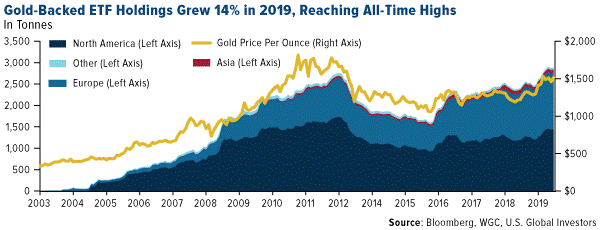
Global gold-backed exchange-traded funds (ETFs) and similar products had $19.2 billion or 400 tonnes of net inflows in 2019 after holdings rebounded in December, the World Gold Council (WGC) reports. In the fourth quarter, ETF holdings reached an all-time high of 2,900 tonnes.

Overall, gold-backed assets under management (AUM) grew by 37% in dollar terms during the year owing to positive demand and an 18.4% increase in the gold price.

From a regional perspective, North American funds led the way with inflows of 206 tonnes ($10.1 billion, 14.4% AUM). SPDR Gold Shares – the world’s biggest gold ETF—and iShares Gold Trust accounted for nearly half of last year’s inflows.

Low-cost gold-backed ETFs in the US have seen positive flows for 18 of the past 19 months and increased their collective holdings by 60%, according to the latest WGC data.

Elsewhere, holdings in European funds increased by 188 tonnes ($8.8 billion, 13.6%), while funds listed in Asia were nearly flat, recording an outflow of 0.1 tonnes ($12 million, 0.3%). The remaining regions had combined inflows of 6.3 tonnes ($311 million, 16.3%).

Looking ahead, WGC analysts said that they expect investor demand to remain robust through 2020.

“The strength of gold was mainly the byproduct of a dovish shift in monetary policy. Our research indicates that a shift from a hawkish or neutral stance to a dovish one has historically led gold to outperform,” a WGC analyst said.

About American Creek

American Creek is a Canadian mineral exploration company with a strong portfolio of gold and silver properties in British Columbia. Three of those properties are located in the prolific “Golden Triangle”; the Treaty Creek and Electrum joint venture projects with Tudor Gold/Walter Storm as well as the 100% owned past producing Dunwell Mine.

More information about the Treaty Creek Project can be found here: https://americancreek.com/index.php/projects/treaty-creek/home

An exploration program is ongoing on American Creek’s 100% owned Dunwell Mine property located near Stewart. More information can be found here: https://americancreek.com/index.php/projects/dunwell-mine

The Corporation also holds the Gold Hill, Austruck-Bonanza, Ample Goldmax, Silver Side, and Glitter King properties located in other prospective areas of the province.

For further information please contact Kelvin Burton at: Phone: 403 752-4040 or Email: [email protected]. Information relating to the Corporation is available on its website at www.americancreek.com

Source: https://www.mining.com/gold-backed-etf-holdings-grew-14-in-2019/

Spyder #Cannabis $SPDR.ca – Exploring Canada’s Cannabis Demand-Supply Landscape $CGC $ACB $APH $CRON.ca $OGI.ca

Posted by AGORACOM-JC at 4:48 PM on Thursday, January 9th, 2020

SPONSOR: Spyder Cannabis (SPDR:TSXV) An established chain of high-end vape stores. Aggressive expansion plan is already in place that will focus on Canadian retail and US Hemp derived kiosks in high traffic areas. Click here for more info.

Exploring Canada’s Cannabis Demand-Supply Landscape

By Sushree Mohanty

  • Cannabis demand is rising
  • However, there seems to be a gap between cannabis demand and supply in Canada
  • It’s been a year since Canada legalized marijuana, but it seems consumers in the country are still struggling to obtain legal cannabis
  • This demand-supply imbalance took a toll on cannabis companies’ revenues and stock prices last year

Let’s take a closer look at the demand-supply imbalance in Canada.

The cannabis demand-supply landscape in Canada

Health Canada has come up with a national Cannabis Tracking System to keep track of the cannabis produced and sold across the country. The intention is to keep a check on illegal cannabis sales. Health Canada requires federal license holders and provincial and territorial growers to report this data on a monthly basis.

Another objective behind this move could be to ensure that cannabis producers aren’t growing marijuana illegally. Such was the case last year with CannTrust (NYSE:CTST). The company was found to be growing marijuana illegally and was reportedly in violation of Health Canada’s regulations.

The monthly report tracks the sales of medical and recreational marijuana. It also takes into account the cannabis inventories held by retailers and distributors. Here are a few details from the report for the period that ended on September 30, 2019:

  • Total sales of dried cannabis fell by 0.4% to 12,922 kilograms on a month-to-month basis.
  • Cannabis oil total sales rose by 4.8% to 11,187 liters on a month-to-month basis.
  • The total amount of finished dried cannabis inventory rose by 5% to 64,151 kilograms on a month-to-month basis.
  • The total amount of finished cannabis oil inventory rose by 1.1% to 102,060 liters on a month-to-month basis.

“Finished inventory” here implies that the products are ready and packed for sale. The finished inventory for dried cannabis was higher for both provincial and territorial distributors and retailers and federal license holders.

For dried cannabis, federal license holders saw a 5.7% increase in finished inventories, while provincial and territorial distributors and retailers saw a 4.3% increase. Additionally, for cannabis oil, federal license holders saw a 2.6% increase in inventories, while provincial and territorial distributors and retailers saw a 1.4% decrease.

What caused the imbalance?

Canada legalized marijuana in October 2018. The demand for marijuana was high in the country. Thus, producers cultivated more cannabis, hoping to meet this demand. However, regulatory procedures were slow and strenuous, which resulted in a delay in the licensing and opening of new legal stores. The delay resulted in higher inventories and caused supply issues. Hence, cannabis sales were affected across Canada. Looking at the data for September, we can conclude that most retailers had products ready for sale. However, the lack of stores caused a supply issue and a rise in inventory.

Moreover, the licensing process isn’t that simple. A Cannabiz Media article stated, “The amount of time to obtain a license to grow marijuana in Canada’s legal market was excessive with some cultivators waiting months or even a year. Once a grower obtained a cultivation license, it needed to produce two full crops, have them tested, get its sales software audited, and apply for a sales license, which could take another year.”

How’s the marijuana demand and supply situation in the US?

While we’re on the subject, let’s talk about the demand and supply situation in the US. Marijuana isn’t legal at the federal level in the US. However, 33 states and the District of Columbia allow medical marijuana. Additionally, 11 states and the District of Columbia allow recreational marijuana.

Black market sales are a matter of concern even in the US. California, which legalized medical marijuana in 1996 and adult-use marijuana in 2016, also suffers from illicit cannabis activity. An article by Cannabis Business Plan discussed how cannabis consumers in the state will initially be inclined toward the illegal market to avoid regulatory costs. The article also stated that predictions show that by 2022, the marijuana market in the state could be worth $7.7 billion driven mostly by recreational marijuana.

Cannabiz Media also discussed how states such as Michigan are facing supply shortages due to a lack of licensed growers. Recently, recreational marijuana sales went live in Michigan. Pennsylvania faced similar problems when demand for medical cannabis couldn’t match supply in the state.

Furthermore, the abundance of marijuana resulted in losses for many licensed cultivators as prices fell. Obtaining capital for cannabis businesses is still an issue in the US. Banks and financial institutions are scared to provide help to cannabis companies because marijuana is still illegal federally. However, hopes are that the passing of the SAFE Act could smooth this process.

How are cannabis companies coping with the demand-supply situation?

The demand-supply imbalance hit cannabis companies’ revenues and profitabilities last year. After Canada legalized cannabis, companies increased their production capacities to match demand. However, the lack of legal stores caused a supply issue. Initially, Ontario was strict with its cannabis laws. Recently, though, after the second phase of legalization, Ontario relaxed its laws to tackle the problem of black market sales. Canada’s three largest provinces now expect higher sales this year from the Cannabis 2.0 expansion.

Hence, Aurora Cannabis (NYSE:ACB), Canopy Growth (TSE:WEED), Cronos Group (NASDAQ:CRON), and HEXO (TSE:HEXO) have struggled with overproduction. The companies missed their revenue targets and reported lower profitabilities in 2019. HEXO even withdrew its fiscal 2020 outlook due to lower store rollout issues.

Cannabis edibles are in high demand among marijuana products. Hence, consumers turned to the black market to obtain these products when Canada hadn’t legalized edibles. The prices of cannabis products on the black market are also lower than they are on the legal market. Now, with Cannabis 2.0 products ready to hit the stores, marijuana companies expect to recover their losses in 2020. These companies are ready with a variety of edibles, vapes, and beverages.

Though analysts expect a turnaround in 2020, they’ve kept a subdued outlook on marijuana companies’ 2020 revenues. Some analysts feel regulations and licensing delays could still affect Cannabis 2.0 revenues this year. Companies’ 2020 revenue estimates are as follows:

  • Aurora Cannabis’s fiscal 2020 revenue could be around 371.6 million Canadian dollars.
  • Canopy Growth’s (NYSE:CGC) fiscal 2020 revenue could be around 403.3 million Canadian dollars.
  • Cronos Group’s fiscal 2020 revenue could be around 146.1 million Canadian dollars.
  • HEXO’s fiscal 2020 revenue could be around 79.1 million Canadian dollars.

Final thoughts

The demand-supply imbalance in the cannabis market is an important issue. However, we also have to consider that the industry is a growing one and will have its ups and downs. Currently, the flow of regulations isn’t smooth, which is causing licensing and cultivation delays. It may take some time for things to smooth out in the industry.

Many also feel that federal legalization will help balance the demand-supply issue in the US. Nevertheless, considering the efforts by Canada and certain states in the US, we can expect a turnaround in 2020.

Stay tuned to learn more about the ins and outs of the marijuana industry.

Source: https://articles2.marketrealist.com/2020/01/exploring-canadas-cannabis-demand-supply-landscape/#

North Bud Farms $NBUD.ca Provides Corporate Update $CGC $ACB $APH $CRON.ca $OGI.ca

Posted by AGORACOM-JC at 4:16 PM on Thursday, January 9th, 2020
  • In late December completed first harvest at Salinas, California cultivation facility
  • Harvested 2,687 plants that were included in the acquisition of the Qlora Group

TORONTO, Jan. 09, 2020 — North Bud Farms Inc. (CSE: NBUD) (OTCQB: NOBDF) (“NORTHBUD” or the “Company“) is pleased to provide shareholders with the following corporate update:

Cannabis Production Facility in Salinas, California

In late December we completed our first harvest at our Salinas, California cultivation facility. We harvested 2,687 plants that were included in the acquisition of the Qlora Group (“Qlora”). The Company anticipates completing testing and sale of the product in late January 2020, which will represent the first revenue generated by the Company in California.  The Company has also completed an in-depth review and analysis of both the infrastructure and cultivation practices and will be implementing significant efficiencies over the course of the next four harvests. The Company anticipates continual harvests of 2,000-3,000 plants every 25 days, with quality and yield improving with each harvest. This product will be sold via wholesale agreements to existing Qlora clients in the interim as we prepare for the launch of NORTHBUD branded flower products in California in the third quarter of 2020.  

“Despite challenges faced by the cultivation team during this period of transition, we are extremely excited to be harvesting our first crops and look forward to continual improvements as we implement procedural and infrastructure efficiencies,” said Justin Braune, President of Bonfire Brands USA, a wholly owned subsidiary of NORTHBUD.

Cannabis Production Facility in Reno, Nevada

The Company is pleased to announce the completion of the first harvest of approximately 175 indoor grown plants. Upon the completion of testing and processing, the product will be distributed as NORTHBUD flower, pre-rolls and infused pre-rolls into selected Nevada dispensaries. The launching of NORTHBUD branded products into Nevada marks a significant milestone for the Company.

Status of Cultivation Licence Application for Cannabis Production Facility in Low, Quebec

On September 18, 2019, the Company received a confirmation of receipt of the site evidence package submitted in late August 2019. On November 22, 2019, the Company received a request for information from Health Canada (the “Request”).  The Request was received within the 60-business day service window for feedback provided by the regulator.  The Company is pleased to report that the Request was responded to in full in advance of the December 8th deadline. The Request did not contain any notices of deficiencies in the Company’s cultivation licence application nor did it require the Company to make any modifications or changes to its facility.

On December 19, 2019 the Company received a subsequent follow-up request for information consisting of two questions which were responded to that same day, and on December 20th, the Company received a request to clarify the roles of recently-hired employees in relation to the requested cultivation licence. This request was responded to in full on January 3, 2020. The Company has received no further communication from Health Canada.

The Company is confident that the approval process is on track and within comparable timelines experienced by other publicly-traded companies who have recently submitted evidence packages.  At this time, the Company cannot predict when it will be granted a cultivation licence by Health Canada. The Company will update shareholders on any further progress on the application.

Annual General Meeting

The Company wishes to inform shareholders that it will hold its Annual General and Special Meeting at 1:00 p.m. ET on Monday, February 3, 2020 at the office of McMillan LLP, World Exchange Plaza, Suite 2000, Ottawa, Ontario. The Company will file the required information for the annual and special meeting under its issuer profile on SEDAR at www.sedar.com.

Staffing and Personnel

The Company is pleased to announce the hiring of Adam Shapero as General Counsel. Adam comes to NORTHBUD after serving as Director of Risk Management, Corporate Secretary and Senior Counsel at Origin House (CSE: OH), who was recently acquired by Cresco Labs (CSE: CL) in a transaction valued at ~ $520 million. “We are extremely pleased to welcome Adam to our team,” said Sean Homuth, CEO of NORTHBUD. “His first-hand experience in the Cannabis industry will add tremendous value to our team while reducing our reliance on external counsel.”

About North Bud Farms Inc.

North Bud Farms Inc., through its wholly owned subsidiary GrowPros MMP Inc., is pursuing a license under The Cannabis Act.  The Company has built a state-of-the-art purpose-built cannabis production facility located on 135 acres of Agricultural Land in Low, Quebec, Canada. NORTHBUD through its wholly owned U.S. subsidiary, Bonfire Brands USA has acquired cannabis production facilities in California and Nevada. The Salinas, California property is located on 11 acres which currently consists of a 300,000 sq. ft. of licensable greenhouse space with 60,000 sq. ft. actively cultivating cannabis and a 2,000 sq. ft. building licensed for distribution.  The Reno, Nevada property is located on 3.2 acres of land which was acquired through the acquisition of Nevada Botanical Science, Inc. a world class cannabis production, research and development facility with 5,000 sq. ft. of indoor cultivation which holds medical and adult use licenses for cultivation, extraction and distribution.

For more information visit: www.northbud.com

Neither the CSE nor its Regulation Services Provider (as that term is defined in the policies of the CSE) accepts responsibility for the adequacy or accuracy of this release.

Forward-looking statements
Certain statements and information included in this press release that, to the extent they are not historical fact, constitute forward-looking information or statements (collectively, “forward-looking statements”) within the meaning of applicable securities legislation.  Forward-looking statements, including, but not limited to, those identified by the expressions “anticipate”, “believe”, “plan”, “estimate”, “expect”, “intend”, “may”, “should” and similar expressions to the extent they relate to the Company or its management.

Forward-looking statements, including, but not limited to, those regarding the success of the Company’s licence application in Quebec, future sales of cannabis in California and Nevada, plant harvest yields at the Company’s California and Nevada operations, conditions in the cannabis market, the Company entering agreements in connection with the B2B supply of cannabis and the Company’s transition into a revenue generating operational phase of development are based on the reasonable assumptions, estimates, analysis and opinions of management made in light of its experience and its perception of trends, current conditions and expected developments, as well as other factors that management believes to be relevant and reasonable in the circumstances at the date that such statements are made, but which may prove to be incorrect.

Forward-looking statements involve known and unknown risks, uncertainties and other factors that may cause the actual results, performance or achievements of the Company to differ materially from any future results, performance or achievements expressed or implied by the forward-looking statements.  Such risks and uncertainties include, among others, the risk factors included in the Company’s final long form prospectus dated August 21, 2018, which is available under the Company’s SEDAR profile at www.sedar.com. Accordingly, readers should not place undue reliance on any such forward-looking statements. Further, any forward-looking statement speaks only as of the date on which such statement is made. New factors emerge from time to time, and it is not possible for the Company’s management to predict all of such factors and to assess in advance the impact of each such factor on the Company’s business or the extent to which any factor, or combination of factors, may cause actual results to differ materially from those contained in any forward-looking statements. The Company does not undertake any obligation to update any forward-looking statements to reflect information, events, results, circumstances or otherwise after the date hereof or to reflect the occurrence of unanticipated events, except as required by law including securities laws. This news release does not constitute an offer to sell or a solicitation of any offer to buy any securities of the Company.

FOR ADDITIONAL INFORMATION, PLEASE CONTACT:
North Bud Farms Inc.
Edward Miller
VP, IR & Communications
Office: (855) 628-3420 ext. 3
[email protected]

Will 2020 Be Junior Mining’s Year? SPONSOR: Loncor $LN.ca $ABX.ca $TECK.ca $RSG $NGT.to

Posted by AGORACOM at 1:55 PM on Thursday, January 9th, 2020
This image has an empty alt attribute; its file name is Loncor-Small-Square.png

Sponsor: Loncor is a Canadian gold exploration company focused on two projects in the DRC – the Ngayu and North Kivu projects, both have historic gold production. Exploration at the Ngayu project is currently being undertaken by Loncor’s joint venture partner Barrick Gold. The Ngayu project is 200km southwest of the Kibali gold mine, operated by Barrick, which produced 800,000 ounces of gold in 2018. Barrick manages and funds exploration at the Ngayu project until the completion of a pre-feasibility study on any gold discovery meeting the investment criteria of Barrick. Click Here for More Info

Another year of covering commodities and select junior mining stocks is all but done and dusted. 

We’ve seen palladium prices more than double those of platinum, its sister metal, on tight supply and high demand for catalytic converters in gas-powered vehicles, as smog-belching diesel cars and trucks get phased out to meet tighter air emissions standards particularly in Europe and China. 

Indonesia advanced a 2022 deadline for banning the export of mineral ores, including nickel, prompting a massive surge in the price of the stainless steel and electric-vehicle battery ingredient. In September, nickel powered past $8 a pound, before slipping back to around $6/lb after the resumption of Indonesian ore exports and weaker demand from the stainless steel industry.  

Palladium and nickel are both in-demand metals for the foreseeable future, nickel for its use in batteries and stainless steel, and palladium as an important ingredient of catalytic converters found in gas-powered/ hybrid vehicles.

Zinc inventories in February fell to the point where there were less than two days worth of global consumption locked in London Metal Exchange (LME) warehouses. The paucity of the metal used to prevent rusting caused prices to spike to the highest since June 2018. 

Gold started off the year around $1,300/oz, and didn’t do much for the first half on account of higher interest rates holding prices down. In July though, gold started to run when the US Federal Reserve reversed course and began cutting interest rates instead of raising them. The ECB and a number of other central banks followed suit, wanting to keep interest rates low to try and boost flagging economic growth. 

The yellow metal advanced to $1,550 in early September due to a combination of factors including negative real interest rates (always good for gold), a sluggish dollar, and safe haven demand owing to US tensions with Iran, impeachment, Brexit fears, etc.

Silver followed a similar, though more bumpy trajectory. The white metal used more for industrial than investment purposes traded in a tight range (~$1.50) from January to May, bottoming out at $14.38 before jumping Sept. 4 to within two bits of $20 ($19.57). 

Copper had an off year in 2018 over fears of slowing Chinese growth and the US-China trade war, but as we at AOTH have always maintained, the market fundamentals are solid. Over 200 copper mines currently in operation will reach the end of their productive life before 2035. Most of the low-hanging copper “fruit” has been picked. New copper mines will be lower-grade and farther afield, meaning higher capex and production costs.

Although copper prices suffered in the second and third quarter, things are looking up for the essential base metal needed for plumbing and wiring, power generation, communications, 5G networks, and electric vehicles, which use around four times as much copper as a conventional car or truck. 

Energized by a rip-roaring fourth quarter, copper bulls are back on board. From its 52-week low in August of $2.51/lb, the red metal gained an impressive 11%, reaching a pinnacle of $2.83/lb Dec. 12, on expectations of a trade war resolution between the world’s number one and two economies, and the improved economic growth prospects that would entail. Copper has risen 7% in December alone. 

Proven right 

Our predictions for all of these metals have been bang on. We were right to say, as we did last January, that Commodities are the right story for 2019

We pinned our thesis on three key points: 1/ Commodities are cyclical, and the timing is right to get in now; 2/ The US dollar is falling, and will likely continue to fall or be range-bound going forward. A resolution to the trade war between the US and China, and a looser monetary policy by the Federal Reserve (both of which are likely) will weigh on the dollar and be good for commodities; 3/ The need for infrastructure spending is not going to let up. 

Close to a year later, our commodities hypothesis rings true. The dollar’s upward march in 2018 (DXY moved from 89 to 97) did stop in 2019, helping commodities priced in US dollars. The US-China trade war escalated but as we predicted, there was a resolution – not a complete trade deal – but enough hope for one, to send copper, the most important base metal, soaring in recent weeks. 

At the beginning of the year, as stock markets bounced back from their awful fourth-quarter 2018, everyone thought that the US economy was roaring. We weren’t so sure, and presented evidence of a less sanguine picture including negative fallout from the trade war with China and a yield curve inversion which is a very accurate indicator of a coming recession. 

The US Federal Reserve appeared to agree. Worried about low growth, globally and in the US, the Fed slammed the brakes on the interest rate hikes it started in 2015, and began lowering them in July, 2019. That immediately juiced gold and silver. Investors piled into precious metals as an alternative to near-zero or negative-yielding sovereign bonds. Looser monetary policy, check. 

In later articles we showed the bullish cases for zinc, nickel and palladium. 

The palladium price tripled from the start of 2016 to spring of 2019, beating gold just under a year ago for the first time in 16 years. Palladium has been in deficit for eight straight years, because of low mined output and smoking-hot demand from the auto sector. So far in 2019 it has gained 47%. 

Battery companies have been developing nickel-rich batteries in two of the dominant chemistries for EVs, the nickel-manganese-cobalt (NMC) battery used in the Chevy Bolt (also the Nissan Leaf and BMW i3) and the nickel-cobalt-aluminum (NCA) battery manufactured by Panasonic/Tesla. Added to Indonesia’s on and off export ban, a demand boost from nickel’s growing use in electric-vehicle batteries, and dwindling global stockpiles, have helped support nickel prices.

According to the USGS, despite new zinc mines opening in Australia and Cuba, supply failed to keep up with consumption. Some very large zinc mines have been depleted and shut down in recent years, with not enough new mine supply to take their place. As a result, the zinc market was in deficit in 2018. 

Tighter environmental restrictions in China are lessening the amount smelters can produce. National production of refined zinc in 2018 fell to just 4.53 million tonnes, the sharpest downturn since 2013. The result has been a record amount of refined zinc imported by the world’s largest metals consumer, 715,355t in 2018. The high demand in China has also pulled a lot of zinc out of LME warehouses.

In October zinc prices hit a four-month high due to falling zinc stocks – inventories in London Metal Exchange-registered warehouses plunged to 57,775 tonnes – a smidgen higher than the 50,425t in April, the lowest since the 1990s, Reuters said. 

Tough market for explorers

It’s good to see we were right about so many metal markets. 

Regrettably however, the valuations of mineral exploration companies have yet to follow the prices of the metals they are hunting. 

Indeed the junior mining sector has been in a funk since around 2012. 

The juniors’ place in the mining food chain is to provide projects to be turned into mines for larger mining companies whose reserves are running low. This is becoming a growing problem as all the low-hanging, high-grade deposit fruit has been picked. Such is the case for gold, silver, copperpalladium, zinc and nickel, all of which are encountering, or will shortly encounter, supply deficits, amid booming demand for battery metals and precious metals. 

Finding the kind of grades at amounts that will make a mine profitable usually requires going farther afield or deeper – greatly adding to costs per ounce or tonne.

Here’s the problem juniors have been facing: At the same time as investment capital has been pulled out of the mining majors and mid-tiers – by investors tired of seeing falling or stagnant stock prices/ red ink balance sheets – there’s been a dearth of speculative capital flowing into exploration companies.

The ascendance of index funds has also made it harder for juniors to attract money, because they are too small to be in the funds that these vehicle track. 

According to a 2019 report by PDAC – the association that puts on the annual mining show in Toronto – and Oreninc, a junior financing tracker, equity financing in 2018 was 35% less than in 2017 – a decade-low $4.1 billion. 

A good chunk of that cash went to marijuana stocks, as dozens of companies emerged to take advantage of the pot legalization bill passed by the Canadian federal government. Whereas weed stock IPOs attracted $491.1 million in investment dollars in 2018, mining IPOs only accounted for $51.6 million, a startling drop from the $830 million in 2017.

That’s a lot of speculative capital pulled out of resource stocks. However it’s not all gloom and doom, according to TD Securities mining investment bankers, who say “current market conditions and historical precedents make them optimistic generalist investors will return in greater numbers to mining stocks,” Bloomberg reported:

“The current market is reminiscent of the late 90’s and early 2000’s, [TD Securities’ Deputy Chairman Rick] McCreary says. At the time, investors had low interest in mining, and companies found it hard to raise capital. That was followed by waves of consolidation and a mining bull run. A similar trend may be building as this ‘period of consolidation’ rolls on.”

Gold M&A 

As far as that goes, mining companies, especially in the gold space, have realized since the vicious 2012-16 bear market, they have cut as much as they can and the next step is to bring assets and companies together. On top of that, the top gold miners are running out of reserves, and are looking to replace them with high-margin projects that have the right combination of grade, size and infrastructure.

This explains Barrick combining with South Africa’s Randgold, the Barrick-Newmont joint venture in Nevada, the fusing of Newmont and Goldcorp, a $1-billion deal for Lundin Mining to acquire a Brazilian copper-gold mine from Yamana Gold, Newcrest’s 70% purchase of Imperial Metals’ Red Chris mine in British Columbia, and other recent examples of gold mining M&A.

Among December’s gold deals are Zijin Mining’s cash purchase of Continental Gold’s Buriticá project in Colombia, for CAD$1.3 billion; and a $770 million merger between two mid-tier gold miners, Equinox Gold and Leagold Mining. The latter arrangement will keep the Equinox name and create a company valued at $1.75 billion with six mines spread across Brazil, Mexico and the United States. 

Junior resource M&A? 

The goal of every junior resource investor is for the company(ies) they are invested in to get bought out, resulting in a 5, 10, even 20-bagger.

The question is, will the current round of mergers and acquisitions at the major and mid-tier level trickle down to the juniors? PwC appears hopeful. In its 2019 report â€˜Shifting Ground’ the mining consultancy states, 

The heightened level of deal activities, most of which have been in the gold sector, may well spark further moves among intermediate players seeking to grow into multi-project companies. A new phase of industry consolidation could pave the way for more exploration and mine development and boost investor interest and activity.

Another optimistic opinion comes from Tom Palmer, chief operating officer at Newmont, who told the Wall Street Journal that smaller players are waiting to see what the bigger miners sell once they have completed their mergers before they start their own M&A.

“Fast forward two or three years, there will be countless more” mergers, he said.

In fact we are already starting to see this happening. Nevada has witnessed the return of junior gold explorers, and majors, after a lull in activity between 2012 and 2016. According to an industry report, exploration in Nevada increased by 15% in 2017, with 19,040 new claims. The tide has continued to turn in mining’s favor, with 198,337 active claims as of January, 2019 – 7% more than in 2018.

In 2018 Idaho-based Hecla Mining snapped up Klondex Mines for US$462 million, delivering three more Nevada properties – Fire Creek, Midas and Hollister – to Hecla’s stable of mines and adding 162,000 gold-equivalent ounces to its annual production. 

Also in Nevada, last year Alio Gold paid Rye Patch Gold $128 million for the Vancouver-based company and its past-producing Florida Canyon mine. 

The 2019 creation of Nevada Gold Mines (the Barrick-Newmont JV) has piqued the interest of other companies looking to discover and develop new ounces in the golden state. Major miners with new projects include AngloGold Ashanti, Coeur Mining and Kinross Gold. For the details read Getchell’s Gold 

And for an inspiring story of junior mining success in Canada, look no further than Great Bear Resources. Working the historic Red Lake gold camp in Ontario, Great Bear’s drills discovered the “LP Fault Zone” this past May. That eureka moment, the realization that most of the gold on its property is structurally controlled, prompted a massive 90,000m drill program aimed at identifying the parameters. The discovery of three new gold zones with high-grade intercepts, along with the earlier nearby Hinge-Dixie Limb discoveries, caught the market’s attention; within 18 months, Great Bear’s stock catapulted 2,000%. 

Conclusion

I firmly believe that 2019 has been a pivotal year for junior mining. Coming out of 2018’s slump in several commodities, due mostly to the uncertainty associated with the US-China trade war, this year we saw very strong performances from gold, silver, copper, palladium, nickel and zinc – having correctly predicted price corrections for each.

While it’s disappointing not to see a rising tide of junior miner stock prices to accompany these bullish calls, we continue to believe.

After all, we want to own the cheapest most in demand metals we can find to reap the maximum coming rewards. That means buying it while it’s still in the ground.

The fact is junior resource companies – the owners of the world’s future mines – are on sale. If you like their management teams, their projects and their plans for 2020, perhaps now is the time to be acquiring a position.

Courtesy of Richard (Rick) Mills:
subscribe to my free newsletter
aheadoftheherd.com
Ahead of the Herd Twitter

https://aheadoftheherd.com/Newsletter/2020/Will-2020-be-junior-minings-year.html

New tool uses #AI to flag fake news for media fact-checkers – SPONSOR: Datametrex AI Limited $DM.ca

Posted by AGORACOM-JC at 1:24 PM on Thursday, January 9th, 2020

SPONSOR: Datametrex AI Limited (TSX-V: DM) A revenue generating small cap A.I. company that NATO and Canadian Defence are using to fight fake news & social media threats. The company announced three $1M contacts in Q3-2019. Click here for more info.

New tool uses AI to flag fake news for media fact-checkers

  • A new artificial intelligence (AI) tool could help social media networks and news organizations weed out false stories.
  • The tool uses deep-learning AI algorithms to determine if claims made in posts or stories are supported by other posts and stories on the same subject.

By: University of Waterloo

A new artificial intelligence (AI) tool could help social media networks and news organizations weed out false stories.

The tool, developed by researchers at the University of Waterloo, uses deep-learning AI algorithms to determine if claims made in posts or stories are supported by other posts and stories on the same subject.

“If they are, great, it’s probably a real story,” said Alexander Wong, a professor of systems design engineering at Waterloo. “But if most of the other material isn’t supportive, it’s a strong indication you’re dealing with fake news.”

Researchers were motivated to develop the tool by the proliferation of online posts and news stories that are fabricated to deceive or mislead readers, typically for political or economic gain.

Their system advances ongoing efforts to develop fully automated technology capable of detecting fake news by achieving 90 per cent accuracy in a key area of research known as stance detection.

Given a claim in one post or story and other posts and stories on the same subject that have been collected for comparison, the system can correctly determine if they support it or not nine out of 10 times.

That is a new benchmark for accuracy by researchers using a large dataset created for a 2017 scientific competition called the Fake News Challenge.

While scientists around the world continue to work towards a fully automated system, the Waterloo technology could be used as a screening tool by human fact-checkers at social media and news organizations.

“It augments their capabilities and flags information that doesn’t look quite right for verification,” said Wong, a founding member of the Waterloo Artificial Intelligence Institute. “It isn’t designed to replace people, but to help them fact-check faster and more reliably.”

AI algorithms at the heart of the system were shown tens of thousands of claims paired with stories that either supported or didn’t support them. Over time, the system learned to determine support or non-support itself when shown new claim-story pairs.

“We need to empower journalists to uncover truth and keep us informed,” said Chris Dulhanty, a graduate student who led the project. “This represents one effort in a larger body of work to mitigate the spread of disinformation.”

Source: https://www.sciencedaily.com/releases/2019/12/191216122422.htm

NORTHBUD $NBUD.ca – When #CBD met chocolate $CGC $ACB $APH $CRON.ca $OGI.ca

Posted by AGORACOM-JC at 11:00 AM on Thursday, January 9th, 2020

SPONSOR: NORTHBUD (NBUD:CSE) Sustainable low cost, high quality cannabinoid production and procurement focusing on both bio-pharmaceutical development and Cannabinoid Infused Products. Learn More.

When CBD met chocolate

The health-conscious, environmentally-aware consumer has encouraged new trends in the chocolate sector that affect flavour, texture and harvesting. Greater Goods has gone one step further, infusing the beloved food of the gods with CBD. Bethan Grylls hears from its co-founder about why this combination works.

Indulgent, premium and good-for-you: these words will be familiar to the modern-day confectioner as they look to address current trends1 and differentiate themselves in a competitive market. Be it a new sensory experience across taste, texture or colour; the lure of single-origin sourcing; or a guilt-free treat, the realms of chocolate innovation and buyer demands have stretched well beyond the days of penny sweets.

Some brands have taken things one step further, combining trends like organic, fair trade and non-GMO confectionery, with the demand for CBD – a term that was Googled 6. 4 million times during April 2019.2

Greater Goods, based in Oregon, US, is one example, offering its customers a selection of cannabinoid-infused ‘goodies’. Despite being a modest husband and wife venture, the team says they are looking to compete against the larger companies through hand-crafted, fun and unusually-flavoured products.

Source: https://www.newfoodmagazine.com/article/101342/when-cbd-met-chocolate/

#Edtech Unicorn Byju’s Gets $200 Mn From Tiger Global SPONSOR: BetterU Education Corp. $BTRU.ca $ARCL $CPLA $BPI $FC.ca

Posted by AGORACOM-JC at 10:30 AM on Thursday, January 9th, 2020
SPONSOR:  BetterU Education Corp. aims to provide access to quality education from around the world. The company plans to bridge the prevailing gap in the education and job industry and enhance the lives of its prospective learners by developing an integrated ecosystem. Click here for more information.

Edtech Unicorn Byju’s Gets $200 Mn From Tiger Global

  • Secondary transactions are expected to provide exit to early investors
  • Byju’s plans to launch Online Tutoring in next few months
  • Byju”s has reportedly been valued at $8 Bn with this investment

Bengaluru-based edtech company Byju’s, on Thursday (January 9), announced that it has raised funding from New York-based Tiger Global. The company didn’t share the funding amount, but reports have said that Tiger Global has invested $200 Mn in Byju’s.

The report further said that secondary transactions, estimated at $100Mn-$200 Mn, are also expected to provide exit to early investors. The round reportedly valued Byju’s at $8 Bn. The company didn’t specify the same and also didn’t share details of plans to use the funds. 

Byju Raveendran, founder and CEO, Byju’s said, “We are happy to partner with a strong investor like Tiger Global Management. They share our sense of purpose and this partnership will advance our long term vision of creating an impact by changing the way students learn. This partnership is both a validation of the impact created by us so far and a vote of confidence for our long term vision.”

Byju’s Growth Plans

Founded in 2008 by Divya Gokulnath and Byju Raveendran, Byju’s offers a learning app, which was launched in 2015 and has learning programmes for students in classes IV-XII, along with courses to help students prepare for competitive exams like JEE, NEET, CAT, IAS, GRE, and GMAT.

Byju’s was last valued at $ 5.7 Bn and has raised over $969.8 Mn funding from investors such as General Atlantic, Tencent, Naspers, Qatar Investment Authority, and Canada’s Pension Plan Investment Board (CPPIB) among others.

In January 2019, Byju’s also forayed into the US with the acquisition of Osmo, a US-based learning platform. Over the last year, the company’s fundraising has focused on international expansion. The expansion to the Middle East, the US, the UK, South Africa, and other African and Commonwealth markets have been on the cards.

Related Article: Edtech Unicorn BYJU’S Revamps ESOPs Plan For Employees

Further, Byju’s has also tied up with Disney to launch its edtech services for kids in classes 1st to 3rd. BYJU’S Early Learn app for young children aged between 6 to 8 years old with Disney’s stories and characters from Disney Princess, Frozen, Cars, Toy Story franchises and more. This year, the company is planning to launch Byju’s Online Tutoring, which will further help the company to accelerate its growth and profitability.

In the past 12 months, Byju’s claims to have witnessed tremendous growth with over 42 Mn registered users and 3 Mn paid subscribers from both rural and urban areas in India. It claims that the average number of minutes a student spends on the app has increased from 64 minutes to 71 minutes per day over the last year and the annual renewal rates are as high as 85%.

The company had claimed to have tripled its revenue from INR 520 Cr to INR 1480 Cr in FY 18-19 and turned profitable on a full-year basis. The company also said it is on track to double revenues to INR 3000 Cr in the current financial year.

“Byju’s has emerged as the leader in the Indian education-tech sector. They are pioneering technology shaping the future of learning for millions of school students in India. We are excited to support Byju and the team,” said Scott Shleifer, Partner, Tiger Global.

Challenges In Edtech Amid Increasing Investor Interest

The impact Byju’s has created has been highlighted in Mary Meeker’s Internet Trends 2019 report. The report said that Byju’s number of paying students between the ages of 9-17, had crossed over 1.5 Mn in March 2019 from the 1 Mn mark in the last financial year.

Digital evolution and the boom in smartphone adoption are expected to define the way Indian students learn. Real-time book updates, online tutoring, edutainment, online test preparation, web-based research, and gamification — technology has changed our traditional education system in more ways than one. With more than 260 Mn enrolments, India has the world’s largest K-12 (primary and secondary) education system.

According to DataLabs by Inc42, there were 3,500 edtech startups in India in 2018. Between 2014 and 2019, a total of $1.802 Bn was raised by edtech startups across 303 deals.

Byju’s close competitors include Toppr and Unacademy, who are working towards dominating the Indian edtech segment, which is expected to be a $1.96 Bn market by 2021.

DataLabs noted that one of the reasons for edtech startups being unable to go mainstream and attract investments is lack of awareness about the latest education technology in the country. To support the sector, the government is working on national education policy as well.

The draft policy has “proposed the revision and revamping of all aspects of the education structure, its regulation and governance, to create a new system that is aligned with the aspirational goals of 21st-century education, while remaining consistent with India’s traditions and value systems.”

The draft policy says that technology will play an important role in the improvement of educational processes and outcomes. The draft policy says that the relationship between technology and education at all levels is bidirectional.

Source: https://inc42.com/buzz/edtech-unicorn-byjus-gets-200-mn-funding-from-tiger-global/