Agoracom Blog

12-Year Breakout in Mining Stocks Relative to Gold – SPONSOR: American Creek Resources $AMK.ca $TUD.ca $SII.ca $GTT.ca $AFF.ca $SEA.ca $SA $PVG.ca $AOT.ca

Posted by AGORACOM at 7:40 PM on Monday, January 13th, 2020

SPONSOR: American Creek owns a 20% Carried Interest to Production at the Treaty Creek Project in the Golden Triangle. 2019’s first hole averaged of 0.683 g/t Au over 780m in a vertical intercept. The Treaty Creek property is located in the same hydrothermal system as the Pretivm and Seabridge’s KSM deposits.

Excerpts from Crescat Capitals November Newsletter:

Precious Metals

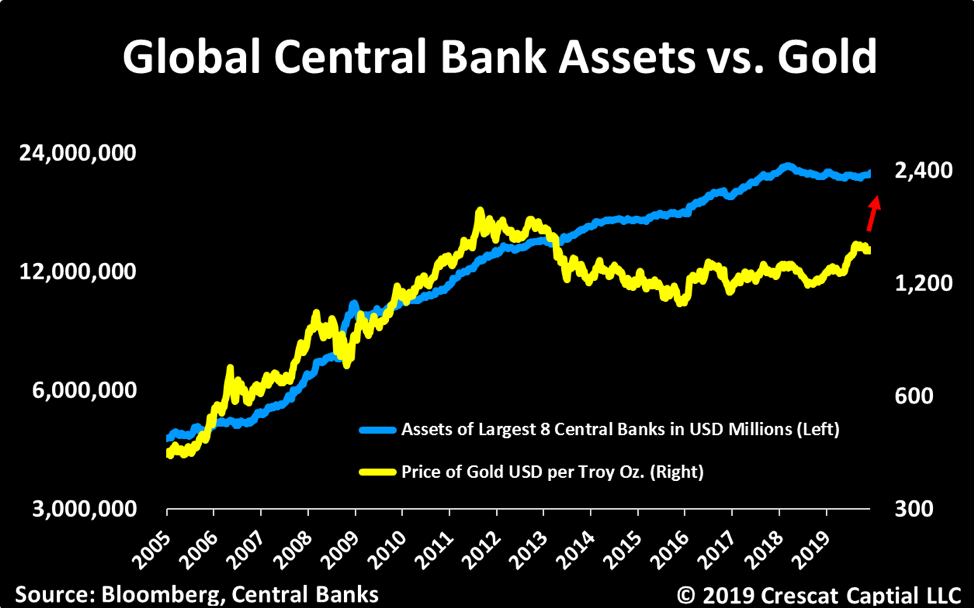
Precious metals are poised to benefit from what we consider to be the best macro set up we’ve seen in our careers. The stars are all aligning. We believe strongly that this time monetary policy will come at a cost. Look in the chart below at how the new wave of global money printing just initiated by the Fed in response to the Treasury market funding crisis is highly likely to pull depressed gold prices up with it.

The imbalance between historically depressed commodity prices relative to record overvalued US stocks remains at the core of our macro views. On the long side, we believe strongly commodities offer tremendous upside potential on many fronts. Precious metals remain our favorite. We view gold as the ultimate haven asset to likely outperform in an environment of either a downturn in the business cycle, rising global currency wars, implosion of fiat currencies backed by record indebted government, or even a full-blown inflationary set up. These scenarios are all possible. Our base case is that governments and central banks will keep their pedals to the metal to attempt to fend off credit implosion or to mop up after one has already occurred until inflation becomes a persistent problem.

The gold and silver mining industry is precisely where we see one of the greatest ways to express this investment thesis. These stocks have been in a severe bear market from 2011 to 2015 and have been formed a strong base over the last four years. They are offer and incredibly attractive deep-value opportunity and appear to be just starting to break out this year. We have done a deep dive in this sector and met with over 40 different management teams this year. Combining that work with our proprietary equity models, we are finding some of the greatest free-cash-flow growth and value opportunities in the market today unrivaled by any other industry. We have also found undervalued high-quality exploration assets that will make excellent buyout candidates.

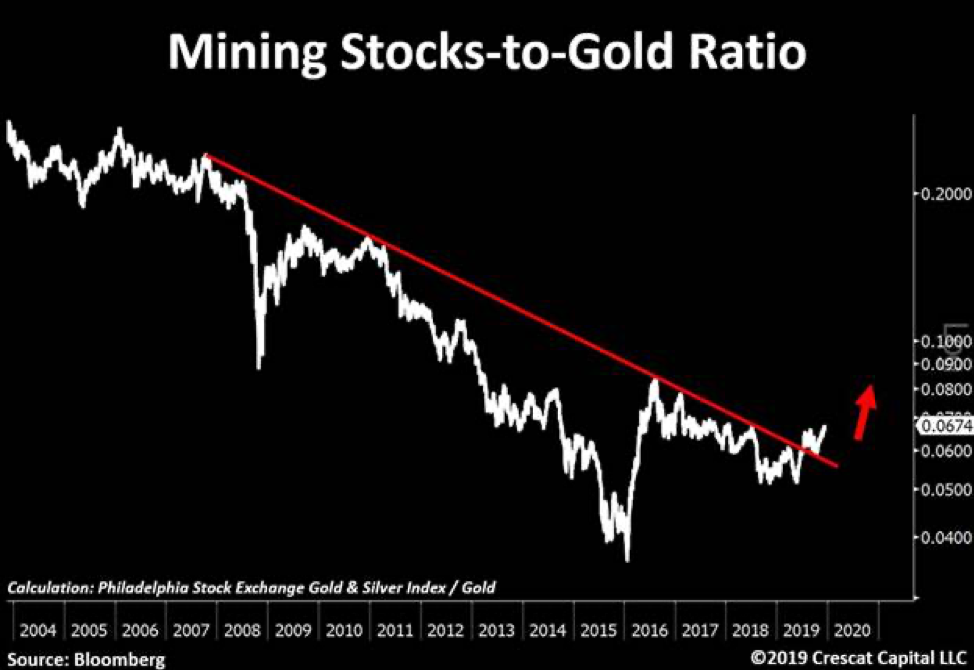
We recently point out this 12-year breakout in mining stocks relative to gold now looks as solid as a rock. In our view, this is just the beginning of a major bull market for this entire industry. We encourage investors to consider our new Crescat Precious Metals SMA strategy which is performing extremely well this year.

Zero Discounting for Inflation Risk Today

With historic Federal debt relative to GDP and large deficits into the future as far as the eye can see, if the global financial markets cannot absorb the increase in Treasury debt, the Fed will be forced to monetize it even more. The problem is that the Fed’s panic money printing at this point in the economic cycle may hasten the unwinding of the imbalances it is so desperate to maintain because it has perversely fed the last-gasp melt up of speculation in already record over-valued and extended equity and corporate credit markets. It is reminiscent of when the Fed injected emergency cash into the repo market at the peak of the tech bubble at the end of 1999 to fend off a potential Y2K computer glitch that led to that market and business cycle top.
After 40 years of declining inflation expectations in the US, there is a major disconnect today between portfolio positioning, valuation, and economic reality. Too much of the investment world is long the “risk parity” trade to one degree or another, long stocks paired with leveraged long bonds, a strategy that has back-tested great over the last 40 years, but one that would be a disaster in a secular rising inflation environment.

With historic Federal debt relative to GDP and large deficits into the future as far as the eye can see, rising long-term inflation, and the hidden tax thereon, is the default, bi-partisan plan for the US government’s future funding regardless of who is in the White House and Congress after the 2020 elections. The market could start discounting this sooner rather than later.
The Fed’s excessive money printing may only reinforce the unraveling of financial asset imbalances today as it leads to rising inflation expectations and thereby a sell-off in today’s highly over-valued long duration assets including Treasury bonds and US equities, particularly insanely overvalued growth stocks. We believe we are in the vicinity of a major US stock market and business cycle peak.

Source:”Running Hot”

Courtesy of Crescat Capital: https://www.crescat.net/running-hot/

Thanks to

Kevin C. Smith, CFA
Chief Investment Officer

Tavi Costa
Portfolio Manager

Tartisan #Nickel $TN.ca – Battery markets charge up for 2020 $ROX.ca $FF.ca $EDG.ca $AGL.ca $ANZ.ca

Posted by AGORACOM-JC at 5:00 PM on Monday, January 13th, 2020

SPONSOR: Tartisan Nickel (TN:CSE)  Kenbridge Property has a measured and indicated resource of 7.14 million tonnes at 0.62% nickel, 0.33% copper. Tartisan also has interests in Peru, including a 20 percent equity stake in Eloro Resources and 2 percent NSR in their La Victoria property. Click her for more information

Tc logo in black

Battery markets charge up for 2020

  • Our main area of focus is what we see as the critical minerals and metals in the battery supply chain – lithium, graphite, cobalt and nickel
  • There are a lot more minerals and metals that are used in the EV supply chain, but we focus on those four because they’re going to experience the most considerable growth from the emergence of EVs over the coming years

by Canadian Mining Journal

Why we’re headed toward a ‘tipping point’ for EVs

According to the International Energy Agency, in 2018, the global stock of EV passenger cars surpassed 5 million, a rise of 63% over the previous year. Nearly half of those EVs – 45% – were in China.

The growth over the past decade has encouraged investment in battery minerals and metals – lithium, graphite, cobalt and nickel. But interest in new projects has waned as prices have fallen – largely in response to a scale back of subsidies for EV’s in China and an oversupply of battery minerals.

To understand the disconnect between expected growth in the battery minerals markets and current prices, Canadian Mining Journal spoke with Andrew Miller, head of price assessments with Benchmark Mineral Intelligence, a consultancy and advisory firm that provides independent pricing and market data on battery minerals, in December.

Canadian Mining Journal: Which minerals and metals are considered EV minerals and metals – which ones does Benchmark track?

Andrew Miller: Our main area of focus is what we see as the critical minerals and metals in the battery supply chain – lithium, graphite, cobalt and nickel. There are a lot more minerals and metals that are used in the EV supply chain, but we focus on those four because they’re going to experience the most considerable growth from the emergence of EVs over the coming years. They’re susceptible to volatility because of the huge growth that they’re facing and the rigid supply structure in each of those markets. As you’ve seen with lithium and cobalt over the last three to four years, you have an extremely volatile pricing situation. So those are the four that we see as really critical in this supply chain and areas that are really going to have to develop to support electrification.

CMJ: Can you give us a sense of how big and fast–growing the EV market is right now?

AM: To date, the market has been driven by adoption of batteries in heavy duty vehicles, e-buses for instance have seen considerable growth. But we’re only in the very early stages of what’s really going to drive the market over the coming decade, which is the adoption of electric vehicles for passenger applications. We’re seeing considerable growth, particularly in the Chinese market.

China’s been very dominant in the supply chain because of some of the incentives they had in place to promote electrification and we’re now entering what we think is going to be a tipping point for that electric vehicle industry outside of China, as Western OEMs are committing a huge amount of their future fleet to electrified models. Ultimately, what that’s going to mean is the rampup of these OEMs and their electrification plans is really going to drive the battery sector forward outside of China and Asia.

The lithium-ion battery market right now is producing around 200 GWh and we’re forecasting it will grow to around 1,800 GWh by 2028, so that gives you some idea of scale – almost 10X growth in terms of battery output in the coming decade.

CMJ: At The Northern Miner’s Progressive Mine Forum in the fall, you forecast that we could see a deficit in cobalt in 2020 and lithium and graphite by 2022. That’s obviously not far off. What are the key factors that could swing those forecasts either way?

AM: With some of the cutbacks in cobalt production, there’s definitely going to be a tighter cobalt market going into the new year. (Glencore recently announced that it’s closing its Mutunda mine, a large cobalt producer, for two years.) Around that 2021/2022 time horizon, we’re expecting others – lithium and graphite for instance – will also become tighter markets.

The big factor in terms of demand in the short term, as I mentioned, is what’s been happening in China. And although you’ll hear a lot said about what slowing Chinese growth actually means, in reality, China’s still growing at quite a healthy rate – double digit growth in terms of its EV production. So it’s not bad, it’s just not as much as in previous years. And the reason for that is they’re phasing out their subsidies, which is forcing some liquidity issues and some consolidation along the supply chain.

Chinese policy can swing things quite considerably one way or the other, but as I mentioned, we’re entering a market in the next two to three years where demand isn’t so China-focused. Although China will remain an important driver of growth, we’re also going to see significant growth in Europe and North America, and that diversity of demand is going to see this story accelerate in terms of consumption numbers.

You’re also seeing some very pro-electrification policies being put in place in Europe at the moment, which are expected to have a positive impact and could see things grow at a faster speed. China is due to bring their subsidies to an end by next year – I think that’s already built into a lot of people’s demand models, but if Chinese growth dries up in the short term that still has a meaningful impact on global demand.

So I think there’s more on the upside in terms of where that outlook could go wrong, particularly when you look at the market balance of these raw materials and you consider that we’re really in a period where to support the growth of 2022, money needs to be going into those markets now. And investment has dried up because of the negative price environment for all of these key materials – investment has actually dried up at a time when it’s incredibly important that new supply is brought into the market. So things have a chance of becoming more fragile rather than less fragile over the coming years.

CMJ: There seems to be a bit of a disconnect between, as you say, that negative price environment and the actual projected increases in demand in the relatively near future – what’s causing that disconnect?

AM: It’s a short-term effect. What we saw around 2015/2016, particularly in the cobalt and lithium markets with the rapid increase in pricing that occurred, was a wave of investment that was based on the market at that point and the more considerable growth that was expected in the future. That led to this sort of transition period that we’re in in the moment where there’s still double-digit demand growth across all of these markets from the battery sector, but because we’ve been able to introduce some new supply that’s accelerated above the rate of new demand, you have this imbalance that is driving a correction in pricing. The spike in pricing and the highs in pricing we saw several years ago weren’t sustainable, but equally now, pricing we’re seeing in areas like lithium are unsustainable to allow for new supply in the future.

So unfortunately, the correction that’s happened because of this new supply is only making the longer-term outlook that much more fragile.

CMJ: In addition to that difficult market, many battery minerals are specialty minerals that are finicky to produce in a quality and specification that battery manufacturers need. What do new producers have to do to be successful in this market?

AM: I think it’s really an issue of time. Even the most established producers in the market, to expand their production of these refined materials takes time, even if you have the investment and infrastructure in place. So whether you’re an existing producer or a development stage project, you’re going to need time because it’s not a commodity game – it’s not just taking it out of the ground and worrying about the logistics, it really is more an issue of refining that product, working with the end user to make something they can use.

On that note, I think any type of partnership with your customer or any way of working with them in order to understand their requirements is helpful. That can be quite difficult in itself because we’re still in this period where people are trying to figure out what is the most cost-effective type of anode and cathode material to use and how much energy density can we squeeze out of this material. But the closer the relationship with their end user the better the chance of success for new companies, particularly as they introduce new suppliers.

So I think it’s a combination of time, expertise, knowing your market and your product and then coupling that with a strong relationship with the people that will ultimately be using your product.

CMJ: What is the dominant type of chemistry or lithium-ion battery in the EV market right now?

AM: On the anode side, it’s a bit more clean cut – you’re either using natural or synthetic graphite, and more typically now a combination of the two materials to maximize the cost/energy performance requirements of the anode.

It’s a little more varied on the cathode side. What was driving the market around the mid-2000s was the rise of consumer electronics, which required LCO (lithium cobalt oxide) cathodes, which is a cobalt-intensive cathode. What you’re seeing for electric vehicles and what’s really going to drive the market going forward is the use of either NCM (nickel cobalt manganese) or NCA (nickel cobalt aluminum) cathode types. Tesla use NCA.

These are more nickel-intensive cathode chemistries that still do use cobalt but in a lower intensity than LCO. For more heavy duty vehicles, like buses and trucks, you have LFP – lithium iron phosphate, a cathode that’s really grown to a lot of people’s surprise this year and continues to grow. It’s a lower-cost type of cathode – you get less energy density from it, but for some of the larger vehicle applications, it’s a very stable, reliable chemistry.

CMJ: Are there any advances that are happening in the EV battery space that you’re watching that could affect the market?

AM: There are a lot of exciting things that are happening in the EV market that you have to keep tabs on, particularly on the technology side. We’re reaching a point with the electric vehicle market where it’s really about fine tuning the existing chemistries – that’s going to be the real development that you see rather than a major overhaul or anything that could disrupt the future projection. Because if you look at the time to commercializing any of these technologies, to overcome the consistency, quality, performance and safety issues – it takes a huge amount of time to tick all of those boxes and to bring something new in.

CMJ: You’ve outlined a big supply challenge that looks like perhaps it can’t be met – we can’t necessarily speed up permitting to get projects developed faster, even if prices rise dramatically in the near term. How do you see that being resolved?

AM: It’s a big concern for the industry and ultimately you’ll have to see a huge influx of investment going in in quite a short amount of time. These projects do take time and it’s not going to be something that resolves itself overnight. There’s the potential for some of these industries to become major bottlenecks to the expansion of the electric vehicle market. On that note, I do think that’s being realized at the moment and even though investment may not be coming into the sector from public markets, you are seeing more joint venture partnerships in companies downstream, getting involved with the raw material supplies to ensure that that supply availability is there, so I think that will continue.

One area that we still haven’t seen come to maturity is battery recycling – bringing some of these materials back out of the battery and being able to use them again. In the longer term, though, these issues will be resolved because, with the possible exception of cobalt, these aren’t scarce materials geologically, it’s just getting them out of the ground and refining them in the right way.

There are definitely going to be some real teething issues over the coming years because you need continued and sustained investment to support this new production and at the moment it’s just not being forthcoming at the speed that’s required. But the hopeful side of that is we saw in 2015 and 2016 how quickly the prospect of this major battery growth can attract investment into the sector. It didn’t provide everything that was needed, but when prices start going up again and when there’s a tighter market, parties can turn their attentions to this very quickly, particularly when you’re moving into the real growth that we’re expecting come the mid-2020s.

Source: http://www.canadianminingjournal.com/features/battery-markets-charge-up-for-2020/

Labrador Gold $LAB.ca Gold Market Update $RIO.ca $WHM.ca $SIC.ca $NXS.ca

Posted by AGORACOM at 4:33 PM on Monday, January 13th, 2020
This image has an empty alt attribute; its file name is LAB-square-logo-2.png

SPONSOR: Labrador Gold – Two successful gold explorers lead the way in the Labrador gold rush targeting the under-explored gold potential of the province. Exploration has already outlined district scale gold on two projects, including a 40km strike length of the Florence Lake greenstone belt, one of two greenstone belts `covered by the Hopedale Project. Click Here for More Info

It has been a week of surprises since the last updates were posted. First, I had not expected Iran to retaliate following the murder of its top General by a US drone, but it did, despite the risks, as it was politically necessary to assuage the extreme anger of its population who demanded revenge. The next surprise was that Israel and the US did not use this retaliation as an excuse to bomb Iran back to the Stone Age, which is what they really want to do. As we know, the long-term goal of Israel and the US is to subjugate Iran, and they will not stop until they attain this goal, and so it goes on. It appears that there was a bit of theater involved in Iran’s retaliation, as it clandestinely signaled its intentions which allowed US forces to get out of harm’s way. Perhaps US forces did not then launch a blitzkrieg out of consideration for this courtesy.

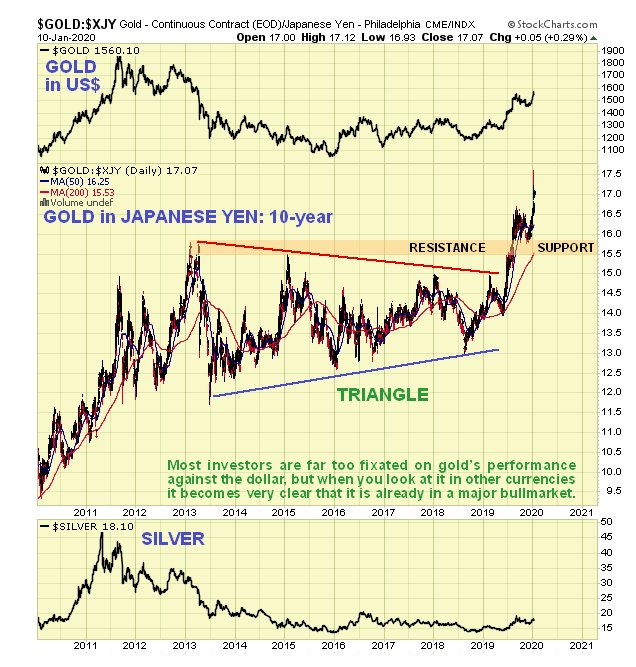
Regardless of the muddled and unpredictable fundamental situation, which included the accidental downing of a passenger plane by Iranian defensive missile batteries, the charts allowed us to make a reasonably accurate prediction regarding what was likely to happen to the gold price. The call for a near-term top in the PM sector made on the site on Monday looked incorrect the following evening when gold suddenly surged about $35 on news of the retaliatory Iranian missile strike, but when it later became apparent that there were, strangely, no US troop casualties and no further action against Iran, gold and silver reversed dramatically and dropped quite hard as the tension then looked set to ease, at least over the short-term. Technically what happened is that gold pushed quite deep into heavy overhead resistance, becoming very overbought at a time when COTs were showing extreme readings, and was thus vulnerable to a sudden reversal. The action around this time illustrates an important point, which is that when gold rises due to sudden geopolitical developments, the gains tend not to stick – what really matters and is the big driver for gold at this time is the insane monetary expansion that is going on, which is being undertaken in a desperate attempt to postpone the systemic implosion that is baked in for as long as possible. As we have already observed in these updates in recent weeks, gold is already in a raging bullmarket against a wide variety of currencies, and it won’t be all that long before it’s in a raging bullmarket against the dollar too, as the Fed sets the stage for hyperinflation.

There are two big and compelling reasons for the US government to tank the dollar. One is that it makes US exporters more competitive, and the other is that it can use the mechanism of inflation to wipe clean its colossal debts, by paying them off in devalued coin, printing vast amounts of money to pay them off, in the process legally swindling the foolish creditors out of their dues. This is precisely what the Weimar Republic in Germany did in 1923 to eliminate the unfair reparations imposed by the Treaty of Versailles, which were unfair also because Germany didn’t start the 1st World War – it was tricked into it by the allies, because the British Empire was scared of Germany’s rising industrial and military might and wanted to destroy it, 100 plus years of propaganda lies about Germany being responsible for the 1st World War notwithstanding.

We’ll look at the dollar a little later. First we will review gold’s charts, starting with the 10-year chart.

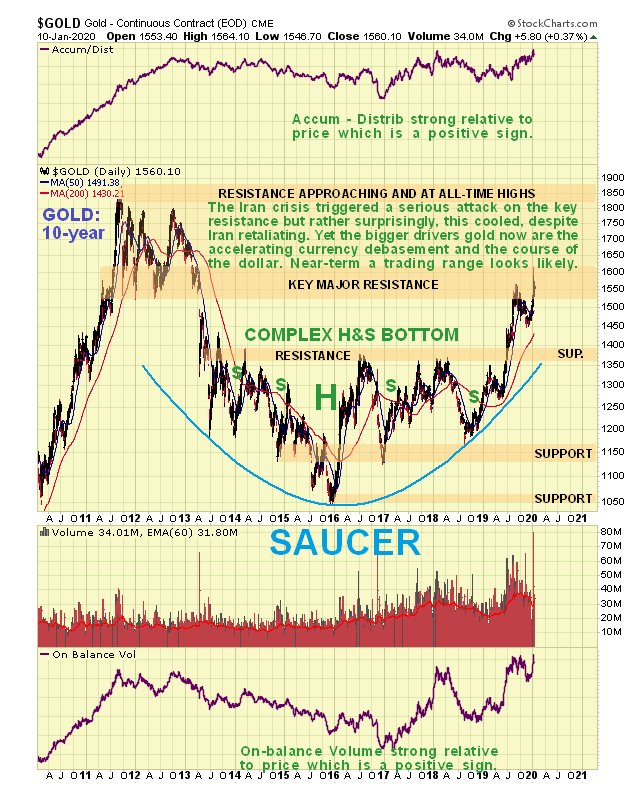
On the 10-year chart we see that gold is now a bullmarket, even against the dollar, and is currently challenging the heavy resistance arising from the 2011 – 2013 top area. The second attack on this resistance in the space of few months got further because of the Iran crisis, and if this cools any more short-term, it will probably lead to gold settling into a trading range before it mounts a more successful attack on this resistance. A point to note here is that while the resistance up to the 2011 highs in the $1800 area looks like a major obstacle, it’s not such a big deal as many think, given the rate at which the dollar is now being debased.


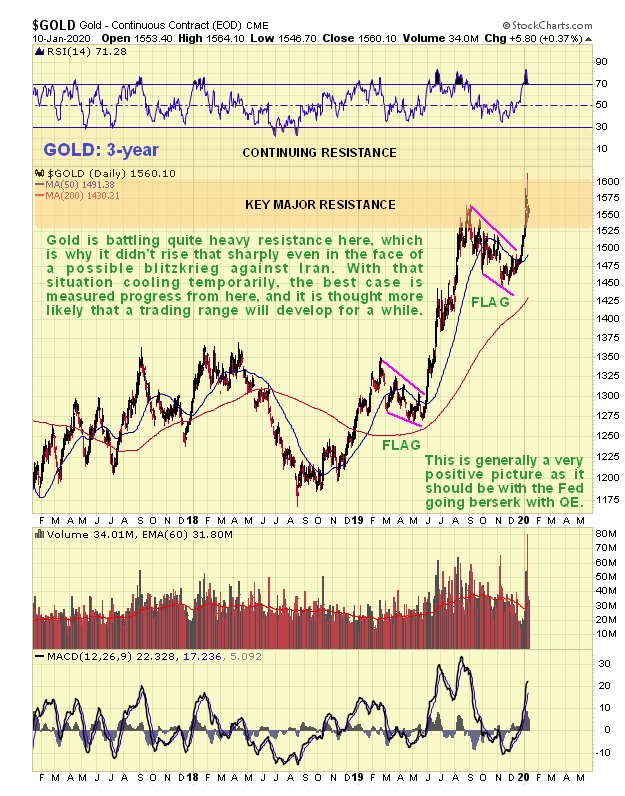
This week it’s worth also taking a quick look at a 3-year chart for added perspective. This chart shows us that since the bullmarket started in mid-Summer, we have seen 3 sharp runups punctuated by 2 bull Flags. While the 2nd of these Flags targets the $1800 area, we have to factor in that gold now has much more overhanging supply to contend with than on the 1st runup, and this, coupled with quite extreme COT readings, inclines to the view that this will need to be worked off. Hence the interpretation that it will probably need to consolidate for a while before it makes significant further progress, although it obviously won’t if the US starts a serious bombing campaign against Iran. The Fed’s increasingly manic money printing will eventually drive it higher, of course


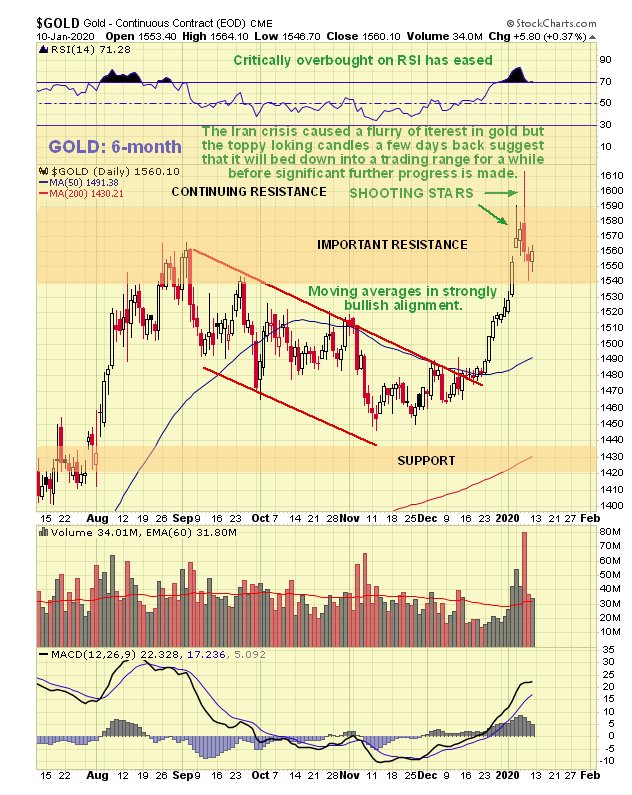
On the 6-month chart we can see the interesting price action around the Iran crisis over the past week or so. A bearish “shooting star” appeared on the chart last Monday, which we took as a sign that gold was forming a short-term top, but then overnight on the 7th to the 8th it surged briefly above $1610 when Iran lobbed missiles at US bases in Iraq, which had many concluding, not unnaturally that this would trigger a major Israel – US bombing campaign. When it became apparent that there were no casualties from the Iranian attack and no US counter strike, tensions quickly cooled and gold lost ground fast the next day, putting in a big high-volume reversal candle, approximating to another “shooting star”. Normally such action is followed by a retreat at least for a while, and some stocks, like silver stock Coeur Mining (CDE), that we ditched a while ago, got clobbered. This is why gold is expected to settle down into a trading range for a while before mounting another attack on the resistance.


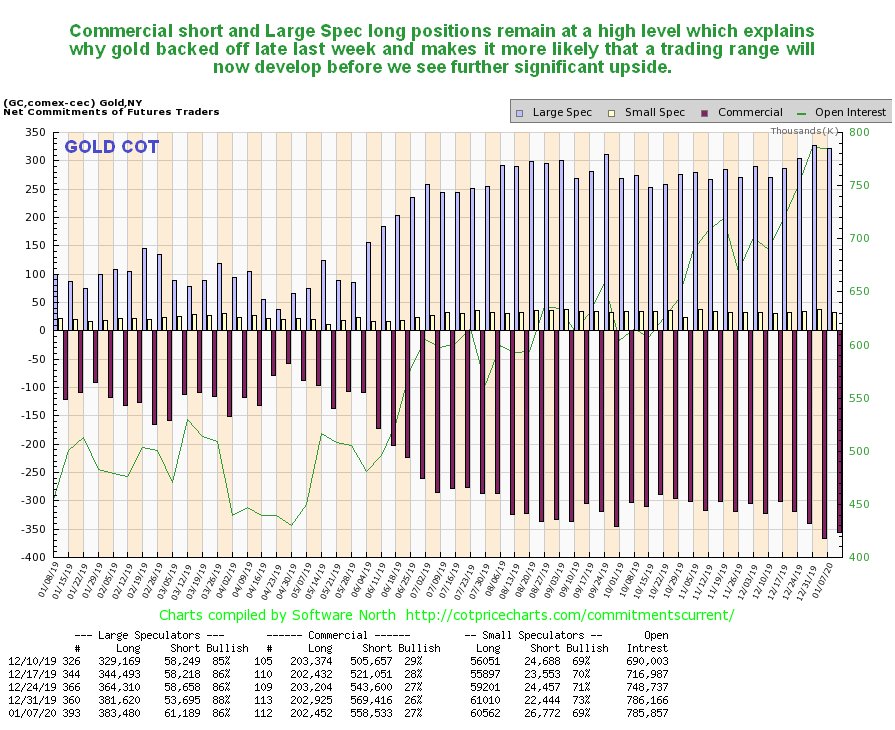
Another factor suggesting that gold will consolidate / react back for a while is the latest COT, which shows still very high Commercial short and Large Spec long positions…

Click on chart to popup a larger, clearer version.


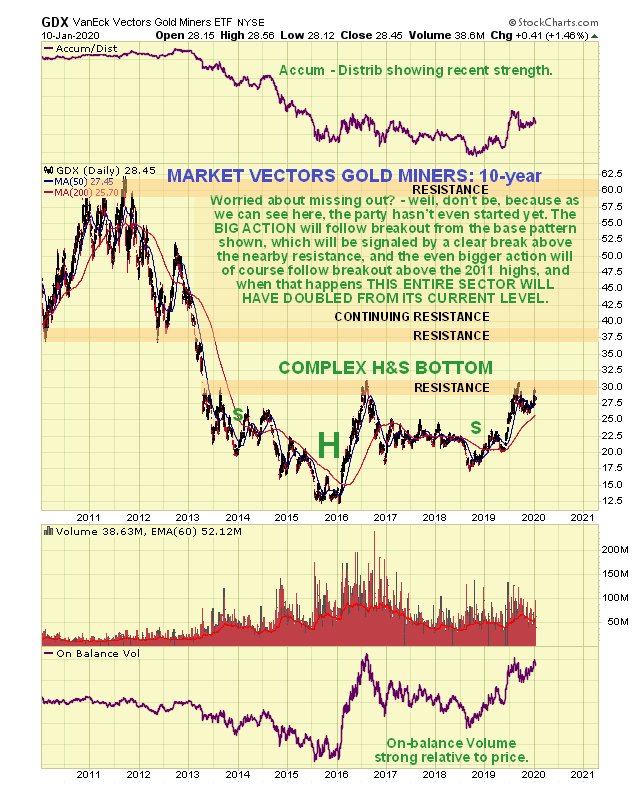
What about Precious Metals stocks? The latest 10-year chart for GDX shows that we still have most everything to look forward to, for despite the rally from the middle of last year, it still hasn’t broken out of the giant complex Head-and-Shoulders bottom that has been formed since way back early in 2013. A breakout above the nearby resistance should lead to a rapid ascent to the next resistance level at the underside of a large top pattern, and thereafter it will have to work its way through continuing resistance up to its highs. The strength of the volume indicators in the recent past are a sign that it “means business”.


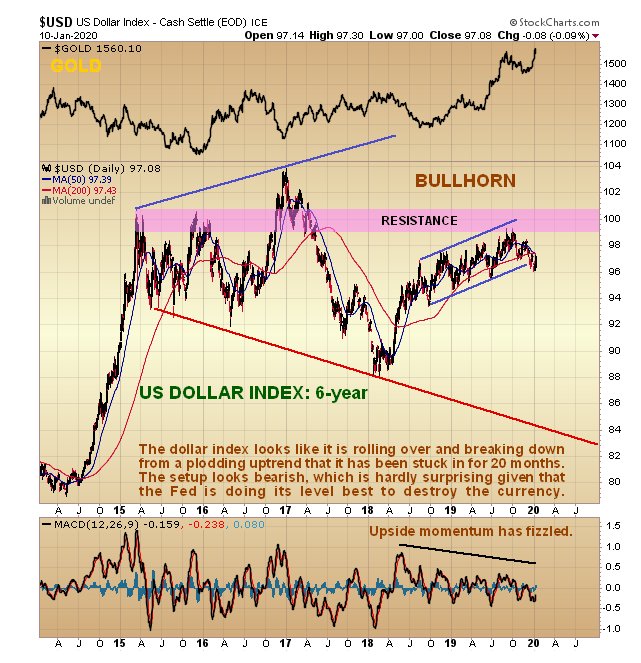
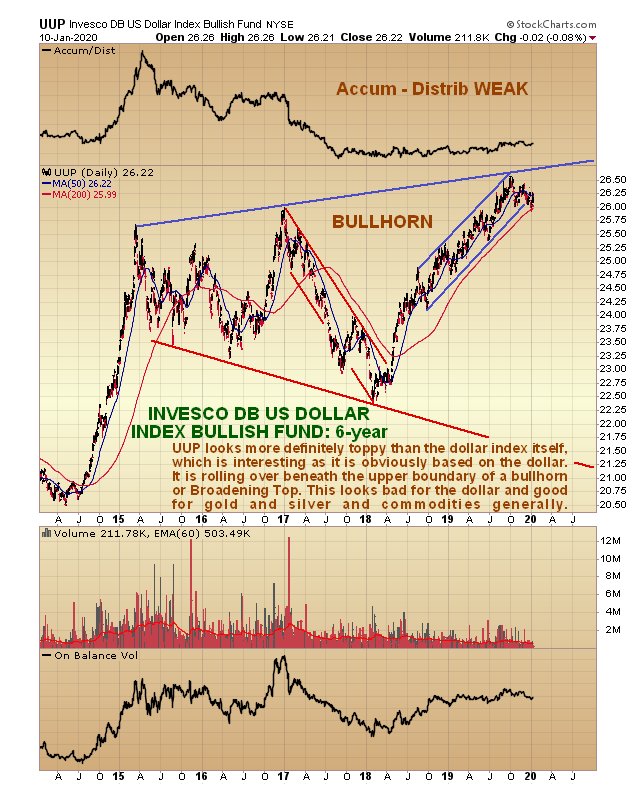
Now we turn our attention to the dollar, which is looking increasingly frail as we can see on the latest 6-year chart for the dollar index. It is rolling over beneath resistance and appears to be breaking down from the 16-month gentle uptrend shown. This is of course the main reason that gold, shown at the top of this chart, has been breaking higher again. If it fails to hold up here it could be targeting the lower boundary of the bullhorn pattern, which would involve a heavy drop from the current level that would “light a fire” under the Precious Metals, and many other commodities, notably copper.


A chart that really gives the game away and calls time on the dollar is the 6-year chart for dollar proxy UUP. As we can see, unlike the dollar index itself, this has risen up to the upper boundary of its giant bullhorn pattern and appears to be on the point of breaking down. Its Accumulation line has been very weak. This chart suggests that the dollar could be in for a very rough ride before long, which is hardly surprising considering the lengths to which the Federal Reserve is going to destroy it. While other countries and trading blocs, most notably the EU, are making a valiant attempt to destroy their own currencies, they will be hard put to keep up with the Fed.


And now, for the benefit of anyone who still doubts that gold is in a bullmarket, I have pleasure in presenting the following 6-year chart for gold against the Japanese Yen…


Still think gold might be in bearmarket? – no – didn’t think you would.

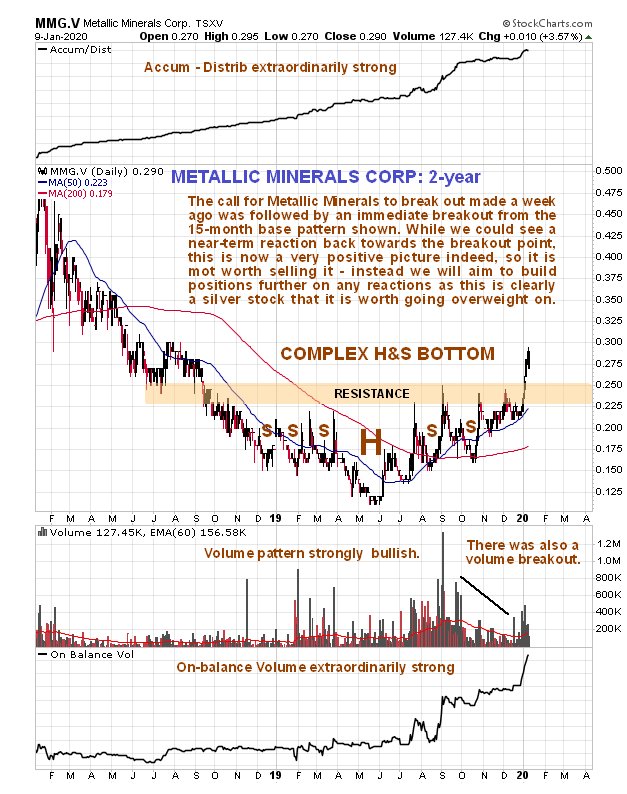
It’s always good to end on a positive note, and we’ll do so by looking at a stock with a supremely bullish setup, which we happened to buy right before it broke out about a week ago, and it may well have been our buying that triggered the breakout…


Although you can never be 100% sure of anything with these smaller issues, I am sure that you will agree with me that this chart is not suggestive of a sector that is going anywhere but up.

Conclusion: although last week’s reversal candle and the current rather extreme COT structure mean that gold may react back more near-term, the overall picture is strongly bullish, which is hardly surprising as the fiat money system is fast approaching its nemesis, with the line of least resistance leading to hyperinflation. Our general approach therefore is not to sell PM sector investments, except on a case by case basis where they become critically overbought, but instead buy or add to positions on dips.

https://www.clivemaund.com/gmu.php?art_id=68&date=2020-01-12

Spyder #Cannabis $SPDR.ca – DOPE! New cannabis compound 30 TIMES more potent than #THC found in one #marijuana variety $CGC $ACB $APH $CRON.ca $OGI.ca

Posted by AGORACOM-JC at 1:00 PM on Monday, January 13th, 2020

SPONSOR: Spyder Cannabis (SPDR:TSXV) An established chain of high-end vape stores. Aggressive expansion plan is already in place that will focus on Canadian retail and US Hemp derived kiosks in high traffic areas. Click here for more info.

DOPE! New cannabis compound 30 TIMES more potent than THC found in one marijuana variety

  • Compound is one of two newfound cannabinoids that have been discovered in the Cannabis plant glands of the sativa L species.

By: Charlotte Edwards

A NEW cannabis compound has been discovered and it may be 30 times more potent than THC.

Scientists aren’t yet sure whether the compound causes a high or has medical benefits so they’ve been conducting tests to try and figure this out.

The compound is one of two newfound cannabinoids that have been discovered in the Cannabis plant glands of the sativa L species.

Cannabinoids is the collective term for the group of diverse chemical compounds that act on the cannabinoid receptors of the brain.

THC is just one of these cannabinoids and it’s currently considered to be the principal psychoactive component of cannabis.

THC, or tetrahydrocannabinol, plugs into brain receptors and can alter our ability to co-ordinate movements, reason, record memories and perceive things like time and pleasure.

  THC in cannabis is what can give smokers a high feelingCredit: Getty – Contributor

It’s thought that cannabis contains over 140 similar chemicals that can interact with receptors all over the body.

However, THC is currently the only one we know can result in a high spaced out feeling.

Of the two new cannabinoids discovered, one looks similar to the compound CBD, which isn’t psychoactive.

The other appears similar to THC but may even produce stronger mind-bending effects.

This THC lookalike is called tetrahydrocannabiphorol (THCP).

Recent research suggests that it interacts with the same brain receptor as THC but has slight differences in its chain of atoms.

The slight difference in shape of THCP means it can technically fit more snugly into its preferred brain receptor than THC.

A test showed that the compound can actually bind 30 times more reliably than THC.

When given to lab mice, the THCP made them behave as if they were on THC with slower movements and decreased reactions to pain.

The mice reached this state with a much lower does than would have been required with THC meaning the new compound is stronger.

However, this lab experiment still doesn’t mean that the same effect would happen in humans.

THCP doesn’t appear to be present in large amounts in cannabis plants but even if it was, increased psychoactive properties would still not be guaranteed.

Source: https://www.thesun.co.uk/tech/10725348/new-cannabis-compound-more-potent-weed/

Young people buying into ‘fake news’- SPONSOR: Datametrex AI Limited $DM.ca

Posted by AGORACOM-JC at 12:15 PM on Monday, January 13th, 2020

SPONSOR: Datametrex AI Limited (TSX-V: DM) A revenue generating small cap A.I. company that NATO and Canadian Defence are using to fight fake news & social media threats. The company announced three $1M contacts in Q3-2019. Click here for more info.

Young people buying into ‘fake news’

By: Esther Cepeda

My son, his best friend, Dave, and I were chatting over a pizza last weekend when Dave dropped some (absolutely incorrect) information: The elderly are forgoing nursing homes for cruise ships, because the room and board cost about the same, plus you get entertainment and travel.

Again — this is not a real phenomenon. A few healthy, affluent retirees have spent a few years this way, but the cruise ship industry is in no way prepared to offer extended care for masses of frail elderly adults with complex medical conditions like chronic diseases and memory problems.

When I prompted our friend for more information, he said it made sense because cruise ships have onboard medical staff and morgues.

When further pressed — in my son’s spirited retelling, I’m described as in a rabid state, pouncing on his innocent pal — Dave said he’d definitely read a news story about it.

Errrrr, actually, he knew he’d definitely seen it somewhere.

Mmmmmm, maybe on Reddit?

My son acts like at this point I had fire blazing from my eyes. I’ll only admit that I was alarmed.

Dave is a bright young man who attended an excellent high school, just completed his first semester of college at a fancy East Coast university and is generally thoughtful and curious about the world.

But he passed on information he believed was fact because he saw “something” on a news aggregation and message board site, or “somewhere.”

This gem about retiring to a cruise ship has been around since at least 2003, according to the fact-checking site Snopes.com. It started out as a bit of viral e-lore, and there have been a few examples of real-life extended stays. But today, otherwise legitimate news-gathering organizations post branded, sponsored-content “articles” (these are paid advertisements) about how to plan such a retirement alongside real news that was reported by professional journalists and vetted by editors.

I’m not picking on a kid I care about — he’s just an example of how incredibly ill-equipped our young people are to navigate an internet that’s loaded with fake news, junk science and other “information” designed to fool them and everyone else.

In a 2018-19 national assessment of U.S. high school students, researchers at Stanford University found that two-thirds couldn’t tell the difference between reported news stories and advertisements set off by the words “sponsored content” on the homepage of a popular news website.

And more than one-third of middle school students in the U.S. said that they “rarely” or “never” learned how to judge the reliability of sources, according to an analysis of 2018 survey data from The Nation’s Report Card by the Reboot Foundation, a Paris-based nonprofit that promotes the teaching of evidence-based reasoning skills.

But while it’s clear that students must be taught media-literacy skills, there are few teachers prepared to do so. Many people, not just teachers, tend to believe that their maturity and life experience make them naturally media literate — i.e., not likely to fall for fake news or bad sources of information.

A small 2011 study of the effectiveness of teacher training on media literacy found that eight hours of in-person training — quite a lot by the common standards of professional development — prepared someone to pass on such skills. And the study also showed that, like anyone else, teachers need systematic, direct instruction on media literacy, and it must be practiced over time.

The bright side is that it’s not rocket science. For the average reader, becoming media literate is generally simple: Find some good sources, check bold assertions and be aware of any fine print, like the basis of an author’s expertise or their potential financial interest.

Now, no one can check every fact in every bit of text they read, but a high level of skepticism is warranted in this time of newsy advertisements and active disinformation campaigns. If it sounds too good (or too bad) to be true, it probably is. And since those types of pieces of “information” are what drive clicks, views and “reader engagement,” they’ve proliferated.

Do yourself and your loved ones a service, bookmark a few key fact-checking websites and use them regularly (an extensive list can be found in the appendix of the Reboot Foundation’s report, at reboot-foundation.org/fighting-fake-news).

Source: https://www.uticaod.com/opinion/20200113/young-people-buying-into-fake-news

How #Edtech Can Fill Gaps In Quality Education In Tier-3 Cities? SPONSOR: BetterU Education Corp. $BTRU.ca $ARCL $CPLA $BPI $FC.ca

Posted by AGORACOM-JC at 12:00 PM on Monday, January 13th, 2020
SPONSOR:  BetterU Education Corp. aims to provide access to quality education from around the world. The company plans to bridge the prevailing gap in the education and job industry and enhance the lives of its prospective learners by developing an integrated ecosystem. Click here for more information.

How Edtech Can Fill Gaps In Quality Education In Tier-3 Cities?

  • A majority of young Indians, mostly belonging to Tier-3 cities, are deprived of quality education due to a lack of accessible educational infrastructure and resources
  • Lack of committed educators, unavailability of textbooks, and a dearth of credible coaching centres are among a few of the problems underserved Indian students have to deal with on a daily basis

by Divya Jain

While there is some merit to heeding to your relatives’ advice of devoting more time to “self-study”, for a large number of students across the country it happens to be a singular necessity and unfortunate compulsion. A majority of young Indians, mostly belonging to Tier-3 cities, are deprived of quality education due to a lack of accessible educational infrastructure and resources. Lack of committed educators, unavailability of textbooks, and a dearth of credible coaching centres are among a few of the problems underserved Indian students have to deal with on a daily basis.

The absence of quality coaching centres in Tier-3 cities in India is a major reason why multiple youths preparing for competitive examinations like UPSC choose to migrate to Tier-1 and Tier-2 cities like Delhi, Nagpur, Pune, Jaipur, Mumbai, etc., in search of better learning prospects. However, in addition to offering greater learning resources and opportunities, and an improved lifestyle overall, the expense of living in metro cities also puts a magnified financial burden on to these students. Besides paying the fees of the institution they join, the basic outlay of living (surviving) alone, which includes food and rent of hostels or PGs, becomes unmanageable for all youths not belonging to the affluent class. Add to this the expenditure of buying study material and conveyance, at the minimum. All of these expenses together end up causing the students to go in debt.

The financial aspect aside, the teaching institutes and coaching centres accommodate a very large number of students and the curriculum in these places is designed to cater to those who are either fast-learners or those who have already had a solid academic foundation. A lack of individual teaching approach aimed at educating each and every student based on their individual learning abilities and sensibilities causes a majority of at-risk students to struggle with mental health problems. Impersonal teaching methods of the teachers bent upon drilling information into the students’ heads further adding to the tribulations of most of these students who find it difficult to cope with the vast and fast-paced nature of the syllabi.

It is here that EdTech presents itself as an impeccable solution to all of these problems.

By providing a personalised learning experience to students, EdTech platforms enhance their methods of self-study and self-assessment. Since most of the EdTech platforms contain video lectures on the same topic by multiple instructors, a student can choose to watch the video most agreeable to his or her style. The most empowering featuring of video lectures when compared with in-classroom lectures is that a video can be played, re-played, and paused as many times and as per the convenience of the viewer. Thus, a student can watch and re-watch a lecture until they get the wholesome understanding of a concept, something that is not possible in real-time.

This feature comes as a boon for shy students who find it difficult to engage in discussions during a lecture. For most youths, the overcrowded classroom atmosphere can feel overpowering and even suffocating. E-learning tools can solve their problem by letting them hold one-on-one interactions with senior students or subject experts over the cyberspace. In this way, online engagement gives a student a way out of the limiting classroom environment to get their queries resolved on their own terms as suits them best without them having to follow rigid classroom schedules that run on express speed.  

In addition to these facilities, most EdTech platforms also leverage advanced AI-based technologies like data analytics, machine learning and deep learning to map a student’s learning journey and produce recommendations accordingly. The e-learning platforms can then use this data to come up with personalised test series and assessment plans for individual students. Simultaneously, students can also utilize this facility to make self-assessments and accordingly work upon their weaknesses and strengths with respect to each subject.

EdTech is already disrupting the education sector the world over on the back of its exceptional accessibility, efficiency, and unparalleled convenience. For students belonging to a developing country like India, EdTech comes as both a welcome extension and a much-needed alternative to the existing educational infrastructure.

Source: http://www.businessworld.in/article/How-Edtech-Can-Fill-Gaps-In-Quality-Education-In-Tier-3-Cities-/11-01-2020-181523/

ThreeD Capital $IDK.ca – This Chart Shows the #Crypto Market Is On Verge of Bull Phase $HIVE.ca $BLOC.ca $CODE.ca

Posted by AGORACOM-JC at 10:45 AM on Monday, January 13th, 2020

SPONSOR: ThreeD Capital Inc. (IDK:CSE) Led by legendary financier, Sheldon Inwentash, ThreeD is a Canadian-based venture capital firm that only invests in best of breed small-cap companies which are both defensible and mass scalable. More than just lip service, Inwentash has financed many of Canada’s biggest small-cap exits. Click Here For More Information.

This Chart Shows the Crypto Market Is On Verge of Bull Phase

  • Murad Mahmudov, CIO of Bitcoin fund Adaptive Capital, recently drew attention to a textbook chart that applies to any financial market — including crypto — which shows what trends in an asset’s volume, open interest, and price means for said asset’s future trajectory.

By: Nick Chong

Over the past seven months, analysts have been wondering when the crypto market is going to revert back to a bull phase.

You see, when Bitcoin started rallying from $4,000 higher in early-2019, analysts and investors thought this was the start of a new bullish paradigm for the cryptocurrency market. But, they were sorely mistaken when BTC fell by 50% from its peak and crypto assets like Ethereum and XRP actually posted losses on the year.

Per a simple tried-and-true chart depicting trends in markets, the crypto market is likely on the verge of entering its next bull phase. Here’s more on why.

Crypto Market About to Enter Bull Phase

Murad Mahmudov, CIO of Bitcoin fund Adaptive Capital, recently drew attention to a textbook chart that applies to any financial market — including crypto — which shows what trends in an asset’s volume, open interest, and price means for said asset’s future trajectory.

The chart shows that the most optimistic scenario for any market is if the asset’s price, volume, and open interest for its futures market rise in tandem, suggesting “strength,” “bullish” price action, and an overall trend of prices rising.

And what do you know! Bitcoin, over the past few weeks, has seen its price, volume, and open interest increase all at once, showing effectively no signs of weakness. This suggests the crypto market is on the verge of entering into a serious uptrend for the first time in months. Related Reading: Key Bitcoin Sell Signal Flashes: Here’s Why Analysts Aren’t Concerned

Bitcoin Bull Case Builds

And it isn’t only this that has crypto traders optimistic.10 BTC & 20,000 Free Spins for every player in mBitcasino’s Winter Cryptoland Adventure!

Notably, there is a bull case for Bitcoin rapidly building. For instance, the Lucid Stop and Reversal indicator, which “signals a stop and an entry in the opposite direction” when it reverses, just printed an extremely bullish signal. The indicator shows that Bitcoin just saw its first buy signal since March 2019, with the trend as defined by the SAR turning bullish.

On the fundamental side of things, Bitcoin is now four or so months out from its next block reward reduction, known as a “halving” or “halvening.” Prominent investors, including former Goldman Sachs employees, have suggested that this event will affect BTC’s supply-demand dynamics in a way that will push prices dramatically higher.

With Bitcoin leading the rest of the crypto market, any strong increases in the price of BTC should lead to similar price action for altcoins. Of course, there is a growing expectation that altcoins will underperform the market leader, but a strong uptrend in BTC shouldn’t do anything but help the rest of the crypto market higher.

Source: https://www.newsbtc.com/2020/01/13/these-three-trends-suggest-crypto-market-bullish/

Clean-car push puts #palladium in the fast lane SPONSOR: New Age Metals $NAM.ca $WG.ca $XTM.ca $WM.ca $PDL.ca $GLEN

Posted by AGORACOM-JC at 9:50 PM on Sunday, January 12th, 2020

SPONSOR: New Age Metals Inc. The company owns one of North America’s largest primary platinum group metals deposit in Sudbury, Canada. Updated NI 43-101 Mineral Resource Estimate 2,867,000 PdEq Measured and Indicated Ounces, with an additional 1,059,000 PdEq Ounces Inferred. Learn More.

Clean-car push puts palladium in the fast lane

By: Henry Sanderson and Neil Hume

  • For more than a year the silvery-white metal has been more precious than gold Palladium is used in the production of hybrid cars such as Toyota’s Prius, and high prices for the precious metal have led to a rise in the theft of catalytic converters Palladium is used in the production of hybrid cars such as Toyota’s Prius, and high prices for the precious metal have led to a rise in the theft of catalytic converters

Global efforts to clean up petrol cars are driving a record surge in the precious metal palladium, which has rallied 8 per cent in the first week of the year to more than $2,000 a troy ounce. The precious metal, which is now more valuable than gold, has benefited from continued demand from the car industry for palladium-based catalytic converters on exhausts, along with limited supply from mines in South Africa and Russia. Prices for palladium have surged by about 25 per cent since the beginning of October. Demand for car catalysts has increased over the past few years due to stricter emissions regulations in Europe and plans in China to toughen standards.

Catalytic converters take toxic emissions and produce carbon dioxide, water and nitrogen. Palladium-based catalysts are also used in hybrid cars, which are powered by engines as well as batteries. Often hybrid cars require greater quantities of the metal, since the engine is required at short notice and does not have time to warm up the catalyst. The high price of palladium has led to a rise in the theft of catalytic converters from cars.

Last year Toyota, which makes the Prius hybrid car, warned drivers in the UK to take precautions to prevent theft by buying a “Catloc” device, which is fitted around the converter to stop it being cut out. Analysts at Bank of America Merrill Lynch expect carmakers to struggle to source more palladium in the next few years as global supply is set to remain flat, at about 10.2m ounces. Last year it rose to 10.5m ounces, from 9.9m.

The price of the silvery-white metal overtook gold in December 2018 for the second time, having been more expensive for a period spanning 2000 and 2001. On Thursday palladium was trading at $2108 a troy ounce, to gold’s $1546. Palladium’s price rise has boosted the stocks of South African miners, sending the FTSE/JSE African Platinum Mining index up 4 per cent already this year. Michael Widmer, an analyst at BofA, said big carmakers had begun to consider substituting palladium for other materials, such as platinum or rhodium, which are in the same family of precious metals. Rhodium prices are up by about 15 per cent this year, outpacing palladium.

“Carmakers are starting to look into substitution. It will probably take another 12 to 18 months,” Mr Widmer said. “You can get hold of palladium but you have to pay up for it.” He added: “The quicker they do the substitution, or re-jig the catalysts, the quicker the rally will ultimately come to an end.”

Source: https://www.ft.com/content/9101bd22-3233-11ea-a329-0bcf87a328f2

ThreeD Capital $IDK.ca – The race to integrate #crypto into global banking is real $HIVE.ca $BLOC.ca $CODE.ca

Posted by AGORACOM-JC at 9:30 PM on Sunday, January 12th, 2020

SPONSOR: ThreeD Capital Inc. (IDK:CSE) Led by legendary financier, Sheldon Inwentash, ThreeD is a Canadian-based venture capital firm that only invests in best of breed small-cap companies which are both defensible and mass scalable. More than just lip service, Inwentash has financed many of Canada’s biggest small-cap exits. Click Here For More Information.

The race to integrate crypto into global banking is real

Public sector projects are driving greater interest to adopt fiat-backed cryptocurrencies by central and regional banks.

Metamorworks / Getty Images

  • Central banks in Asia and Europe are in the final stages of launching digital currencies for future payment systems and cross-border transactions, according to a new report from accounting firm KPMG.

And governments around the world see the launch of these blockchain-based central bank digital currencies (CBDC) as something that could one day give them a competitive advantage in global trade.

“In 2020, we at KPMG expect to assist regional and central banks in the development of well-defined technology frameworks that can anchor private-sector initiatives,” Arun Ghosh, U.S. Blockchain Leader at KPMG, said in a blog post.

Among other banking entitires, the International Monetary Fund (IMF) has shown support for fiat-backed cryptocurrencies, saying they can reduce the reliance on government-issued money, “and unlike bank transfers, crypto asset transactions can be cleared and settled quickly without an intermediary,” Dong He, deputy director of the IMF’s Monetary and Capital Markets Department, wrote in a post for the IMF.

“The advantages are especially apparent in cross-border payments, which are costly, cumbersome, and opaque,” He said. “New services using distributed ledger technology and crypto assets have slashed the time it takes for cross-border payments to reach their destination from days to seconds by bypassing correspondent banking networks.”

In a blog post, the IMF said today’s fiat currencies are in flux “and innovation will transform the landscape of banking and money.”

Other countries are already looking to innovate in ways that given them an advantage.

China is reportedly close to releasing a national cryptocurrency that, because of greater efficiencies, could challenge the U.S. dollar as the de facto currency for international trade. Other smaller countries such as Sweden are planning their own state-sponsored cryptocurrency. (Sweden’s would be called the e-Krona.)

And the Bank of England has been researching cryptocurrency since 2015. Even though theit does not currently plan to issue a cryptocurrency linked to Pound sterling, it has published extensive research on the monetary policy and financial system implications of issuing CDBCs.

“If a central bank issued a digital currency, then everyone (including businesses, households and financial institutions other than banks) could store value and make payments in electronic central bank money,” the Bank of England said in a research paper. “While this may seem like a small change, it could have wide-ranging implications for monetary policy and financial stability.”

Regardless of any movement by central banks, Ghosh said, fiat-based ‘stablecoins’ are already being issued by the private sector to support enhanced value exchange and settlement within organizations and across banking networks.

For example, JP Morgan Chase announced last year it had developed what was seen at the time as the first cryptocurrency backed by a major bank – a move that could legitimize blockchain as a vehicle for fiat cryptocurrencies. JPM Coin, as the bank calls its new digital money, is considered fiat currency because it’s backed by U.S. dollars in accounts designated at JPMorgan Chase N.A.

Each JPM Coin is equal in value to one U.S. dollar.

Wells Fargo has also announced it will pilot its own cryptocurrency to enable near real-time money movement and cut out settlement middlemen, thus reducing fees.

And the Reserve Bank of Australia has conducted pilots with Ethereum-based cryptocurrency in the hope it could be used by third parties for cross-border payments. So far, the bank has not found a significant case for its use in light of Australia’s relatively stable banking system, according to a Senate inquiry into the matter last month.

“The upside for businesses and consumers will trickle down through adoption…, Ghosh said, nothing that the new systems could result in “near instantaneous value settlement” with “enhanced cash flow realization and/or liquidity of certain positions.” 

Blockchain is being piloted by financial services institutions in five primary areas: for clearance and settlement, trade finance, cross-border payments, insurance claims processing and anti-money laundering (AML) and know your customer (KYC) efforts.

For cross-border transactions, stablecoin could cut settlement times from days to minutes by eliminating the need for private organizations such as Depository Trust and Clearance Corp. (DTCC) in the U.S. and Euroclear in the European Union. The DTCC and Euroclear now handle securities settlements.

Blockchain-based systems could also streamline the process of buying and selling  stocks and bonds. Those transactions can take up to three days, with longer delays  of up to 10 days not uncommon, according to Bruce Fenton, founder and managing director of Atlantic Financial and a board member of the Bitcoin Foundation.

“The challenge with securities now is you need a trusted third party to say what’s true,” Fenton said. “It’s not your broker. It’s not Merrill Lynch or Fidelity and it’s not the issuer either; Apple has no clue who their shareholders are, either. The function is performed by these large centralized groups because the brokers don’t necessarily trust each other; they’re dealing with their competitors.”

The problem with relying on central settlement organizations is that transactions can get bottlenecked through the use of a single ledger, such as VisaNet or SWIFT, he said. With blockchain, trust becomes moot since digital tokens representing securities or money are inextricably linked to the funds or securities – and transfers can be done  in hours, Fenton said.

Given those efficiencies, more than a half dozen universities are already working on developing a payment system to rival today’s conventional clearance and settlement networks.

In addition to the scaled adoption of cryptoassets now being driven by the public sector, Ghosh sees four other crypto trends likely to emerge over the next year or so as business executives apply “an unprecedented level of innovation … driving new revenue models by leveraging blockchain and tokenized assets.”

Those trends include:

  • Advances in cryptoasset custody technology, or how digital assets are owned, stored, secured, transferred and accessed in a decentralized environment.
  • A shift from private-permissioned to interoperable blockchain implementations. With many private blockchain implementations coming to fruition, the next step is interoperability.
  • More success when scaling the technology with a converged artificial intelligence (AI) framework – and better results when initializing their AI investments.
  • The convergence of AI, blockchain and the Internet of Things (IoT) to help manage climate change.

About that last prediction, Ghosh said: “Decentralized, transparent data models enabled by blockchain, which houses data transferred via IoT that is measurable using advanced analytic techniques, can be visible to a vast number of countries and regulators that are jointly monitoring and reporting on carbon emissions, rising sea levels and the remediation of toxic waste, among other applications.

Source: https://www.computerworld.com/article/3512650/the-race-to-integrate-crypto-into-global-banking-is-real.html

Tartisan #Nickel $TN.ca – Nickel demand set to rise in 2020 along with growth in electric vehicle #EV sales $ROX.ca $FF.ca $EDG.ca $AGL.ca $ANZ.ca

Posted by AGORACOM-JC at 9:00 PM on Sunday, January 12th, 2020

SPONSOR: Tartisan Nickel (TN:CSE)  Kenbridge Property has a measured and indicated resource of 7.14 million tonnes at 0.62% nickel, 0.33% copper. Tartisan also has interests in Peru, including a 20 percent equity stake in Eloro Resources and 2 percent NSR in their La Victoria property. Click her for more information

Tc logo in black

Nickel demand set to rise in 2020 along with growth in electric vehicle sales

  • China is stepping up its efforts to be a leader in autonomous cars and is aiming for a quarter of all cars sold in the country to be new-energy vehicles by 2025
  • 500,000 tonnes of refined nickel will be used annually in lithium-ion batteries for EVs by 2025  

Nickel’s demand outlook looks bright, especially from the electric vehicle sector of the automotive industry

Fastmarkets analysts estimate that 500,000 tonnes of refined nickel will be used annually in lithium-ion batteries for EVs by 2025, up from 100,000 tonnes in 2018.

That growth in nickel consumption comes even before the wider adoption of the nickel-cobalt-manganese (NCM) 8-1-1 battery, which the market expects to become an industry staple.

A recent report drafted by the Ministry of Industry & Information Technology indicates that China will step up its efforts to be a leader in autonomous cars and is aiming for a quarter of all cars sold in the country to be new-energy vehicles [NEVs] by 2025.

NEVs include electric cars, hybrids and fuel-cell vehicles.

Ban on nickel exports in Indonesia

In response to the risk of increasing demand tightening local supply, the Indonesian government announced a ban on the export of raw nickel ores, bringing the ban forward from 2022 to January 2020.

According to GlobalData director of analysis David Kurtz, this ban is intended to produce value-added nickel products, stimulate domestic processing of ore, and make the country a hub for electric vehicle production.

Indonesia is the largest global producer of nickel and a major supplier of the metal to China’s stainless steel industry. In anticipation of the ban, Chinese producers are building up nickel inventories.

This has increased the price of nickel significantly, with prices at the end of September 2019 reaching more than $16,000 per tonne, an increase of more than 60% from January.

When the ban was announced, nickel prices increased by 8.8% to reach a peak of $18,620 per tonne, the highest price since 2014.

Source: https://www.proactiveinvestors.com.au/companies/news/910319/nickel-demand-set-to-rise-in-2020-along-with-growth-in-electric-vehicle-sales-910319.html