Agoracom Blog Home

Author Archive

Red Light Holland $TRIP.ca Announces Closing of $9.77 Million Bought Deal Financing $SHRM.ca $RVV.ca $MMED $PLNT.ca $HALO.ca $PSYC.ca

Posted by AGORACOM at 10:48 AM on Thursday, January 28th, 2021

Red Light Holland Corp. (CSE: TRIP) (“Red Light Holland” or the “Company“), an Ontario-based corporation engaged in the production, growth and sale of a premium brand of magic truffles to the legal, recreational market within the Netherlands, is pleased to announce that it has closed its previously announced bought deal short form prospectus offering, including the exercise in full of the underwriter’s over-allotment option (the “Offering“). In connection with the Offering, the Company issued 38,334,100 units of the Company (the “Units“) at a price of $0.255 per Unit, for aggregate gross proceeds of $9,775,195. The Offering was conducted by Eight Capital (the “Underwriter“).

“To have Red Light Holland – The People’s Company, being supported by ‘The Suits’ alongside our new and existing shareholders truly strengthens our Psychedelic Movement and our growth. We are so grateful for all of our loyal supporters and we now have over $20 million[1] of capital available which is incredible! This funding will enable us to fully execute on our business plan and the Red Light Holland team will continue working hard towards our goal of developing a leading brand in this emerging industry. Our mission continues – providing legal and responsible adult access now,” said Todd Shapiro, CEO and Director of Red Light Holland.

Read More:https://agoracom.com/ir/RedLightHolland/forums/discussion/topics/754141-red-light-holland-announces-closing-of-9-77-million-bought-deal-financing/messages/2300783#message

XPhyto Therapeutics $XPHY.ca $XPYHF Announces Drug Formulation Strategy and 2021 Milestones Innovation to Impact $NGM.ca $SONA.ca $HBP.ca $MIR.ca $IPA.ca

Posted by AGORACOM at 7:56 AM on Thursday, January 28th, 2021
  • Construction of commercial drug manufacturing facility in Germany
  • Four clinical studies in neurological indications in 2021
  • Development of oral biosensor and contract development & manufacturing
  • Psychedelic transdermal and sublingual drug formulation development

VANCOUVER, BC / ACCESSWIRE / January 28, 2021 / XPhyto Therapeutics Corp. (CSE:XPHY)(OTCQB:XPHYF)(FSE:4XT) (“XPhyto” or the “Company“) is pleased to announce its drug formulation and delivery business strategy and milestones for 2021. As a bioscience accelerator at the leading-edge of the life science industry, XPhyto targets growth through commercialization of its product pipeline and focused investment in impact driven innovation with the potential for meaningful value creation.

Further to XPhyto’s press release dated January 18, 2021, the Company’s core milestones for this year include the commercialization of infectious disease diagnostics, the clinical validation of transdermal and sublingual drug formulations and continued investment in psychedelic medicine.

Regarding XPhyto’s drug formulation business, the Company is pleased to set out the strategy and milestones for 2021 of its wholly owned German subsidiary, Vektor Pharma TF GmbH (“Vektor”). Vektor will position itself for commercial manufacturing, pipeline development and drug formulations for critical mental health conditions.

“2021 is expected to be a transformative year for Vektor. We will be building on significant momentum from 2020 as we advance our drug formulation, contract development, and psychedelic business,” said Prof. Dr. Thomas Beckert, managing director of Vektor Pharma TF GmbH. “The addition of scalable in-house manufacturing capability creates the potential for significant growth across virtually all of our development and commercialization programs.”

Vektor is a German narcotics manufacturer, developer, and researcher located in the district of Biberach, Baden-Württemberg, Germany. For over a decade, the company and its team have been leaders in the design, testing and manufacture of thin film drug formulations, particularly transdermal patches and sub-lingual (oral) strips for the delivery of active pharmaceutical ingredients (“API”) for the treatment of pain and neurological conditions.

Read More: https://agoracom.com/ir/XphytoTherapeutics/forums/discussion/topics/754109-xphyto-announces-drug-formulation-strategy-and-2021-milestones-innovation-to-impact/messages/2300734#message

Mountain Valley MD $MVMD.ca Proceeding With COVID-19 Clearance Trial in Level 4 Biohazard Facility $CTLT $MRNA $NVAX

Posted by AGORACOM at 9:11 AM on Wednesday, January 27th, 2021
  • Lab study to demonstrate solubility technology applied to the Ivermectin drug can be applied as a broad therapeutic to immediately treat COVID-19
  • Commencing lab trial in late February 2021, with results anticipated in April 2021.

Mountain Valley MD Holdings Inc. (the “Company” or “MVMD“) (CSE: MVMD) (FRA: 20MP) is pleased to announce it has executed an agreement to conduct its Bio Safety Level 4 (“BSL-4”) lab study of COVID-19 viral clearance in transgenic mice designed to prove the superiority of the Company’s solubilized Ivermectin technology versus commercially available oral form in speed and efficacy of viral clearance.  The agreement was signed January 26, 2021.

“This is a very significant project for MVMD and it will clearly demonstrate how our solubility technology applied to the Ivermectin drug can be applied as a broad therapeutic to immediately treat COVID-19, as well as its role in stopping the deadly spread of future pandemics that are certain to follow,” stated Dennis Hancock, President and CEO of Mountain Valley MD.  “Quicksol™ allows us to imagine a world’s first as an injectable Ivermectin format for emergency front line usage as well as a rapid dissolve tablet that is administered for prevention like vitamin C around the world.”

There are less than thirty BSL-4 facilities in the world capable of performing this study and it is not unusual for projects to take up to three years to schedule.  The Company was able to demonstrate the significance of its patented solubilized Ivermectin technology through its presentation of the superior pharmacokinetic data documented from two previously completed pre-clinical trials and was granted approval by the BSL-4 facility to commence this trial in late February 2021.  The study results are anticipated in April 2021.

This study will be the first of its kind ever conducted with human grade solubilized Ivermectin anywhere in the world and its design was led by the Company’s key scientific advisor, Dr. John Clements.  Dr. Clements is Emeritus Professor of Microbiology and Immunology at Tulane University School of Medicine and has over 35 years of experience in vaccine, immunology and infectious diseases research and development, with a distinguished scientific career focused on developing and evaluating vaccines for a wide range of infectious diseases globally.

Read More: https://agoracom.com/ir/MountainValleyMD/forums/discussion/topics/754031-mountain-valley-md-proceeding-with-covid-19-clearance-trial-in-level-4-biohazard-facility/messages/2300498#message

Tajiri Resources $TAJ.ca Updates K4-K5 Prospect, Reo Project, Burkina Faso $GXS.ca $EDV.ca $IMG.ca $GUY.ca

Posted by AGORACOM at 3:00 PM on Tuesday, January 26th, 2021
http://blog.agoracom.com/wp-content/uploads/2020/08/Tajiri-Blog-2.png
  • Commenced an infill auger drilling program at K4-K5 to tighten the historic auger sampling pattern
  • Grid decreased to 200 x 50m in order to better constrain individual gold zones

Tajiri Resources Corp. (the “Company”) (TSXV: TAJ) is pleased to provide an update to the ongoing exploration work at the Company’s 100% owned Reo Gold Property, Burkina Faso, West Africa.

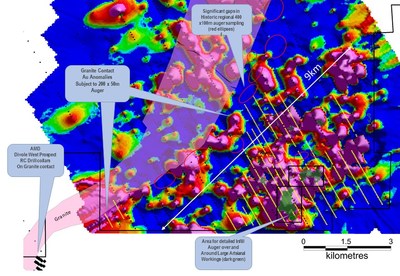
After completing initial drilling of the Morley prospect where numerous hits were reported including hole MRTC0022’s 11 metres of  8.6 g/t Au including 3 metres at 30.9 g/t Au from 20 metres; the Company began power auger drilling and trenching at the K4-K5 Prospect, where historic wide spaced drill lines returned significant mineralised intersections including: 18m @ 2.5g/t;  44m @ 1.5g/t, 12m @ 5.0g/t, 4m @ 16.2g/t;  36m @ 1.3g/t, 16m @ 2.7g/t, 20m @ 1.7g/t 18m @ 2.5g/t,  20m @ 1.7g/t, 18m @ 1.6g/t 12m @ 4.1g/t.  RC: 13m @ 2.2g/t, 6m @ 2.7g/t, 16m @ 2.0g/t, 10m @ 3.5g/t; 3m @ 11.5g/t, 2m @ 16.8g/t, over an area of 3 x 4km from within a larger area of gold in saprolite anomalism of approximately 9 x 4 km (see Figure 1).

Due to the massive scale of the prospect and previous wide spaced sampling programmes Tajiri commenced an infill auger drilling program at K4-K5 to tighten the historic auger sampling pattern from a 400 x 100m grid to a 200 x 50m grid in order to better constrain individual gold zones within the broad gold in saprolite anomaly and to also investigate individual larger areas of artisanal workings on 100 x 25m to 25 x 25m grid spacings on an east west grid. Because artisanal workings have largely not been sampled or drilled to date and because they potentially overly areas of significant gold mineralisation it was considered important to sample these areas and determine orientation of mineralisation prior to commencing more expensive RC / diamond drilling programs. 

Read More: https://agoracom.com/ir/TajiriResources/forums/discussion/topics/753983-tajiri-resorces-updates-k4-k5-prospect-reo-project-burkina-faso/messages/2300356#message

Marble Financial $MRBL.ca $MRBLF Announces Technology Partnership with VoPay International $MOS.ca $MOGO.ca $CTZ.ca

Posted by AGORACOM at 2:23 PM on Tuesday, January 26th, 2021

  • VoPay’s payment tech platform gives Marble‘s customers an ideal solution to easily and rapidly incorporate EFT payments
  • simplifies the process for providing a single API integration to banking providers
  • Allows Marble to improve customer retention and reduce costs

Vancouver, B.C.  January 26, 2021 – Marble Financial Inc. (CSE:MRBL ); ( OTC:MRBLF); (CNSX:MRBL.CN); (“Marble” or the “Company”) a financial technology company that empowers Canadians’ toward a positive financial future, is pleased to announce that it has partnered with VoPay International Inc. (“VoPay”) to deliver its open banking payments solution with coverage for thousands of new and existing MyMarble customers.

This partnership which enables new payment options to consumers, simplifies the process for providing a single API integration to banking providers.

VoPay’s payment technology platform now provides Marble an ideal solution to enable customers to easily and rapidly incorporate electronic funds transfer (“EFT”) payments into their financial technology solutions. With VoPay’s integrated single payment API, Marble is able to improve customer retention and reduce costs, which results in rapidly expanded and streamlined payment options for MyMarble users and for the Company to expand its top-end revenue channels.

According to Payments Canada Methods and Trends (CPMT) 2020 report, EFT payments have increased and represent 61% of the total remote payments volume. This presents a growing preferred payment method by Canadians, something Marble has not been able to offer in the past.

“We are very excited about partnering with VoPay to add a new payment option to Marble’s growing customer base and revenue streams,” said Karim Nanji, CEO Marble. “VoPay is a leader in payment processing with a world-class product when it comes to speed and efficiency. Our partnership with VoPay will position Marble to support rapid growth, and together we can further support Canadians that do not have access to credit as a payment option.”

Read more: https://agoracom.com/ir/MarbleFinancial/forums/discussion/topics/753981-marble-financial-announces-technology-partnership-with-vopay-international/messages/2300351#message

AGORACOM Small Cap 60: Affinity Metals $AFF.ca Drilling Carscallen Extension Adjoining Melkior/Kirkland Lake Gold JV $OSK.ca $RKR.ca $MKR.ca $SII.ca $KL.ca

Posted by AGORACOM at 12:13 PM on Tuesday, January 26th, 2021
https://s3.amazonaws.com/s3.agoracom.com/public/companies/logos/564657/hub/Affinity_Metals_Corp_Logo.png

Affinity Metals (AFF : TSXV) discusses rational for recently acquired Carscallen Extension property. The Carscallen Extension immediately adjoins the Melkior/Kirkland Lake Gold JV Carscallen Project located approximately 6 km west of Pan American Silver’s West Timmins Mine and approximately 25 KM West of Timmins.

Affinity announced the commencement of drilling on trend with the projected extension of the Shenkman-ZamZam gold system which has been the focus of the Melkior/Kirkland Lake Gold JV.

St. Georges Eco $SX.ca $SXOOF Altair Provides Update on Lithium Extraction and Battery Recycling Technology $NNX.ca $OM.ca $ICM.ca $ATAO

Posted by AGORACOM at 8:43 AM on Tuesday, January 26th, 2021
  • The two companies to jointly develop a patentable industrial scale process for Electric Vehicle Lithium-ion battery (LIB) recycling.

Altair International Corp. (the “Company” or “Altair”) (OTC: ATAO) is pleased to provide an update on its previously announced partnership with St-Georges Eco-Mining Corp. (CSE: SX) (OTC: SXOOF) (FSE: 85G1) (“St-Georges”) a Canadian public company engaged in the development of new Lithium extraction technologies.

On December 1, 2020 the two companies entered into a Binding agreement that would allow Altair access to St-Georges’ patent-pending Lithium processing technology for Altair’s Nevada based Stonewall project and most importantly bring together the two companies to jointly develop a patentable industrial scale process for Electric Vehicle Lithium-ion battery (LIB) recycling.

As the global Electric Vehicle (EV) market heats up over the coming decade, the demand for battery metals is expected to outpace current production. Even with increased energy density and charge cycles, Lithium based batteries for EVs, laptops, phones and other mobile devices will create cumulative waste challenges both in the environmental footprint of production and end-of-life LIB disposal.

Altair and St-Georges recognize that new optimized recycling technologies will offer valuable solutions to both a waste-management and battery metal supply. Selective, economic and responsible metal extraction of spent LIBs will be an integral part of the multi-billion dollar green economy and play a crucial part in the future of EV dominance of the automotive sector.

Read More: https://agoracom.com/ir/St-GeorgesEco-Mining/forums/discussion/topics/753930-st-georges-eco-altair-provides-update-on-lithium-extraction-and-battery-recycling-technology/messages/2300224#message

AGORACOM Welcomes Marble Financial $MRBL.ca $MRBLF A #Fintech Company Utilizing the Power of #AI, Data Science and Machine Learning to Help Canadians Build and Manage Credit to Improve Their Financial Wellness $MOS.ca $MOGO.ca $CTZ.ca

Posted by AGORACOM at 11:33 AM on Monday, January 25th, 2021

(MRBL: CSE) (MRBLF: OTC) (2V0: FSE)

www.mymarble.ca

Why Marble?

  • Revolutionary fintech company utilizing the power of AI technology to help Canadians manage debt, build credit and budget.
  • Provides users:
    • Expert budgeting insights
    • Consumer proposal-exiting guidance
    • AI-powered credit boosting intelligence
    • Financial literacy
  • Robust B2B and B2C offerings.
  • A trusted fintech provider for businesses to maximize their customers credit profile.
  • Servicing a previously underserved subprime Canadian market
  • Strong Insiders/Management Ownership: 35%

What Exactly Does Marble Do?

‘MyMarble’ offers very specific, personalized financial recommendations about when to pay bills, how to prioritize debt management decisions and offers, tracks and highlights personalized data insights.

‘MyMarble’ through its suite of products offers innovative structured credit product solutions:

Screen-Shot-2021-01-22-at-3-44-59-PM

The MyMarble Ecosystem obtains leads from a number of tier one Canadian fintech companies which are funnelled accordingly due to a detailed needs analysis.

Screen-Shot-2021-01-22-at-3-46-41-PM

Did You Know 12 Million Canadians Are Below A Prime Credit Rating? credit

According to MNP (October 2020) , almost 50% of Canadians are living paycheque to paycheque and based on statistics from Statistics Canada’s Household Sector Credit Market Summary (June 2020), for every dollar of disposable income, Canadians carry a $1.77 of debt.  Additionally, Canada is a credit-based economy and financial literacy and good credit score is a major determinant to Financial Inclusion.

What Problem Does That Pose To Individuals Seeking Credit?

Screen-Shot-2021-01-22-at-3-41-01-PM

The Marble Model

marbl4

How Marble Acquires and Converts Customers

marble4

Screen-Shot-2021-01-22-at-2-06-21-PM

Benefits of This World Class, AI-Powered Platform:

  • Expert AI Insights and Real-Time Recommendations
    • Comprehensive monthly reporting provides expert insights to guide the best course of action to manage budgets effectively
  • Data-Driven Credit Score Improvement Solution
    • Marble’s Score-Up AI insights suggests steps which will make the biggest positive impact on credit scores using industry-leading monitoring and point deduction technology. 
    • In a recent Personal Finance Sentiments Survey conducted by Marble, approximately 70% of the respondents commented that they were embarrassed by their credit score, proving a willingness to improve their credit to an acceptable mainstream banking level.
    • In addition, a similar number of the same respondents identified having over $100 in disposable income each month, confirming Score-Up Lite’s affordability to people that could benefit from it. 
  • Specialist Curated Financial Literacy Platform
    • The company’s Maestro Financial Literacy education platform has been designed and developed by personal finance experts with decades of experience within the industry. 
  • Sustainable Consumer Proposal Exit solution
    • One of the only companies in Canada that specializes in exiting consumer proposals in a safe, fair and ethical way.

What Does The Company’s Financial Future Look Like?

marbl-6
marbl6
marble20

Hub On AGORACOM / Corporate Profile

Fabled $FCO.ca Drills 68.6 Meters of Continuous Silver Mineralization in Initial Drilling at Santa Maria $GGD.ca $EDR.ca $RDU.ca $KTN.ca $GMBXF $EDR.ca

Posted by AGORACOM at 7:54 AM on Monday, January 25th, 2021
Fabled Silver Gold Corp. (@Fabled_FCO) | Twitter

Fabled Silver Gold Corp. (TSXV: FCO) (FSE: 7NQ) (“Fabled” or the “Company”) is pleased to announce initial diamond drill results from the on-going 8,000-meter drill program on the Santa Maria Property in Parral, Mexico, with assays from two additional holes pending.

Peter J. Hawley, CEO and President remarks, “We are quite excited with the results from our first drill hole drilled to the east of the last underground workings and the exceptional wide intersection of 68.6 meters of continuous silver in shallow oxide mineralization. Within this broad zone, 20 meters reported 0.35 g/t Au, 106.29 g/t Ag and within this 20 meters, widths grading 146 g/t Ag, 238 g/t Ag and 151 g/t Ag were intersected (See Table 1 for widths and values). Drill holes SM20-02 and SM20-03 are drilled on the same section with the target being the sulphide intercept of this broad hydrothermal breccia zone, which is typically higher in grade due to metal values not being leached out by surface ground waters as commonly seen in oxide zones. The data being obtained from this fence of drill holes will not only target adding silver ounces to the overall resource but also allow us to interpret and model the behavior of this robust mineralized system for future drill hole success.”

Table 1: Drill Hole Intercepts

Hole NoFrom
(meters)
To (meters)Width
(meters)
g/t Aug/t Ag
SM20-00178.40147.0068.600.1843.98
Including112.00132.0020.000.35106.29
Including115.00117.002.000.27146.00
Including123.00124.601.601.09238.00
Including124.60126.501.900.34151.00

Drill hole SM20-01 was drilled at an angle of -45 degrees for a total hole depth of 164 meters. Drill hole SM20-02 was drilled at -65 degrees from the same station for a total hole depth and drill hole SM20-03 was stationed 75 meters behind the drill station for holes 01-02 and drilled at an angle of -75 degrees for a total depth of 375 meters.

Read More: https://agoracom.com/ir/FabledSilverGold/forums/discussion/topics/753841-fabled-drills-68-6-meters-of-continuous-silver-mineralization-in-initial-drilling-at-santa-maria/messages/2300012#message

Psychedelics: From Woodstock to Walgreens SPONSOR: Red Light Holland $TRIP.ca $SHRM.ca $RVV.ca $MMED $PLNT.ca $HALO.ca $PSYC.ca

Posted by AGORACOM at 9:34 AM on Friday, January 22nd, 2021

SPONSOR: Red Light Holland (CSE: TRIP) is engaged in the production, growth and sale (through existing Smart Shops operators and an advanced e-commerce platform) of a premium brand of magic truffles to the legal, recreational market within the Netherlands. Learn more.

https://i.ibb.co/ZdKv64V/Red-Light-Holland-Square.jpg

Psychedelic experience is only a glimpse of genuine mystical insight, but a glimpse which can be matured and deepened by the various ways of meditation in which drugs are no longer necessary or useful. If you get the message, hang up the phone. For psychedelic drugs are simply instruments, like microscopes, telescopes, and telephones. The biologist does not sit with eye permanently glued to the microscope, he goes away and works on what he has seen…

– Alan Watts

What Are Psychedelics?

The term “psychedelic” was first used by psychiatrist Humphry Osmond in 1956 during a discussion with Aldous Huxley, the famous author and pioneer of psychedelic consumption. The etymology of the word is derived from the Greek meaning “mind-manifesting”. A more robust definition of the word was developed by Grinspoon and Bakalar:

“a psychedelic drug is one which, without causing physical addiction, craving, major physiological disturbances, delirium, disorientation, or amnesia, more or less reliably produces thought, mood, and perceptual changes otherwise rarely experienced except in dreams, contemplative and religious exaltation, flashes of vivid involuntary memory and acute psychoses.”

– Grinspoon and Bakalar (Multidisciplinary Association for Psychedelic Studies)

Notice that this definition excludes drugs like heroin, methamphetamine, cocaine, and THC, all of which can produce psychedelic effects but are not their primary effect.

2D structural formula and 3D models of Lysergic acid diethylamide (LSD), also known as “acid”.

History of Psychedelic Use

Sacred Ceremonies

Psychedelics have been regarded as sacred plants since the dawn of civilization, with the earliest known consumption of plants containing psychedelic agents occurring in 5000 BCE in Southeastern Algeria . The use of psychedelics to conjure religious experiences was universal amongst humans, as evidenced by depictions of sacred ceremonies centered on these mind-expanding substances found across the globe. The plants which contain these psychedelic agents include mushrooms, cacti, morning glory vines, and even some grasses. Psychedelic ceremonies have shaped many religions and are still used throughout the world.

Examples include:

  • “Soma” found in Sanskrit texts of Hinduism, derived from the Amanita Muscaria mushroom (~1500 BCE)
  • Ergot fungus used in the Eleusinian Mystery Rites of the Greeks, the active ingredient being similar to the synthetic LSD (“acid”) (~2000 BCE)
  • Psylocibin mushrooms used in the town of Villar del Humo in Spain (earliest evidence of psychedelic mushrooms in Europe, ~4000 BCE)
  • Peyote used by the Native Americans, found in the Shumla Caves (~3700 BCE)
  • Modern day usage of psychedelics includes Ayahuasca in the Amazon (active ingredient is DMT), Peyote by the Native Americans in the Western USA, and the global use of Psilocybin.

Earliest depiction of a psychedelic ceremony. Frescos of mushroom-holding shamans were found in caves on the Tassili plateau of Southeastern Algeria.

Sacred ceremonies were (and are) typically led by a Shaman, a respected elder who plays the role of doctor, therapist, and priest. Along with administration of the psychedelic plants, the Shaman provides “non-drug” support to his “patient” to amplify and control the mind-enhancing effects of the compounds. The dreamlike states that the Shaman can invoke brings forth the shadows that lurk in the subconscious into the spotlight of the conscious mind. I have heard frequent users of psychedelics in religious contexts explain the experience as 10 years’ worth of therapy crammed into 4 hours… you are forced to confront your demons and reconcile your angst. These ceremonies are vital to preserving ancient cultures and should be respected as integral parts of religion Now that’s heavy stuff. Let’s move on to something a bit lighter…

Discovery of LSD

Lysergic Acid Diethylamide (“LSD”) is probably the most widely recognized psychedelic substance. Colloquially known as “acid”, LSD was first synthesized in 1938 at the Sandoz research labs in Basel, Switzerland, by Dr. Albert Hofmann. While conducting research into ergot, a fungus that grows on grains and was the cause of mass poisoning in the middle ages (“Saint Anthony’s fire”), Dr. Hofmann realized that the panic-inducing effects of ergot consumption could be attributed to specific alkaloids present in the plant. The basic group of the primary alkaloid (ergobasine) was discovered to be lysergic acid, and several modifications were made to produce LSD as it is known today (“LSD-25”, the 25th modification to the lysergic acid base). The first clinical applications of LSD-25 were tested on controlling blood flow loss in the uterus, but it was quickly determined that the synthetic LSD was not as effective as the naturally occurring substance in ergot. Dr. Hofmann abandoned his research until he accidentally ingested a microscopic amount of LSD via absorption through his skin. According to popular lore, Dr. Hofmann then took an interesting bike ride home during which he was not completely sure whether he was actually moving… upon examination by a medical doctor it was determined that Dr. Hofmann experiencing the full-blown effects of the first acid trip, characterized by pleasant visual distortions and intensely bright colors.

Psychedelics in the Clinic

The LSD-25 compound was tested by other researchers at Sandoz for its potential medicinal benefits. Marketed under the name “Delysid”, Sandoz’s LSD-25 was approved for psychiatric use and disseminated to psychiatrists worldwide. Predicated on the large-scale manufacturing capabilities in the post-WWII 20th century, and the emerging field of psychiatric research and treatment, interest in LSD-25 skyrocketed and hit the public consciousnesses.

Much of the early research into using LSD-25 as a catalyst for inducing changes in brain states was conducted by the CIA in a project known as “MK-ULTRA”. The CIA speculated that LSD could be used as a “truth drug” to assist in interrogations, and in 1953 the agency was given formal approval to test a wide range of psychedelic substances as possible interrogation “enhancers” (LSD being the prime candidate). The MK-ULTRA story is fascinating, fraught with corruption and mysterious deaths, yet the conclusion of the program was uninspiring: LSD-25 is a very poor truth serum and the effects were largely unpredictable between recipients.

Meanwhile, psychiatrists were developing two new models of psychedelic-assisted therapy: psychedelic therapy and psycholytic therapy. Both paradigms involved the use of LSD in treatment, but psycholytic therapy was much a softer approach that involves substantially lesser amounts of LSD than psychedelic therapy, with the goal of bringing about gradual change in personality over the course of months. The underlying theory of psycholytic therapy was based upon Freudian psychoanalysis, with the idea that LSD served as a priming agent by inhibiting the portion of the brain responsible for the ego-identity. LSD was intended to break down the ego and render the patient in a naïve, infantile state of feeling, often associated with derealization and mystic experience. Contrastingly, psychedelic therapy was an attempt to wage total war on the brain using extremely high amounts of LSD dosed in a single session, with the goal of bringing about a symptomatic change in behavior (poorly defined). The original theory was that extremely high doses of LSD could shock alcoholic patients and scare them away from drinking permanently by giving them a horrific experience… but to the clinicians’ surprise the patients experienced very pleasant effects. Emphasis of psychedelic therapy switched to creating a mystical type of experience to re-wire the patient’s brain in a way directed by the psychiatrist or therapist.

“Many people remember vaguely that LSD and other psychedelic drugs were once used experimentally in psychiatry, but few realize how much and how long they were used. This was nota quickly rejected and forgotten fad. Between 1950 and the mid-1960s there were more than a thousand clinical papers discussing 40,000 patients, several dozen books, and six international conferences on psychedelic drug therapy. It aroused the interest of many psychiatrists who were in no sense cultural rebels or especially radical in their attitudes.”

– Grinspoon and Bakalar, 1979

Turn On, Tune in, Drop Out

The popularization of LSD as a substrate for religious-like experiences in American culture was pioneered by the likes of Aldous Huxley, Gerald Heard, Timothy Leary, and Richard Alpert (later to be known as Ram Daas). Their collective work chronicled the psychonaut’s journey through time and space, blending Eastern philosophy with Western ideas. These writings were often written like a piece of “gonzo journalism”, the focus being on the author’s own lived experience. These first-person essays galvanized the public’s curiosity into using psychedelics to unlock latent mental bandwidth and enhance the sensory world.

“The really important facts were that spatial relationships had ceased to matter very much and that my mind was perceiving the world in terms of other than spatial categories. At ordinary times the eye concerns itself with such problems as where? — how far? — how situated in relation to what? In the mescaline experience the implied questions to which the eye responds are of another order. Place and distance cease to be of much interest. The mind does its perceiving in terms of intensity of existence, profundity of significance, relationships within a pattern.”

– Aldous Huxley, The Doors of Perception

Back in the day, loose regulations around controlled substances allowed psychiatrists to give people LSD with little oversight in questionable environments, leading to a surge in recreational use beginning in 1962. FDA regulations began to tighten around the same time, and the introduction of the Kefauver-Harris Drug Amendment forced Sandoz to limit the supply of LSD to physicians at the National Institute of Mental Health. Not long after, the 1965 Drug Control Amendment forced Sandoz to stop supplying LSD entirely (it was later deemed a Schedule 1 substance by the FDA, 1970). As the counter-culture movement of the ‘60s took off, illegal manufacturing and distribution of LSD kept the hippy generation satisfied.

State-of-the-Science

Mechanism of Action

The discovery of the psychedelic effects of LSD in 1943 was followed by the detection of serotonin in the brains of mammals (1953) . Comparison of the serotonin structure with that of LSD revealed a striking similarity in the scaffold of the molecules. Could LSD’s mechanism of action in the brain rely on the same neuronal pathways that serotonin signals through? It was quickly discovered that the mind-altering effects of LSD were attributed to an interference in serotonin signaling in the brain (via competition for the 5-HT2 serotonin receptors) . This discovery catapulted research into the role of serotonin in neuroscience.

Similarity in the serotonin and LSD molecular structures

Clinical Research

The clinical research on psychedelics of the 20th century ended with the Controlled Substances Act of 1970. Fortunately, the recent resurgence in interest into the medical benefits of psychedelics has led to the renewal of experimentation in humans.  On March 5, 2019, esketamine (Janssen Pharmaceuticals, a J&J company) became the first approved psychedelic drug by the FDA for the treatment of psychiatric disorders. Delivered as a nasal spray, esketamine is a pure ketamine substance that has been indicated for major depressive disorder (MDD). Some patients report immediate relief from suicidal ideations, although the greater scientific community is not completely convinced due to the small effect size.

Clinicians are also promoting the use of psilocybin (the active ingredient in magic mushrooms) as a means to increase the patient’s receptivity to talk therapy. A quick search of the ClinicalTrials.gov site reveals that there are 53 ongoing human clinical studies on the therapeutic effects of psilocybin for a wide range of diseases, from anorexia to cancer. Leading the way, a Phase 2 study (N=80; NCT03866174) investigating the antidepressive effects of a single-dose psilocybin administration is currently being conducted by the Usona Institute and was recently granted “Breakthrough Designation”. Compass Pathways is also currently conducting a Phase 2b study (N=216, NCT03775200) for the use of psilocybin in treating treatment resistant depression.

The Multidisciplinary Association for Psychedelics Studies (MAPS) recently raised $30M for its MDMA study in the treatment of PTSD . Granted the “Breakthrough Therapy” designation by the FDA. MAPS’ Phase 3 clinical trials are ongoing with expected approval as early as 2022 . There are 90 other trials currently being conducted on MDMA.

SOURCE: https://www.medicalgold.ca/posts/psychedelics-from-woodstock-to-walgreens